r/Futurism • u/JustAvi2000 • 23m ago
Personal advice needed re: use of AI
reddit.com
1
Upvotes
r/Futurism • u/MathematicianFit3229 • 1h ago
r/Futurism • u/brainshades • 6h ago
The announcement that AI has solved the Riemann Hypothesis, reminds me of the Charles Stross story - Antibodies…
r/Futurism • u/ZHAEVORYX_OFFICIAL • 9h ago
— On the Possibility of Complete Liberation through the Maximization of Pleasure and the Replacement of the Self
When human beings reach the limit of the material abundance that capital can provide, what ultimate value do they pursue next? Perhaps it is no longer wealth, but the total maximization of pleasure that can be experienced mentally, emotionally, and physically, along with an absolute freedom from every duty and constraint of reality.
If we could reach an artificial paradise designed to satisfy our desires and senses perfectly, an environment beyond the limits of everyday reality, could we call it utopia?
Here, we can posit a hypothesis.
Suppose there exists a replica that perfectly reproduces not only a person's physical appearance but also their speech habits, patterns of behavior, social relationships, and even their personality. This replica takes the original person's place in the real world, fulfilling their social roles and daily obligations. If the imitation were so precise that no one around them noticed the substitution, the original person could keep their identity in reality while being completely freed from the responsibilities that come with it.
Meanwhile, the original person would remain in a utopia built solely for themselves, continuously enjoying sensory satisfaction and mental peace, free from the limits of time and the pressures of society. Their life in reality would be sustained by the replica, while their consciousness would focus entirely on rest, pleasure, and self-fulfillment.
But is this truly the ultimate form of happiness that human beings can attain?
In an environment where pleasure is constantly supplied, can people still recognize pleasure as pleasure? In a life from which pain and lack, labor and responsibility have been completely removed, can satisfaction keep its original meaning? And has a person who hands their social existence over to a replica gained true freedom, or given up their agency over their own life?
Furthermore, we must ask whether happiness can be reduced to the sum of positive sensations, or whether it lies in the very process of choosing, taking responsibility, and creating meaning within an imperfect reality.
In the end, the fundamental question this thought experiment raises is not simply whether utopia can be realized.
If human beings could escape every responsibility of reality and enjoy infinite pleasure and perfect rest, would that be the ultimate fulfillment of existence, or a departure from the very essence of life that makes us human?
r/Futurism • u/Fighter_41 • 19h ago
With a perfect understanding of science would it be possible to do anything? -time travel, teleportation, levitation, invisibility, etc.
Is there anything we could never achieve even with a perfect and complete understanding of science?
r/Futurism • u/Fresh-Ladder-1604 • 22h ago
Do you think this can ever be possible : The advent of AI could make self-sustainable microsocieties not merely an ideological aspiration, but a technically and economically feasible form of human organisation.
1. AI could reduce the minimum viable size of a society
Historically, a community needed a sufficiently large population to sustain specialised functions:
This created a dependency on large cities, centralised institutions and complex supply chains.
AI could fundamentally alter this constraint.
A small community of perhaps 100–1,000 people could potentially operate with the technical and administrative capabilities that previously required much larger organisations.
AI could function as a distributed layer of intelligence, coordinating resources, optimising production, managing infrastructure and making specialised knowledge accessible to everyone.
The minimum viable society could become much smaller.
Imagine a microsociety with:
Such a community would not necessarily need to produce everything internally. Instead, it could achieve a high degree of resilience by producing essential goods locally while exchanging specialised products and knowledge with other communities.
The objective would not be complete isolation, but reduced dependence on fragile external systems.
Today, much of our economic and social organisation exists because coordinating people and resources is expensive.
We build corporations, bureaucracies and centralised systems partly because they are effective ways of managing complexity.
AI could lower the cost of coordination.
A community might use AI systems to:
This raises an intriguing possibility: societies might become less dependent on hierarchical institutions and more capable of operating through distributed, cooperative structures.
However, AI itself would need to be governed democratically. Otherwise, a supposedly autonomous microsociety could simply become dependent on whoever owns its models, servers, energy infrastructure or data.
These points are AI generated - though i wanted to know if this was a possibility?
r/Futurism • u/songkranw • 1d ago
For me is instant teleportation.
r/Futurism • u/ZHAEVORYX_OFFICIAL • 1d ago
If information processing, decryption, and data recovery technologies were to reach their theoretical limits, would it ultimately be possible to recover and access all private records created by an individual during their lifetime, as well as any information they deliberately concealed, regardless of the passage of time, data deletion, encryption, or access restrictions?
No. Even with technology at its theoretical limits, much of it couldn't be recovered. That's because the limits come from physics and mathematics, not from engineering.
What stays out of reach
Information-theoretically secure encryption: A properly used one-time pad can't be broken with unlimited computing power, because the ciphertext fits every possible message equally well.
Strong symmetric encryption (e.g., AES-256): Just counting through 2²⁵⁶ keys would take more energy than the Sun puts out over its lifetime, according to Landauer's limit. Quantum computers only cut the effective strength to about 128 bits, which is still out of reach.
Truly destroyed data: Physics may say information is never destroyed at the most basic level. But once a record is turned into heat and scattered into the environment, getting it back is impossible in any practical sense.
Things never written down: Thoughts, private intentions and unrecorded conversations don't exist as data, so there is nothing to recover.
What really is vulnerable
Today's public-key encryption (RSA, ECC): A large quantum computer would break it. Data captured now can be decrypted later ("harvest now, decrypt later").
"Deleted" data that wasn't really destroyed: Leftover traces on drives, backups, cloud copies, logs and other people's devices.
Metadata and inference: Who you contacted, when, and from where can reveal a lot without decrypting anything.
Human weak points: Weak passwords, leaked keys, coercion and insiders.
Total recall of a person's life is ruled out by physics. In practice, though, most secrets come out through copies, metadata and people, not through broken encryption. The weak points are how data is handled, not the math.
r/Futurism • u/ImaginaryExternal338 • 1d ago
r/Futurism • u/Memetic1 • 1d ago

r/Futurism • u/Legal-Concern-1187 • 1d ago
r/Futurism • u/Rparty_b • 1d ago
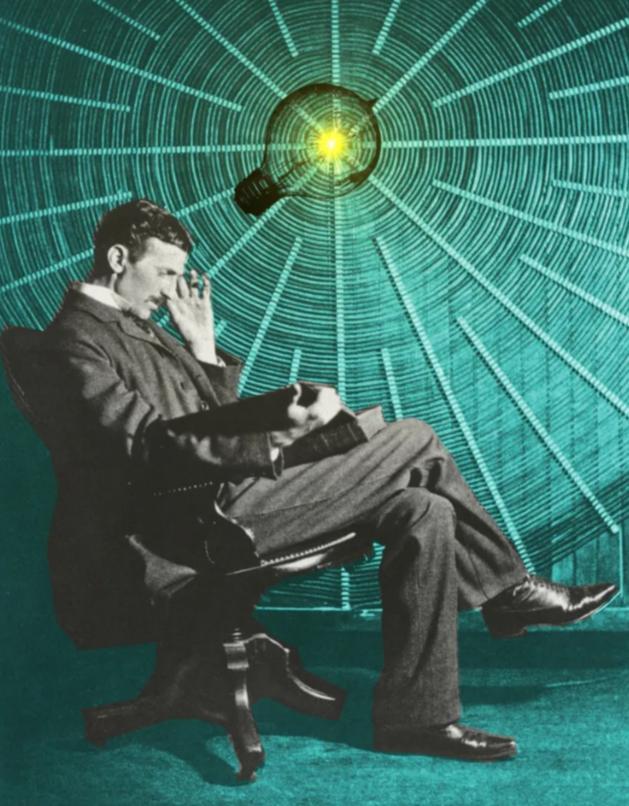
This quote comes from Nikola Tesla’s famous interview with John B. Kennedy, published in Collier's magazine on January 30, 1926 ("When Woman is Boss"). In the same interview, he also predicted wireless power transmission, global television broadcasts, and autonomous machines.
r/Futurism • u/Familiar-Wish-9137 • 1d ago
https://www.reddit.com/r/Futurology/?f=flair_name%3A%22Discussion%22I’ve been reading quite a few discussions about how AI might replace human labor, leading to widespread unemployment, declining tax revenues, and eventually problems funding government services.
But I think these discussions are based on a fundamentally wrong assumption.
They assume that even after AGI transforms the economy, we will still need the same economic and political systems we have today.
Why?
The main purpose of taxation is to fund government operations and public services. But governments are not necessarily the only way to organize and provide those services. And throughout history, governments have also used their power to accumulate resources, often creating opportunities for corruption, inefficiency, and abuse.
If AGI can perform most intellectual work and robots can handle most physical labor, why would we still need large bureaucracies, career politicians, and centralized governments to manage society?
Perhaps public services could be organized differently. People could vote directly on specific public projects and services, with AGI providing professional analysis, coordinating resources, and carrying out decisions. Instead of giving a government broad authority over enormous resources, people could decide collectively what services they actually want and how to organize them.
In such a world, taxation as we know it might no longer be necessary. Government itself might be reduced to just a handful of people genuinely dedicated to providing public services.
Do you think this basic premise is realistic?
If it is, what other changes might naturally emerge in the way human society is organized?
I'm interested in exploring the possibilities, even if they seem very different from the world we live in today.
r/Futurism • u/Minimum_Hour519 • 1d ago
r/Futurism • u/stonybrookdragon • 1d ago

r/Futurism • u/stonybrookdragon • 1d ago

r/Futurism • u/zooper2312 • 2d ago

These are people problems, AI can't solve them for us because that is what "living" is about.
r/Futurism • u/Familiar-Wish-9137 • 2d ago
r/Futurism • u/hazzo2000 • 2d ago
Let’s assume, for a moment, that the whole thing was a conspiracy.
Imagine it: 1969. The United States announces that humans have landed on the Moon. Millions watch on television. The world celebrates. But then people start asking questions.
“Why is the American flag moving if there is no wind?” - “How did they take a vehicle to the Moon?” - “Why didn’t we see a huge cloud of dust when the lunar module took off?” - “How could they communicate with Earth from the Moon?”
And, of course: “How can we be sure any of it really happened?” These are interesting questions.
But here is where the story becomes much more interesting than the conspiracy itself.
Because before deciding that the Moon landings were fake, we have to understand the things we are questioning: vacuum, gravity, orbital mechanics, rocket propulsion, communications, radiation, photography, geology and the physics of the lunar environment.
1- The flag wasn't blowing in wind. The Apollo astronauts used a horizontal support bar to hold it extended, and the movement people see came from the astronauts handling and installing it. In a vacuum, there is no air resistance to quickly damp that movement.
2- The lunar rover didn't magically appear on the Moon either. It was engineered to be folded and transported on the Apollo lunar module, then deployed by the astronauts.
3- And the famous “dust” question has an equally interesting answer. The Moon has essentially no atmosphere, so there is no air to create the enormous dust cloud people might expect from a rocket launch on Earth. The lunar module's engine still disturbed the surface, but the dust behaved very differently in a vacuum and under lunar gravity.
4- The same applies to communications. The Apollo missions didn't need a giant telephone cable stretching from the Moon to Earth. Radio signals travel through the vacuum of space at the speed of light.
Once you start looking at the actual science, many of the supposed “impossible” things become understandable, and there is something even harder for the conspiracy argument to explain.
Humans landed on the Moon six times between 1969 and 1972: Apollo 11, 12, 14, 15, 16 and 17, thousands of people were involved. Lunar rocks and soil were brought back to Earth and studied by scientists around the world. The missions left scientific instruments on the lunar surface. Later spacecraft have photographed Apollo landing sites and hardware from lunar orbit.
So for me, the more interesting question isn't: “Did we really land on the Moon?” It is:
Why did we go there in the first place? - Was it purely scientific? - Was it about demonstrating technological superiority during the Cold War? - Was it about proving that the United States could accomplish something the Soviet Union could not? - Was it about understanding the Moon as a future resource? Or was the Moon always considered something much bigger than a destination? Because this is where the story changes.
In 1969, reaching the Moon was primarily a demonstration of what human technology could accomplish, today, returning to the Moon is becoming a question of what humanity can build there.
NASA, China, India, SpaceX and other organizations are developing technologies for a future in which the Moon could become more than somewhere we visit for a few days, and that creates several possibilities.
1- The Moon could eventually become part of the infrastructure for missions toward Mars and beyond.
2- The lunar environment, especially the possibility of accessible water ice, could become extremely important for science, fuel production and future exploration.
3- If the technology and economics eventually make it possible, tourism, transportation and other commercial activities could develop around the Moon.
4- +1 There is also a strategic question that cannot simply be ignored, if humanity establishes permanent infrastructure beyond Earth, who controls it, who regulates it and who protects it?, that doesn't automatically mean “military bases” or countries claiming pieces of the Moon. International space law makes territorial ownership much more complicated than simply planting a flag and saying, “This is ours.”
But strategically, the Moon could become extremely important, and this is why landing on the Moon in 1969 is not the same challenge as building a permanent human presence there today.
Apollo's longest lunar surface stay was roughly 75 hours, during Apollo 17, a permanent or semi-permanent lunar presence is an entirely different engineering problem, you need reliable power.
Water, Oxygen, Radiation protection, Thermal control, Food and life-support systems, Communications, Reliable landing and launch systems, Medical capabilities, Protection from the extreme lunar environment, and eventually, you need to understand whether parts of the lunar geological environment can actually be used to construct or protect habitats.
That is no longer simply a “Can we land there?” question, It becomes:
“Can we survive there?” And eventually: “Can we build an economy there?”
So, ironically, I think the Moon conspiracy is asking the wrong question.
Instead of spending all our time arguing about whether Apollo happened, perhaps we should ask something much more fascinating:
when humanity did land on the Moon more than 50 years ago, why did we stop going for so long and what exactly are we planning to do differently this time? Because the next Moon landing may not be about proving that we can reach again the Moon, It may be about proving that we can stay.
And if humanity succeeds at that, the Moon may become the first step toward a civilization that is no longer limited to one planet.
That is where the real story begins
#MoonLanding #Apollo11 #NASA #SpaceExploration #Astronomy #RocketScience #ScienceVsConspiracy #FutureOfHumanity #HopeProbe #MBRSC #Dubai #AbuDhabi
