r/Futurism • u/XLCOAcidBurn • 1h ago
A Proposal to Humanity: January 1, 2027
reddit.com
1
Upvotes
r/Futurism • u/MathematicianFit3229 • 14h ago
r/Futurism • u/Rparty_b • 1d ago
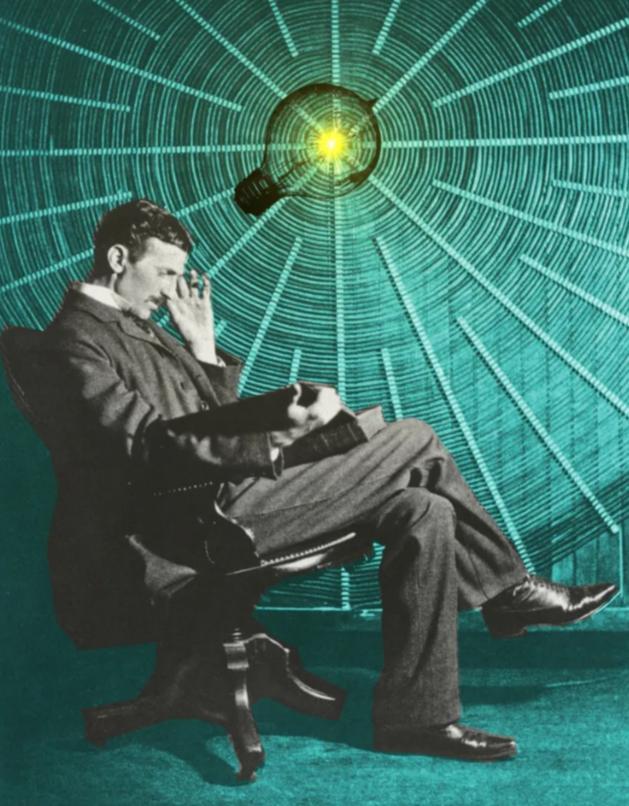
This quote comes from Nikola Tesla’s famous interview with John B. Kennedy, published in Collier's magazine on January 30, 1926 ("When Woman is Boss"). In the same interview, he also predicted wireless power transmission, global television broadcasts, and autonomous machines.
r/Futurism • u/brainshades • 19h ago
The announcement that AI has solved the Riemann Hypothesis, reminds me of the Charles Stross story - Antibodies…
r/Futurism • u/ZHAEVORYX_OFFICIAL • 21h ago
— On the Possibility of Complete Liberation through the Maximization of Pleasure and the Replacement of the Self
When human beings reach the limit of the material abundance that capital can provide, what ultimate value do they pursue next? Perhaps it is no longer wealth, but the total maximization of pleasure that can be experienced mentally, emotionally, and physically, along with an absolute freedom from every duty and constraint of reality.
If we could reach an artificial paradise designed to satisfy our desires and senses perfectly, an environment beyond the limits of everyday reality, could we call it utopia?
Here, we can posit a hypothesis.
Suppose there exists a replica that perfectly reproduces not only a person's physical appearance but also their speech habits, patterns of behavior, social relationships, and even their personality. This replica takes the original person's place in the real world, fulfilling their social roles and daily obligations. If the imitation were so precise that no one around them noticed the substitution, the original person could keep their identity in reality while being completely freed from the responsibilities that come with it.
Meanwhile, the original person would remain in a utopia built solely for themselves, continuously enjoying sensory satisfaction and mental peace, free from the limits of time and the pressures of society. Their life in reality would be sustained by the replica, while their consciousness would focus entirely on rest, pleasure, and self-fulfillment.
But is this truly the ultimate form of happiness that human beings can attain?
In an environment where pleasure is constantly supplied, can people still recognize pleasure as pleasure? In a life from which pain and lack, labor and responsibility have been completely removed, can satisfaction keep its original meaning? And has a person who hands their social existence over to a replica gained true freedom, or given up their agency over their own life?
Furthermore, we must ask whether happiness can be reduced to the sum of positive sensations, or whether it lies in the very process of choosing, taking responsibility, and creating meaning within an imperfect reality.
In the end, the fundamental question this thought experiment raises is not simply whether utopia can be realized.
If human beings could escape every responsibility of reality and enjoy infinite pleasure and perfect rest, would that be the ultimate fulfillment of existence, or a departure from the very essence of life that makes us human?
r/Futurism • u/Fighter_41 • 1d ago
With a perfect understanding of science would it be possible to do anything? -time travel, teleportation, levitation, invisibility, etc.
Is there anything we could never achieve even with a perfect and complete understanding of science?
r/Futurism • u/songkranw • 1d ago
For me is instant teleportation.
r/Futurism • u/Fresh-Ladder-1604 • 1d ago
Do you think this can ever be possible : The advent of AI could make self-sustainable microsocieties not merely an ideological aspiration, but a technically and economically feasible form of human organisation.
1. AI could reduce the minimum viable size of a society
Historically, a community needed a sufficiently large population to sustain specialised functions:
This created a dependency on large cities, centralised institutions and complex supply chains.
AI could fundamentally alter this constraint.
A small community of perhaps 100–1,000 people could potentially operate with the technical and administrative capabilities that previously required much larger organisations.
AI could function as a distributed layer of intelligence, coordinating resources, optimising production, managing infrastructure and making specialised knowledge accessible to everyone.
The minimum viable society could become much smaller.
Imagine a microsociety with:
Such a community would not necessarily need to produce everything internally. Instead, it could achieve a high degree of resilience by producing essential goods locally while exchanging specialised products and knowledge with other communities.
The objective would not be complete isolation, but reduced dependence on fragile external systems.
Today, much of our economic and social organisation exists because coordinating people and resources is expensive.
We build corporations, bureaucracies and centralised systems partly because they are effective ways of managing complexity.
AI could lower the cost of coordination.
A community might use AI systems to:
This raises an intriguing possibility: societies might become less dependent on hierarchical institutions and more capable of operating through distributed, cooperative structures.
However, AI itself would need to be governed democratically. Otherwise, a supposedly autonomous microsociety could simply become dependent on whoever owns its models, servers, energy infrastructure or data.
These points are AI generated - though i wanted to know if this was a possibility?
r/Futurism • u/zooper2312 • 2d ago

These are people problems, AI can't solve them for us because that is what "living" is about.
r/Futurism • u/Legal-Concern-1187 • 1d ago
r/Futurism • u/ZHAEVORYX_OFFICIAL • 1d ago
If information processing, decryption, and data recovery technologies were to reach their theoretical limits, would it ultimately be possible to recover and access all private records created by an individual during their lifetime, as well as any information they deliberately concealed, regardless of the passage of time, data deletion, encryption, or access restrictions?
No. Even with technology at its theoretical limits, much of it couldn't be recovered. That's because the limits come from physics and mathematics, not from engineering.
What stays out of reach
Information-theoretically secure encryption: A properly used one-time pad can't be broken with unlimited computing power, because the ciphertext fits every possible message equally well.
Strong symmetric encryption (e.g., AES-256): Just counting through 2²⁵⁶ keys would take more energy than the Sun puts out over its lifetime, according to Landauer's limit. Quantum computers only cut the effective strength to about 128 bits, which is still out of reach.
Truly destroyed data: Physics may say information is never destroyed at the most basic level. But once a record is turned into heat and scattered into the environment, getting it back is impossible in any practical sense.
Things never written down: Thoughts, private intentions and unrecorded conversations don't exist as data, so there is nothing to recover.
What really is vulnerable
Today's public-key encryption (RSA, ECC): A large quantum computer would break it. Data captured now can be decrypted later ("harvest now, decrypt later").
"Deleted" data that wasn't really destroyed: Leftover traces on drives, backups, cloud copies, logs and other people's devices.
Metadata and inference: Who you contacted, when, and from where can reveal a lot without decrypting anything.
Human weak points: Weak passwords, leaked keys, coercion and insiders.
Total recall of a person's life is ruled out by physics. In practice, though, most secrets come out through copies, metadata and people, not through broken encryption. The weak points are how data is handled, not the math.
r/Futurism • u/ImaginaryExternal338 • 1d ago
r/Futurism • u/Memetic1 • 1d ago

r/Futurism • u/Familiar-Wish-9137 • 2d ago
https://www.reddit.com/r/Futurology/?f=flair_name%3A%22Discussion%22I’ve been reading quite a few discussions about how AI might replace human labor, leading to widespread unemployment, declining tax revenues, and eventually problems funding government services.
But I think these discussions are based on a fundamentally wrong assumption.
They assume that even after AGI transforms the economy, we will still need the same economic and political systems we have today.
Why?
The main purpose of taxation is to fund government operations and public services. But governments are not necessarily the only way to organize and provide those services. And throughout history, governments have also used their power to accumulate resources, often creating opportunities for corruption, inefficiency, and abuse.
If AGI can perform most intellectual work and robots can handle most physical labor, why would we still need large bureaucracies, career politicians, and centralized governments to manage society?
Perhaps public services could be organized differently. People could vote directly on specific public projects and services, with AGI providing professional analysis, coordinating resources, and carrying out decisions. Instead of giving a government broad authority over enormous resources, people could decide collectively what services they actually want and how to organize them.
In such a world, taxation as we know it might no longer be necessary. Government itself might be reduced to just a handful of people genuinely dedicated to providing public services.
Do you think this basic premise is realistic?
If it is, what other changes might naturally emerge in the way human society is organized?
I'm interested in exploring the possibilities, even if they seem very different from the world we live in today.
r/Futurism • u/Kalpesh_38 • 2d ago
r/Futurism • u/Minimum_Hour519 • 2d ago
r/Futurism • u/21Kuranashi • 3d ago
r/Futurism • u/stonybrookdragon • 2d ago

