Happy Monday, everyone! This discussion thread is posted Monday at 12:00am Market time.
If you are looking to learn more about the stock market, custody, and how to protect your investments – you are in the right place!
Retail investors have been on a long march to understand more about the markets and the at times bizarre ways in which they operate. Here are some key takeaways and resources.
What is GMEJungle?
GMEJungle is a investing community focused around GameStop, and was founded as an offshoot of other GME communities. GME is a private subreddit, and only approved members can submit posts or leave comments - but anyone can browse the discussions that take place here.
What’s this all about?
Retail Investor Rights and Advocacy. The current market structure involves a centralized securities depository for ease of settlement and for access to liquidity. That depository maintains technical ownership rights for the vast majority of all outstanding shares of all publicly issued companies in the United States. Simply: You do not have direct ownership rights of shares you own through a broker.
What is DRS?
DRS is a system by which shares are transferred between the DTC (Depository Trust Company) and Transfer Agents. Shares held at DTC include all brokerage holdings, and shares held at Transfer Agents are held directly on the issuer ledger in the name of the investor. Colloquially, DRS also refers to shares which individual investors have decided to own in their own names.
What are some pros of DRS?
You have confidence that your shares are owned by you, and are there when you need them. You can more easily submit shareholder proposals, request and view company documents, and communicate with agents of the company. You know that you will be able to both cast your vote and have your vote counted when participating in votes. You can receive a more favorable tax status on received dividends. You can directly engage with your company and they can directly engage with you.
What are some cons of DRS?
You can’t easily use equity in DRS for margin trading like you can with shares in a brokerage account. Holding in a broker has more ‘anonymity’ as the public has no way to know your holdings or PII, while holding in DRS is comparatively more public. Depending on which transfer agent the company uses, investor access to liquidity may be limited.
What a Transfer Agent?
A Transfer Agent is a company which specializes in managing ownership ledgers and providing shareholder services. Every public company must have a Transfer Agent. GameStop uses Computershare, an established professional and market leader trusted by thousands of companies around the world.
What is the DTC?
DTC is a Self Regulatory organization which controls the nominee Cede and Co, which is the entity which has the material ownership of most public shares as described above. DTC is one part of the DTCC, alongside other bodies including the NSCC. The DTCC is essentially a monopoly on both clearing and settlement in the American markets, one which has been sanctioned by regulators to perform it's duties.
How do I DRS?
The answer can vary. For help DRSing GME from over 150 brokers, both American and from around the world, check out these Community-sourced detailed broker guides. Select your broker from the dropdown to get to the guide, which will walk you through the process including how to get started, how to communicate to your broker, what fees might exist and what cheaper alternatives there are (if any). If your broker isn’t listed here, reach out to the site and we can work together to improve the community resources.
Where can I learn even more?
Computershare has an extensive FAQ page which is excellent and covers a lot of ground regarding how holding your investment directly on the issuer ledger works in practice.
Two community-built websites that are full of free resources and information are www.DRSGME.org, which has a variety of information specific to GameStop including the broker guides linked above, and www.WhyDRS.org. WhyDRS is an open source platform built to provide general assistance and information about custody and finance reform, along with key information on the many thousands of U.S. publicly traded companies.
The WhyDRS Database is an extensive, free, open source repository of various contact information for all publicly traded securities.
Types of Holdings: Book-Entry vs Book vs Plan vs Certificate
You may see these terms when referring to share ownership. In short:
Book-Entry means any share that is electronically tracked in a ledger rather than being held on physical paper. Book and Plan are two labels for shares that are used in Computershare's Investor Center. Book shares (DRS) are fully owned by the investor. Plan shares (DSPP) are owned by Computershare’s nominee, with the investor’s name appearing on the ledger in a subclass. Part of Plan shares are kept with DTC for Operational Efficiency. Exact custody chain details are provided by Computershare and quoted below. Both DRS and DSPP shares are book-entry. Certificates, meanwhile, are still tracked by the TA but have a sanctioned physical certificate associated with that share.
"Purchases made through the issuer (or its transfer agent) of securities you intend to hold in DRS are usually executed under the guidelines of an issuer’s stock purchase plan, which uses a broker-dealer to execute the orders. Thus, to hold in DRS once the securities are acquired, you would need to instruct the transfer agent to move the securities from the issuer plan to DRS." - SEC Bulletin 7/12/23
"Purchases made through the issuer (or its transfer agent) of securities you intend to hold in direct registration are usually executed under the guidelines of the issuer’s stock purchase plan. You’ll need to instruct the transfer agent to move the securities to the DRS." - FINRA Investor Insight 7/12/23
If you are an investor seeking total ownership of your assets, both SEC and FINRA agree that holding in directly on the issuer ledger and in your own name is the only way. Holding shares with the issuer's transfer agent in an investment plan is more direct than holding with a broker in terms of named ownership - with DRS holdings even more so. Shares held with a Plan are not DRS - they are held by the TAs nominee (for Computershare, this is Dingo and Co), and must be transferred out of the plan and into DRS. This is explained by Computershare on their FAQ page under ‘chains of custody’. This question was one of several asked by the WhyDRS.org community in early 2024, and we appreciate Computershare for providing a detailed answer. Their whole FAQ page has a ton of information, and is useful for any investor looking to know more.
Q: “Can you outline the chains of custody and ownership for Pure DRS and DSPP shares enrolled in the DirectStock Plan? Please specify how names are recorded 'On the Ledger' in different holding scenarios. (added 5/16/24)"
A: "The first part is a very straightforward answer. There is no ‘chain of custody’ for DRS or Pure DRS. Investors hold the shares in their own name. There is no intermediary. Computershare’s role here is solely as a transfer agent (i.e., the agent of the issuer).
For the DSPP, we use a Computershare nominee to hold the underlying shares. For the largest portion of the plan holding (80%-90%), these shares are held on the register in the main class. So the chain of custody is “CPU Nominee -> Investor”.
For the 10%-20% that we hold via our broker at DTC, the custody chain is “Cede -> Broker -> Computershare -> investor”. Notwithstanding this, all holding types are registered and held in the name of the investor in the sub-class.”
Is Buying through DSPP a Problem?
There is nothing wrong with purchasing through DirectStock if that is what makes sense for you, as it does come with some additional benefits. Many international investors buy GameStop through the plan because DirectStock is much more affordable than buying through a broker and paying them to do a DRS transfer. The fee for DirectStock is $5 and some international brokers cost hundreds of dollars to DRS, so it's smart to use DirectStock in these cases. You can check your broker's DRS transfer rates on their guidepage at DRSGME.org. Other investors buy through DirectStock because they want to be able to schedule recurring buys, or would like to be able to buy in fractional shares and accumulate ownership in smaller portions over time.
If you choose to buy through the DirectStock plan, and want to ensure total ownership of your assets, manually terminate the plan after each purchase. This will leave your account with pure DRS holdings, but comes with the cost of selling off your fractional share - this is because only whole shares can be held in direct registered ownership. Because the proceeds will be reduced by the selling fee, it's likely you will receive $0 for selling the fractional share, though you will also not be charged as the fee cannot exceed the sale price. Here's the DRSGME guide on terminating DirectStock.
What is GameStop's Investment Plan?
GameStop contracts Computershare as a Transfer Agent to manage it's stock ledger and distribute shareholder materials such as proxy materials for the annual general meeting. Computershare offers several proprietary plan structure to interested companies, including a custom option called CIP (Computershare Investment Plan) and managed DSPs (Direct Stock Purchase) for other companies such as Home Depot in which the issuer can sell stock directly to investors. However, by far the most common plan offering that they have is called DirectStock, which is a Direct Stock Purchase Plan. The boiler plate DirectStock brochure is located here. GameStop uses the DirectStock plan.
Legacy Computershare DD Series (from 2021 to 2022)
This series was originally written by PinkCatsonAcid, who started this sub a few years ago. She recently deleted all her old posts, but content is still available through the Internet Archive. Research continued during and since these posts were originally written, and using more recent resources can be more reliable – some of the information shared in these posts is known now to no longer be accurate. However, these archives are provided here for posterity and completeness. All of these links are to the most updated archive available before the posts were deleted.
If you look through the archives, check out part 7 first. It reviews the misunderstanding running through earlier parts that book and plan designations were equal in terms of custody, which is now known to be untrue and was confirmed by Computershare.
For a fleeting moment, we’re not just watching. We feel like we can actually fight back.
You don’t have to care about Kitty, but understand why I do. I’m usually the first one to ask people to focus on the data and what’s tangible. But this isn’t about valuations or logic. It’s about seeing one of our own go toe-to-toe with people who usually seem untouchable. Someone they can’t easily dismiss, playing a game they’re used to controlling.
It’s one of us stepping into the ring with a barbed-wire baseball bat. That doesn’t mean he can’t lose. It doesn’t mean anyone following him is safe. But it means there’s a fight.
And it means that there will be blood. Step into the ring at your own risk.
The Securities and Exchange Commission today issued a proposal to address the inefficiencies in the current governance and funding model of the Consolidated Audit Trail (CAT). The Commission is proposing to rescind Rule 613 of Regulation NMS, which obligates the national securities exchanges and national securities associations (SROs) to establish, implement, and maintain the CAT. In its place, the Commission proposes to require SROs and broker-dealers to record and electronically report to the Commission or its designee substantially the same information currently required to be recorded and reported pursuant to current CAT requirements. This proposal would bring the CAT under the SEC’s direct control, while ensuring its continued operation with minimal disruption.
The proposal came as a result of the comprehensive review of the CAT directed by SEC Chairman Paul S. Atkins and follows exemptive relief and approved amendments that have, among other benefits, helped reduce the CAT’s projected annual operating costs by over $100 million and permanently eliminated the reporting of personally identifiable information to the CAT. In April, the Commission issued a concept release soliciting public comment on the CAT. In public comment, both investors and market participants voiced support for the Commission exercising more control over the management and funding of the CAT.
“Today’s proposal addresses persistent concerns with cost overruns, funding, and governance of the Consolidated Audit Trail. The proposed rule would encompass the changes that we have already made towards rightsizing the CAT, including increasing its cost-effectiveness and eliminating the collection of personally identifiable information. The proposal is intended to put the CAT on a sustainable footing: accountable in its governance and disciplined in its costs, to the benefit of our markets and those who participate in them,” said Chairman Atkins.
The CAT supports regulatory efforts to administer and enforce the federal securities laws, but the decentralized governance structure established by the CAT NMS Plan has presented certain challenges to administering the CAT and warrants revisiting. The proposal would rescind Rule 613 of Regulation NMS and add new Rule 17a-26 under the Securities Exchange Act of 1934, requiring SROs and broker-dealers to record and electronically report to the Commission or its designee substantially the same information that is currently required pursuant to current CAT requirements, such as Rule 613, the CAT NMS Plan, related SRO compliance rules, and related exemptive relief previously issued by the Commission. Proposed Rule 17a-26 would require that data to be reported to the Commission or its designee instead of to a CAT system independently administered by the participants under a national market system plan. The Commission intends to use funds appropriated by Congress to pay the Commission’s costs relating to use, operation, and maintenance of the CAT system.
The public comment period will remain open for 60 days after publication in the Federal Register.
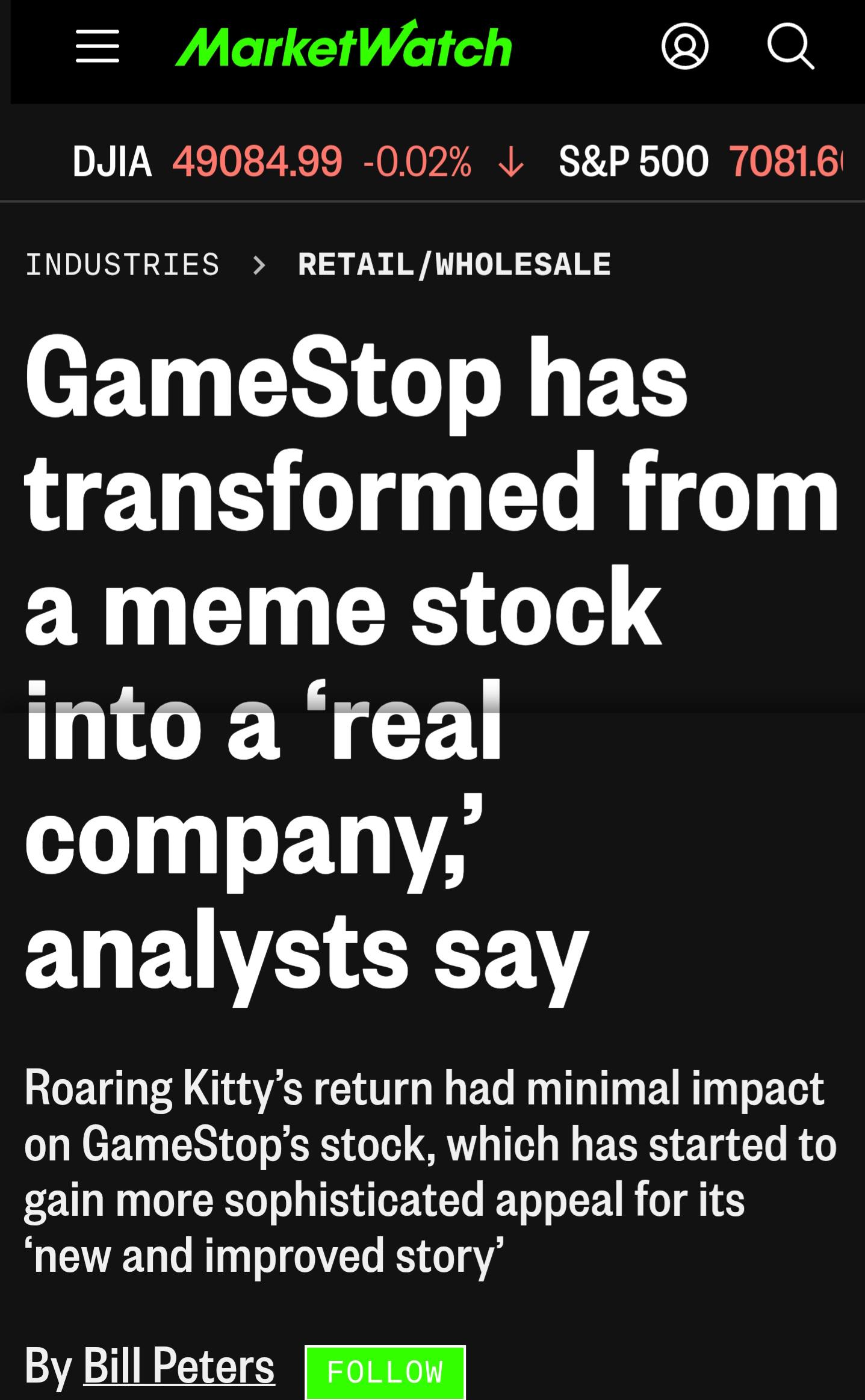
After Roaring Kitty’s reawakening on Thursday nudged GameStop’s shares only modestly higher, some analysts are declaring the meme trade dead for the videogame and collectibles retailer.
The chain, after being cast off by many analysts, no longer needs to rely simply on meme-stock energy for gains, according to Mike Hickey, an analyst at StoneX. Rather, shares stand to benefit from the ongoing collectibles boom and the launch of “Grand Theft Auto VI,” as gamers download the game and upgrade their equipment to play it.
“It’s a real company, and it’s trading at what we think is a very undervalued price,” Hickey said of GameStop.
When his firm previously covered GameStop, it had a sell rating and a price target of zero, he said. When the chain was swept up in the meme-stock frenzy, they stopped covering it, he noted: “But that trade is over.”
I would like to receive updates and special offers from Dow Jones and affiliates. I can unsubscribe at any time.
Few analysts cover GameStop. But StoneX this month initiated coverage of GameStop shares with a buy rating and a $33 price target. Analysts there noted that the company, which over the years had closed hundreds of stores, stood to gain from select reopenings announced in September.
“September’s announcement of selective U.S. store reopenings adds a new growth catalyst, while expanded collectibles space and dedicated fixtures could improve productivity within existing locations,” the note said.
Dan Ives, senior managing director at Yorkville Ives & Co., echoed the optimism.
CEO Ryan Cohen “is turning GameStop into a collectibles story with massive efficiency,” he said over email. “This is no longer a meme stock; it’s in the process of becoming a new and improved story.”
He added: “GameStop will still have many retail fans but we see it as a very undervalued asset.”
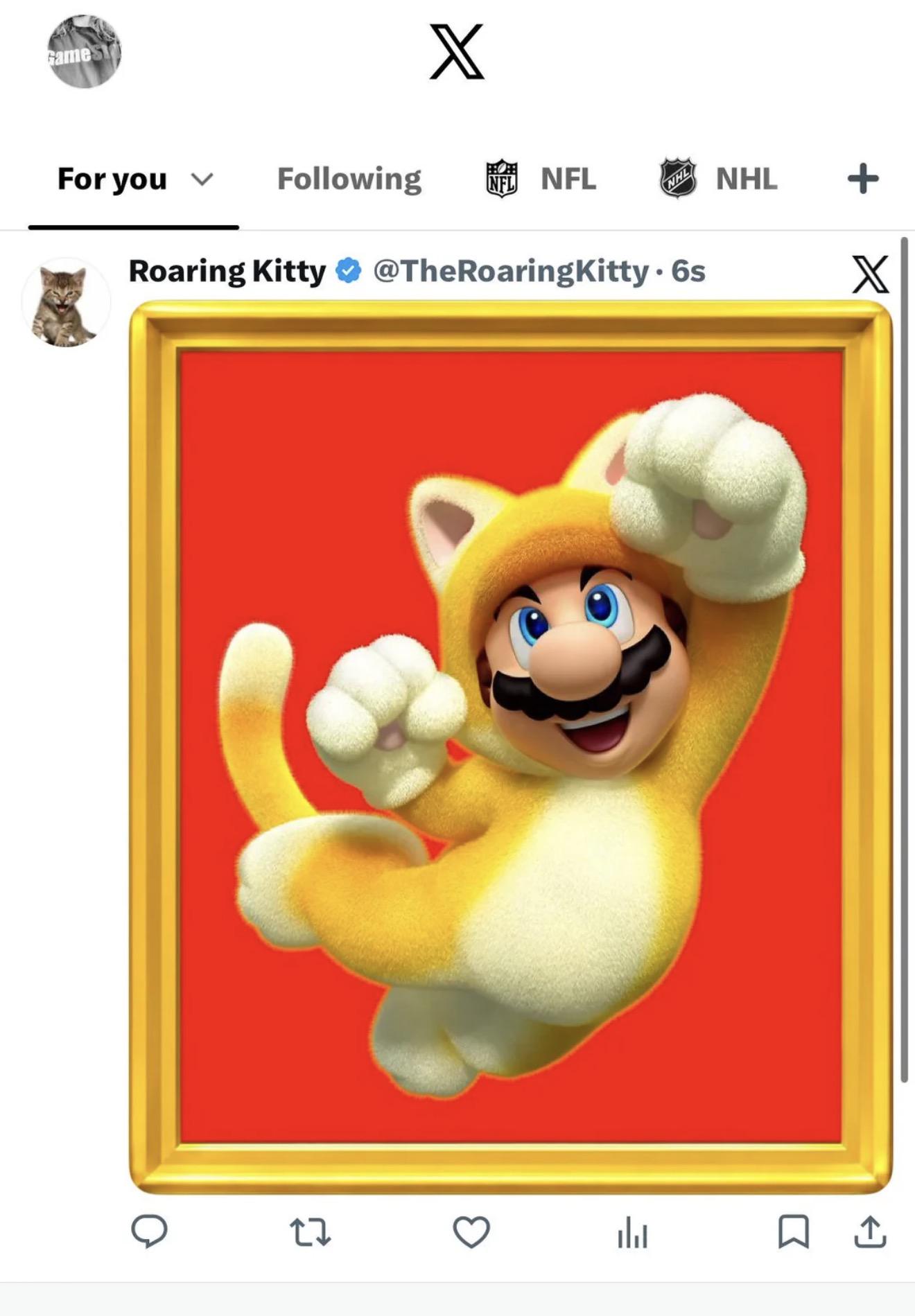
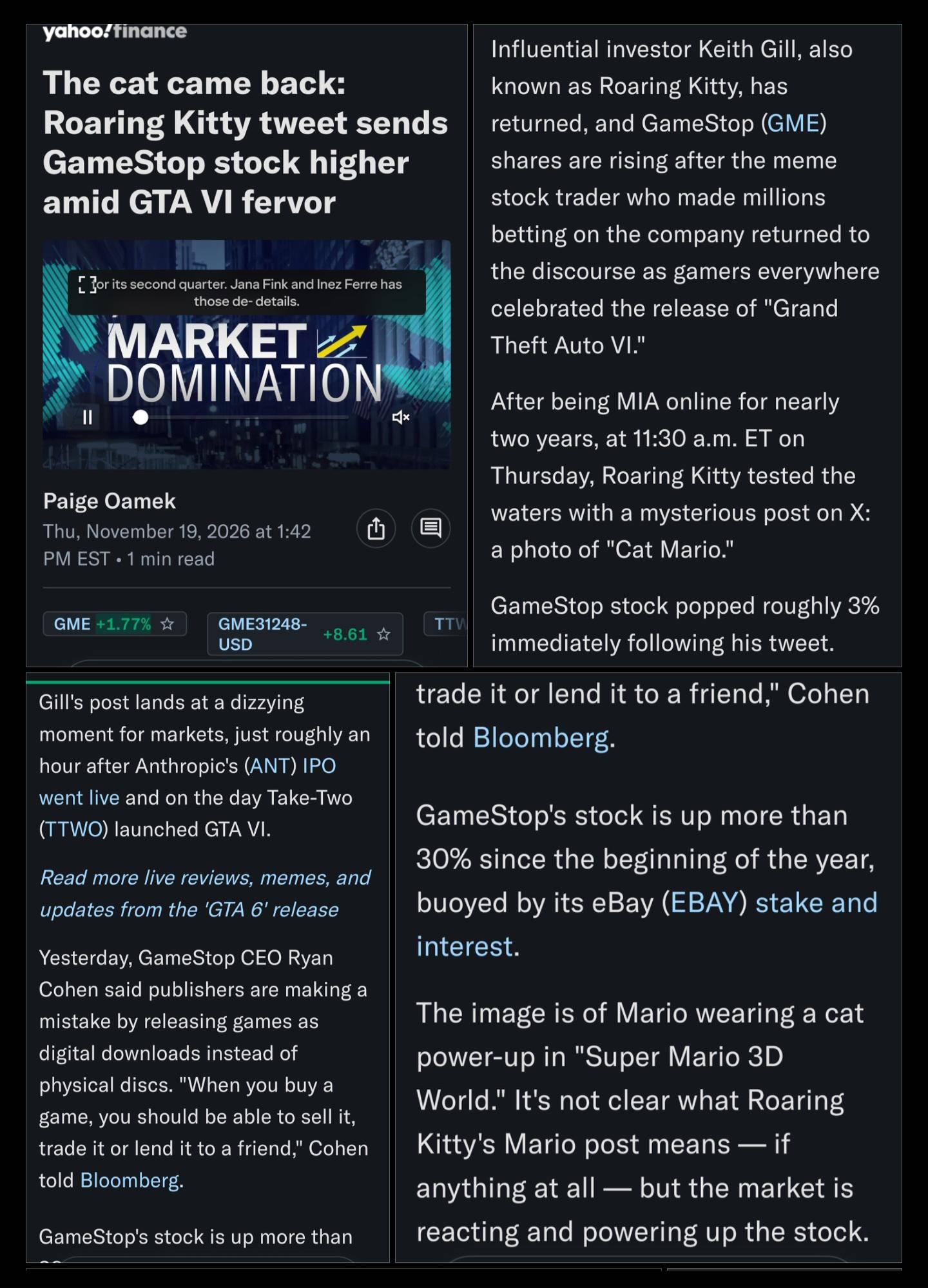
On Thursday, a new post showing a picture of Cat Mario, appeared on the X account for Keith Gill, the investor known as Roaring Kitty, whose enthusiasm for GameStop created a retail-trading stampede into the stock in 2021. At the time, that ruined short sellers’ bets against the company. But unlike previous spikes that followed arcane posts in years past, shares of GameStop only rose around 1.5% on Thursday.
Over the stock’s roller-coaster journey since 2021, analysts have cast doubt on GameStop. They have cited losses, uneven sales, disruption from e-commerce and a shift toward online gaming. There are also general concerns about the videogame industry’s ability to sustain demand as consumers struggle with higher prices for essentials. Some analysts have predicted that the chain might not survive the 2020s. And Wall Street questioned GameStop’s efforts to buy or otherwise collaborate with eBay
In the second quarter, GameStop’s sales fell 18.7% to $790.2 million. But revenue from collectibles — things like trading cards and action figures — jumped 57% and made up 45.1% of sales.
GameStop in September also raised its forecast for adjusted earnings before interest, taxes, depreciation and amortization — a profitability metric — to more than $650 million for its full fiscal year, which ends on Jan. 30.
The collectibles market has taken off thanks to nostalgia and the card industry’s focus on rarities and limited drops. Quarterly sales of “Magic: The Gathering” have risen past $600 million, Hasbro,
which makes the game, said last month. Shares of collectible figurine maker Funko
have roughly doubled this year.
Shares of GameStop are up 34% over that period, and trading at around $27. That’s still well off their 2021 highs. But Hickey still believes in the stock.
“There’s really no other stock that you can buy that gives you that much exposure to collectibles, which we think is a durable opportunity,” Hickey said.
“When we’re out there talking to people, the first thing that people ask is, ‘Are you serious? Isn‘t that a meme stock?’” he added. “We’re serious as serious gets, and no, it’s not a meme stock.”
About the Author
Bill Peters
Follow
Bill Peters is a Los Angeles–based MarketWatch reporter.
Rising rates, zero-coupon issuance and a broad sector universe have brought convertible arbitrage back
Before Citadel turned into a global juggernaut, Ken Griffin made his name trading convertible bonds from his Harvard bedroom. Griffin exploited an inefficiency, discovering that bonds didn’t seem to be priced consistently with stocks. This opportunity morphed into a durable and return-yielding strategy, and convertible bond arbitrage became the bedrock on which Citadel was built.
Griffin became its main proprietor, at a time when convertible bonds were an area of huge, untapped potential. Japan in particular was worth north of $350bn, an astronomical figure given the hedge fund industry was still in its relative infancy. One character who sought to exploit this vast opportunity was Chris McGuire. After working for several major banks in the sell-side division, McGuire launched his fund, Phalanx Capital Management, in 2004, trading convertible bond, volatility, and capital structure arbitrage.
For McGuire, the opportunity set in Japan has always been unique: “The market oscillated and experienced significant volatility. Japan was a market characterized by cash-rich companies trading below book value, with little incentive to invest that cash or change how they operated.” During this period, the investment universe was close to 1,000 different issues, with a market not defined by high levels of tech concentration; companies of almost every industry were issuing convertible bonds.
As the 00s grew older, convertible bond arbitrage became harder for hedge funds to justify. The GFC meant pressure was applied to funds as they faced redemption requests and a broader deleveraging took place across the industry. Short-selling restrictions were put in place, a constraint that meant convertible bond arbitrage strategies became redundant. The BOJ’s easing and negative rates from 2016 further compounded the dwindling appeal of the strategy. A cheap coupon in exchange for an equity option was no longer attractive, because straight debt was nearly free.
The dwindling opportunity set eventually led McGuire to vacate the investment scene altogether, before returning in a new guise with Eagles View Japan Management a couple of years ago. Convertible bonds are now back in fashion. A soaring equity market, driven by corporate capital being deployed strategically and aggressively, prompted the BOJ into action to help stem the growing inflationary tide. Moreover, with borrowing costs continuing to rise significantly, companies can now issue zero-coupon convertible bonds. McGuire notes that despite the high equity market concentration, convertible bonds are not limited to one single sector, with the fund holding a broad-based exposure: “Companies across several industries are now accustomed to issuing convertible debt; our holdings include airlines, railways, steel companies and even a company that cleans up space debris.”
Another appealing feature of the Japanese market is the credit quality it possesses. To exploit these opportunities, McGuire uses asset swap strategies; “this allows you to strip away the fixed-income component and retain exposure to the equity option.” However, credit quality being attractive can place a natural barrier on returns, with fewer high-yield and high-volatility options that could be significantly profit-rich.
McGuire is keen to point out Japan’s continuing appeal and the opportunities it offers, comparable to the largest Western economies, despite growing economic development across APAC. “China is a huge, developing economy, but its markets do not always offer the same degree of correlation or accessible risk liquidity for global investors.” This is not a consensus broadly held - China is continuously heralded for its astronomical and hegemonic economic growth, while South Korea and Taiwan have been at the epicentre of the AI buildout, reaping huge rewards for those funds with exposure.
Japanese equities have become a forgotten story - despite the Nikkei 225 being up close to 115% in the past five years. McGuire sees many mistakes from investors, who underappreciate the unique makeup of the economy: “Many believe they trade in the same way as Western markets. Companies and markets behave differently in Japan.” The recent yen intervention by Treasury Secretary Scott Bessent was a prime example of this. Investors had built short positions in the currency because they believed Japan was lagging behind other markets. When fundamentally, the BOJ position and market behavior in Japan are because of the unique relationship between public and private governance.
McGuire understands this and is bolstered by having years of experience to hone his approach. In this current environment, the Japanese convertible bond market size is now a fraction of the US, at $20bn compared to $400bn, with even Taiwan and Hong Kong exceeding $100bn. “The small size of the market works in our favour and makes it hard for very large hedge funds, who want to invest tens of billions of dollars to generate returns; there simply isn’t the capacity.” The firm returned 24% last year and is up more than 20% so far this year. Re-energized after several years out of the spotlight, McGuire is making the most of the convertible bond arbitrage opportunity in Japan.
Happy Monday, everyone! This discussion thread is posted Monday at 12:00am Market time.
If you are looking to learn more about the stock market, custody, and how to protect your investments – you are in the right place!
Retail investors have been on a long march to understand more about the markets and the at times bizarre ways in which they operate. Here are some key takeaways and resources.
What is GMEJungle?
GMEJungle is a investing community focused around GameStop, and was founded as an offshoot of other GME communities. GME is a private subreddit, and only approved members can submit posts or leave comments - but anyone can browse the discussions that take place here.
What’s this all about?
Retail Investor Rights and Advocacy. The current market structure involves a centralized securities depository for ease of settlement and for access to liquidity. That depository maintains technical ownership rights for the vast majority of all outstanding shares of all publicly issued companies in the United States. Simply: You do not have direct ownership rights of shares you own through a broker.
What is DRS?
DRS is a system by which shares are transferred between the DTC (Depository Trust Company) and Transfer Agents. Shares held at DTC include all brokerage holdings, and shares held at Transfer Agents are held directly on the issuer ledger in the name of the investor. Colloquially, DRS also refers to shares which individual investors have decided to own in their own names.
What are some pros of DRS?
You have confidence that your shares are owned by you, and are there when you need them. You can more easily submit shareholder proposals, request and view company documents, and communicate with agents of the company. You know that you will be able to both cast your vote and have your vote counted when participating in votes. You can receive a more favorable tax status on received dividends. You can directly engage with your company and they can directly engage with you.
What are some cons of DRS?
You can’t easily use equity in DRS for margin trading like you can with shares in a brokerage account. Holding in a broker has more ‘anonymity’ as the public has no way to know your holdings or PII, while holding in DRS is comparatively more public. Depending on which transfer agent the company uses, investor access to liquidity may be limited.
What a Transfer Agent?
A Transfer Agent is a company which specializes in managing ownership ledgers and providing shareholder services. Every public company must have a Transfer Agent. GameStop uses Computershare, an established professional and market leader trusted by thousands of companies around the world.
What is the DTC?
DTC is a Self Regulatory organization which controls the nominee Cede and Co, which is the entity which has the material ownership of most public shares as described above. DTC is one part of the DTCC, alongside other bodies including the NSCC. The DTCC is essentially a monopoly on both clearing and settlement in the American markets, one which has been sanctioned by regulators to perform it's duties.
How do I DRS?
The answer can vary. For help DRSing GME from over 150 brokers, both American and from around the world, check out these Community-sourced detailed broker guides. Select your broker from the dropdown to get to the guide, which will walk you through the process including how to get started, how to communicate to your broker, what fees might exist and what cheaper alternatives there are (if any). If your broker isn’t listed here, reach out to the site and we can work together to improve the community resources.
Where can I learn even more?
Computershare has an extensive FAQ page which is excellent and covers a lot of ground regarding how holding your investment directly on the issuer ledger works in practice.
Two community-built websites that are full of free resources and information are www.DRSGME.org, which has a variety of information specific to GameStop including the broker guides linked above, and www.WhyDRS.org. WhyDRS is an open source platform built to provide general assistance and information about custody and finance reform, along with key information on the many thousands of U.S. publicly traded companies.
The WhyDRS Database is an extensive, free, open source repository of various contact information for all publicly traded securities.
Types of Holdings: Book-Entry vs Book vs Plan vs Certificate
You may see these terms when referring to share ownership. In short:
Book-Entry means any share that is electronically tracked in a ledger rather than being held on physical paper. Book and Plan are two labels for shares that are used in Computershare's Investor Center. Book shares (DRS) are fully owned by the investor. Plan shares (DSPP) are owned by Computershare’s nominee, with the investor’s name appearing on the ledger in a subclass. Part of Plan shares are kept with DTC for Operational Efficiency. Exact custody chain details are provided by Computershare and quoted below. Both DRS and DSPP shares are book-entry. Certificates, meanwhile, are still tracked by the TA but have a sanctioned physical certificate associated with that share.
"Purchases made through the issuer (or its transfer agent) of securities you intend to hold in DRS are usually executed under the guidelines of an issuer’s stock purchase plan, which uses a broker-dealer to execute the orders. Thus, to hold in DRS once the securities are acquired, you would need to instruct the transfer agent to move the securities from the issuer plan to DRS." - SEC Bulletin 7/12/23
"Purchases made through the issuer (or its transfer agent) of securities you intend to hold in direct registration are usually executed under the guidelines of the issuer’s stock purchase plan. You’ll need to instruct the transfer agent to move the securities to the DRS." - FINRA Investor Insight 7/12/23
If you are an investor seeking total ownership of your assets, both SEC and FINRA agree that holding in directly on the issuer ledger and in your own name is the only way. Holding shares with the issuer's transfer agent in an investment plan is more direct than holding with a broker in terms of named ownership - with DRS holdings even more so. Shares held with a Plan are not DRS - they are held by the TAs nominee (for Computershare, this is Dingo and Co), and must be transferred out of the plan and into DRS. This is explained by Computershare on their FAQ page under ‘chains of custody’. This question was one of several asked by the WhyDRS.org community in early 2024, and we appreciate Computershare for providing a detailed answer. Their whole FAQ page has a ton of information, and is useful for any investor looking to know more.
Q: “Can you outline the chains of custody and ownership for Pure DRS and DSPP shares enrolled in the DirectStock Plan? Please specify how names are recorded 'On the Ledger' in different holding scenarios. (added 5/16/24)"
A: "The first part is a very straightforward answer. There is no ‘chain of custody’ for DRS or Pure DRS. Investors hold the shares in their own name. There is no intermediary. Computershare’s role here is solely as a transfer agent (i.e., the agent of the issuer).
For the DSPP, we use a Computershare nominee to hold the underlying shares. For the largest portion of the plan holding (80%-90%), these shares are held on the register in the main class. So the chain of custody is “CPU Nominee -> Investor”.
For the 10%-20% that we hold via our broker at DTC, the custody chain is “Cede -> Broker -> Computershare -> investor”. Notwithstanding this, all holding types are registered and held in the name of the investor in the sub-class.”
Is Buying through DSPP a Problem?
There is nothing wrong with purchasing through DirectStock if that is what makes sense for you, as it does come with some additional benefits. Many international investors buy GameStop through the plan because DirectStock is much more affordable than buying through a broker and paying them to do a DRS transfer. The fee for DirectStock is $5 and some international brokers cost hundreds of dollars to DRS, so it's smart to use DirectStock in these cases. You can check your broker's DRS transfer rates on their guidepage at DRSGME.org. Other investors buy through DirectStock because they want to be able to schedule recurring buys, or would like to be able to buy in fractional shares and accumulate ownership in smaller portions over time.
If you choose to buy through the DirectStock plan, and want to ensure total ownership of your assets, manually terminate the plan after each purchase. This will leave your account with pure DRS holdings, but comes with the cost of selling off your fractional share - this is because only whole shares can be held in direct registered ownership. Because the proceeds will be reduced by the selling fee, it's likely you will receive $0 for selling the fractional share, though you will also not be charged as the fee cannot exceed the sale price. Here's the DRSGME guide on terminating DirectStock.
What is GameStop's Investment Plan?
GameStop contracts Computershare as a Transfer Agent to manage it's stock ledger and distribute shareholder materials such as proxy materials for the annual general meeting. Computershare offers several proprietary plan structure to interested companies, including a custom option called CIP (Computershare Investment Plan) and managed DSPs (Direct Stock Purchase) for other companies such as Home Depot in which the issuer can sell stock directly to investors. However, by far the most common plan offering that they have is called DirectStock, which is a Direct Stock Purchase Plan. The boiler plate DirectStock brochure is located here. GameStop uses the DirectStock plan.
Legacy Computershare DD Series (from 2021 to 2022)
This series was originally written by PinkCatsonAcid, who started this sub a few years ago. She recently deleted all her old posts, but content is still available through the Internet Archive. Research continued during and since these posts were originally written, and using more recent resources can be more reliable – some of the information shared in these posts is known now to no longer be accurate. However, these archives are provided here for posterity and completeness. All of these links are to the most updated archive available before the posts were deleted.
If you look through the archives, check out part 7 first. It reviews the misunderstanding running through earlier parts that book and plan designations were equal in terms of custody, which is now known to be untrue and was confirmed by Computershare.