r/GMEJungle • • 1h ago Bravo

Dr Trimbath spelled out a plan that is "designed to shrink the unresolved FTDs" if brought to the attention of "anyone on the House Financial Services Committee or the Senate Banking Committee" in your state. "They are in charge of Wall Street rules."

Post image
97 Upvotes

Below is the text of a bill to amend the public law that allows the Depository Trust and Clearing Corporation (DTCC) subsidiary, the National Securities Clearing Corporation (NSCC), to ignore margin calls for companies like Robinhood when they fail to deliver shares of companies like Gamestop that were sold to household investors but that don’t have and Robinhood can just “turn off the Buy Button”. IYKYK, right? If you don’t know, read the GAMESTOPPED report, ok?

Below the text of the report is the PURPOSE, which is usually included in the government printing office text of the bills, plus a lot of wonky stuff justifying what this will do to LIQUIDITY (bottom line: help it!) and settlement RISK (bottom line: help it!) for all the Wall Street lapdogs out there (yeah, I’m lookin’ at YOU Tim Geithner!) who think we don’t know you are gas-lighting us because you think we don’t know what those words mean. We ain’t in Congress! WE KNOW WHAT THEY MEAN. SOME OF US EVEN USED TO WORK ON WALL STREET. SOME OF US EVEN INVENTED THE USE OF THOSE WORDS IN CONTEXT.

And, yeah, we can use AI to write legislation, too. And, yeah, I’m in a bad mood this week because I use Microsoft products, watch the news and maybe I had a flight cancelled and missed a birthday party because of my government’s failure to communicate and fix the transportation infrastructure that I told them was failing more than 15 YEARS AGO!

Below is the legislation for both the House and the Senate. Copy/paste it, fax or email it (House should be in session in DC this week). Print it, mail it, glue it to the front door of their offices, march around with it on a poster (House should be in their district offices next week). Senators are a little harder to find because there are only 2 per state, but they have public schedules, too. Look up your House Rep and Senator here. You are more likely to have pull with your own Congress person, unless you know one personally or have a boatload of money (and didn’t donate it to sinking the SS United States in Florida, pun intended for my Twitter followers). You can send it to members of the House Financial Services Committee and the Senate Banking Committee who are in charge of Wall Street rules. The membership, especially Ranking Members, will change in January as the Congressional majority is changing. I suggest we get this done now and again in January. Maybe departing Republicans will do it out of spite to their Wall Street donors; maybe incoming Democrats will do it to make a show of not being controlled by their Wall Street donors. Either way, I don’t care, it just needs to get done.

Here you go:

This implements the one-word change (changing the discretionary “may” to the mandatory “shall” in the summary suspension provision covering defaults on delivery of securities). The bill amends the underlying Securities Exchange Act (which is codified in the U.S. Code) in standard bill format.

119th CONGRESS

H. R. ____

A BILL

To amend the Securities Exchange Act of 1934 to require registered clearing agencies to summarily suspend and close the accounts of participants under specified circumstances, and for other purposes.

Be it enacted by the Senate and House of Representatives of the United States of America in Congress assembled,

SECTION 1. SHORT TITLE.

This Act may be cited as the “Clearing Agency Mandatory Account Suspension Act of 2026”.

SECTION 2. MANDATORY SUMMARY SUSPENSION AND CLOSING OF ACCOUNTS.

Section 17A(b)(5)(C) of the Securities Exchange Act of 1934 (15 U.S.C. 78q–1(b)(5)(C)) is amended by striking “may” and inserting “shall”.

Senate

119th CONGRESS

S. ____

A BILL

To amend the Securities Exchange Act of 1934 to require registered clearing agencies to summarily suspend and close the accounts of participants in specified circumstances, and for other purposes.

Be it enacted by the Senate and House of Representatives of the United States of America in Congress assembled,

SECTION 1. SHORT TITLE.

This Act may be cited as the “Clearing Agency Mandatory Account Suspension Act of 2026”.

SECTION 2. MANDATORY SUMMARY SUSPENSION AND CLOSING OF ACCOUNTS.

Section 17A(b)(5)(C) of the Securities Exchange Act of 1934 (15 U.S.C. 78q–1(b)(5)(C)) is amended by striking “may” and inserting “shall”.

This is the Senate counterpart to the prior House draft. It uses the same operative amendment (changing “may” to “shall” in 15 U.S.C. § 78q–1(b)(5)(C)) and follows standard Senate bill format. The short title and substance are identical so the two versions can move in parallel or be reconciled later.

Purpose of the bill

The bill amends Section 17A(b)(5)(C) of the Securities Exchange Act of 1934 (15 U.S.C. § 78q–1(b)(5)(C)) by changing one word: “may” becomes “shall.”

Under current law, a registered clearing agency (such as the Depository Trust & Clearing Corporation (DTCC) and/or its subsidiary the National Securities Clearing Corporation (NSCC)) may summarily suspend and close the accounts of a participant that:

• is in default of any delivery of securities to the clearing agency,

among other things.

The bill removes that discretion for these situations and instead requires the clearing agency to take the summary suspension and account-closing action.

The change is aimed at making enforcement of securities-delivery obligations mandatory rather than optional. Advocates argue that the existing “may” language allows clearing agencies to forbear on persistent failures to deliver, and that a mandatory standard would reduce settlement risk and strengthen the integrity of the clearance and settlement system.

Impact on settlement risk

The bill would make summary suspension and account closure mandatory (rather than discretionary) when a clearing-agency participant is in default of securities or funds deliveries, thereby reducing any increase in settlement risk from that member.

How this affects settlement risk

• Reduces the accumulation of unresolved failures to deliver. Under the current “may” standard, a clearing agency can choose to continue dealing with a participant that has open delivery failures. Persistent failures to deliver (FTDs) create ongoing settlement exposure for the clearing system and other participants. A mandatory “shall” rule would force earlier isolation of the defaulting firm, limiting how long undelivered securities or unpaid funds can remain on the system’s books.

• Lowers counterparty and systemic exposure inside the clearing house. Clearing agencies mutualize risk among participants. Allowing a weak or non-performing participant to stay active can transfer its settlement shortfalls onto the broader membership. Mandatory suspension cuts that channel of contagion more quickly.

• Can create short-term liquidity or market-disruption risk. Forcing an abrupt suspension of a large participant can trigger forced close-outs, margin calls on its counterparties, or temporary shortages of the securities it was supposed to deliver. These secondary effects can themselves increase settlement friction or price volatility in the short run, even if they reduce longer-term unresolved FTD risk.

• Shifts the risk-management posture of clearing agencies. Today, agencies retain flexibility to weigh the systemic consequences of suspending a member against the benefits of continued participation. The bill removes that judgment for the listed triggers, so the agency’s primary tool becomes immediate suspension rather than graduated remedies (higher margins, restricted activity, negotiated resolution, etc.).

In short, the bill is designed to lower the volume and duration of unsettled positions that contribute to settlement risk, at the potential cost of less flexibility when managing the failure of a major participant.

Impact on liquidity risk

The bill’s shift from discretionary (“may”) to mandatory (“shall”) summary suspension of a clearing-agency participant affects liquidity risk in two opposing ways.

  1. Potential reduction in longer-term liquidity risk

• Persistent failures to deliver or unpaid obligations can lock up capital and securities inside the clearing system. Other participants must post higher margins or maintain larger buffers to cover the resulting exposure. Mandatory suspension removes the defaulting participant sooner, limiting how long those resources remain tied up and reducing the need for the broader membership to hold extra liquidity against unresolved positions.

• By cutting off continued access for a firm that is already in delivery default, the rule reduces the chance that a single participant’s funding or inventory problems quietly expand into a larger drain on market-wide liquidity.

2) Potential increase in short-term liquidity stress

• An immediate suspension can trigger rapid close-outs, forced sales, or recall of securities the participant had been expected to deliver. Those actions can suddenly withdraw liquidity from the specific securities or from related funding markets (repo, stock loans, etc.).

• Counterparties of the suspended firm may face unexpected margin calls or the need to replace positions quickly, creating concentrated demand for cash or securities at a moment when market depth may already be thin.

• Clearing agencies currently can use graduated tools (higher margins, position limits, negotiated settlement) that spread liquidity pressure over time. The mandatory rule removes that staging option for the listed triggers, so liquidity shocks arrive more abruptly.

Net effect

The bill is intended to shrink the pool of unresolved obligations that quietly consume liquidity across the clearing membership. In exchange, it raises the likelihood of sharper, more concentrated liquidity demands whenever a participant hits one of the statutory triggers. The size of either effect depends on how large and interconnected the suspended firm is and on the availability of alternative sources of securities and funding at the moment of suspension.

Systemic risk impacts of the proposed “may” → “shall” change

The bill would convert summary suspension and account closure from a discretionary tool into a mandatory response when a clearing-agency participant is in default of funds or securities deliveries, has been expelled from an SRO, or is in serious financial difficulty. This alters how stress at a single participant can propagate through the clearance and settlement system.

Risk-reducing effects

• Limits mutualization and contagion inside the clearing house. Unresolved delivery failures and unpaid obligations currently can remain on the system while the clearing agency exercises forbearance. Mandatory suspension truncates that exposure earlier, reducing the amount of risk that is mutualized across the membership through the default fund or residual loss-sharing arrangements.

• Reduces moral hazard and the accumulation of latent exposures. When suspension is optional, large or politically sensitive participants may receive extended forbearance. A bright-line “shall” rule removes that option, making the cost of persistent failures to deliver more immediate and predictable. This can discourage the buildup of large open FTD positions that later become systemic.

• Aligns with prompt corrective action logic. Similar to bank capital triggers, an automatic response can prevent a slowly deteriorating participant from remaining in the system long enough to create a larger, more correlated loss when the problem finally becomes unmanageable.

Risk-amplifying effects

• Concentrated liquidity and fire-sale shocks. Immediate suspension of a large participant can force rapid close-outs, securities recalls, or margin calls on its counterparties. Because many large clearing members are highly interconnected across multiple products and markets, these forced actions can simultaneously withdraw liquidity from cash, repo, and securities-lending markets, amplifying price moves and funding stress.

• Loss of orderly resolution options. Discretion currently allows the clearing agency (and, in extreme cases, regulators) to stage responses—higher margins, restricted activity, coordinated porting, or temporary forbearance—while assessing systemic consequences. A mandatory suspension removes that staging for the listed triggers. If the suspended firm is systemically important, the sudden removal of its intermediation capacity can itself become a transmission channel.

• Interaction with recovery and resolution frameworks. Clearing agencies and their members operate under recovery plans and, for the largest entities, Title II or bank-resolution-style tools. An automatic statutory suspension can conflict with or accelerate those processes, potentially complicating the ability to port customer positions or maintain critical market functions during a broader stress event.

• Concentration and procyclicality. In markets dominated by a handful of large clearing members, the rule’s effect is highly nonlinear: it is low-impact for small participants but can generate outsized systemic spillovers when applied to a top-tier firm during already stressed conditions.

Net assessment

The bill is designed to shrink the pool of unresolved obligations that can quietly transmit risk across the clearing membership. In normal or moderate stress, that reduction in latent exposure is likely to lower systemic risk. In severe stress involving a large, interconnected participant, the loss of discretion raises the probability of sharper, more synchronized liquidity and market-function shocks. The overall systemic-risk outcome therefore depends on the size and interconnectedness of the firm that triggers the mandatory suspension and on the surrounding market’s capacity to absorb the resulting close-outs and funding demands.

Deeper analysis of systemic risk impacts

The one-word change interacts with how the U.S. equity clearing system actually operates, the statutory safety valves that remain, and the documented behavior of settlement fails.

How fails currently create and transmit risk

NSCC’s Continuous Net Settlement (CNS) system nets the vast majority of broker-to-broker equity trades. When a participant fails to deliver, NSCC still delivers to the net long side where possible (using its stock-borrow program) and records a fails-to-deliver position against the short participant. Empirical work (Iyer & Macchiavelli, Federal Reserve) shows that fails-to-receive are passed through into fails-to-deliver at roughly 90–100 percent rates. Fails therefore form chains rather than isolated bilateral events. Aggregate FTD balances are large and persistent; daily values in the billions of dollars are common, concentrated in ETFs and hard-to-borrow names. NSCC’s primary response has been a duration-based CNS Fails Charge (recently amended to scale from 5 percent to 100 percent of market value according to how long the fail remains open) plus buy-in rights, not automatic membership suspension.

What the statute and current practice actually do

The existing text of § 78q-1(b)(5)(C) already permits summary suspension for a delivery default. In practice, NSCC Rule 46 treats ceasing to act or restricting access as a non-automatic determination made by the Board Risk Committee after considering facts and circumstances. Recent high-profile cease-to-act cases (Lek Securities, Alpine Securities) were driven by capital and liquidity shortfalls and inadequate risk responses, not by ordinary or even aged fails-to-deliver. Suspension has been reserved for situations in which continued participation itself threatens the clearing fund and non-defaulting members. Graduated tools (higher margin, activity caps, enhanced surveillance) have been the first-line response to delivery problems.

Effects of converting “may” to “shall”

• Removal of the primary judgment point. The clearing agency would lose the ability to decide that a particular delivery default does not yet warrant the nuclear option. Because the statute contains no materiality, duration, or “material risk” qualifier, a literal reading could require action on any unpaid delivery obligation. Clearing agencies would almost certainly attempt to define “default of any delivery” more narrowly in their rules; whether the SEC would accept that narrowing is an open question.

• Safety valves that remain. Even after a summary suspension, the participant is entitled to a prompt hearing, and the appropriate regulatory agency (normally the SEC) may stay the suspension if it determines the stay is consistent with the public interest and investor protection. The mandatory character is therefore not absolute; the systemic-risk regulator retains an explicit override. This reduces—but does not eliminate—the risk of an irreversible, poorly timed suspension.

• Interaction with the fails-charge regime. The duration-based CNS Fails Charge is a continuous, price-based incentive. A mandatory suspension rule sits on top of it as a binary cliff. If suspension is triggered early, the graduated charge loses much of its disciplining effect; if agencies define “default” only after fails have aged substantially, the practical change is smaller than the statutory wording suggests.

• Cascade and fire-sale dynamics under stress. Because fails transmit nearly one-for-one, suspending a firm that is itself failing to receive can break a chain and limit further mutualization. It can also force simultaneous close-outs of the positions that firm was expected to deliver or receive, concentrating liquidity demand in the same securities at the same moment. In a market already experiencing elevated fails (as occurred in corporate securities in 2022 or around the T+1 transition), the probability of such synchronized pressure rises.

• Revealed preference of the clearing system. The historical pattern is that clearing agencies treat persistent FTDs as a margin and operational problem and reserve membership suspension for capital, liquidity, or governance failures. The bill would override that revealed preference and impose a stricter standard than the one the system has chosen to operate under for decades.

Bottom-line assessment

The bill would shrink the period during which unresolved delivery obligations can be mutualized and would make the cost of continued failing more immediate. In moderate stress involving smaller participants this is likely to reduce latent systemic exposure. In severe stress involving a large, interconnected member whose fails are themselves the product of upstream fails-to-receive, the loss of case-by-case judgment raises the chance of synchronized close-outs and funding shocks. The remaining SEC stay power and post-suspension hearing rights provide a partial backstop, but they operate after the initial suspension has already occurred and after market participants have begun to react. The practical systemic-risk outcome therefore hinges on how narrowly “default of any delivery” is interpreted and on whether the SEC is willing to use its stay authority promptly when a large participant is involved.


r/GMEJungle • • 2h ago

The tides are turning 🌊

Post image
48 Upvotes

By Bill Peters

GameStop's base of fervent retail investors is still intact, but Needham analysts say more institutional investors should take note of the company's transformation

Shares of GameStop are up around 36.5% so far this year.

The trading-card boom has bailed out GameStop, and some mainstream investors are ignoring it at their own risk, Needham analysts said on Tuesday.

The Needham team of Stefanos Crist and Bernie McTernan became the latest analysts to find renewed faith in the videogame and collectibles chain and original meme stock. They started coverage of GameStop shares (GME) with a buy rating and a $33 price target.

"We think the company's meme history has been a disqualifier for institutional investors, who are overlooking a much leaner company with growth potential in new end markets," they wrote.

One of those areas is collectibles and trading cards, which has boomed thanks to the pandemic as well as the convergence of nostalgia with expanding financialization. Needham estimates the market for sports cards and cards used in games - like Pokemon and Magic: The Gathering - could reach $45 billion by 2031. While GameStop's videogame business has struggled to keep up with the rise of digital gaming, collectibles now make up 45% of the retailer's revenue overall.

"The shift of focus to collectibles effectively saved the company," the analysts said.

Some have seen GameStop's waves of store closures over recent years - it has shrunk its store count to around 1,900 from roughly 5,500 since 2019 - as a sign of an inevitable demise. But the Needham analysts noted that every store is now profitable. At the end of the second quarter, GameStop had around $5 billion in cash.

Shares of GameStop were up 0.4% on Tuesday. The stock is up around 36.5% so far this year.

In recent weeks, other analysts have come around to GameStop after the meme-stock fervor and previous stretch of losses had scared them away. Those who cover the stock now generally think GameStop's financials are on more solid footing. They've also argued that meme traders have looked elsewhere for risky bets, including in crypto and prediction markets.Still, GameStop offers online pack rips, where collectors can open a pack of cards virtually, see what cards or other items they get, keep the ones they like and sell back the others. They can potentially get higher-value fare in higher-priced packs. That segment of GameStop's business lists "chase" items - or rare, coveted items - such as Pokemon cards and even Rolex watches worth more than $60,000.

"We think there is significant overlap between consumers who bet on sports and customers who like sports and trading cards," the Needham analysts wrote.

The analysts said that while GameStop doesn't offer so-called live selling - or live-streamed auctions where trading cards and others can sell in a matter of seconds - it could in the future.Analysts broadly have questioned GameStop's interest in buying or collaborating with eBay (EBAY). But the Needham analysts said the two companies' interests align in several ways. They noted that GameStop in 2024 partnered with Professional Sports Authenticator, which authenticates cards and collectibles, and which also partners with eBay. EBay in 2022 also bought TCG Player, an online marketplace and price tracker for trading cards used in games like Pokemon and Magic: The Gathering.

As competition heats up in trading cards, the analysts said GameStop's size gives it an advantage, as its "network and scale provides better pricing from card distributors, more inventory for repacks, and a large consumer base [and] distribution network for reselling cards," they said. "GameStop also sells other collectibles including action figures, clothing and other accessories that cater to a similar audience as trading cards," they added.

The Needham analysts noted that the retail-investor base that has carried GameStop's stock over the past five years is still intact.

"We think the company has become more institutionally relevant now that its retail business has been cleaned up and the collectibles business is driving more meaningful revenue," they wrote. "However, we think there is more retail ownership than other companies in our coverage and this could drive volatility in shares."

-Bill Peters

This content was created by MarketWatch, which is operated by Dow Jones & Co. MarketWatch is published independently from Dow Jones Newswires and The Wall Street Journal.

(END) Dow Jones Newswires

11-24-26 1448ET

https://kessler-prod.reta52d8.eas.morningstar.com/news/marketwatch/2026112488/gamestop-has-been-saved-by-trading-cards-and-even-rolex-watches-say-wall-streets-newest-bulls


r/GMEJungle • • 22h ago

Needham Starts GameStop at Buy, Says It's More Than a Meme Stock

Thumbnail
finance.yahoo.com
101 Upvotes

Needham started coverage of GameStop (NYSE: $GME) with a Buy rating and a $33 price target on Tuesday, implying about 20% upside, as it argued that the retailer has become a different company since its 2021 meme-stock run.

The call marks a shift in how Wall Street is starting to view GameStop. Needham said investors have focused on the stock's trading frenzy while missing a deeper overhaul built around collectibles, leaner stores, and a large cash position.

"We think the meme history of GME from early 2021 has overshadowed these structural changes," the analysts wrote in their Nov. 24 report.

The biggest change is trading cards and collectibles, which now make up about 45% ofGameStop, or buy repackaged "Power Packs" with a chance of finding valuable cards. Needham sees room to grow Power Packs and to expand into live shopping.

GameStop has also slimmed down. It has cut its store count from about 5,500 in 2019 to roughly 1,900, and Needham said every remaining store is now profitable. Adjusted EBITDA margins have climbed to about 22% from near zero in under two years.The balance sheet adds to the case. GameStop held about $5 billion in cash at the end of its second quarter, including $2.5 billion in net cash, along with 43.4 million eBay (NASDAQ: $EBAY) shares, about 9.8% of the company. Needham values those assets at about $15 per GameStop share.

Needham is the second firm to start covering GameStop this month. StoneX also initiated the stock with a Buy rating and a $33 price target on Nov. 2, according to Cryptoprowl's stock ratings.

Shares of GameStop (NYSE: GME) are currently trading at $27.49.


r/GMEJungle • • 23h ago

Cramer’s Stop Trading: GameStop

Thumbnail
cnbc.com
82 Upvotes

r/GMEJungle • • 23h ago

Remember, only a week till “Back to 10 (pre-split) fast” guy, who understands securities fraud better than us gets sentenced

Post image
59 Upvotes

r/GMEJungle • • 2d ago

💎🙌🚀 Weekly $GME Discussion Thread

17 Upvotes

This is the Weekly $GME discussion thread

Happy Monday, everyone! This discussion thread is posted Monday at 12:00am Market time.

If you are looking to learn more about the stock market, custody, and how to protect your investments – you are in the right place!

Retail investors have been on a long march to understand more about the markets and the at times bizarre ways in which they operate. Here are some key takeaways and resources.

What is GMEJungle?

GMEJungle is a investing community focused around GameStop, and was founded as an offshoot of other GME communities. GME is a private subreddit, and only approved members can submit posts or leave comments - but anyone can browse the discussions that take place here.

What’s this all about?

Retail Investor Rights and Advocacy. The current market structure involves a centralized securities depository for ease of settlement and for access to liquidity. That depository maintains technical ownership rights for the vast majority of all outstanding shares of all publicly issued companies in the United States. Simply: You do not have direct ownership rights of shares you own through a broker.

What is DRS?

DRS is a system by which shares are transferred between the DTC (Depository Trust Company) and Transfer Agents. Shares held at DTC include all brokerage holdings, and shares held at Transfer Agents are held directly on the issuer ledger in the name of the investor. Colloquially, DRS also refers to shares which individual investors have decided to own in their own names.

What are some pros of DRS?

You have confidence that your shares are owned by you, and are there when you need them. You can more easily submit shareholder proposals, request and view company documents, and communicate with agents of the company. You know that you will be able to both cast your vote and have your vote counted when participating in votes. You can receive a more favorable tax status on received dividends. You can directly engage with your company and they can directly engage with you.

What are some cons of DRS?

You can’t easily use equity in DRS for margin trading like you can with shares in a brokerage account. Holding in a broker has more ‘anonymity’ as the public has no way to know your holdings or PII, while holding in DRS is comparatively more public. Depending on which transfer agent the company uses, investor access to liquidity may be limited.

What a Transfer Agent?

A Transfer Agent is a company which specializes in managing ownership ledgers and providing shareholder services. Every public company must have a Transfer Agent. GameStop uses Computershare, an established professional and market leader trusted by thousands of companies around the world.

What is the DTC?

DTC is a Self Regulatory organization which controls the nominee Cede and Co, which is the entity which has the material ownership of most public shares as described above. DTC is one part of the DTCC, alongside other bodies including the NSCC. The DTCC is essentially a monopoly on both clearing and settlement in the American markets, one which has been sanctioned by regulators to perform it's duties.

How do I DRS?

The answer can vary. For help DRSing GME from over 150 brokers, both American and from around the world, check out these Community-sourced detailed broker guides. Select your broker from the dropdown to get to the guide, which will walk you through the process including how to get started, how to communicate to your broker, what fees might exist and what cheaper alternatives there are (if any). If your broker isn’t listed here, reach out to the site and we can work together to improve the community resources.

Where can I learn even more?

Computershare has an extensive FAQ page which is excellent and covers a lot of ground regarding how holding your investment directly on the issuer ledger works in practice.

Two community-built websites that are full of free resources and information are www.DRSGME.org, which has a variety of information specific to GameStop including the broker guides linked above, and www.WhyDRS.org. WhyDRS is an open source platform built to provide general assistance and information about custody and finance reform, along with key information on the many thousands of U.S. publicly traded companies.

The WhyDRS Database is an extensive, free, open source repository of various contact information for all publicly traded securities.

The WhyDRS Information Packet covers a wide variety of information about DRS and was put together ahead of when some WhyDRS advocates participated in an interview with Chairman Gensler in 2023. https://www.whydrs.org/the-whydrs-information-packet

Types of Holdings: Book-Entry vs Book vs Plan vs Certificate

You may see these terms when referring to share ownership. In short:

Book-Entry means any share that is electronically tracked in a ledger rather than being held on physical paper.
Book and Plan are two labels for shares that are used in Computershare's Investor Center.
Book shares (DRS) are fully owned by the investor. Plan shares (DSPP) are owned by Computershare’s nominee, with the investor’s name appearing on the ledger in a subclass. Part of Plan shares are kept with DTC for Operational Efficiency. Exact custody chain details are provided by Computershare and quoted below. Both DRS and DSPP shares are book-entry. Certificates, meanwhile, are still tracked by the TA but have a sanctioned physical certificate associated with that share.

"Purchases made through the issuer (or its transfer agent) of securities you intend to hold in DRS are usually executed under the guidelines of an issuer’s stock purchase plan, which uses a broker-dealer to execute the orders. Thus, to hold in DRS once the securities are acquired, you would need to instruct the transfer agent to move the securities from the issuer plan to DRS." - SEC Bulletin 7/12/23

"Purchases made through the issuer (or its transfer agent) of securities you intend to hold in direct registration are usually executed under the guidelines of the issuer’s stock purchase plan. You’ll need to instruct the transfer agent to move the securities to the DRS." - FINRA Investor Insight 7/12/23

If you are an investor seeking total ownership of your assets, both SEC and FINRA agree that holding in directly on the issuer ledger and in your own name is the only way. Holding shares with the issuer's transfer agent in an investment plan is more direct than holding with a broker in terms of named ownership - with DRS holdings even more so. Shares held with a Plan are not DRS - they are held by the TAs nominee (for Computershare, this is Dingo and Co), and must be transferred out of the plan and into DRS. This is explained by Computershare on their FAQ page under ‘chains of custody’. This question was one of several asked by the WhyDRS.org community in early 2024, and we appreciate Computershare for providing a detailed answer. Their whole FAQ page has a ton of information, and is useful for any investor looking to know more.

Q: “Can you outline the chains of custody and ownership for Pure DRS and DSPP shares enrolled in the DirectStock Plan? Please specify how names are recorded 'On the Ledger' in different holding scenarios. (added 5/16/24)"

A: "The first part is a very straightforward answer. There is no ‘chain of custody’ for DRS or Pure DRS. Investors hold the shares in their own name. There is no intermediary. Computershare’s role here is solely as a transfer agent (i.e., the agent of the issuer).

For the DSPP, we use a Computershare nominee to hold the underlying shares. For the largest portion of the plan holding (80%-90%), these shares are held on the register in the main class. So the chain of custody is “CPU Nominee -> Investor”.

For the 10%-20% that we hold via our broker at DTC, the custody chain is “Cede -> Broker -> Computershare -> investor”. Notwithstanding this, all holding types are registered and held in the name of the investor in the sub-class.”

Is Buying through DSPP a Problem?

There is nothing wrong with purchasing through DirectStock if that is what makes sense for you, as it does come with some additional benefits. Many international investors buy GameStop through the plan because DirectStock is much more affordable than buying through a broker and paying them to do a DRS transfer. The fee for DirectStock is $5 and some international brokers cost hundreds of dollars to DRS, so it's smart to use DirectStock in these cases. You can check your broker's DRS transfer rates on their guidepage at DRSGME.org. Other investors buy through DirectStock because they want to be able to schedule recurring buys, or would like to be able to buy in fractional shares and accumulate ownership in smaller portions over time.

If you choose to buy through the DirectStock plan, and want to ensure total ownership of your assets, manually terminate the plan after each purchase. This will leave your account with pure DRS holdings, but comes with the cost of selling off your fractional share - this is because only whole shares can be held in direct registered ownership. Because the proceeds will be reduced by the selling fee, it's likely you will receive $0 for selling the fractional share, though you will also not be charged as the fee cannot exceed the sale price. Here's the DRSGME guide on terminating DirectStock.

What is GameStop's Investment Plan?

GameStop contracts Computershare as a Transfer Agent to manage it's stock ledger and distribute shareholder materials such as proxy materials for the annual general meeting. Computershare offers several proprietary plan structure to interested companies, including a custom option called CIP (Computershare Investment Plan) and managed DSPs (Direct Stock Purchase) for other companies such as Home Depot in which the issuer can sell stock directly to investors. However, by far the most common plan offering that they have is called DirectStock, which is a Direct Stock Purchase Plan. The boiler plate DirectStock brochure is located here. GameStop uses the DirectStock plan.

Legacy Computershare DD Series (from 2021 to 2022)

This series was originally written by PinkCatsonAcid, who started this sub a few years ago. She recently deleted all her old posts, but content is still available through the Internet Archive. Research continued during and since these posts were originally written, and using more recent resources can be more reliable – some of the information shared in these posts is known now to no longer be accurate. However, these archives are provided here for posterity and completeness. All of these links are to the most updated archive available before the posts were deleted.

If you look through the archives, check out part 7 first. It reviews the misunderstanding running through earlier parts that book and plan designations were equal in terms of custody, which is now known to be untrue and was confirmed by Computershare.

Part 1, archived 9/9/24

Part 2, archived 4/5/24

Part 3, archived 1/28/25

Part 4, archived 8/6/24

Part 5, archived 1/16/25

Part 6, archived 2/5/23

Computershare AMA Part 1, archived 2/1/25

Computershare AMA Part 2, archived 2/1/25

Part 7, the Book vs. Plan Update, archived 1/22/2022

The Jungle is a restricted community and only approved members can post and comment.

We are not accepting requests for approval at this time

Keep it groovy or leave, man! ✌

Tag mods and use the report feature if you have issues


r/GMEJungle • • 4d ago

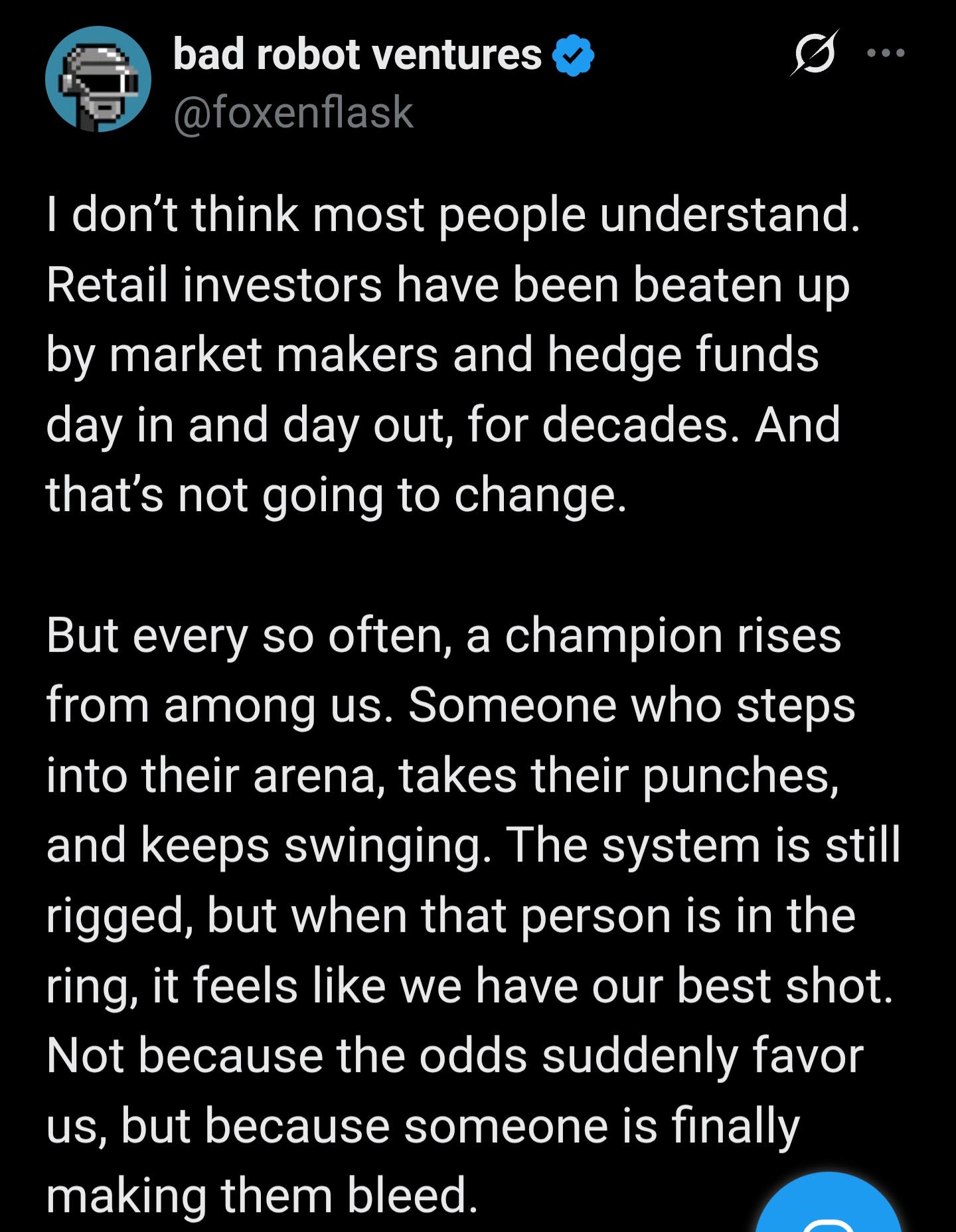
I concur

Post image
273 Upvotes

For a fleeting moment, we’re not just watching. We feel like we can actually fight back.

You don’t have to care about Kitty, but understand why I do. I’m usually the first one to ask people to focus on the data and what’s tangible. But this isn’t about valuations or logic. It’s about seeing one of our own go toe-to-toe with people who usually seem untouchable. Someone they can’t easily dismiss, playing a game they’re used to controlling.

It’s one of us stepping into the ring with a barbed-wire baseball bat. That doesn’t mean he can’t lose. It doesn’t mean anyone following him is safe. But it means there’s a fight.

And it means that there will be blood. Step into the ring at your own risk.

1:25 PM · Nov 20, 2026

https://x.com/foxenflask/status/2123845316659020104?a=6vULrW7YNN1ixUt357A&s=20


r/GMEJungle • • 4d ago Bravo

DFV 👑 Game Cock Almost 6 years into it

Post image
129 Upvotes

My body is ready My body is ready My body is ready


r/GMEJungle • • 4d ago

They're Restructuring the Consolidated Audit Trail

Thumbnail
gallery
86 Upvotes

Washington D.C., Nov. 20, 2026 —

The Securities and Exchange Commission today issued a proposal to address the inefficiencies in the current governance and funding model of the Consolidated Audit Trail (CAT). The Commission is proposing to rescind Rule 613 of Regulation NMS, which obligates the national securities exchanges and national securities associations (SROs) to establish, implement, and maintain the CAT. In its place, the Commission proposes to require SROs and broker-dealers to record and electronically report to the Commission or its designee substantially the same information currently required to be recorded and reported pursuant to current CAT requirements. This proposal would bring the CAT under the SEC’s direct control, while ensuring its continued operation with minimal disruption.

The proposal came as a result of the comprehensive review of the CAT directed by SEC Chairman Paul S. Atkins and follows exemptive relief and approved amendments that have, among other benefits, helped reduce the CAT’s projected annual operating costs by over $100 million and permanently eliminated the reporting of personally identifiable information to the CAT. In April, the Commission issued a concept release soliciting public comment on the CAT. In public comment, both investors and market participants voiced support for the Commission exercising more control over the management and funding of the CAT.

“Today’s proposal addresses persistent concerns with cost overruns, funding, and governance of the Consolidated Audit Trail. The proposed rule would encompass the changes that we have already made towards rightsizing the CAT, including increasing its cost-effectiveness and eliminating the collection of personally identifiable information. The proposal is intended to put the CAT on a sustainable footing: accountable in its governance and disciplined in its costs, to the benefit of our markets and those who participate in them,” said Chairman Atkins.

The CAT supports regulatory efforts to administer and enforce the federal securities laws, but the decentralized governance structure established by the CAT NMS Plan has presented certain challenges to administering the CAT and warrants revisiting. The proposal would rescind Rule 613 of Regulation NMS and add new Rule 17a-26 under the Securities Exchange Act of 1934, requiring SROs and broker-dealers to record and electronically report to the Commission or its designee substantially the same information that is currently required pursuant to current CAT requirements, such as Rule 613, the CAT NMS Plan, related SRO compliance rules, and related exemptive relief previously issued by the Commission. Proposed Rule 17a-26 would require that data to be reported to the Commission or its designee instead of to a CAT system independently administered by the participants under a national market system plan. The Commission intends to use funds appropriated by Congress to pay the Commission’s costs relating to use, operation, and maintenance of the CAT system.

The public comment period will remain open for 60 days after publication in the Federal Register.

###

Last Reviewed or Updated: Nov. 20, 2026

https://www.sec.gov/newsroom/press-releases/2026-117-sec-issues-proposal-restructure-consolidated-audit-trail


r/GMEJungle • • 4d ago

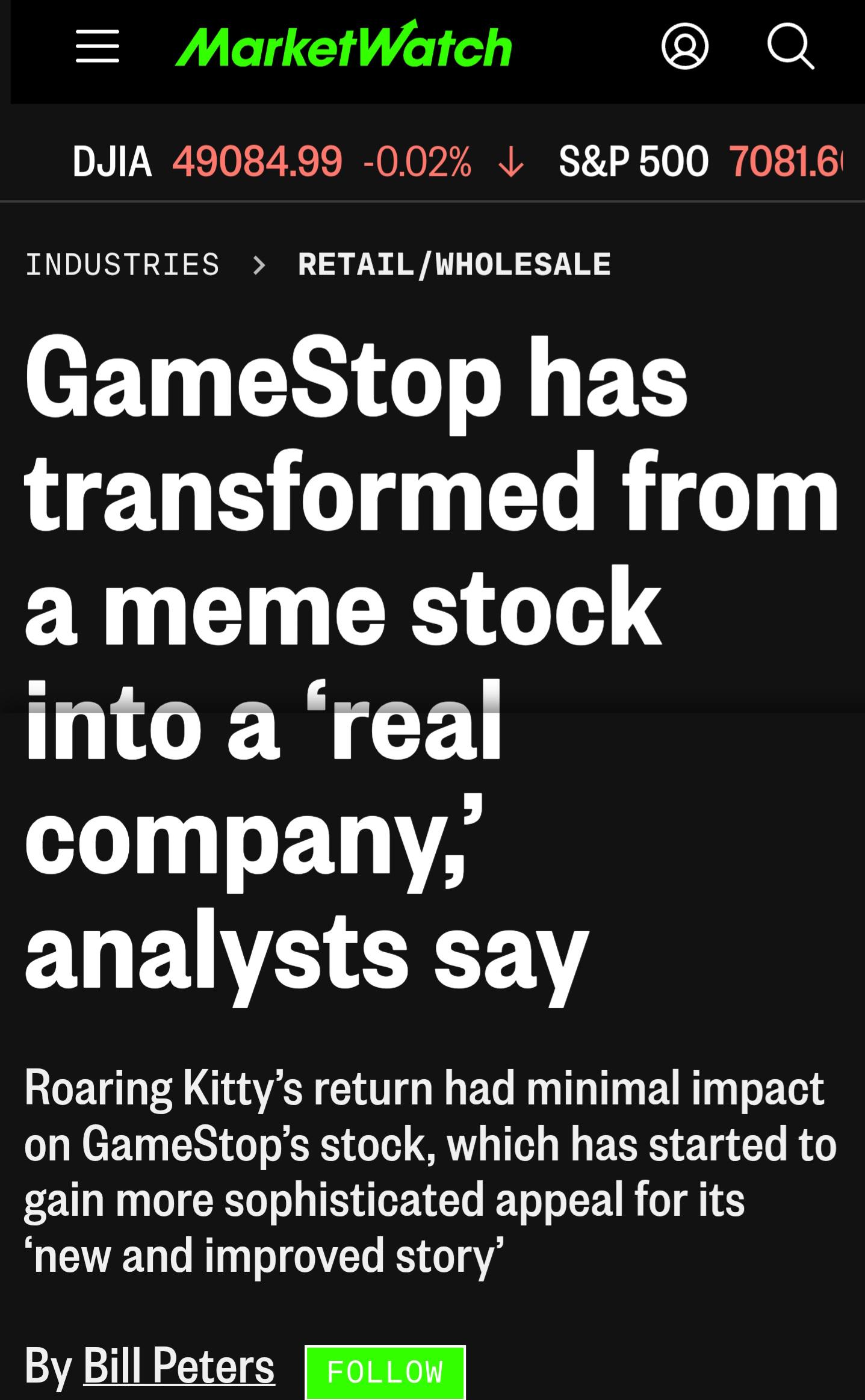
GameStop has ransformed from a meme stock into a real company, analysts say

Post image
159 Upvotes

After Roaring Kitty’s reawakening on Thursday nudged GameStop’s shares only modestly higher, some analysts are declaring the meme trade dead for the videogame and collectibles retailer.

The chain, after being cast off by many analysts, no longer needs to rely simply on meme-stock energy for gains, according to Mike Hickey, an analyst at StoneX. Rather, shares stand to benefit from the ongoing collectibles boom and the launch of “Grand Theft Auto VI,” as gamers download the game and upgrade their equipment to play it.

“It’s a real company, and it’s trading at what we think is a very undervalued price,” Hickey said of GameStop.

When his firm previously covered GameStop, it had a sell rating and a price target of zero, he said. When the chain was swept up in the meme-stock frenzy, they stopped covering it, he noted: “But that trade is over.”

I would like to receive updates and special offers from Dow Jones and affiliates. I can unsubscribe at any time.

Few analysts cover GameStop. But StoneX this month initiated coverage of GameStop shares with a buy rating and a $33 price target. Analysts there noted that the company, which over the years had closed hundreds of stores, stood to gain from select reopenings announced in September.

“September’s announcement of selective U.S. store reopenings adds a new growth catalyst, while expanded collectibles space and dedicated fixtures could improve productivity within existing locations,” the note said.

Dan Ives, senior managing director at Yorkville Ives & Co., echoed the optimism.

CEO Ryan Cohen “is turning GameStop into a collectibles story with massive efficiency,” he said over email. “This is no longer a meme stock; it’s in the process of becoming a new and improved story.”

He added: “GameStop will still have many retail fans but we see it as a very undervalued asset.”

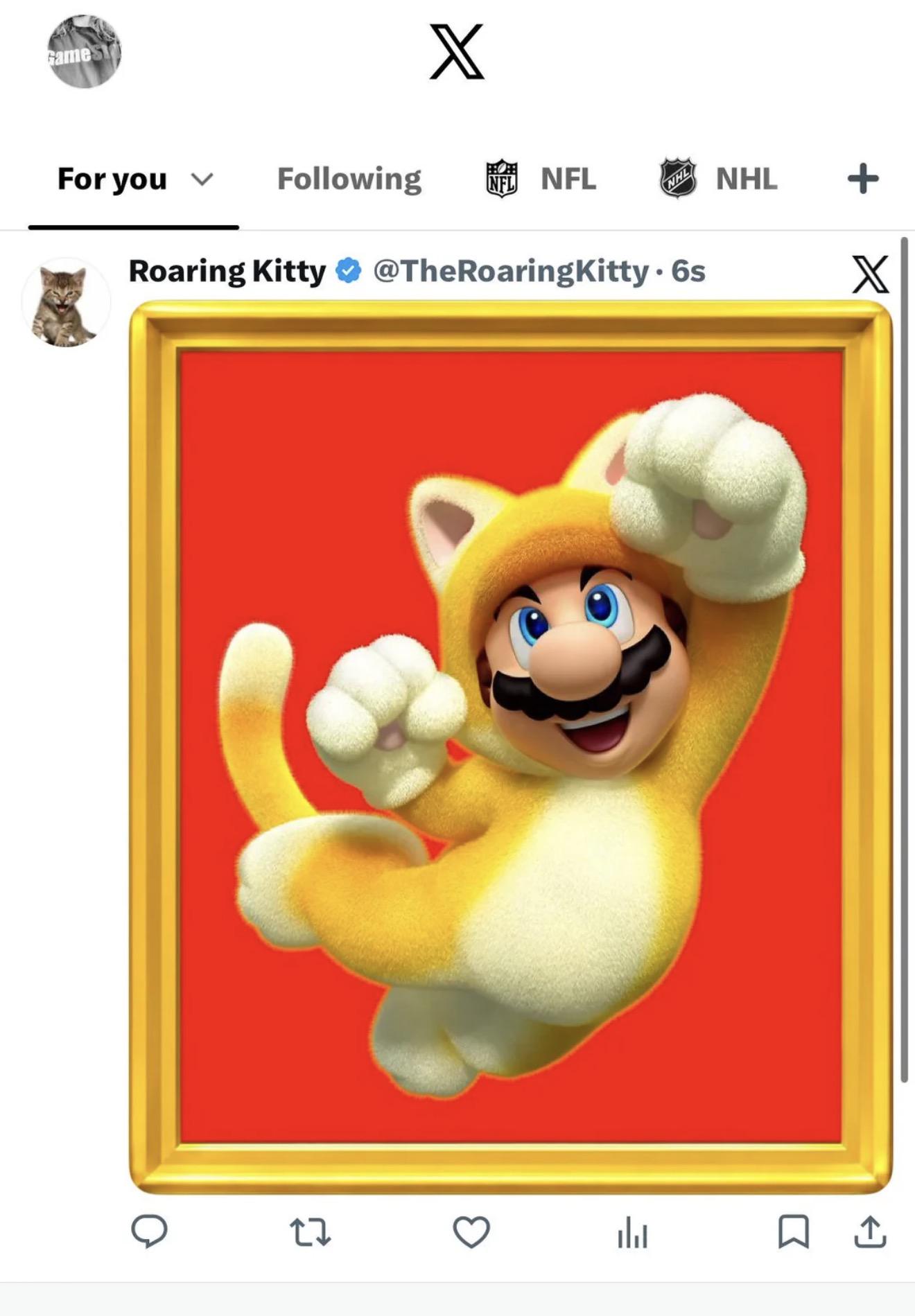
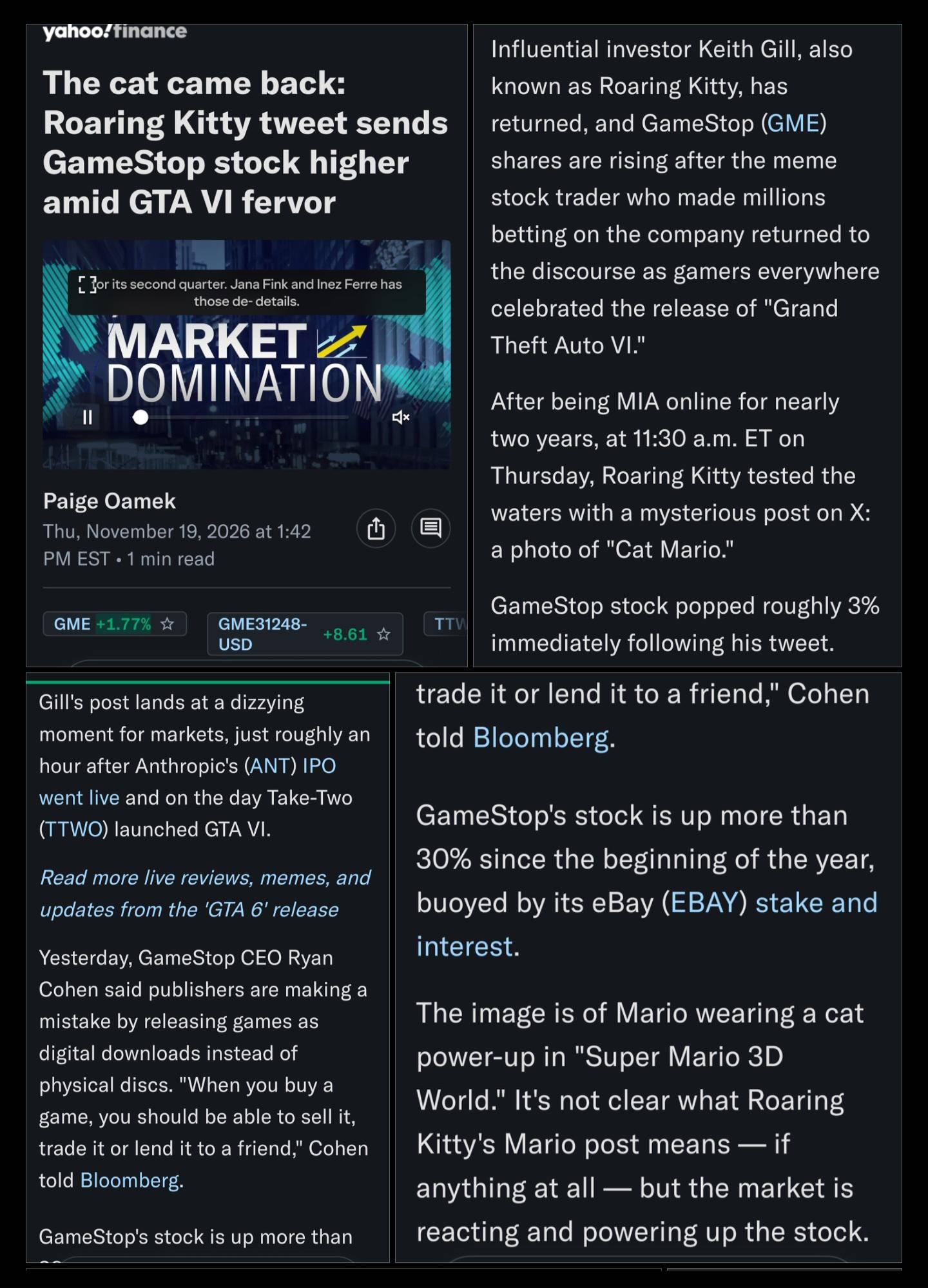
On Thursday, a new post showing a picture of Cat Mario, appeared on the X account for Keith Gill, the investor known as Roaring Kitty, whose enthusiasm for GameStop created a retail-trading stampede into the stock in 2021. At the time, that ruined short sellers’ bets against the company. But unlike previous spikes that followed arcane posts in years past, shares of GameStop only rose around 1.5% on Thursday.

Over the stock’s roller-coaster journey since 2021, analysts have cast doubt on GameStop. They have cited losses, uneven sales, disruption from e-commerce and a shift toward online gaming. There are also general concerns about the videogame industry’s ability to sustain demand as consumers struggle with higher prices for essentials. Some analysts have predicted that the chain might not survive the 2020s. And Wall Street questioned GameStop’s efforts to buy or otherwise collaborate with eBay

 In the second quarter, GameStop’s sales fell 18.7% to $790.2 million. But revenue from collectibles — things like trading cards and action figures — jumped 57% and made up 45.1% of sales.

GameStop in September also raised its forecast for adjusted earnings before interest, taxes, depreciation and amortization — a profitability metric — to more than $650 million for its full fiscal year, which ends on Jan. 30.

The collectibles market has taken off thanks to nostalgia and the card industry’s focus on rarities and limited drops. Quarterly sales of “Magic: The Gathering” have risen past $600 million, Hasbro,

which makes the game, said last month. Shares of collectible figurine maker Funko

 have roughly doubled this year.

Shares of GameStop are up 34% over that period, and trading at around $27. That’s still well off their 2021 highs. But Hickey still believes in the stock.

“There’s really no other stock that you can buy that gives you that much exposure to collectibles, which we think is a durable opportunity,” Hickey said.

“When we’re out there talking to people, the first thing that people ask is, ‘Are you serious? Isn‘t that a meme stock?’” he added. “We’re serious as serious gets, and no, it’s not a meme stock.”

About the Author

Bill Peters

Follow

Bill Peters is a Los Angeles–based MarketWatch reporter.


https://www.marketwatch.com/story/gamestop-has-transformed-from-a-meme-stock-into-a-real-company-analysts-say-7ae5c7ed?mod=dist


r/GMEJungle • • 5d ago Bravo

💎🙌🚀 Roaring kitty new post on x

Post image
468 Upvotes

r/GMEJungle • • 5d ago

That was fast

Post image
68 Upvotes

r/GMEJungle • • 6d ago

Robinhood opens a position in GME

Post image
448 Upvotes

r/GMEJungle • • 6d ago

GameStop "Can't steal a disc with a flashlight" claims that GTA 6 download codes can be seen through sealed boxes with a flashlight and went viral - per dexerto

Thumbnail
gallery
145 Upvotes

r/GMEJungle • • 6d ago

Exclusive: GameStop CEO Ryan Cohen lambasts game publishers for going discless on the eve of GTA VI's release. "Unquestionably, the decision to move o all digital has hurt onsumers, and it's also hurt GameStop."

Thumbnail
gallery
115 Upvotes

r/GMEJungle • • 6d ago

PlayStation Network is down as GTA 6 is set to release

Post image
211 Upvotes

r/GMEJungle • • 8d ago

Ryan Cohen

Post image
371 Upvotes

r/GMEJungle • • 8d ago

No wonder I had issues 😳 Downdetector reports user issues at major US banks

Thumbnail
gallery
61 Upvotes

r/GMEJungle • • 8d ago

Gme Q3 filings

Post image
61 Upvotes

r/GMEJungle • • 9d ago

💎🙌🚀 Weekly $GME Discussion Thread

24 Upvotes

This is the Weekly $GME discussion thread

Happy Monday, everyone! This discussion thread is posted Monday at 12:00am Market time.

If you are looking to learn more about the stock market, custody, and how to protect your investments – you are in the right place!

Retail investors have been on a long march to understand more about the markets and the at times bizarre ways in which they operate. Here are some key takeaways and resources.

What is GMEJungle?

GMEJungle is a investing community focused around GameStop, and was founded as an offshoot of other GME communities. GME is a private subreddit, and only approved members can submit posts or leave comments - but anyone can browse the discussions that take place here.

What’s this all about?

Retail Investor Rights and Advocacy. The current market structure involves a centralized securities depository for ease of settlement and for access to liquidity. That depository maintains technical ownership rights for the vast majority of all outstanding shares of all publicly issued companies in the United States. Simply: You do not have direct ownership rights of shares you own through a broker.

What is DRS?

DRS is a system by which shares are transferred between the DTC (Depository Trust Company) and Transfer Agents. Shares held at DTC include all brokerage holdings, and shares held at Transfer Agents are held directly on the issuer ledger in the name of the investor. Colloquially, DRS also refers to shares which individual investors have decided to own in their own names.

What are some pros of DRS?

You have confidence that your shares are owned by you, and are there when you need them. You can more easily submit shareholder proposals, request and view company documents, and communicate with agents of the company. You know that you will be able to both cast your vote and have your vote counted when participating in votes. You can receive a more favorable tax status on received dividends. You can directly engage with your company and they can directly engage with you.

What are some cons of DRS?

You can’t easily use equity in DRS for margin trading like you can with shares in a brokerage account. Holding in a broker has more ‘anonymity’ as the public has no way to know your holdings or PII, while holding in DRS is comparatively more public. Depending on which transfer agent the company uses, investor access to liquidity may be limited.

What a Transfer Agent?

A Transfer Agent is a company which specializes in managing ownership ledgers and providing shareholder services. Every public company must have a Transfer Agent. GameStop uses Computershare, an established professional and market leader trusted by thousands of companies around the world.

What is the DTC?

DTC is a Self Regulatory organization which controls the nominee Cede and Co, which is the entity which has the material ownership of most public shares as described above. DTC is one part of the DTCC, alongside other bodies including the NSCC. The DTCC is essentially a monopoly on both clearing and settlement in the American markets, one which has been sanctioned by regulators to perform it's duties.

How do I DRS?

The answer can vary. For help DRSing GME from over 150 brokers, both American and from around the world, check out these Community-sourced detailed broker guides. Select your broker from the dropdown to get to the guide, which will walk you through the process including how to get started, how to communicate to your broker, what fees might exist and what cheaper alternatives there are (if any). If your broker isn’t listed here, reach out to the site and we can work together to improve the community resources.

Where can I learn even more?

Computershare has an extensive FAQ page which is excellent and covers a lot of ground regarding how holding your investment directly on the issuer ledger works in practice.

Two community-built websites that are full of free resources and information are www.DRSGME.org, which has a variety of information specific to GameStop including the broker guides linked above, and www.WhyDRS.org. WhyDRS is an open source platform built to provide general assistance and information about custody and finance reform, along with key information on the many thousands of U.S. publicly traded companies.

The WhyDRS Database is an extensive, free, open source repository of various contact information for all publicly traded securities.

The WhyDRS Information Packet covers a wide variety of information about DRS and was put together ahead of when some WhyDRS advocates participated in an interview with Chairman Gensler in 2023. https://www.whydrs.org/the-whydrs-information-packet

Types of Holdings: Book-Entry vs Book vs Plan vs Certificate

You may see these terms when referring to share ownership. In short:

Book-Entry means any share that is electronically tracked in a ledger rather than being held on physical paper.
Book and Plan are two labels for shares that are used in Computershare's Investor Center.
Book shares (DRS) are fully owned by the investor. Plan shares (DSPP) are owned by Computershare’s nominee, with the investor’s name appearing on the ledger in a subclass. Part of Plan shares are kept with DTC for Operational Efficiency. Exact custody chain details are provided by Computershare and quoted below. Both DRS and DSPP shares are book-entry. Certificates, meanwhile, are still tracked by the TA but have a sanctioned physical certificate associated with that share.

"Purchases made through the issuer (or its transfer agent) of securities you intend to hold in DRS are usually executed under the guidelines of an issuer’s stock purchase plan, which uses a broker-dealer to execute the orders. Thus, to hold in DRS once the securities are acquired, you would need to instruct the transfer agent to move the securities from the issuer plan to DRS." - SEC Bulletin 7/12/23

"Purchases made through the issuer (or its transfer agent) of securities you intend to hold in direct registration are usually executed under the guidelines of the issuer’s stock purchase plan. You’ll need to instruct the transfer agent to move the securities to the DRS." - FINRA Investor Insight 7/12/23

If you are an investor seeking total ownership of your assets, both SEC and FINRA agree that holding in directly on the issuer ledger and in your own name is the only way. Holding shares with the issuer's transfer agent in an investment plan is more direct than holding with a broker in terms of named ownership - with DRS holdings even more so. Shares held with a Plan are not DRS - they are held by the TAs nominee (for Computershare, this is Dingo and Co), and must be transferred out of the plan and into DRS. This is explained by Computershare on their FAQ page under ‘chains of custody’. This question was one of several asked by the WhyDRS.org community in early 2024, and we appreciate Computershare for providing a detailed answer. Their whole FAQ page has a ton of information, and is useful for any investor looking to know more.

Q: “Can you outline the chains of custody and ownership for Pure DRS and DSPP shares enrolled in the DirectStock Plan? Please specify how names are recorded 'On the Ledger' in different holding scenarios. (added 5/16/24)"

A: "The first part is a very straightforward answer. There is no ‘chain of custody’ for DRS or Pure DRS. Investors hold the shares in their own name. There is no intermediary. Computershare’s role here is solely as a transfer agent (i.e., the agent of the issuer).

For the DSPP, we use a Computershare nominee to hold the underlying shares. For the largest portion of the plan holding (80%-90%), these shares are held on the register in the main class. So the chain of custody is “CPU Nominee -> Investor”.

For the 10%-20% that we hold via our broker at DTC, the custody chain is “Cede -> Broker -> Computershare -> investor”. Notwithstanding this, all holding types are registered and held in the name of the investor in the sub-class.”

Is Buying through DSPP a Problem?

There is nothing wrong with purchasing through DirectStock if that is what makes sense for you, as it does come with some additional benefits. Many international investors buy GameStop through the plan because DirectStock is much more affordable than buying through a broker and paying them to do a DRS transfer. The fee for DirectStock is $5 and some international brokers cost hundreds of dollars to DRS, so it's smart to use DirectStock in these cases. You can check your broker's DRS transfer rates on their guidepage at DRSGME.org. Other investors buy through DirectStock because they want to be able to schedule recurring buys, or would like to be able to buy in fractional shares and accumulate ownership in smaller portions over time.

If you choose to buy through the DirectStock plan, and want to ensure total ownership of your assets, manually terminate the plan after each purchase. This will leave your account with pure DRS holdings, but comes with the cost of selling off your fractional share - this is because only whole shares can be held in direct registered ownership. Because the proceeds will be reduced by the selling fee, it's likely you will receive $0 for selling the fractional share, though you will also not be charged as the fee cannot exceed the sale price. Here's the DRSGME guide on terminating DirectStock.

What is GameStop's Investment Plan?

GameStop contracts Computershare as a Transfer Agent to manage it's stock ledger and distribute shareholder materials such as proxy materials for the annual general meeting. Computershare offers several proprietary plan structure to interested companies, including a custom option called CIP (Computershare Investment Plan) and managed DSPs (Direct Stock Purchase) for other companies such as Home Depot in which the issuer can sell stock directly to investors. However, by far the most common plan offering that they have is called DirectStock, which is a Direct Stock Purchase Plan. The boiler plate DirectStock brochure is located here. GameStop uses the DirectStock plan.

Legacy Computershare DD Series (from 2021 to 2022)

This series was originally written by PinkCatsonAcid, who started this sub a few years ago. She recently deleted all her old posts, but content is still available through the Internet Archive. Research continued during and since these posts were originally written, and using more recent resources can be more reliable – some of the information shared in these posts is known now to no longer be accurate. However, these archives are provided here for posterity and completeness. All of these links are to the most updated archive available before the posts were deleted.

If you look through the archives, check out part 7 first. It reviews the misunderstanding running through earlier parts that book and plan designations were equal in terms of custody, which is now known to be untrue and was confirmed by Computershare.

Part 1, archived 9/9/24

Part 2, archived 4/5/24

Part 3, archived 1/28/25

Part 4, archived 8/6/24

Part 5, archived 1/16/25

Part 6, archived 2/5/23

Computershare AMA Part 1, archived 2/1/25

Computershare AMA Part 2, archived 2/1/25

Part 7, the Book vs. Plan Update, archived 1/22/2022

The Jungle is a restricted community and only approved members can post and comment.

We are not accepting requests for approval at this time

Keep it groovy or leave, man! ✌

Tag mods and use the report feature if you have issues


r/GMEJungle • • 10d ago

💎🙌🚀 The Key To Good Investing Is To Continue To Ask Questions

38 Upvotes

r/GMEJungle • • 10d ago

WS status change - delisted to worthless

Post image
6 Upvotes

r/GMEJungle • • 11d ago

1M shares on Chicago

Post image
85 Upvotes

r/GMEJungle • • 12d ago

RC interview with Dan Ives ✨️Dan Ives' "biggest takeaway" from a lunch with GameStop Corp NYSE:GME) CEO Ryan Cohen

Thumbnail
gallery
100 Upvotes