r/HomeworkHelp • • Sep 11 '26

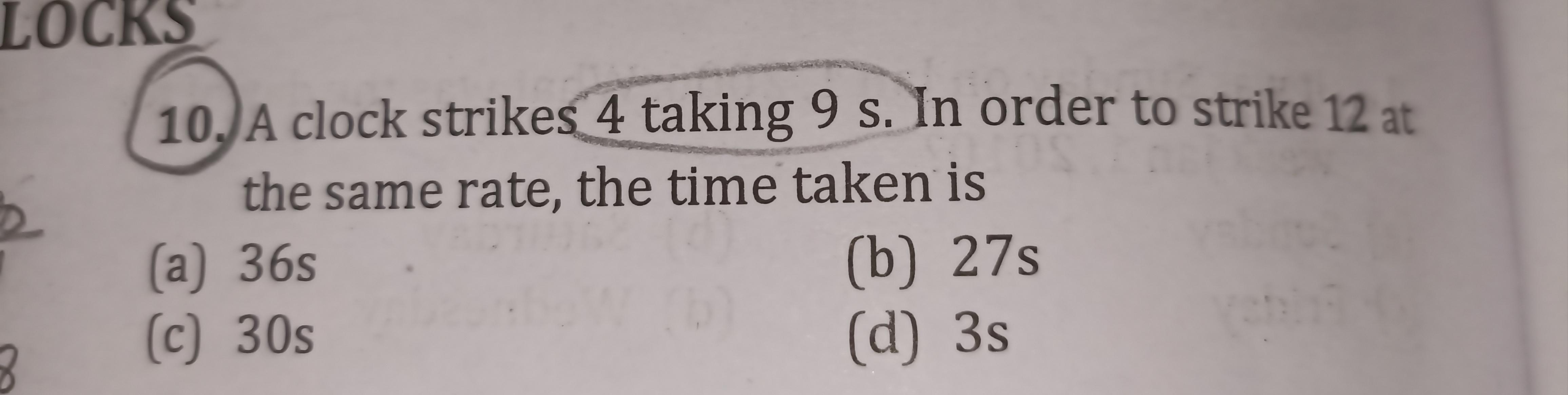
Answered [middle school math] shouldn't the answer be 33?!
Post image

(i got it guys 😭🄹 there's too many answers I'm not able to keep up so thank u already but i got it 😭) Since there's an interval of 3 seconds between each bong shouldn't 33 seconds be taken for it to strike 12 times? There will be 11 intervals and each interval is 3 seconds so 11*3=33, right?!

Edit: thank you so much gng, I kinda understand why the answer would be 27s, and i thank everyone for explaining both how my logic was sound as well as the other ways one could approach this problem.

So 9 seconds for 4 bongs would not strictly only include the time immediately after that last bong bongs (😭), but also include the resonance of that bong. As in, we must assume in this scenario that the bongs are not short/immediate, but carry on for a short amt of time.

In this scenario, the amount of time 1 bong takes (assuming that the next one starts immediately as it's resonance fades out) would be 9/4 seconds.

This multiplied by 12 gives is 27 which is the answer ✨

164 Upvotes

190 comments sorted by

View all comments

201

u/VirusAlternative132 Sep 11 '26

I think it's easier to calculate this using the entire segment of time it takes the hand to strike 4. So in 9s the hand goes to 4, in another 9s, the hand would strike 8, and in yet another 9s, the hand would strike 12. So 9s+9s+9s=27s

105

u/RadiatorSam Sep 11 '26 edited Sep 11 '26 • Bravo

I think OP is getting confused with the fencepost illusion. If you think of the bongs as being instantaneous then the time is taken up by waiting to hit the bell again. If it goes Bong-wait-bong-wait-bong-wait-bong (4 hits, 3 waits) then your time is mostly just wait time and the wait time is 9/3=3 seconds. If you were to do 12 you would then have 11 waits so 33 seconds.

I think the question (by looking at the answer options) is assuming there is no wait time between bong hits (lol) and the bell rings for a duration of time, it that case you need to divide the whole time by just the number of hits (4) and your method applies.

21

u/TheThiefMaster Sep 11 '26 edited Sep 11 '26

I think it's assuming the duration of one "bong" (from hit to fading out) is 2.25 seconds.

14

u/RadiatorSam Sep 11 '26

Yep that's what I'm saying. The question is a bit vague in the asking, but I guess part of the skill of answering it is looking at the available options to tell you what assumptions to make.

7

u/TheThiefMaster Sep 11 '26

You said "no wait time between bong hits". There is a wait between the hits - it's 2.25 seconds. But that wait is also put on the end because it takes that long for the bell to fade out too.

bong-fade-bong-fade-bong-fade-bong-fade
\------------- 9 seconds -------------/

14

u/ThunkAsDrinklePeep Sep 11 '26 edited Sep 11 '26

You guys would say the clock hasn't struck 4 until the fourth bong has faded?

OP isn't falling for the fencepost * "illusion"; they're correct. Unfortunately, this is just a poorly written ratios question. As others said, the "at the same rate" and lack of 33 as an answer are good clues to the authors intent.

To clarify: it doesn't matter how long the clock bongs ring or the length of silence between them. They are all intervals after the strike of the clocks hammer on the bell, which for our purposes is an instantaneous moment, like a clap. Clapping and clock striking are both fencepost problems.

Related viewing: the famous clock race scene in Chariots Of Fire.

12

u/[deleted] Sep 11 '26 edited Sep 11 '26

[removed] — view removed comment

4

u/Confusedlemure Sep 11 '26

Really like your interpretation here. I’m old enough to remember counting the strikes from another room. You really don’t know the time until the ā€œlackā€ of another strike. But what about at 12? In that special case you know the time instantly after the last strike. I suppose you can argue that for all other cases you must wait for the fade so that sets the ā€œstandardā€.

→ More replies (1)

2

u/Beefington Sep 11 '26

You’re talking about how long it takes to interpret the information. u/Kite42 is right that 12 is a special case where you know it won’t continue, but also the interpretation time is irrelevant to the original question, which asks how long the striking takes. If it’s 5 o’clock, the clock is done as soon as the clapper hits the bell for the 5th time.

(Kite is also right about hating these ambiguous questions 😣)

3

u/ThunkAsDrinklePeep Sep 11 '26

I see what you're saying, but I dusagree. That's just not what the phrase "the clock strikes x" means. If you were timing the clock, you would stop not on the fourth strike, but the moment you should have heard a fifth?

→ More replies (3)

3

u/Kite42 šŸ‘‹ a fellow Redditor Sep 11 '26

Ah, but at the moment of hearing the twelfth bong you would already know the time, would you not, Mr Bond?...No need to wait for the fading out when it is 12 o'clock. 33 seconds will suffice.

I hate these ambiguous questions.

2

u/Responsible-Kale2352 Sep 11 '26

What’s the ambiguous part? It takes 9 seconds for 4 bongs to happen. How long for 12 bongs? You have three sets of bongs, each of which takes 9 seconds. 3x9=27. It seems really straightforward.

I’m not clear on what the length of fading out has to do with anything.

4

u/wildgurularry Sep 11 '26

Picture a timeline of the clock striking (|) and fading (-) four times:

|-----|-----|-----|-----

Now, is the 9 seconds from the start of that timeline to the end? Or is it from the start of the 1st bong to the start of the 4th bong?

|-----|-----|-----|

Depending on how you interpret the 9s, it makes a huge difference on the answer. The teacher/question is assuming it is the first situation, where the 9 seconds includes the fade time at the end. This gives the answer 27 as you have noticed.

OP is assuming it is the second situation, where the 9s is measured between the moment the first chime is struck, and the moment the fourth chime is struck. This gives the answer 33 for 12 strikes, as OP noticed.

The question is somewhat ambiguous. One could argue that the first situation is "obvious", and since it is multiple choice, you can quickly check to see which case they are looking for. I have to admit that when I tried the question in my head, I got the answer 33, so I argue that the first interpretation is not 100% obvious.

→ More replies (4)

1

u/WillowsEnd Sep 11 '26 edited Sep 11 '26

I was thinking the same thing and you put it very well.Ā  Clock chimes aren’t instantaneous unless you only are counting the start of the chime as the moment of interest but that isn’t realistic for a clock. Like, yeah, when you are telling time from a clock chime you aren’t done til it fades away to determine there isn’t another afterĀ 

1

u/-Majgif- Sep 12 '26

I think you are working under a false premise. It has struck 4 as soon as it hits the gong the 4th time. Whether you know it or not until you wait for the absence of the 5th is irrelevant.

Regardless, they're asking about the time to strike 12. As there's no 13, there's no need to wait.

5

u/fermat9990 šŸ‘‹ a fellow Redditor Sep 11 '26

Then OP is actually not getting confused, they are just choosing a particular interptetation of the physical situation.

2

u/i-stubbed-my-toe- Sep 11 '26

Thanks for this reply, RadiatorSam. ✨

1

u/RadiatorSam Sep 11 '26

No prob :)

2

u/MaesterPraetor Sep 11 '26 edited Sep 11 '26

I think you're over thinking it. It's middle school. They want you to thinkĀ 

4x=9.Ā 

So x=9/4.

12x=y.

12/1*9/4

129/14

108/4

27

Edit: didn't read the entire comment.

1

u/bstump104 Sep 12 '26

the OP on this thread is not considering the ringing of the time. They are considering it takes 9 seconds to reach 4, so in 9 more seconds it will reach 8, not 3 hours 59 minutes and 51 seconds later how much time will the ring take to declare it is 8.

Selecting the correct interval of "bongs" would be very difficult as there isn't enough information to determine that. You need to know the interval and the die off. It could be 0.5 s per "bong" and then 7.5 s to die off. maybe its 1s per bong and 6s to die. Both if those greatly change the answer. To determind it this way you need at least 2 different points of reference.

I think the question fails because it doesn't tell you where it started.

3

u/Torrasque67051 Sep 11 '26

I just did cross multiply:
T / 12 = 9 / 4
T x 4 = 9 x 12
T = 108 / 4
T = 27

1

u/Odd_Science Sep 11 '26

Yes, that's what you get when you mindlessly plug the numbers you are given into operations that look vaguely correct without actually thinking. Then it's really easy.

1

u/PrincessYuri Sep 11 '26

Alternatively, if you're more numerically minded, you can just let the units guide you. (9 seconds/4 numbers) * 12 numbers. The numbers unit cancels out and you just end up with 27 seconds. It's similar to how you can lowkey check your work in a lot of science and engineering calcs if you make sure the units align with what you would expect.