We used to think that the Yamnaya were on horseback at one time for warfare, but now we know that they only used it for herding. Does this change the horses role in spreading IE?
Also, did the Yamnaya farm for different plants than the people that they conquered, and did they have access to different domesticated animals?
"The Lisakovsk burial complex belongs to the Bronze Age and forms part of the Andronovo cultural horizon. More than 200 burials associated with the Sintashta, Petrovka, Alakul, and Fyodorovo archaeological cultures have been excavated over the course of 35 years of fieldwork. Some of these burials have been identified as female on the basis of anthropological data and the decorative characteristics of personal ornaments, comprising a total of 25 graves. The overwhelming majority of the female burials belong to the Alakul culture (ca. 1750 BC), while a single burial is attributed to the Petrovka culture (ca. 1950 BC). The article presents an analysis of the grave goods and ritual features of the female burials, on the basis of which a symbolic model of the funerary rite is reconstructed. The results indicate the existence of several groups of women within the Bronze Age Lisakovsk community, differentiated by age, occupation, and leadership status. The principal element of the grave assemblage is a headdress with a nakosnik (hairdressing decoration or braid adornment). In one of the burials, weaving implements and ritual features indicate the interment of a professional weaver. The leadership status of another woman is reflected by the presence of a knife-dagger and by the placement of her grave within the central kurgan, which was surrounded by a ditch containing children’s burials. Markers of women’s social status were incorporated into the funerary rite and became part of the collective memory that contributed to the preservation of behavioural norms and the regulation of social relations."
This book, which draws on Lisa Bendall's lectures over three decades, provides an engaging and accessible survey of everything students need to know to read and understand texts in Linear B. As John Chadwick noted, the Linear B scholar must be 'not just an epigraphist, not just a linguist, not just an economic historian and archaeologist; ideally he or she…must be all these things simultaneously'. Volume 1 introduces the student to the writing system and the language, especially the phonology and morphology. It also explains the formal aspects of the documents and gives guidance on the tools available to the student and scholar. Volume 2 will provide a guide to using the documents to understand the Mycenaean world.
Provides a step-by-step introduction to Linear B, assuming no prior specialist knowledge, to give students confidence to read and understand the documents themselves
Covers all the areas required to understand the documents, from philology to archaeology, so that students from different subject backgrounds are catered for
Draws on the lectures given by the author over three decades and so is well-attuned to what the beginning student needs to know
Do we know anything about how the Vedas' meaning became forgotten over time, and how it became decipherable and known once again? At what age did the meaning behind it become forgotten?
When the Odyssey and Iliad were written after 1200 BC, were their meanings ever lost over time, or was the meaning behind them always known?
I'm not a linguist, nor an academic. I'm just a guy with some curiosity. I've been trying to understand the relation between the Anatolian languages and PIE.
As far as I understand (please correct me if I'm wrong), Anatolian is an early branch of PIE that has archaic features and does not have the innovations of later Indo-European languages.
I've also read that PIE ablaut came as a result of the elision of unstressed vowels (that might be an oversimplification on my part).
So my question is: in terms of language evolution, where exactly was Proto-Anatolian? Was that a pre-ablaut language? Or did it also have traces of the ablaut system?
Abstract - South and Southeast Asia represent geographic crossroads of immense ethnic, cultural, and genetic diversity. However, the Rohingya, an ethnic group primarily indigenous to the Rakhine State of Myanmar and speakers of an Eastern Indo-European language closely related to the Chittagonian dialect of Bengali, remain one of the least genetically characterized populations in the region. While recent massive displacements driven by regional policies have drawn significant global attention to their socio-political and public health challenges, the deep biological history and evolutionary trajectory of the Rohingya have remained largely unexplored. To address this critical gap, we generated the first high-resolution, genome-wide dataset for Rohingya individuals and individuals from neighbouring regions, contextualizing them against 2,217 reference samples from across Eurasia. Our comprehensive genomic analyses reveal that the ancestry of the Rohingya aligns robustly with their linguistic affinity, comprising a major South Asian foundational lineage admixed with a minor but significant Southeast Asian component. Specifically, following the historical settlement of their ancestors in the Arakan region, the Rohingya experienced localized gene flow from surrounding Tibeto-Burman-speaking communities. This introgression resulted in a significantly elevated East Eurasian ancestry compared with neighbouring Bangladeshi populations. Furthermore, we identified unique signatures of genetic adaptation and putative disease associations specific to the Rohingya genome. These findings provide unprecedented insights into the admixture dynamics and biological history of a highly marginalized population, underscoring the critical value of genomic data in illuminating both the evolutionary narratives and the ancestry-informed health profiles of vulnerable communities.
"Once labeled the “Dark Ages” of Anatolian prehistory, the Chalcolithic period (c. 6000–3000 BCE) was characterized by drastically reduced settlement densities compared with the preceding Neolithic and the succeeding Bronze Ages, a change interpreted as population decline. Using 44 new genomes combined with published data, we find no evidence for a population reduction. The genetic evidence instead suggests that populations in Chalcolithic Anatolia were increasingly mobile and/or growing in size while receiving gene flow from eastern regions (e.g., East Anatolia and the South Caucasus) through a 3,000-year-long admixture process. We propose that genetic and archaeological evidence may be reconciled by hypothesizing the presence of communities with dispersed and mobile lifeways that are mostly invisible to archaeology. These communities also practiced consanguinity at frequencies unobserved in previous periods. Finally, we identify a mid-5th-millennium BCE individual in Central Anatolia carrying ∼10%–30% Pontic-Caspian Steppe-related ancestry, shedding light on mobility between the Eurasian Steppe and Anatolia."
Okay so, while not entirely Indo-European, the Eastern Hunter Gatherers were a major contributor to the Western Steppe Herder genetic pool and while theories on what they brought into the Indo-European culture vary, they almost certainly left some contribution, and so I hope this post fits this place, as I can find no other to properly post this.
The EHG people lived in Eastern Europe from some 12,000 BCE until at least 5000 BCE, surviving mainly as hunters and are for sure the center of my ancient history interest. Now, the Shigir Idol is the oldest known wooden carving in the world, being discovered near present-day Kirovgrad and dating to about 9500 BCE. I've tried to connect the dots between Shigir Idol and its potential creators, but the only group I can place decently near are the EHG, though their closest site to the idol is some 600 km away.
Do you think its plausible that the EHG people are the authors of Shigir? And if so, is there anything we can learn from it in relation to the later Indo-European mythology?
The book is an interdisciplinary study on P ythian Three, Nemean Three and Nemean Five , three Pindaric epinicians, which share a special use of the word τέκτων, ‘fashioner’. In these victory odes, the term τέκτων refers to creators of immaterial objects and occurs close to the first and/or the final words of the poems, in connection with key themes, namely: health, poetry, choral performance, movement as opposed to stasis. The study shows that structures in which Pindaric metaphors are found have parallels in Indo-European languages of ancient attestation: Old Indic and Avestan. In doing so, the book casts new light on Pindar’s language and the stylistic features of his odes, which are in a relation of historical continuity with phraseological and structural characteristics of religious hymns of Ancient India and Iran. The study reveals that * tetƙ- metaphors and “* tetƙ- compositions”, i.e. metaphors and ring-compositions built by means of repetitions of “* tetƙ- words” (Vedic takṣ , Avestan taš , and Greek τέκτων), have a deep meta-thematic relevance in three linguistically related traditions and are an inherited phraseological stylistic feature common to Ancient Greek and Indo-Iranian poetic creations.
“We build upon the QuantWealth framework (Nørtoft 2022) and apply it to a data set of more than 300 graves for a multivariate estimation of wealth display and inequality in the Corded Ware culture (CWC) in Czechia. Our multivariate wealth proxies include exclusivity, labour skill-time, material source distance, grave pit depth, and meat expenditure. We explore their correlations with PCA, map resource networks, and we statistically test hypotheses from observed wealth patterns. We argue that absolute inequality measures most effectively show changing social structures over time and integrate available bioarchaeological data to assess if grave wealth display coincided with health (embodied wealth), genetic ancestry and haplogroups (relational wealth). We find that wealth display increased gradually over time as resource networks expanded in the Bohemian CWC, while the Moravian CWC displayed the most wealth, and had more extensive resource networks, primarily in its middle phase. We propose an initial cooperation phase in which people in the Bohemian CWC, organized in mixed migrant patrilines, were more egalitarian with gerontocratic tendencies, and built mounds and networks as they populated Bohemia after a severe climate event. Middle-phase Bohemian CWC showed more competition and inequality in wealth display, possibly via funerary feasts, with increased representation of young male adults, and with potential power struggles between patrilines. In the late phase, patrilines narrowed to primarily one, suggesting dominance over previous lineages. We do not find that biological close-kinship, genetic ancestry, trauma, disease, or childhood malnutrition correlated with burial wealth display or inequality. Thus, Czech CWC society may have had high social mobility and celebrated achieved wealth, with possible emerging traits of persistent inequality in the late phase in both Bohemia and Moravia.”
"Domesticated approaches the past through novel archaeological methods to rewrite the existing narrative of the rise of social complexity in the grassland steppe. Each chapter tracks the trajectories of human societies after they adopted cultivated species, to demonstrate how domesticated animals and plants impacted populations, interactions, and social organization. Economies shifted from hunting and gathering, to the adoption of ruminant livestock and dairying, to horse dairying and riding, and finally to the cultivation of grains. A model is proposed that demonstrates how domestic species were integrated into societies. Through the management of cultivated species and alteration of landscapes, communities in north-central Asia built complex societies and long-distance Silk Road networks, which linked cities and supported empires."
While the headline "Celtic from the East" alongside the Tumulus/Urnfield expansion has been the main take home of this paper a discussion buried deep in the supplementary raises more questions that it answers - Where did the Tumulus/Urnfield population come from?
Let's set the scene.
The core aDNA finding of the paper is that the corded-ware ancestry Únětice culture in Eastern Central Europe was wiped out by a migrating Bell-Beaker ancestry group who go onto form the Tumulus/Urnfield Cultures and this ancestry spreads across the "Celtic" zone of europe.
But where did these migrating Bell-Beaker ancestry people who became the Tumulus/Urnfield Cultures come from?
This Knovíz Tumulus/Urnfield population contains three aDNA signals:
A small Hungary–Serbia BA-related ancestry.
The small Hungary–Serbia BA-related ancestry is pretty clear and only enters central and western europe in the BA after the fall of Únětice. Its origin is clear seems to be one or other or all of the bronze age cultures of the Carpathian basin associated with the development of the bronze age swords.
As this ancestry is not found in Central and Western Europe before this period is can be used to mark a movement of ancestry from Eastern Central Europe to Western Europe from the Mid-late BA to Iron Age. This is the "Celtic from the East" signal.
2) A large Bell Beaker derived ancestry they term "Knovíz".
This is the problematic signal. This is the major ancestry to enter Knovíz and replace the Únětice and so the authors call it "Knovíz". It doesn't come from the Carpathian basin but is already found all across the central and western "Celtic" zone from the early BA with the highest level in France. This means that despite this ancestry being the main ancestry entering Knovíz after Únětice it is difficult to see either its origin or its subsequent spread westerwards.
For the subsequent spread westerwards this doesn't matter, the Hungary–Serbia BA-related ancestry can be used to see that.
However working out where this main ancestry come from is very problematic as it is all over the "Celtic" zone.
3) A very small S.France–N.Iberia BA-related ancestry.
This Steppe derived signal occurs without the French-Iberian Neolithic farmer signal seen in western France indicating that it does not come from the contemporary S.France–N.Iberia region but from the more central European region that was the origin of these Steppe derived people in France.
The authors acknowledge that they simply don't have many aDNA samples from this zone in this critical time period and conclude that "we are unable to identify the specific source", suggest an area encompassed by "southern Germany" and "Italy".
If we look at the IBD Clustering we can see things more clearly. The Knovíz samples cluster with earlier "Bell-Beaker" samples across the entirety of Bell-Beaker europe suggesting either the involvement of widespread migration or a core population that hasn't been well sampled. Areas with few if any samples are the Alps, the Po Valley and southern Germany.
To look deeper at these Knoviz urnfield samples used as the Knoviz source I looked at the samples that cluster with them but weren't used as the Knoviz source. I used the authors C5_Lech Valley cluster set for each sample in this group but removed any source where the signal was below the sample error and then pooled together. This should be only the most robust signal.
There seems to be western bias in the sources
Source
Area
%
EBA_Lech
Lech Valley
24.64%
0_2_1_4_5_C_2800+
France - England
22.54%
0_3_4_2_2_C_2800+
Carpathian Basin - Balkan
17.97%
0_3_2_2_2800+
Iberia
10.63%
0_2_1_2_5_1_C_2800+
Netherlands
8.19%
0_2_2_2_1_1_C_2800+
Local Eastern Europe
5.28%
0_3_2_6_1_2800+
Alps
4.02%
0_1_4_1_C_2800+
Denmark
2.19%
0_1_2_3_C_2800+
Sweden
2.17%
0_1_1_1_2_1_1_2800+
Baltic
1.11%
0_3_2_1_2_2800+
Iberia
0.60%
0_3_4_1_1_2800+
Anatolia
0.58%
0_5_3_2_3_2800+
Italy
0.09%
So while we can conclude that there was a mass migration into the Únětice culture zone from the west replacing the Únětice population and that this was accompanied by a smaller migration from the "Carpathian" area we are left with critical questions.
What language did this "middle-ish" europe population speak?
Did only one "middle-ish" europe population "invade" the Únětice zone or was it a mass movement from across "middle-ish" europe?
Did they already speak the same language (Proto-Celtic) facilitating their combined movement East or did they form Proto-Celtic from their various para-Celtic languages?
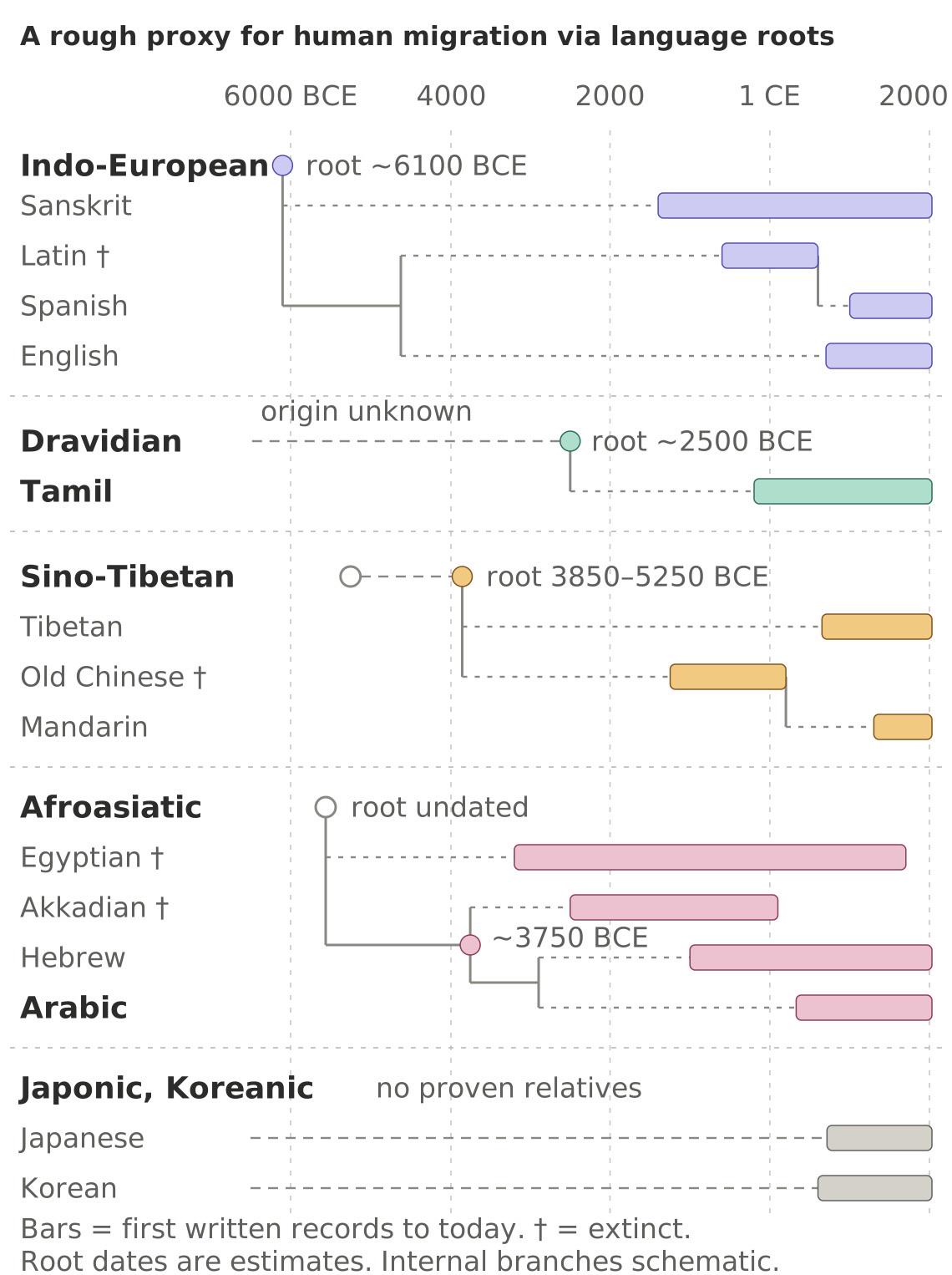
Major language families on one timeline to see how far language trees can stand in for human migration. Each bar shows when a language was first written down, not when its speakers moved. The root markers are published divergence estimates. Dotted lines mark the undocumented stretch before the first records, and a dashed stem means the origin is unknown. Internal branch positions are schematic.
**Sources** Heggarty et al., *Language trees with sampled ancestors support a hybrid model for the origin of Indo-European languages*, Science, 2023.
Gray & Atkinson, Nature, 2003, and Gray et al., Phil. Trans. R. Soc. B 366:1090–1100, 2011.
Kassian et al., Linguistics, 2021 (Inner Indo-European branching, \~3357–2162 BCE). Zhang et al., Nature 569:112–115, 2019 (Sino-Tibetan). Sagart et al., PNAS 116:10317–10322, 2019 (doi 10.1073/pnas.1817972116).
List, Lai & Starostin, J. Language Relationship 17/1, 2019 (the two Sino-Tibetan studies differ on dating and subgrouping). Kolipakam et al., 2018 (Dravidian \~4,500 years old).
Kitchen, Ehret, Assefa & Mulligan, Proc. R. Soc. B 276:2703–2710, 2009 (doi 10.1098/rspb.2009.0408; Semitic origin \~5,750 years ago).
Bagley 2004, in *The First Writing* (Anyang oracle bones, c. 1250–1050 BCE). Haak et al., Nature 522:207–211, 2015 (steppe migration and Indo-European languages).
Lazaridis et al., Southern Arc ancient DNA study (Anatolian evidence). Woodard (ed.), *Ancient Languages of Syria-Palestine and Arabia*, Cambridge University Press, 2008 (Afro-Asiatic chapter).
I'm looking for a book on Indo-European languages that would be suitable for a polyglot (English, German, Spanish, Russian) without formal linguistics education. To read about connections between the languages, discover unexpected common word roots, that type of thing. Informative but not too technical.