Vehicle Information
- Year: 2012
- Make/Model: Buick Regal (Chinese-market model)
- Engine: 2.4L SIDI, LAF
- Mileage: 160,000 km (approximately 99,400 miles)
- Push-button start
- No stored DTCs and no check engine light.
1. Background
The car previously ran smoothly without hesitation or noticeable misfires.
My average city fuel consumption was approximately 14.6 L/100 km (16.1 MPG US), with an average speed of around 15 km/h (9.3 mph).
About three months ago, during a routine oil change, the mechanic overfilled the engine with approximately 500 mL (0.53 qt) of extra oil.
The oil used was US-market Castrol EDGE 5W-30.
The symptoms started around the same time as this oil change and have persisted for approximately three months. I cannot confirm whether the oil overfill caused the problem, but the timing is worth mentioning.
2. Parts Already Replaced
The following components have been replaced:
- Aftermarket catalytic converter
- Oxygen sensors
- Mass Air Flow (MAF) sensor
- Spark plugs
- Ignition coils
Replacing the spark plugs and ignition coils did not resolve the problem.
Important details:
- The oxygen sensors successfully complete their OBD readiness tests.
- The aftermarket catalytic converter passes the local emissions inspection.
- There are no stored DTCs or check engine light.
3. Misfire Data – OBD Mode $06
This is one of the most confusing aspects of the problem.
During driving, OBD Mode $06 shows misfire counts on all four cylinders.
After approximately 10–20 km (6–12 miles) of driving, the typical readings are:
- Cylinder 1: Approximately 20–30 misfire counts
- Cylinder 2: Approximately 10 misfire counts
- Cylinder 3: Approximately 20–30 misfire counts
- Cylinder 4: Approximately 10 misfire counts
The exact numbers vary, and the misfire events appear random and intermittent.
Cylinders 1 and 3 generally accumulate more counts than cylinders 2 and 4.
The counts gradually increase as I continue driving rather than occurring only during cold starts.
However:
- The standard live-data misfire counters generally show no misfires.
- Historical misfire records show no misfires.
- No diagnostic trouble codes are stored.
- The check engine light never comes on.
Another observation from a professional GM diagnostic scan tool:
Immediately after starting the engine, the scan tool sometimes reports approximately two misfire events each on cylinders 1 and 3. These events appear intermittently.
The spark plugs and ignition coils have already been replaced, but the issue persists.
The Mode $06 misfire counts reset to zero after turning the engine off and restarting it.
I am unsure why Mode $06 and the standard misfire data show different results.
4. Normal Live Data Under Most Conditions
Under normal idle and acceleration conditions, the following parameters appear normal:
- Intake manifold pressure (MAP)
- Camshaft timing / phase angle
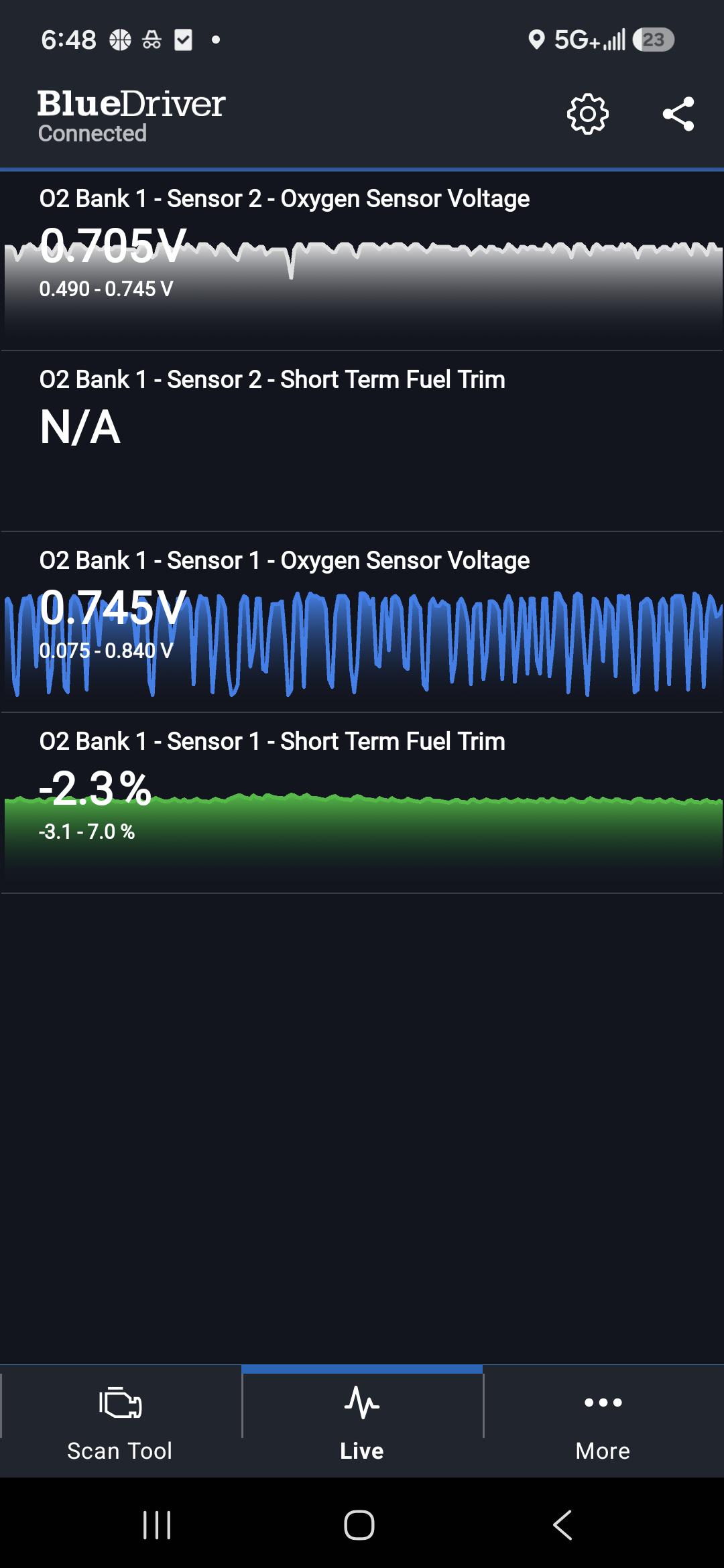
- Basic oxygen sensor signals
- Short-term fuel trim (STFT)
- Long-term fuel trim (LTFT)
Idle calculated engine load is approximately 23–25%.
With the A/C running, the transmission in Drive, and the brake pedal applied, the engine occasionally surges or runs unevenly.
I have not yet identified a consistent relationship between the misfire counts and a particular driving condition or engine temperature.
5. Abnormal Fuel Trims and Upstream O2 Sensor Behavior During Deceleration
This is the most repeatable driving-related symptom.
When driving at approximately 40–50 km/h (25–31 mph), gradually slowing down either by applying the brakes or simply coasting, the following happens:
After slowing down and pressing the accelerator again:
- STFT suddenly rises to its displayed maximum of +19.99%.
During deceleration, when vehicle speed drops to approximately 20–30 km/h (12–19 mph):
- STFT and oxygen sensor voltage briefly drop to zero, apparently during Deceleration Fuel Cut-Off (DFCO).
- Immediately afterward, the upstream oxygen sensor voltage jumps to approximately 0.8 V and remains almost completely flat instead of switching normally.
- The abnormal readings persist while the vehicle is moving.
Once the vehicle comes to a complete stop:
- Both upstream and downstream oxygen sensor signals return to normal.
- Fuel trims also return to normal.
This behavior is repeatable under similar driving conditions.
Could this be related to DFCO exit strategy, intermittent fuel delivery, an exhaust leak, an oxygen sensor signal issue, or something else?
6. Cold Start Symptoms and Engine Noise
There are several additional symptoms:
- Occasionally, cold starting takes longer than normal.
- Immediately after a cold start, pressing the accelerator can produce slight hesitation or jerking.
- On some cold starts, there is a very loud tractor-like metallic rattling or rapid ticking noise for approximately 1–2 seconds, which then disappears completely.
- The engine occasionally runs unevenly under high load at idle with the A/C on and the transmission in Drive.
I found GM service bulletin PI0562F, which describes a loud startup rattle lasting 3 seconds or less on 2011–2012 Buick Regal models equipped with the LAF engine.
The bulletin discusses camshaft position actuators and ECM calibration.
Could my startup noise be related to this known issue?
7. Increased Fuel Consumption
My main concern is the significantly increased fuel consumption.
Under similar city-driving conditions and approximately the same average speed:
- Previously: 14.6 L/100 km (16.1 MPG US)
- Currently: 17–18 L/100 km (13.1–13.8 MPG US)
The displayed average fuel consumption also increases by approximately 0.2–0.5 L/100 km after each cold start.
I would primarily like to restore the vehicle's original fuel economy and eliminate the underlying problem.
8. Questions for Experienced Mechanics
I would particularly appreciate advice from technicians familiar with GM 2.4L SIDI LAF engines.
- What could cause Mode $06 to report random misfire counts on all four cylinders, while standard live-data misfire counters remain at zero and no DTCs are stored?
- Why do cylinders 1 and 3 generally accumulate more misfire counts than cylinders 2 and 4?
- Could the misfire pattern indicate an intermittent fuel delivery issue, injector problems, carbon deposits on the intake/exhaust valves, valve sealing problems, or inaccurate misfire detection?
- Could the abnormal STFT and upstream O2 sensor behavior after DFCO indicate a fuel delivery problem, an exhaust leak, or an ECU control issue?
- Given the 1–2 second cold-start rattle, should I prioritize inspecting the intake and exhaust camshaft position actuators, their solenoid valves, oil pressure, timing chain tensioner, and ECM calibration according to GM PI0562F?
- Could the original 500 mL oil overfill have contributed to the current symptoms?
- What diagnostic tests would you recommend before replacing any additional parts?
I am looking for a systematic diagnostic approach and a prioritized repair plan rather than replacing more components based on guesswork.
9. Has Anyone Experienced Something Similar?
Has anyone here experienced similar symptoms on a 2.4L GM LAF engine or another GM direct-injection engine?
I'm particularly interested in hearing from anyone who has dealt with:
- Random misfire counts across multiple cylinders without any stored DTCs.
- Mode $06 showing misfires while standard live-data counters show none.
- STFT suddenly reaching its upper limit after deceleration or DFCO.
- An upstream O2 sensor signal becoming stuck around 0.8 V while driving, then returning to normal when the vehicle stops.
- A loud 1–2 second rattling noise during cold starts.
If you've encountered a similar problem, I'd really appreciate hearing what the actual cause turned out to be and how you eventually fixed it.
I'm also interested in whether anyone has successfully resolved these symptoms without replacing a large number of parts through trial and error.
Any real-world experience, diagnostic suggestions, or repair recommendations would be greatly appreciated!
Thank you for taking the time to read this.
A Personal Note
This problem has been troubling me for nearly six months, and honestly, I'm becoming exhausted from trying to figure it out.
I've spent a great deal of time and effort checking the vehicle and trying to identify the root cause. I really don't want to keep replacing parts blindly or paying for unnecessary cleaning services without knowing whether they will actually solve the problem.
Given the age and value of the car, I also have to be careful about how much money I spend on repairs. Unfortunately, I don't have the option of taking it to a dealership, so I've been relying on independent repair shops to diagnose and fix the issue.
I'm reaching out here because I genuinely need some help and advice from people who may have experienced something similar or have the technical knowledge to point me in the right direction.
If anyone can share their experience, suggest a diagnostic approach, or help me narrow down the possible causes, I would be incredibly grateful.
Thank you so much to everyone who takes the time to read my post and offer advice. I truly appreciate your help!