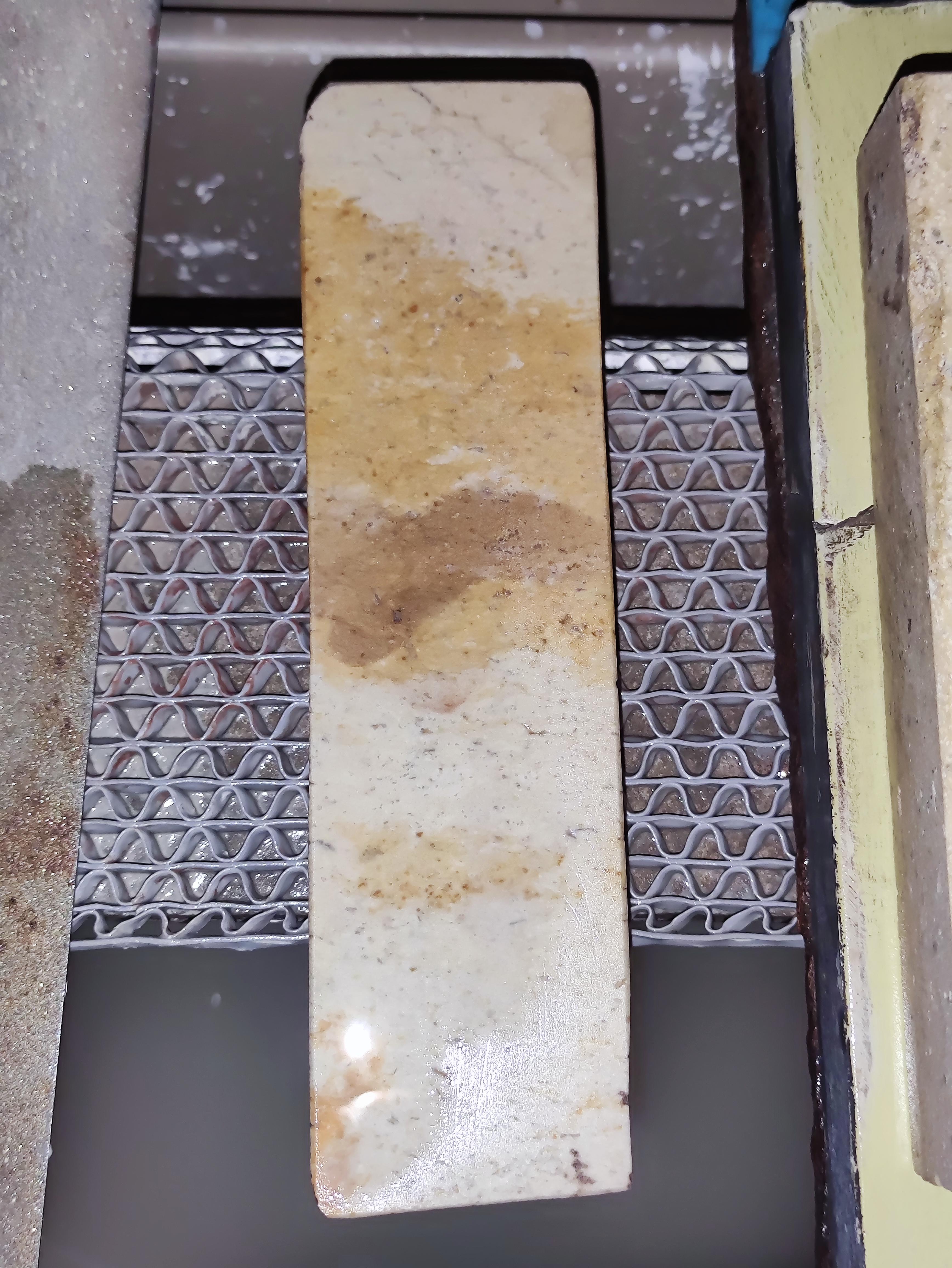
r/NaturalWhetstones • u/Preindustrialist • 4h ago
Whetstone ID - unknown natural stone ?
gallery
7
Upvotes
r/NaturalWhetstones • u/sea-plus • Oct 04 '26
Hi guys,
There hasn’t been any rules set on self advertising yet, but to protect anyone from any potentially dangerous sales / paid services moving forward we’re gonna ask that anyone that wish to do that message the mods first.
Message the mods mentioning that you’ll like to get the vendor flair, and you’ll be asked to provide some details on your service or products. Then you can go ahead and make your self advertisement in either posts or comments.
We haven’t decided on the frequency of the advert posts that we’re allowing, so for now just don’t make it excessive (if you post more ads than actual content, we’re gonna ask you to behave a little 🤏)
Our stance right now is that we’re just limiting the ad posts or comments to flaird users. We are NOT responsible for any sales gone wrong to any users, flaired or not, that’s up to each persons own discretion. Remember that you’re dealing with online strangers, in an exchange that could potentially have anything happen.
If it sounds too good to be true, it most likely is, and even when it’s something that looks reasonable at a quick glance, make sure to protect yourself. Always question the details, and I suggest that redditor to redditor sales make use of timestamped photos between the parties, and use common sense. For example I would not buy anything from someone with an account 13 days new with no karma, or if someone says they have an extensively tested jnat, yet their photos have full face stamps, it’s probably not tested
We are also still making the wiki which would include a vendor list, but haven’t ironed out the full details yet. Let us know in this post comments if there’s things members would like to see
r/NaturalWhetstones • u/sea-plus • Aug 29 '26
This is just a simple guide. Maybe the mods would be interested in adding it or something like it to the subreddit wiki, if it turns out to be useful
So you bought that unlabeled stone that looks funky, and you can't for the life of you figure out what it is. Before making a post, follow these steps:
also, please take your photos in bright natural light, showing the face (top side where you sharpen on), side, and features that are on the stone
1 Figure out the origin of the stone
This step isn't strictly necessary if your stone is one that has very distinct visuals, but helps.
Include in your post:
Seller origin (This usually isn't 100% to where the stone is from, but provides a useful hint)
Any boxes, labels that show the origin (usually if you have this, just google the label with image search and you'll probably find some forum post, solving your search)
2 Identify visual features in the stone
Look at the stone, and identify what it looks like. What you want to look out for is:
Are there layers to the stone?
Are there patterns in the stone?
Identify the colours to the stone. (This step might require degreasing of the stone, which is a whole topic by itself and deserves a whole write up, but I wont get into this here)
Is the stone coated with something? If so, what is it? Is it cashew lacquer (yellow tinge, transparent), urushi (deep red / black look, ultra hard coating), or something else?
3 How does the stone work?
This step is best done with a clad knife, like a kiridashi or a japanese kitchen knife. The soft steel combined with a hard steel allows for the general identification of many many stones.
How does the stone finish? Is it fine, coarse?
What is the finish type? Mirror finish, cloudy kasumi, or satin scratches? Are the scratches going in the direction of your strokes, or random?
If kasumi, what kind is it: dark on soft clad, bright, colour of the polish etc (advanced, it is not easy to identify this easily and requires some experience with many stones, particularly jnats)
Hardness of the stone: how does it feel to put steel to the stone? Does it feel like glass, or a rougher stone? Describe it in detail
Slurry behaviour: does it produce a mud? What is the mud like, does it refresh the surface? Does it polish, or hinder the finer polish? Does it produce it easily, or does it refuse to produce unless under certain conditions?
Oil or water?: Put a few drops of water on the surface of the stone, and document how it reacts. Does it bead, and slide around because of oil in the stone? Does it absorb the water strongly, or lightly retains it on the surface? Does it take a lot of water?
4 How does the stone lap
This is surprisingly quite revealing to the identify of stones, how it laps, what slurry it makes, and how long it takes.
Some stones can take quite literally 5 hours + for a not so drastic lapping, and some stones can take 30 seconds for a big lapping.
Pictures are very helpful of the lapping process for members to assist in identification
5 conclusion, and what to do with the info attained above?
This section i suspect will be very long going to make decent looking, but many many times with the posts I see here looking for help with finding out what stone they have, cross checking with info generally avail can easily produce a concrete identification.
American natural stones (ANATs)
Arkansas stones:
Quite hard across all the types, soft hard and true hard. Takes a very very long time to lap, and in use does not produce a slurry. Often feels glass hard, and smooth feedback. Soft arks often are a little porous.
Soft ark example 1: https://imgur.com/a/Ub7UlPK
Colour can vary on these, they can have yellow, black, orange, and more bits. They can also be pure white. They are porous, and feels mostly smooth with a little bite in use. Usually used with oil.
True hard ark example 1:https://imgur.com/a/KsHBgKx
True hard arks are extremely hard, feels like glass in use without much biting feedback, and take forever to lap. They can come in a variety of colours, such as black, translucent white, or with tinges of yellow, pink and other colours rarely. Used with oil.
Washita example 1:https://imgur.com/a/JuWcxwK
Washitas honestly deserve a whole writeup by itself, which I may do (and I'll hit up some of the crazy collectors in this reddit for help for sure!)
All the washita grades: https://imgur.com/a/jwmKqOt
Washitas generally have a mottled pattern look, feel hard (some can be borderline, feel softish but all will be solid feeling at the very least), and can come in a variety of colour. Do take note that the state of the stone taking in oil can DRASTICALLY affect the visuals. There is also the possibility of bleaching the stone with degreasers that make it look like certain types. The example here is just a typical, medium hard washita.
Washitas come in several types, and grades.
And for grades
The grades are not able to be determined without having the info of the origin. In my opinion, the only concrete way to tell is with labels. If you stone is from pike, and has end labels it can only be a LW. There are also other brands that have these grades, but pike is the manufacturer, and the mines belong to them. They are all mined 50+ years ago, with 50 yr old examples being relatively new. There is also a modern run from the 2000s, but for this guide we will ignore that since they are ultra rare.
Slates:
I don't have any, so I am asking for help with this section!
Japanese Natural Stones (JNATs)
There are just too many visual features, but there are good guides out there which do well in describing and listing the features to identify your stone. I recommend looking at these resources:
https://naturalwhetstones.com/natural-whetstones/japanese-natural-stones-jnats/
https://www.tomonagura.com/jnats/jnat-gallery/
The identification of Japanese natural stones can be spotty, as the origins are often impossible to tell without the labels, or if they're not very obviously stones from a certain place (such as ohira renge suita having that certain look)
European stones:
Coticules example 1:https://imgur.com/a/4jwvQIO
This is a les lat hybrid, but coticules are usually a yellow soft stone on a slate backing, or if its a natural combo there will be a belgian blue below. The yellow part is usually soft, and makes a slurry. The sharpening feel varies from very gritty with a lot of slurry, to very smooth and glassy like with no slurry. They are used with both oil and water.
Thuringian: https://imgur.com/a/F100vAD
These are slates from Germany, and have a relatively plain look with the colour tinge. There are many types of colours, this example is a dark blue. Eschers in bigger sizes can cost a lot of coin. Even smaller ones like this have sold recently for some unreasonable money. Relatively hard feeling in use, and smooth. Some produce a slurry, carrying the stone colour, but not all. Produces a kasumi that is very similar to one from a hard asagi if comparing to Jnats.
I don't have much else for this section, but I would love to have some help from the european stone collectors.
Indonesian stones:
I'm pretty sure these are mudstones and slates for most types. Photos to come. Kind of resembles JNATs in use, but not really. I have not come across one in the finishing grit range, and I have a LOT of them.
DO NOT PAY CRAZY PRICES FOR ANY INDONESIAN STONE!!
Personal experience: I have bought 10kg of their top grade stones directly in person, and I spent below 50USD doing so. There are sellers that list them at crazy prices, and claim they are something they are not.
They are often called bogor stones, or nusantara stones.
Types:
Grey "ivory": Probably a slate, extremely hard and is in my opinion the pre finishing grit range, and not so useful for polishing. Does not auto slurry easily, and with a slurry it makes a finish I would say is similar to a mejiro nagura, but cuts way slower.
Red / beige stone: Can be soft to hard approaching 4.5+. Can be used for polishing for the softer ones, auto slurries. Makes a finish rougher than tsushima, finer than most aizu. Cuts medium speed. My personal pick if you wanted one from Indonesia, pretty neat stone for very cheap if you get the right sources.
Grey stone: Pretty soft, and slurries a lot. Feels a lot like a soft aoto, and is in the lower middle grit range. Roughness is similar to a very muddy and soft natsuya.
Sorry, I haven't taken pictures of my stones here will amend when I get the time.
That's it for now, but I will continuously update this with the help of members that choose to help. If you have some stones or some opinions you would like to add, please dm me!
r/NaturalWhetstones • u/Preindustrialist • 4h ago
r/NaturalWhetstones • u/DrivingMaple05 • 4h ago
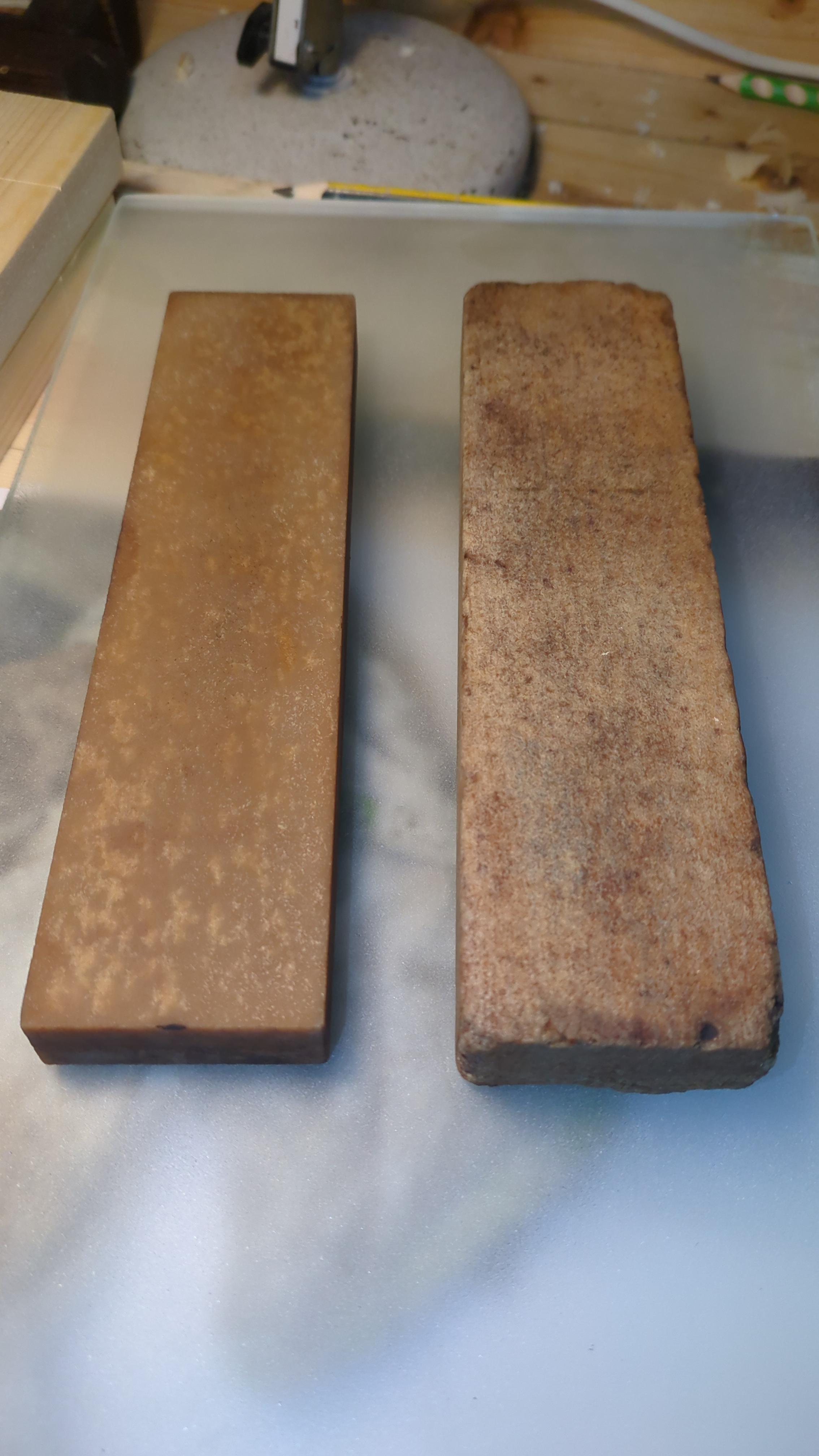
Hi.
What might these be.
The one on the left is freshly lapped and the one on the right has been degreased.
I got them used in the uk
r/NaturalWhetstones • u/Frater_Aequanimitas • 23h ago

This is a natural whetstone I have personally taken, hewn and dressed from surface boulders in my local area. It is coarse, similar to Oomura if you're familiar with it. Lots of mud in long use, but starting off it's not super muddy (As in some Aoto jnats). The grain does seem to break down slightly, but I suspect this is actually just changing surface tension based on mud control, pressure, and the release of swarf.
The cut is shallow, but fast. It produces a dense, coarse kasumi with little rogue scratching. Easily refined by ~2000 grit synthetic or natural options, but you can really speed it up if you gently use a 1k synthetic afterwards which I do, when I'm craving speed.
It is hilariously consistent for this kind of coarseness. There aren't any extremely hard zones, but you'll see feathers of softness, about half a centimetre wide and 5 centimetres long as you get through the stone. These are not very distracting, but they are more porous - so watch out if you've worked with coarser slurry than this.
Give it a scrub with a stiff non abrasive plastic brush before, during and after use, it doesn't hurt the stone at all.
I slurry it with a diamond plate. Atoma or Jiriuke brand (From AliExpress, not an ad, I'm not paid. I did receive this diamond plate as a gift in exchange from a friend, for a sample of this whetstone (Pictured: the odd-shaped stone, and bloomery kiridashi).
My friend says, it's friable and helps for making convex bevels - easing synthetic coarse scratches. I am inclined to agree.
It is a bevel setter for straight razors. I leap straight into a Mikawa Nagura progression after this. I insist that it is perfectly flat, using a diamond plate, and conditioned with a tomo Nagura before rinsing all the grit off and working on the bevel. Less is more, with bevel setting.
I might cut scythe stones from this rock too. My girlfriend is an avid scythe and sickle user.
The geological formation is Lower Ordovician Castlemaine Group.
I am inquiring into sourcing other Castlemaine Group siltstones, mudstones, shales, slates, and chert.
r/NaturalWhetstones • u/Scotty-LeJohn • 1d ago

This is a box for a beautiful Escher slate hone I found for a whopping $2 at an estate sale. It's made from purpleheart and finished with Watco satin lacquer. The last two images show the mostly intact label on the stone, and if anyone has input on how to preserve the label I'd be greatly appreciative. If anyone also has a good idea on the value of this stone, I'd be glad to hear your thoughts, and for reference the stone is about 7"x1.5"x~.800" in dimension. Thanks for looking!
r/NaturalWhetstones • u/Argg1618 • 19h ago

A typical ebay score.
And what a pleasant surprise when I saw what was really in the box!
I show an example of a Norton Soft Arkansas label to show what the pyramid shape would have looked like. This was the blue colored label, there for it was the Washita.
This seems to be a very nice, softer Washita stone, with grease stains from use.
r/NaturalWhetstones • u/Complete-Ocelot5956 • 1d ago

r/NaturalWhetstones • u/paintmyhouse • 1d ago

Expanding my collection. Feedback is welcome.
I sharpen my Japanese knife collection. Edge sharpening is mainly what I do but I’m practicing with thinning. Once I get better at setting the primary bevel, I’ll start polishing.
I enjoy a sharp edge that lasts. The nakayama koppa opened my eyes to Jnats.
This stone- Natural finishing stones from the Kyoto region occupy a category of their own in the sharpening world, and Ohira is one of the most respected names within it. The Ohira mine sits in the mountains northwest of Kyoto near the Umegahata area and Mount Atago, within the Nishimono western mine district that also includes Nakayama and Shobudani - names that serious sharpeners recognize immediately. CKTG sources these stones directly from the Imanishi Stone Company, where each piece is personally evaluated and stamped by Mr. Imanishi before it leaves his hands. That grading process is not a formality. It is a meaningful assessment from one of the most knowledgeable people in the Japanese natural stone trade, and the High Quality stamp on this stone reflects his direct judgment of its character and performance
Ohira Tomae stones are sedimentary mudstones formed during the Cretaceous period as part of the Tamba geological formation - compressed over millions of years into dense layers with extremely fine abrasive particles that produce a finishing surface unlike anything manufactured synthetics can replicate. This particular stone falls in the 8-10K grit range, is firm and hard in feel, and cuts faster than most stones at its level of refinement. The finish it leaves is a refined kasumi (hazy) polish that retains useful edge toothiness - not a pure mirror that slides off food, but a working edge with real bite and a surface that reflects the quality of the steel being sharpened. This stone was mined in the early 1970s and stored carefully in Mr. the Imanishi san basement until recently released. Stones from this region are no longer being actively mined, which makes well-preserved examples from verified sources increasingly difficult to obtain. Each stone is photographed and weighed individually as it sells - what you see is the exact stone you will receive.
r/NaturalWhetstones • u/Argg1618 • 1d ago

Likely considered a grey Tam. I sealed it to be safe. This one is soft and a fast midrange stone on razors.
I personally like this stone for tools and knife edges. Feedback is heavenly. It's a weird combination of a soft and gritty feeling.
A cool historic UK hone
r/NaturalWhetstones • u/rwdread • 2d ago

From left to right:
I think this is purple slate. My first ever find which started this addiction.
Unknown - possibly an unfigured Dalmore, but I really don't know what it is. A great stone though
Llyn Idwal
Grecian
Coticule
Unknown Slate (amazing feedback)
Salmon Red
Glanrafon
r/NaturalWhetstones • u/RemoveOne9760 • 2d ago

This is a piece of blue canyon slate I've lapped down to I think around 1 to 2k. I'm kinda new at this but it's getting a wicked edge on my carbon steels! It's also known as shoofly complex slate I think, would love any input to using this in the best capacity.
r/NaturalWhetstones • u/Timwcic • 2d ago

This was a flea market rescue. When asked for a sharpening stone, I was handed a bag containing a stone and most of a wooden case. Seeing what it was, score. The stone was a nice 7 inch covered in the usual funk. Laying all the wood pieces out, most all the pieces for the case were there except a few end pieces. The stone went into the dip and I cut up the replacement case pieces. Reglued everything back together and sanded to finish. A light spray of clear coat completed this job. The surprise came out of the dip. As a scrubbed the stone, I discovered the original stamp. A Choice Razor Hone from A. P. & Co. That’s a new name to me. When done, fit and finish was perfect
r/NaturalWhetstones • u/Original_Two_589 • 2d ago
r/NaturalWhetstones • u/Argg1618 • 3d ago

A very old Pike label. In those earlier days, "Hard Arkansas" wasn't a term for these stones just yet. Soft Arkansas wasn't a term yet either.
There were only two grades of Arkansas stones mentioned, "Washita", and "Arkansas".
So anyways I smashed the box open to release the stone. No big deal. An identical new box is being made, and the old top will be inset into the new box.
Although these older stones are often oil soaked, Underneath the glue, sealing the bottom of the stone for all of these years, is a nice buttery color of old Hard Arkansas rock. I show it beside an actual white translucent Arkansas for color comparison.
r/NaturalWhetstones • u/sea-plus • 3d ago

I bought it thinking it was tsushima (i have an addiction to them the way u/argg1618 has an addiction to washita) but the moment I held it I knew it was something different. It slurries a pitch black goop (tsushima slurries grey, and dries grey too) and it just looked and felt different.
I think it might be bushu since it finishes finer than usual tsushima, but then again comparing with Japanesechefs, it looks different from his.
r/NaturalWhetstones • u/rwdread • 4d ago

Love the banding on this stone
r/NaturalWhetstones • u/Argg1618 • 4d ago

On top of impeccable customer service, these modern cut translucent Arkansas stones are fantastic. Very high quality stones and they come dead flat. More than I could ever ask for.
r/NaturalWhetstones • u/Timwcic • 5d ago

Part of a lot I recently picked up and finally got around to cleaning. A boxed Yellow Lake and a handsome Lynn Ldwal or from a mine in the area. The YL came in the red box and by color is a Alberllefenni Slate. Nice and fine in the typical 8-10k neighborhood. The LI is just as gorgeous. Love the Welch Green color with vivid layering and also 8K-ish, maybe a li'l bit more.
r/NaturalWhetstones • u/Specific_Lonely • 5d ago
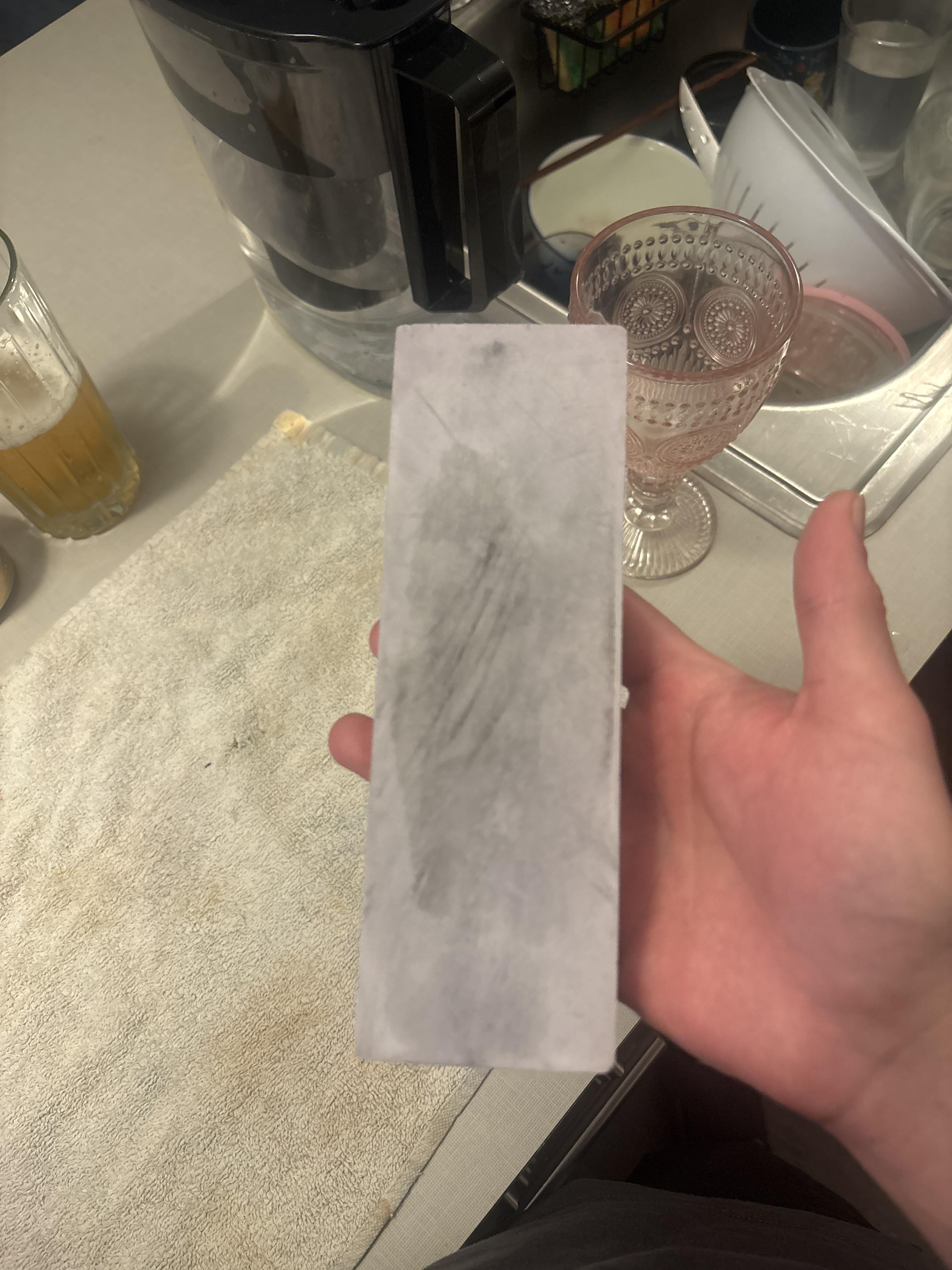
Got it gifted kinda messed it up 🥲
r/NaturalWhetstones • u/Argg1618 • 6d ago

A fast cutting stone when used with oil. Very comparable to the Washita. Similar feedback
r/NaturalWhetstones • u/Timwcic • 8d ago

A uncommon Translucent Arkansas marketed as “Made In Germany”. A 6x2x1 inch stone that went from Arkansas to Germany and back to the USA. Dixon stones are usually very clean with no inclusions or faults. They were resold with there line of tools. Dixon was a maker of high-quality metalworking and silversmithing hand tools. Along with Arks, other things made by Dixon were jeweler's saws, pliers, and repoussé hammers, all highly collectible