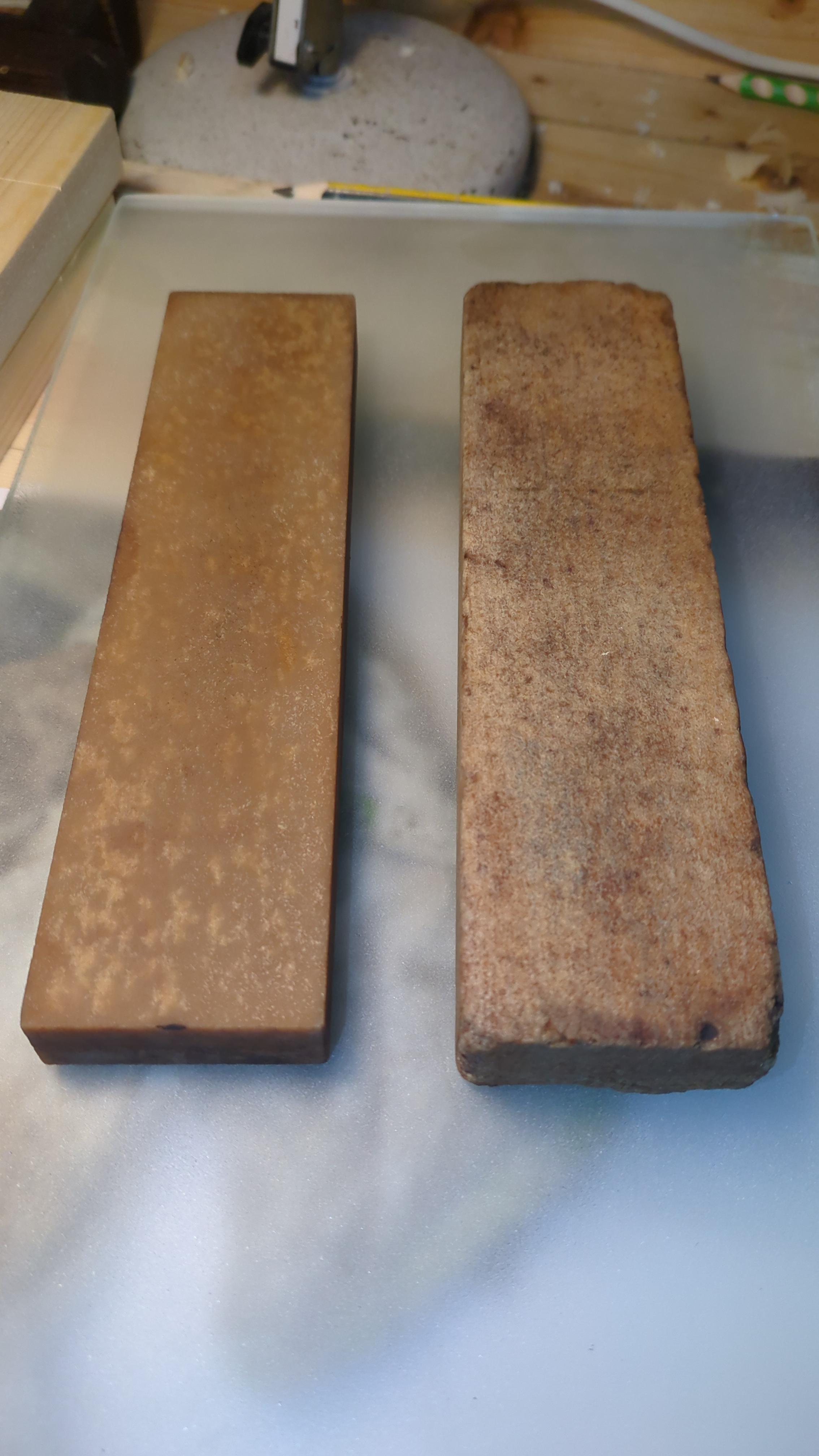
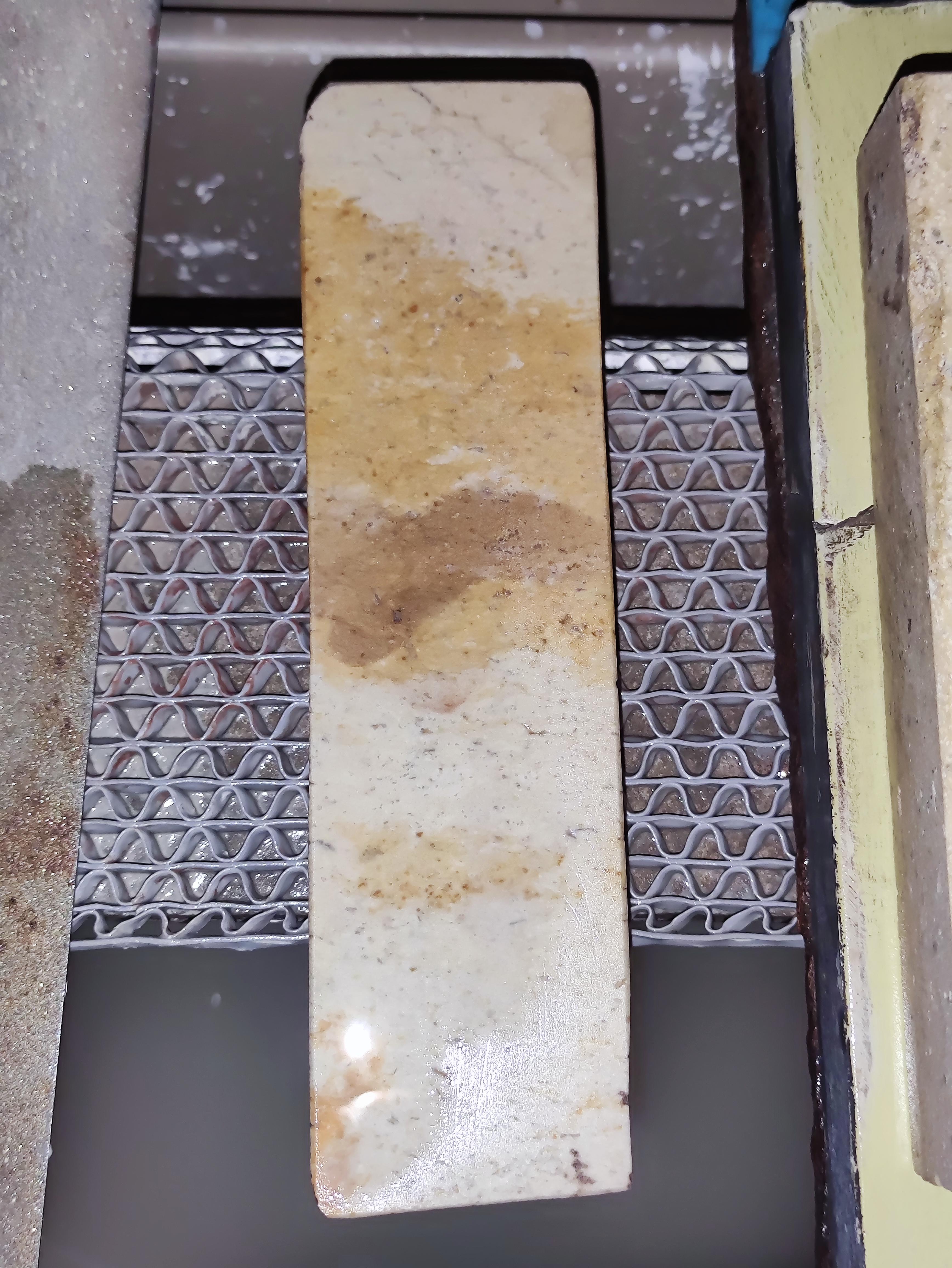
This is a natural whetstone I have personally taken, hewn and dressed from surface boulders in my local area. It is coarse, similar to Oomura if you're familiar with it. Lots of mud in long use, but starting off it's not super muddy (As in some Aoto jnats). The grain does seem to break down slightly, but I suspect this is actually just changing surface tension based on mud control, pressure, and the release of swarf.
The cut is shallow, but fast. It produces a dense, coarse kasumi with little rogue scratching. Easily refined by ~2000 grit synthetic or natural options, but you can really speed it up if you gently use a 1k synthetic afterwards which I do, when I'm craving speed.
It is hilariously consistent for this kind of coarseness. There aren't any extremely hard zones, but you'll see feathers of softness, about half a centimetre wide and 5 centimetres long as you get through the stone. These are not very distracting, but they are more porous - so watch out if you've worked with coarser slurry than this.
Give it a scrub with a stiff non abrasive plastic brush before, during and after use, it doesn't hurt the stone at all.
I slurry it with a diamond plate. Atoma or Jiriuke brand (From AliExpress, not an ad, I'm not paid. I did receive this diamond plate as a gift in exchange from a friend, for a sample of this whetstone (Pictured: the odd-shaped stone, and bloomery kiridashi).
My friend says, it's friable and helps for making convex bevels - easing synthetic coarse scratches. I am inclined to agree.
It is a bevel setter for straight razors. I leap straight into a Mikawa Nagura progression after this. I insist that it is perfectly flat, using a diamond plate, and conditioned with a tomo Nagura before rinsing all the grit off and working on the bevel. Less is more, with bevel setting.
I might cut scythe stones from this rock too. My girlfriend is an avid scythe and sickle user.
The geological formation is Lower Ordovician Castlemaine Group.
I am inquiring into sourcing other Castlemaine Group siltstones, mudstones, shales, slates, and chert.