r/Sikh • u/OptiMatrix888 • 1m ago
Discussion A Deep Dive Into Shared Vocabulary between Sikhi and Hinduism
I often hear that Sikhi is essentially Hinduism because the Gurus speak of karma, maya, bhagti and mukti. As a Sikh, I think those connections are real and worth discussing. What I question is the leap from “the Gurus inherited this vocabulary” to “the Gurus taught the same theology.” Even Hindu traditions that accept the same scriptures use those words to reach very different conclusions.
1. Om, Ik Oankar and what it means to say reality is one
Take a question as basic as “What is my relationship to God?” Even within Vedanta, there are at least three answers.
- In Shankara’s Advaita, the deepest self, Atman, is ultimately identical with Brahman.
- In Madhva’s Dvaita, God and the individual soul remain distinct, even in liberation.
- In Ramanuja’s Vishishtadvaita, souls and the world are real, wholly dependent on Brahman and related to Brahman as a body is to its indwelling self.
All three can invoke Om. Hearing the word doesn’t tell you which answer a Hindu accepts. So why should hearing Oankar settle the question for a Sikh?
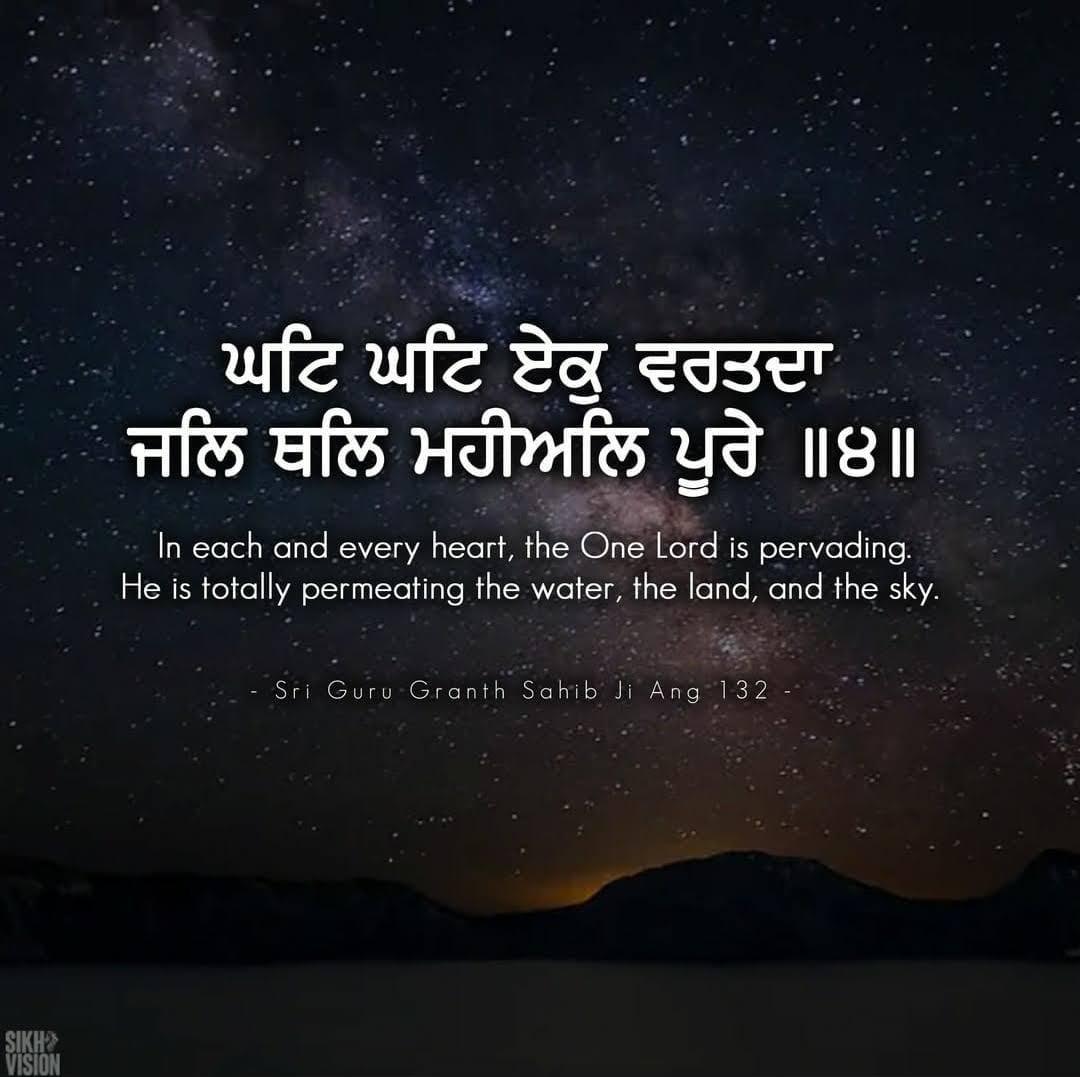
Guru Nanak Dev Ji opens Gurbani with ੴ (Ik Oankar), placing the numeral 1 before Oankar to affirm that the Divine is One. The Mool Mantar then describes this One, who pervades all creation, as Karta Purakh (Creator), Nirbhau (without fear), Nirvair (without enmity), Ajooni (beyond birth) and Saibhang (self-existent).
Gurbani speaks of that same One as nirgun and sargun, beyond attributes and manifest through them. There are real parallels with Vedanta here. Identifying Gurmat, the Guru’s teaching, with any one of those schools takes more than recognizing the opening word. (Angs 1, 290.)
2. When two people sing “Ram,” who do they mean?
Two people can sing the same name with complete sincerity. One may be addressing Rama, son of Dasharatha, whose incarnation is central to their devotion. Another may be invoking the One who pervades every being. Bhagat Kabir Ji explicitly asks us to distinguish between uses of “Ram.” The same question comes up with Krishna. (Ang 1374.)
- In the Bhagavad Gita, Krishna calls himself unborn and says he manifests by his own power. He tells Arjuna that whoever understands his divine birth and deeds comes to him, free from rebirth. (Gita 4.6, 4.9.)
- In Gurbani, Guru Arjan Sahib addresses the belief that Govind was born on the eighth lunar day. His answer is that Narayan, the Divine, is beyond birth and death. (Ang 1136.)
To the devotee in the Gita, the truth about Krishna’s divine birth is part of what frees them from rebirth. A Sikh singing Govind can be praising the very One whom Guru Arjan Sahib says is beyond birth. Counting the name would tell you nothing about that difference.
3. When Gurbani speaks of maya, is it saying the world is an illusion?
- In Shankara’s Advaita, the world of changing forms is mithya. Think of a clay pot. Reshape it into a bowl and the pot is gone, but the clay remains. The pot is real in everyday life. Its form has no independent, ultimate reality. Shankara uses that distinction to explain the world’s dependence on Brahman. (Chandogya Upanishad 6.1.4.)
- In Gurbani, Guru Nanak Sahib calls the worlds and their forms sach (true). Guru Angad Sahib describes this world as a room in which the True One dwells. When Guru Amar Das Ji explains maya in Anand Sahib, he identifies what happens to us through it. We grow attached and forget the Divine. (Angs 463, 921.)
I can treat something temporary as permanent, or something given to me as mine to possess forever. That is how I can be caught in maya while living in a creation the Guru calls true. The word alone doesn’t commit a Sikh to Shankara’s account of reality.
4. Karma and rebirth tell you there is a cycle. What actually frees you from it?
In Japji Sahib, Guru Nanak Sahib brings deeds and grace together in one line. Karmi aavai kapra, nadri mokh duaar (Deeds shape the physical body we receive, but the door to liberation opens through Divine Grace.)
The Bhagavad Gita (18.66) also speaks of grace, where Krishna promises deliverance to whoever takes refuge in him as an Avatar. In Japji Sahib, however, that Glance of Grace belongs to the One whom the Guru has just defined in the Mool Mantar as Ajooni (Unborn, beyond incarnation).
- What can deeds earn? A person can give to charity and spend the entire time thinking about what a generous person they are. The gift helps someone, but their Haumai, the habit of putting "I" and "mine" at the center, survives intact. That is why simply adding up good deeds gives an incomplete account of liberation.
- What can birth determine? The Manusmriti assigns “twice-born” status to the first three varnas (Manusmriti 10.4). Guru Amar Das Ji takes up those same four social classes and asks what makes one vessel higher than another when the Potter used the same clay for all. In that very shabad, he says our deeds bind us. Gurbani affirms karma and rejects spiritual rank by birth in the same passage (Ang 1128).
5. Can a person live free while working and raising a family?
Hindu scripture itself offers more than one answer about the place of renunciation. That makes the comparison with Gurbani worth drawing carefully.
- Leaving the household. The Jabala Upanishad allows a seeker to take up *sannyas* (renunciation) as soon as detachment arises. On Ang 140, Gurbani describes the irony of a renunciant who has put on saffron robes but still longs for food and clothes, he’s left home, but he’s taken his attachments with him.
- Remaining in the world. The Bhagavad Gita (3.20) holds up King Janaka as someone who attained perfection through action. There’s a genuine parallel in Gurbani. What stands out to me, however, is how ordinary Guru Arjan Sahib’s examples are on Ang 522: "Hasantian khelantian pehnantian khavantian vichhe hovai mukti" (amid laughing, playing, dressing, and eating, liberation can be attained).
For a Sikh householder, this is what Jivan Mukti (liberation while alive) looks like. Earning honestly by one's own labor, sharing those earnings, and doing seva (selfless service) are practical ways to live in keeping with Hukam (divine order) and loosen the grip of "I" and "mine" (Ang 1245). A Sikh can do that spiritual work in the very act of caring for a family.
6. What changes when someone wears a sacred thread or bathes at a shrine?
External rituals offer something comforting: a visible sign that you've fulfilled a duty. But Gurbani constantly pushes us to ask what those rites actually alter inside us.
- Janeu (Sacred Thread): Historically, it marked a caste-restricted initiation for upper-caste men. On Ang 471, Guru Nanak Sahib doesn't just decline the thread; he asks the priest for a thread whose cotton is compassion, whose yarn is contentment, whose knot is restraint, and whose twist is truth. A priest can tie cotton, but cotton rots, breaks, and burns at death. The internal virtues Guru Sahib names are permanent and they are equally open to everyone the traditional ceremony excluded.
- Tirath (Pilgrimage): While texts like the Mahabharata (Vana Parva) praise bathing in the Ganga for washing away sins, Guru Amar Das Ji notices a different psychological reality on Ang 116: a pilgrim travels to sacred waters and returns carrying more of the very ego (Haumai) they went to wash away. The trip itself becomes something to brag about. In that shabad, true inner cleansing comes not from physical water, but from remembering Naam (The Divine) and engaging in Seva (Seflless Service).
7. How does Gurbani describe the Guru’s teaching alongside the six Hindu schools?
A common claim online is that Sikhi is just a practical form of Vedanta or Samkhya. But rather than relying on modern debates, it helps to look at how Gurbani itself addresses the Khat Darshan, the six classical systems of Hindu philosophy, which include Vedanta's non-duality, Samkhya's dualism of consciousness and nature, and Mimamsa's Vedic ritual commands.
On Angs 360-361, Guru Amar Das Ji explicitly brings up these six schools. He acknowledges that they are widely followed, but he then describes Gur ka darshan (the Guru’s philosophical vision) as unfathomable and boundless (agam apara). The refrain makes his point clear: "Gur kai darsan mukat gat hoi" (Through the Guru’s vision, liberation is attained).
What matters here is who is drawing the boundary. It isn't a modern commentator trying to create artificial divisions; it is the Guru himself using the word darshan for both, explicitly distinguishing the six traditional systems from Gur ka darshan, and directing the seeker to the Guru for liberation.
Any argument that tries to subsume Gurmat inside Vedanta has to answer why Guru Amar Das Ji explicitly set his teachings apart from all six schools.
8. Who gets to decide what those words mean for a Sikh?
When the Yogis in Sidh Gosht ask Guru Nanak Sahib who his Guru is, he does not name a historical figure, a deity, or an ancient text. He answers: "Shabad Guru, surat dhun chela" (The Word is the Guru, and the consciousness attuned to it is the disciple, Ang 943). For Sikhs, that unmediated relationship continues today in Sri Guru Granth Sahib Ji, alongside the collective deliberation of the Guru Panth.
This brings us to the core issue: authority. Hearing echoes of the Upanishads in Gurbani is a great starting point for dialogue, resemblance between traditions is natural and worth exploring. But calling the Gurus "the living Vedas" begs the question: it assumes the very relationship being debated.
A Sikh can recognize wisdom in any sacred passage and even cite it to illustrate a point. But appreciating wisdom in another text is fundamentally different from accepting it as binding authority.
Recognizing shared 16th-century vocabulary across traditions shows a shared regional language, not a shared path.
Bhul Chuk Maaf 🙏
Waheguru Ji Ka Khalsa, Waheguru Ji Ki Fateh