r/TheSharkAttackFiles • u/SharkBoyBen9241 • 1d ago
📜 Case Report Attack Horror Stories - Brian Derry
January 17th, 1959; Safety Cove, near Port Arthur, Southeastern Tasmania;
Take one look at the coastline along the southern coast of Tasmania and an undeniable chill goes down your spine. One immediately distinguishable by the one caused by gusts of harsh Southern Ocean winds. It’s the same feeling one gets when walking in the Southeast Asian jungles or on the African plains. Some places just have that feeling of being guarded. As if shrouded by its aura, one can immediately sense the presence of one of the world’s greatest predators here, in these chilly southern waters. The presence of Carcharodon carcharias.

Except for maybe California, perhaps no place is more emblematic and better suited for White Sharks than the Southern Ocean surrounding the island of Tasmania. Thanks to a combination of cool, temperate ocean temperatures, key migratory corridors, and an abundance of calorie-dense prey items like marine mammals, Tasmania is an ideal habitat for White Sharks. And 500 years ago, long before Abel Tasman and the first Europeans arrived on the island, it was an even more ideal environment. In those days, the deep, rich Southern Ocean waters were bountiful beyond belief, filled with great pods of Sperm Whales (Physeter macrocephalus), Humpback Whales (Megaptera novaeangliae), and Southern Right Whales (Eubalaena australis). New Zealand Fur Seals (Arctocephalus forsteri), Australian Fur Seals (Arctocephalus p. doriferus), and Australian Sea Lions (Neophoca cinerea) numbered in the hundreds of thousands, with breeding sites dotted all around the island's coast and throughout Bass Strait. And Southern Elephant Seals (Mirounga leonina), perhaps the most delectable and preferred prey item of all for adult White Sharks, were also plentiful in the region, with multiple established breeding colonies in northern Tasmania and in Bass Strait. King Island, located about 50 miles off the northwestern coast of the Tasmanian mainland in Bass Strait, was once an especially prolific breeding site for Elephant Seals in the region, and was by far the biggest aggregation site for Elephant Seals in Australian waters. It was a unique place, not unlike Año Nuevo Island and the Farallon Islands of California today, where tens of thousands of seals migrated to each spring and summer in order to molt, breed, and bear their young. And being situated in Bass Strait meant that King Island was an accessible feeding site for both major subpopulations of Australia's White Sharks. With such an impressive historic abundance of prey in the region, it's little wonder why White Sharks found the rich feeding opportunities of Bass Strait and around Tasmania's shores so irresistible.

One can only imagine what the early convicts who helped build the colony might have witnessed back in those old days. In between strikes of your spade, you glance up and spot a pod of fur seals porpoising along the surface just offshore. An interesting respite from your monotonous and not-so-voluntary task, all whilst being lashed by the harsh Southern Ocean winds, in a strange land far from where you were born and far from all the trouble your tough way of living brought about. Perhaps you were a thief. Perhaps you were a murderer. Whatever you might have been back home, it didn’t matter anymore here. Because here, in Van Dieman’s Land, you were just meat for the Empire. Free labor to aid in the conquering and colonizing of the far reaches of the world. At least here, there were many things to catch your attention, including the fur seals, which you had never seen before. “You wouldn’t see that at Newgate,” you silently say to yourself, trying to feign even a fleeting sense of optimism. But that sense is soon gone, and you glance back down to strike your spade once more.
Suddenly, an extraordinary noise sounds from where you had just been admiring the fur seals just offshore. You look up just in time to see a massive fish, a fish with a characteristically white belly and a dark back, catapulting its nearly 6-meter body fully out of the water, a hapless fur seal fatally clasped in its jaws. You have never seen, or even dared to imagine, a fish of this magnitude and ferocity before. The fish slams back down to the water with a terrific splash, as the other fur seals in the pod scatter in all directions away from the attack. The commotion alerts the attention of your foreman and that of your fellow convict coworkers, who rush to where you’re standing to get a better view of the terrifying spectacle unfolding before your very eyes. For a few seconds, all is quiet. And then suddenly, the fish breaks the surface again and it begins violently thrashing its head from side to side in an attempt to sever its prey into bite-sized portions. A quick flurry of action cuts the fur seal in half, and the surface of the water is soon stained red with a brilliant blanket of blood. The true guardian of the penal colony has revealed itself to you, and the grim reality of your situation becomes brutally clear. “I will never leave this place alive,” you now think to yourself.

Perhaps this scenario is exactly what the British had in mind when they established their penal settlements in what was then called Van Dieman’s Land. After the American Revolutionary War, the British government were desperate to find another dumping ground for their huge prison population. With a colony already established on the Australian mainland in New South Wales and with the colony's prison populations already starting to rise there, the British looked further south, to Van Dieman's Land. It was about as far from the motherland as one could go. The landscape was rugged, untamed, temperamental, and wild. And through accounts from the region’s early sealers and whalers, the island’s temperate waters were teeming with large, dangerous sharks, making the potential for escape rather…minimal. This made Van Diemen's Land the perfect place for the British to send the worst of their worst. In fact, after the notorious prison at Port Arthur was constructed in 1832, the guards at Eaglehawk Neck, the only land route off the Tasman Peninsula, where Port Arthur was situated, would routinely source offal from a nearby abattoir and dispose of it off the beaches at Eaglehawk Neck. This was deliberately done to attract sharks and thus prevent escape attempts to the Tasmanian mainland. In a sense, the sharks had been deputized as unofficial prison guards, and as intended, the waters of the Tasman Peninsula were soon reputed to be "shark infested", and any escape attempt via the sea was perceived by many as suicidal.
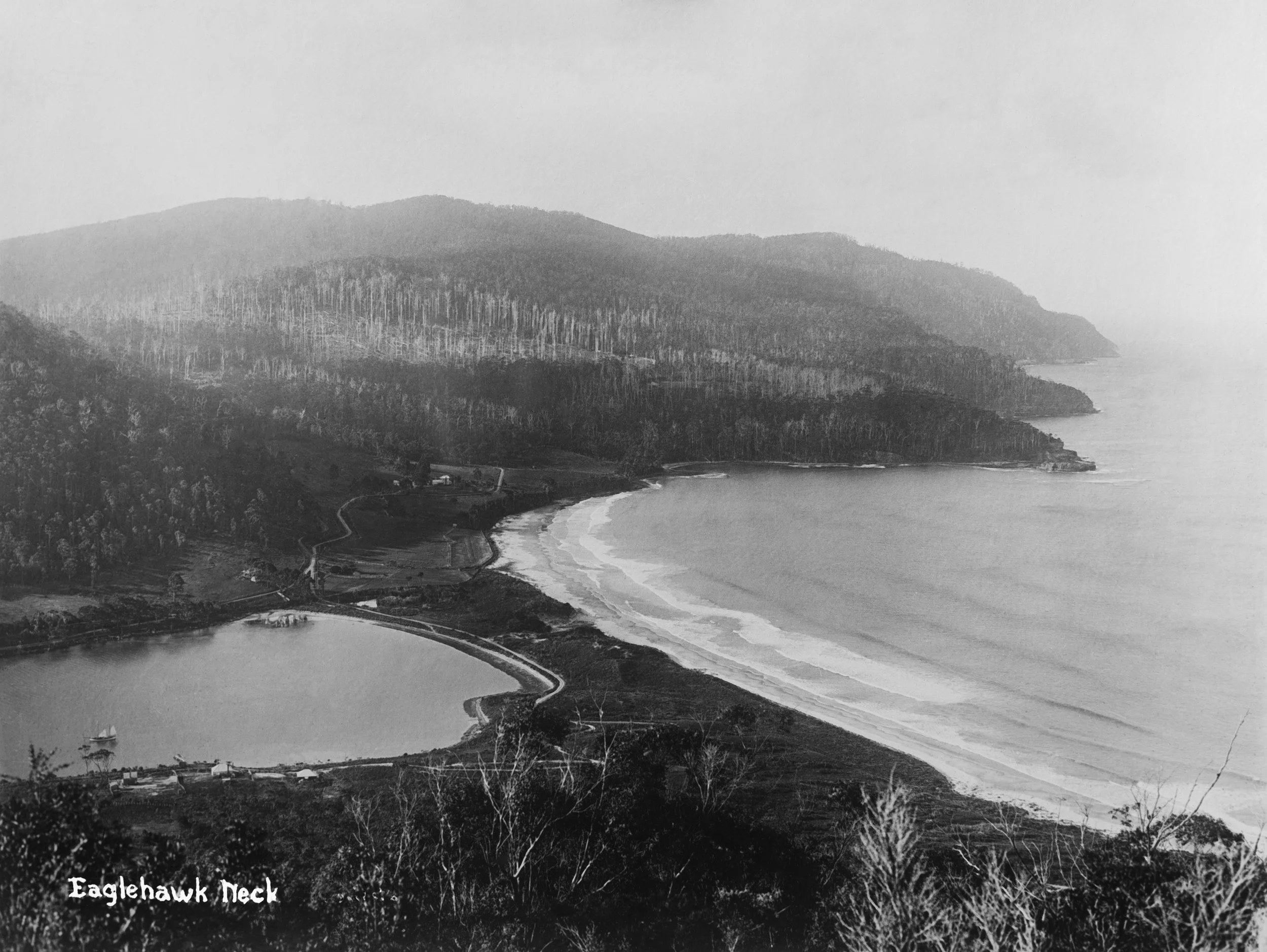
Just how many fatalities there were in the early days of settlement will never be fully known, but the instances which were recorded and have lived on into modern memory have gone on to become local legends. If you were a convict in mid-19th century Van Dieman’s Land, you had no doubt heard of the infamous demise of a bloke named “Amphibious Jack”, a British convict laborer renowned for his diving prowess, who was attacked and killed while diving for oysters at Pitt Water, near Sorell in 1825. Or the story of Owen, another convict who attempted to escape from Port Arthur with two other mates in 1843, but the escape attempt was ruthlessly thwarted when Owen was seized and subsequently devoured by a huge shark, while his fellow would-be escapees fled back to shore into the comparatively more tender grasp of their captors. While other instances of attack which escaped recording in colonial logs undoubtedly occurred, these two infamous cases are perhaps the two most well-known instances of fatal shark attack experienced by Tasmania during its early colonial history. But sharks and the potential risk they posed to islanders were well-known to the indigenous residents long before Europeans arrived on the scene.
From the earliest days of European settlement on the island, stories of sharks were manifested in official colony records, newspaper reports, and in the oral traditions of the Aboriginal people. One notable record comes from the year 1816, when Captain James Kelly documented an extremely dangerous method of sealing which was employed by a number of Aboriginal women on the island’s northeast coast. Captain Kelly, who would go on to become one of the most successful whaling entrepreneurs in Tasmania and was, at the time, in the process of completing a coastal circumnavigational survey of the island, noted in his logs how, on the 18th of January 1816, he and his men had been sealing on King George’s Island (today known as King George’s Rocks) and how he had been astounded by the remarkable hunting methodology employed by their six Aboriginal women assistants, who were indigenous to the Eddystone Point area and were revered among their people for their seal-hunting prowess.
The native huntresses were exceptionally adept at catching fur seals, and their most successful method involved simply swimming across to the seal colony at the offshore rocks whilst wielding a club. Once ashore, the women, keeping careful to stay downwind of the wary seals, would slowly and carefully crawl on their hands and knees over the jagged rocks right into the center of the colony, calming any startled seals by simply imitating their sounds and movements. As soon as the women were in position, they would leap in unison and within seconds, each woman had killed one or two seals on either side of them with a single club bash to the head. The women would then swim back to the boat across from the seal colony, all whist carrying one or more bleeding seal corpses, where the seals’ meat and pelts could then be processed. Over the next three days, the six women employed by Captain Kelly had dispatched 54 seals from the colony, having to swim out further and further on every successive hunting excursion, as the remaining colony members became ever more suspicious of their actions.

This unique method of sealing was also known to be employed all along the Bass Strait islands, and oftentimes, these hunts were conducted during the seals’ summer breeding season, a time when large predators, such as White Sharks, routinely patrol the rookeries in search of an easy meal. With such a uniquely dangerous method of harvesting their quarry, it seems almost inconceivable that the indigenous women engaged in (or forced into) such a hazardous occupation would have escaped completely unscathed on every single occasion. But their slave status among the white Europeans who worked the Strait – not to mention the illiteracy and sheer ruthlessness of their captors – practically guaranteed that anyone who was unfortunate enough to experience such a horrific fate were unlikely to be recorded in official colony records of the time.
What is documented, however, is the merciless human hunting pressure inflicted Tasmania’s marine mammals in the 18th and 19th centuries, which absolutely decimated the populations of both pinnipeds and cetaceans in Southern Australian waters. By 1805, all major Southern Elephant seal breeding colonies in Bass Strait, including the stronghold at King Island, had been completely wiped out, and effectively extirpating the species from Australian waters. Along with tens of thousands of whales and literally hundreds of thousands of fur seals, the senseless, short-sighted, industrial-scale slaughter of marine mammals in Tasmania operated at level that hardly seems imaginable today. By the 1830s, severe overhunting and a near-exhaustion of populations brought the commercial sealing industry in both South Australia and Tasmania to collapse. We can only speculate as to how much this huge reduction in the biomass of their preferred prey items during this time period may have impacted the behavior and dietary preferences for future generations of White Sharks in Southern Australian waters.

By the time the 20th century rolled about, shark attack was becoming an ever increasingly poignant threat in Australian waters, with the vast majority of these early attacks occurring in the warmer waters of Northern Australia and particularly along the more highly populated East Coast between Cairns and Sydney. Back in those days, the risk of shark attack was thought to be largely correlated with increased water temperatures, and according to Dr. Victor Coppleson, an Australian surgeon and one of the first pioneers to engage in the study of shark attacks on man, the cooler waters of Southern Australia and Tasmania represented areas of low risk, as the prevalence of dangerous species in temperate waters, such as Carcharodon, was thought to be minimal. Of course, this notion would later be shown to be faulty.
Up until the 1950s, there had only been one confirmed nonfatal shark attack recorded in Tasmanian waters during the 20th century, when 18-year-old Robert Kay was seriously injured by either a White Shark or a Bronze Whaler (Carcharhinus brachyurus) in August of 1949 whilst wading ashore off the east coast of Flinders Island in Bass Strait. At the time, the case of Robert Kay was the southernmost recorded shark attack in Australia. Then, in the summer of 1958, there was another unfortunate, yet unconfirmed instance in which a 10-year-old girl named Gloria Rigby disappeared while swimming with five other children off Long Point in the River Derwent. While the girl’s official cause of death was listed as drowning, a series of shark sightings in the subsequent days after Gloria Rigby’s disappearance was interpreted as support that perhaps shark attack may have had something to do with the young girl’s untimely and as-yet unexplainable demise. In response, a major shark hunt commenced in the River Derwent, which resulted in high-profile, sensationalist news coverage and the subsequent slaughter of over a dozen large Derwent Sevengills. In the old days, the coastal residents of Tasmania were much more fearful of the species which they encountered more regularly, like the large, but rather inoffensive Broadnose Sevengill (Notorynchus cepedianus), known to Tassies in those days as the “Tasmanian Tiger Shark”. To the average landsman, one unaware of the island’s history, the island’s temperate waters and southerly latitude meant there simply couldn’t be large, potentially dangerous sharks in their waters. Prior to 1959, even Orcas were more feared in Tasmanian waters than the notorious “White Death”. All of that would change on one fateful afternoon in January of 1959, and the place in which this groundbreaking incident occurred could not have had a more tragically ironic name.
On the morning of Saturday, the 17th of January 1959, the Australian naval training ship, the HMAS Cootamundra, commanded by Lieutenant Commander J.M. Nicholas, pulled into the sheltered waters of Safety Cove on the Tasman Peninsula, near Port Arthur, carrying a complement of eighty-five young trainee sailors. Although primarily visiting Tasmanian waters for the purpose of performing training exercises, the Cootamundra was also due to play a flagship role at the upcoming Sandy Bay Regatta in the Derwent estuary later in the following week.

The summer of 1959 was a real scorcher in Tasmania, and the south coast of the state was experiencing near record temperatures on a daily basis as the Cootamundra steamed into Safety Cove that fateful Saturday morning. By the time the clock struck 9:00am, the air temperature at Hobart had already climbed to 27 degrees Celsius. And as the Cootamundra lay at anchor in the secluded waters of the cove, her sensors were registering water temperatures as high as 18 degrees Celsius at a depth of three meters (10 feet). These readings were to remain constant throughout the day.

Due to the scorching heat, calm blue seas, and the picturesque location, it was decided by the ship’s officers that an excursion ashore was justified. The excursion ashore was ostensibly for training purposes, but effectively for rest and recreation. In short order, a motor launch was deployed and in small groups, the boat began ferrying the ship’s complement of trainees to the white, inviting strip of sand at Safety Cove’s beach. Among the ratings who landed on the beach at Safety Cove that day was 22-year-old Brian John Derry of East Melbourne, an electrical mechanic trainee and a member of Cootamundra’s shallow-water diving team.
On the beach, the young trainees were pleasantly surprised when they were warmly greeted by a number of local residents, who had gathered on the shoreline with the ship’s arrival in the bay, and a cheerful, holiday-like atmosphere was quickly established on the beach’s baking white sands. In no time, the inviting, clear water off the beach was festooned with carefree sailors, who noisily splashed about as they enjoyed this welcome respite from their duties aboard ship. Some of the men swam and splashed about in the shallows just off the beach, while Brian Derry and the other members of the ship’s dive squad decided to combine exercise training with spearfishing in the deeper water further off the beach. Brian Derry was young, exceptionally fit, and to the locals, he stood out among his shipmates as a particularly strong and able swimmer. This was demonstrated when at one point, Derry was seen to swim several hundred yards straight out into the bay, make a dive, and then return to shore unflagged and without incident in a matter of minutes, proudly carrying his contribution to the beachside picnic.

Shortly after lunchtime, a general excitement among the beachgoers was aroused when a pair of black fins were clearly spotted by several trainees moving parallel to the beach in the deep water just offshore. It was assumed, perhaps prematurely, that the fins belonged to dolphins, and their brief appearance did little to dampen the enthusiasm of the young sailors seeking cool relief from the heat. By this time, the mercury had peaked to over 32 degrees Celsius.

Later in the afternoon, after the beachside picnic had reluctantly adjourned, the motor launch began to ferry the young sailors back to the Cootamundra. As he waited for the launch to return, Brian Derry, whether out of hubris or sheer impatience, decided that he would swim back to the vessel rather than wait to be ferried back in the launch. Brian then asked one of the local residents present at the beach, a farmer and lifetime resident of the area named L.G. Briggs, whether there were any large sharks in the bay. Briggs replied, “It has never been heard of here.” Satisfied with this supposed reassurance from a local, Brian turned to his shipmates and asked them to take his clothes and his diving goggles back to the ship with them. Brian then ran down the beach and dove headlong into the water, swimming with powerful strokes towards the Cootamundra, lying at anchor more than a quarter of a mile offshore. The time was 4:30 in the afternoon.
Less than five minutes after Brian Derry began his swim back towards the ship, farmer Briggs was following the young rating’s progress with a pair of binoculars. Suddenly and without warning, an enormous shark abruptly exploded from the water in a tremendous shower of spray, striking Brian Derry with tremendous force and catapulting both him and the first third of its body out of the water, before coming down with the hapless sailor in its jaws and taking him underwater in a swirling circular motion. Within seconds, a large patch of blood appeared on the surface. Although Brian was more than 300 meters from shore when he was hit, the sound of the impact when he was struck was such that the sound was clearly heard by those on the beach and on the Cootamundra. The farmer, L.G. Briggs, who witnessed the entire event from start to finish through his binoculars, would later say, “I definitely saw the shark…it was a big one.”
Transfixed by the horror unfolding before their eyes in such a tranquil and unlikely setting, some on shore were stunned into shocked silence, while others shouted the alarm and frantically tried to signal Cootamundra of the occurring drama by waving their shirts above their heads. Meanwhile, the huge shark spent the next several minutes feeding at the surface, and the movements of its dorsal, pectoral, and tail fins as it twisted and rolled in the water initially led some witnesses to mistakenly believe that multiple sharks were involved in the attack.

In short order, the motor launch put off from the mother ship with several armed men aboard and began hurriedly towards the spot where Brian Derry had disappeared. As the boat approached the scene, the massive shark was still lingering near the surface, but there was no trace of Brian Derry to be seen, except for a large, slowly dissipating patch of oily, bloodstained water. According to Nicholas, the shark itself was huge, at least half the size of the 12-meter launch boat (between 20 and 22-feet in length). The animal did not appear to be intimidated by the boat and was only driven away after the sailors began firing upon it with their .303 rifles. Although Lieutenant Commander Nicholas confirmed that the massive fish was definitely hit once, the animal quickly sped off after it was hit, apparently not seriously injured.
After the shark disappeared, the launch circled and fruitlessly searched the area for the vanished sailor for nearly an hour before collecting the remaining trainees from the beach and ferrying them back to the ship. Cootamundra then solemnly weighed anchor and made for nearby Port Arthur to report Brian Derry’s death to the local police. The following day, Lt. Cdr. Nicholas conducted a hushed memorial service aboard Cootamundra to commemorate the life of the young departed naval rating. Meanwhile, local fishing boats were recruited to conduct dragging operations in Safety Cove to search for the rating’s body. Shark-lines were also deployed in the bay in an attempt to capture his killer.
Just after sunset that day, Sunday, January 18th, the lighthouse keeper stationed on Tasman Island, roughly 11 kilometers southeast of the attack site, spotted what he believed was a corpse, floating on the surface of the sea about 200 meters east of the island. He then contacted the Cape Bruny lighthouse keeper by radio, who in turn relayed the message to the naval office in Hobart by telephone. At dawn the following morning, the Cootamundra, along with another visiting warship, the HMAS Swan, along with a company of local fishing boats, arrived at Tasman Island and began an exhaustive search procedure to look for the reported body. After 10 hours, all efforts failed to locate any trace of human remains. Dragging operations, under the supervision of Sergeant Langford of Hobart Water Police and assisted by constables from both Port Arthur and Dunalley, also continued at Safety Cove through the weekend. Unfortunately, no trace of Brian Derry was ever found, and the massive shark which had supposedly taken him was never sighted again.
Sadly, two full days would pass before Brian Derry’s mother could be officially informed of her son’s death. She had been travelling between Brisbane and Melbourne at the time of the incident and could not be contacted until the search for her son’s remains had been abandoned. On Friday the 23rd of January, the Cootamundra and her crew travelled to Hobart, and with heavy hearts, they fulfilled their official flagship duties at the Sandy Bay Regatta. During the ceremony, a message of sympathy and condolence was extended to the grieving crew by the regatta association, and the regatta flag at Long Beach was flown at half-mast as a mark of respect for the young Australian naval rating lost at Safety Cove.

Despite the horror which had been witnessed at Safety Cove, in the days following the demise of Brian Derry, the initial reaction was that of denial. While today, there is no doubt of the fate that befell the unfortunate naval rating, at the time, many islanders simply could not accept that large, man-eating sharks, including the famous White Pointer, were indeed resident to their temperate, southern shores and that they posed a potential risk to bathers.
In the days immediately following the death of Brian Derry, a whole host of wild theories were expounded by landsmen of all sorts, including scientists who should have known better, to explain the disappearance of the unfortunate sailor. Some scoffed at the size of the shark described by witnesses, asserting falsely that Tasmanian sharks did not reach such dimensions and that some other animal must have been responsible. Even Dr. Eric Guiler, the senior lecturer in zoology at the University of Tasmania and a world-renowned authority on species like the Thylacine (Thylacinus cynocephalus), refused to believe that a shark was responsible and instead implicated Killer Whales (Orcinus orca) in Brian Derry’s death. Others, like Ian Cutler, secretary for the Tasmanian Game Fishing Association, were more open to the possibility of a shark attack, but instead curiously suggested the “Blue Pointer” or Shortfin Mako (Isurus oxyrinchus) as the guilty party, even though Cutler was certainly aware of the presence of White Sharks in Tasmanian waters at the time, and the species he implicated, the Mako, is not known to have been responsible for a human death in Tasmanian waters. Dark rumors even circulated that Derry had been inadvertently shot in the water when his shipmates fired upon a pod of dolphins (a practice not nearly as frowned upon in those days as it is now) or that he had been accidentally blown up by some kind of unspecified ordinance fired by the ship. There is no evidence whatsoever for either of these absurd accusations and such baseless speculation is probably best explained as a symptom of the inability, or outright refusal, of many Tasmanians to actually accept the fact that large, predatory sharks, particularly White Sharks, naturally occurred off their island’s coast.

Takeaways –
The psychological and scientific impact of the fatal shark attack at Safety Cove in 1959 was hugely significant and cannot be overstated. In many ways, Brian Derry’s death was a watershed moment, not only for the research advancement into the phenomenon of shark attacks on man, but for the psychology of Tasmania’s coastal residents, many of whom would find it difficult to fully trust their temperate waters again after the incident at Safety Cove. Tasmanians had grown up with the belief that their waters were seemingly safe and free from the risk of shark attack. Overnight, they were forced to accept the fact that large, potentially dangerous shark did cruise and feed in the inshore waters, and that under certain circumstances, they were capable of attacking, killing, and even consuming a human being. The fact that Brian Derry’s death was so anomalous at the time tempted many people, including scientists who should have known better, to write off the attack as a freak occurrence, caused by an animal which had strayed far from its typical range. Or perhaps it was a species that was known locally at the time but had somehow become more aggressive in some way.
1958 had seen the publication of Dr. Victor Coppleson’s extensively researched and widely influential book entitled Shark Attack, in which the renowned Sydney surgeon attempted to link the occurrence and likelihood of shark attack with increased water temperatures. Through exhaustively researched data collected around the world since the 1920s and 30s, Coppleson identified what he called the “world shark attack belt”, a range of latitudes extending right around the world which highlighted where the risk was thought to be higher, as well as a timetable noting the time of year in which water temperatures were highest for a given area and thus marked the times in which the risk of attack was highest.

In those days, sharks were thought to be more active, and therefore more dangerous, in relation to warmer water temperatures, which implied that the risk of shark attack was highest in tropical seas. Conversely, the risk was thought to diminish as warmer waters gave way to more temperate seas in higher latitudes of both the northern and southern hemispheres. Based on the data and knowledge he had at the time, Coppleson was strongly convinced of increased water temperatures being the principal factor in determining the probability of attack in any given location at any given time. Based on this model, it was widely believed that the risk of shark attack occurring south of the Australian mainland were extremely remote. Then, in August of 1949, Robert Kay was badly injured by an unknown shark as he waded ashore near Flinders Island in Bass Strait. Coppleson recognized this case as a deviation from his proposed theory and addressed it in the following way:
“This is the most southerly attack in Australia, and being in August, only time will show which was wrong, the shark or the timetable.” – Dr. Victor Coppleson

With the disappearance of Brian Derry in Tasmania’s southeast came confirmation that something was in fact wrong. Not only with Coppleson’s timetable, but with the broader scientific knowledge of sharks at the time, especially White Sharks. The extent to which White Sharks ranged across temperate seas was not sufficiently understood at the time, nor were the species’ incredible migratory capabilities or their remarkable circulatory system. Because Brian Derry’s death was so inconsistent with the accepted wisdom of the day, rigorous investigations were undertaken and a range of sea temperature readings near the attack location were subsequently collected and analyzed. The results revealed that on the day of the attack, surface temperatures were between 5 and 7 degrees Celsius above normal for that time of year. The combination of increased sea temperatures and the high-profile Sevengill captures from the River Derwent in the wake of the disappearance of Gloria Rigby in February 1958 were subsequently perceived as proof that Tasmania’s ongoing heatwave was coaxing dangerous sharks into Tasmanian waters from further north or was somehow making the local sharks, like the much-maligned Sevengill, more active and more aggressive.
This assertion was flawed on two counts. Firstly, at the time, it was unknown that White Sharks were regionally endothermic and inhabit Tasmanian waters year-round, regardless of sea temperatures. It wasn’t until the following two decades, thanks to groundbreaking work done by academics such as Francis Carey, John McCosker, Tim Tricus, Ken Goldman, and others, that the White Shark’s remarkable countercurrent heat-exchange circulatory system, capable of maintaining a body temperature up to 25 degrees Fahrenheit warmer than the surrounding seawater, was adequately understood. We now know that not only are White Sharks present around Tasmania at all times of the year, but their range extends much further south than was previously thought, with records from as far south as Macquarie Island, nearly 1,000 miles south of Tasmania. Secondly, the sharks which were caught in the River Derwent the year prior to Brian Derry’s death were local Sevengills, a species which not only had nothing to do with the Safety Cove incident, but was also a species which had always abounded in the area. The difference was that only now, during a state of hypertension and hypervigilance following a shocking tragedy, were the local sharks actually being noticed by a broader public. Unfortunately, their seemingly increased presence was interpreted as support that more and more sharks were invading the coastline because of the heat wave. To Tasmanian scientists and the public, Brian Derry's death, as shocking as it was, was largely written off as a freak occurrence - one that occurred under extraordinary circumstances - and the illusion that incidents like the one at Safety Cove could somehow be predicted or explained away was maintained.

Since 1959, there have been four additional fatalities attributed to White Sharks in Tasmanian waters - one at Tenth Island off the state's north coast in 1993 and three in the state's southeast in 1975, 1982, and 2015. Of the attacks which occurred in the southern part of the state, two occurred during the depths of winter, and the other took place in the southernmost bay on the Tasmanian mainland. And chillingly, in three of the following four incidents, few remains, if any, were ever found. Of course, all of these attacks would have been considered anomalous to the proposed parameters for shark attack put forth by Victor Coppleson when he published his book back in 1958. The primary faults with his theory largely rested in the fact that Coppleson, and the broader scientific community at the time, did not sufficiently factor in the evolving range of human water activities into his hypothesis, nor did he understand the White Shark’s extensive range, impressive migration patterns, and the species' affinity for temperate seas. Just as his long-held “rogue shark theory” has been reassessed in recent years, so too has his proposed “timetable of shark attack” been largely superseded thanks to continuing research.
It must be noted, however, that the perceived limitations in Coppleson’s theories have only been unearthed because of subsequent research built upon the foundations laid down by Coppleson in 1958. Notwithstanding the fact that scientists today have come to drastically different conclusions, the fact remains that Victor Coppleson’s pioneering work into the phenomenon of shark attacks on man proved to be the inspiration for much of the dedicated, modern shark research which has followed in the subsequent decades. In his foreword for the updated 1988 edition of Shark Attack, renowned Australian game fishing writer Peter Goadby defended Coppleson against the barbs of modern-day investigators armed with 20/20 hindsight:
“Sir Victor’s theories expressed in the first edition of this book back in 1958 have been the basis of much research right around the world. Whenever a pioneer has the courage to set out on a previously unresearched subject, it is to be expected that subsequent research and analysis may put different connotations on some of the data he or she has collected.” – Peter Goadby
Indeed, it was the 1959 death of Brian Derry at Safety Cove which first demonstrated the limitations of Coppleson’s attempt to impose a semblance of order and explanation for what is, in truth, just a random act of predation by a fish. However, this fact in itself did not undermine the original intent of Coppleson’s painstaking research. Rather, the incident would serve as a catalyst for all subsequent refinement and reinterpretation of shark attack data. In this sense, the modern understanding of shark attacks on man owes as much to the ill-fated, young naval rating from East Melbourne who lost his life that tragic day at Safety Cove as it does to Sir Victor Coppleson himself.

Our investigation continues...our next case takes us to the Adriatic Sea, where we examine the only documented fatal shark attack in the history of Montenegro, and discuss the historical prevalence of White Sharks and their attacks on man in the region.
Links and Supporting Media –
Black, Chris, 2010, White Pointer South: A Compendium of White
Shark Encounters, Captures, and Attacks in Tasmanian Waters, Wellington Bridge Press (Hobart, Tasmania)
Coppleson, Victor, 1958, Shark Attack, Angus & Robertson Publishers (NSW, Australia)
Gilbert, Perry W., Leonard P. Schultz, and Stewart Springer. “Shark Attacks during 1959.” Science 132, no. 3423 (1960): 323–26.
https://sharkmans-world.org/doc/shark_attacks_1959.pdf
https://notaboataccident.com/incident/b77b9e94-eae7-48cf-8843-a0f89c8c3797