r/TheSharkAttackFiles • • 1d ago

📜 Case Report Attack Horror Stories - Brian Derry

68 Upvotes

January 17th, 1959; Safety Cove, near Port Arthur, Southeastern Tasmania;

Take one look at the coastline along the southern coast of Tasmania and an undeniable chill goes down your spine. One immediately distinguishable by the one caused by gusts of harsh Southern Ocean winds. It’s the same feeling one gets when walking in the Southeast Asian jungles or on the African plains. Some places just have that feeling of being guarded. As if shrouded by its aura, one can immediately sense the presence of one of the world’s greatest predators here, in these chilly southern waters. The presence of Carcharodon carcharias.

The rugged, foreboding, and undeniable beauty of Tasmania's southeast coast.

Except for maybe California, perhaps no place is more emblematic and better suited for White Sharks than the Southern Ocean surrounding the island of Tasmania. Thanks to a combination of cool, temperate ocean temperatures, key migratory corridors, and an abundance of calorie-dense prey items like marine mammals, Tasmania is an ideal habitat for White Sharks. And 500 years ago, long before Abel Tasman and the first Europeans arrived on the island, it was an even more ideal environment. In those days, the deep, rich Southern Ocean waters were bountiful beyond belief, filled with great pods of Sperm Whales (Physeter macrocephalus), Humpback Whales (Megaptera novaeangliae), and Southern Right Whales (Eubalaena australis). New Zealand Fur Seals (Arctocephalus forsteri), Australian Fur Seals (Arctocephalus p. doriferus), and Australian Sea Lions (Neophoca cinerea) numbered in the hundreds of thousands, with breeding sites dotted all around the island's coast and throughout Bass Strait. And Southern Elephant Seals (Mirounga leonina), perhaps the most delectable and preferred prey item of all for adult White Sharks, were also plentiful in the region, with multiple established breeding colonies in northern Tasmania and in Bass Strait. King Island, located about 50 miles off the northwestern coast of the Tasmanian mainland in Bass Strait, was once an especially prolific breeding site for Elephant Seals in the region, and was by far the biggest aggregation site for Elephant Seals in Australian waters. It was a unique place, not unlike Año Nuevo Island and the Farallon Islands of California today, where tens of thousands of seals migrated to each spring and summer in order to molt, breed, and bear their young. And being situated in Bass Strait meant that King Island was an accessible feeding site for both major subpopulations of Australia's White Sharks. With such an impressive historic abundance of prey in the region, it's little wonder why White Sharks found the rich feeding opportunities of Bass Strait and around Tasmania's shores so irresistible.

Prior to the arrival of Europeans, Tasmania's rich, temperate waters and bountiful supply of marine mammals had made it an ideal habitat for White Sharks for thousands of years.

One can only imagine what the early convicts who helped build the colony might have witnessed back in those old days. In between strikes of your spade, you glance up and spot a pod of fur seals porpoising along the surface just offshore. An interesting respite from your monotonous and not-so-voluntary task, all whilst being lashed by the harsh Southern Ocean winds, in a strange land far from where you were born and far from all the trouble your tough way of living brought about. Perhaps you were a thief. Perhaps you were a murderer. Whatever you might have been back home, it didn’t matter anymore here. Because here, in Van Dieman’s Land, you were just meat for the Empire. Free labor to aid in the conquering and colonizing of the far reaches of the world. At least here, there were many things to catch your attention, including the fur seals, which you had never seen before. “You wouldn’t see that at Newgate,” you silently say to yourself, trying to feign even a fleeting sense of optimism. But that sense is soon gone, and you glance back down to strike your spade once more.

Suddenly, an extraordinary noise sounds from where you had just been admiring the fur seals just offshore. You look up just in time to see a massive fish, a fish with a characteristically white belly and a dark back, catapulting its nearly 6-meter body fully out of the water, a hapless fur seal fatally clasped in its jaws. You have never seen, or even dared to imagine, a fish of this magnitude and ferocity before. The fish slams back down to the water with a terrific splash, as the other fur seals in the pod scatter in all directions away from the attack. The commotion alerts the attention of your foreman and that of your fellow convict coworkers, who rush to where you’re standing to get a better view of the terrifying spectacle unfolding before your very eyes. For a few seconds, all is quiet. And then suddenly, the fish breaks the surface again and it begins violently thrashing its head from side to side in an attempt to sever its prey into bite-sized portions. A quick flurry of action cuts the fur seal in half, and the surface of the water is soon stained red with a brilliant blanket of blood. The true guardian of the penal colony has revealed itself to you, and the grim reality of your situation becomes brutally clear. “I will never leave this place alive,” you now think to yourself.

The sight of a White Shark launching its massive, torpedo-shaped body clear of the water in pursuit of its mammalian prey is as awesome and formidable as it is terrifying.

Perhaps this scenario is exactly what the British had in mind when they established their penal settlements in what was then called Van Dieman’s Land. After the American Revolutionary War, the British government were desperate to find another dumping ground for their huge prison population. With a colony already established on the Australian mainland in New South Wales and with the colony's prison populations already starting to rise there, the British looked further south, to Van Dieman's Land. It was about as far from the motherland as one could go. The landscape was rugged, untamed, temperamental, and wild. And through accounts from the region’s early sealers and whalers, the island’s temperate waters were teeming with large, dangerous sharks, making the potential for escape rather
minimal. This made Van Diemen's Land the perfect place for the British to send the worst of their worst. In fact, after the notorious prison at Port Arthur was constructed in 1832, the guards at Eaglehawk Neck, the only land route off the Tasman Peninsula, where Port Arthur was situated, would routinely source offal from a nearby abattoir and dispose of it off the beaches at Eaglehawk Neck. This was deliberately done to attract sharks and thus prevent escape attempts to the Tasmanian mainland. In a sense, the sharks had been deputized as unofficial prison guards, and as intended, the waters of the Tasman Peninsula were soon reputed to be "shark infested", and any escape attempt via the sea was perceived by many as suicidal.
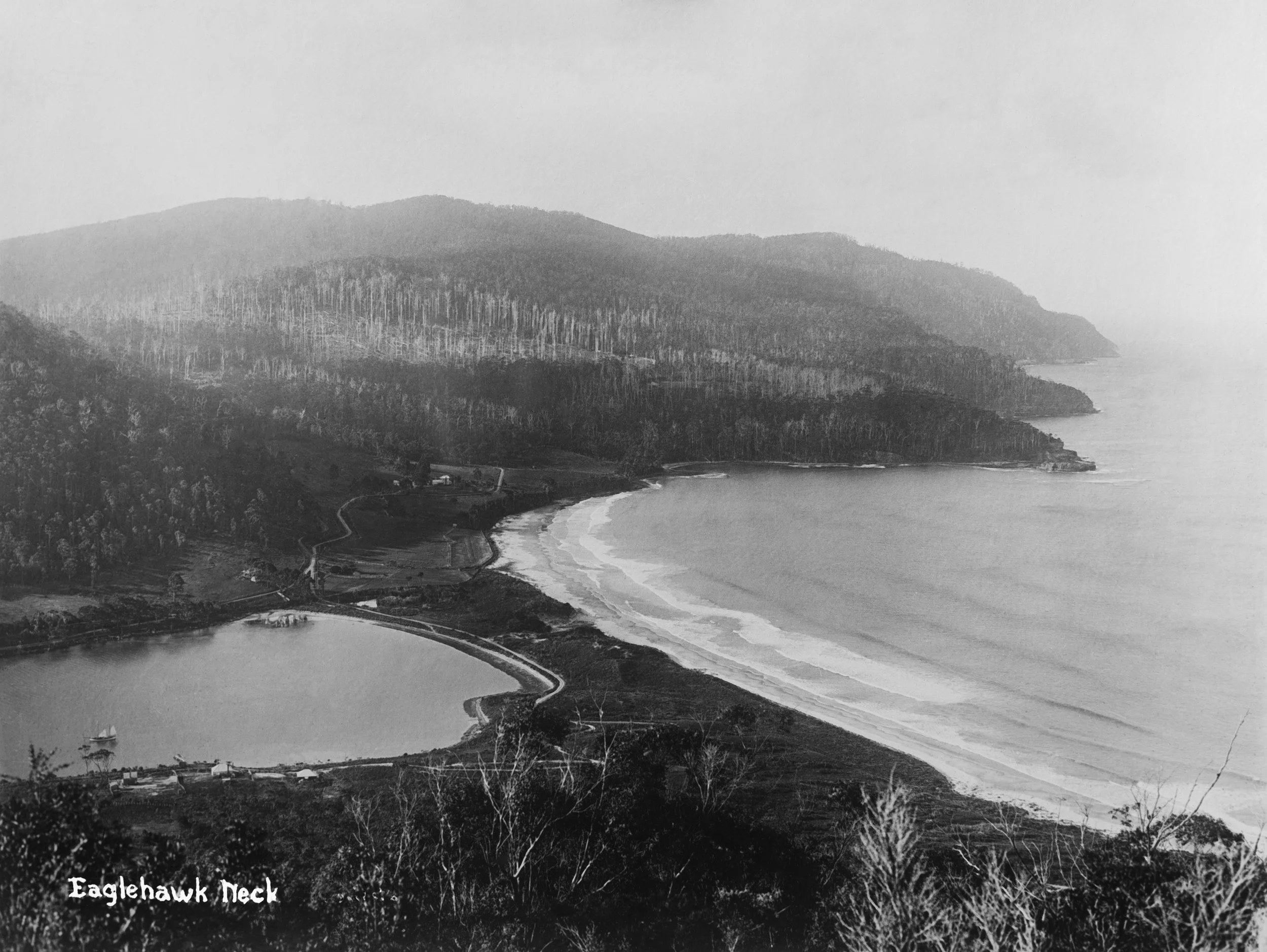
The beaches at Eaglehawk Neck, the narrow strip of land which connects the Tasman Peninsula to the Tasmanian mainland. It was here where the prison guards at Port Arthur would routinely chum the waters with offal sourced from an abattoir. This was done with the express purpose of attracting large sharks into shore and thus making a successful escape attempt off the peninsula less likely.

Just how many fatalities there were in the early days of settlement will never be fully known, but the instances which were recorded and have lived on into modern memory have gone on to become local legends. If you were a convict in mid-19th century Van Dieman’s Land, you had no doubt heard of the infamous demise of a bloke named “Amphibious Jack”, a British convict laborer renowned for his diving prowess, who was attacked and killed while diving for oysters at Pitt Water, near Sorell in 1825. Or the story of Owen, another convict who attempted to escape from Port Arthur with two other mates in 1843, but the escape attempt was ruthlessly thwarted when Owen was seized and subsequently devoured by a huge shark, while his fellow would-be escapees fled back to shore into the comparatively more tender grasp of their captors. While other instances of attack which escaped recording in colonial logs undoubtedly occurred, these two infamous cases are perhaps the two most well-known instances of fatal shark attack experienced by Tasmania during its early colonial history. But sharks and the potential risk they posed to islanders were well-known to the indigenous residents long before Europeans arrived on the scene.

From the earliest days of European settlement on the island, stories of sharks were manifested in official colony records, newspaper reports, and in the oral traditions of the Aboriginal people. One notable record comes from the year 1816, when Captain James Kelly documented an extremely dangerous method of sealing which was employed by a number of Aboriginal women on the island’s northeast coast. Captain Kelly, who would go on to become one of the most successful whaling entrepreneurs in Tasmania and was, at the time, in the process of completing a coastal circumnavigational survey of the island, noted in his logs how, on the 18th of January 1816, he and his men had been sealing on King George’s Island (today known as King George’s Rocks) and how he had been astounded by the remarkable hunting methodology employed by their six Aboriginal women assistants, who were indigenous to the Eddystone Point area and were revered among their people for their seal-hunting prowess.

The native huntresses were exceptionally adept at catching fur seals, and their most successful method involved simply swimming across to the seal colony at the offshore rocks whilst wielding a club. Once ashore, the women, keeping careful to stay downwind of the wary seals, would slowly and carefully crawl on their hands and knees over the jagged rocks right into the center of the colony, calming any startled seals by simply imitating their sounds and movements. As soon as the women were in position, they would leap in unison and within seconds, each woman had killed one or two seals on either side of them with a single club bash to the head. The women would then swim back to the boat across from the seal colony, all whist carrying one or more bleeding seal corpses, where the seals’ meat and pelts could then be processed.  Over the next three days, the six women employed by Captain Kelly had dispatched 54 seals from the colony, having to swim out further and further on every successive hunting excursion, as the remaining colony members became ever more suspicious of their actions.

While it seems unimaginable today, tens of thousands of pinnipeds, including these New Zealand Fur Seals, were ruthlessly slaughtered from coast to coast in Tasmania and throughout the Bass Strait islands. All for the sake of their once-valuable pelts.

This unique method of sealing was also known to be employed all along the Bass Strait islands, and oftentimes, these hunts were conducted during the seals’ summer breeding season, a time when large predators, such as White Sharks, routinely patrol the rookeries in search of an easy meal. With such a uniquely dangerous method of harvesting their quarry, it seems almost inconceivable that the indigenous women engaged in (or forced into) such a hazardous occupation would have escaped completely unscathed on every single occasion. But their slave status among the white Europeans who worked the Strait – not to mention the illiteracy and sheer ruthlessness of their captors – practically guaranteed that anyone who was unfortunate enough to experience such a horrific fate were unlikely to be recorded in official colony records of the time.

What is documented, however, is the merciless human hunting pressure inflicted Tasmania’s marine mammals in the 18th and 19th centuries, which absolutely decimated the populations of both pinnipeds and cetaceans in Southern Australian waters. By 1805, all major Southern Elephant seal breeding colonies in Bass Strait, including the stronghold at King Island, had been completely wiped out, and effectively extirpating the species from Australian waters. Along with tens of thousands of whales and literally hundreds of thousands of fur seals, the senseless, short-sighted, industrial-scale slaughter of marine mammals in Tasmania operated at level that hardly seems imaginable today. By the 1830s, severe overhunting and a near-exhaustion of populations brought the commercial sealing industry in both South Australia and Tasmania to collapse. We can only speculate as to how much this huge reduction in the biomass of their preferred prey items during this time period may have impacted the behavior and dietary preferences for future generations of White Sharks in Southern Australian waters.

The business of sealing was an unhappy, unhealthy, dismal existence, even to the hardened men who took up the practice.

By the time the 20th century rolled about, shark attack was becoming an ever increasingly poignant threat in Australian waters, with the vast majority of these early attacks occurring in the warmer waters of Northern Australia and particularly along the more highly populated East Coast between Cairns and Sydney. Back in those days, the risk of shark attack was thought to be largely correlated with increased water temperatures, and according to Dr. Victor Coppleson, an Australian surgeon and one of the first pioneers to engage in the study of shark attacks on man, the cooler waters of Southern Australia and Tasmania represented areas of low risk, as the prevalence of dangerous species in temperate waters, such as Carcharodon, was thought to be minimal. Of course, this notion would later be shown to be faulty.

Up until the 1950s, there had only been one confirmed nonfatal shark attack recorded in Tasmanian waters during the 20th century, when 18-year-old Robert Kay was seriously injured by either a White Shark or a Bronze Whaler (Carcharhinus brachyurus) in August of 1949 whilst wading ashore off the east coast of Flinders Island in Bass Strait. At the time, the case of Robert Kay was the southernmost recorded shark attack in Australia. Then, in the summer of 1958, there was another unfortunate, yet unconfirmed instance in which a 10-year-old girl named Gloria Rigby disappeared while swimming with five other children off Long Point in the River Derwent. While the girl’s official cause of death was listed as drowning, a series of shark sightings in the subsequent days after Gloria Rigby’s disappearance was interpreted as support that perhaps shark attack may have had something to do with the young girl’s untimely and as-yet unexplainable demise. In response, a major shark hunt commenced in the River Derwent, which resulted in high-profile, sensationalist news coverage and the subsequent slaughter of over a dozen large Derwent Sevengills. In the old days, the coastal residents of Tasmania were much more fearful of the species which they encountered more regularly, like the large, but rather inoffensive Broadnose Sevengill (Notorynchus cepedianus), known to Tassies in those days as the “Tasmanian Tiger Shark”. To the average landsman, one unaware of the island’s history, the island’s temperate waters and southerly latitude meant there simply couldn’t be large, potentially dangerous sharks in their waters. Prior to 1959, even Orcas were more feared in Tasmanian waters than the notorious “White Death”. All of that would change on one fateful afternoon in January of 1959, and the place in which this groundbreaking incident occurred could not have had a more tragically ironic name.

On the morning of Saturday, the 17th of January 1959, the Australian naval training ship, the HMAS Cootamundra, commanded by Lieutenant Commander J.M. Nicholas, pulled into the sheltered waters of Safety Cove on the Tasman Peninsula, near Port Arthur, carrying a complement of eighty-five young trainee sailors. Although primarily visiting Tasmanian waters for the purpose of performing training exercises, the Cootamundra was also due to play a flagship role at the upcoming Sandy Bay Regatta in the Derwent estuary later in the following week.

The inviting white sands and clear waters of Safety Cove.

The summer of 1959 was a real scorcher in Tasmania, and the south coast of the state was experiencing near record temperatures on a daily basis as the Cootamundra steamed into Safety Cove that fateful Saturday morning. By the time the clock struck 9:00am, the air temperature at Hobart had already climbed to 27 degrees Celsius. And as the Cootamundra lay at anchor in the secluded waters of the cove, her sensors were registering water temperatures as high as 18 degrees Celsius at a depth of three meters (10 feet). These readings were to remain constant throughout the day.

The HMAS Cootamundra.

Due to the scorching heat, calm blue seas, and the picturesque location, it was decided by the ship’s officers that an excursion ashore was justified. The excursion ashore was ostensibly for training purposes, but effectively for rest and recreation. In short order, a motor launch was deployed and in small groups, the boat began ferrying the ship’s complement of trainees to the white, inviting strip of sand at Safety Cove’s beach. Among the ratings who landed on the beach at Safety Cove that day was 22-year-old Brian John Derry of East Melbourne, an electrical mechanic trainee and a member of Cootamundra’s shallow-water diving team.

On the beach, the young trainees were pleasantly surprised when they were warmly greeted by a number of local residents, who had gathered on the shoreline with the ship’s arrival in the bay, and a cheerful, holiday-like atmosphere was quickly established on the beach’s baking white sands. In no time, the inviting, clear water off the beach was festooned with carefree sailors, who noisily splashed about as they enjoyed this welcome respite from their duties aboard ship. Some of the men swam and splashed about in the shallows just off the beach, while Brian Derry and the other members of the ship’s dive squad decided to combine exercise training with spearfishing in the deeper water further off the beach. Brian Derry was young, exceptionally fit, and to the locals, he stood out among his shipmates as a particularly strong and able swimmer. This was demonstrated when at one point, Derry was seen to swim several hundred yards straight out into the bay, make a dive, and then return to shore unflagged and without incident in a matter of minutes, proudly carrying his contribution to the beachside picnic.

The beach at Safety Cove, where Brian Derry and his shipmates enjoyed a seaside picnic with a group of local residents in the hours before the attack.

Shortly after lunchtime, a general excitement among the beachgoers was aroused when a pair of black fins were clearly spotted by several trainees moving parallel to the beach in the deep water just offshore. It was assumed, perhaps prematurely, that the fins belonged to dolphins, and their brief appearance did little to dampen the enthusiasm of the young sailors seeking cool relief from the heat. By this time, the mercury had peaked to over 32 degrees Celsius.

While initially assumed to be the fins of one or more dolphins, what the witnesses might have seen may have actually been the dorsal and caudal fins of a large White Shark.

Later in the afternoon, after the beachside picnic had reluctantly adjourned, the motor launch began to ferry the young sailors back to the Cootamundra. As he waited for the launch to return, Brian Derry, whether out of hubris or sheer impatience, decided that he would swim back to the vessel rather than wait to be ferried back in the launch. Brian then asked one of the local residents present at the beach, a farmer and lifetime resident of the area named L.G. Briggs, whether there were any large sharks in the bay. Briggs replied, “It has never been heard of here.” Satisfied with this supposed reassurance from a local, Brian turned to his shipmates and asked them to take his clothes and his diving goggles back to the ship with them. Brian then ran down the beach and dove headlong into the water, swimming with powerful strokes towards the Cootamundra, lying at anchor more than a quarter of a mile offshore. The time was 4:30 in the afternoon.

Less than five minutes after Brian Derry began his swim back towards the ship, farmer Briggs was following the young rating’s progress with a pair of binoculars. Suddenly and without warning, an enormous shark abruptly exploded from the water in a tremendous shower of spray, striking Brian Derry with tremendous force and catapulting both him and the first third of its body out of the water, before coming down with the hapless sailor in its jaws and taking him underwater in a swirling circular motion. Within seconds, a large patch of blood appeared on the surface. Although Brian was more than 300 meters from shore when he was hit, the sound of the impact when he was struck was such that the sound was clearly heard by those on the beach and on the Cootamundra. The farmer, L.G. Briggs, who witnessed the entire event from start to finish through his binoculars, would later say, “I definitely saw the shark
it was a big one.”

Transfixed by the horror unfolding before their eyes in such a tranquil and unlikely setting, some on shore were stunned into shocked silence, while others shouted the alarm and frantically tried to signal Cootamundra of the occurring drama by waving their shirts above their heads. Meanwhile, the huge shark spent the next several minutes feeding at the surface, and the movements of its dorsal, pectoral, and tail fins as it twisted and rolled in the water initially led some witnesses to mistakenly believe that multiple sharks were involved in the attack.

The turning, twisting movements of the shark's dorsal and caudal fins as it fed at the surface led some witnesses to mistakenly believe that multiple sharks were attacking Brian Derry.

In short order, the motor launch put off from the mother ship with several armed men aboard and began hurriedly towards the spot where Brian Derry had disappeared. As the boat approached the scene, the massive shark was still lingering near the surface, but there was no trace of Brian Derry to be seen, except for a large, slowly dissipating patch of oily, bloodstained water. According to Nicholas, the shark itself was huge, at least half the size of the 12-meter launch boat (between 20 and 22-feet in length). The animal did not appear to be intimidated by the boat and was only driven away after the sailors began firing upon it with their .303 rifles. Although Lieutenant Commander Nicholas confirmed that the massive fish was definitely hit once, the animal quickly sped off after it was hit, apparently not seriously injured.

After the shark disappeared, the launch circled and fruitlessly searched the area for the vanished sailor for nearly an hour before collecting the remaining trainees from the beach and ferrying them back to the ship. Cootamundra then solemnly weighed anchor and made for nearby Port Arthur to report Brian Derry’s death to the local police. The following day, Lt. Cdr. Nicholas conducted a hushed memorial service aboard Cootamundra to commemorate the life of the young departed naval rating. Meanwhile, local fishing boats were recruited to conduct dragging operations in Safety Cove to search for the rating’s body. Shark-lines were also deployed in the bay in an attempt to capture his killer.

Just after sunset that day, Sunday, January 18th, the lighthouse keeper stationed on Tasman Island, roughly 11 kilometers southeast of the attack site, spotted what he believed was a corpse, floating on the surface of the sea about 200 meters east of the island. He then contacted the Cape Bruny lighthouse keeper by radio, who in turn relayed the message to the naval office in Hobart by telephone. At dawn the following morning, the Cootamundra, along with another visiting warship, the HMAS Swan, along with a company of local fishing boats, arrived at Tasman Island and began an exhaustive search procedure to look for the reported body. After 10 hours, all efforts failed to locate any trace of human remains. Dragging operations, under the supervision of Sergeant Langford of Hobart Water Police and assisted by constables from both Port Arthur and Dunalley, also continued at Safety Cove through the weekend. Unfortunately, no trace of Brian Derry was ever found, and the massive shark which had supposedly taken him was never sighted again.

Sadly, two full days would pass before Brian Derry’s mother could be officially informed of her son’s death. She had been travelling between Brisbane and Melbourne at the time of the incident and could not be contacted until the search for her son’s remains had been abandoned. On Friday the 23rd of January, the Cootamundra and her crew travelled to Hobart, and with heavy hearts, they fulfilled their official flagship duties at the Sandy Bay Regatta. During the ceremony, a message of sympathy and condolence was extended to the grieving crew by the regatta association, and the regatta flag at Long Beach was flown at half-mast as a mark of respect for the young Australian naval rating lost at Safety Cove.

After seeing action during World War II and serving as a naval training vessel in the early 1950s, HMAS Cootamundra was decommissioned less than five months after the death of Brian Derry at Safety Cove.

Despite the horror which had been witnessed at Safety Cove, in the days following the demise of Brian Derry, the initial reaction was that of denial. While today, there is no doubt of the fate that befell the unfortunate naval rating, at the time, many islanders simply could not accept that large, man-eating sharks, including the famous White Pointer, were indeed resident to their temperate, southern shores and that they posed a potential risk to bathers.

In the days immediately following the death of Brian Derry, a whole host of wild theories were expounded by landsmen of all sorts, including scientists who should have known better, to explain the disappearance of the unfortunate sailor. Some scoffed at the size of the shark described by witnesses, asserting falsely that Tasmanian sharks did not reach such dimensions and that some other animal must have been responsible. Even Dr. Eric Guiler, the senior lecturer in zoology at the University of Tasmania and a world-renowned authority on species like the Thylacine (Thylacinus cynocephalus), refused to believe that a shark was responsible and instead implicated Killer Whales (Orcinus orca) in Brian Derry’s death. Others, like Ian Cutler, secretary for the Tasmanian Game Fishing Association, were more open to the possibility of a shark attack, but instead curiously suggested the “Blue Pointer” or Shortfin Mako (Isurus oxyrinchus) as the guilty party, even though Cutler was certainly aware of the presence of White Sharks in Tasmanian waters at the time, and the species he implicated, the Mako, is not known to have been responsible for a human death in Tasmanian waters. Dark rumors even circulated that Derry had been inadvertently shot in the water when his shipmates fired upon a pod of dolphins (a practice not nearly as frowned upon in those days as it is now) or that he had been accidentally blown up by some kind of unspecified ordinance fired by the ship. There is no evidence whatsoever for either of these absurd accusations and such baseless speculation is probably best explained as a symptom of the inability, or outright refusal, of many Tasmanians to actually accept the fact that large, predatory sharks, particularly White Sharks, naturally occurred off their island’s coast.

One can easily imagine how Brian Derry and his shipmates would be lulled into a false sense of security brought on by a location as idyllic as Safety Cove.

Takeaways –

The psychological and scientific impact of the fatal shark attack at Safety Cove in 1959 was hugely significant and cannot be overstated. In many ways, Brian Derry’s death was a watershed moment, not only for the research advancement into the phenomenon of shark attacks on man, but for the psychology of Tasmania’s coastal residents, many of whom would find it difficult to fully trust their temperate waters again after the incident at Safety Cove. Tasmanians had grown up with the belief that their waters were seemingly safe and free from the risk of shark attack. Overnight, they were forced to accept the fact that large, potentially dangerous shark did cruise and feed in the inshore waters, and that under certain circumstances, they were capable of attacking, killing, and even consuming a human being. The fact that Brian Derry’s death was so anomalous at the time tempted many people, including scientists who should have known better, to write off the attack as a freak occurrence, caused by an animal which had strayed far from its typical range. Or perhaps it was a species that was known locally at the time but had somehow become more aggressive in some way.

1958 had seen the publication of Dr. Victor Coppleson’s extensively researched and widely influential book entitled Shark Attack, in which the renowned Sydney surgeon attempted to link the occurrence and likelihood of shark attack with increased water temperatures. Through exhaustively researched data collected around the world since the 1920s and 30s, Coppleson identified what he called the “world shark attack belt”, a range of latitudes extending right around the world which highlighted where the risk was thought to be higher, as well as a timetable noting the time of year in which water temperatures were highest for a given area and thus marked the times in which the risk of attack was highest.

Victor Coppleson's "Shark Attack", originally published in 1958.

In those days, sharks were thought to be more active, and therefore more dangerous, in relation to warmer water temperatures, which implied that the risk of shark attack was highest in tropical seas. Conversely, the risk was thought to diminish as warmer waters gave way to more temperate seas in higher latitudes of both the northern and southern hemispheres. Based on the data and knowledge he had at the time, Coppleson was strongly convinced of increased water temperatures being the principal factor in determining the probability of attack in any given location at any given time. Based on this model, it was widely believed that the risk of shark attack occurring south of the Australian mainland were extremely remote. Then, in August of 1949, Robert Kay was badly injured by an unknown shark as he waded ashore near Flinders Island in Bass Strait. Coppleson recognized this case as a deviation from his proposed theory and addressed it in the following way:

“This is the most southerly attack in Australia, and being in August, only time will show which was wrong, the shark or the timetable.” – Dr. Victor Coppleson

Dr. Victor Coppleson - a true pioneer in the endeavor to investigate and attempt to understand the phenomenon of shark attacks on man. No doubt the death of Brian Derry at Safety Cove, mere months after the publication of his groundbreaking book, caused the doctor much consternation and confusion in the time that followed.

With the disappearance of Brian Derry in Tasmania’s southeast came confirmation that something was in fact wrong. Not only with Coppleson’s timetable, but with the broader scientific knowledge of sharks at the time, especially White Sharks. The extent to which White Sharks ranged across temperate seas was not sufficiently understood at the time, nor were the species’ incredible migratory capabilities or their remarkable circulatory system. Because Brian Derry’s death was so inconsistent with the accepted wisdom of the day, rigorous investigations were undertaken and a range of sea temperature readings near the attack location were subsequently collected and analyzed. The results revealed that on the day of the attack, surface temperatures were between 5 and 7 degrees Celsius above normal for that time of year. The combination of increased sea temperatures and the high-profile Sevengill captures from the River Derwent in the wake of the disappearance of Gloria Rigby in February 1958 were subsequently perceived as proof that Tasmania’s ongoing heatwave was coaxing dangerous sharks into Tasmanian waters from further north or was somehow making the local sharks, like the much-maligned Sevengill, more active and more aggressive.

This assertion was flawed on two counts. Firstly, at the time, it was unknown that White Sharks were regionally endothermic and inhabit Tasmanian waters year-round, regardless of sea temperatures. It wasn’t until the following two decades, thanks to groundbreaking work done by academics such as Francis Carey, John McCosker, Tim Tricus, Ken Goldman, and others, that the White Shark’s remarkable countercurrent heat-exchange circulatory system, capable of maintaining a body temperature up to 25 degrees Fahrenheit warmer than the surrounding seawater, was adequately understood. We now know that not only are White Sharks present around Tasmania at all times of the year, but their range extends much further south than was previously thought, with records from as far south as Macquarie Island, nearly 1,000 miles south of Tasmania. Secondly, the sharks which were caught in the River Derwent the year prior to Brian Derry’s death were local Sevengills, a species which not only had nothing to do with the Safety Cove incident, but was also a species which had always abounded in the area. The difference was that only now, during a state of hypertension and hypervigilance following a shocking tragedy, were the local sharks actually being noticed by a broader public. Unfortunately, their seemingly increased presence was interpreted as support that more and more sharks were invading the coastline because of the heat wave. To Tasmanian scientists and the public, Brian Derry's death, as shocking as it was, was largely written off as a freak occurrence - one that occurred under extraordinary circumstances - and the illusion that incidents like the one at Safety Cove could somehow be predicted or explained away was maintained.

A massive 6-meter female White Shark, caught during the depths of winter at Pirates Bay, Eaglehawk Neck on the Tasman Peninsula by professional fishermen and brothers Peter and Robert Cunningham in June of 1983. This heavyweight specimen, perhaps more than 4,000-pounds, remains the largest White Shark ever caught in Tasmanian waters.

Since 1959, there have been four additional fatalities attributed to White Sharks in Tasmanian waters - one at Tenth Island off the state's north coast in 1993 and three in the state's southeast in 1975, 1982, and 2015. Of the attacks which occurred in the southern part of the state, two occurred during the depths of winter, and the other took place in the southernmost bay on the Tasmanian mainland. And chillingly, in three of the following four incidents, few remains, if any, were ever found. Of course, all of these attacks would have been considered anomalous to the proposed parameters for shark attack put forth by Victor Coppleson when he published his book back in 1958. The primary faults with his theory largely rested in the fact that Coppleson, and the broader scientific community at the time, did not sufficiently factor in the evolving range of human water activities into his hypothesis, nor did he understand the White Shark’s extensive range, impressive migration patterns, and the species' affinity for temperate seas. Just as his long-held “rogue shark theory” has been reassessed in recent years, so too has his proposed “timetable of shark attack” been largely superseded thanks to continuing research.

It must be noted, however, that the perceived limitations in Coppleson’s theories have only been unearthed because of subsequent research built upon the foundations laid down by Coppleson in 1958. Notwithstanding the fact that scientists today have come to drastically different conclusions, the fact remains that Victor Coppleson’s pioneering work into the phenomenon of shark attacks on man proved to be the inspiration for much of the dedicated, modern shark research which has followed in the subsequent decades. In his foreword for the updated 1988 edition of Shark Attack, renowned Australian game fishing writer Peter Goadby defended Coppleson against the barbs of modern-day investigators armed with 20/20 hindsight:

“Sir Victor’s theories expressed in the first edition of this book back in 1958 have been the basis of much research right around the world. Whenever a pioneer has the courage to set out on a previously unresearched subject, it is to be expected that subsequent research and analysis may put different connotations on some of the data he or she has collected.” – Peter Goadby

Indeed, it was the 1959 death of Brian Derry at Safety Cove which first demonstrated the limitations of Coppleson’s attempt to impose a semblance of order and explanation for what is, in truth, just a random act of predation by a fish. However, this fact in itself did not undermine the original intent of Coppleson’s painstaking research. Rather, the incident would serve as a catalyst for all subsequent refinement and reinterpretation of shark attack data. In this sense, the modern understanding of shark attacks on man owes as much to the ill-fated, young naval rating from East Melbourne who lost his life that tragic day at Safety Cove as it does to Sir Victor Coppleson himself.

16 years would pass before Tasmania would suffer its next fatal shark attack.

Our investigation continues...our next case takes us to the Adriatic Sea, where we examine the only documented fatal shark attack in the history of Montenegro, and discuss the historical prevalence of White Sharks and their attacks on man in the region.

Links and Supporting Media –

Black, Chris, 2010, White Pointer South: A Compendium of White
Shark Encounters, Captures, and Attacks in Tasmanian Waters, Wellington Bridge Press (Hobart, Tasmania)

Coppleson, Victor, 1958, Shark Attack, Angus & Robertson Publishers (NSW, Australia)

Gilbert, Perry W., Leonard P. Schultz, and Stewart Springer. “Shark Attacks during 1959.” Science 132, no. 3423 (1960): 323–26.

https://sharkmans-world.org/doc/shark_attacks_1959.pdf

https://www.themercury.com.au/lifestyle/tasmanias-shark-attack-history-explained/news-story/bf1ee692c607858e22ade1cb0d83ede5

https://notaboataccident.com/incident/b77b9e94-eae7-48cf-8843-a0f89c8c3797


r/TheSharkAttackFiles • • 2d ago

⌚ Recent Incident Surfer gets "smoked" in North Santa Barbara County, California- "Welp, pretty rattled. Got smoked this morning by an about 15-20ft Great White."

Thumbnail instagram.com
159 Upvotes

Tictacjack_ (Instagram)----Welp, pretty rattled. Got smoked this morning by an about 15-20ft Great White surfing North SB County. Was sitting out the back when a huge dark shape bolted under me and blew up on the back half of my board from underneath. Thankfully was able to kick my legs forward and away from its mouth. u/dylanstolley1 was sitting nearby and saw it blow me 2 feet out of the water. It had my board in its mouth and I was able to kick it and push my self away from it. It let go pretty quickly and I was able to get back on my board and paddle to the beach. Super grateful to walk away without a scratch.


r/TheSharkAttackFiles • • 2d ago This

📜 Case Report Fatal Shark Attacks In KwaZulu-Natal 🇿🇩

49 Upvotes

May 24, 1852
Durban Bay
Victim: Male (Servant)
Activity: Boat Capsized/Clinging Hull
(Awaiting Rescue)
Injury: Consumed
Species: White Shark (Likely)

July 21, 1897
Back Beach, Durban
Victim: Male (Indian)
Age: Youth
Activity: Wading (Retrieving Netted Sardines)
Injury: Consumed
Species: Bull Shark (Likely)

1890 (Circa)
Cape Vidal, iSimangaliso Wetlands
Victim: Male (Zulu)
Age: Youth
Activity: Swimming (With Friends)
Injury: Major Lacerations (Leg/Foot)
Species: Bull Shark

1900s (Circa)
Durban
Victim: Male (Indian)
Age: Youth
Activity: Swimming
Injury: Leg Severed
Species: Bull Shark (Likely)

April 6, 1905
Back Beach, Durban
Victim: James Anderson
Age: 26
Activity: Swimming/Wading
Injury: Major Lacerations (Thigh)
Species: Bull Shark

December 31, 1905
Back Beach, Durban
Victim: Eric Supperman
Age: 18
Activity: Swimming
Injury: Major Lacerations (Torso/Shoulder)
Species: Bull Shark

January 20, 1906
Battery Beach, Durban
Victim: Ramdayal (Indian Labourer)
Age: 30
Activity: Wading (Washing Horses)
Injury: Major Lacerations (Legs/Hip)
Species: Bull Shark

1913 (Circa)
Durban
Victim: Male (Zulu)
Activity: Fishing
Injury: Major Lacerations (Torso)
Species: Bull Shark (Likely)

January 20, 1919
Beach Hotel, Durban
Victim: Male (Scottish)
Activity: Bathing (Wading In Shallows)
Injury: Major Lacerations (Leg)
Species: Bull Shark

1921 (Circa)
Durban Bay
Victim: Male (Sailor)
Activity: Swimming (Alongside Ship)
Injury: Consumed
Species: Several White Sharks (Likely)

1921 (Circa)
Durban
Victim: Male
Activity: Bathing
Injury: Major Lacerations (Torso)
Species: Bull Shark (Likely)

January 29, 1924
South Beach, Durban
Victim: Johannes Karl Schultz
Age: 22
Activity: Swimming
Injury: Half Consumed (Torso)
Species: White Shark

April 1, 1934
Winkelspruit Beach, Kingsburgh
Victim: Male (Zulu)
Age: Youth
Activity: Swimming (Caught In Rip)
Injury: Consumed
Species: White Shark (Likely)

January 7, 1940
Warner Beach, Kingsburgh
Victim: Frederick Aubrey Hooper
Age: 18
Activity: Swimming
Injury: Major Lacerations (Leg)
Species: Bull Shark (Likely)

February 22, 1940
Inyoni Rocks, Amanzimtoti
Victim: Leslie Plummer Lund
Age: 17
Activity: Swimming
Injury: Major Lacerations (Leg)
Species: White Shark

March 31, 1940
Danger Pool, Winklespruit
Victim: Joseph Lees
Age: 25
Activity: Swimming/Treading Water
(Lifesaving Group)
Injury: Major Lacerations (Leg)
Species: White Shark

April, 1940
Winklespruit Beach, Kingsburgh
Victim: Female (Indian)
Activity: Swimming
Injury: Unknown
Species: Unknown

December 20, 1940
Inyoni Rocks, Amanzimtoti*
Victim: Desmond Chandley
Age: 17
Activity: Swimming
Injury: Major Lacerations (Legs/Buttock)
Species: White Shark (Likely)

November 28, 1942
50km off St. Lucia, ISimangaliso
Victim: British Crew & Italian POWS
(HMS Nova Scotia)
Activity: Shipwreck (Torpedoed By German Submarine)
Injury: Many Consumed
Species: Oceanic Whitetip Sharks

March 21, 1943
North Beach, Durban
Victim: Eric Ridley
Age: 31
Activity: Swimming
Injury: Major Lacerations (Legs)
Species: Bull Shark (Likely)

December 12, 1943
Inyoni Rocks, Amanzimtoti
Victim: James Crawford Mathews
Age: 17
Activity: Swimming (Body Surfing)
Injury: Major Lacerations (Torso/Leg)
Species: White Shark (Likely)

January 4, 1944
North Beach, Durban
Victim: Ronald Joel Selby
Age: 26
Activity: Swimming
Injury: Major Lacerations (Calf)
Species: Bull Shark

January 20, 1944
North Beach, Durban
Victim: Anthony Bunn (HMS Kongoni)
Age: 22
Activity: Swimming (Body Surfing)
Injury: Major Lacerations (Thigh)
Species: Bull Shark (Likely)

March 26, 1944
North Beach, Durban
Victim: Geoffrey Best
Age: 23
Activity: Swimming (Wading In Shallows)
Injury: Major Lacerations (Leg)
Species: Bull Shark

August 20, 1944
Margate, South Coast
Victim: Dennis Nissen
Age: 19
Activity: Swimming
Injury: Consumed
Species: White Shark

February 11, 1950
South Beach, Durban
Victim: Clive Heath Gordon Dumayne
Age: 14
Activity: Swimming (Body Surfing)
Injury: Consumed (Foot Recovered)
Species: White Shark

1March 8, 1950
North Beach, Durban
Victim: Brian Von Berg
Age: 20
Activity: Swimming/Lifesaving Drill (Night)
Injury: Consumed
Species: White Shark (Likely)

January 21, 1951
Native Beach, Durban
Victim: Hendrie Nkwazi
Age: 19
Activity: Swimming
Injury: Leg Severed
Species: Bull Shark (Likely)

January 12, 1952
North Beach, Durban
Victim: Edward P. Temple
Age: 17
Activity: Swimming (Wading In Surf)
Injury: Major Lacerations (Legs)
Species: Bull Shark

January 15, 1955
St. Lucia Estuary, ISimangaliso
Victim: Male (Zulu)
Activity: Swimming (Crossing Bay)
Injury: Major Lacerations (Leg)
Species: Bull Shark

January 5, 1957
Umgeni Estuary, Durban
Victim: Sydney Victor Williams
Age: 12
Activity: Wading (Playing With Brother)
Injury: Major Lacerations
Species: Bull Shark

December 20, 1957
Uvongo Beach, Margate
Victim: Allan Green
Age: 15
Activity: Swimming
Injury: Major Lacerations (Torso/Arm)
Species: Bull Shark (Likely)

December 23, 1957
Margate, South Coast
Victim: Vernon James Berry
Age: 23
Activity: Swimming (Wading In Shallows)
Injury: Major Lacerations (Arms/Torso/Thigh)
Species: Bull Shark (Likely)

January, 9 1958
Scottburgh Beach, South Coast
Victim: Derryck Garth Prinsloo
Age: 42
Activity: Swimming (Wading)
Injury: Major Lacerations (Legs/Buttock)
Species: White Shark

April 3, 1958
Port Edward, South Coast
Victim: Nicholaas Francois Badenhorst
Age: 29
Activity: Swimming
Injury: Limbs Severed (Arms/Shoulder)
Species: White Shark

April 5, 1958
Uvongo Beach, Margate
Victim: Fay Jones Bester
Age: 28
Activity: Swimming (Wading In Shallows)
Injury: Major Lacerations (Torso/Leg)
Species: White Shark (Likely)

1958 (Circa)
Makakatana Bay, St. Lucia Estuary
Victim: Male (Zulu Fishermen)
Age: 20s
Activity: Wading (Retrieving Fish)
Injury: Leg Severed
Species: Bull Shark

December 24, 1960
Margate, South Coast
Victim: Serame Petrus Sithole
Age: 25
Activity: Swimming
Injury: Legs Severed
Species: White Shark

February 5, 1962
Winkelspruit Beach, Kingsburgh
Victim: Reece F. Nielsen
Age: 13
Activity: Swimming (Body Surfing)
Injury: Major Lacerations (Leg)
Species: White Shark (Likely)

February 7, 1962
Winkelspruit Beach, Kingsburgh
Victim: Clifford Hoogvorst
Age: 22.
Activity: Swimming/Wading
Injury: Major Lacerations (Legs)
Species: Bull Shark

December 20, 1963
Umvoti Rivermouth, KwaDukuza
Victim: Matangusa Mzize
Age: 15
Activity: Wading (Playing With Friends)
Injury: Major Lacerations (Torso/Legs/Arm)
Species: Bull Shark

January 7, 1967
Port Edward, South Coast
Victim: David J. Smith
Age: 16
Activity: Surfing
Injury: Major Lacerations
Species: White Shark

September 29, 1973
Mission Rocks Beach, iSimangaliso
Victim: Male (Fishermen)
Activity: Boat Capsized (Being Pulled Ashore)
Injury: Major Lacerations
Species: Bull Shark (Likely)

December 14, 1974
Umhlanga Rocks, Near Durban
Victim: Charles J. Wilson
Age: 32
Activity: Surfing
Injury: Major Lacerations (Torso/Leg)
Species: Bull Shark

December 12, 1978
Sodwana Bay, Maputaland
Victim: Phillip Steenkamp
Age: 23
Activity: Spearfishing (Swimming Ashore)
Injury: Major Lacerations (Legs)
Species: White Shark

May 5, 1979
Mabibi Reef, Maputaland
Victim: Alan Edly Symons
Age: 26
Activity: Scuba Diving (Diving Class)
Injury: Consumed
Species: Tiger Shark (Likely)

March 29, 1980
Umdloti Beach, North Coast
Victim: Ray Booth
Age: 52
Activity: Crayfishing (Returning To Shore)
Injury: Half Consumed (Torso)
Species: Tiger Shark

January 4, 1984
Umlaas Canal, Durban
Victim: Female
Age: 14
Activity: Swimming
Injury: Major Lacerations
Species: Bull Shark (Likely)

January 24, 1995
Tiger Rocks, Isipingo Beach
Victim: Mthokozisi Cedrick Mpanza
Age: 14
Activity: Swimming (Lifeguard Training)
Injury: Major Lacerations (Legs)
Species: Tiger Shark

November 27, 2003
Sodwana Bay, Maputaland
Victim: Seldon Jee
Age: 21
Activity: Spearfishing
Injury: Consumed (Hand Recovered)
Species: Tiger Shark

May 21, 2011
Levan Point, iSimangaliso
Victim: Warren Smart
Age: 28
Activity: Spearfishing
Injury: Major Lacerations (Thigh)
Species: Bull Shark

April 12, 2017
Protea Banks Reef, 8km Off Margate
Victim: Leopold Mairhuber
Age: 68
Activity: Scuba Diving
Injury: Half Consumed (Torso)
Species: Tiger Shark (Likely)

July 4, 2025
Mfazazana Beach, Hibberdene
Victim: Male
Age: 37
Activity: Spearfishing
(Swimming Through Sardine Shoal)
Injury: Major Lacerations
Species: Bronze Whaler Shark

KwaZulu-Natal Total: 53

  • Consumed: 13
    Ratio: 24%

Activities

  • Swimming: 36
  • Spearfishing: 4
  • Fishing: 4
  • Surfing: 2
  • Lifesaving Drill: 2
  • Boat Capsize: 2
  • Scuba Diving: 2
  • Shipwreck: 1

Species Implicated

Bull Shark: 27

  • Consumed: 1
    Ratio: 4%

White Shark: 18

  • Consumed: 6
    Ratio: 33%

Tiger Shark: 5

  • Consumed: 4
    Ratio: 80%

Oceanic Whitetip: 1

Bronze Whaler Shark: 1

Attacks By Century/Decade

19th Century
1850s: 1
1890s: 2
Total: 3

20th Century
1900s: 4
1910s: 2
1920s: 3
1930s: 1
1940s: 12
1950s: 12
1960s: 5
1970s: 4
1980s: 2
1990s: 1
Total: 46

21st Century
2000s: 1
2010s: 2
2020s: 1
Total: 4


r/TheSharkAttackFiles • • 4d ago

⌚ Recent Incident Bull shark bites man in Fiji diving for freshwater mussels (Naitasiri river)

Thumbnail
fijitimes.com.fj
39 Upvotes

r/TheSharkAttackFiles • • 4d ago

đŸ“ș Media & News WEEKEND WATCH: The Ultimate Assassin

Thumbnail
youtube.com
15 Upvotes

r/TheSharkAttackFiles • • 5d ago

⌚ Recent Incident Shark attack in Maui, Hawaii (Kanaha Beach) on November 12, 2026?

Thumbnail
gallery
79 Upvotes

Interesting situation here- Tiger shark season is currently in full swing in Hawaii and it's no secret that Maui is the epicenter of tiger shark activity on the island chain.

Apparently, there was an incident last week on November 12th. However, there are very few details available 7 days later.

Attached is the only information I've come across at this point:

  1. A letter to the editor at The Maui News stating- "I’m surprised you guys have not mentioned anything in the newspaper about the shark attack at Kanaha Beach Park that happened Nov. 12." "The public should be aware of these things."
  2. An Instagram post from Maui247news stating- SHARK BITE: There was an incident of a shark bite this afternoon at Kanaha Beach Park in Kahului. Ocean Safety personnel cleared the ocean of swimmers windsurfers etc.
  3. A comment on the Maui247news post stating- "Thank you first responders! I am glad it was not worse, but same time, Hoping for full recovery and restoration of her leg. âœïžđŸ™đŸœ."

I'm not sure what's going on here but it just feels odd. Or, maybe I'm just missing something? Feel free to post any additional information or perspective below in the comments.

In fairness, there were two reported shark attacks last month at the Cayman Islands. Both were later chalked up to an ornery barracuda based on a non-public evaluation of the wounds. The problem barracuda was then located, removed, and a public announcement was made that the threat was taken care of. Similar situation to this incident in that very little detail is being made available đŸ€·â€â™‚ïž

Bonus- I came across this database while looking into the incident and thought I would share. I found it interesting and usefull: https://dlnr.hawaii.gov/sharks/shark-incidents/incidents-list/


r/TheSharkAttackFiles • • 6d ago

📜 Case Report Fatal Shark Attacks In Florida đŸ‡ș🇾

52 Upvotes

August 8, 1780
Pensacola Harbour, British West Florida
Victim: Joseph Feron (Sailor)
Activity: Swimming
Injury: Foot Severed
Species: Bull Shark (Likely)

September 10, 1845
Near Pensacola
Victim: Nickerson (Fishermen)
Activity: Wading (Seine Netting)
Injury: Consumed
Species: Tiger Shark (Likely)

June 8, 1849
Off Navy Yard, Pensacola
Victim: Mrs. Cracton & Mr. Mansfield
Activity: Swimming/Rescuing Victim
Injury: Major Lacerations & Consumed
Species: Several Bull Sharks (Likely)

1853 (Circa)
Off Fernandina Beach, Nassau
Victim: George Jacob Hanscheldt (Captain)
Activity: Knocked Overboard (Treading Water)
Injury: Consumed
Species: Tiger Shark (Likely)

May 5, 1857
Cape Sable, Everglades
Victim: Pvt. Dunn (US Soldier)
Activity: Boat Capsized (Swimming Ashore)
Injury: Consumed
Species: Several Bull Sharks

June, 1883
Fort Pickens, Pensacola
Victim: Male (Captains Son)
Age: Youth
Activity: Fell Overboard (Coming Ashore)
Injury: Limbs Severed (Head/Legs/Arms)
Species: Several Bull Sharks

October 18, 1887
Hillsboro Inlet, Pompano Beach
Victim: James Edward Hamilton (Mail Carrier)
Activity: Crossing Inlet (Sharks Attacked Boat)
Injury: Consumed
Species: Several Bull Sharks

July, 1889
Fernandina Beach, Nassau
Victim: Eddie Roe
Age: 12
Activity: Swimming (With Friends)
Injury: Major Lacerations (Calf)
Species: Bull Shark

1896
Florida Coast
Victim: Male
Activity: Swimming Ashore (Off Vessel)
Injury: Consumed
Species: Tiger Shark (Likely)

August 15, 1899
Trout River, Jacksonville
Victim: Delano Wood
Age: 15
Activity: Swimming
Injury: Major Lacerations (Leg)
Species: Bull Shark

1902 (Circa)
Ponce de Leon Inlet, Volusia
Victim: Male
Activity: Canoe Capsized (Swept By Current)
Injury: Limbs Severed (Legs/Arms)
Species: Bull Shark

March 26, 1907
Garden Key, Pine Island Sound
Victim: Belton C. Larkin
Activity: Tarpon Fishing (Skiff Capsized)
Injury: Major Lacerations (Torso)
Species: Bull Shark

May 10, 1908
Marathon, Florida Keys
Victim: John C. Williams
Activity: Swimming
Injury: Major Lacerations
Species: Bull Shark (Likely)

August 13, 1909
Off Navy Yard, Pensacola
Victim: William Creigg (Fishermen)
Age: 45
Activity: Fell Overboard (Swimming To Boat)
Injury: Consumed
Species: Tiger Shark (Likely)

September 20, 1911
Pensacola Bay
Victim: Thomas Ashe (Ships Pilot)
Activity: Fell Overboard (Swimming To Boat)
Injury: Limbs Severed (Arm/Leg)
Species: Bull Shark (Likely)

July 18, 1917
Key West, Florida Keys
Victim: William Sinker
Activity: Swimming (Diving Off Wharf)
Injury: Consumed
Species: Tiger Shark (Likely)

April 6, 1919
Florida Keys
Victim: Male (Fishermen)
Activity: Fell Overboard
Injury: Major Lacerations
Species: Tiger Shark
(Jaws Displayed At The Carnegie Museum)

June 17, 1922
Municipal Pier, St. Petersburg
Victim: Dorothy McLatchie
Age: 18
Activity: Swimming (Floating Around Buoy)
Injury: Major Lacerations (Thigh)
Species: Bull Shark

April 10, 1933
Miami Beach
Victim: Thomas N. Martin
Age: 24
Activity: Swimming (Wading In Surf)
Injury: Major Lacerations (Arms/Head)
Species: Bull Shark (Likely)

June 20, 1934
Melbourne Beach, Brevard
Victim: Richard Clark Best Jr.
Age: 8
Activity: Swimming (Wading In Shallows)
Injury: Major Lacerations (Torso/Hip)
Species: Bull Shark

June 6, 1936
Boca Ciega Causeway, St. Pete Beach
Victim: Male
Age: 40s
Activity: Swimming (Wearing Inflatable Tube)
Injury: Major Lacerations
Species: Bull Shark (Likely)

July 18, 1943
40 Miles Off Islamorada, Florida Keys
Victim: Isadore Stessel (Navy Marines PO)
Age: 18
Activity: Airship Destroyed/Treading Water (K-74)
Injury: Consumed
Species: Oceanic Whitetip Shark (Likely)

August 4, 1947
St. Augustine Canal
Victim: Ralph Reginald Rives, Jr.
Age: 20
Activity: Swimming
Injury: Major Lacerations (Calf)
Species: Bull Shark

1952
Key West, Florida Keys
Victim: American Male
Activity: Swimming
Injury: Major Lacerations (Groin)
Species: Bull Shark (Likely)

July 10, 1958
Key West, Florida Keys
Victim: Angel B. Escartin
Age: 35
Activity: Swimming (Off Yacht)
Injury: Major Lacerations
Species: Bull Shark

August 15, 1959
Off Panama City
Victim: James Claude Neal (Navy Lt.)
Age: 26
Activity: Spearfishing
Injury: Consumed
Species: Mako & Blue Shark

June 24, 1961
Near Key Biscayne, Miami
Victim: William J. Dandridge
Age: 23
Activity: Spearfishing (Scuba)
Injury: Limbs Severed (Shoulder/Arm)
Species: Tiger Shark (Likely)

October, 1961
Boca Raton, Palm Beach
Victim: Jacob Horn
Age: 45
Activity: Swimming
Injury: Major Lacerations
Species: Bull Shark (Likely)

July 2, 1974
35 Miles Off Carabelle, Gulf Of Mexico
Victim: Billy Horne
Age: 10
Activity: Yacht Capsized (Clinging To Hull)
Injury: Major Lacerations (Arm/Shoulder)
Species: Oceanic Whitetip Shark (Likely)

September 12, 1976
Jacksonville Fishing Pier
Victim: Michael Karras Jr.
Age: 16
Activity: Swimming/Off Jetty (With Brother)
Injury: Major Lacerations (Thigh/Shoulder)
Species: Bull Shark (Likely)

August 10, 1981
Off Ormond Beach, Volusia
Victim: Christy Wapniarski
Age: 19
Activity: Cataman Capsized (Swimming Ashore)
Injury: Leg Severed
Species: Bull Shark (Likely)

September 15, 1981
Egmont Key, Tampa Bay
Victim: Mark Meeker
Age: 26
Activity: Swimming
Injury: Major Lacerations (Calf)
Species: Tiger Shark

February 7, 1982
Elliot Key, Florida Keys
Victim: Kim Seibel (Male)
Age: 29
Activity: Spearfishing
Injury: Consumed
Species: Mako Shark

February 13, 1982
Palm Beach
Victim: Gladys Sackville
Age: 76
Activity: Swimming/Wading
Injury: Major Lacerations (Hip/Arm)
Species: Bull Shark (Likely)

August 17, 1985
19 Miles Off Bayport, Gulf Of Mexico
Victim: Thomas R. Sewell
Age: 67
Activity: Scuba Diving
Injury: Consumed
Species: Tiger Shark (Likely)

September 13, 1988
Shell Island, Panama City
Victim: John P. Martin
Age: 38
Activity: Snorkeling
Injury: Major Lacerations (Thigh/Hand)
Species: Bull Shark

August 30, 1990
Juno Beach, Jupiter
Victim: Michael Mortimer
Age: 30
Activity: Scuba Diving
Injury: Major Lacerations (Thigh)
Species: Bull Shark (Likely)

September 13, 1995
Alligator Reef, Islamorada
Victim: William Covert (Marine Biologist)
Age: 25
Activity: Scuba Diving (Collecting Fish)
Injury: Consumed
Species: Bull Shark

November 21, 1998
Jaycee Park, Vero Beach
Victim: James Willie Tellasmon
Age: 9
Activity: Swimming (Caught In Rip)
Injury: Major Lacerations
Species: Tiger Shark

August 30, 2000
Belle Vista Canal, St. Petersburg
Victim: Thaddeus Kubinski
Age: 69
Activity: Swimming
(Jumped From Dock Behind House)
Injury: Major Lacerations (Torso)
Species: Bull Shark

September 16, 2001
Pompano Beach
Victim: Eric Reichardt
Age: 42
Activity: Scuba Diving
Injury: Limbs Severed (Arm/Leg)
Species: Bull Shark (Likely)

June 25, 2005
Miramar Beach, Destin
Victim: Jamie Marie Daigle
Age: 14
Activity: Boarding
Injury: Major Lacerations (Thigh/Hand)
Species: Bull Shark

February 3, 2010
Stuart, Martin County
Victim: Stephen Howard Schafer
Age: 38
Activity: Kiteboarding
Injury: Major Lacerations (Thigh)
Species: Bull Shark

Florida Total: 43

  • Consumption: 13
    Ratio: 30%

Activity Statistics

  • Swimming: 18
  • Boat Capsize/Fell Overboard: 7
  • Scuba Diving: 4
  • Spearfishing: 3
  • Fishing: 3
  • Canoeing: 3
  • Snorkeling: 2
  • Boarding: 1
  • Kiteboarding: 1
  • Plane Crash: 1

Species Implicated

Bull Shark: 29

  • Consumption: 4
    Ratio: 13%

Tiger Shark: 10

  • Consumption: 6
    Ratio: 60%

Oceanic Whitetip: 2

  • Consumption: 1
    Ratio: 50%

Mako Shark: 2

  • Consumption: 2
    Ratio: 100%

Blue Shark: 1

Attacks By Century/Decade

18th Century
1780s: 1
Total: 1

19th Century
1840s: 2
1850s: 2
1880s: 3
1890s: 2
Total: 9

20th Century
1900s: 4
1910s: 3
1920s: 1
1930s: 3
1940s: 2
1950s: 3
1960s: 2
1970s: 2
1980s: 6
1990s: 3
Total: 29

21st Century
2000s: 3
2010s: 1
Total: 4


r/TheSharkAttackFiles • • 7d ago

📜 Case Report Joe Petrovich- White shark attack while spearfishing off Perth, Western Australia (September 7, 2019). NOTE- Restart the video from the beginning.

Thumbnail
youtube.com
151 Upvotes

Two great posts recently on an aggressive oceanic white tip & a bite from a grey reef shark. I thought adding this attack to the sub would give perspective on what happens when it's a white shark that takes interest in a similar scenario.

Joe had strayed about 300 metres away from the boat, trying to hunt down a school of pink snapper when this white shark decided to challenge his reflexes.


r/TheSharkAttackFiles • • 11d ago

💬 Open Discussion What colors and patterns are best to avoid shark bites?

24 Upvotes

. What's the final answer?

I went to grad school for marine behavioral ecology decades ago, and this was a hot topic back then too.

I’m in the water most days now and I favor bold, high-contrast stripes. I would never wear solid black or dark blue—especially in areas with seals or marine mammals (let's face it, I look a bit like a manatee out there).

Armchair or professional shark biologists: let the discussion begin.


r/TheSharkAttackFiles • • 11d ago

💬 Open Discussion WEEKEND WATCH: World of Discovery- Shark Chronicles w/ Al Giddings (1991)

Thumbnail
youtube.com
17 Upvotes

Taking it back to 1991. When shark documentaries didn't suck. This is widely considered one of the best shark documentaries ever made. Enjoy & have a great weekend!


r/TheSharkAttackFiles • • 12d ago

đŸ‘€ Survivor Account Meet Greg Pickering- South Western Australia diving legend & 2x shark attack survivor.

Post image
79 Upvotes

Interview- https://www.instagram.com/p/DedmhcgAjx_/

Video Documentary on attack- https://www.youtube.com/watch?v=xi8xPoOtX_8

Abalone Diver, Spear-Fisher and Free-Diving Champion of both South and West Australia.

  • Commenced spearfishing / free-diving in 1970
  • 20 plus Great White Shark encounters
  • Australian Spearfishing Champion (1989) at Kangaroo Island SA
  • Winner of the South Australian Spearfishing Championships 1978
  • South African Spear fishing champion (1994)
  • Abalone Fishing 35 years plus in South Australia and Western Australia
  • Established 3x World Spearfishing Records for blue water gamefish
  • Participator for 10 years in the Australian Spearfishing Championship
  • Winner of Team Tripartite Spearfishing competition
  • Competed at two World Spearfishing Championships

Greg suffered his first shark attack in 2004, whilst spearfishing off Cervantes. After a bronzed Whaler shark bite to the lower leg, he returned to the water 3 months later.

Gregs second shark attack occurred whilst abalone diving 160 kms east of Esperance, West Australia, bitten around the head and shoulder he miraculously escaped. He made it to the surface from 15 metres, assisted by Callan Turner in a boat. Andrew Rowe and Shanan Worrall were in another boat nearby, and came over to assist. They made a rendezvous with an ambulance officer and ambulance on remote dirt road 110 kms from Esperance. They travelled to Esperance hospital and then flew to Perth by Royal Flying Doctor Service. Greg was in surgery in Royal Perth for 10 hours. A 19MM tooth fragment was removed from his right eye, and was subsequently identified as a White Shark tooth from rear of jaw.

-Source: https://www.sharkeyesglobal.com/blogs/news/greg-pickering?srsltid=AYCX9vIcy3vmcyON0iDkMGiVmuwgg-EHcXZR1QNAIillF5CzwN1fxwmC


r/TheSharkAttackFiles • • 12d ago

⌚ Recent Incident [OC] Having to repeatedly push a persistent Oceanic Whitetip shark away while waiting for our boat to come back and pick us up

254 Upvotes

r/TheSharkAttackFiles • • 13d ago

📜 Case Report Attack Horror Stories - Raymond Bennett, David Paton, and Australia's "Shark Era"

70 Upvotes

First incident: January 22nd, 1936 - West Beach, Adelaide, Gulf St. Vincent, South Australia

Second incident: February 4th, 1936 - South Steyne Beach, Manly, Sydney, New South Wales

Nothing would quite be the same in Australia after the 1930s. In addition to the growing geopolitical tension, with Japan’s expansionist fervor in the Pacific and the early days of Hitler’s reign of terror destined to drag the entire world into war in just a few short years, Australians were already hard at work battling against a different kind of adversary. One with teeth and jaws instead of guns and bombs. An oceangoing adversary whose grim shadow loomed large over their sea loving livelihoods and had shrouded the Australian public in a climate of fear whenever they went down to their world-renowned beaches.

Sydney's world-famous Bondi Beach, circa 1930s. Note how very few of the beachgoers are actually in the water any deeper than their ankles. As we'll soon examine, there was a profound reason for that.

When one hears ‘shark attack”, few places are more synonymous with that phrase than the island continent of Australia. And while there had been attacks reported dating back to the earliest days of European colonization, Australia’s fear of sharks and shark attack would not become firmly ingrained within the national consciousness until the early stages of the 20th century, when a relaxing of early colonial decency laws and an increase in leisure time caused ocean bathing to become increasingly popular in the country. Afterall, during this trying economic period, a day at the beach and splashing around in the surf was one of the few leisure activities that cost the public nothing to participate in.

But as soon as Australians started recreating in the ocean in greater numbers, shark attacks began occurring with a shockingly increased regularity, resulting in numerous high-profile incidents, of which a startling percentage proved fatal. This in turn created a media frenzy, and any attack, regardless of the outcome, was sure to bring about a surge in sensationalist media coverage detailing the shocking event in the days and weeks which followed. This dangerous combination of factors resulted in a morbid mixture of fear and fascination that would become keenly etched into the hearts and minds of the Australian public for generations to come. To Australians, the between-war time would become forever known as “The Shark Era.”

While it is certainly considered an essential human right and part of the national heritage today, ocean bathing and recreation were long considered novel activities in colonial Australia, rarely engaged in by the white settlers. In fact, public bathing had been banned in Sydney in 1810, and the ban was then extended to all of New South Wales as part of the state’s Police Act of 1838. In those days, not only was there a heightened overall fear of the ocean, the place that drowned ships and sailors and was home to untold numbers of sea monsters, but the Victorian views towards modesty demanded that bathing oneself was an activity one did only in privacy, as showing one’s skin in public was considered extremely improper and indecent at the time. And the idea of men and women bathing together or strolling along the sand in less than proper clothing was absolutely unthinkable. Beaches were regularly patrolled by police and those who were caught defying the ban on public bathing between the hours of 6am and 8pm faced being arrested. To avoid prosecution, men and women who wished to engage in the novelty of ocean bathing would either swim at dawn or dusk outside of enforced hours, or they would discretely bathe from these bizarre, machine-powered changing rooms on wheels, known as bathing machines. Or even more strangely, some would bathe while wearing a makeshift canvas device, known as a privacy screen, which made the user look more like a lamp than a human being and was quite unflattering to say the very least.

An example of the bizarre-looking Victorian bathing machine.
A group of Australian women galavanting in their awkward-looking bathing privacy screens.

But towards the latter half of the Victorian Era, defiance of the bathing ban increased tremendously, and public values concerning morality and modesty became gradually less stringent, as views towards issues like gender, health, and fitness began to shift in a more progressive direction, and the novel concepts of leisure time and the pursuit of pleasure became more important. Victorian anxieties about modesty gave way to a new cultural appreciation for physical fitness, open-air exercise, and the idealized "beach body" became a marker of national vitality and identity. Swimming was now considered a great way to stay fit and was deemed an exercise suitable for both men and women. And as Australian cities became more crowded, industrial, and congested, even doctors and physicians were increasingly prescribing exposure to sea air and salt water as a therapeutic tonic and even a cure for various physical ailments. By the early 1920s, it wasn’t uncommon in the summer for there to be over 50,000 people at Bondi Beach in a single day. To combat the risk of drowning, the first swimming schools and surf lifesaving clubs were established on the Australian East Coast, with Australia’s lifesavers soon becoming renowned around the world for their proficiency, professionalism, and bravery. But as Aussies took to the water in ever increasing numbers, run-ins with the ocean’s most notorious predators also increased proportionally.

During the intermission period between the First and Second World War, Australia found itself in the midst of a major human-wildlife conflict, and shark attacks had become an all too regular occurrence along the nation’s shores. The vast majority of incidents occurred along the East Australian coast, particularly the highly populated section from the Queensland Gold Coast right down to the Sydney metropolitan area. It didn’t help matters that the East Coast of Australia is one of just a handful of locations around the globe that is home to all three of the most dangerous species of shark, those being the Bull (Carcharhinus leucas), the Tiger (Galeocerdo cuvier), and the notorious Carcharodon carcharias. And with the effects of large-scale, industrial overfishing not being nearly as severe back then as they are today, all three of these most dangerous species were present in significant numbers along the Australian East Coast during the early 20th century. And in the case of the White Pointer, its range, while poorly understood at the time, was even more extensive, reaching south into the cooler, temperate waters of Victoria, South Australia, and Tasmania.

Responsible for more fatal attacks along the shores of the island continent than anywhere else in the world, Australians quickly learned to fear the destructive power and ruthless efficiency of the notorious "White Pointer".

Although it has been part of coastal life ever since European man arrived on the continent’s shores, the so-called “Shark Era” in Australia effectively commenced in the early 1920s, when there were eight fatalities within a 14-month period between October of 1921 to December of 1922. Among the deaths were the gruesome, high-profile attacks on Milton Coughlan and Mervyn Gannon, both killed by White Sharks at Sydney’s popular Coogee Beach just 25 days apart in February and March of 1922. It was during this time that pioneering shark attack investigator, Dr. Victor Coppleson’s “rogue shark theory” first rose to prominence and was widely embraced by water-safety officials and by the public, as fatalities seemed to occur in clusters in those days, with multiple incidents occurring in a relatively small area and sometimes just a matter of days of weeks apart. In addition to the two fatalities within 25 days at Coogee Beach in 1922, Stockton Beach experienced two serious nonfatal attacks just 6 days apart later that same year. Even Sydney’s world-famous Bondi was not spared in this plight, with two fatalities (Colin Stewart and John Gibson) occurring just 27 days apart in January and February of 1929.

Sydney's Coogee Beach, circa 1938. It was here, on this beach, where Australia's "Shark Era" officially commenced in 1922.

Over the next 15 years following the tragic deaths of Milton Coughlan and Mervyn Gannon at Coogee Beach in 1922, there were a total of 178 recorded shark attacks recorded in Australian waters, with an astonishing 69 of those attacks proving fatal. Of the nonfatal incidents, a significant percentage involved limb-loss and other life-altering injuries. During this period, 25 fatalities alone were recorded in New South Wales, with an additional 33 recorded in Queensland, while Western Australia, Victoria, South Australia, and the Northern Territory accumulated figures of 4, 3, 2, and 2 deaths in their respective states’ waters. Towards the end of this era, there would be two eerily similar incidents, and two teenage boys would meet their end when they came face to face with the “White Death.” And its these two chillingly similar incidents, the first of which occurred in the cool waters of Adelaide, South Australia and the second in the Sydney suburb of Manly, separated by less than two weeks, which perhaps encapsulate the horror brought about during this time period greater than most, as both incidents occurred in the most populated sectors of their respective states and both resulted in the worst possible outcome; with the victim being totally consumed. The feverish mixture of fear and controversy which followed in the wake of these two grisly attacks, particularly after the second incident on the East Coast, initiated a massive investment by the New South Wales state government to combat the perceived threat Australia’s sharks posed to bathers.

It was just before 6pm on that fateful Wednesday evening on January 22nd, 1936, when 18-year-old Leonard James Bedford arrived down at Adelaide’s West Beach, situated roughly halfway between Henley Beach and Glenelg on the eastern shores of Gulf St. Vincent in the state of South Australia. Most people had gone home for their evening tea, so West Beach was ominously deserted as Leonard made his way onto the sand, looking forward to an evening swim in the gulf after a hot summer’s day. While the waters of the East Coast were notoriously regarded as extremely dangerous at the time, the cooler waters of South Australia had largely been spared from the onslaught of the nation's "Shark Era", with only one fatality so far recorded in the state during the 20th century. As Leonard started unbuttoning his shirt in preparation to enter the cool Southern Ocean waters, he had no idea of the horror he would bear witness to in just a matter of moments.

Adelaide's West Beach, looking unusually deserted, just as it did that tragic Wednesday evening when young Raymond Bennett rode down for a carefree swim.

Unbeknownst to Leonard, he was not the only young lad who had come down to West Beach to cool off that evening. Just a few minutes before he had arrived down at the beach, 13-year-old newsboy Raymond “Ray” Bennett had just completed his evening paper route and rode his bicycle onto the sand, intent on a refreshing dip in the sea after a long day of work. Ray was the eldest son of Mr. and Mrs. George Bennett and resided on Lombard Street in North Adelaide, along with his sister and his two younger brothers. Unfortunately, Ray’s father, George, who stocked shelves at an Adelaide general store and had seen combat during both the Boer War and World War I, had recently fallen ill with a heart ailment and the condition had become serious enough that he was unable to work. In addition to this crippling family blow, Ray’s youngest brother was also being treated for diabetes. Being the loyal son and brother that he was, Ray tried to help pick up the slack for his family by delivering newspapers, where he would ride many miles each day on his bicycle, all over the Adelaide metropolitan area, making his paper deliveries. After a long, hot day of biking around the city, an evening dip in the cool, calm waters of Gulf St. Vincent was something Ray would often look forward to upon completing his paper route for the day.

After riding his bicycle down onto a deserted-looking West Beach at about a quarter to 6 in the evening, Ray Bennett, who had borrowed a friend’s pair of bathers and was wearing them under his work clothes, parked his bicycle and set his belongings down on the sand. Ray then stripped down to his borrowed pair of bathers and ran into the surf without a care in the world. This was mere minutes before Leonard Bedford arrived down at the beach himself, approximately 250 yards up the beach from where Ray had entered the water. As Ray dove and splashed about in the shallow 4-foot water some distance away, Leonard couldn’t have known that he would be the last person to see the young newsboy alive.

The only publically available photograph of young Raymond Bennett.

Without any warning, Leonard heard a blood-curdling scream emanating from the water down the beach from him. He turned in the direction where he heard the scream and a splash of white water about 20 yards off the beach caught his eye. Leonard could see arms flailing and a large, dark-colored, torpedo-shaped body thrashing on the surface. Then a flash of the creature’s tail fin slashed about 3 feet out of the water. In that moment, Leonard realized that someone was being attacked by a shark. Leonard began running as fast as he could to where the commotion was happening. But by the time he got to the water’s edge where the attack was taking place, there was nothing to be seen. The person and the shark had disappeared. Leonard paced frantically up and down the beach for nearly twenty minutes, hoping to catch a glimpse of the person or the shark again, but he saw nothing. Leonard then turned and saw a lone bicycle lying on the sand. On top of the bicycle was a leather satchel bag, containing eight newspapers. And beside it, neatly folded, was the clothing of a young boy, which included a cap, an overcoat, a pair of overalls, a button-down shirt, a pair of socks, and a pair of Buster Brown shoes. Leonard looked in the coat pocket. In it was a small notebook, documenting the boy’s newspaper sales. On the cover was the owner’s name and address. “R. Bennett, 28 Lombard Street, North Adelaide.”

Adelaide's West Beach at sunset.

At that moment, as he was examining the now ownerless belongings, a sulky cart came trotting past on Seaview Road, which runs parallel to West Beach, and Leonard flagged down the man and his horse and ran up to the path to meet him. Upon informing the man of the incident he had witnessed, the man promised Leonard that he was on his way to Glenelg and would inform the police of the incident as soon as he got into town. Unfortunately, the man in the sulky apparently never bothered to call the police, and Leonard Bedford spent an hour-and-a-half anxiously waiting at West Beach for a law enforcement response to meet him, replaying the horrific sight he had seen earlier in his head. Eventually, although it didn’t feel right, Leonard left the boy’s clothing and took the now-abandoned bicycle off the beach, where he then peddled as fast as he could to Glenelg to report the attack himself. Upon reaching the Glenelg Police Station, Leonard informed officers of the incident at about 7:40pm. Upon receiving the report from Leonard, the Glenelg Police then telephoned Constable A.T. Hulster of Henley Beach station, who immediately hurried down to West Beach in a motorcar. However, by the time he reached the beach, the sun had set and the darkness made it impossible to see anything in the water. Aided by the light of his torch, Constable Hulster searched the beach and found the boy’s clothing and his leather satchel bag. Not finding anything else on the beach and with not enough light to do anything else, Constable Hulster collected the items and took them to Glenelg Police Station.

Two days later, on the morning of Friday, January 24th, Special Constable Colwell was patrolling West Beach when, at 5 o’clock in the morning, he observed a black object floating on the surface just off the beach. Constable Colwell then proceeded to take out a rowboat to retrieve the object and found that it was a pair of black woolen bathers. Chillingly, the backside of the woolen bathers had been ripped away and was completely missing. Constable Colwell immediately suspected that these could be the bathers worn by Ray Bennett when he was taken, and Ray’s mother, Mrs. George Bennett was subsequently asked to identify the clothing as her son’s. To her dismay, she confirmed the bathers were not Ray’s, as his pair were red, not black, and were still at the family home on Lombard Street. But she acknowledged that the paper boys often exchanged and borrowed clothing to each other, and Ray may well have borrowed the pair from a friend.

Unfortunately, the torn pair of bathers was the only trace of young Raymond Bennett that was ever found, and this presented the state with an opportunity to put a newly established legal statute into practice. Historically, under British common law, a coroner could not hold an inquest into a death unless there was a corpus delicti – a physical body to view (super visum corporis). Prior to 1935, if, for example, a shark completely consumed a victim during an attack or the remains were subsequently swept out to sea and unable to be recovered, the coroner had no legal authority to officially rule on the cause of death without a special, cumbersome dispensation from a supreme court. The Coroners Act No. 2248 of 1935 radically changed this rule in South Australia. The Act granted the state's coroners the explicit authority to hold an inquiry if a person had died under circumstances whereby the body was either destroyed, entirely lost, or unrecoverable (such as in a deep-sea drowning or an apex predator attack). Because of this newly enacted 1935 statute, signed into law mere months before the tragic demise of Raymond Bennett, Adelaide City Coroner A. S. Blackburn was legally empowered to conduct a swift, official coronial inquiry into the young newsboy's disappearance in February of 1936. The case stands as one of the earliest high-profile applications of Act No. 2248, allowing the state to legally confirm a violent death and bring closure to a grieving family despite the complete absence of a physical body.

On a broader scale, the disappearance of Raymond Bennett was significant for several other reasons. The young newsboy’s death was only the fourth documented fatal shark attack in South Australian waters dating back to the colony’s founding in 1836, and it was only the second fatal attack to be recorded from the greater Adelaide area, with the first occurring ten years earlier in 1926. It was also to be the last fatal shark attack recorded in South Australia for nearly 27 years. And morbidly, it was the first case of the 20th century in which an attack in South Australia resulted in no recovery of remains, a theme which would become disturbingly common with fatal attacks in the state’s waters in the ensuing decades. But just 13 days later, there was a shockingly similar attack, 1,200 kilometers to the northeast.

On the afternoon of February 4th, 1936, tragedy struck again, this time on the highly populated East Coast. The location: South Steyne Beach, in the northeast Sydney suburb of Manly, just north of the entrance to Sydney Harbour. It was a cloudy, yet swelteringly humid Tuesday afternoon when 14-year-old David Paton and a group of friends from Manly’s St. Matthew’s Sunday School ventured over to South Steyne Beach, the southern portion of a mile-long stretch of inviting white sand known as Manly Beach. Though the cloud cover helped block the intensity of the sun’s rays, the day was not only oppressively muggy, but the water temperature was peaking at nearly 74°F in the shallows, feeling more like bath water rather than a refreshing respite from the sweaty onslaught brought about by the near 90% humidity.

South Steyne Beach in Manly, New South Wales.

As a result, South Steyne was packed with beachgoers that day, all looking to seek relief from the humidity. Just in the southern corner of the beach nestled against the rocks beneath the Marine Parade waterfront walking path were over a hundred people and at least another hundred people splashing around in the surf, with dozens of people also dotted along the walking track. Intent on finding some cooler water, David Paton, along with his friend and classmate Benjamin Redfern, swam out to sea during the incoming tide, well beyond the beach’s main group of swimmers, making their way to a point approximately 120 yards offshore, but close to the rocky headland beneath the waterfront. David and Benjamin were in very shallow water, less than 10 feet deep. The boys had no idea that a huge predator was on the prowl nearby.

Without warning, onlookers on the headland observed a massive, dark shape suddenly rise up from the water just feet away from where David Paton was treading water, with Benjamin Redfern only a few yards away. In a flash, the animal, with half its body out of the water and its formidable tooth-lined set of jaws agape, crashed down violently onto the unsuspecting boy. A chorus of horrified screams soon began emanating from the walking track and from the beach. Benjamin Redfern only heard a brief, subdued shriek from David as he was struck. A brief splash as the animal’s front half came back down to the water was followed soon after by a huge patch of blood on the surface. Benjamin only saw a swish of the shark’s tail as David disappeared beneath the surface, where he then observed the great pool of blood where his friend had just been. As beachgoers started exiting the water in a blind panic, Benjamin Redfern, knowing there was nothing he could do to help, swam desperately for shore.

An aerial of South Steyne Beach. The attack site was just a matter of yards from the rocky headland beneath the Marine Parade walking track.

Meanwhile, Beach Inspector Dudley Beer and a local man named Don Redington, who had also observed the attack from the beach, ran down the sand and jumped headlong into the waves. With no consideration for their own safety, the two men then began making for the blood-stained patch of water off the beach and near the rocks where the attack took place. Upon reaching the spot, however, Inspector Beer and Don Redington could find no trace of the boy, or the shark which had apparently taken him. Despite the immediate response by lifesavers and emergency personnel, no trace of the victim was found that day. Despite days of fruitless searching, David Paton’s body was never recovered. According to witnesses on the Marine Parade walking path, a very large shark was reportedly seen cruising near a bank of seaweed adjacent to South Steyne in the minutes leading up to the attack. Unfortunately, the alarm could not be raised in time. Based on eyewitness descriptions, authorities determined that a White Shark (Carcharodon carcharias) of about 4 to 4.5 meters in length was responsible for the attack.

A newspaper report detailing the unfortunate demise of David Paton.
Home to not only the Great White, but also to the dangerous Tiger and Bull Sharks, the East Coast of Australia has seen more fatal shark attacks than anywhere else on Earth.

The disappearance of David Paton had hugely significant consequences for beach safety in the entire region. Young David Paton was the last person to die in a shark attack on a Sydney surfing beach for the duration of 20th century. In fact, the streak without a fatality on a Sydney ocean-facing surf beach would not be broken until the gruesome, high-profile death of Simon Nellist, who was attacked and fully consumed by a large White Shark on February 16th, 2022, while swimming alone in Sydney’s Little Bay. In October of 1937, approximately 20 months after the death of David Paton at South Steyne Beach, after months of debate and a substantial reservation of state funding during this precarious period of tension leading up to the outbreak of World War II in Europe and Asia, the New South Wales state government initiated a controversial and systematic shark meshing program at all metropolitan beaches – a protective measure that would become a defining feature of Sydney's coastal management and beach safety protocol for decades to come.

Takeaways -

To say that this was a momentous and precarious time in Australian history would be a drastic understatement. During this early part of the 20th century, Australians were just beginning to embrace the ocean in droves. As thousands of people rushed into the surf for the first time, they unwittingly entered the pristine hunting grounds of the most ferocious predators in the oceans, turning their popular city beaches into sudden conflict zones. And with World War I in the historical rearview mirror, the gruesome attacks filled a cultural void, providing fresh opportunities for public bravery in the face of such a sinister, unseen threat. But above all, the public panic and demand for a response to this new and continuing threat led to the creation of perhaps the most controversial, destructive beach safety measure ever put into practice to combat the threat of shark attack – the shark meshing system.

The Durban Anti-Shark Barrier. First constructed in 1907, this huge barrier was the first major attempt at preventing bather and shark from meeting.

The phenomenon of protecting swimming beaches from sharks with barriers and nets has its origins in the early 20th century, when three fatalities along the beaches of Durban, South Africa in 1906 led to the creation of the Durban Anti-Shark Barrier in 1907. This barrier was the first of its kind and was the first ever attempt to prevent bather and shark from meeting. In the late 1900s, Italy and Croatia used netted off, anti-shark swimming enclosures at popular swimming beaches along the Adriatic coast in an effort to safeguard them from the threat posed by the region’s White Sharks, whose predatory attacks on bathers were especially brutal and much more commonplace in the region at the time. In subsequent years, the United States also attempted to safeguard their beaches from the threat of shark attack, including during and after the notorious 1916 Jersey Shore Attacks, copying the South African model of erecting massive steel-mesh barriers.

These barriers essentially acted like giant fences in the ocean, creating a square-shaped and seemingly shark-proof enclosure in the sea. Unfortunately, these barriers were enormously cumbersome, as well as expensive, and required near constant maintenance and repair as they were continuously battered by the sea. By design, the barriers were shown to be wholly incapable of indefinitely standing up to the relentless, unceasing power of the ocean, and many barriers were completely destroyed within just a matter of weeks or months, especially if their construction was hasty. In the case of the Durban Anti-Shark Barrier, it actually faired the best, managing to withstand the constant battering from the Indian Ocean for 20 years before it too finally crumbled and collapsed to pieces, leaving the beaches of the Natal Coast unprotected once again.

A smaller example of a steel-mesh shark barrier. The flimsy design and often hasty construction of these barriers meant that many were completely demolished by the ocean in a matter of weeks or months.

The first ideas about using a system of meshing to protect Australian swimming beaches from shark attack came in 1929, when the New South Wales Shark Menace Committee, appointed by New South Wales premier Thomas Bavin, recommended against fixed, steel-mesh barriers, citing their impracticality and prohibitive costs and instead recommended a systematic meshing program, using a series of staggered, wide-meshed gillnets, designed to catch and drown sharks rather than prevent contact between them and bathers. However, the New South Wales premier, Thomas Bavin, was reluctant at first to endorse the idea of meshing the beaches, believing spending public tax dollars to deliberately catch sharks would be political suicide.

It took nearly 8 years, multiple changes in government, and an additional 10 fatalities in the state before the committee’s recommendations were finally put into action. While initially beginning as an experiment in 1935, the rollout was not accelerated and did not become state funded until October of 1937. This acceleration was not only in response to the horrific death of David Paton at South Steyne in Manly, but because local politicians feared that another high-profile shark attack would potentially disrupt or distract from the nation’s upcoming 150th anniversary celebrations, scheduled for January of 1938.

One of Coogee Beach's shark nets, circa 1938.

Unlike the barriers, however, the purpose of the shark nets was not preventing contact between the swimmers and the sharks altogether. A common misconception, even today, is that the shark net is a barrier, keeping between the sharks on the oceanside and the bathers on the beachside. This assertion is incorrect. The shark nets are not a barrier of any kind. The nets themselves are typically only several hundred feet long and about 20 feet high. To avoid snagging swimmers and surfers, the shark nets are submerged about 2 to 4 meters below the surface, and they are deployed in water at least 10-12 meters (30-40 feet) deep. The nets do not reach the surface of the sea, nor do they trail on the bottom of the sea. And rather than stretching from shoreline to shoreline and enclosing an area, the nets are strategically deployed across the face of the beach several hundred yards offshore, secured by a system of buoys and anchored weights at both ends. This means that sharks are, in fact, able to avoid the nets altogether, either by swimming over the nets, under the nets, or around the sides, thus still gaining access to the beach swimming areas.

This diagram shows exactly how ineffective the shark nets really are.

So, as we can see, the purpose of the shark nets is not to act as a barrier of any kind, as it does not prevent contact between humans and sharks. The purpose of the nets is to act as fishing devices, catching and drowning as many of the sharks off a swimming beach as possible and thereby reducing the potential risk of attack on bathers. And the nets are very effective killers. During the first 17 months that the nets were installed, approximately 1,500 sharks were caught. But after that first year, catch rates already began to drop off, with only approximately 100-300 sharks caught in nets off Sydney beaches each year from 1938 to the outbreak of World War II. After temporarily being removed during World War II, the meshing campaign was expanded to cover the Newcastle and Wollongong beaches as well, which had also seen their fair share of fatalities through the early part of the 20th century. In 1962, after a series of fatalities along the Queensland coast the year prior, the Queensland Shark Control Program was launched, using a combination of meshing and baited drum lines.

A harmless juvenile Scalloped Hammerhead (Sphyrna lewini) - one of the most commonly ensnared non-target shark species caught in Australia's shark nets.
Another casualty of the nets - a Bottlenose Dolphin.
An unfortunate Humpback Whale calf, one of the 81 whales which have drowned in the shark nets off Queensland alone just since 2001.

While the attack and fatality rates have dropped considerably in both Queensland and New South Wales, thanks in large part to the meshing programs, our safety has come at a terrible environmental price. For starters, the local populations of numerous shark species in areas where meshing occurs have been reduced drastically over the last 60 years. Although the shark nets are targeted towards the most dangerous shark species, being Great Whites, Tigers, and Bulls, analysis of the reported catch data has shown that the overall catch rates of those targeted species have steadily declined since the early years of the meshing, only making up roughly 10-17% of the total annual catch. The rest, approximately 83-90% of all marine animals caught in Australia’s shark nets, are non-target species. For every individual of the three targeted species of shark that are caught in the nets each year, 12-25 non-target animals are caught. In the 1960s and 70s, some of the most commonly meshed species included Hammerheads, Grey Nurses, Australian Angel Sharks, and Zebra/Leopard Sharks, all of which are mostly, if not entirely harmless to man, and are currently threatened or endangered in Australian waters.

To make matters worse, the biggest issue with the shark nets, the issue that undoubtedly generates the most controversy, is the fact that they are truly indiscriminate killers, and take their fair share of animals us humans have a much greater affinity for than sharks. In addition to trapping harmless, non-target shark species, many thousands of other sea creatures, including sea turtles, sea birds, rays, dugongs, dolphins, and even whales, have also been killed in the shark nets. Ironically, even humans aren’t safe from the threat posed by the shark nets, with at least two people having drowned after becoming entangled in shark nets, once in 1992 at Nobbys Head in Queensland and another in 2007 at Shoal Bay, near Port Stephens in New South Wales. Modern alternatives to the nets, including helicopter patrols, real-time smartphone alert apps, smart drumlines, and monitoring drones, do exist and are in practice at many popular beaches. But despite outcries from conservationists, marine scientists, and the public, the nets remain in use in both Queensland and New South Wales today, with 27 nets in Queensland and 51 in New South Wales.

"The nets are wrong. They're the worst thing for the environment that's been ever put in the water..." - Vic Hislop, shark hunter

The impact that Australia’s “Shark Era” of the 1920s and 30s cannot be overstated. It was undeniably a definitive period in Australian history. It was a time that fundamentally transformed the nation’s relationship with the ocean, leaving a deep, cultural legacy that still dictates current beach safety, public policy, and environmental arguments to this day. And until they are removed completely, the shark nets will remain firmly at the center of an ongoing and fierce modern debate – should we continue destroying the environment just to make us feel safer? Or should we take responsibility for our own safety and understand that the ocean is the realm of the shark, and that we are mere visitors in his ocean? Sharks are certainly efficient and dangerous predators, and their attacks on man are tragic, horrifying events that scar everyone who experiences or bears witness to one. But should the entire ocean suffer because of our fear and ignorance? Or is there a better solution? One that not only protects us, but preserves the integrity of the most critically important environment on the planet? Only time will tell.

Meanwhile, the investigation continues. Our next case takes us to Australia’s Apple Isle. Next destination: Safety Cove on Tasmania’s southeast coast.

Links & Supporting Media -

https://trove.nla.gov.au/newspaper/article/36213158

https://trove.nla.gov.au/newspaper/article/133057218

https://trove.nla.gov.au/newspaper/article/17233138

https://trove.nla.gov.au/newspaper/article/246483374

https://trove.nla.gov.au/newspaper/article/158989649

https://www.thesharkfiles.com/blog/disentangling-shark-nets


r/TheSharkAttackFiles • • 13d ago

đŸ“ș Media & News Man who swam the Amazon details moment dolphins helped protect him during terrifying shark encounter

Thumbnail
unilad.com
95 Upvotes

Most people would call it quits after being struck by lightning while swimming the Mississippi.

Not Martin Strel.

The Slovenian endurance swimmer, known as the "Big River Man," became the first person to swim the entire Amazon River in 2007, covering more than 3,200 miles in 66 days. Along the way, he says he faced bull sharks, piranhas, caimans, dangerous snakes, storms and even pirates.

But one of the strangest moments came when he claims dolphins came to his rescue during two separate encounters with bull sharks.

Strel says he began calling out to the dolphins and that they appeared, confronting the sharks while he continued swimming. Although the moments weren't caught on camera, he still describes them as some of the most incredible experiences of the expedition.

He also says piranhas attacked him during the swim, leaving scars that are still visible today.


r/TheSharkAttackFiles • • 14d ago

💬 Open Discussion Who's paddling out to surf the beefy left at Año Nuevo Island with a guy who's not worried one bit about white sharks? My thoughts on his ambitious plan.

Thumbnail
gallery
66 Upvotes

The recent shark activity in California has sent me down a bit of a rabbit hole on the red triangle and other white shark hot spots close by- Bodega Bay, Tomales Point, Point Reyes, Farallon Islands, Half Moon Bay, Año Nuevo, Davenport Landing, Monterey Bay, Lovers Point, Big Sur, Morro Bay, Lompoc, Point Conception, etc
California has an incredibly scenic coastline that demands respect for sure. 

While browsing a local surfing forum the other night, I stumbled across a post that made me laugh out loud and then consumed me with fascination. Let me be clear: I am not making fun of this guy. In fact, I give him immense respect for his creativity and dedication to surfing. But with the pure entertainment value of his scenario—and the subsequent comment section—I thought it was too good not to share.

First, you have to admire the scouting using satellite imagery. Surfers are notoriously tight-lipped about their spots, so this guy took matters into his own hands to locate a beefy, uncrowded left break at the island. Creative? Absolutely.

Second, the logistics were solid. He actively problem-solved the approach, figuring out that if he used the mainland walkway out to the point, he could bypass a massive chunk of the journey and make the final paddle across the channel to the island. Entirely feasible. The internet says the .62 mile paddle would take him approximately 25 minutes each way.

Third, he did some environmental homework. He correctly identified a legitimate wildlife risk: Año Nuevo Island is home to a large elephant seal colony. If you’ve never looked into these creatures, they are absolute units. They weigh thousands of pounds, can be aggressive, and are more than capable of inflicting catastrophic injuries to a human in the water. Recognizing that threat? Smart. 

As I sat there pondering his plan—a plan that would give me secondary anxiety just watching it unfold from the safety of the beach or even my couch—I started to second-guess myself. "Wait,” I thought. “Am I remembering Año Nuevo correctly?" "Is it actually not that sharky?" "Maybe I’m just overly risk-averse." "Maybe my view point is the problem." "Hell, maybe I’m just a pussy.” I actually had to shut my laptop, step away, and go run some mundane errands just to reset my brain. When I got back, my common sense had returned, and I started to scroll down the comment section
. And the local feedback did not disappoint.  

With my regained confidence, I dove back into my original concern- White shark activity. I came across a link to a tagging program that has a receiver located just off the island. According to the data, the receiver recorded 640,000 pings from tagged white sharks over the past year. I'll repeat that, 640k pings in the past 365 days. From tagged white sharks only. To put that into perspective, using a simple average for simplicity, that means white sharks are patrolling the island a minimum of 1,753 times per day
. Again, not including untagged sharks. On top of the sheer amount of shark activity, this is a feeding site. Ground zero for their favorite prey. The sharks aren’t just cruising through. They cruise through other areas along the coast to reach Ano Nuevo and are for sure in predatory mode around the island.

In conclusion. I now feel confident again that my original assessment and reaction to this surf plan is valid. Based on the known shark activity, it being a predation zone, the 1.25 miles of open water paddling, & another estimated 2-3 hours of surf time= NOPE. 

Thoughts?


r/TheSharkAttackFiles • • 15d ago

💬 Open Discussion Swim in Croatia

65 Upvotes

When I was a young man, I swam from the small island just off Dubrovnik (in Croatia) over to the city itself. It was a pretty decent swim, across what felt like quite deep water, and took a good while.

Looking back at it now, as someone who can't stop reading about sharks, I don't know how I worked up the confidence to do it.

But my question is, realistically, was I in any danger?

I don't live near the Med, and I've heard about sharks being seen there, but at the same time, it's not a place I've ever really heard about attacks happening in.

Just curious as someone now much more afraid of the water than the young man I once was.


r/TheSharkAttackFiles • • 15d ago

đŸ‘€ Survivor Account Shark attack survivor Leah Stewart celebrates leg wound scar as 'best


Thumbnail
archive.li
23 Upvotes

r/TheSharkAttackFiles • • 15d ago

📜 Case Report On this day in 1916: Fatal shark attack on soldier bathing at Kissing Point Camp, Townsville

22 Upvotes

Kissing Point Camp, Townsville, November 9, 1916: a swimmer was killed by a shark near the shore. Within twelve hours, a second fatal attack struck a nearby beach. Two deaths, one district, one night — a near-simultaneous double fatality recorded for the area.

Would the history of that stretch of coastline change how you feel about swimming there today?

https://notaboataccident.com/i/f2brcqq?s=r


r/TheSharkAttackFiles • • 16d ago

đŸ“ș Media & News Another video exposing Ocean Ramsey as a faux scientist.

Thumbnail
youtu.be
47 Upvotes

Not the typical source. I found it informative and easy to digest if you’d never heard of her before.


r/TheSharkAttackFiles • • 17d ago

💬 Open Discussion The exact Tiger shark that killed Vladimir Popov in Hurghada in 2023. Displayed in Hurgada Marine Museum. Photos don’t do justice but she is absolutely huge.

Thumbnail gallery
74 Upvotes

r/TheSharkAttackFiles • • 17d ago

💬 Open Discussion Weekend Watch: The Sharkiest Place In The World. The Red Triangle: 46 Years of Surfing. Retired Bay Area Meteorologist Shares His Stories.

Thumbnail
youtube.com
28 Upvotes

Thought this was appropriate based on the activity we've seen in CA the past few weeks. Enjoy!


r/TheSharkAttackFiles • • 18d ago

📜 Case Report On this day in 2000: Fatal Great White Shark Attack at Cottesloe Beach, Perth

33 Upvotes

Cottesloe Beach, Nov 2000. A ~4.9 m great white attacked two Pod swim-club members in waist-deep water. Ken Crew, 49, died on the beach from blood loss. Dirk Avery, 52, survived with severe leg injuries — and later delivered Crew's eulogy from a wheelchair.

Would you return to swimming at Cottesloe Beach after an incident like this?

https://notaboataccident.com/i/x2t6gxb?s=r


r/TheSharkAttackFiles • • 19d ago

⌚ Recent Incident Windsurfer bitten on foot- Davenport Landing (CA)

93 Upvotes