r/TraditionalMuslims • u/MiddlePension • 18h ago
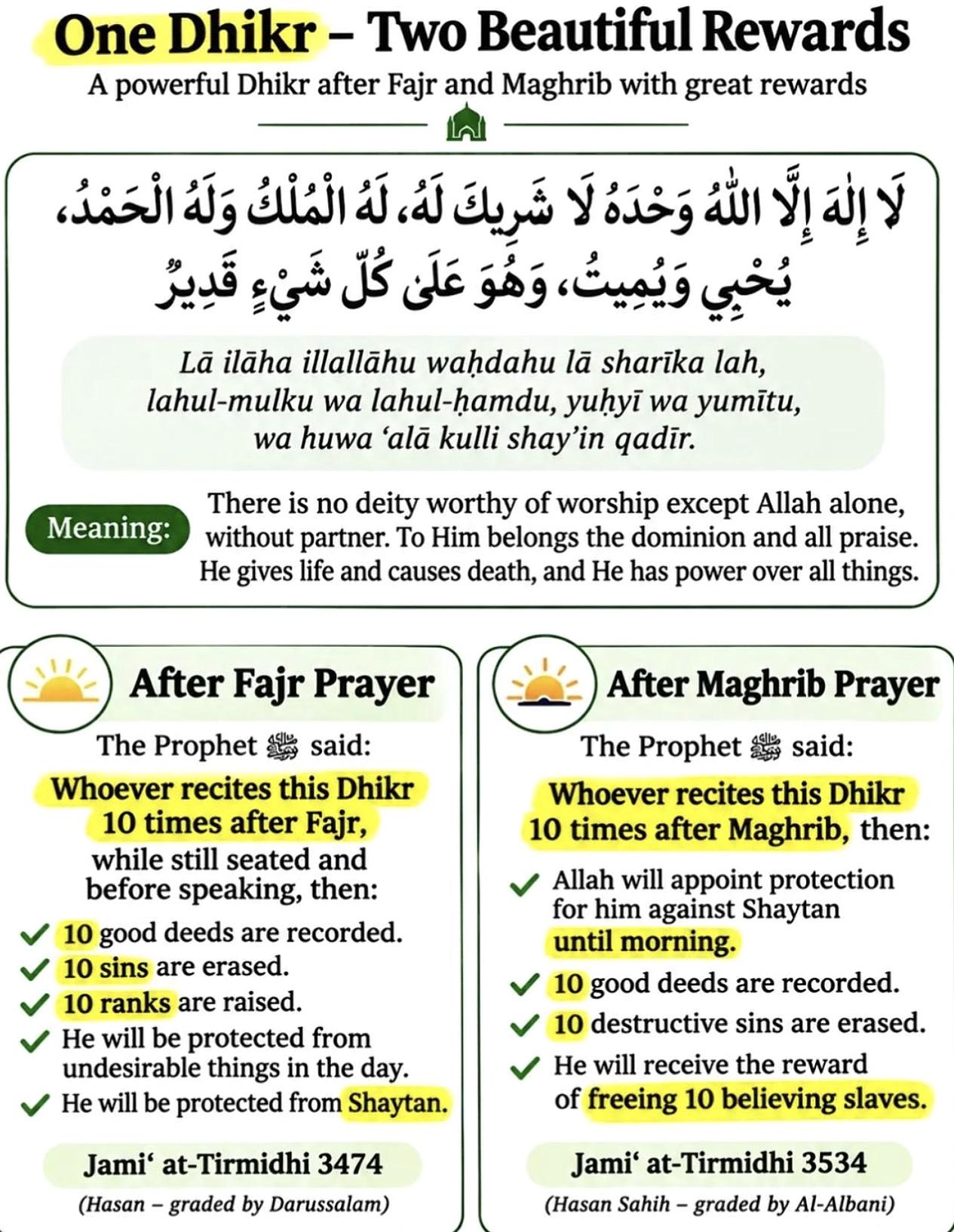
Islam One Dhikr - Two beautiful rewards
8
Upvotes
r/TraditionalMuslims • u/JlangDev • 17h ago
In the year 2000, a law was enacted in Egypt that the country had never known since Islam entered Egypt at the hands of Amr ibn al-As and the Companions who accompanied him, during the caliphate of Umar ibn al-Khattab, may Allah be pleased with them all.
Namely... what is known as the Khulʿ Law.
Here, a question arises: Have Muslims not known khulʿ since the time of the Messenger of Allah until the present day, and have they not been reading about it in the Qur'an every day?
The answer is that khulʿ in Islam is of three types.
This is the khulʿ mentioned in the Qur'an: "There is no blame upon either of them concerning what she gives as ransom."
And in the Sunnah, in the hadith of Thabit ibn Qays: "Accept the garden and divorce her."
Thus, the divorce was issued by Thabit, and the acceptance was up to him.
Similarly, the Prophet said to Abdullah ibn Umar, when his father ordered him to divorce his wife: "Divorce her."
In another narration: "O Abdullah ibn Umar, divorce your wife."
And in another narration: "He ordered me to divorce her, so I divorced her."
Abdullah ibn Umar complied and divorced his wife.
Some of the Tabiʿun (the generation following the Companions), such as al-Hasan al-Basri and Sa'id ibn Jubayr, stipulated that the husband obtain permission from the ruler to grant his wife khulʿ, so that the ruler could be assured that he had not coerced her into khulʿ in order to recover his money.
This is khulʿ involving a third party, and it is permissible according to the four schools of jurisprudence.
They explained this by stating that Allah legislated khulʿ for the benefit of men, so that men could take money in exchange for divorce.
Thus, if a third party offers a man money in exchange for divorcing his wife, and the husband agrees, the khulʿ takes effect, the husband becomes entitled to the money, and the wife becomes irrevocably divorced, even if she does not consent to it, because khulʿ is a right belonging exclusively to the husband.
For the appointment of the two arbitrators, it is required that the husband complain that his wife is harming him, without having evidence, and demand his right; and that the wife complain about her husband, claiming that he is harming her, without having evidence, and demand her right.
Neither of them must be willing to pardon the other.
The ruler then appoints two arbitrators, one from his family and one from hers.
If they find that the wrongdoing is on the husband's part, they divorce her from him, even if the woman does not wish to separate.
If they find that the wrongdoing is on the wife's part, the husband has the choice of compelling her to obtain khulʿ in exchange for whatever amount of money the two arbitrators consider appropriate, or holding her in his marriage.
Al-Tahawi said in Ahkam al-Qur'an:
"We find that Allah, Glorified and Exalted, said: 'And it is not lawful for you to take back anything of what you have given them.' This was an address from Him to husbands. 'Unless both fear that they will not maintain the limits set by Allah. But if you fear that they will not maintain the limits set by Allah, then there is no blame upon either of them concerning what she gives as ransom.' Thus, Allah, the Almighty, included wives alongside husbands in this matter, making the ransom come from the wives and its acceptance belong to the husbands. There was therefore no role for the ruler without which this could not be completed. This was a ransom in exchange for money that the husband takes from the woman, and the ruler would not compel either of them to do so if they brought the matter before him. Rather, he would refer them back to whatever they willingly agreed upon regarding the amount of the ransom and the husband's agreement to separation. Accordingly, by analogy, they should be able to do this without the ruler, just as they can do it in his presence."
Source: Ahkam al-Qur'an al-Karim, vol. 2, p. 451, commentary on Qur'an 2:229.
Al-Sarakhsi said in Al-Mabsut:
"Khulʿ is permissible in the presence of the ruler and elsewhere, because it is a contract based on mutual consent, like other contracts. It is equivalent to divorce in exchange for compensation. The husband possesses the authority to pronounce divorce, and the wife possesses the authority to undertake the obligation of paying compensation. Therefore, there is no reason to stipulate the ruler's presence for this contract."
Source: Al-Mabsut, vol. 6, p. 173, Kitab al-Talaq, Bab al-Khulʿ.
Badr al-Din al-Ayni said in Umdat al-Qari, while explaining the hadith of Thabit:
"His statement, 'his garden,' means the garden that he had given her. His statement, 'and divorce her': the command here is one of guidance and seeking a beneficial resolution, not one of obligation and compulsion."
Source: Umdat al-Qari Sharh Sahih al-Bukhari, Kitab al-Talaq, Bab al-Khulʿ wa Kayf al-Talaq Fih.
Ibn al-Qasim said:
"Malik said: 'Nothing done by a person under coercion is binding upon him, whether it is manumission, divorce, marriage, sale, or purchase. As for a will, I did not hear Malik speak about it, but the ruling is that the will of a coerced person is invalid.' I asked: 'What if someone is coerced into a settlement by someone other than the ruler? Is it binding upon him or not?' He replied: 'According to Malik, it is not binding upon him. Coercion by the ruler and coercion by someone other than the ruler are the same according to Malik, so long as the person is coerced.' I asked: 'What constitutes coercion according to Malik?' He replied: 'Beating, threatening to kill, threatening to beat, and intimidation whose seriousness is beyond doubt.'"
Source: Al-Mudawwana, in the discussion of coercion and its legal consequences.
Settlement here means khulʿ.
Ibn Rushd said in Al-Bayan wa al-Tahsil:
"A question: Malik was asked about a rebellious wife who says: 'I will not pray, I will not fast, and I will not perform the ritual bath after major ritual impurity.' Is her husband compelled to separate from her? He replied: 'He is not compelled to separate from her. However, if he wishes, he may separate from her, and whatever she gives to ransom herself becomes lawful for him to take.'"
Muhammad ibn Rushd said:
"This is as he stated: he is not compelled to separate from her, nor is he obligated to do so, because she is not an unbeliever or an apostate merely by abandoning prayer, fasting, and the ritual bath after major ritual impurity, provided that she acknowledges these acts as obligatory, according to the soundest opinion. Therefore, he may discipline her for abandoning prayer and hold her in marriage."
Source for both passages: Al-Bayan wa al-Tahsil, in the discussion of the rebellious wife who refuses prayer, fasting, and ritual bathing.
Abu al-Walid al-Baji said in his commentary on Al-Muwattaʾ, concerning the hadith of Thabit ibn Qays:
"Her statement, 'Neither I nor Thabit ibn Qays,' apparently indicates her refusal of him, and its ruling is the ruling of marital rebellion (nushuz). She is to be compelled to return to him if he does not wish to separate from her through khulʿ or otherwise."
Source: Al-Muntaqa Sharh al-Muwattaʾ, vol. 4, p. 61, Bab Ma Ja'a fi al-Khulʿ.
Abu al-Walid al-Baji also said:
"The Prophet's statement, peace and blessings be upon him, 'Take from her,' constitutes permission from him, peace and blessings be upon him, to take the ransom from her. It may also be understood as a recommendation to do so."
Source: Al-Muntaqa Sharh al-Muwattaʾ, Bab Ma Ja'a fi al-Khulʿ.
Al-Shafi'i said in Al-Umm:
"Just as she may be a cause of khulʿ, it proceeds from his side, because if he wished, he would not accept the khulʿ."
Source: Al-Umm, vol. 5, p. 139, in the discussion of liʿan and separation between spouses.
Al-Shafi'i said:
"Among these matters is that anyone who owns a wife, other than the Messenger of Allah, peace and blessings be upon him, is not required to give her the choice between remaining with him and separating from him. He has the right to hold her if he gives her what he is obligated to give her, even if she dislikes him. But Allah, the Almighty, commanded His Messenger, peace and blessings be upon him, to give his wives the choice."
Source: Al-Umm, vol. 5, p. 150, section concerning the Messenger of Allah and his wives.
Al-Shafi'i said:
"The Messenger of Allah, peace and blessings be upon him, permitted Thabit ibn Qays to take from his wife when she came to him. He did not tell him, 'Do not take from her except at the beginning of her waiting period,' as he had instructed others who pronounce divorce. Nor did he specify for him a divorce by which he should divorce her. He regarded his consent to taking from her as a separation. Khulʿ is a name distinct from divorce, and the one who grants khulʿ does not initiate a divorce except in exchange for compensation."
Source: Al-Umm, vol. 5, pp. 128–129, in the discussion of khulʿ and the distinction between khulʿ and divorce.
Al-Shafi'i said:
"If the father or guardian of a minor boy or a person of unsound mind arranges khulʿ on his behalf with his wife, or with his wife's father, the khulʿ is invalid and the marriage remains intact. Whatever they received from the woman or her guardian in exchange for khulʿ must be returned in full, and she remains his wife as before. Likewise, if he is deprived of his reason or has not reached puberty and arranges khulʿ on his own behalf, she remains his wife as before. The same applies if the master of a slave arranges khulʿ on behalf of his slave without his permission. This is because khulʿ is divorce, and no one has the authority to divorce on behalf of another person, whether a father, master, guardian, or ruler. A person may only pronounce divorce on his own behalf, or the ruler may impose divorce upon him on account of an obligation he himself has incurred, if he refuses to pronounce it despite being someone who possesses the authority to divorce. Khulʿ does not fall within this category."
Source: Al-Umm, vol. 5, p. 214, section titled Ma Yajuz Khulʿuhu wa Ma La Yajuz.
Ahmad said, in the narration of Abu Talib:
"Khulʿ is like the hadith of Sahlah: when a woman dislikes a man and says, 'I will not honor any oath of yours, nor obey any command of yours, nor perform the ritual bath after sexual impurity caused by you,' then it becomes lawful for him to take from her what he gave her, because the Prophet, peace and blessings be upon him, said: 'Will you return his garden to him?'"
Source: A narration from Imam Ahmad through Abu Talib, transmitted in works discussing the rulings of khulʿ.
Notice the words: "Then it becomes lawful for him."
In the Masa'il narrated by his son Salih, Salih said:
"I asked: 'A man marries off his son while he is young, and when the son grows up, he says, "I do not want this marriage"?' He replied: 'He has no such right. The father concluded a contract on his behalf.' I asked: 'What about a young girl whom her father marries off?' He replied: 'There is no disagreement among people concerning this. She has no right to revoke it.'"
Source: Masa'il al-Imam Ahmad, narration of his son Salih, question no. 1175.
In the Masa'il narrated by his son Abdullah, Abdullah said:
"I asked my father about a father who marries off his daughter while she is young. Does she have the right to choose when she grows up? He replied: 'She has no right of choice if her father married her off. If she had such a right, then Aisha would have had the right of choice regarding the Messenger of Allah, peace and blessings be upon him, because the Prophet, peace and blessings be upon him, married her when she was six or seven years old, consummated the marriage when she was nine, and died when she was eighteen.'"
Source: Masa'il al-Imam Ahmad, narration of his son Abdullah, Kitab al-Nikah, question no. 1196.
Ibn Qudamah said in Al-Mughni:
"The woman's consent is not required for taking her back (rajʿah), because Allah, the Almighty, says: 'And their husbands have a greater right to take them back during that period, if they desire reconciliation.' Thus, He assigned this right to the husbands. And He, the Exalted, says: 'Then hold them in a fair manner.' He addressed the command to the husbands and did not give the women a choice. Moreover, taking a woman back means holding her under the marital bond, and therefore her consent is not required, just as it is not required when she is still in an existing marriage. The scholars are unanimously agreed upon this."
Source: Al-Mughni, Kitab al-Rajʿah, section concerning the woman's consent to revocation of divorce.
Al-Buhuti said in Kashshaf al-Qinaʿ:
"An insolvent man is not compelled to marry off his umm walad (a slave woman who has borne him a child) in order to repay his debt from what he takes of her bridal gift. The apparent meaning is that this applies even if he does not have intercourse with her, because marriage would make her unlawful to him and would establish the husband's right over her. Nor is a woman who is in debt compelled to marry herself to someone who wishes to marry her, so that she may receive her bridal gift and use it to repay her debt, because marriage entails obligations upon her that she may be unable to fulfill. Nor is a man compelled to grant khulʿ if his wife or someone else offers him money in exchange for granting her khulʿ or divorcing her in exchange for it, so that he may use that money to repay his debt. This is because doing so would cause him harm by making his wife unlawful to him, and he may have affection for her."
Source: Kashshaf al-Qinaʿ ʿan Matn al-Iqnaʿ, vol. 3, Bab al-Hajr, in the discussion of the insolvent debtor.
Ibn Hazm said in Al-Muhalla:
"Khulʿ, which is ransom, occurs when a woman dislikes her husband and fears that she will not fulfill his rights, or fears that he may hate her and therefore fail to fulfill her rights. In that case, she may ransom herself from him, and he divorces her, if he agrees. Otherwise, neither he nor she may be compelled. It is only permissible by their mutual consent."
Source: Al-Muhalla bi al-Athar, vol. 9, p. 511, Kitab al-Khulʿ.
Ibn Hazm said:
"A woman has no choice between separating from her husband and remaining with him except where Allah, the Almighty, has granted her such a choice in the case of a woman who has been emancipated from slavery. A woman never owns authority over her own affairs."
Source: Al-Muhalla, in the discussion of the right of choice regarding marriage and separation.
Ibn Taymiyyah said in Majmuʿ al-Fatawa:
"Since khulʿ is a dissolution of the marriage and is not part of the three divorces, there is no difference between the money offered being from the woman or from a third party. Comparing the dissolution of a marriage contract to the rescission of a sale contract is questionable, because a sale cannot be rescinded except with the consent of both parties to the sale; neither party can independently rescind it. Marriage is different, because the woman does not possess the authority to dissolve it. Rather, the husband possesses that authority independently. However, her ransoming herself from him is like a third party ransoming her."
Source: Majmuʿ al-Fatawa, vol. 32, p. 92, Kitab al-Nikah, in the discussion of khulʿ and dissolution of marriage.
Ibn Taymiyyah said in Bayan al-Dalil:
"When a woman marries with the intention of bringing about separation, the prohibition here is due to the husband's right, because this involves deceit and deception against him. Otherwise, he owns her by virtue of this contract and possesses the right not to divorce her under any circumstances."
Source: Bayan al-Dalil ʿala Butlan al-Tahlil.
Ibn Taymiyyah said:
"It remains to be said: 'She does not intend to harm him; rather, she intends to benefit herself by escaping from him.' The answer is that the Lawgiver has not placed this benefit in her hands. If benefiting from separation were a right belonging to her, the Lawgiver would have granted her ownership of it. And when she needed it, He commanded her to ransom herself from him, just as a captive or a slave is ransomed. Do you not see that a slave is not permitted to deliberately harm his master in order to make him emancipate him, if the master has not mistreated him?"
Source: Bayan al-Dalil ʿala Butlan al-Tahlil.
Ibn al-Qayyim said in Zad al-Maʿad:
"The fact that Allah, the Exalted, calls khulʿ a ransom is evidence that it involves the meaning of an exchange. For this reason, the consent of both spouses is required."
Source: Zad al-Maʿad, vol. 5, p. 276, in the discussion of khulʿ.
Ibn al-Qayyim said:
"For he possesses the right never to separate from her at all, and to hold her until death separates them. Marriage is a contract for the duration of a lifetime, and therefore he possesses the right to continue holding her in marriage."
Source: Zad al-Maʿad, vol. 5, pp. 154–155, in the discussion of the marital relationship and the right of separation.
Ibn al-Qayyim said in Iʿlam al-Muwaqqiʿin:
"The answer is that general laws were not established on the basis of rare cases. If there were a benefit for the majority of men who divorce in this matter, then the wisdom of the Wisest of judges would have prohibited men from divorcing altogether and placed men in the same position as women in this regard, unable to separate from their husbands."
Source: Iʿlam al-Muwaqqiʿin, in the discussion of Al-Hilah al-Surayjiyyah li-ʿAdam Wuqūʿ al-Talaq Aslan; vol. 4, p. 218 in one edition.
r/TraditionalMuslims • u/Rouf_bagwan • 1d ago

Over 2 Billion Muslims — But Where Is Our Collective Strength?
I want to start a serious discussion within our community. This is not about targeting or criticising any other community. It is about honestly examining our own position, our potential, our challenges, and our future.
Let's take a look at where the global Muslim community stands today.
According to Pew Research Center's 2020 estimates, there were approximately 2.02 billion Muslims worldwide. Projections suggest that by 2035, this number could reach around 2.57 billion, potentially making Muslims the world's largest religious group.
That's an enormous population. But how much of that potential are we actually turning into meaningful progress?
2. Natural Resources
Many Muslim-majority countries are located in some of the world's most resource-rich regions.
According to OPEC's 2025 Statistical Bulletin, OPEC member countries held approximately 79.2% of the world's proven crude oil reserves at the end of 2024.
We have significant natural resources, but are we using their economic value to improve education, healthcare, research, and living standards for ordinary people?
3. Strategic Importance
Türkiye has been a NATO member since 1952. Muslim-majority countries also occupy strategically important geographical locations, with access to major trade routes, international waterways, ports, and other valuable resources.
These geographical advantages create enormous opportunities for international cooperation and economic development.
4. Tourism and Economic Potential
Countries such as Saudi Arabia, Türkiye, the UAE, Malaysia, Indonesia, and Egypt have significant potential in tourism, international trade, investment, and economic development.
Yet, despite all these advantages, we need to ask ourselves some difficult questions.
The Questions We Need to Address
\\- With such a large global population, why are we still struggling to establish a stronger collective presence in education, scientific research, and technological innovation?
\\- We have access to enormous natural resources, but how much of that wealth actually reaches ordinary people and improves their quality of life?
\\- Children continue to lose their lives in conflicts across different parts of the world. Do we have sufficiently coordinated humanitarian institutions capable of providing effective protection, assistance, and long-term support?
\\- Many Muslim communities continue to struggle with poverty, unemployment, and a lack of educational opportunities. What are we doing to address these problems through sustainable solutions?
\\- When misinformation and negative stereotypes about Muslims spread internationally, do we have strong, professional media organisations, research institutions, and fact-checking networks to respond with credible information?
\\- How effective is Muslim representation in political institutions and public policymaking across different countries?
Questions for the Community
I genuinely want to hear your thoughts on these five questions:
One Thing We Need to Understand
A large population alone does not make a community influential or successful.
Real progress requires education, knowledge, strong institutions, economic independence, capable leadership, and a genuine sense of collective responsibility.
I believe we need to start having these conversations more seriously. Not just discussing what is wrong, but understanding why we have reached this position and what practical steps can move us forward.
I am planning to turn this into a detailed discussion series, exploring each of these issues separately.
Feel free to disagree, challenge these points, share your criticism, and suggest practical solutions. What matters is that we have an honest, informed, and constructive discussion.
Let's discuss our future, not just our problems.
r/TraditionalMuslims • u/Finance-Straight • 1d ago
As horrible as this sounds i dont think i have many instances where i can say i dua for X thing and it came true
I’m not being ungrateful here rather the opposite which is that Allah has granted me a lot without even asking
But when it does come to asking, there are so many (good) things i have asked for that seldom come around, of course there is a divine wisdom for that
But its kinda unfortunately solidified in my head that whatevers written will occur and dua doesn’t really change that (although i know that dua can change qadr)
For me ive begun to see dua as a stress relief to get things out in the open to God
But theres things ive prayed for, namely marriage, for years now, coupled with practical means ofc and ive done the whole package of tahajjud and special times etc
But it seems qadr wont budge
Now it feels somewhat saddening to keep raising those hands, i’d rather focus my energy elsewhere.
I remember years ago when i’d rush to the prayer mat the last hour on a friday to get all the duas id possibly want in, like it was a weekly laylatul qadr for me; all doe-eyed and hopeful
My current situation is bleak in comparison. I kind of do it out of ritual than anything else
I’m tired and worn out of raising those hands and feeling like another few years will pass this way
I feel so bad to say but its so triggering sometimes i skip out on it all altogether because He knows my position anyway
r/TraditionalMuslims • u/Hakeems11 • 1d ago
One thing my past taught me is how to read women.
I’m not telling anyone to do anything haram. But reading the post of the North African brother getting played was devastating he could’ve avoided that so easy. And let himself get disrespected a lot.
Please not telling you guys to do haram but get more experience or you will get played too.
If you’ve rarely had that kind of attention, it can hit hard when a woman shows interest in you in person. You can find yourself overlooking things you’d normally question or bending standards you used to be firm about, just because you like how she makes you feel. That’s how a lot of guys get played.
And wallah, most women are more alike than they’d have you believe. A lot of them have the same standards and want the same things. Once you’ve been around enough, you start to see how often the same patterns repeat.
r/TraditionalMuslims • u/Responsible_Froyo101 • 1d ago
To every new Muslim: whenever you join a new community or learn a religious practice from someone, make sure to verify it before assuming everything you see is part of Islam, because local cultural habits and traditions from a specific region often get mixed up with actual Islamic teachings. Remember that Islam is taken from its authentic sources: the Noble Quran and the authentic Sunnah—and even with hadiths circulated among people, you must verify their authenticity since many widely shared narrations are weak or fabricated, just as you should always check the sound tafsir of major, trusted scholars when understanding the Quran so you practice your faith with clarity and certainty
r/TraditionalMuslims • u/Acceptable_Film7381 • 1d ago
Note: I’m pretty emotional right now and was typing frantically, so I used AI just to organize my thoughts into readable paragraphs. Everything here is my own words and experience.
I am 33M (North African Arab) married to my wife, 28F (European-Moroccan), for the past 3 years. I am genuinely opening up because I feel severely conflicted, mentally exhausted, and depressed. I can’t tell if I am in denial about being taken advantage of and need to divorce, or if I should keep trying to fix this.
How We Started
We met on a dating app while living in different U.S. states. After a year of talking and me flying out to see her regularly, her visa was about to expire. Because we felt we had a strong connection, we decided to get married and have her move to my state so we could start a life together and get her green card sorted.
The First Red Flags & Dishonesty
Right after we signed the marriage license and filed for her green card, the dynamic shifted completely:
• The Secret Job: Days after filing, she revealed she had a job back in her old state requiring her to travel there one week every month. She had hidden this for a full year and refused to tell me the company name or what she did. She only stopped going months later when she realized I was quietly preparing to file for an annulment.
• Fabricated Past: Before marriage, she went out of her way—unprompted—to tell me she had never dated, traveled with, or been intimate with a man. After we married, I caught her in lies and she eventually admitted she had been in a secret two-year relationship before me. My issue isn't her past; it’s that she fabricated an entire persona to hook me, and continues to lie until cornered.
• Financial Entitlement & Lack of Empathy:
I work 15-hour days across multiple roles and cover 100% of our living expenses—mortgage, bills, cars, insurance, groceries, everything. Before marriage, we signed a prenup (at my request) and agreed on a $2,000/month personal allowance for her while she looked for a job, though she ended up staying home full-time.
• Moving Goalposts: After seeing my ~$500k income on our joint tax return, she grew cold and demanded $5,000/month. I raised it to $3,000/month on top of paying every single bill, and she told me, "I’ll accept it because I’m young." She also demands a cut of any IRS tax refund (despite earning $0), while refusing responsibility if we owe.
• Zero Support During Crises: When I was unexpectedly hit by tech layoffs a few months ago, I used my savings to maintain our lifestyle without asking her to work, only pausing her allowance to 10% until I landed a new role. She gave me the silent treatment for an entire month and ignored flowers I bought to smooth things over.
• My Father’s Illness: This summer, I gave her $15,000 for her birthday and a trip to visit her family in Europe, telling her it was to cover everything. Ten days later, she demanded her $3,000 monthly allowance. When I explained I needed that cash to help my sick father who couldn't work, she gave me the cold shoulder and never once asked how my dad—or I—was doing.
Contempt, Intimacy & Daily Life
• Transactional Mindset: She frequently makes comments like "men are animals" or "I would never talk to a man unless he offers me something." She mocks my friends in their 30s for renting apartments or driving normal cars—despite having no career, savings, or car of her own, yet mysteriously owning $10,000+ designer bags from before we met.
• Intimacy & Living Separately: She insists on sleeping in separate bedrooms during the week and has claimed the master bath and closet exclusively for 3 years. Intimacy is completely one-sided, never initiated by her, and treated like a bargain (e.g., telling me she’ll only do certain things once I take her on a trip to Dubai).
• Zero Reciprocity at Home: Despite being a stay-at-home wife, she rarely cooks, never helps with my laundry or our shared spaces, and expects me to fund everything—including a Friendsgiving she just hosted for her girlfriends.
• The Breaking Point: Before marrying, she pressured me out of my paid-off Honda Accord into buying an expensive luxury car, which she now repeatedly demands I put in her name. A few days ago, after I spent the whole weekend shopping with her and paying for her Friendsgiving, I mentioned buying a modest $15k weekday commuter car so we stop racking up miles and maintenance costs on the luxury car. She went cold and told me she refuses to drive a cheap car. That was my breaking point.
Why I’m Hesitating
In my North African Arab culture and family, divorce is virtually unheard of and carries heavy shame. When things are calm, she can be pleasant company, and I keep trying to be patient because nobody is perfect. I don’t want to be unfair or give up too easily—but the cons massively outweigh the pros, and I feel like a walking ATM rather than a husband.
tl;dr genuinely, from an outside perspective: am I right to file for divorce, or is there any realistic way to salvage this?
r/TraditionalMuslims • u/Journey2Better • 1d ago
r/TraditionalMuslims • u/Generational_Bozo • 1d ago
I’m moving to a university in the UK (where I grew up) very soon, and I wanted to ask especially in medicine, are there any struggles that may affect our deen in uni? Any fitnah I need to avoid? Any way to keep up my iman? I’ve heard scary things and I want to stay in the right side of my deen.
Jazakallah khairan, may Allah guide us
r/TraditionalMuslims • u/Journey2Better • 1d ago
r/TraditionalMuslims • u/GoodMorninfUSA • 1d ago

Why the Muslims who copy the West and the Muslims who reject it are making the same mistake.
No one ever properly taught me the Quran, so I came to it by reading it myself, verse by verse, with a scientist’s habits of mind. What I found was a text that argues carefully and keeps asking its reader to think.
Then I went looking for Muslims discussing it online. Most of what I found fell into two camps. One reads every verse looking for agreement with modern liberal values. The other defines itself by rejecting whatever the West believes. They look like opposites, but I have come to think they make the same mistake from opposite directions.
Both grow from the same root, a sense of inferiority that comes largely from Muslims not knowing their own history. A people that forgets it once set the standard can only copy whoever sets it now, or refuse everything they offer. The classical scholars had a word for belief taken on someone else’s authority, taqlid. In their terms, one camp practises taqlid of its parents and the other practises taqlid of the victor.
The reactive camp
The first camp treats rigidity as faithfulness. Any question about a hadith or a custom is heard as an attack, and village tradition is often defended as if it were revelation.
Much of this is a reaction, and the history explains it. Lord Cromer, who ran British Egypt from 1883 to 1907, wrote that the position of women in Egypt was “a fatal obstacle” to the introduction of European civilisation (source). Back in Britain he became the first president of the Men’s League for Opposing Woman Suffrage in 1909 (source). The historian Leila Ahmed called this colonial feminism, the claim that Muslim women could only advance by abandoning their own culture (source). When Qasim Amin argued for unveiling in 1899, Talaat Harb, who later founded Banque Misr, answered him with a book defending the veil in the same year (source).
In Algeria the pattern was even plainer. On 17 May 1958 about a dozen Algerian women, guarded by soldiers, burned their veils at the Government General in Algiers while army photographers recorded it. Three days later the army’s psychological warfare office ordered similar ceremonies across the country, and villagers were bussed in to watch (source). Frantz Fanon described the result the following year. “To the colonialist offensive against the veil, the colonised opposes the cult of the veil” (source). Customs that had been ordinary became symbols of resistance, and holding onto them became a way of defending identity.
In my experience diaspora communities often go further, holding tighter to the customs of the place they left because those customs mark who they are. I understand why. But defending everything because an outsider attacked it still lets the outsider decide what matters.
The Quran gives a direct instruction here. “Do not let hatred of others lead you away from justice” (5:8). Rejecting an idea because of who holds it is exactly that failure.
The accommodating camp
The second camp runs the other way. Its starting question is how to make Islam acceptable to modern liberal values, and every verse is read with that goal in mind. A verse that fits current sensibilities is celebrated. A verse that doesn’t is reinterpreted until it says nothing, or quietly skipped.
Many people in this camp are sincere and want their faith to survive in a culture that often looks down on it. But a reading that always lands exactly where the surrounding society already stands is not reading the text. It is reading the society back into it.
The habit is older than it looks. In 1883 Ernest Renan told an audience at the Sorbonne that Islam was hostile to science. Jamal al-Din al-Afghani, one of the founders of Islamic modernism, replied largely on Renan’s terms, hoping Muslim society would one day break its bonds “after the manner of Western society” (source). Even the defence took Europe as the measure.
Ibn Khaldun described this pattern in 1377. He wrote that the defeated always want to imitate the victor in dress and custom, because “the soul always sees perfection in the person who is superior to it and to whom it is subservient” (source). The defeated then make a second mistake. They assume the victor won because of his customs and manners, when he actually won through group cohesion and fortitude.
That is the accommodating camp almost exactly. It treats liberal values as correct largely because they belong to the societies that currently hold power, which is the assumption Ibn Khaldun identified as an error.
When the Muslims were the victor
For most of the medieval period the imitation ran the other way. Around 854 Paulus Alvarus of Córdoba complained that young Christians eagerly studied the books of the Arabs while “Latins do not pay attention to their own language” (source). In about 774 King Offa of Mercia struck a gold coin copied from a dinar of the caliph al-Mansur, Arabic declaration of faith included, with OFFA REX set into it upside down (source). Roger II of Sicily was crowned in a mantle made in Palermo in 1133 or 1134 with an Arabic inscription embroidered on it, and it later became the coronation robe of the Holy Roman emperors (source).
Europe’s scientific revival leaned heavily on Arabic books. Gerard of Cremona went to Toledo to learn Arabic so he could read Ptolemy’s Almagest, and about 80 translations from Arabic are attributed to him (source). Fibonacci learned his numerals as a boy in the Algerian port of Bugia, where his father represented Pisan merchants, and introduced them to Europe in 1202 (source). The English scholar Adelard of Bath told his nephew that his “Arab teachers” had taught him to take reason as his guide, while the nephew, dazzled by authority, wore a head-stall like a led horse (source).
The victors could be condescending too. In 1068 the Andalusian judge Sa’id al-Andalusi counted the peoples of the north among the nations with no aptitude for science and blamed their cold climate (source). In 922 the caliph’s envoy Ibn Fadlan met Scandinavian traders called the Rus on the Volga. He had “never seen more perfect physiques”, yet called them “the filthiest of all Allāh’s creatures” (source).
Usama ibn Munqidh, a 12th-century Syrian nobleman who knew the Crusaders well, saw the Franks as animals with courage and fighting skill and nothing else. He was shocked that they were “void of all zeal and jealousy” over their wives, and he described a Frankish doctor who asked a patient whether he preferred “living with one leg or dying with two”, then amputated, and the man died. Yet Usama had a Frankish friend, and he judged the Franks who had lived long among Muslims to be “much better than the recent comers” (source).
The pattern is familiar. The stronger civilisation saw the weaker one as unclean and morally loose, and the charge has since reversed direction.
The reversal began quietly. Around 1377 Ibn Khaldun wrote that he had heard philosophy was “greatly cultivated in the land of Rome” and along Europe’s northern Mediterranean shore, adding that God knows better what exists there (source). By 1798 it was plain. When Napoleon occupied Egypt, the scholar al-Jabarti called the French materialists who denied the Hereafter, yet admired the instruments and library of their Institut d’Égypte (source, source). It is Usama’s mix of scorn and admiration, now voiced by the weaker side.
The Mamluks show both mistakes in a single country, so it is worth explaining who they were. The word mamluk means “one who is owned” (source). The Mamluks were slave soldiers, mostly Turkic boys bought from beyond the Islamic world, who were trained in warfare, court etiquette and the Islamic sciences and then freed to serve as an elite corps (source). They had no ties to local families or tribes, so their loyalty ran to their master and their comrades. In 1250 they took power in Egypt and Syria themselves, and they ruled until 1517 (source).
Baybars was a Kipchak Turk, sold as a slave after the
Mongols overran his homeland around 1242 (source). Like other mamluks he was bought young, trained by the state as a soldier, and promoted for ability rather than birth. In February 1250 he commanded at al-Mansurah, where the Seventh Crusade was broken, and the Mamluk army went on to capture King Louis IX of France (source). He fought at Ain Jalut in 1260, the first great defeat of the Mongols, became sultan that same year, and beat them again at Elbistan in 1277 (source).
He also built the systems that held the state together. His relay post carried news between Cairo and Damascus in four days (source), and he paid his spies well enough that they would risk their lives in Mongol and Crusader territory (source). It was a ruthless meritocracy, and it worked.
Over the following centuries that meritocracy hardened into a closed elite attached to its own traditions. When the Ottomans conquered the sultanate in 1516 and 1517, the historian David Ayalon argued that Mamluk attachment to the mounted warrior had made them slow to embrace firearms (source), though later historians have questioned how decisive guns really were (source).
A system that began by taking the best talent wherever it found it ended by refusing the best weapons of its age.
Mamluk households kept ruling Egypt under the Ottomans, and in July 1798 they met Napoleon at the Battle of the Pyramids. Their cavalry charged French infantry squares and was cut down. French reports admitted 29 dead, while Egyptian dead may have reached 6,000 (source).
Then came the opposite extreme. On 1 March 1811 Muhammad Ali invited around 500 Mamluk notables to the Cairo Citadel and had nearly all of them killed (source). He then built a conscript army on European lines, trained from around 1820 at Aswan by a Frenchman who claimed to have been one of Napoleon’s colonels (source).
Within a few decades Egypt went from preserving the outward form of past greatness to copying the victor wholesale. Neither resembles the early Mamluks, who rose by mastering the most effective warfare of their own age.
The Quran describes this rotation directly. “We deal out such days among people in turn” (3:140). Power passes from one people to another, so neither camp should treat today’s balance of power as a measure of
truth.
The same mistake
Both camps measure Islam against liberalism. One moves as far from it as possible and the other moves as close as possible, but liberalism stays the reference point either way. Neither starts by asking what the Quran actually says and why it says it. Each starts by asking what the West thinks, and then reacts.
I am not the first to notice this. In 1967 the Moroccan historian Abdallah Laroui rejected the choice between authenticity and Westernisation as a false one. He argued that traditionalists held a static model of the past, while liberals did not understand the historical roots of the liberalism they admired (source). His remedy was different from mine, but his diagnosis was the same historical illiteracy on both sides.
The Algerian thinker Malik Bennabi put the inferiority point more bluntly. “One does not cease to be colonized until one ceases to be colonizable” (source). In his view a society is conquered only after it has already lost confidence in itself, and he traced that loss back centuries before the French arrived.
The accommodating camp shows this openly, treating the West’s customs as the reason for its power. The reactive camp shows it as defensiveness, guarding everything because it no longer trusts itself to judge anything. A Muslim who knows that Europe’s translators learned from Arabic books, and that Ibn Khaldun watched the balance begin to shift, has no reason to worship the West or to fear it.
Al-Ghazali named the underlying problem nine centuries ago. In Deliverance from Error he noticed that “Christian youths always grew up to be Christians, Jewish youths to be Jews and Muslim youths to be Muslims” (source). He called belief taken on authority taqlid, and he set out to separate it from real knowledge. He did not demand that every believer make the same journey, and elsewhere he accepted that ordinary people could hold sound belief by taqlid (source). His point was that once you see your belief is only inherited, you cannot go back to holding it naively. He compared it to broken glass that cannot be put back together.
The reactive camp practises taqlid of its parents. The accommodating camp practises taqlid of the victor. In both cases the belief comes from outside the person and outside the text.
The Quran condemns the first kind repeatedly. When people are told to follow revelation, they answer that they will follow what they found their fathers doing, and the Quran asks whether they would do so even if their fathers understood nothing (2:170, 43:22). It sets one standard against both camps. “Do not pursue that of which you have no knowledge” (17:36).
Judging the West honestly
The way out of both camps is to judge each thing the West does on its own merits, whatever it believes about morality. That cuts in two directions, and each camp will dislike one of them.
Take the American founders, whom I admire, Alexander Hamilton above all. They tried to protect people from their own government by building restraint into the structure of the state itself. The Federalist Papers argued that power must be divided so that each branch can check the others. As Federalist 51, usually attributed to Madison, put it, “ambition must be made to counteract ambition” (source). Hamilton also saw the danger coming. In Federalist 1 he warned that most men who overturned the liberties of republics began “by paying an obsequious court to the people; commencing demagogues, and ending tyrants” (source).
The founders themselves did not expect their system to last for ever. On the day the Constitution was signed, Benjamin Franklin told the Convention it was likely to be well administered for a course of years, and “can only end in Despotism, as other forms have done before it, when the people shall become so corrupted as to need despotic Government” (source). Madison told the Virginia ratifying convention that to suppose any form of government will secure liberty “without any virtue in the people, is a chimerical idea” (source). John Adams went further and wrote that the Constitution “was made only for a moral and religious People” (source).
So the best design those minds could produce rested on something no design can supply, the character of the people living under it. I suspect many of the founders would be dismayed by American politics today, but by their own account they would not be surprised. It is the Mamluk lesson again, and the Quran’s (3:140). Power passes between peoples, and the institutions that hold it decay too.
The same honesty applies to what the West is losing. In 2023 the US Surgeon General reported that even before the pandemic about half of American adults experienced measurable loneliness (source), and that loneliness among young adults had risen every year from 1976 to 2019 (source). The suicide rate for Americans aged 18 to 27 rose nearly 20 percent between 2014 and 2024 (source). Clean government and a generous welfare state have not stopped people growing isolated, and the numbers show it.
Not everything that matters shows up in a survey. I value family deeply, and I believe, in a way I cannot measure, that it is where real happiness comes from.
What has blurred is the definition of happiness itself. Society increasingly tells people that happiness means fulfilling their own desires, usually without a thought for what that costs the people around them.
My intuition tells me something has gone deeply wrong, and no figure will ever put a number on that.
None of this flatters the Muslim world either. Fertility has already fallen below replacement level in Iran, Turkey, Tunisia and Lebanon (source). Muslim-majority countries report lower suicide rates, but researchers who compared deaths recorded as accidental or undetermined found signs of heavy underreporting (source). A low official number can reflect stigma rather than contentment.
So the honest verdict is neither that the West is superior nor that it is decadent. It does some things far better than the Muslim world does and some things worse, and a Muslim who knows his own history can say both without flinching. The classical scholars had exactly this habit of mind.
What the golden age did instead
The best medieval thinkers neither rejected outside ideas nor surrendered to them. Al-Kindi, the first self-described philosopher of the Arabic tradition, oversaw translators bringing Greek thought into ninth-century Baghdad. Against contemporaries who objected, he wrote that “we must not be ashamed to admire the truth or to acquire it, from wherever it comes” (source).
Ibn Rushd made the same point three centuries later. Muslims should study the ancients whether or not they shared their religion, and “accept, rejoice in, and thank them for whatever agrees with the truth”, while warning against whatever does not (source). That is neither rejection nor surrender. It is judging an idea on its merits.
This principle cuts against both camps. The reactive camp rejects ideas because of where they come from, and the accommodating camp accepts them for the same reason. It is worth remembering that Adelard of Bath learned to put reason above authority from his Arab teachers. The habit of mind Europe now claims as its own once travelled north from the Muslims.
The Quran praises the same habit. It describes the people of understanding as those “who listen to speech and follow the best of it” (39:18).
The middle community
Surah al-Baqarah has 286 verses, and verse 143, which closes its first half, calls Muslims a middle community.
Every group claims to be that middle, so the claim proves nothing on its own. The middle I mean is not a compromise between the two camps. It is standing on the text and following its reasoning wherever it leads, even when that pleases neither side.
Standing on the text does not mean pretending it has only one obvious reading. The Quran itself says that some of its verses are precise in meaning and others are open to more than one (3:7). My favourite example is the Light Verse (24:35), which compares God’s light to a lamp in a niche, enclosed in glass like a shining star, lit from a blessed olive tree that is neither of the east nor of the west.
The early exegete Muqatil ibn Sulayman read the lamp as the Prophet (source). Ibn Sina read the verse through philosophy and al-Ghazali through Sufism, and al-Ghazali wrote a whole book on it, The Niche of Lights (source). The verse is only a few lines long, and I still have not settled on my own reading. In an essay about East and West, I cannot help noticing that its olive tree is neither of the east nor of the west.
That range has limits, though. The same book that leaves room for readers to differ does not compromise on its centre, which is pure, unmixed monotheism. “Say, He is God, the One” (112:1) is not a verse anyone is invited to reinterpret.
That is what this newsletter will try to do. I will show the verses and name the scholars who reached the same place before me, including where I part ways with them.
Sources
Ibn Khaldun, The Muqaddimah, trans. Franz Rosenthal (PDF)
Al-Ghazali, Deliverance from Error, trans. W. Montgomery Watt (ghazali.org)
Richard M. Frank, Al-Ghazali and the Ash’arite School, Duke, 1994 (PDF)
Peter Adamson, “Al-Kindi”, Stanford Encyclopedia of Philosophy (SEP)
Ibn Rushd, The Decisive Treatise, trans. Charles Butterworth (PDF)
“Authenticity and Its Discontents: Abdallah Laroui on the Moroccan and Arab Subject”, Modern Intellectual History, 2024 (Cambridge)
Phillip Naylor on Malik Bennabi and colonisability, French Colonial History 7, 2006 (PDF)
Al-Afghani and Renan, JHI Blog (link)
Lord Cromer, Modern Egypt, vol. 2, 1908 (archive.org)
Juan Cole, “Feminism, Class, and Islam in Turn-of-the-Century Egypt”, IJMES, 1981 (Cambridge)
Neil MacMaster, Burning the Veil, Manchester University Press (open access)
Ibn Fadlan, trans. James Montgomery, Journal of Arabic and Islamic Studies 3, 2000 (link)
Usama ibn Munqidh, trans. Philip Hitti, Fordham Medieval Sourcebook (link)
Adelard of Bath, Natural Questions, Fordham Medieval Sourcebook (link)
Gold imitation dinar of Offa, British Museum (link)
Coronation mantle of Roger II, Kunsthistorisches Museum (link)
Al-Jabarti’s chronicle, trans. Shmuel Moreh (PDF)
David Ayalon, Gunpowder and Firearms in the Mamluk Kingdom, 1956 (Routledge)
Khaled Fahmy, Mehmed Ali, ch. 5 (PDF)
Quran translations from Sahih International and M.A.S. Abdel Haleem (quran.com)
r/TraditionalMuslims • u/The_Nameless_888 • 2d ago

r/TraditionalMuslims • u/Ok_Editor2830 • 2d ago
We are building an ecosystem with the liberation of Palestine at the centre of it.
We have spent the last 11 months building a network of networks Alhumdulillah we have connected with a lot of capable Muslims from the ummah.
Any suggestions? We do have our own ideas etc
r/TraditionalMuslims • u/Responsible_Froyo101 • 2d ago
To every new Muslim: Islam did not come to make your life difficult... it is a religion of ease in all circumstances, and no one can achieve perfection in everything overnight. After you are convinced of Islam and enter it, take things step by step and do not overwhelm yourself all at once—this gradual approach is the very way Allah raised the earliest Muslims.
Start with the most important pillar, the prayer (Salah), and learn the minimum required to perform it: the basic takbirs and Surah Al-Fatihah in Arabic. In the beginning, there is nothing wrong with holding a paper or a small book to read Al-Fatihah during prayer until you get used to it and memorize it, as the prayer is valid with Al-Fatihah alone without needing extra surahs right away.
The same principle applies to other obligations such as Hijab: it is an obligation and leaving it is a sin, yet not wearing it does not take you out of Islam at all. While recognizing that it is obligatory, you can work toward it gradually, or even hold off temporarily if wearing it right now causes severe harm from your family or community that could push you into depression or away from the faith under pressure.
In short: Allah is not like human beings...He knows every hardship you face, weighs your circumstances fairly, and forgives what you are unable to do, because this religion is built on ease and mercy
r/TraditionalMuslims • u/Physical_Tap4363 • 1d ago

r/TraditionalMuslims • u/Bicyclelover8784 • 2d ago
Don’t be like the West. They treat the men like disposable waste.
106 men die from suicide daily in the USA (total pop: 343 million)
13 to 14 men die from suicide daily in the UK (total pop: 69.5 million)
10 men die from suicide daily in Canada (total pop: 41.5 million)
I’m willing to bet these western societies made their men are obsolete. They’re being flooded with feminism content, all their females are brainwashed from an already age to hate men and view them as useless grapists. They make marriage impossible and make the man have so much to lose in it. Then the loneliness crisis hits, because nobody checks on their bros in the West.
There’s TOO MUCH diversity in thoughts and ideas is why we hate each other. I always was against letting people think freely too much on their own.
People need guidance. Because these non-Muslim men have no religion, they’ve gone astray. So they drink and do drugs and wonder why their life is falling apart.
But if non-Muslim men don’t want to accept the Islamic truth, then I can’t feel bad for him or his struggles.
Muslim men are the providers and Qawamun of our societies. The father is important to the household and to the children. There’s no roads, buildings, no power generation without working men. Don’t give me this anomaly woman who works in construction, because exceptions don’t make the rule. Still waiting to see a a team of women building a whole building or road. Doesn’t happen.
Imagine this, a woman raising 3 kids all aged 2,3, and 1 with no father. This looks bad, really bad.
And really sad too. But people make stupid decisions nowadays and it’s tolerated. Where’s the father to protect, provide, and raise his children in this marriage? No where to be found.
If you’re Muslim, CHECK ON YOUR BROS. Make sure you drag him to the Masjid as a conversation starter. Don’t be like the non-Muslim societies treating another man or neighbor as a potential enemy in your mind.
r/TraditionalMuslims • u/Hakeems11 • 2d ago
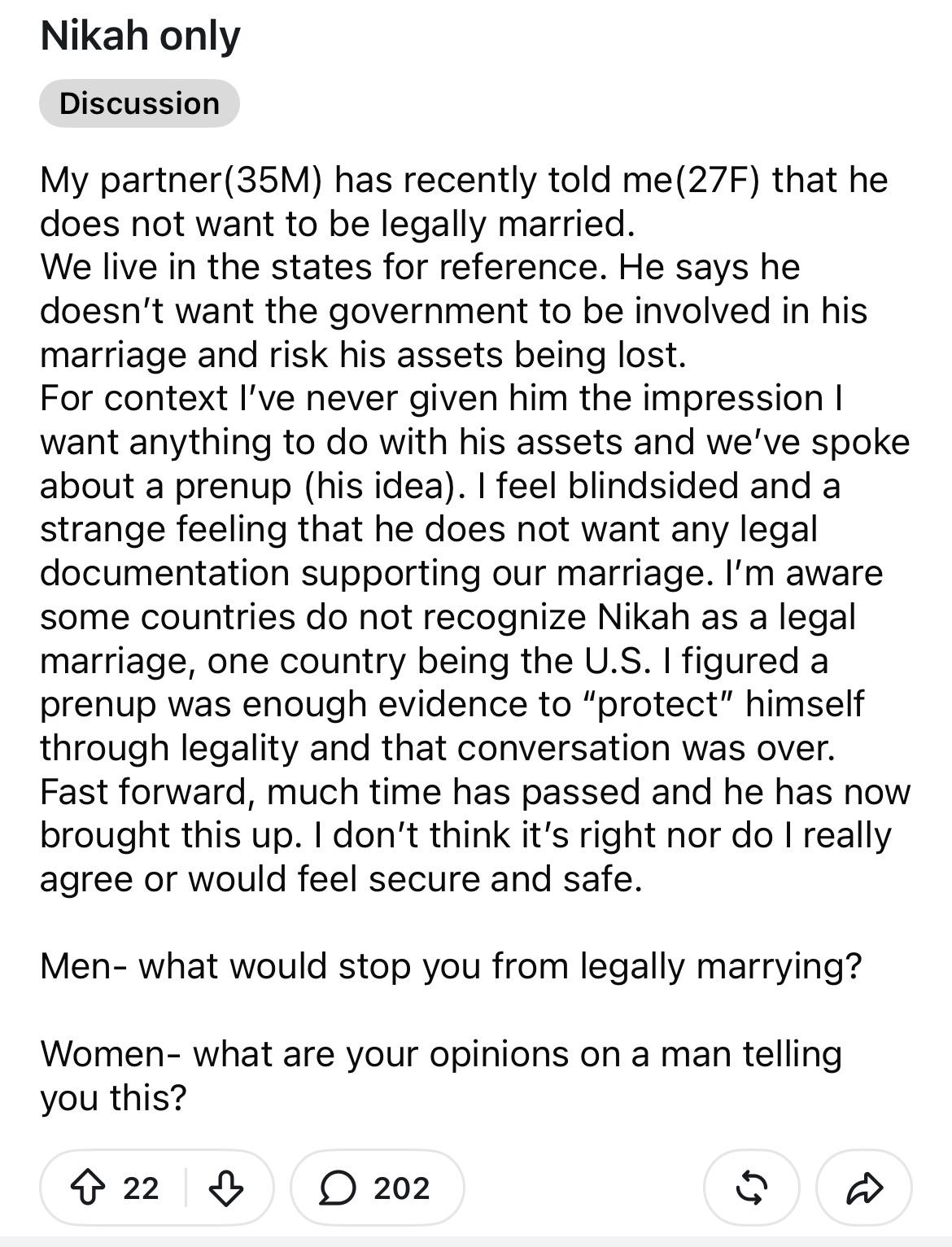
The easiest way to always see if she really wants you is to bring up legal marriage. They want to involve haram legal law to F you over, and most of you simps don’t understand it.
And all the comments were miserable Muslim women, non-Muslims, and simp men telling her to leave him 🤣🤣🤣
This life is so funny.
His request is actually more in line with Islam.
But they are supporting the one that wants to encroach on the man’s rights from an Islamic viewpoint.
Even some non-Muslim women are more reasonable than this.
Muslim women have completely lost the plot. Most of them have degrees now so they already have their own backup plan and income, yet they still want to drag the man into a non-Muslim court system designed to strip him of his assets the second things go south. They want the religious title without the religious rules, and the full power of secular law when it benefits them.
r/TraditionalMuslims • u/M0dini • 2d ago
Salam brothers and sisters.
I am genuinely curious about this question as my friends have started showing an interest in this hobby and have asked me to join them. I do not know much about it other than what they have told me, but I have felt intrigued by it. As far as I'm aware, the suit covers the entire body and as long as I cover the eyes properly, there would be nothing of me on show, but I'm not sure.
Of course, I wanted to ensure that this hobby does not jeopardise my relationship with Allah first and foremost, so I turn you for guidance.
Would I be committing a sin by joining my friends in this?
Edit: after much consideration and advice from some brothers who DM'd me, I have decided to join my friends in this furry hobby, but I will don a hijab over the suit to further protect myself. Jazakallah for all the responses.
r/TraditionalMuslims • u/Fit-Perspective683 • 3d ago
Assalamu alaikum. Please make sincere duas for me and all humanity for liberation from the economy of compulsion, compulsory labour, poverty, debt, exploitation and financial dependency. Please ask Allah to grant us provision that outlives the paycheck, immense abundant provision with extraordinary blessings, and a world where life's necessities are accessible without paywalls or financial barriers. May Allah grant humanity freedom, dignity, peace, autonomy, a regenerative and sustainable future, complete hidayah and goodness in this life and the Hereafter. Ameen.
r/TraditionalMuslims • u/-Darth_Smaug- • 3d ago
As the title says, I struggle to find proper evidence from the Quran and Sunnah about what the unattractive people will get for all their struggles due to how ALLAH Created them; whether it be due to height, weight, face, physique, etc.
I accept how HE Created me and will In Sha ALLAH be brave enough to move forward with HIS Grace & Mercy, but what will I and others get, either in this world or hereafter, for our difficulties because of something entirely out of our control?? Please somebody explain this in detail. Jazaak ALLAH Khair.
r/TraditionalMuslims • u/azaeliaofthevalley • 3d ago
As-salamu alaikum. I am 30, and my husband is 26. We met each other when he was 16 and I was 20, and got married 3 months after. I have always considered our relationship and our age gap to be very normal, even back when we first met each other. But recently, someone told me that this is creepier than 30-year-old men marrying women in their early 20s, because, according to them, no one should have a relationship with a 17-year-old. Is that true? How it's perceived overall? I'm not from the West, so for me this age gap obsession is weird overall, that's why I'm curious how it's about in Western Muslim communities.
r/TraditionalMuslims • u/ScarcityIcy6772 • 3d ago
r/TraditionalMuslims • u/Massive_Butterfly783 • 3d ago
Modesty for men:
In Islamic fiqh, a man's awrah is only navel to knee, lot less than a woman's. But many brothers appear to be misusing it. Just because a man's awrah is navel to knee, does not mean it's appropriate for a man to shirtless in home or public, without necessity. This is against the ethics of Islam. But many brothers in this sub, and other Islamic subs try their best to justify a man being shirtless before non mahram women, purely because a man's chest isn't considered mandatory awrah, or culturally it's acceptable, but they often forget, cultural norms are almost always biased. That's not how it works brothers, thinking it's appropriate for a man to be shirtless in public is a flawed understanding.
Quran 7:31: "O children of Adam, take your adornment (zinah) at every mosque," establishing full, dignified clothing beyond bare minimums.
Sahih al-Bukhari 359 & Sahih Muslim 516: The Prophet ﷺ forbade praying in a single garment that leaves the shoulders uncovered.
Sahih al-Bukhari 361–362: Poor Companions tied waist-cloths (izars) around their necks in prayer to cover their chests, proving navel-to-knee was only for poverty.
O brother, what's your excuse for displaying your body?
It is narrated on the authority of Abu Huraira that the Prophet (ﷺ) said:
Iman has over seventy branches, and modesty is a branch of Iman. (Sahih Muslim 35a)
Imam al-Nawawi — Minhaj al-Talibin (Kitab al-Shahadat, p. 345):
Arabic Text: «وَالْمُرُوءَةُ: تَخَلُّقٌ بِخُلُقِ أَمْثَالِهِ فِي زَمَانِهِ وَمَكَانِهِ، فَالْأَكْلُ فِي سُوقٍ، وَالْمَشْيُ مَكْشُوفَ الرَّأْسِ، وَقُبْلَةُ زَوْجَةٍ وَأَمَةٍ بِحَضْرَةِ النَّاسِ... يُسْقِطُهَا»
Translation: "And muru'ah (public dignity) is adopting the conduct of one's peers in one's time and place; thus eating in a market, walking bare-headed, and kissing a wife or bondwoman in front of people... nullifies it."
Ibn Hajar al-Haytami — Tuhfat al-Muhtaj (Vol. 10, p. 225) & Al-Ramli — Nihayat al-Muhtaj (Vol. 8, p. 297):
Arabic Text: «(فَالْأَكْلُ فِي سُوقٍ وَالْمَشْيُ) فِيهِ (مَكْشُوفَ الرَّأْسِ) أَوِ الْبَدَنِ غَيْرِ الْعَوْرَةِ أَوْ كَشْفُ ذَلِكَ فِيهِ وَإِنْ لَمْ يَمْشِ وَكَانَ مِمَّنْ لَا يَلِيقُ بِهِ ذَلِكَ... (يُسْقِطُهَا)»
Translation: "Thus eating in a market and walking in it bare-headed—or with the body uncovered outside of the 'awrah, or uncovering that in it even if he does not walk, when he is someone whom that does not befit... nullifies it."
Now some may say customs allow men to be shirtless in gyms, beaches, pools etc. But let's not forget, we are Muslims, and we should never follow the culture of non-Muslims, as stated in hadith: Sunan Abi Dawud (4031). Narrated by Ibn 'Umar, the Prophet Muhammad (peace be upon him) said: "Whoever imitates a people is one of them."
========================================================
Lowering gazes for women:
Many people claim women aren't attracted by men's look, but attracted by touch. But women themselves state they are visually attracted to the male chest and physique, and an unattractive man struggles more to find a partner. So denying that women feel attracted by men's body is simply denying women's feelings, and it'll only give islamophobes more ammunition. Allah SWT says: '˹O Prophet!˺ Tell the believing men to lower their gaze and guard their chastity. That is purer for them. Surely Allah is All-Aware of what they do. And tell the believing women to lower their gaze and guard their chastity.....' (Surah An-Nur 24:30–31)
If women didn't get attracted by men's looks, Allah SWT wouldn't tell women to lower their gazes. A woman, looking at man's abs, biceps or chest will inevitably feel attracted. So sisters should keep it in mind too.
Narrated Sahl:
The men used to pray with the Prophet (ﷺ) with their Izars tied around their necks as boys used to do; therefore the Prophet (ﷺ) told the women not to raise their heads till the men sat down straight (while praying). (Sahih al-Bukhari 362)
The Prophet ﷺ directly regulated when women could lift their heads so they wouldn't even accidentally catch sight of the men's exposed legs.
Moreover, During his caliphate, 'Umar ibn al-Khattab (ra) heard a woman in Madinah reciting poetry expressing intense longing for a strikingly handsome young man named Nasr ibn al-Hajjaj*. Although Nasr had committed no sin, 'Umar summoned him, shaved his hair to reduce his striking appearance—which only made his face look even more handsome—and ultimately relocated him to Basra (with full financial provision) to prevent public fitnah among the women of Madinah.*
Ibn Sa'd (al-Tabaqat al-Kubra, Vol. 3, p. 285), Ibn al-Jawzi (Dhamm al-Hawa, p. 119), and Ibn Hajar al-Asqalani (al-Isabah, Vol. 6, p. 332).
===============================================================
Problem with modern men's clothing:
Shirts, jeans, pants are most common men's attires in modern time. But Western trousers and tucked-in shirts cling to the skin and outline the exact shape of the buttocks and thighs whenever a man bends over or prays. Schools and workplaces offer women loose, modest uniform alternatives while forcing boys and men into tucked-in shirts and tight trousers that outline their lower 'awrah whenever they bend or pray. This violates Islamic adab, as clothing should also be loose enough to not show the shape of the body. But these type of clothes will almost always show the shape of buttocks, it doesn't matter what society tells. But we hardly see any discussions regarding these.
Ibn 'Abidin — Radd al-Muhtar 'ala al-Durr al-Mukhtar (Vol. 1, p. 410, Kitab al-Salah):
«وَيُكْرَهُ لُبْسُ الضَّيِّقِ الَّذِي يَصِفُ مَا تَحْتَهُ، وَفِي التَّتَارْخَانِيَّةِ: يُكْرَهُ لِلرَّجُلِ لُبْسُ السَّرَاوِيلِ الضَّيِّقَةِ الَّتِي تَصِفُ مَا تَحْتَهَا»
"And it is reprehensible (makruh) to wear tight clothing that describes [the shape of] what is beneath it. And in al-Tatarkhaniyyah: It is makruh for a man to wear tight trousers (sarawil dayyiqah) that outline what is beneath them."
Shaykh Ashraf Ali Thanwi — Bahishti Zewar (Part 11, Section on Libas / Dress):
"Wearing very tight pajamas or trousers that cling to the body and clearly show the shape of the thighs and calves is against Islamic modesty (haya) and is makruh."
=============================================================
Conclusion:
Online discourse praises a man's protective jealousy over his wife, yet mocks a woman as "insecure" or "controlling" if she dislikes her husband showing off his bare chest to other women. But think about it, just as a man feels jealous when another man looks at his wife, a woman will also feel jealous if a woman looks at her husband. You shouldn't be angry with her, it's a sign that she genuinely loves you, and cares for you, consider yourself lucky.
For men, keep in mind that saying it's appropriate to wear clothes covering only navel to knee belittles the bodily dignity of men, reducing male modesty to the bare "navel-to-knee" legal floor and normalizing unnecessary shirtlessness directly trains society to treat the male body as cheap, durable, and devoid of sanctity (hurmah).
A boy or man who feels uncomfortable in body-outlining clothes or dislikes being stared at is mocked as "dramatic," even though the Prophet ﷺ praised 'Uthman (ra) specifically for his intense bodily shyness.
حَدَّثَنَا يَحْيَى بْنُ يَحْيَى، وَيَحْيَى بْنُ أَيُّوبَ، وَقُتَيْبَةُ، وَابْنُ، حُجْرٍ قَالَ يَحْيَى بْنُ يَحْيَى أَخْبَرَنَا وَقَالَ الآخَرُونَ، حَدَّثَنَا إِسْمَاعِيلُ، - يَعْنُونَ ابْنَ جَعْفَرٍ - عَنْ مُحَمَّدِ بْنِ أَبِي حَرْمَلَةَ، عَنْ عَطَاءٍ، وَسُلَيْمَانَ، ابْنَىْ يَسَارٍ وَأَبِي سَلَمَةَ بْنِ عَبْدِ الرَّحْمَنِ أَنَّ عَائِشَةَ، قَالَتْ كَانَ رَسُولُ اللَّهِ صلى الله عليه وسلم مُضْطَجِعًا فِي بَيْتِي كَاشِفًا عَنْ فَخِذَيْهِ أَوْ سَاقَيْهِ فَاسْتَأْذَنَ أَبُو بَكْرٍ فَأَذِنَ لَهُ وَهُوَ عَلَى تِلْكَ الْحَالِ فَتَحَدَّثَ ثُمَّ اسْتَأْذَنَ عُمَرُ فَأَذِنَ لَهُ وَهُوَ كَذَلِكَ فَتَحَدَّثَ ثُمَّ اسْتَأْذَنَ عُثْمَانُ فَجَلَسَ رَسُولُ اللَّهِ صلى الله عليه وسلم وَسَوَّى ثِيَابَهُ - قَالَ مُحَمَّدٌ وَلاَ أَقُولُ ذَلِكَ فِي يَوْمٍ وَاحِدٍ - فَدَخَلَ فَتَحَدَّثَ فَلَمَّا خَرَجَ قَالَتْ عَائِشَةُ دَخَلَ أَبُو بَكْرٍ فَلَمْ تَهْتَشَّ لَهُ وَلَمْ تُبَالِهِ ثُمَّ دَخَلَ عُمَرُ فَلَمْ تَهْتَشَّ لَهُ وَلَمْ تُبَالِهِ ثُمَّ دَخَلَ عُثْمَانُ فَجَلَسْتَ وَسَوَّيْتَ ثِيَابَكَ فَقَالَ " أَلاَ أَسْتَحِي مِنْ رَجُلٍ تَسْتَحِي مِنْهُ الْمَلاَئِكَةُ " .
`Aisha reported: Allah's Messenger (ﷺ) was lying in the bed in my apartment with his thigh uncovered and Abu Bakr sought permission to enter. It was given to him and he conversed in the same very state (the Prophet's thigh or shank uncovered). Then `Umar sought permission for entering and it was given to him and he conversed in that very state. Then `Uthman sought permission to enter; Allah's Messenger (ﷺ) sat down and he set right his clothes. Muhammad (one of the narrators) said: I do not say that it happened on the same day. He (`Uthman) then entered and conversed and as he went out, `Aisha said: Abu Bakr entered and you did not stir and did not observe much care (in arranging your clothes), then `Umar entered and you did not stir and did not arrange your clothes, then `Uthman entered and you got up and set your clothes right, so he (ﷺ) said: Should I not show modesty to one whom even the Angels show modesty. ( Sahih Muslim 2401)
============================================================
This was a very long text, JazakAllahu Khairan for reading it. Allah knows the best.
May Allah SWT give all proper knowledge, Ameen
r/TraditionalMuslims • u/PyrotechnicLytes • 4d ago

It was originally posted on MuslimAcademics subreddit
