r/TraditionalMuslims • u/MiddlePension • 18h ago
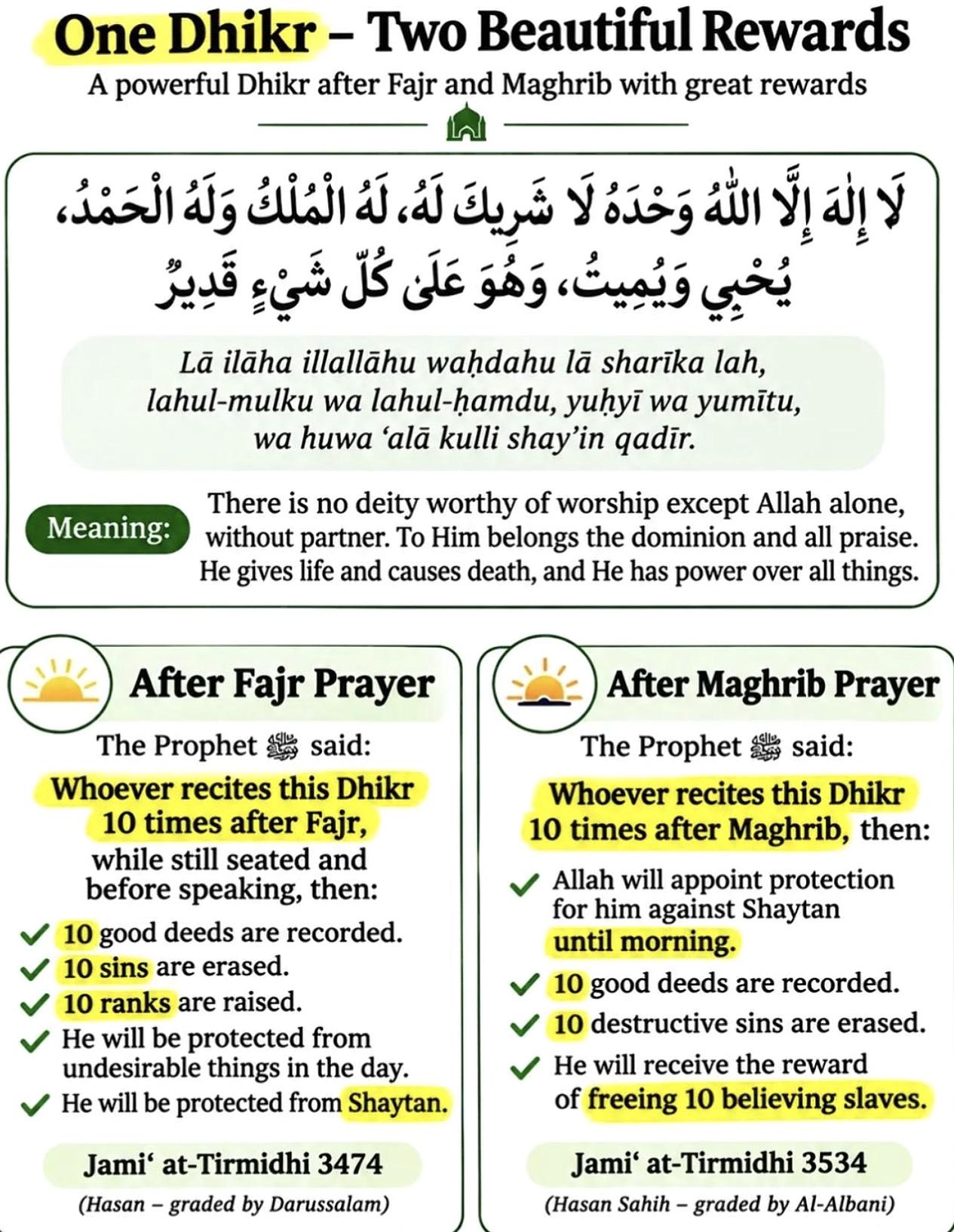
Islam One Dhikr - Two beautiful rewards
8
Upvotes
r/TraditionalMuslims • u/JlangDev • 17h ago
In the year 2000, a law was enacted in Egypt that the country had never known since Islam entered Egypt at the hands of Amr ibn al-As and the Companions who accompanied him, during the caliphate of Umar ibn al-Khattab, may Allah be pleased with them all.
Namely... what is known as the Khulʿ Law.
Here, a question arises: Have Muslims not known khulʿ since the time of the Messenger of Allah until the present day, and have they not been reading about it in the Qur'an every day?
The answer is that khulʿ in Islam is of three types.
This is the khulʿ mentioned in the Qur'an: "There is no blame upon either of them concerning what she gives as ransom."
And in the Sunnah, in the hadith of Thabit ibn Qays: "Accept the garden and divorce her."
Thus, the divorce was issued by Thabit, and the acceptance was up to him.
Similarly, the Prophet said to Abdullah ibn Umar, when his father ordered him to divorce his wife: "Divorce her."
In another narration: "O Abdullah ibn Umar, divorce your wife."
And in another narration: "He ordered me to divorce her, so I divorced her."
Abdullah ibn Umar complied and divorced his wife.
Some of the Tabiʿun (the generation following the Companions), such as al-Hasan al-Basri and Sa'id ibn Jubayr, stipulated that the husband obtain permission from the ruler to grant his wife khulʿ, so that the ruler could be assured that he had not coerced her into khulʿ in order to recover his money.
This is khulʿ involving a third party, and it is permissible according to the four schools of jurisprudence.
They explained this by stating that Allah legislated khulʿ for the benefit of men, so that men could take money in exchange for divorce.
Thus, if a third party offers a man money in exchange for divorcing his wife, and the husband agrees, the khulʿ takes effect, the husband becomes entitled to the money, and the wife becomes irrevocably divorced, even if she does not consent to it, because khulʿ is a right belonging exclusively to the husband.
For the appointment of the two arbitrators, it is required that the husband complain that his wife is harming him, without having evidence, and demand his right; and that the wife complain about her husband, claiming that he is harming her, without having evidence, and demand her right.
Neither of them must be willing to pardon the other.
The ruler then appoints two arbitrators, one from his family and one from hers.
If they find that the wrongdoing is on the husband's part, they divorce her from him, even if the woman does not wish to separate.
If they find that the wrongdoing is on the wife's part, the husband has the choice of compelling her to obtain khulʿ in exchange for whatever amount of money the two arbitrators consider appropriate, or holding her in his marriage.
Al-Tahawi said in Ahkam al-Qur'an:
"We find that Allah, Glorified and Exalted, said: 'And it is not lawful for you to take back anything of what you have given them.' This was an address from Him to husbands. 'Unless both fear that they will not maintain the limits set by Allah. But if you fear that they will not maintain the limits set by Allah, then there is no blame upon either of them concerning what she gives as ransom.' Thus, Allah, the Almighty, included wives alongside husbands in this matter, making the ransom come from the wives and its acceptance belong to the husbands. There was therefore no role for the ruler without which this could not be completed. This was a ransom in exchange for money that the husband takes from the woman, and the ruler would not compel either of them to do so if they brought the matter before him. Rather, he would refer them back to whatever they willingly agreed upon regarding the amount of the ransom and the husband's agreement to separation. Accordingly, by analogy, they should be able to do this without the ruler, just as they can do it in his presence."
Source: Ahkam al-Qur'an al-Karim, vol. 2, p. 451, commentary on Qur'an 2:229.
Al-Sarakhsi said in Al-Mabsut:
"Khulʿ is permissible in the presence of the ruler and elsewhere, because it is a contract based on mutual consent, like other contracts. It is equivalent to divorce in exchange for compensation. The husband possesses the authority to pronounce divorce, and the wife possesses the authority to undertake the obligation of paying compensation. Therefore, there is no reason to stipulate the ruler's presence for this contract."
Source: Al-Mabsut, vol. 6, p. 173, Kitab al-Talaq, Bab al-Khulʿ.
Badr al-Din al-Ayni said in Umdat al-Qari, while explaining the hadith of Thabit:
"His statement, 'his garden,' means the garden that he had given her. His statement, 'and divorce her': the command here is one of guidance and seeking a beneficial resolution, not one of obligation and compulsion."
Source: Umdat al-Qari Sharh Sahih al-Bukhari, Kitab al-Talaq, Bab al-Khulʿ wa Kayf al-Talaq Fih.
Ibn al-Qasim said:
"Malik said: 'Nothing done by a person under coercion is binding upon him, whether it is manumission, divorce, marriage, sale, or purchase. As for a will, I did not hear Malik speak about it, but the ruling is that the will of a coerced person is invalid.' I asked: 'What if someone is coerced into a settlement by someone other than the ruler? Is it binding upon him or not?' He replied: 'According to Malik, it is not binding upon him. Coercion by the ruler and coercion by someone other than the ruler are the same according to Malik, so long as the person is coerced.' I asked: 'What constitutes coercion according to Malik?' He replied: 'Beating, threatening to kill, threatening to beat, and intimidation whose seriousness is beyond doubt.'"
Source: Al-Mudawwana, in the discussion of coercion and its legal consequences.
Settlement here means khulʿ.
Ibn Rushd said in Al-Bayan wa al-Tahsil:
"A question: Malik was asked about a rebellious wife who says: 'I will not pray, I will not fast, and I will not perform the ritual bath after major ritual impurity.' Is her husband compelled to separate from her? He replied: 'He is not compelled to separate from her. However, if he wishes, he may separate from her, and whatever she gives to ransom herself becomes lawful for him to take.'"
Muhammad ibn Rushd said:
"This is as he stated: he is not compelled to separate from her, nor is he obligated to do so, because she is not an unbeliever or an apostate merely by abandoning prayer, fasting, and the ritual bath after major ritual impurity, provided that she acknowledges these acts as obligatory, according to the soundest opinion. Therefore, he may discipline her for abandoning prayer and hold her in marriage."
Source for both passages: Al-Bayan wa al-Tahsil, in the discussion of the rebellious wife who refuses prayer, fasting, and ritual bathing.
Abu al-Walid al-Baji said in his commentary on Al-Muwattaʾ, concerning the hadith of Thabit ibn Qays:
"Her statement, 'Neither I nor Thabit ibn Qays,' apparently indicates her refusal of him, and its ruling is the ruling of marital rebellion (nushuz). She is to be compelled to return to him if he does not wish to separate from her through khulʿ or otherwise."
Source: Al-Muntaqa Sharh al-Muwattaʾ, vol. 4, p. 61, Bab Ma Ja'a fi al-Khulʿ.
Abu al-Walid al-Baji also said:
"The Prophet's statement, peace and blessings be upon him, 'Take from her,' constitutes permission from him, peace and blessings be upon him, to take the ransom from her. It may also be understood as a recommendation to do so."
Source: Al-Muntaqa Sharh al-Muwattaʾ, Bab Ma Ja'a fi al-Khulʿ.
Al-Shafi'i said in Al-Umm:
"Just as she may be a cause of khulʿ, it proceeds from his side, because if he wished, he would not accept the khulʿ."
Source: Al-Umm, vol. 5, p. 139, in the discussion of liʿan and separation between spouses.
Al-Shafi'i said:
"Among these matters is that anyone who owns a wife, other than the Messenger of Allah, peace and blessings be upon him, is not required to give her the choice between remaining with him and separating from him. He has the right to hold her if he gives her what he is obligated to give her, even if she dislikes him. But Allah, the Almighty, commanded His Messenger, peace and blessings be upon him, to give his wives the choice."
Source: Al-Umm, vol. 5, p. 150, section concerning the Messenger of Allah and his wives.
Al-Shafi'i said:
"The Messenger of Allah, peace and blessings be upon him, permitted Thabit ibn Qays to take from his wife when she came to him. He did not tell him, 'Do not take from her except at the beginning of her waiting period,' as he had instructed others who pronounce divorce. Nor did he specify for him a divorce by which he should divorce her. He regarded his consent to taking from her as a separation. Khulʿ is a name distinct from divorce, and the one who grants khulʿ does not initiate a divorce except in exchange for compensation."
Source: Al-Umm, vol. 5, pp. 128–129, in the discussion of khulʿ and the distinction between khulʿ and divorce.
Al-Shafi'i said:
"If the father or guardian of a minor boy or a person of unsound mind arranges khulʿ on his behalf with his wife, or with his wife's father, the khulʿ is invalid and the marriage remains intact. Whatever they received from the woman or her guardian in exchange for khulʿ must be returned in full, and she remains his wife as before. Likewise, if he is deprived of his reason or has not reached puberty and arranges khulʿ on his own behalf, she remains his wife as before. The same applies if the master of a slave arranges khulʿ on behalf of his slave without his permission. This is because khulʿ is divorce, and no one has the authority to divorce on behalf of another person, whether a father, master, guardian, or ruler. A person may only pronounce divorce on his own behalf, or the ruler may impose divorce upon him on account of an obligation he himself has incurred, if he refuses to pronounce it despite being someone who possesses the authority to divorce. Khulʿ does not fall within this category."
Source: Al-Umm, vol. 5, p. 214, section titled Ma Yajuz Khulʿuhu wa Ma La Yajuz.
Ahmad said, in the narration of Abu Talib:
"Khulʿ is like the hadith of Sahlah: when a woman dislikes a man and says, 'I will not honor any oath of yours, nor obey any command of yours, nor perform the ritual bath after sexual impurity caused by you,' then it becomes lawful for him to take from her what he gave her, because the Prophet, peace and blessings be upon him, said: 'Will you return his garden to him?'"
Source: A narration from Imam Ahmad through Abu Talib, transmitted in works discussing the rulings of khulʿ.
Notice the words: "Then it becomes lawful for him."
In the Masa'il narrated by his son Salih, Salih said:
"I asked: 'A man marries off his son while he is young, and when the son grows up, he says, "I do not want this marriage"?' He replied: 'He has no such right. The father concluded a contract on his behalf.' I asked: 'What about a young girl whom her father marries off?' He replied: 'There is no disagreement among people concerning this. She has no right to revoke it.'"
Source: Masa'il al-Imam Ahmad, narration of his son Salih, question no. 1175.
In the Masa'il narrated by his son Abdullah, Abdullah said:
"I asked my father about a father who marries off his daughter while she is young. Does she have the right to choose when she grows up? He replied: 'She has no right of choice if her father married her off. If she had such a right, then Aisha would have had the right of choice regarding the Messenger of Allah, peace and blessings be upon him, because the Prophet, peace and blessings be upon him, married her when she was six or seven years old, consummated the marriage when she was nine, and died when she was eighteen.'"
Source: Masa'il al-Imam Ahmad, narration of his son Abdullah, Kitab al-Nikah, question no. 1196.
Ibn Qudamah said in Al-Mughni:
"The woman's consent is not required for taking her back (rajʿah), because Allah, the Almighty, says: 'And their husbands have a greater right to take them back during that period, if they desire reconciliation.' Thus, He assigned this right to the husbands. And He, the Exalted, says: 'Then hold them in a fair manner.' He addressed the command to the husbands and did not give the women a choice. Moreover, taking a woman back means holding her under the marital bond, and therefore her consent is not required, just as it is not required when she is still in an existing marriage. The scholars are unanimously agreed upon this."
Source: Al-Mughni, Kitab al-Rajʿah, section concerning the woman's consent to revocation of divorce.
Al-Buhuti said in Kashshaf al-Qinaʿ:
"An insolvent man is not compelled to marry off his umm walad (a slave woman who has borne him a child) in order to repay his debt from what he takes of her bridal gift. The apparent meaning is that this applies even if he does not have intercourse with her, because marriage would make her unlawful to him and would establish the husband's right over her. Nor is a woman who is in debt compelled to marry herself to someone who wishes to marry her, so that she may receive her bridal gift and use it to repay her debt, because marriage entails obligations upon her that she may be unable to fulfill. Nor is a man compelled to grant khulʿ if his wife or someone else offers him money in exchange for granting her khulʿ or divorcing her in exchange for it, so that he may use that money to repay his debt. This is because doing so would cause him harm by making his wife unlawful to him, and he may have affection for her."
Source: Kashshaf al-Qinaʿ ʿan Matn al-Iqnaʿ, vol. 3, Bab al-Hajr, in the discussion of the insolvent debtor.
Ibn Hazm said in Al-Muhalla:
"Khulʿ, which is ransom, occurs when a woman dislikes her husband and fears that she will not fulfill his rights, or fears that he may hate her and therefore fail to fulfill her rights. In that case, she may ransom herself from him, and he divorces her, if he agrees. Otherwise, neither he nor she may be compelled. It is only permissible by their mutual consent."
Source: Al-Muhalla bi al-Athar, vol. 9, p. 511, Kitab al-Khulʿ.
Ibn Hazm said:
"A woman has no choice between separating from her husband and remaining with him except where Allah, the Almighty, has granted her such a choice in the case of a woman who has been emancipated from slavery. A woman never owns authority over her own affairs."
Source: Al-Muhalla, in the discussion of the right of choice regarding marriage and separation.
Ibn Taymiyyah said in Majmuʿ al-Fatawa:
"Since khulʿ is a dissolution of the marriage and is not part of the three divorces, there is no difference between the money offered being from the woman or from a third party. Comparing the dissolution of a marriage contract to the rescission of a sale contract is questionable, because a sale cannot be rescinded except with the consent of both parties to the sale; neither party can independently rescind it. Marriage is different, because the woman does not possess the authority to dissolve it. Rather, the husband possesses that authority independently. However, her ransoming herself from him is like a third party ransoming her."
Source: Majmuʿ al-Fatawa, vol. 32, p. 92, Kitab al-Nikah, in the discussion of khulʿ and dissolution of marriage.
Ibn Taymiyyah said in Bayan al-Dalil:
"When a woman marries with the intention of bringing about separation, the prohibition here is due to the husband's right, because this involves deceit and deception against him. Otherwise, he owns her by virtue of this contract and possesses the right not to divorce her under any circumstances."
Source: Bayan al-Dalil ʿala Butlan al-Tahlil.
Ibn Taymiyyah said:
"It remains to be said: 'She does not intend to harm him; rather, she intends to benefit herself by escaping from him.' The answer is that the Lawgiver has not placed this benefit in her hands. If benefiting from separation were a right belonging to her, the Lawgiver would have granted her ownership of it. And when she needed it, He commanded her to ransom herself from him, just as a captive or a slave is ransomed. Do you not see that a slave is not permitted to deliberately harm his master in order to make him emancipate him, if the master has not mistreated him?"
Source: Bayan al-Dalil ʿala Butlan al-Tahlil.
Ibn al-Qayyim said in Zad al-Maʿad:
"The fact that Allah, the Exalted, calls khulʿ a ransom is evidence that it involves the meaning of an exchange. For this reason, the consent of both spouses is required."
Source: Zad al-Maʿad, vol. 5, p. 276, in the discussion of khulʿ.
Ibn al-Qayyim said:
"For he possesses the right never to separate from her at all, and to hold her until death separates them. Marriage is a contract for the duration of a lifetime, and therefore he possesses the right to continue holding her in marriage."
Source: Zad al-Maʿad, vol. 5, pp. 154–155, in the discussion of the marital relationship and the right of separation.
Ibn al-Qayyim said in Iʿlam al-Muwaqqiʿin:
"The answer is that general laws were not established on the basis of rare cases. If there were a benefit for the majority of men who divorce in this matter, then the wisdom of the Wisest of judges would have prohibited men from divorcing altogether and placed men in the same position as women in this regard, unable to separate from their husbands."
Source: Iʿlam al-Muwaqqiʿin, in the discussion of Al-Hilah al-Surayjiyyah li-ʿAdam Wuqūʿ al-Talaq Aslan; vol. 4, p. 218 in one edition.
