r/WW2HolocaustHistory • • 18h ago

November 23, 1944 Holocaust: 22,000 Dead in the Mountains of Alsace

Thumbnail
gallery
63 Upvotes

Allied Troops Liberate the Infamous Natzweiler-Struthof Camp

September 1940: Following the de facto German annexation of Alsace, Nazi officials discover a vein of pink granite in the Vosges Mountains near Natzweiler.

May 1941: The SS establishes Konzentrationslager Natzweiler-Struthof—the only Nazi concentration camp on pre-war French territory—initially housing prisoners in the former Hotel Struthof to work the granite quarries.

1942–1943: The camp expands into a major detention site for Western European resistance fighters (Nacht und Nebel prisoners) and begins establishing a network of roughly 50 to 70 subcamps across Alsace and southwestern Germany.

April–August 1943: A small gas chamber is constructed; in August, 86 Jewish men and women transferred from Auschwitz are murdered there for Nazi anatomist August Hirt’s "Jewish skeleton collection" at the Reich University of Strasbourg.

Early September 1944: As Allied forces advance, the SS evacuates the main camp—overseen by former Auschwitz commandant Josef Kramer—sending prisoners on forced marches and transports to Dachau and subcamps east of the Rhine.

November 23, 1944: Troops of the French First Army under the U.S. Sixth Army Group enter and liberate the largely abandoned main camp, making it the first Nazi concentration camp discovered by the Western Allies.

March–April 1945: The remaining Natzweiler subcamps east of the Rhine are disbanded, and surviving prisoners are forced onto brutal death marches toward Dachau.

"Natzweiler-Struthof was a Nazi concentration camp located in the Vosges Mountains close to the villages of Natzweiler and Struthof in the Gau Baden-Alsace of Germany, on territory annexed from France on a de facto basis in 1940. It operated from 21 May 1941 to September 1944, and was the only concentration camp established by the Germans in the territory of pre-war France. The camp was located in a heavily forested and isolated area at an elevation of 800 metres (2,600 ft).

About 52,000 prisoners were estimated to be held there during its time of operation. The prisoners were mainly from the resistance movements in German-occupied territories. It was a labor camp, a transit camp and, as the war went on, a place of execution. Some died of exhaustion and starvation – there were an estimated 22,000 deaths at the camp and its network of subcamps.

Many prisoners were moved to other camps; in particular, in 1944 the former head of Auschwitz concentration camp was brought in to evacuate the prisoners of Natzweiler-Struthof to Dachau as the Allied armies approached. Only a small staff of Nazi SS personnel remained when the camp was liberated by the French First Army under the command of the U.S. Sixth Army Group on 23 November 1944.

The anatomist August Hirt made a Jewish skull collection, whose purpose was to portray Jews as racially inferior, at the camp. A documentary movie was made about the 86 named men and women who were killed there for that project. Some of the people responsible for atrocities in this camp were brought to trial after the war ended.

The camp is preserved as a museum in memory of those held or killed there. The European Centre of Deported Resistance Members is located at this museum, focusing on those held. A monument to the departed stands at the site. The present museum was restored in 1980 after damage by neo-Nazis in 1976. Among notable prisoners, the writer Boris Pahor was interned in Natzweiler-Struthof and wrote his novel Necropolis based on his experience." LOTS MORE---> https://en.wikipedia.org/wiki/Natzweiler-Struthof_concentration_camp

1: Left: The Natzweiler-Struthof Camp (UNIVERS HISTORI) (French Edition), by Robert Steegmann

“Between 1941 and 1945, Alsace, annexed by the Third Reich, saw the establishment of one of the deadliest concentration camps of the Second World War: the KL-Natzweiler. Of the 52,000 individuals who passed through, more than 20,000 did not return, victims of terrifying detention conditions, devastating scientific experiments, and ruthless "death marches."

Supported by unpublished archives and testimonies, Robert Steegmann offers a masterful study of this little-known camp. An instrument of a policy of violent repression, a reservoir of labor for German industry, it obeyed the relentless logic of the concentration camp mechanism operating on both sides of the Rhine. Through departures and arrivals, forced labor, punishments, or medical experiments, it is the men, victims or docile agents of barbarism, who are at the heart of this book. Their destiny is that of the history of Nazi barbarism.

A doctor of history, Robert Steegmann is a contemporary history teacher in preparatory classes in Strasbourg. A member of the scientific council of the European Center for Deportees-Resistance fighters, he notably published Struthof. The KL-Natzweiler and its kommandos (La Nuée bleue, 2005).” (Amazon)

Right: French resistance members inspect the crematorium after liberation

2: Natzweiler-Struthof after liberation

3: An American soldier in Natzweiler-Struthof examines an urn used to hold the ashes of cremated prisoners.

4: The crematorium at Natzweiler-Struthof as it looks today

5: The Monument to the Departed at Natzweiler-Struthof


r/WW2HolocaustHistory • • 11h ago

November 23, 1938 Holocaust: The Kristallnacht Aftermath at Sachsenhausen

Thumbnail
gallery
19 Upvotes

12-of-62 Jewish Prisoners Beaten To Death at the Camp Gates

"The Jews who had been seized during the Kristallnacht, and sent to concentration camps, experienced a foretaste of what (Nazi) vengeance might be.

On November 23 the News Chronicle, a London newspaper, reported the arrival of sixty-two Jews, including two rabbis, at Sachsenhausen concentration camp, north of Berlin. The arrested men had reached the camp gates under police escort from Berlin. At the gates, the police were made to hand them over to an SS unit.

The sixty-two Jews were then forced to run a gauntlet of spades, clubs and whips . According to an eye-witness, the police, 'unable to bear their cries, turned their backs'. As the Jews were beaten, they fell. As they fell they were beaten further.

This 'orgy' of beating lasted half an hour. When it was over, 'twelve of the sixty-two were dead, their skulls smashed. The others were all unconscious. The eyes of some had been knocked out, their faces flattened and shapeless'.

In New York, on this day, a mass demonstration organized by the Joint Boycott Council protested against the renewed violence.

Two days later, in Chicago, protesters burned swastika flags.

Elsewhere, however, the Nazi excesses only fanned the flames of hatred. In the Slovak province of the now truncated Czechoslovakia, the anti-Jewish party having gained the ascendancy, attacks on Jews not only increased, but went unchallenged by the police.

The writer Dr Geza Fischer was attacked in the street.

'He was an inoffensive man', one of Fischer's colleagues later recalled, 'of definite Jewish appearance. He was brought into a doorway and his head was knocked against the wall. He was brought to the hospital half dead, and he died within a few hours. His wife committed suicide.'

The search for refuge had become desperate. From Berlin, Captain Foley sent a strongly worded telegram to Jerusalem, asking for extra Palestine certificates, including one thousand for young Jews who might thereby be allowed in without their parents.

As Benno Cohn recalled, Foley 'did everything in his power to enable us to bring over as many Jews as possible. He helped all the categories, and one can say that he rescued thousands of Jews from the jaws of death.'

Among those who saw Captain Foley at work in the British Passport Control Office in Berlin was the young Dutchman, Wim van Leer. Forty-six years later he recalled Foley's 'genuine compassion for the throngs that day in , day out besieged his office with their applications, requests and enquiries as to the progress of their case'.

Van Leer added:

'The winter of 1938 was a harsh one, and elderly men and women waited fro m six in the morning, queuing up in the snow and biting wind. Captain Foley saw to it that a uniformed commissionaire trundled a tea-urn on a trolley along the line of frozen misery, and all this despite the clientele, neurotic with frustration and cold, doing little to lighten his task'."

From The Holocaust: A History of the Jews of Europe During the Second World War, by Martin Gilbert

October 28, 1938 The Catalyst: Nazi Germany expels roughly 17,000 Polish Jews to the Polish border, stranding them in harsh conditions.

November 7, 1938 The Shooting: Herschel Grynszpan, a 17-year-old Polish Jew whose family was among those expelled, shoots German diplomat Ernst vom Rath in Paris.

November 9, 1938 The Pretext & Order: Vom Rath dies from his wounds. That evening in Munich, Propaganda Minister Joseph Goebbels incites Nazi Party leaders to launch nationwide "spontaneous" riots against Jews.

November 9–10, 1938 The Pogrom: SA stormtroopers, SS units, Hitler Youth, and civilians ransack Jewish neighborhoods across Germany, annexed Austria, and the Sudetenland. Police and firefighters are ordered to stand down unless non-Jewish property is threatened.

November 10–16, 1938 Mass Arrests: Gestapo and local police round up Jewish men across the Reich, transporting them to Dachau, Buchenwald, and Sachsenhausen concentration camps.

November 12, 1938 Economic Ruin: Hermann Göring chairs a meeting imposing a 1 billion Reichsmark "atonement tax" on the Jewish community, confiscating insurance payouts, and banning Jews from owning businesses.

November 15, 1938 Social Exclusion: Jewish children are permanently expelled from German public schools.

December 1938 – Early 1939 Releases & Flight: Most concentration camp detainees are gradually released on the strict condition that they immediately emigrate. Great Britain launches the Kindertransport, rescuing nearly 10,000 unaccompanied Jewish children.

Results

Nazi officials initially reported 91 Jews murdered during the two nights of street violence. Modern historians estimate the true death toll was between 1,000 and 2,000+ people, accounting for fatal beatings in concentration camps, untreated injuries, and roughly 638 suicides triggered by the terror.

Between 26,000 and 30,000 Jewish men were rounded up and sent to Dachau, Buchenwald, and Sachsenhausen. Hundreds died within weeks from torture, exposure, and exhaustion. Roughly 90% or more of the 30,000 arrested men survived their initial imprisonment and were released by early 1939, provided they had secured papers to emigrate immediately.

Over 1,400 synagogues and prayer rooms were burned, approximately 7,500 Jewish-owned businesses were looted, and countless homes, hospitals, and cemeteries were desecrated. Roughly 200,000 Jews managed to flee Germany before World War II began in September 1939. Of the approximately 214,000 Jews who remained in Germany and Austria at the outbreak of the war, fewer than 10% survived the Holocaust.

1: SS guards force Jews, arrested during Kristallnacht (the "Night of Broken Glass"), to march through the town of Baden-Baden. Onlookers watch from along the street and walls. Baden-Baden, Germany. November 10, 1938.

2: After the Kristallnacht pogrom in Linz, Austria, Jewish women are made to wear signs saying, 'I am not part of the national community,' while being humiliated on stage in public

3: Just one of the front page articles from November 1938 following the violence of Kristallnacht, from The Leeds Mercury, November 12 1938. Please be aware: you may find some of the language used in this article upsetting.


r/WW2HolocaustHistory • • 19h ago

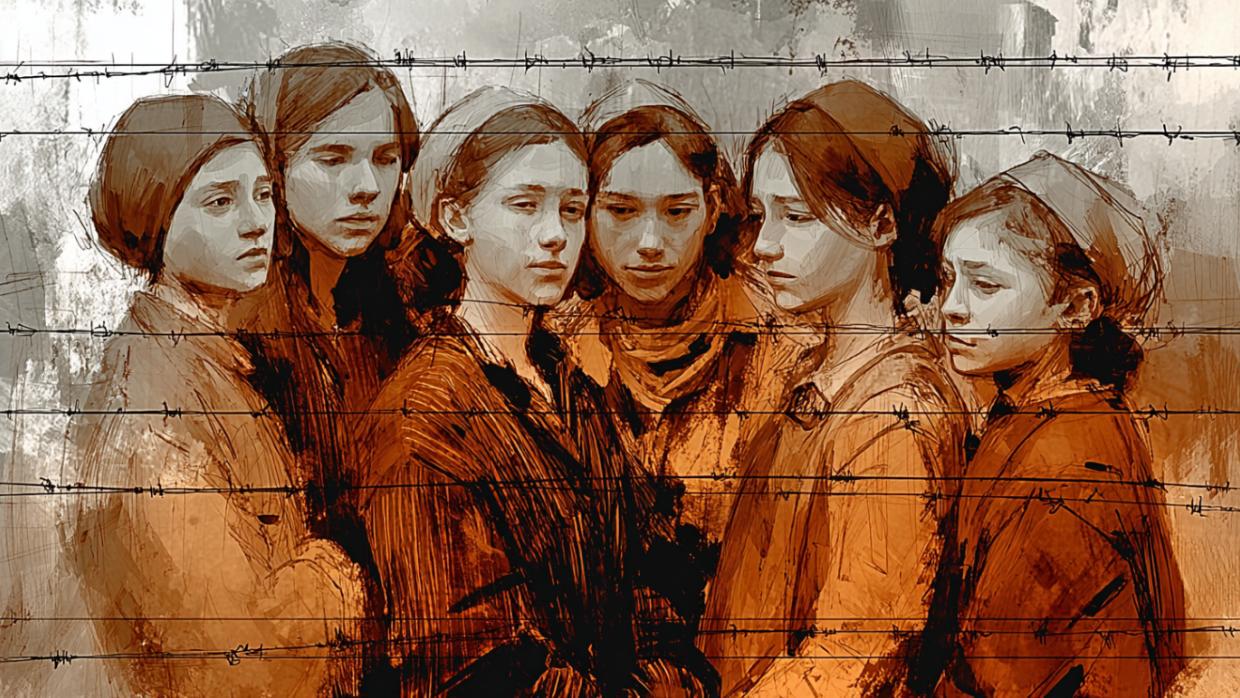
Sisterhood in the Concentration Camps

Post image
44 Upvotes

Women Forged Bonds that Helped them Survive the Horror of the Holocaust

"In the Nazi camps, where humanity was dismantled and death was carried out with chilling precision, survival often hinged not on strength but on solidarity. For women, survival was not just physical—it was psychological, rooted in their instinct to mother others. The only light in the darkness they had was each other.

Older inmates, many having lost their own children, fostered younger girls orphaned by war. Teenagers, like my mother-in-law, Rifka—terrified, alone, and raw with grief—were “adopted” by strangers who became surrogate mothers, sisters, and protectors. It was in this space where cruelty knew no bounds that the role of Lager Schvestern (camp sisters) quietly emerged.

Rifka spoke of one such orphan, Freidl, a beautiful 17-year-old from Odessa whose entire family had been slaughtered in a pogrom. Yet despite this catastrophic loss, hope still lived within her. She dared to dream of love, a husband, a family, sharing these secret fantasies with her camp sisters.

Then the unthinkable happened—during roll call one day, a Kapo erupted in rage when Freidl stumbled over the words of a camp song, savagely beating her, leaving her face badly disfigured. “I am no more beautiful,” she cried to the camp sisters. “Who will marry me?”

In a world where everything had been stripped from her, this final blow shattered what little hope she had, and she ended her life by throwing herself onto the camp’s electrified fence.

The camp sisters, overwrought by her death, were determined to mourn her passing. For seven evenings, after they returned exhausted from their worksites, they shared their sorrow, congregating on their bunks “to sit shiva” for her—murmuring prayers from memory, speaking her name, recalling the family she had lost and the future she would never have. In this crucible of barbarity, designed to erase every trace of personhood, they honored her in death with the same devotion they had shown her in life.

Shielding Younger Girls

These sisterly bonds, weaving strands of hope into a tapestry of survival, were often forged in line at roll call or in the barracks during the rare lull after evening rations. In that thin sliver of time, older women mentored the younger ones, sharing advice, teaching caution, and offering what little hope could be cobbled together. And when necessary, these women absorbed pain meant for others.

There are documented instances—Rifka spoke of them—where a woman would offer herself to a Kapo to shield a younger girl from being raped or marked for the gas chamber. It wasn’t spoken of as it carried shame. But it was compassion, in its most twisted form.

Rifka, barely a teenager at the time, came of age under the watchful eyes of D’vorah and Gitl. Though depleted themselves, they became her guides in a world where femininity was weaponized and danger lurked in every corner. On occasions, the roles reversed, when the elderly D’vorah was beaten and couldn’t stand in line for the evening meal, it was Rifka and the others who shared their bread with her, each tearing a piece from her coveted portion. Such was the heroic selflessness of the camp sisters despite their wracking hunger.

Some weeks after the beating, tragedy struck. D’vorah died from her injuries. Her body was carried from the barracks and laid among the dead on the Appelplatz for morning roll call. Upon seeing her there, Rifka collapsed onto the floor. Two camp sisters immediately rallied, pulling her swiftly to her feet, whisking her back to the barracks, defying the rule that no one was permitted to touch a fallen inmate on pain of a beating. Had they left her there, she would have been deemed unfit for work and transported to Majdanek for extermination.

Terror and Moments of Levity

Women in the camps faced especially cruel abuse. The threat of sexual assault was constant. SS guards would burst into the barracks at night, drag the women from their bunks, and violate them behind the latrines. Yet even in the face of such atrocities, the women found ways to preserve their humanity and protect the younger girls, all the while teaching them to navigate the daily perils of camp life and how to appear invisible. When to speak and when to swallow pain so the guards wouldn’t smell weakness. These small but crucial lessons were the inheritance passed from one woman to another in place of a mother’s legacy or a teacher’s wisdom.

Yet, amid these sordid atrocities, there was also levity. They would compose irreverent lyrics to popular tunes and make self-deprecating jokes about their shaved heads and shriveled breasts. They performed spoofs about the camp’s demonic Kommandant and the loathsome Kapo, whom they nicknamed kakerlake (cockroach).

They found comfort in sharing memories from the past. They discussed books and plays. And, when hunger gnawed in their bellies like knives, they would fantasize about food. Steaming bowls of lentil and onion soup, warm loaves of bread straight from the oven, freshly picked berries bubbling in saucepans, trying to outdo each other in a crescendo of recipe one-upmanship.

When I asked Rifka whether all this food talk wasn’t just another twist of the knife, she insisted it had a nourishing effect. They called it “kokhn mit di moyl (cooking with the mouth).” Through their tears and laughter, the specter of death never far, they bonded as sisters in their collective struggle to beat the odds even as their numbers dwindled.

These camp sisters were everyday warriors. They grieved together and celebrated small victories together. They resisted not with weapons, but with touch, with song, with camaraderie.

The lessons Rifka learned from her camp sisters never left her. After the war, she became a formidable and indefatigable force of compassion, discreetly easing the financial burdens of the struggling, comforting the sick, always alert to someone else’s need.

Her story—and countless others like it—remind us that the female experience of the Holocaust cannot be told in numbers alone. It is a tapestry spun from sacrifice, quiet heroism, and unbreakable bonds forged in hell." https://aish.com/sisterhood-in-the-concentration-camps/


r/WW2HolocaustHistory • • 8h ago

November 23, 1945 Nuremberg Tribunal Day-4: Following the Money to Aggressive War

Post image
7 Upvotes

Prosecuting the "Financial Wizardry" of the Third Reich

Mr. Thomas J. Dodd, Executive Trial Counsel for the United States, Presents the Case of the Economic Preparation for Aggressive War:

"I will not take the time of this Tribunal to prove what the world already knows: that the Nazi conspirators rearmed Germany on a vast scale. I propose to place in evidence the secret records of the plans and deliberations of the inner councils of the Nazis, which prove that the reorganization of the German Government, the financial wizardry of the Defendant Schacht, and the total mobilization of the German economy largely under the Defendant Schacht, Goering, and Funk, were directed at a single goal: aggressive war.

I should like to hand to the Court at this point the so-called document book, which contains the English translation of the original German document. I do not make an offer at this time of these documents in evidence, but hand them to the Court for the purpose of easing the task of the Court in following the discussion concerning these documents. I might say at this point also that I should like to submit at a little later date a brief for the assistance of the Court after I have concluded my remarks before it this morning.

The significance of the economic measures adopted and applied by the conspirators can, of course, be properly appraised only if they are placed in the larger social and political context of Nazi Germany. The economic measures were adopted while the conspirators were, as has already been shown, directing their vast propaganda apparatus to the glorification of war.

They were adopted while the conspirators were perverting physical training into training for war. They were adopted while, as my colleagues will show, these conspirators were threatening to use force and were planning to use force to achieve their territorial and political objects. In short, if Your Honors please, these measures constitute in the field of economics and government administration the same preparation for aggressive war which dominated every aspect of the Nazi State.

In 1939 and 1940 after the Nazi aggression upon Poland, Holland, Belgium, and France it became perfectly clear to the world that the Nazi conspirators had created probably the greatest instrument of aggression in history.

That machine was built up almost in its entirety in a period of less than one decade. ..."

FULL TRANSCRIPT: https://avalon.law.yale.edu/imt/11-23-45.asp

Turns Out the "Nazi Economic Miracle" Was Mostly Just Armed Robbery and Creative Accounting

Early 1920s Party Grassroots & Sympathizers: Funded through membership dues, rally ticket sales, Völkischer Beobachter newspaper revenue, and donations from wealthy early supporters (such as Helene Bechstein and Fritz Thyssen).

1925–1933 Mein Kampf Royalties: Sales of Hitler’s book generated steady personal income, skyrocketing once the state began buying copies to distribute to newlyweds and soldiers.

1931–1933 German Big Business: Major industrialists and bankers (including Krupp, IG Farben, and Hjalmar Schacht) funneled millions into the NSDAP to counter communism and secure future state contracts.

1933–1938 The Reichsfluchtsteuer (Reich Flight Tax): Heavy exit taxes stripped emigrating German Jews of massive percentages of their wealth before they were allowed to leave the country.

1933–1939 "Aryanization" (Arisierung): The forced sale and outright confiscation of Jewish-owned businesses, real estate, and financial assets at a fraction of their value.

1934–1939 MEFO Bills: Hjalmar Schacht invented a shadow-currency promissory note system, allowing the Reich to secretly borrow billions to fund rearmament off the official government books.

1935–1945 Winterhilfswerk & Party "Collections": State-mandated charity drives and coerced public donations funneled billions of Reichsmarks directly into Nazi welfare and state coffers.

1938 Gold Reserves of Annexed Territories: The Anschluss of Austria and the annexation of the Sudetenland gave the Reichsbank immediate access to foreign currency and gold reserves needed to avert bankruptcy.

November 1938 The Judenvermögensabgabe (Atonement Tax): Following Kristallnacht, the Nazi regime fined the German Jewish community one billion Reichsmarks to pay for the destruction caused by Nazi rioters.

1939–1945 Occupation Taxes & Central Bank Looting: Conquered nations (like France, Poland, and the Low Countries) were forced to pay exorbitant "occupation costs," surrender national gold reserves, and accept worthless Reichskreditkassenscheine (occupation script).

1939–1945 Systematic Plunder of Occupied Territories: The Reich stripped conquered lands of raw materials, industrial machinery, agricultural goods, and priceless art collections to sustain the German war effort and home front.

1939–1945 Forced & Slave Labor: Millions of POWs, concentration camp inmates, and occupied civilians were worked without pay for the German state and leased out to private corporations (like IG Farben and Siemens) for profit.

1941–1945 Aktion Reinhard & Holocaust Expropriation: Murdered victims in ghettos and extermination camps were systematically stripped of all remaining cash, jewelry, watches, household goods, and even gold dental fillings, which were melted down and deposited into the Reichsbank.

NOT MY LINKS

The Nuremberg Defendants: http://4rs.neocities.org/index.html

NOT MY LINKS

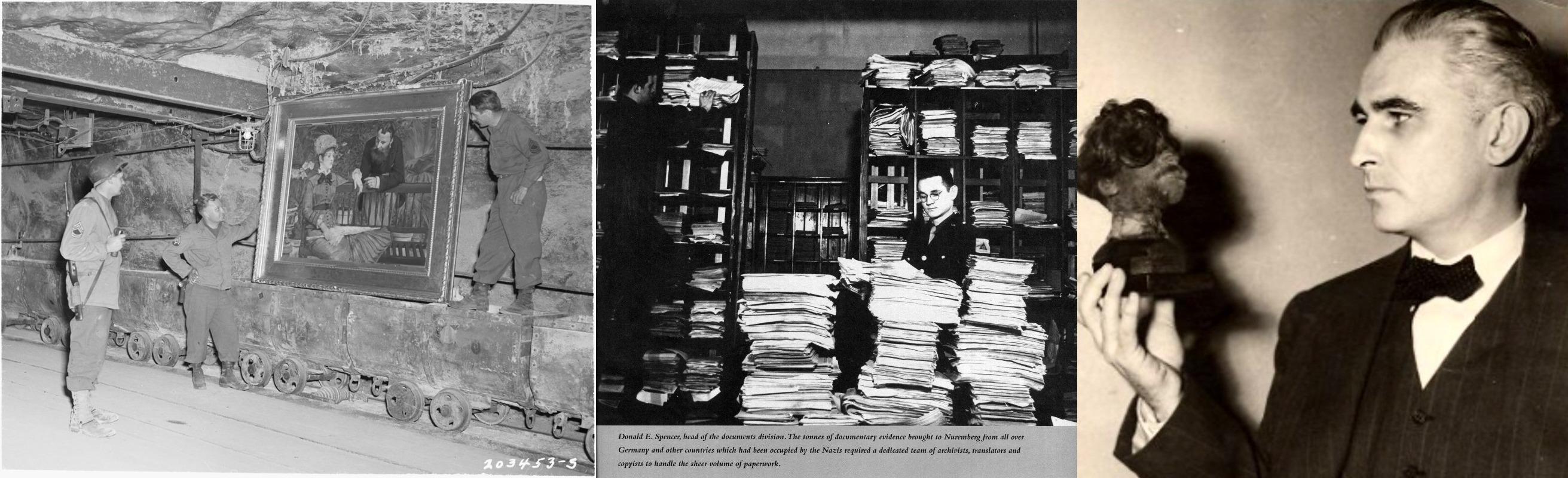
1: This photograph shows U.S. Army soldiers with Édouard Manet's 1879 painting In the Conservatory (also known as The Winter Garden or Dans la serre) inside a salt mine in Merkers, Germany, on April 25, 1945.

3: Executive Trial Counsel for the United States, Thomas Dodd, with Shrunken Head Exhibit. Dec. 1945, Nuremberg


r/WW2HolocaustHistory • • 11h ago

November 23, 1939 Holocaust: The Introduction of the Star Badge for Polish Jews

Post image
21 Upvotes

"Without It You Were Not Allowed to Go Out"

The despicable "Hans Frank, the Nazi Governor-General of occupied Poland, decreed that all Jews in Poland over the age of 10 were to wear a white badge with a blue Star of David on their right arm.

This continued until September 1941, when all Jews in occupied Europe over the age of six were required to wear a yellow Star of David.

The Nazi policy of forcing Jews to wear a star was an act of symbolization which aimed to divide the Jewish and non-Jewish population. Jews who failed to wear the star risked death, whilst Jews who did wear them were then more likely to become victims of antisemitic attacks and harassment.

As soon as the Germans entered Poland, they began to persecute the Jews. Jews were not permitted to practise their professions, they were not allowed to keep their shops open or walk on the pavement. They soon made us wear a yellow Star of David, pinned on the front and back of our clothes; without it you were not allowed to go out." https://www.hmd.org.uk/resource/23-november-1939-introduction-of-a-star-badge-for-polish-jews/

1938: Following the Kristallnacht pogroms in November 1938, Reinhard Heydrich first proposed forcing German Jews to wear an identifying badge in public. Inside concentration camps, prisoners were already forced to wear color-coded cloth triangles—with Jewish prisoners assigned a yellow Star of David.

1939: Weeks after invading Poland, local German military and civilian commanders began issuing unstandardized badge orders in specific towns (starting in Włocławek on October 29, 1939), requiring yellow patches, hats, or armbands under threat of death.

November 23, 1939: Hans Frank, Governor-General of occupied central Poland, issued the first sweeping regional decree. All Jews over the age of 10 were required to wear a white armband with a blue Star of David on their right sleeve in public. (In western Polish territories annexed directly into Germany, such as the Warthegau, authorities instead mandated yellow stars pinned to the chest and back, as described in Renee Salt's testimony.)

September 1, 1941 (taking effect September 19), Reinhard Heydrich ordered all Jews over age six in Germany, Alsace, Bohemia-Moravia, and annexed western Poland to wear a palm-sized yellow Star of David inscribed with Jude ("Jew") in faux-Hebrew lettering. Jews had to buy the badges themselves from Nazi-controlled Jewish councils and sew them onto the left breast of their outer garments. Simultaneously, German forces invading the Soviet Union imposed armbands or yellow patches across occupied eastern territories.

1942: Shortly before launching mass deportations to extermination camps, Nazi authorities extended the yellow star mandate to occupied Western Europe—introducing it in the Netherlands on April 29, 1942 (inscribed Jood), Belgium in May 1942 (Juif/Jood), and occupied northern France on June 7, 1942 (Juif).

1943–1944: As Germany occupied former allies—such as Hungary in March 1944—local authorities rapidly enforced the yellow star alongside ghettoization and deportations. Notably, the badge was never successfully enforced in Denmark (due to fierce resistance and the 1943 rescue of Danish Jews), Norway (where ID cards were stamped with a "J" instead), or Vichy (unoccupied southern) France.

By visibly marking Jewish citizens, the regime stripped away anonymity, enforced social ostracization, restricted movement (making curfews and travel bans easy to police), and streamlined roundups for deportation.

NOT MY LINKS

Holocaust survivor Renee Salt BEM describes wearing the yellow star: https://www.hmd.org.uk/resource/renee-salt/

1: Left: This photograph shows a young boy in German-occupied Poland holding white armbands marked with a Star of David, wearing one on his right sleeve. Right: An emaciated woman sells the compulsory Star of David armbands for Jews. In the background are concert posters; almost all are destroyed. Warsaw ghetto, Poland, September 19, 1941.

This photograph was taken by Heinrich Joest, a German army sergeant during WW2. On September 19, 1941, he took 140 images of every aspect of life and death in the Warsaw ghetto.


r/WW2HolocaustHistory • • 18h ago

November 23,1897 Birth: Karl Gebhardt, Malpractice Murderer & SS Chief Surgeon

Thumbnail
gallery
19 Upvotes

Architect of Rigged Camp Atrocities

November 23, 1897: Born in Haag in Oberbayern, Bavaria, Germany.

November 1923: Participates in Adolf Hitler’s failed Beer Hall Putsch as a member of the Freikorps Oberland.

May 1, 1933: Joins the Nazi Party (NSDAP), later entering the SS in 1935 and becoming Medical Superintendent of the Hohenlychen Sanatorium.

1936–1938: Serves as senior physician for the 1936 Summer Olympics before being appointed Heinrich Himmler’s personal physician in 1938 and Chief Surgeon of the Waffen-SS during WW2.

May–June 1942: Treats SS leader Reinhard Heydrich after an assassination attempt in Prague; Gebhardt’s refusal to use sulfonamide antibiotics contributes to Heydrich dying of sepsis on June 4.

1942–1944: To vindicate his medical ego and prove sulfa drugs useless, he coordinates horrific surgical experiments on prisoners at Ravensbrück and Auschwitz—deliberately breaking their legs, infecting wounds with gas gangrene, withholding care, and attempting limb transplants.

December 9, 1946: Placed on trial as a primary defendant in the Nuremberg Doctors' Trial (American Military Tribunal No. I).

August 20, 1947: Convicted of war crimes, crimes against humanity, and membership in a criminal organization; sentenced to death.

June 2, 1948: Executed by hanging at Landsberg Prison in Bavaria at age 50. VIDEO - The JUSTIFIED Execution Of Karl Gebhardt - Heinrich Himmler's Doctor - https://www.youtube.com/watch?v=DiqdjJXD4GE

NOT MY LINKS

WIKI BIO: https://en.wikipedia.org/wiki/Karl_Gebhardt

NOT MY LINKS

1: Left: The Nazi Doctors: Medical Killing And The Psychology Of Genocide, by Robert Jay Lifton - Review: Review Essay of The Nazi Doctors

Right: Photograph of Karl Gebhardt as a defendant in the Doctors' Trial at Nuremberg. Courtesy of the United States Holocaust Memorial Museum.

2: Karl Gebhardt execution