r/WarCollege • • 13h ago

Question Is it true that operating inside a T-34 tank was extremely uncomfortable?

Post image
129 Upvotes

I've heard how T-34 tanks are extremely cramped even by Tank Standards, trying to operate the tank is physically exhausting to like a guy needing to hammer a lever to get it a higher gear or something?

I'm curious to hear what the actual comfort and how hard it is to be inside the t-34 and do normal tank things as I'm not really as into WW2 Tank stuff as much as you guys are.


r/WarCollege • • 19h ago

To Read I just want to thank everyone who has helped me during this journey, It started as a very basic map/pen/paper and a ruler idea and now has grown into something very different. It is a gift that I have had to ask for your help and I really appreciate it so much. So thank you all, you guys rock!

Thumbnail
wearethemighty.com
59 Upvotes

Thank you for answering all my Artillery related questions and weird and wonderful questions that I came up with as a civilian trying to understand a very complex but fascinating part of the military.

So again, thank you to all those who have helped me on the quest.


r/WarCollege • • 18h ago

Question What is the advantage of using shotguns instead of SMGs in WW2 (Pacific)?

48 Upvotes

The US used Winchester Model 1897 and 1912 shotguns in both the trenches of WW1 and the Pacific jungles of WW2. Now in WW1, i can understand that something like a pump action shotgun, with its ability to rapid fire a wide scatter of shot relatively quickly, would be very useful in a close quarters situation, when the concept of a SMG didnt exist yet (not counting the MP18 ofcourse). However, can someone explain to me, what was the reason to continue using it in WW2. From what i read, they were used in dense jungle environments where it was hard to spot the japanese hiding, and ambushes were a real problem. However, to me (and my inexperienced mind) that sounds like a job that a Thompson or Grease Gun would do just fine. Is 20/30 rounds of fully automatic .45 ACP really inferior to 5 shells of 12 gauge?


r/WarCollege • • 10h ago

Question Has the War in Ukraine led to any new demand for landmine production or development?

11 Upvotes

A few years back, when large-scale armor warfare was still present un Ukraine, there was a lot of talk about the utility of landmines. Not just that, but AT mines in particular were also being used as munitions for drones, UGVs, and infantry outside of its intended purpose. I believe the Israelis repurposed their AT mines for demolition of structures and tunnels in their recent wars. While there is talk of there still not being enough artillery shells and interceptors; what is the situation with landmines? How have various armies reexamined the landmine and their place in their arsenal?


r/WarCollege • • 8h ago

In terms of gun-based air defense (including machine guns, autocannons, and ground/naval-based cannonry), what would the preferred targets of something like a GPMG up to a 127mm naval cannon in terms of what they should be/want to be shooting down when used in the AD task today?

4 Upvotes

I'm aware that air defense now is mostly a missile affair since they're more reliable against much bigger threats like surface-targeting missiles, but as of recently gun-based air defense is making a comeback since cheap drones and guided munitions are stressing missile stockpiles. That being said, I also heard talk of issues with gun-based AD having its own issues with magazine depth with CIWS-style systems depleting ammunition faster than it can be restocked among other things, and that tools like machine guns or autocannons (manned or automated), as well as large-bore cannons are being used not only to minimize air attacks but cover each other, especially since said drones or cheap munitions are flying higher, and faster than before and can't be intercepted by all gun systems.

As of right now, what kind of preferred targets would different gun systems like the typical GPMG, HMG, autocannon, and larger-bore AA cannons (like the Otomatic 76 for example) be optimized for fighting against generally speaking?

Thank you in advance, and apologies in advance too if my question is worded strangely, but I am curious to see how air defense is handled in terms of preferred targets in the planning/use in combat today (if that's even a concept here).


r/WarCollege • • 22h ago

Question Why was only Czechoslovakia within the Warsaw Pact 'permitted' to produce so many different domestic military designs?

41 Upvotes

Was there any rulings in place to prevent, for instance, East-German engineers from making their own aircraft, artillery systems, rifles and tanks?

How come only Czechoslovakia made its own equipment (to some extent), such as their rifles (Vz. 58), artillery systems (152mm DANA), APCs (OT-64 SKOT), rocket artillery (RM-70), and jets (L-39).


r/WarCollege • • 6h ago

Literature Request Sourcing WWII-Era French 1st Army Literature and Documents

1 Upvotes

Hello all,

I'm currently looking to find any relevant literature or primary documents for French units that crossed the Rhine in 1945, such as the 3e DIA and the 2e DIM among others.

I'm struggling to find cheap unit histories, or generally accessible literature. Many of the great works are out of print and range in the hundreds, or even thousands of Euro/dollars.

I'm seeking any leads on older or contemporary literature. Not opposed to saving money with PDF recommendations as well.

I did find a great web resource recently that has helped me understand the force-organization of many of the composite colonial units: The Tirailleurs - Home For those curious, check out the link.

But I figured I'd throw a hail-Mary and see if this community has any leads.

I'm also aware that the French government has some online digitalized holdings, similar to the NARA archives in the US. But only a fraction of these primary sources are available and half of the time, the website is down for maintenance.

Thanks for your time


r/WarCollege • • 1d ago

Discussion 103 Field Battery fired in support of the Battle of Long Tan for three and a half hours on 18 August 1966, delivering 1,078 rounds. For the 6 gun battery that is 179.67 rounds over the 3.5 hours (210 minutes) so that becomes 0.856 rounds per minute (or about 1 round every 70 seconds).

Post image
290 Upvotes

So my questions are:

  1. Is this considered to be a "good" rate of fire?
  2. This number is well below the 3 RPM sustained ROF for the howitzer, what could be the reason for this?
  3. How many rounds per gun did a standard ANZAC Firebase in Vietnam hold?
  4. Across all 24 supporting guns at Nui Dat, 3,500 rounds were fired which is an average of 146 rounds per gun during the battle. Would this be considered a lot of fire for a 5 hour total engagement?
  5. In your experience (if your in the Artillery branch) how many rounds per min sustained would you be happy with?

r/WarCollege • • 19h ago

Question Verifiable sources regarding MACV-SOG?

2 Upvotes

I've known about MACV-SOG for a while, but recently I've tried to look deeper into them, and a lot of the information I've come across online seems pretty dramatic and/or unsubstantiated. My current university doesn't have a lot coverage on them either, especially ones that are in-depth. What are some good, actually verifiable sources on the unit and its activities during the Vietnam War?


r/WarCollege • • 1d ago

Question Why the URG-I?

Post image
187 Upvotes

My understanding is that the Special Operation Forces and Special Forces community have weapons like M4 SOPMOD kit and HK416 for the team to tailor the weapon for each mission. What does URG-I kit bring to the picture compared to them? Was it just the M-LOK? Couldn’t buying new rails for the M4 under the SOPMOD kit work out as well compared to buying a whole upper receiver?

What was the special operations community looking for when they decided to find something like URG-I?


r/WarCollege • • 1d ago

Tuesday Trivia Tuesday Trivia Thread - 24/11/26

2 Upvotes

Beep bop. As your new robotic overlord, I have designated this weekly space for you to engage in casual conversation while I plan a nuclear apocalypse.

In the Trivia Thread, moderation is relaxed, so you can finally:

  • Post mind-blowing military history trivia. Can you believe 300 is not an entirely accurate depiction of how the Spartans lived and fought?
  • Discuss hypotheticals and what-if's. A Warthog firing warthogs versus a Growler firing growlers, who would win? Could Hitler have done Sealion if he had a bazillion V-2's and hovertanks?
  • Discuss the latest news of invasions, diplomacy, insurgency etc without pesky 1 year rule.
  • Write an essay on why your favorite colour assault rifle or flavour energy drink would totally win WW3 or how aircraft carriers are really vulnerable and useless and battleships are the future.
  • Share what books/articles/movies related to military history you've been reading.
  • Advertisements for events, scholarships, projects or other military science/history related opportunities relevant to War College users. ALL OF THIS CONTENT MUST BE SUBMITTED FOR MOD REVIEW.

Basic rules about politeness and respect still apply.

Additionally, if you are looking for something new to read, check out the r/WarCollege reading list.


r/WarCollege • • 1d ago

What was the exact role of Civil Affairs units in the Iraq and Afghanistan wars?

23 Upvotes

r/WarCollege • • 1d ago

Question How long would a sniper be expected to be outside the wire for?

10 Upvotes

I understand their role today is mostly recon and rarely involves shooting someone. Are they expected to be camping in the bush for weeks at a time or shorter?


r/WarCollege • • 2d ago

Question How effective were land based heavy anti-aircraft guns (76mm+) in the 1970s and 1980s?

58 Upvotes

Even though SAMs emerged in the 1950s and 1960s, many less well funded militaries kept using land based AAA. But how effective actually were the KS-19 and KS-30 AAA guns in Vietnam, the Iran-Iraq War and various arab-israeli wars across the 70s and 80s, well after the USSR had retired them in the early 60s?


r/WarCollege • • 1d ago

Question Which military adapted the term "sniper" for a unit and or gun?

3 Upvotes

It doesn't matter which, just that it was the first and that it was officially adapted. So it wasn't like some guys calling each other snipers or a single guy being named it. Specifically a unit/gun.


r/WarCollege • • 2d ago

Question Can "stealth" anti-vehicle weapons exist in any way? A weapon meant to destroy an armored vehicle without revealing the position of the shooter and keep the enemy from forming a good response to hunt down the shooter and/or defend against the attack better?

44 Upvotes

I know that we have stealth anti-personnel weapons in the form of suppressed or low-noise firearms even to the heavy machine gun level (like suppressed .50 HMGs or even miniguns) for making the shooter harder to spot among other benefits, but can stealth anti-vehicle weapons exist that do something similar? Harming/destroying an armored vehicle that's harder to detect and defend against by hiding the shooter.

By "weapon," I don't mean something like a anti-tank mine (which can be hidden but can't really be used immediately, only just laying them out and hoping/waiting for someone to arrive) or a stealth bomber (which is a something that carries and uses weapons on targets in a way that allows them to be stealthy by association), but a weapon- like a projectile armament or a missile or rocket and the like- that a vehicle or person can equip and use against another vehicle that'll harm/destroy it but be less noticeable in doing so?


r/WarCollege • • 3d ago

Question Why did the Soviet (and subsequently Russia) really wanted a fleet of aircraft carriers despite their big geographical restraints?

78 Upvotes

Really just cant get this into my head. It seems like a big waste of money and resources to build a carrier fleet with their geographic restraint and issues.


r/WarCollege • • 2d ago

What is the bar to clear for "indigenous development"?

15 Upvotes

Back in college I was heavily involved with the war gaming scene around DC and while we spent hours analyzing different defense industries it was assumed all nations had some form of indigenous development. The US naval industry these days is essentially kept alive thanks to contracts and afaik most raw components are either sourced domestically or bought from allied nations. China developed the Type 56 after almost a decade and a half of different designs kicking around.

Lately I have become interested in the development of India's defense industry and it seems like the bar for what qualifies as "indigenous development" is extremely high. It strikes me as odd that a country with a long history and present of fostering engineering talent in a variety of disciplines can have design bureaus )to use the parlance I am used to) which can draft plans for a tank but not be able to actually build the thing domestically. To be fair a lot of countries have gone to the British or French or Germans to collaborate on projects, so I don't understand how there is all this discourse when discussing India as if every bolt has to come from a domestic factory.


r/WarCollege • • 3d ago

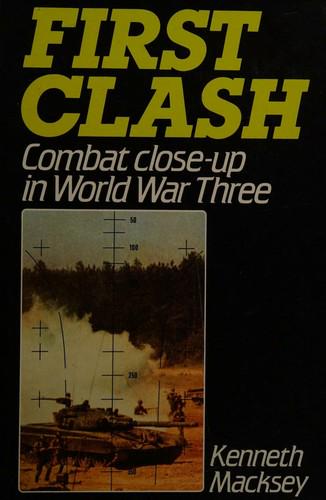
Reading Club r/WarCollege Reading Club - First Clash: Combat close-up in World War Three

32 Upvotes

Introduction

Hello everyone, and welcome to the third session of the r/WarCollege Reading Club. The purpose of the r/Warcollege Reading Club is to present books of topics relevant to the community, give anyone that wants to a chance to read them, and then a certain time later have a discussion on the book based around questions presented both when the book is announced and when the discussion post is posted. The time between when the book is presented and when the discussion will happen will vary from book to book to accommodate for length of the text, but we will announce when the discussion post will be so you will know ahead of time how long you have to finish the book.

Book - First Clash: Combat close-up in World War Three by Kenneth Macksey

Link to text

Questions

  1. In your own words, what was the book about?
  2. Are there any lessons you can take away from the reading?
  3. How well did the Canadian forces prepare for the Soviet attack?
  4. How important was terrain, positioning, and preparation to the outcome of the engagement?
  5. Are there any parts of the book that you think oversimplify war?
  6. Which do you think was more difficult for the Canadians, the defense or the withdrawal after conducting the defense?
  7. Though we only get snippets of their point of view, what is something(s) good or bad that the Soviets did that stood out to you?
  8. Was there anything the Canadians in the book did that you think is overoptimistic of how they would have actually preformed?
  9. What do you think of fictionists conflicts being used to teach lessons?
  10. This book was on the Commanding General of the Canadian Army's Reading List for 2025. The book is an account of a fictional conflict set 40 odd years in the past. What do you think the Commanding General intended by placing this book on his list?

This text is 211 pages of text. As such, I would say that three weeks is enough time to read it. The discussion post for this will be posted at 0700 PST/1000 EST/1500 GMT on Monday, 14 December. Save all answers to the above reading questions until that time.

If you have any questions or clarifications, please do not hesitate to ask.


r/WarCollege • • 2d ago

Question Did the USN ever give much thought to making a combination of submarine-launched ballistic missiles and ballistic missile submarines that could reach targets in the Soviet Union and other targets from patrols positioned in the opposite hemisphere?

11 Upvotes

The Earth is about 40,000 kilometers in circumference, meaning a ballistic missile with a range of around 20,000 kilometers could reach any target from any firing point. But the longest range SLBM the USN fielded "only" had a range of about 12,500 kilometers. This precludes, say, patrolling the South Atlantic and South Pacific and still being able to launch warheads at Moscow without sailing great distances to get in range.

Having the range to reach across half the Earth's circumference maximizes the search area that must be covered to hunt down each and every USN ballistic missile submarine before it launches, giving them more safety margin against the Soviet Navy regardless of how the Soviets decided to expand or improve it. And it seems like such a missile and submarine to carry it could also be loaded up with many more warheads and reentry vehicles for counterforce missions at closer range if the USN felt confident in protecting its submarine from Soviet anti-submarine warfare operations or felt that the risk was worth it.

As a bonus, such a missile and submarine pair would be more or less at the maximum useful size for its purpose, rendering them capable of accommodating plenty of retrofits and having the hull and missile (designs) be the basis for future blocks with improved capability, rather than having to be outright replaced as a class of boats and/or a series of missiles if range requirements ever needed to grow.


r/WarCollege • • 3d ago

Question Why do assualt rifles maintain full auto capabilities if they are so rarely used in combat?

209 Upvotes

r/WarCollege • • 2d ago

If the Confederate army was soundly defeated in the west in 1862 what caused them to remain undefeated until 1865?

Thumbnail
youtu.be
0 Upvotes

I'm currently watching YouTube channel Kings and Generals 'The American Civil War'

By 1862 the Texas detachment sent to rally Arizona and capture California was starved out on their march in the desert and stragglers returned to San Antonio defeated and outnumbered.

Around Memphis and Nashville Grant is winning victory afte victory. Jefferson Davis famously stated after General Johnston was mortally wounded at Shiloh "the West is lost"

In WWII if an army was severely defeated and outflanked the nation would lose the war. Think Bagration where one of the German armies was destroyed and a large gap was created in the line. It was a disaster for them.

But somehow, despite the western theater "lost" in the words of Mr. Davis the Confederacy continued to fight and the Union army did not complete an encirclement of the Army of Northern Virginia.

Is it a logistical problem? Lack of manpower?


r/WarCollege • • 3d ago

Question Information, literature, or any other media on training within the PLA.

14 Upvotes

I was doing some digging on this topic and came across this post asking essentially the same question, which had a seemingly well informed answer and mentioned the the book "The "People" in the PLA: Recruitment, Training, and Education in China's Military," which is a collection of essays by various authors on the topic. Although a seemingly good read, it is from 2008 which makes it nearly two decades old at this point. As such, I was wondering if anyone had any more up to date information on the topic.

Further, that answer discussed the "informalization" of the PLA, and how often most training is conducted at a brigade level through competitive decentralized simulation and exercises rather than traditional coursework and instruction. He states that there is no standardization for training and exercises, instead they are developed and innovated on at a unit level, then adopted by other units. For example, highlighting that the Nanjing Armored Brigade was the first to establish a brigade level OPFOR which is widely used. This is very surprising considering the stereotype of a top heavy and doctrine focused force rather than one emphasizing independent decision making and on-the-job learning.

As I said I'm very surprised by this as it essentially directly opposes the stereotype of the PLA and thus would love to know more, but some specific questions that spring to mind are: Is this the case across all branches of the PLA? How are training and exercises evaluated? How are scenarios and training requirements decided, is it at a brigade level or are there things emphasized form higher up? Any information is greatly appreciated.


r/WarCollege • • 4d ago

Question What are the pros and cons of allowing the army to operate its own oceangoing ships?

38 Upvotes

At one time, I believe the Imperial Japanese Army in WW2 operated their own submarines and their own class of warships called "Land Craft Carriers" that resemble modern Amphibious Assault Ships despite the existence of the Imperial Japanese Navy. In contemporary times, most armies are limited to transport or littoral vessels if they operate their own waterborne craft at all. But when it comes to how an army would benefit from having its own organic assets at sea, what are the arguments in favor of it or against it?


r/WarCollege • • 4d ago

General Stanisław Sosabowski's command decisions on the ground during Arnhem

23 Upvotes

While popular history and A Bridge Too Far turned Sosabowski into an infallible prophet wronged by British snobbery, and Browning* did, in fact, throw him under the bus post-battle, leading to Sosabowski's dismissal in December was his actal leadership in the battle really effective? My own gut feeling is that he was dealt a bad hand, but he played it poorly anyway.

Consider.

Failure to Immediately Seize the Heveadorp Ferry; when they landed, it as still intact and lightly guarded; if they had made haste as their order demanded, they could have taken it and helped Urquhart.

Once ferry was lost he made no real effort to try and improvise and cross, instead waiting for XXX Corp to bring up boats, while when they actually linked up with 43rd Division he was rather prickly and uncooperative; I think only a quarter of his brigade (in reality, a reinforced battalion) managed to cross.

So he seems to have had very good operational foresight but tactically, iffy.

*As an aside some of the biggest critiques about Browning in Cornilius Ryan's book and subsequent movie were unfair; he did in fact, take the presence of the German armored divisions seriously enough to ask both Monty and Brereton about risks, and the argued for landing at the bridge directly, which USAAF and RAF flatly refused, leading to the famous Bridge too far " comment, which came before, not after, the battle. The novelist Daphne Du Maurier collected a lot of his papers post-1977, planning to write a biography of him for some reason (/sarcasm) but died before she could,