r/casualconlang • • 1h ago

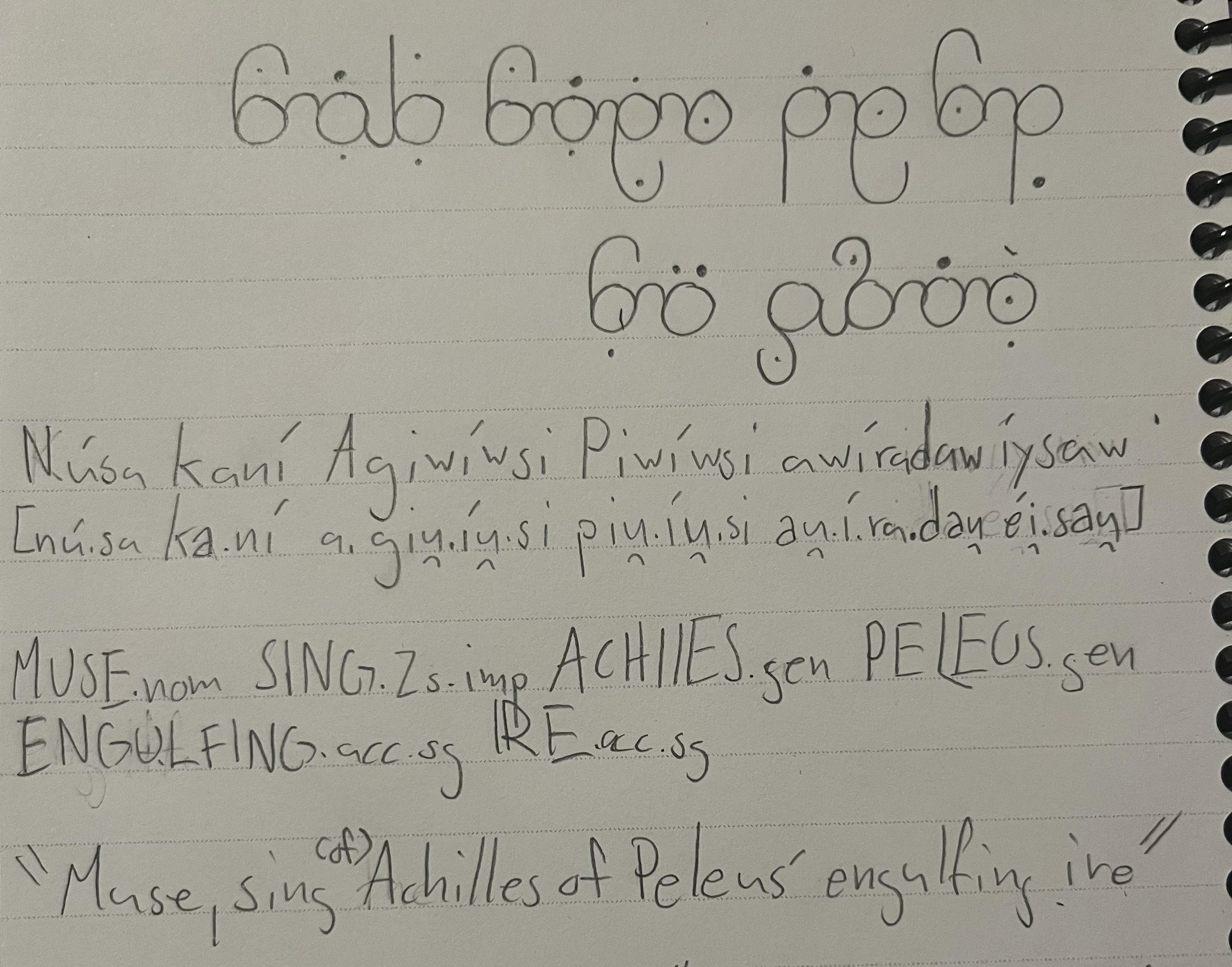
Translation First line of the Iliad in Káduw

Post image
3 Upvotes

The first line of the Iliad in Káduw using dactyl hexameter, written in the Káduw and Latin script

Latin script for clear read:

”Núsa kaní Agiwíwsi Piwíwsi awíradaw íysaw”

[nú.sa ka.ní a.ɡiu̯.íu̯.si piu̯.íu.si au.í.ra.dau̯ éi.sau̯]

MUSE.nom SING.2s.imp ACHILLES.gen PELEUS.gen ENGULFING.acc.sg.fem IRE.acc.sg.fem

”Muse, sing of Achilles of Peleus’ engulfing ire”

Etymologies:

núsa – borrowed from Ancient Greek (AG) Μοῦσα

kaní – from Proto-Indo-European (PIE) *keh₂n-

Agiwíwsi – borrowed from AG Ἀχιλλεύς

Piwíwsi – borrowed from AG Πηλεύς

awíradaw – from PIE *h₂wer-

íysaw – from PIE *h₁eys-


r/casualconlang • • 3h ago

Beginner/Casual How to have fun while working on your conlang?

3 Upvotes

This is kind of a genuine question bc most of the time when I work on my conlang is when I am bored out of my mind,but if I work on it for more than short periods of time I get bored of it too. I think it also kills me the fact I ma not really creative and kinda slow(the opposite of spontaneous) so I can't really think of new ideas to add to my conlang since I barely created my personal subjective pronouns and conjugated a slight irregular verb. What do y'all do to focus on your conlang and have ideas to implement or develop it?


r/casualconlang • • 6h ago

Translation The Lord's Prayer in Neo-Etruscan

7 Upvotes

Here is a cute little translation excercise I made for my Neo-Etruscan conlang. I tried to translate the Lord's Prayer into Neo-Etruscan, using the Koine Greek text as a source.

APAMAR (Neo-Etruscan)LORD'S PRAYER (English)
Apamar, ipa ame celerthi, śanti unu ama fechalan, ara ricimalan, unu ama vulalan, ich celthi ecac tularthi. Turmur un tinca faśemer tinina, mlacinmarc un revemer, ich emr ce mlacine reuśvalemer. Einc minu thuch un temptaziunthi, fu minu mutin un thapals. Amen.Our Father, who art in heaven, hallowed be thy name; thy kingdom come, thy will be done, on earth as it is in heaven. Give us this day our daily bread, and forgive us our trespasses, as we forgive those who trespass against us; and lead us not into temptation, but deliver us from evil. Amen.

Note that the original Greek text has some slight differences from the English translation, so the words in Neo-Etruscan don't always exactly match their English counterparts. Because of this, the English text is just to be taken as a broad reference, not as a word by word translation of the Neo-Etruscan one.

Let me know whether you'd like a more in detail translation of the Neo-Etruscan text.


r/casualconlang • • 12h ago

Overview Holiday Commemoration Familial Reunion:

Post image
2 Upvotes

r/IdiomNeutral , r/Ido , r/LatinoSineFlexione , r/Interlingue , r/Novial , r/Interlingua , r/Glosa , r/LinguaFrancaNova ( r/Elefen ) & r/Neolatino Romance are mutually comprehensible naturalistic auxiliary planned languages that resemble Latinic dialects cause they utilize le Portugaliañolish (Português + Galego + Italiano + Español + English) international vocabulary for maximized immediate intercomprehension & maximized cosmopolitic communication.


r/casualconlang • • 1d ago

Beginner/Casual A Wordin’ In Me First Made Tounge.

Post image
11 Upvotes

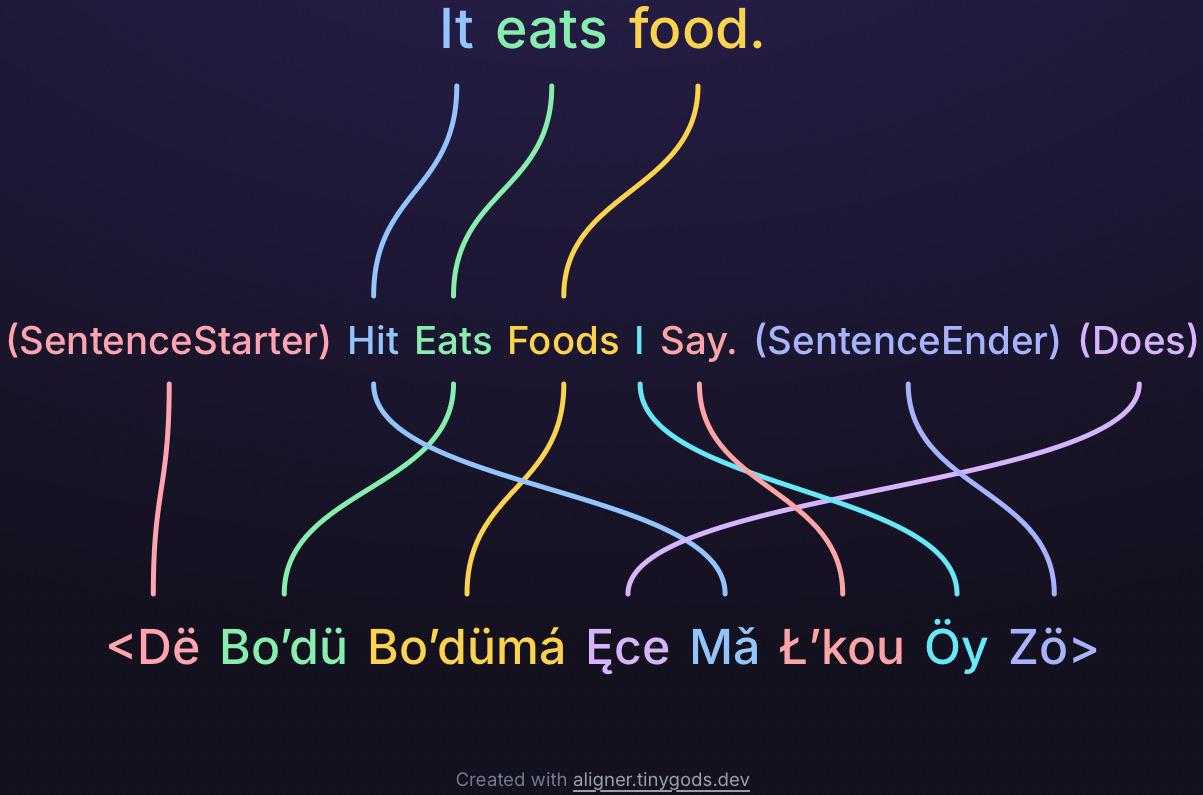
Top Be Modern English, Middle Beith Coffyk English Uns Bottom Be (Anglo-Latin) HylLisc. (‘Does’ Bein Parentheses To Show The Word Ain’t There But Was The Word Translates To)


r/casualconlang • • 1d ago

Translation My first conlang, be nice

Thumbnail
gallery
36 Upvotes

Pronunciation because I forgot to include it in the photos

/fɛn jɛk tɛn ˈlɔksən ɡɔn ɛm had jɛk ˈbrʏnə ei̯fs/

/fɛn mɛr dɛ lɔks fœr hei̯t had jɛk ˈbrʏnə ei̯fs/

/dei̯r vaz nat dɛt dɛn dɔn hei̯t bei̯ dɔm ˈlɔksən/

/dɛn dei̯ farf fan myə̯m ˈei̯vər bəˈʃei̯rd hei̯t/

Also "ten" should've been "te'n". This shortening is optional though it can also be "te den"


r/casualconlang • • 1d ago

Grammar Relative pronouns in my conlang

1 Upvotes

https://youtu.be/jTMnl5DDNO4?si=6FXD-1ffsVFgtIvK

Use of umik

Umik is a relative pronoun which is used to relate two things that are not identical. For example 😄

The woman who carries the bag is my mother. The book, which was in my bag, is lost Here the word 'who,which' is relating the concepts so these are relative pronoun. In Bonumuk there is only one relative pronoun that is 'umik' Let's translate above sentences: Onet umik kepenset tengentiji o momemen dem. The woman who carries the bag is my mother. (Tengust = to carry) (Kepenset = bag) Janliket umik mokepensetete deji, deraserj. The book, which was in my bag, is lost. (Aserjust = to lose) One who speaks is called a speaker. Umik mukentij pongis mukenet. (Pongis = is/are called) (Note : umik is used as the word ' which, who, one who, whom' as relative pronouns) 140Umik can sometimes be used as a relative pronoun as English 'that' Pedenset umik tu mide donemuj o bonu dem. The book that you gave me is good. Umik can be used with different interrogative words and nouns to make new expressions such as : Umikenet : whoever / anyone who Umikkekem : whichever / whatever Umikenet etesigete anentij, ode e kurusiyete setulelep vedemef. Tell whoever comes inside to sit on this chair. Umikkekem desemij ode lenemase. You can take whatever you want.


r/casualconlang • • 1d ago

Resource Introducing Langscape: The ultimate Conlanger's toolkit in Obsidian

5 Upvotes

Hello!

I'm a third year university student majoring in Computer science and Linguistics, and I thought it would be cool to make a project at the intersection of the two.

Langscape is a completely free and open source Obsidian plugin I've been developing that brings together several useful tools and features for us conlangers to document our languages:

  • Use custom fonts (including your own writing systems) directly in your notes
  • Direct Lexurgy (credit to u/meamoria) integration, with a full text editor, syntax highlighting, tracing, etc
  • Automations to batch-apply your sound changes to notes from one folder and funnel the output to another folder
  • Insert and edit syntax trees directly in your notes

etc etc. If you want more details check out the website or the github.

I briefly want to talk about why I think something like Langscape needs to exist. There have been many attempts before at a unified "Conlang editor", but I think all of them fall short for one reason:

Vendor Lock-in.

Whether its a web app or a desktop app, basically every conlanging software I can think of uses proprietary file formats that make it impossible to migrate or move your languages somewhere else. Conlanging is especially unique in that there are plenty of tools and file types that people need (spreadsheets/tables, sound change appliers, tree generators, dictionaries, font software), and everyone has a different workflow. Vendor lock-in and proprietary formats/software goes against all of this, so most conlangers end up just storing their languages in giant folders with various filetypes, using a mishmash of software to edit things.

Langscape tries not to lock you into anything. Obsidian is a markdown editor, just a fancy text editor essentially. Anyone can make a plugin that lets obsidian support editing literally any filetype you want, so I figured its ideal for conlangers who need to edit all sorts of file types.

What I like about obsidian is that everything lives on your computer, your vault is literally just a folder on your drive, you own it. Langscape is built on that foundation.

Finally, with the rise of AI in software, all sorts of open source projects are suddenly getting bombarded with community contributions, often low effort slop. Since this is a plugin that I am personally using to document my own conlangs, I have a vested interest in maintaining it and ensuring it doesn't become too bloated with superglued features or start feeling clunky, so I will be very hesitant to accept most community pull requests. The community is always free to fork the repo of course.

That said, I do have many planned features I will add to Langscape soon enough. Might mention some in the comments.

If you want to support the project, the best way to help is by giving Langscape a star on github so that I can land an internship this summer 🙏

If you want to support the project financially, feel free to buy me a coffee, optional of course.

Enjoy the plugin, thanks for reading :)


r/casualconlang • • 1d ago

Beginner/Casual Video twelve for my Conlang and Worldbuilding

Thumbnail
youtu.be
2 Upvotes

Hello Friend, my name is Ioni, this is my twelfth video, I talk about the doa magic in Ada (my conlang), follow me if you like my video.

Ika Esu, nomo’o Ioni, lubio’o onito sino toso, Ioni keti puari miago doa ina Ada, uto sekuo Ioni osi uto auva lubio'o.


r/casualconlang • • 2d ago

Writing System The Queen Bee and Jupiter: Aesop's Fables in Filipino Written in Yugo

Thumbnail gallery
5 Upvotes

r/casualconlang • • 2d ago

Overview More complex than Ithkuil? Yonmyon

Thumbnail
gallery
4 Upvotes

I didn’t set out to make my language overly complex for the sake of it—it just naturally turned out the way it is. In previous posts, I’ve talked about Yonmyon’s grammar and how my conlang’s tri-script writing system interacts syntactically and morphologically within a sentence. Yonmyon was created as an artlang meant to reflect a different mode of thinking, and I’d love to hear some independent opinions on it. Right off the bat, I’ll say that Yonmyon and Ithkuil are complex in their own ways, though personally, I feel that once I finish Yonmyon’s grammar, it could rival—or even surpass—Ithkuil’s grammatical complexity.
First, an overview: how does the grammar work?
In Ithkuil, there are only two or three parts of speech (formatives and adjuncts, plus referentials in New Ithkuil)—words are formed dynamically using semantic roots and case/morphological affixes. Its difficulty lies in constructing words on the fly during speech, which is notoriously hard. In natural languages, words already exist as established lexical items; you don't have to invent them mid-sentence.
So, what makes Yonmyon unique? It has 12 primary parts of speech, three of which—nouns, verbs, and adjectives—act as base classes from which 10 additional derived parts of speech are formed. The complexity comes from the fact that every single part of speech has its own distinct paradigm rules: ranging from numerals with independent case forms that must be memorized via tables, to uninflected concepts that always appear in their dictionary form. Moreover, all of these parts of speech are defined purely semantically. On top of that, Yonmyon is full of exceptions, so simply memorizing a rule isn't enough—to speak it comfortably, you have to know the rule along with all its edge cases and nuances.
Phonology: I think my tongue’s bones just broke—if tongues even have bones…
We all know that Ithkuil packs in a ton of brutal sounds collected from every corner of our green planet. Your tongue definitely won't thank you if you try to speak Ithkuil regularly—its phonology is sheer torture. And here I'm talking about the new Ithkuil (Version 4), where John Quijada had mercy on us and left "only" 31 consonants and 9 vowels. The original version had 65 consonants and 17 vowels, so the new one is actually somewhat manageable.
So, what could possibly be that hard in Yonmyon? I can't boast a massive inventory of clicks or gutturals. Sure, I have things like the French R /ʁ/, the Mandarin sh /ʂ/, and a phonemic distinction between a "light" European /l/ and a velarized Russian-like /ɫ/, but I didn't cram in tons of impossible consonants. In fact, I'm a big advocate for vowels—why are vowels always so oppressed in languages? Looking at you in particular, Semitic languages! I’ve got /y/ (u-umlaut), /ø/ (o-umlaut), all kinds of diphthongs, and triphthongs too. Still, that’s not even the hardest part. What’s truly difficult in Yonmyon is pronouncing all 12 tones (low, high, falling-rising, rising-falling, low-high, glottalized/creaky, and others). On top of that, my words aren't monosyllabic, and they have lexical stress too. Honestly, I could pronounce Ithkuil—slowly, at least. My own language? I still can't fully pronounce it myself.
Semantics, lexicon, and all that jazz…
Ithkuil was deliberately engineered to convey precise information with maximum efficiency. Whether you want to or not, you’re forced to pack extra grammatical details into every utterance because the grammar demands it. Meanings are heavily compressed inside a single word, which means you don't have to memorize thousands upon thousands of separate lexical items—you just need to know the affixation rules and the core semantic roots. For example, from a single root for "temperature," you can derive "ice cream," "coldness," "warmth," and so on.
In Yonmyon, things work a bit differently. Since it’s meant to feel more like a living language, it has distinct root words for closely related concepts. On top of that, I have words designed to capture specific situations, emotions, or entire little stories within a single lexical item—much like the Yaghan word mamihlapinatapai, which describes a look shared by two people, each wishing that the other would initiate something they both desire but which neither wants to begin. I’ve already coined one such word in Yonmyon meaning "the first person (I / the ego) walking sadly in the rain with a strange, uncanny feeling." To me, concepts like these—even if they are irregular—can capture experiences without a rigid analytical structure, operating on a subconscious level without needing to spell everything out. Of course, I also have simpler everyday words, like a single verb for "to ride a train" or "to splash water."
A squiggle, a dot, and then a curlicue! Or: the writing system
Depending on which version of Ithkuil we’re looking at, its writing system varies. If we stick to the Romanization, it’s fairly straightforward once you learn the unfamiliar diacritics and symbols. If we look at its native script (Iţkuîl), things get much more complicated. To be honest, I haven't fully mastered it myself yet, though I can say for sure that it’s remarkably precise and logical once you put in the effort to understand it.
Yonmyon combines a tri-script writing system, a structural concept I borrowed from Japanese:

  • Yokomo (Йокомо) or Yokoyama (Йокояма) is used for core meanings. These are unique semantic ideographs that have almost no connection to pronunciation—all grammar is reflected through external visual modifications of the ideographs themselves. Semantically related words might look similar, or they might not at all (meaning related words can sound similar, which makes sense, yet look completely different). However, you can’t tell how a character is pronounced without Kuohao (Куохао)—a Romanization system inspired by Pinyin. Overall, this logographic system takes inspiration from Chinese characters.
  • Xiangxin (Сянсин) is a syllabary used for temporarily transcribing loanwords until a dedicated ideograph is coined for them. When designing it, I looked to Japanese Hiragana and Katakana.
  • Pyonmun (Пёнмун) is the third script, consisting of individual letters arranged into Kandzyo (Кандзё) syllabic blocks, used specifically for proper nouns. It was inspired by Korean Hangul, except unlike Hangul, Pyonmun isn't restricted to a maximum of three letters per syllable—letters still stack into syllabic blocks, just with slightly different structural rules.

Yonmyon also features dialectal spelling variations, though this aspect isn’t heavily developed yet—fleshing out full dialects is more of a future project for me.
Learning all three systems—and how they interact within a single sentence—is pretty tough. Pyonmun is fairly easy to pick up, Xiangxin is somewhere in the middle, while Yokomo (or Yokoyama) is genuinely hard. Dozens of completely distinct, non-compositional ideographs, each with its own paradigm (okay, not literally every single one—that’s mostly a figure of speech, hehe), definitely aren’t for the faint of heart.
Example Sentence (Slide 6)
To give you a taste of how Yonmyon looks and sounds in practice, check out the example sentence on Slide 6. (Note: tones are omitted in the phonetic transcription below). The sentence is taken from the Russian National Corpus (found by searching for the word "arch"):

  • Phonetic transcription: /ˈjal motoˈlosʲ toŋkolɛtuˈnokbuj ˈtowowtɛ bumbukˈsoblʲ toŋkonʲˈtɕɛ ˈtiʁoŋtɕɛ ˈotsɨ/
  • Translation: "For most climbing plants, bamboo sticks, trellises, and arches will work."

So, what’s the verdict?
I think Yonmyon might—almost unintentionally—surpass Ithkuil in complexity, though in a very different category. Looking at its grammar (which is still a work in progress), it’s definitely complex, though it’s best judged from an outside perspective. While Ithkuil is difficult because of its massive set of rigid, exception-free rules and matrix-like word construction, Yonmyon goes to the opposite extreme. It also has a huge number of rules, except they aren’t always linear—they’re full of exceptions, and sometimes you can’t just rely on "in case X, do Y; in case A, do B." Instead, you have to develop an intuitive feel for the language, which sounds easy in theory, even though in practice it’s anything but.
Anyway, what do you think? Can Ithkuil and Yonmyon really be compared directly, or do they sit in completely different realms of complexity? Drop your thoughts in the comments—I’d love to hear some independent perspectives!
P.S. I originally wanted to add a poll to this post, but Reddit wouldn't let me include both images and a poll at the same time—so feel free to drop your "vote" in the comments instead!

r/casualconlang • • 2d ago

Activity Day 3 \ If your country existed on this earth, what and where would it speak?

Post image
35 Upvotes

r/casualconlang • • 2d ago

Grammar A sentence in Asenoan

3 Upvotes

“Nemsat pasenè, et namasata hrazos hupòn”

[wind-ABS.PST] [blow-3M.PRF] [CONJ] [ocean wave-ABS.PST.PLR] [fall to-3M.PRF] [gravely substance-ALL]

“The wind blew, and the waves crashed onto the sand”

I’ll note that tense is causal in practice, but signifies specifically where the noun is at the time of speaking


r/casualconlang • • 3d ago

Translation Bored once again, here’s a random thing in Ultranian.

Thumbnail
gallery
8 Upvotes

Feed your local woodhuntress to the gods, they’ll like it.

Ta-hahsut far-laxxasuku bi-gbid bi’alahkpi’i, ya-matuxusu.

/.tahahsut farlaxxasuku big͡bid biʔalahˈk͡pi.ʔi .yamatuˈxu.su/
eat\2SG.ANIM.CAUS wood-hunt\AGT.PROF-NOM.ANIM.SG-POSS.2SG.ANIM LOC-land LOC-god-ACC.DIVINE.PL like\3PL-OBJ.3SG.ANIM

Feed your local woodhuntress… what? Are you okay?

Ta-hahsut far-laxxasuku bi-gbid… muza? Ta-maru?

/.tahahsut {dim farlaxxasuku big͡bid dim**}** ‖ ˈmu.za↗ .taˈma.ru↗/
eat\2SG.ANIM.CAUS wood-hunt\AGT.PROF-NOM.ANIM.SG-POSS.2SG.ANIM LOC-land INTER-something healthy\2SG.ANIM


r/casualconlang • • 3d ago

Beginner/Casual Basic Colour Terms in Kádow

Thumbnail
gallery
30 Upvotes

Hello all, I’ve recently started the process of another (half-baked) conlang, and for the first time I’ve decided to actually try to tackle basic colour terms! Colour terms in linguistics as a whole has never been something I’ve truly understood, and I’m still not sure what I’ve made here makes perfect sense, but I thought it was finally time to actually attempt this

The Colours:

”ruwdú”, [rou̯.dú] — Red, from Proto-Indo European *h₁rowdʰós. Cognates include Proto-Celtic *roudos and its decendants (like Welsh ”rhudd”), Proto-Germanic *raudaz and its decendants (like English ”red”). There is also ”rusú”, from *h₁rewdʰtos (cognate to Latin ”russus”), but mainly refers to haircolour. All from PIE *h₁rewdʰ-

”kuwrú”, [kou̯.rú] — Yellow, from Proto-Indo-European ǵʰl̥h₃rós, from *ǵʰelh₃-. Cognate with Ancient Greek ”χλωρός”

”púygu”, [púi̯.gu] — Green, from the noun ”púyuw + ”–gu” (-y, -ic), from Proto-Indo-European bʰolyom, from *bʰleh₃-. Cognates include Latin ”folien” and Ancient Greek ”φύλλον”

”kuwsú”, [kou̯.sú] – Greenish-blueish(-bit-purpleish)-colour, from Proto-Indo-Euorpean *ǵʰl̥h₃stós, also from *ǵʰelh₃-. Cognate with Proto-Celtic *glastos and its decendants (like Welsh ”glas”. Kuwsú is not part of the traditional basic colours of Kádow, but will still eventually solidify into ”blue”


r/casualconlang • • 3d ago

Overview Conlang Showcase: Ulumitic

Thumbnail
youtu.be
10 Upvotes

One of my favorite languages to construct!!!


r/casualconlang • • 3d ago

Grammar Translation breakdown and procedure

Thumbnail
reddit.com
1 Upvotes

r/casualconlang • • 3d ago

Translation Something in やかーか゚

Post image
50 Upvotes

r/casualconlang • • 3d ago

Beginner/Casual Loving my causative-nominal rn.

8 Upvotes

This 'causative-nominal' I call, is a deverbal nominal suffix that creates a noun directly from the causative sense of the verb. The related noun is typically an agent.

It's a suffix, 'Vtt'. (V indicates a variety of vowels, doubled consonants indicate a preceding vowel vulnarable to syncope in my langauge's ortogrophy)

'Isitt' - Life, that which causes warmth

'Sevitt' - Venus, that which causes love


r/casualconlang • • 3d ago

Writing System Key of Yugo

Thumbnail gallery
2 Upvotes

r/casualconlang • • 4d ago

Activity Every 2 days I'll post a final map \ If your country existed on this earth, what and Where should it speak?

Post image
10 Upvotes

List of countries currently

UFONIAN (My clong)

Batwiks

Thetk

Lomacen

Mushroom language

Puppets/Vassal States currently

Ria Vono — Puppet of Lomacen


r/casualconlang • • 4d ago

Translation "We must uphold the bro code!" Djyþc Graffiti

Post image
2 Upvotes

r/casualconlang • • 4d ago

Grammar Verb conjugation in Bonumuk

1 Upvotes