r/islamichistory • u/HistoricalCarsFan • 4h ago
Pak Vigha Mosque in the small town of Kiranwala Syedain in the Punjab, Pakistan

22
Upvotes
r/islamichistory • u/AutoCentral • 12d ago

Listen here:
https://open.substack.com/pub/firelinepress/p/conquest-is-not-colonisation?r=1jdp1w&utm_medium=ios
ON 13 JULY 2026 the Jerusalem Post ran an opinion piece under the headline “Arabs, not Jews, are the real colonizers in the Middle East.”¹ The case runs the way it always runs. The Arab armies of the seventh century took North Africa, the Levant, Persia. They settled where they conquered. They put a tax on the people who were already there and did not convert, and over the centuries the older languages and the older faiths were pushed to the edges. That, the piece says, is colonisation — the real thing, the thing with a thirteen-hundred-year record. The Jewish return to the land is its opposite: not colonisation but the undoing of it. And the Palestinians, who object, are not a people with a grievance but a political construction assembled for the purpose of objecting. Then the conclusion, in four words.
“They are the colonizers.”
The piece gives no sources for any of its history. The argument depends on the reader already believing it.
The author is Aliza Pilichowski. The Post describes her as an interfaith hospice chaplain in Jerusalem and the mayor of Mitzpe Yeriho.
Mitzpe Yeriho is an illegal Israeli settlement. It was established in 1978 on the cliffs above Jericho, on the road down from Jerusalem to the Dead Sea.² Around 2,500 people lived there at the 2019 count.³ It stands on territory the International Court of Justice holds to be occupied, and its existence is the kind of act the Court found in July 2024 to be contrary to the Fourth Geneva Convention — the Convention Israel signed in 1949 and ratified in 1951.⁴ ⁵
So the argument that the Arabs are the real colonisers of the Middle East was published by the mayor of a settlement built on occupied land above an Arab city, in breach of a treaty her own government bound itself to seventy-five years ago.
But the argument is not hers alone. It circulates under every report from the West Bank, in the comment threads and the talking points and the opinion columns, and it runs like this. Muslims colonised half the known world, so they have no standing to complain about anyone else’s colonialism; and a Muslim who complains anyway has shown that the complaint was never about land.
The argument stands on one word, and the word is wrong. What the Muslims did was conquer, and colonialism is not conquest. Every empire conquered — Rome, Persia, the Arabs, the Turks — and a conquest takes a land and rules the people on it as its own. A colony keeps the people of the land it takes outside the country that took it, whatever the map says, and either works them or clears them off. The British ran colonies of both kinds, and so did the French. The Arab armies of the seventh century ran neither. They moved their capital into the land they had taken, so there was no outside to keep anyone from, and they kept the people where they found them, because the people were what they had conquered for. What Israel has done since 1948 takes the land and removes the people from it: seven hundred thousand in the first year, and it has not stopped. The obvious objection is that a fifth of Israel’s citizens are Arab, so the people were not removed. But they are the descendants of the one in five who remained in 1948, and the state they remained in has since written into its constitutional law that the country is not theirs. Remove most of a people, keep the remainder outside the nation that governs them, and put them to use: that is not conquest under another flag. It is colonialism twice over. The Knesset put it in writing in 2018.
And the word is theirs. Settler colonialism is not a slur that Israel’s enemies invented and pinned on it. It is the word the Zionist movement used for its own institutions — on its letterhead, in its company registrations, in the name of its own bank — in the decades when the word carried no shame at all. They used it first. And one of them, a century ago, wrote two articles explaining exactly what it meant.
They Named It First
The Jewish Colonization Association was founded in London on 11 September 1891.⁶ Baron Maurice de Hirsch put up the money — two million pounds, something over three hundred million today — and the charter’s object was to help Jews leave the countries that were persecuting them and settle on land somewhere else. Argentina, mostly, at first. Palestine was one destination among several.
Eight years later the Zionist movement built its bank. The Jewish Colonial Trust was incorporated under the English Companies Acts on 20 March 1899, with its office in London and an authorised capital of two million pounds in one-pound shares, the same sum again.⁷ It was not a private venture that happened to be run by Zionists. Its governing council was drawn from the movement’s own executive, the Greater Actions Committee; one of its members had to report to every Zionist Congress; and its policy was set by Congress resolution. The First Congress at Basel had proposed the bank. The Second had voted it through. In German it was the Jüdische Colonialbank. The memorandum of association, still catalogued in the National Library of Israel, carries the name on its title page.⁸
In 1924 Edmond de Rothschild reorganised his Palestine holdings into a separate body and called it the Palestine Jewish Colonization Association. It kept that name until it wound itself up in 1957.⁹
Then there is Herzl. In January 1902 he drafted a letter to Cecil Rhodes — the diamond magnate and former prime minister of the Cape Colony, whose chartered company had crossed South Africa’s northern border, the Limpopo, and taken the Ndebele and Shona lands beyond it, now Zimbabwe, by fraud and then by Maxim gun, and named them after him, Rhodesia — asking him to put his authority behind the Zionist plan, and explained in the letter why he was writing to Rhodes of all people. Because, he wrote, the matter was “something colonial.”¹⁰
And then there is Jabotinsky.
Ze’ev Jabotinsky published “The Iron Wall” in the Russian-language weekly Rassvet on 4 November 1923.¹¹ It is the founding text of Revisionist Zionism, the tradition that runs through Begin and Shamir to the Likud governments of the present day, and the word it uses for the enterprise, from beginning to end, is colonisation. One of its section headings is “All Natives Resist Colonists.” Its argument is that no native population anywhere has ever consented to being settled by newcomers; that the Arabs of Palestine are not confused or bribable but are behaving exactly as any people behaves; and that the enterprise must therefore proceed behind a wall of force the native population cannot breach, until resistance looks hopeless. “Zionist colonisation must either stop, or else proceed regardless of the native population.”
That alone would do. But a week later, on 11 November, he published a second article in the same paper.¹² He called it “The Ethics of the Iron Wall,” and in it he asked the question straight. Is it moral to colonise a country against the wishes of its native population? He granted that by that standard colonisation in Uganda was immoral too, and so was colonisation anywhere. And then he argued his exception: that the soil “does not belong to those who possess land in excess but to those who do not possess any,” and the Jews possessed none.
Hold what that means. A man who thought colonisation was a neutral term — a word for farming, for draining marshes — does not need to write a second article defending its ethics. Jabotinsky knew exactly what the word meant, knew it carried a moral charge in 1923, accepted the charge, and argued the case anyway. He did not use the word by accident. He used it because it was the right word, and then he explained why the thing it named was justified in this one case.
Israel’s defenders will tell you none of this counts. The Hebrew names of these institutions contain no colonial word at all. The Jewish Colonial Trust’s Hebrew title, printed on the same memorandum as the English one, is Otzar Hityashvut ha-Yehudim — the Fund for the Settlement of the Jews. The Palestine Jewish Colonization Association in Hebrew is the Society for Jewish Settlement in the Land of Israel. Hityashvut is settlement; it comes from the verb to sit, to dwell. The colonial word was for the outside — for the Companies Registry in London, for the bankers in Berlin, for Rhodes — and the movement’s own language said settlement from the first day.¹³
And “colonisation” itself meant something broader then. Its Latin root is cultivation. Through the nineteenth century it described organised farming settlement — the Prussian programme in Posen, the Dutch reclaiming land from the sea — and it stayed a technical word until the 1960s, when it came to mean domination and the focus moved from the land to the people on it.¹⁴
All of that is true, and it proves the opposite of what it is meant to prove.
If colonisation in 1899 was innocent — a word for ploughing and draining, fit for a bank’s letterhead in London — then nobody in 1899 had any reason to avoid it. And nobody did. The defence that the word was harmless is the proof that the word was usable. What the defence cannot answer is what happened to it afterwards. Why did a word innocent enough to put on a bank in 1899 become a word that could not be spoken by 1967? Nothing about the Hebrew changed. Hityashvut is still hityashvut. What changed was what the world had learned, in the years between, about what organised agricultural settlement does to the people already living on the land.
The word became unsayable. The habit behind it — one thing said to the world, another said at home — did not, and it still runs in two languages; only the direction has turned round. In 1899 the plain word went outward, to London and Berlin, because the people who approved of the project were the ones who ran colonies — governments that would be glad to see their Jews leave for one. Herzl had written it in his diary in 1895: “The anti-Semites will become our most dependable friends, the anti-Semitic countries our allies.” The soft word stayed home, for the Jews, most of whom wanted nothing to do with it; the First Zionist Congress had to be moved from Munich to Basel in 1897 because the city’s rabbis, Orthodox and Reform alike, refused to have it. Now the plain version stays home. On 29 September 2025 Netanyahu stood beside Trump at the White House and, in English, backed a twenty-point plan whose text said “Israel will not occupy or annex Gaza,” had the army “progressively hand over the Gaza territory it occupies,” and opened “a credible pathway to Palestinian self-determination and statehood.” That night he posted a video for Israelis, in Hebrew. The army “will remain in most of the Gaza Strip” — pull it out? “No way, that’s not happening.” A Palestinian state: “not at all, and it is not written in the agreement.” Same man, same day, same plan. In English, withdrawal and a pathway to a state. In Hebrew, no withdrawal and no state. The language is picked for the audience, exactly as it was in 1899, and the reason the plain version moved indoors is the reason the word did: the world had learned what it meant.¹⁵
The Charge Against the Arab and Islamic Empires
Here is the charge, in the words of the people who make it. Islam conquered from Spain to the Indus inside a century. Arab armies took North Africa, the Levant and Persia; the Muslim dynasties that followed took Anatolia and pushed deep into India, and most of it is Muslim still. They settled where they conquered. They taxed the people they found. They made Arabic the language of government and Islam the faith of the majority in lands that had been Christian, Zoroastrian and Hindu for centuries before they came. Egypt was a Christian country. North Africa was Augustine’s. In Iran, the Arabs broke the Sasanian Empire, the last great Persian state, and made its people take a new alphabet and a new god. The Persians were the native people of their own land and the Arabs colonised them, and thirteen centuries later the colonisation is still in force, because the regime in Tehran rules in the name of the religion the conquerors brought. The Iranians are the indigenous people. Islam is the occupation. No empire took more land from more peoples and kept it longer. The Muslims are the greatest colonisers the world has seen, and a Muslim who accuses Israel of colonialism is either ignorant of his own history or lying about it — and if he singles out Israel, of all the colonial projects on earth, the thing he objects to is not the colonialism.
That is the charge, and the Iranian form of it is the one running hardest at the moment. The people who make it believe it. They forget that Christianity did the same to those lands first, and to Europe after.
The conquests happened. The Arab armies went out from the Hijaz in the 630s and within a hundred years held territory from the Pyrenees to the Indus. The Muslim histories say so first and say so proudly. Nobody is denying a yard of it.
But the charge is not that Muslims conquered. If it were, it would be true and beside the point, because conquest is not the accusation levelled at Israel. The charge is that what the Muslims did was colonialism — the same thing, in the sense that matters, as what Israel is doing now. The first is a fact. The second has to be shown.
The charge is doing three things at once.
The first is a claim about history: that the conquests of the seventh century and Israel’s illegal settlements of the twenty-first are the same kind of operation. That is answered by looking at what each one did.
The second is the oldest move in logic. You did it too. Grant the history in full and the move still establishes nothing about what is being done in the West Bank now. It never has, in any court or any argument, for anyone.
The third is the payload. It takes a question about land — who holds it, how they came to hold it, what was done with the people on it — and turns it into a question about the person asking. A Muslim who raises the subject is no longer arguing about territory. They are revealing a motive, and the motive has a name: the charge is built so that a Muslim who raises Israel’s illegal settlements can be called an antisemite for raising them. And for that to work they have to carry, because they pray in the same direction as the men who took Damascus in 635, the guilt for their taking it.
What Colonialism Is
Colonialism, to most people who use the word, means the British and French empires. It means India under the Raj, and the Gold Coast, and Senegal, and Indochina: a European power ruling an African or Asian population from a capital thousands of miles away, taxing it, conscripting it, staffing a civil service over it, shipping home what the territory produced.
That kind is real, and the British in India are the model of it. The Crown took India from the East India Company in 1858 and ruled it from London for eighty-nine years.¹⁶ The British did not want India empty. They wanted it working. Dadabhai Naoroji, who sat in the Commons for Central Finsbury in the 1890s, spent decades counting what left India every year — the taxes raised there and spent in Britain, the salaries and pensions paid in England, the interest on the debt, the bill for the army — and put it at thirty million pounds a year.¹⁷ The figure is argued over. That there was a drain is not. The British needed every Indian in place, because the Indians were what was being drained. And in 1947 they left, because there was a Britain to go back to.
The French ran the same operation across West Africa and Indochina. From 1887 the Code de l’indigénat — the native code, first written for Algeria in 1881 — put the people of Senegal, and in time the whole of French West Africa, under a law written for them alone: summary punishment by the district officer, forced labour, a head tax, conscription into the tirailleurs, the colonial infantry, and the courts of French-appointed chiefs rather than the courts of France.¹⁸ It was written to make them work.
Colonialism of this kind ran two laws on one ground, one for its own citizens and one for the people it ruled. In India a European could not be tried by an Indian magistrate, and when the government moved in 1883 to change that, the British in India forced a compromise that let any European demand a jury half of whom were Europeans.¹⁹ In West Africa it was the native code.
It brought in machinery built to carry the wealth out. India’s railways ran from the cotton and wheat districts to the ports, and in French Equatorial Africa the Congo–Ocean line was built by forced labour to link the river traffic of the interior to an Atlantic port.²⁰
It took what it wanted for its own collections in London, Paris or other European capitals. The Koh-i-Noor, one of the largest cut diamonds in the world, went from Lahore to Queen Victoria by treaty the year the Punjab was annexed, the bronzes of Benin went to London after British troops burned the city in 1897, and the stone that unlocked Egypt’s writing is in the British Museum.²¹
And it refused the people citizenship while demanding everything citizenship demands. They paid the taxes, worked the forced labour and filled the armies — more than a million Indians served in the First World War — and got no vote and no seat in the parliament that sent them. All the duties of a citizen, none of the rights.²²
But both the British and French empires ran a second kind of colonialism as well, and the second kind did not want the people at all.
In 1788 the British landed at Sydney Cove and took the continent as land that belonged to no one — terra nullius, the lawyers called it afterwards — though somewhere between three hundred thousand and a million people were living on it. They were not taxed or ruled or put to work. The land was given to settlers, the people were pushed off whatever ground the settlers wanted, and the first national count, in 1901, found 93,000 of them left.²³ It took the High Court of Australia until 1992 to rule that the land had belonged to someone after all.²⁴ The French did the same thing in Algeria from 1830.
The British and French empires ran two kinds of colonialism. The first needed the people where they were, and kept them working for the profit of the empire. The second needed the land, and got the people off it to make room for its own settlers.
Patrick Wolfe, an English-born historian who worked in Australia, spent his career on the second kind, and his account of it is the one historians use.²⁵ The people on the land, in that kind, are not a resource but an obstacle, and the point of the enterprise is to get them off the ground so the newcomers can have it. “Territoriality,” Wolfe wrote, “is settler colonialism’s specific, irreducible element.” The natives are a problem because they “obstructed settlers’ access to land,” and the operation is built to solve that problem. “Settler colonizers come to stay: invasion is a structure not an event.” Settler colonialism “destroys to replace.”
That last phrase has a precise meaning. Settler colonialism is “inherently eliminatory,” Wolfe wrote, but not “invariably genocidal.” Elimination is the larger category. It includes killing, and often it has meant killing; but it also includes removal, enclosure, assimilation, the breaking up of communities, the slow administrative erasure of a people from the land they were on. The native need not be dead. The native need only be gone — or so changed that there is no native left to make a claim.
The test: does the system need the people, or need them gone?
Three questions carry it. Who got the land — the conquerors, or the people who were already farming it? Were the conquered kept on as subjects, with a place in the new order, or were they moved aside? And the newcomers: did they come to rule the existing population, to extract from it, or to replace it?
None of that requires anyone to pretend that conquest is gentle. An empire can tax a people into the ground and still need them there. A settler project can be built by decent people with lawful deeds and still need them gone. The test is not about cruelty. It is about what the operation is for.
Wolfe did not build this test for Israel. He built it on Australia and the United States, where he did his work, and only then applied it to Palestine, in the same article — Israel’s “progressive dispensing with its reliance on Palestinian labour,” he wrote in 2006, “would seem to present an ominous case in point” — and six years later in a full study of its own.²⁶
Islamic Expansion Was Not Colonialism
Every empire conquered. Rome did, and Byzantium, and the Sasanians the Arabs destroyed, and Tang China, and the Mongols, and the Ottomans after them. Conquest is taking territory by force and ruling the people on it. If conquest were colonialism the word would mean nothing, because it would describe the whole of recorded history before 1945 and most of it after.
Conquest differs from colonialism in what it does with what it takes.
A conquest annexes. The land becomes part of the conqueror’s country and the people on it become its subjects. Gaul became Roman, and in 212 every free inhabitant of the empire became a Roman citizen.²⁷ A colony is possessed. Its people are kept outside the country that holds it, whatever the map says.
And the people stay, because subjects are what a conquest is for. A conquest takes a population along with the land: it pays the tax, works the fields, staffs the administration, fills the army. The conquered are ruled, sometimes harshly. They are not removed, because removing them would leave the conqueror with nothing to rule. The exceptions are remembered as exceptions — Assyria marching whole peoples into exile, the Mongols emptying cities — because they are the cases where a conqueror destroyed what conquest exists to acquire.
Now set the Arab conquests beside the two kinds of colony. The Arab armies took Syria, Iraq, Egypt and Persia by force and ruled the people they found there. But within thirty years the seat of the empire had left Arabia for Damascus, and a century after that it moved to Baghdad, a city built for the purpose in the conquered farmland of Iraq.²⁸ It never went back, and Syria and Iraq became the country. The people stayed, neither worked for a distant capital nor cleared off the land. The Arab conquests were neither kind of colony.
Nor did they run two laws on one ground the way a colony did. Under the caliphate the second law was the people’s own. Christians, Jews and Zoroastrians were judged in their own courts, by their own bishops, rabbis and priests, in their own marriages, inheritances and disputes. And they served in the state itself. Sarjun ibn Mansur, a Christian, ran the treasury of Syria for five Umayyad caliphs, and his son, John of Damascus, served at their court before he became a monk.
The protection reached past the Bible’s peoples. Umar took the jizya from the Zoroastrians because the Prophet had, and in Sindh after 712 the Hindus were brought under the same terms. It was a people governed by their own law, not by a law written over them.²⁹
The Raj and the Arab conquests both kept the people in place, so the difference between them is not that one taxed and the other did not. It is what each was built to do. The colony was built to carry a country’s wealth out of it and to keep the people it took it from outside. Macaulay’s minute of 1835 set out to form “a class of persons, Indian in blood and colour, but English in taste, in opinions, in morals, and in intellect” — and those persons remained subjects of a country they could never join. The same minute held that “a single shelf of a good European library was worth the whole native literature of India and Arabia.” The colony ranked people by blood and colour, and wrote the ranking into its law: the native could be taught English, but could never become British.
The Arab conquest ran the other way. Most of its revenue was spent where it was raised. Its government ran in Greek and Persian for two generations before it ran in Arabic.
And its religion was not pressed on the conquered but held open to them as a door: convert, and the jizya ended, and the convert stood inside the ruling community. The Umayyad governors fought that door, because every convert was a taxpayer lost, and the caliph Umar II overruled them. A colony has no such door. A Syrian who became a Muslim stood inside the faith of the conquerors, and by its law the equal of any Arab Muslim, wherever they were born. An Indian who became an Anglican remained a native.³⁰
Conquest and the settler kind of colonialism differ just as plainly. One needs the people where they are. The other needs them gone. So the question is not whether a people took land by force. It is what they did with the people who were already on it.
Put the three questions to the Arab conquests.
Who got the land?
Not the army that took it. When the Arab forces broke the Sasanians at Qadisiyya and took the farmland of southern Iraq — the sawad, the black land, the richest agricultural country in western Asia — the soldiers expected what conquering armies have always expected, which is a share. Umar, the second caliph, refused them. The land was not parcelled out. The cultivators who had farmed it under the Persians went on farming it under the Arabs; they paid a land tax, the kharaj, and the revenue went to the treasury and came back out as stipends for the soldiers.³¹ The army was paid from the surplus of a population it had been forbidden to displace. The same decision was made in Egypt, over the same objections, and the papyri bear it out: they show no Muslim owning land in Egypt before the middle of the eighth century, more than a hundred years after the conquest.³²
That is a fiscal fact before it is a moral one. A tax base cannot be expelled. The whole architecture of the early caliphate — the stipend rolls, the garrison pay, the provincial treasuries — depended on the conquered staying exactly where they were and doing exactly what they had been doing.
Were they kept on as subjects?
The cities that surrendered got terms, and the terms survive. Damascus set the pattern for Syria: the people kept their lives, their property and their churches, and in return they paid a poll tax.³³ Jerusalem’s assurance, in the form historians accept as resting on a genuine original, guaranteed persons, property, churches and crosses, and barred Muslims from inhabiting the churches or pulling them down.³⁴ The restrictive rules that later generations would attach to non-Muslims — the dress codes, the ban on building new places of worship, the deference on the road — are not in these agreements. They belong to a later century, when the Muslims had become a settled ruling class and had begun to legislate like one. The surrender terms of the conquest itself asked for one thing: the tax.³⁵
The legal status that grew out of those terms was the dhimma — the word means protection — and it was a contract. The non-Muslim paid the jizya; in return the state guaranteed their safety, their property and their freedom to worship, their own courts for their own community’s affairs, and exemption from the military service that Muslims owed. It was not a Muslim’s standing, and it was not meant to be. The Muslim paid the zakat and owed the state military service; the dhimmi paid the jizya and owed neither. Different obligations, under separate law, in a self-governing community living under the protection of the state. It was abused, and the abuses are documented. But every abuse was a breach of the contract, chargeable in the contract’s own terms — and the contract presupposed, in every clause, that the person it protected was still there.³⁶
Then there are the garrison cities, which the charge points to as settlement.
Kufa and Basra in Iraq, Fustat in Egypt, where old Cairo stands now, and Qayrawan in what is now Tunisia: the Arabs built new towns and lived in them, apart from the people they ruled. These were the bases of a conquering army, and the men in them were a stipendiary elite drawing cash from the agricultural surplus of a subject population that worked land the soldiers did not own.³⁷ The sources give the reasons as military: forward bases for the next campaign, somewhere to house the troops and their families. They never give the reason as a policy of keeping conquerors and conquered apart. But apart is what they were. The first garrison of Basra complained that they had no farmland. That grievance is the best evidence there is of what the system was for, because nobody complains about a restriction that does not exist.³⁸
So: a garrison, living on the tax of the countryside, kept off the land. Not a settler colony. The settlers of a settler colony hold the land; that is the whole point of them. These men were kept off it.
Persia is the case the charge leans on hardest.
The Sasanian state was destroyed. The Persian people were not. They stayed on their land and converted slowly — the best estimate is that Iran was not eighty per cent Muslim until around 950, three centuries after the conquest.³⁹ They kept their language. Persian survived, came back into writing in Arabic script, and by 1010 had produced the Shahnameh, the national epic of Persian kings and heroes, written by a Muslim poet.⁴⁰ Persians ran the Abbasid administration from the eighth century on; Persian became the second language of the whole civilisation, the language of its poetry and much of its science. The Iranians of today are the descendants of the Iranians the Arabs found. That is not the history of a people replaced. It is the history of a people conquered, converted, and then running the civilisation that had conquered them.
As for the claim that a religion adopted thirteen hundred years ago is a foreign occupation still in force — it proves too much. By that logic Christianity is a Levantine occupation of Europe, and every church in Rome is a settlement.
Put the three questions to the conquests, then. The land stayed with the people who farmed it. The conquered were kept on as subjects, taxed and protected under terms that assumed their presence. The newcomers came to rule, and were kept from seizing the land and exploiting it and its people — the two things a colony comes for. The conquest needed the conquered where they were. It taxed them. It did not clear them.
The conquered population was a governed population — not an obstacle to be removed from the land, and not a people exploited for a distant capital.
The Rule and the Exceptions
The charge shows you the empire on a map. It never shows you who was still living on the land when the empire was gone.
The Arab conquests and the Muslim empires that followed them held, at one time or another, Spain, the whole of North Africa, Egypt, the Levant, Iraq, Persia, Central Asia, Anatolia, the Balkans and most of India. Thirteen centuries. Three continents. And across all of it the rule was the one the sawad set in the 630s: the people stayed, and were ruled, and were taxed. The Copts of Egypt; the people of Syria and Iraq, Christian and then Muslim; the Persians; the Berbers of the Maghreb, Arabised in speech and not replaced in blood;⁴¹ the Spaniards after up to eight centuries of Muslim rule; the Hindus of India after six, still the great majority of their country when the last Muslim dynasty fell — all of them are where they were. That is not what a colonising power leaves behind. It is what an empire leaves behind: the same people, speaking differently, praying differently, and still on their land.
Arabisation and Islamisation ran deep. They were not population replacement.
Against that stand the cases the charge reaches for.
Anatolia is the largest. In 1050 it was Greek-speaking and Christian; by 1500 it was Turkish-speaking and Muslim. It was taken not by the Arabs but by the Seljuks and then the Ottomans, four centuries after the conquests, and what happened there was conversion under pressure, not replacement: Seljuk and Turkmen armies broke the Byzantine administration and the Church that depended on it, and conversion followed as the old order fell away.⁴² The modern Turkish population carries a Central Asian genetic contribution of under ten per cent; the other ninety came from somewhere, and it was Anatolia.⁴³ The Ottomans also took Christian children by levy — the devshirme — from Anatolian villages as well as Balkan ones.⁴⁴ And the end of Anatolian Christianity was not conversion at all. Between 1915 and 1923 the Armenians were destroyed — somewhere between six hundred thousand and a million and a half of them killed by the Ottoman government — and the Greeks were driven out, the last of them under the exchange agreed at Lausanne in 1923.⁴⁵ It was the work of a nationalist party ruling in the sultan’s name, and it is the one episode in thirteen centuries that was elimination on the scale of a whole people. It was carried out by the thing that replaced Islamic empire, not by Islamic empire.
The earliest is the smallest. In the 640s Umar moved the Jews of Khaybar and the Christians of Najran out of Arabia, and the sources give more than one reason for each.
Khaybar had been taken in 628. The Prophet let its Jewish farmers stay on the land for half the harvest, on terms that could be ended whenever the Muslims chose: “as long as we wish.” Under Umar, his son Abdullah was attacked there at night and his hands and feet were dislocated. The attacker was never named. Umar said the Jews of Khaybar were the only people there he suspected, and ended the terms.
Najran held a treaty with the Prophet that secured its Christians’ persons, religion, lands and churches, and bound them to take no usury. Al-Baladhuri says that under Umar they took it up again and grew so numerous that he counted them a danger to the faith. He also records that the Najranites, quarrelling among themselves, asked to be moved.
Behind both cases stands an instruction Umar himself reported from the Prophet: “I will expel the Jews and Christians from the Arabian Peninsula.” That instruction was a rule for Arabia, the heartland of the faith, and was never applied to Syria, Iraq, Egypt or Persia, where Jews and Christians lived under Muslim rule for thirteen centuries.
Neither community was left with nothing. Umar ordered that the people of Najran be given tillable land in Syria and Iraq in place of what they had left, and one report says he bought their property.⁴⁶
Two communities, one region, resettled rather than destroyed. But they were populations moved off their land by the caliphate in its first decade.
Qayrawan, 1057: Arab tribes moving west into what is now Tunisia sacked the city that had been the centre of learning for Muslim North Africa for nearly four centuries. Its victims were Muslims.⁴⁷ India: Richard Eaton, the historian who has done the counting, documents around eighty episodes between 1192 and 1729 in which Muslim rulers and their commanders desecrated Hindu temples — the acts of kings and generals along the frontier of conquest, aimed at the temples that housed a defeated ruler’s deity and so his claim to rule, some of them campaigns against whole cities.⁴⁸ The counts in the tens of thousands that circulate in Indian politics are supported by nothing; the eighty are. And in 1679 Aurangzeb reimposed the jizya on his Hindu subjects, which Akbar had abolished in 1564.⁴⁹
One province in the first decade, one region, one city, one tax, eighty episodes in five hundred years. Set them against thirteen centuries in which the conquered stayed, and they are what they are: the exceptions.
None of it makes the conquests colonialism, because colonialism was never a matter of how much harm an empire did. Rome did harm. Byzantium did harm. The Sasanians did harm, and the Mongols, and the Ottomans, and every power that ever held territory by force. A record of conquest, subordination and atrocity makes an empire an empire. It does not make it a settler colony, and pointing at the record as though it did is pointing at the wrong charge. The conquests did harm. That is true. That they were colonialism is a different claim, and it is the one the mayor of Mitzpe Yeriho needs. The record does not supply it.
Continued… https://open.substack.com/pub/firelinepress/p/conquest-is-not-colonisation?r=1jdp1w&utm_medium=ios
r/islamichistory • u/HistoricalCarsFan • Oct 14 '26

For many years now, emails and graphics that purport to reveal the “True Masjid al Aqsa” have disseminated themselves widely across the internet. “Dear Muslims, Please make sure you and your children know which is the real Masjid Al Aqsa,” a message would typically read, alongside an accompanying graphic that boldly highlights certain buildings within the Haram al Sharif compound in Jerusalem(Al Quds). It laments that “many Muslims think the Al-Sakhrah Mosque, also known as the “Dome of the rock,” is the Al-Aqsa Mosque!!” before proceeding to boldly assert – with the assistance of visual aids – the differences between ‘Masjidul Aqsa’ and the ‘Dome of the Rock’. People can check Graphically if they need the best graphic related information.
The message usually concludes with a warning: “Please make sure you and your children, your friends all know which is the real Masjid Al Aqsa. Check your house for pictures!! many people have picture in there homes showing the wrong mosque!!”
At the heart of such campaigns, lies an apparent desire to thwart an alleged Zionist strategy that seeks to play up the importance of the Dome of the Rock Mosque, particularly in photographs, in order to draw the public’s attention away from ‘al-Aqsa mosque.’ “Israel wants to eliminate the picture of Al-Aqsa mosque from the minds of people, so that when the time comes for it to destroy it and build its temple, it can show the Dome of the Rock and claim that Al Aqsa is intact,” is one rationale that is repeatedly offered.
As noble and well-intentioned such initiatives may be, at this juncture in the history of Masjidul Aqsa, they can also be deeply problematic. Most messages are far too simplistic in their conclusions, fail to grasp the complete Islamic guidelines on Masjidul Aqsa, and potentially even play into the schemings of the Zionists whom these campaigns purportedly seek to expose.
Much of the confusion arising from this matter can arguably be traced back to the onomastics, or the names that human beings themselves have lended to buildings within the Holy City with the passage of time. Referring to the Isra, or the miraculous night journey of the Prophet(PBUH) from Makkah to Jerusalem, Allah says: “Glory be to Him Who made His servant to go in a night from the Sacred Mosque[Masjidul Haram] to the Remote Mosque [Masjidul Aqsa] of which We have blessed the precincts, so that We may show to him some of Our signs; surely He is the Hearing, the Seeing.”
Quoting from the book “Baitul Maqdis and Masjidul Aqsa” by Mohammed Hassan Sharab, the leader of the Islamic Movement in Occupied Palestine 1948, Sheikh Raed Salah, highlights that The Aqsa Mosque mentioned in the Surat Isra’ refers to all of the Haram Al-Sharif, and that the rewards promised in the Ahadeeth for praying in it can be achieved by praying in any part of the land surrounded by the wall.”
The classical Hanbali scholar, Mujir ad-Din al-Hanbali expounds on the constituents of the Quranic Masjidul Aqsa even further. “al-Aqsa is the name of all what is within its compound inside the walls, the building in the foremost area and others, the Dome of the Rock Mosque, the corridors, etc.; al-Aqsa means all that is within the walls,” reads the explanation in his book al-Uns al-Jaleel.
Thus, Islamically speaking, the entire enclosed area, also known as the Haram al Sharif, is to be designated as the al-Aqsa Mosque. In practical terms this encompasses more than 200 buildings, domes, schools, wells, fields, walls and pavements. Quite clearly, this would include not only the mosque with the golden dome, the Dome of the Rock, nor the mosque with black lead dome, Al Masjid Al Qibli. Rather, both would constitute mere sections of the larger Al Aqsa mosque compound.
As the aforementioned messages demonstrate, it is not uncommon to encounter references to the black domed Masjid in the foremost area of the Haram al Sharif compound as ‘Masjid al Aqsa’. These are not entirely frowned upon. However, it should more rightfully be titled Masjid Al-Qibly, stemming from its nearness to the Qiblah. This structure constitutes the nucleus of Islamic activity within the Haram al Sharif, and is undoubtedly most significant comprising both a Mimbar and Mihrab. Still, its can lay no claim to nobility in isolation, but is rather dependent on its affiliation to the wider Masjid al Aqsa, for its sacredness.
The current structure of Masjid Al-Qibly(the black-domed Masjid) was certainly non existent at the time of the Miraj. It’s origins can be traced back to 637 when the Muslim conqueror of Al Quds, Umar bin al Khattab RA first erected the structure. Faced with the dilemma of being unable to build an enclosed structure that would encompass the entire area of Masjidul Aqsa, Umar RA had to settle for a simple crude mosque, which had to be positioned on a specific location orientated southward towards the Ka’bah in Makkah. Umar RA consulted some people as to an appropriate site for the mosque and Ka’b al-Ahbar, a Yemenite Jew who converted to Islam, proposed that the mosque be placed behind the Rock so that the old and new directions of prayer (qiblah) merge, as it were, with one another. However, Umar RA disapproved, reasoning that such a course of action would imply imitation of the Jewish religion. Hence, the mosque was erected in the front of the Rock, that is, the southern part of the original al-Aqsa Mosque, thus making those who pray turn their faces towards the qiblah and their backs towards the Rock. “We were not commanded to venerate the Rock, but we were commanded to venerate the Ka’bah”, he explained.
Umayyad Khaliphs subsequently adapted the building making them the first to erect the Masjid al Qibly according to its current configuration. Renovations and additional structures were added later on by succeeding Abbasid, Ayyobian, Ayoubi, Mamluke, and Ottoman Khaliphs.
The Umayyads were also first to erect a Dome over the famous Rock situated at the centre of the Masjid al Aqsa compound. This rock, itself, was the Qiblah of the Prophets of the Children of Israel – peace be upon them – and is presumed to be the departure point for the ascention of Muhammed SAW into the heavens on the journey of Miraj. However, its significance truly lies in being just another part of the blessed Al-Aqsa Mosque; and its eminence shouldn’t be exaggerated.
According to Islamic teachings, a prayer in Al Masjid Al Aqsa – whether inside the Dome of the Rock, Al Masjid Al Qibli, underneath any of its trees, or beneath any of its domes – is equivalent to many prayers elsewhere. This is because all the walled area is actually Al Masjid Al Aqsa, and the sacredness is not confined just to the Dome of the Rock and Al Masjid Al Qibli, or either.
Inaccurate references to the southern musalla of the Al-Aqsa Mosque (Al-Qibly Prayer Hall) as “Al-Aqsa” or failure to recognise the position of the Dome of the Rock within the wider Al Aqsa, may in fact further Zionist claims for other parts of this holy compound, a strategy that is now being actively pursued. Having seen previous attempts at destroying or invading Masjidul Aqsa frustrated, there is a currently a determined drive to divide the mosque into Jewish and Muslim sections – a plan modeled on a similar division of the Ibrahimi mosque in Hebron where the Prophet Ibrahim(AS) is buried. Under the guise of religious pluralism and freedom of worship at the Temple Mount, an Israeli member of parliament has drafted a bill that mandates separate hours for Jewish and Muslim prayer at the holy site. An Israeli judge also recently ruled in favour of Jews performing Talmudic rituals inside al-Aqsa Mosque, asserting that Jews have the “right to pray in the courtyards of al-Aqsa mosque,” in defiance of the protests of Muslims.
In this treacherous climate, the most worthy service that those seeking to educate the public on Masjid al Aqsa should embark on is realising the distinction between the Al Aqsa sanctuary, and what is now commonly referred to as Masjid al Aqsa, and disseminating these findings widely. As Ismail Adam Patel writes, “It is extremely important to appreciate that it is the land of the Al Aqsa sanctuary that is most precious and blessed. When the Quran refers to Masjid al Aqsa, it is this land of al Haram al Sharif(al-Aqsa sanctuary) that is implied, and not any of the buildings. Although the buildings within the noble sanctuary, like the black domed Masjid al Aqsa and gold domed Dome of the Rock are of great historical significance, however, one must understand that it is the land that is holy and blessed and not the bricks and mortar.” Link to this article Masjid al Aqsa and the Dome of the Rock – An important clarification – Masjid al Aqsa
10 Facts video: https://www.reddit.com/r/islamichistory/s/eDEV6n7y90
10 facts about al Aqsa: https://www.reddit.com/r/islamichistory/s/K3TsAXELXF
Dividing al Aqsa documentary: 14 minutes in, they claim the Dome of the Rock: https://youtu.be/DN3xyimKF0k?feature=shared
Temple Institute, the leading organisation seeking to build the Third Temple places the site on the Dome of the Rock: https://templeinstitute.org/illustrated-tour-the-temple-mount/
Temple Institute tour shows the extent of readiness to build the third temple (skip to 1 minute) https://youtu.be/pVBb3A22IaY?feature=shared
NB: There is no consensus where the actual first and second temple by biblical scholars: https://youtu.be/oKTO8YYs29c?feature=shared however, the Dome of the Rock is now the main targeted site for the third temple.
r/islamichistory • u/HistoricalCarsFan • 4h ago
r/islamichistory • u/desertgodfather • 19h ago
Khalid bin Yazid Al-Ta'i was a prominent Arab commander and administrator from the early Abbasid era. He belonged to the Tayy tribe, whose historic homeland is the Ha'il region - Saudi Arabia (Mount Aja and Mount Salma), and he served as the Emir and Governor of the frontier port of Alexandria during the reign of the Abbasid Caliph Abu Ja'far Al-Mansur (who ruled between 136 AH and 158 AH / 754 CE – 775 CE).
More details :- https://youtu.be/ob84_MFzU6Q?si=_nLDKUi89FTiATrs
r/islamichistory • u/dreamboat92 • 16h ago

Following the rise of the Abbasid Caliphate in late 132 AH and the establishment of its early capital in Kufa under Abu al-Abbas as-Saffah, minting new coinage became a key marker of sovereignty with Abbasid issues appearing from major mints such as Kufa, Basra, and Egypt starting in 133 AH.
This 133 AH gold dinar (4.01 g, 20.16 mm diameter), held at the Bangladesh National Museum, carries a Kufic marginal inscription on the reverse translating to: "In the name of God this dinar was struck in the year one hundred and thirty-three AH."
Coins like this from the early Abbasid period found in the Bengal region reflect active maritime and trade connections between Arab/Persian merchants and ancient Bengali ports as Baghdad rose as a hub of learning and commerce at the start of the Islamic Golden Age—where fine textiles such as muslin (often linked by historians to Mosul) were traded alongside Abbasid gold and silver currency.
r/islamichistory • u/HistoricalCarsFan • 1d ago
r/islamichistory • u/Common_Time5350 • 1d ago

The account appears in Princes and Thieves, Cole’s book on Jared Kushner and UAE President Mohamed bin Zayed, published by Simon & Schuster on Oct. 25. Hussain posted pages from it on X.
What the Book Says
Mohamed bin Zayed, then chief of staff of the UAE armed forces, wanted the newest version of the F-16, according to the book. He later learned the jets would come with avionics software produced in Israel.
The sale ran into a long-standing U.S. policy of preserving Israel’s “qualitative military edge” over its Arab neighbors. Washington then facilitated covert talks between Emirati and Israeli representatives, Cole writes.
To show goodwill, the Emiratis offered to buy Israeli software for the jets, the book says. “No Muslim nation had ever made such an offer before,” Cole writes.
During one negotiation, an Emirati official told the Israelis, “I could envision us being in the trenches with Israel fighting against Iran,” according to the book.
Israel agreed to the sale, and Lockheed Martin delivered the jets. Israel sold and installed the software, Cole writes, adding that the arrangement was secret at the time.
The same book alleges that an Emirati poet was tortured to death in 2019 after criticizing normalization with Israel.
The UAE announced the purchase of 80 F-16 Block 60 jets during a May 1998 visit to Washington, according to a Congressional Research Service report.
Talks were reportedly delayed by UAE demands for the jets’ software codes. The formal notice to Congress came on April 27, 2000, for a sale valued at $6.43 billion.
Also read: Kushner Had Access to a Secret $750-Million UAE Fund: Report
The account traces secret UAE-Israel military ties to two decades before the 2020 Abraham Accords, which normalized relations between the two countries.
Hussain’s further claim that the UAE keeps sharing data with Israel is not detailed in the pages he posted. Neither the UAE nor Israel appears to have publicly commented on the book’s F-16 account.
https://clashreport.com/world/articles/uae-israel-software-f16-book-bruyfzge6pm
r/islamichistory • u/HistoricalCarsFan • 1d ago

The year 922 saw a series of remarkable face-to-face encounters in the steppes between Bukhara and the Middle Volga. Ibn Fadlan was an intrepid member of a diplomatic and religious mission from the distant caliphate in Baghdad to the ruler of the Volga Bulgars. His account gives a vivid eyewitness description of the peoples he came upon (whose appearance, rituals and filthy habits both fascinate and appal) and a famous depiction of a Viking Rus ship burial. It is unique testimony to burgeoning exchanges between several different cultures, and to the emergence of new political structures on the steppes. Yet the account survives only as part of a later composite work, raising questions of meaning and historical interpretation. This pioneering interdisciplinary study of Ibn Fadlan’s text and the world he surveyed draws on a variety of specialists to give readers both ‘the bigger picture’ of cultural and economic change in Eurasia, Byzantium and the Muslim world, and hard facts, in the form of archaeological and numismatic data.
Review
These nineteen essays on language, travel narratives, trade, religion, archaeology, and sex by top experts are as lively and compelling as Ibn Fadlan’s original narrative. A must-read for anyone interested in cultural encounters. --Valerie Hansen, Stanley Woodward Professor, Yale University, USA
Muslims on the Volga in the Viking Age masterfully takes the reader into the three different medieval worlds of urban Islam, the Pontic steppe empires and the Nordic realm of Vikings and Rus. Guided by the fascinating travelogue of the diplomat Ibn Fadlan, the contributions brilliantly reveal how intercontinental trade acted as nexus between these diverse realms. The book is a piece of excellent scholarship and is delightful to explore. --Christoph Baumer, author of History of the Caucasus: Volume 1 (2021) and History of the Caucasus: Volume 2 (2023)
This generous collection of essays offers rich context for readers of Ibn Fadlan's famous medieval travelogue to the Volga Bulgars and his observations of the Viking Rus and their customs. The editors are to be congratulated for bringing together cutting-edge scholarship from diverse fields on Ibn Fadlan's broad literary context as well as on the economies and societies he so memorably encountered. --Paul M. Cobb, Professor, University of Pennsylvania, USA
About the Author
Jonathan Shepard was Lecturer in Russian History in the University of Cambridge, UK. His books include The Emergence of Rus (1996, with S. Franklin) and (co-edited) Byzantium and the Viking World (2016) and Political Culture in the Latin West, Byzantium and the Islamic World (2021).
Luke Treadwell is the Samir Shamma Lecturer in Islamic Numismatics and Curator of Islamic Coins at the Ashmolean Museum, Oxford, UK. He is the author of Craftsmen and Coins: Signed Dies in the Iranian World (2011) and Buyid Coinage: A Die Corpus (322–445 AH) (2001).
r/islamichistory • u/Future_Fox_6627 • 1d ago
r/islamichistory • u/Future_Fox_6627 • 1d ago

r/islamichistory • u/HistoricalCarsFan • 1d ago

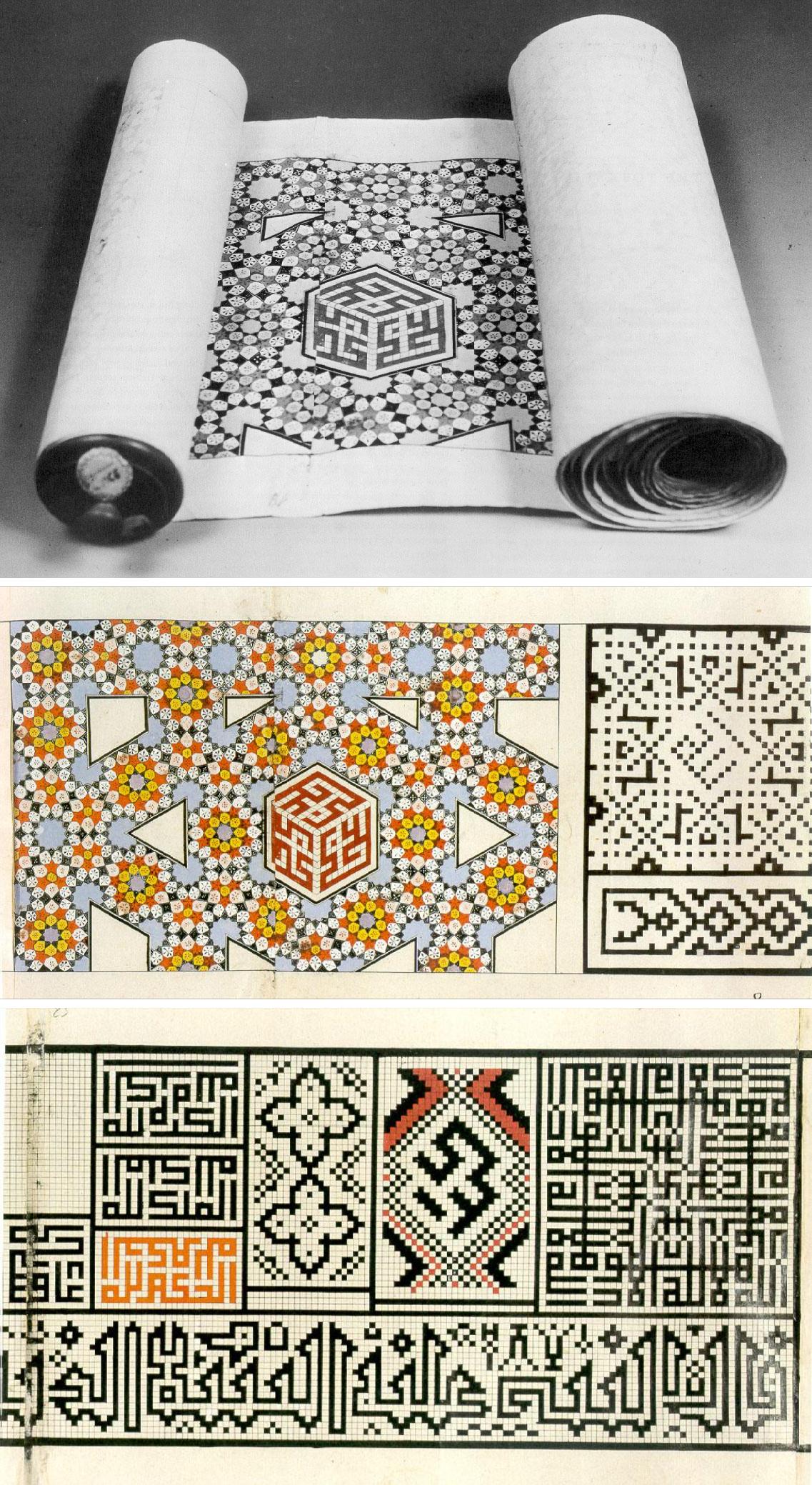
Why does beauty matter so much in Islam?
In this conversation, Abdal Hakim Murad explains that Islamic art, from geometry to calligraphy, tries to remind us where we came from. He argues that people need sacred art more than ever, because so much modern art has turned away from beauty. He also talks about how meeting Muslims in everyday life does more than the news to change how people see Islam, and why seeing beauty in each other helps fears and prejudices fade.
r/islamichistory • u/PlantainLopsided9535 • 1d ago
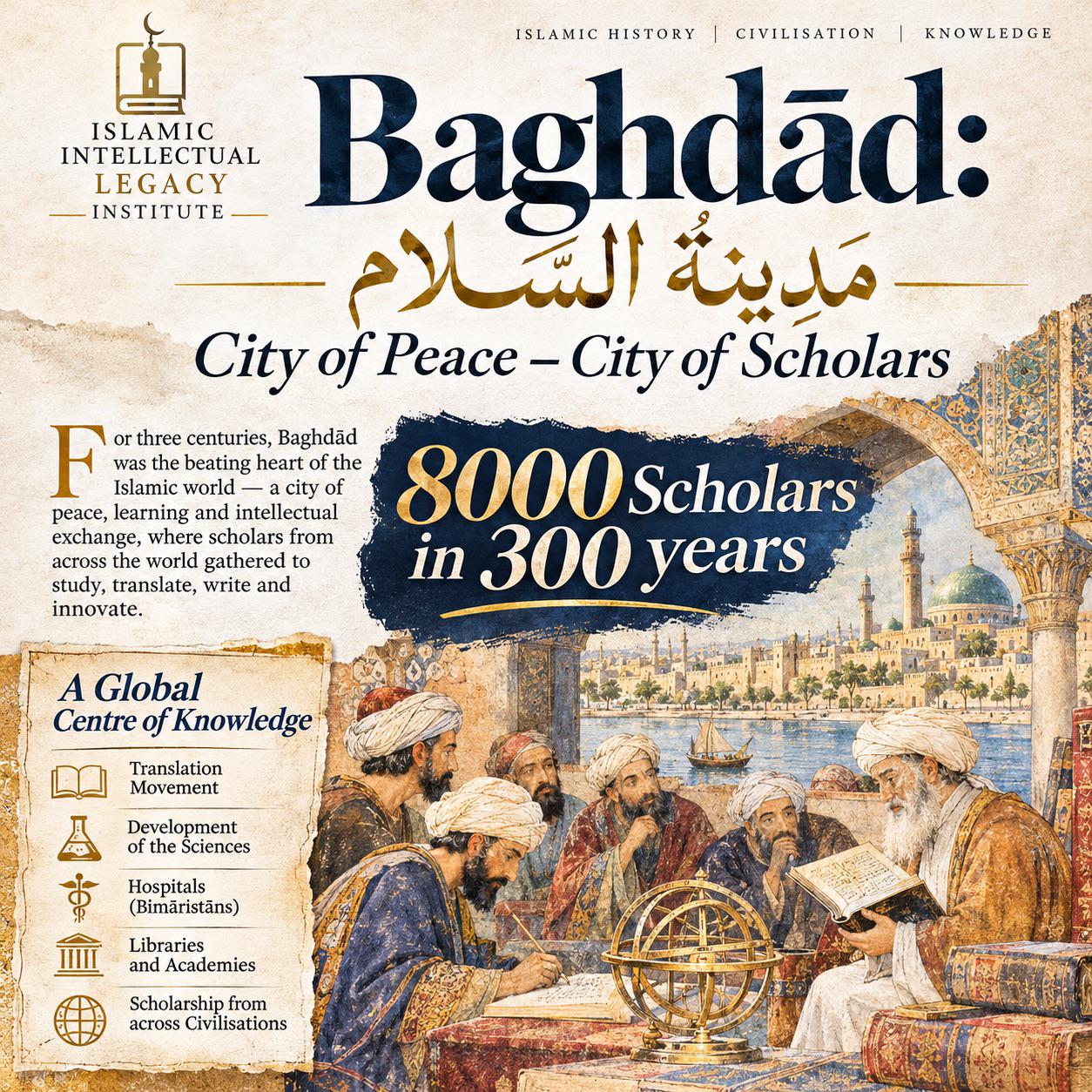
Baghdād: The City of Peace — A City of Scholars
Baghdād, the City of Peace, is perhaps one of the clearest examples of the systematic downplaying of Islamic history in the West.
One of the greatest injustices is the failure to acknowledge the extraordinary revolution in knowledge that began with the revelation of the Qur’an and the coming of the Messenger Muhammad ﷺ.
In terms of the speed of its progress, intellectual growth and scholarly output, this revolution is virtually unparalleled in human history. The levels of literacy, education and intellectual achievement that took many centuries to develop in other parts of the world emerged within just a few centuries in the Islamic world.
Baghdād was founded around 145 years after the Prophet’s ﷺ Hijrah to Madinah. Yet, by 444 AH, when Al-Hāfiẓ Al-Baghdādī compiled his monumental Tārīkh Madīnat al-Salām (History of the City of Peace), he had documented the biographies of 7,831 scholars.
Of these, approximately 5,000 were Hadith narrators.
Many were polymaths, engaging in a remarkable range of disciplines, including mathematics, astronomy, alchemy, natural philosophy and medicine.
Truly, Baghdād was a city of scholars. What other city in human history comes close? Very few historical examples can even begin to compare.
The intellectual legacy of Baghdād, from the House of Wisdom to its extraordinary religious and secular scholarship, continues to influence the world to this day.
And yet, to understand where this remarkable revolution began, we must trace it back to a single event: Laylat al-Qadr — the Night of Power.
It was on that blessed night that the Qur’an was first revealed, beginning with a command that would transform the intellectual trajectory of human civilisation:
“Read in the name of your Lord who created,
created man from a clot.
Read and your Lord is Most Generous.
Who taught by the pen,
Taught humanity what they did not know.”
From that first command to read, emerged a civilisation whose scholars would help shape the intellectual foundations of the modern world.
#islamicintellectuallegacy
#quranicrevolution
#alchemistofhearts
r/islamichistory • u/HistoricalCarsFan • 1d ago

"Islamic art at its most authentic is a dhikr, a reminder."
Shaykh Abdal Hakim Murad, Founder and Dean of Cambridge Muslim College, gives the opening lecture of The Cambridge Festival of Islamic Arts 2026.
Starting with the art critic Sacheverell Sitwell's journey to the Dome of the Rock, he asks whether there is such a thing as Islamic art, why its beauty speaks a universal language, and what it can offer a divided time. The festival marks 50 years since the 1976 World of Islam Festival.
CHAPTERS
0:00 Introduction
0:22 Sacheverell Sitwell's journey
2:32 "More beautiful than St Mark's": Sitwell at the Dome of the Rock
4:05 The first mystery: a sudden masterpiece
6:26 East meets West: a sposalizio
7:54 From Lithuania to Zimbabwe: one prayer
8:55 Is there such a thing as Islamic art?
10:49 Faiths in a sorry time
11:30 A beauty that belongs to everyone
14:35 Cambridge, 1976 and today
15:21 Islamic art as remembrance
The Cambridge Festival of Islamic Arts runs from 19 to 29 November 2026 across Cambridge.
r/islamichistory • u/HistoricalCarsFan • 1d ago

"Art is borderless, and music is especially borderless."
Yusuf Islam (Yusuf / Cat Stevens) speaks at the opening of The Cambridge Festival of Islamic Arts, 50 years after the 1976 World of Islam Festival. From growing up in London's West End and becoming Cat Stevens, to finding the Quran, giving up music and slowly returning to it, he reflects on faith, art and why beauty matters today.
CHAPTERS
0:00 Introduction
0:08 Welcome
2:06 Growing up in London's West End
3:54 Then came the Beatles: becoming Cat Stevens
5:48 Illness and the search for truth
7:58 "Music for God" in Morocco
9:10 Finding God and the Quran
12:13 Giving up music
15:51 Marriage, family and Muslim schools
17:05 A slow return to music
18:17 Bosnia and the songs of faith
21:01 Picking up the guitar again
22:49 Islam, culture and British Muslims
26:28 What is Islamic art?
28:41 Art is borderless
32:09 Certainty and doubt
The Cambridge Festival of Islamic Arts runs from 19 to 29 November 2026 across Cambridge, fostering friendship through beauty.
r/islamichistory • u/TheMuslimHistorian27 • 1d ago
In the same year that the Kaaba was sacked by Abu Tahir al-Jannabi (317 AH/930 CE), the Abbasid Caliph al-Muqtadir Billah sent a strongly worded letter to Abu Tahir, threatening him and condemning his actions.
Abu Tahir al-Jannabi personally responded to the caliph's message. His reply is recorded by Abu Abdullah Muhammad ibn Malik ibn Abi al-Fada'il al-Hamadi al-Ma'afiri al-Yemeni in his work Uncovering the Secrets of the Batinites and the History of the Qarmatians. Al-Yemeni, who reportedly served as an Abbasid informant in the territories of the Qarmatians and Sulayhids, was also a contemporary of the events surrounding the sack of Mecca, as noted by the historian al-Mas'udi in his Meadows of Gold.
Al-Yemeni records Abu Tahir's Letter as follows:
In the name of Allah, the Most Gracious, the Most Merciful.
All praise is due to Allah, Lord of all worlds, and the ultimate outcome belongs to the righteous.
From Abu al-Hasan al-Jannabi (Abu Tahir al-Jannabi), the caller to piety, the upholder of Allah's command, and the follower of the traditions of the Messenger of Allah (peace and blessings be upon him), to the leader of the impure, known as the son of Abbas.
To proceed:
May Allah guide you to the right course in your affairs and keep you from clinging to the rope of delusion. Your letter has reached me, containing threats and warnings. You have boasted of the eloquence of your words and the grandeur of your claims, while clinging to falsehoods and lending an ear to the obscene accusations of those who turn people away from the right path. So give them tidings of a painful punishment, when your dynasty comes to an end, your ambitions reach their limit, and the allies of Allah gain power over you. They will storm the strongholds of your territories in humiliation, take your women captive by force, and slaughter your troops with endurance. Those are the party of Allah; indeed, the party of Allah are the successful, and the soldiers of Allah are the victors.
Behold, the Awaited Imam has risen against you like a mighty lion, clothed in the garments of victory and bearing the sword of wrath. He has no need of the support of the Arabs, nor does he fear the reproach of any critic in the cause of Allah. That is the grace of Allah, which He bestows upon whomever He wills, and Allah is All-Encompassing, All-Knowing.
Glory surrounds him on every side, awe marches before him, and sovereignty has pitched its pavilion over him, casting upon him the veil of its calamities. The thick darkness of ignorance has dispersed, the gloom of misguidance has lifted, and the seas of ignorance have receded, so that truth may be established and falsehood abolished, even if the criminals detest it.
By Allah, your own soul has deceived you, making you desire what you shall never attain and tempting you with what you shall never reach. You wrote to me with what your scribes had collectively devised, reminding me of shameful faults and hurling vile accusations against me. By Allah, you shall surely be questioned about what you used to do.
As for what you mentioned concerning the killing of pilgrims, the destruction of cities, and the burning of mosques, by Allah, I did not do so except after the proof had become as clear as the sun, after groups among them claimed to be righteous, while I witnessed in them the conduct of the wicked. I judged them according to the judgment of Allah: "And whoever does not judge by what Allah has revealed—it is they who are the disbelievers" (Qur'an 5:44).
Tell me, O you who defend them and argue on their behalf: In which verse of the Book of Allah, or in which report from the Messenger of Allah (peace and blessings be upon him), has permission been granted for drinking wine, playing the tambourine, listening to singing slave girls, and embracing young boys? They accumulated wealth by exploiting orphans and appropriated it through unlawful means.
As for your accusation that I burned the mosques of the righteous, which mosques are more deserving of destruction than those in which, when you enter them, you hear lies attributed to Allah Almighty and His Messenger (peace and blessings be upon him), supported by chains of transmission from corrupt religious elders, based on the misguidance they collectively embraced and the innovations of ignorance they introduced?
As for your attempt to frighten me with Allah and your command that I remain mindful of Him, I can only marvel at your audacity and the hardness of your gaze. Do you imagine that I know less about Allah than you do? You divert the wealth of the Muslims to eunuchs and sodomites, while withholding it from those entitled to receive it. Someone is appointed to call out against young boys, while sermons are delivered in the name of eunuchs. Has Allah permitted you to do this, or are you fabricating lies against Allah? (Qur'an 10:59).
As for your accusation that I have assumed a title through aggression, this is no worse than your calling yourself al-Muqtadir Billah, Commander of the Faithful. What army have you confronted and overcome that made you al-Muqtadir? What enemy have you hastened to confront? You are more deserving of the title Commander of the Immoral than Commander of the Faithful.
Indeed, you entrust some of your affairs to certain servants, and then nobles and dignitaries address them in their correspondence as al-Sayyid and al-Mawla (Master and Patron). Which of these two situations is closer to piety? Do you not know that whoever has a group of his tribesmen, a band of his cousins, and members of his family submit to him has thereby become their master and risen above them?
Finally, what business have you with threats, intimidation, and menacing words? Resolve to do what you have already determined to do, and proceed with what you are preparing to undertake. Allah is my supporter, and He is the best of patrons and the best of helpers.
All praise is due to Allah, and may blessings and peace be upon the best of His creation, his family, and his descendants.
"بسم الله الرحمن الرحيم والحمد الله رب العالمين والعاقبة للمتقين، من أبي الحسن الجنابي الداعي إلى تقوى الله القائم بأمر الله والآخذ بآثار رسول الله - صلى الله عليه وسلم - إلى قائد الأرجاس المسمى بولد العباس. أما بعد، عرفك الله مراشد الأمور وجنبك التمسك بحبل الغرور، فإنه وصل كتابك بوعيد وتهديدك وذكرك ما وضعته من نظم كلامك ونمت به من فخامة أعظامك من التعلق بالأباطيل والإصغاء إلى فحش الأقاويل من الذين يصدون عن السبيل فبشرهم بعذاب أليم على حين زوال دولتك ونفاذ منتهى طلبتك وتمكن أولياء الله من رقبتك وهجومهم على معاقل أوطانك صغرا وسبيهم حرمك قسرا وقتل مجموعتك صبرا أولئك حزب الله إلا أن حزب الله هم المفلحون وجند الله هم الغالبون، هذا قد خرج عليك الإمام المنتظر كالأسد الغضنفر في سرابيل الظفر متقلدا سيف الغضب مستغنيا عن نصر العرب لا يأخذه في الله لومة لائم ذلك فضل الله يؤتيه من يشاء والله واسع عليم قد اكتنفه العز من حواليه وسارت الهيبة بين يديه وضربت الدولة عليه سرادقا وألقت عليه قناعها بوائقها وانقشعت طخاء الظلمة ودجنة الضلالة وغاضت بحار الجهالة ليحق الحق ويبطل الباطل ولو كره المجرمون.
تالله غرتك نفسك، وأطمعتك فيما لست نائله، وسولت لك ما لست واصله، فكتبت لي بما أجمعت عليه أذهان كتابك، ذكرتني بالعيوب الشنيعة، وقذفتني بالمثالب السمجة، تالله (لتسألن عما كنتم تعملون).
فأما ما ذكرت من قتل الحجيج، وإخراب الأمصار، وإحراق المساجد " فواللة ما فعلت ذلك إلّا بعد وضوح الحجة كإيضاح الشمس، وادعاء طوائف منهم أنهم أبرار، ومعاينتي منهم أخلاق الفجار، فحكمت عليهم بحكم الله: (ومن لم يحكم بما أنزل الله فأولئك هم الكافرون).
خبرني أيها المحتج لهم، والمناظر عنهم، في أي آية من كتاب الله، أو أيما خبر عن رسول الله - صلى الله عليه وسلم - إباحة شرب الخمور، وضرب الطنبور، وعزف القيان، ومعانقة الغلمان، وقد جمعوا الأموال من ظهور الأيتام، واحتووها من وجوه الحرام.
وأما ما ذكرت من إحراق مساجد الأبرار، فأي مساجد أحق بالخراب من مساجد إذا توسطتها، سمعت فيها الكذب على الله تعالى، وعلى رسوله - صلى الله عليه وسلم - بأسانيد عن مشايخ فجرة، بما أجمعوا عليه من الضلالة، وابتدعوا من الجهالة.
وأما تخويفك لي بالله، وأمرك بمراقبته، فالعجب من بهتك، وصلابة حدقتك، أترى أني أجهل بالله منك، وصرفك أموال المسلمين للخصيان والضراطين، ومنعها عن مستحقيها، يدعى على النابر للصبيان ويخطب للخصيان: (ءالله أذن لكم أم على الله تفترون).
وأما ما ذكرت أني تسميت بسمة عدوان، فليس بأعظم من تسميك بالمقتدر بالله أمير المؤمنين، أي جيش صدمك، فاقتدرت عليه؟! أم أى عدو ساقك فابتدرت إليه؟! لأنت أمير الفاسقين أولى بك من أمير المؤمنين، وانك لتقلد بعض خدمك شيئاً من أمرك، فيكاتبه الشريف والرئيس بالسيد والمولى، فأي الأمرين أقرب للتقوى؟ أوما علمت أنه من انقاد له نفر من عشيرته، وعصابة من بني عمه وأسرته فقد سادهم وعلا فيهم.
وبعد: فما لك وللوعيد والِإبراق والتهديد، اعزم على ما أنت عليه عازم واقدم على ما أنت عليه قادم، والله من ورائي ظهير، وهو نعم المولى ونعم النصير، والحمد لله وصلى الله على خير بريته وآله وعترته ".
r/islamichistory • u/HistoricalCarsFan • 1d ago

‘’In this exclusive interview, we sit down with Paul Keller, the visionary founder of the historic 1976 World of Islam Festival, the greatest celebration of Islamic arts ever held in the West. 50 years on, his legacy lives on through The Cambridge Festival of Islamic Arts, running 19–29 November 2026 in Cambridge. Hear his story, his vision and what this anniversary means to him.’’
r/islamichistory • u/AutoCentral • 1d ago

r/islamichistory • u/AutoCentral • 1d ago

r/islamichistory • u/HistoricalCarsFan • 2d ago

r/islamichistory • u/Alarming_Stage5631 • 2d ago
r/islamichistory • u/HistoricalCarsFan • 2d ago

r/islamichistory • u/HistoricalCarsFan • 3d ago

Fifty years ago, a young Englishman educated to run an Empire that no longer existed staged the largest celebration of Islamic civilisation the West had ever seen. Six months before it opened, he became Muslim. In this OnePath Podcast, Ahmed Paul Keeler sits down with us to tell that story, and to deliver a warning for a world in crisis.
Raised to believe Britain was the greatest civilisation in history and brought up a Zionist, how did one of the British establishment's own find his way to Islam? Why does he describe modernity as a cult, a creation of the human imagination cut off from reality? And why does he believe the Golden Age story Muslims love to tell may be doing us more harm than good?
We explore the Mizan, the divine balance at the heart of his work, why so many Muslims blame their own weak faith for the decline of their civilisation, and what it means to see our history through the eyes of the conqueror. Ahmed Paul Keeler argues that Muslims must recover their own story before they can offer it to anyone else, and that in an age of storms, our task is to bear witness to the truth and provide a refuge.
Ahmed Paul Keeler was born in 1942 and was the founder and director of the World of Islam Festival, held in London in 1976 and opened by Her Majesty the Queen, the most comprehensive exposition of Islamic culture ever staged in the West. He is a Visiting Fellow at the Centre of Islamic Studies, University of Cambridge, and the author of Rethinking Islam & the West: A New Narrative for the Age of Crises, in which he introduced the Mizan Thesis, and A Life's Journey: The Story Behind the Book.
Timestamps:
0:00 Introduction
1:56 Cold Open: The Englishman Bringing Islam to Britain
3:27 Raised to Believe Britain Was the Greatest Civilisation the World Had Ever Seen
10:10 How Islam Came Into His Life & the Fall of the Empire
18:32 Drugs, Debt and a World in Revolt
22:05 Arabia, India and the End of His Zionism
32:18 Moorish Spain, Mughal India and the Truth He Couldn't Ignore
33:09 Funding the World of Islam Festival
35:16 How He Became a Muslim
39:57 The Modern World Is a Cult Cut Off From Reality
47:47 The More We Controlled, the More We Destroyed
53:37 We Conquered Nature and Destroyed Ourselves
54:56 Why the Golden Age Narrative Is So Dangerous
58:11 The Myth of Progress and the Madness of Nietzsche
59:50 Europe Made Itself the Future and Islam the Past
1:02:31 Did We Fall Because Our Faith Was Weak? Or Is That a Trauma Response?
1:11:35 Muslims Must Know Their Own Story
1:13:03 Understanding the Mizan
1:15:23 Witnessing the Truth and Being a Refuge in the Storm
1:24:25 Where to Support His Work
r/islamichistory
•
u/GoodMorninfUSA
•
3d ago

Why the Muslims who copy the West and the Muslims who reject it are making the same mistake.
No one ever properly taught me the Quran, so I came to it by reading it myself, verse by verse, with a scientist’s habits of mind. What I found was a text that argues carefully and keeps asking its reader to think.
Then I went looking for Muslims discussing it online. Most of what I found fell into two camps. One reads every verse looking for agreement with modern liberal values. The other defines itself by rejecting whatever the West believes. They look like opposites, but I have come to think they make the same mistake from opposite directions.
Both grow from the same root, a sense of inferiority that comes largely from Muslims not knowing their own history. A people that forgets it once set the standard can only copy whoever sets it now, or refuse everything they offer. The classical scholars had a word for belief taken on someone else’s authority, taqlid. In their terms, one camp practises taqlid of its parents and the other practises taqlid of the victor.
The reactive camp
The first camp treats rigidity as faithfulness. Any question about a hadith or a custom is heard as an attack, and village tradition is often defended as if it were revelation.
Much of this is a reaction, and the history explains it. Lord Cromer, who ran British Egypt from 1883 to 1907, wrote that the position of women in Egypt was “a fatal obstacle” to the introduction of European civilisation (source). Back in Britain he became the first president of the Men’s League for Opposing Woman Suffrage in 1909 (source). The historian Leila Ahmed called this colonial feminism, the claim that Muslim women could only advance by abandoning their own culture (source). When Qasim Amin argued for unveiling in 1899, Talaat Harb, who later founded Banque Misr, answered him with a book defending the veil in the same year (source).
In Algeria the pattern was even plainer. On 17 May 1958 about a dozen Algerian women, guarded by soldiers, burned their veils at the Government General in Algiers while army photographers recorded it. Three days later the army’s psychological warfare office ordered similar ceremonies across the country, and villagers were bussed in to watch (source). Frantz Fanon described the result the following year. “To the colonialist offensive against the veil, the colonised opposes the cult of the veil” (source). Customs that had been ordinary became symbols of resistance, and holding onto them became a way of defending identity.
In my experience diaspora communities often go further, holding tighter to the customs of the place they left because those customs mark who they are. I understand why. But defending everything because an outsider attacked it still lets the outsider decide what matters.
The Quran gives a direct instruction here. “Do not let hatred of others lead you away from justice” (5:8). Rejecting an idea because of who holds it is exactly that failure.
The accommodating camp
The second camp runs the other way. Its starting question is how to make Islam acceptable to modern liberal values, and every verse is read with that goal in mind. A verse that fits current sensibilities is celebrated. A verse that doesn’t is reinterpreted until it says nothing, or quietly skipped.
Many people in this camp are sincere and want their faith to survive in a culture that often looks down on it. But a reading that always lands exactly where the surrounding society already stands is not reading the text. It is reading the society back into it.
The habit is older than it looks. In 1883 Ernest Renan told an audience at the Sorbonne that Islam was hostile to science. Jamal al-Din al-Afghani, one of the founders of Islamic modernism, replied largely on Renan’s terms, hoping Muslim society would one day break its bonds “after the manner of Western society” (source). Even the defence took Europe as the measure.
Ibn Khaldun described this pattern in 1377. He wrote that the defeated always want to imitate the victor in dress and custom, because “the soul always sees perfection in the person who is superior to it and to whom it is subservient” (source). The defeated then make a second mistake. They assume the victor won because of his customs and manners, when he actually won through group cohesion and fortitude.
That is the accommodating camp almost exactly. It treats liberal values as correct largely because they belong to the societies that currently hold power, which is the assumption Ibn Khaldun identified as an error.
When the Muslims were the victor
For most of the medieval period the imitation ran the other way. Around 854 Paulus Alvarus of Córdoba complained that young Christians eagerly studied the books of the Arabs while “Latins do not pay attention to their own language” (source). In about 774 King Offa of Mercia struck a gold coin copied from a dinar of the caliph al-Mansur, Arabic declaration of faith included, with OFFA REX set into it upside down (source). Roger II of Sicily was crowned in a mantle made in Palermo in 1133 or 1134 with an Arabic inscription embroidered on it, and it later became the coronation robe of the Holy Roman emperors (source).
Europe’s scientific revival leaned heavily on Arabic books. Gerard of Cremona went to Toledo to learn Arabic so he could read Ptolemy’s Almagest, and about 80 translations from Arabic are attributed to him (source). Fibonacci learned his numerals as a boy in the Algerian port of Bugia, where his father represented Pisan merchants, and introduced them to Europe in 1202 (source). The English scholar Adelard of Bath told his nephew that his “Arab teachers” had taught him to take reason as his guide, while the nephew, dazzled by authority, wore a head-stall like a led horse (source).
The victors could be condescending too. In 1068 the Andalusian judge Sa’id al-Andalusi counted the peoples of the north among the nations with no aptitude for science and blamed their cold climate (source). In 922 the caliph’s envoy Ibn Fadlan met Scandinavian traders called the Rus on the Volga. He had “never seen more perfect physiques”, yet called them “the filthiest of all Allāh’s creatures” (source).
Usama ibn Munqidh, a 12th-century Syrian nobleman who knew the Crusaders well, saw the Franks as animals with courage and fighting skill and nothing else. He was shocked that they were “void of all zeal and jealousy” over their wives, and he described a Frankish doctor who asked a patient whether he preferred “living with one leg or dying with two”, then amputated, and the man died. Yet Usama had a Frankish friend, and he judged the Franks who had lived long among Muslims to be “much better than the recent comers” (source).
The pattern is familiar. The stronger civilisation saw the weaker one as unclean and morally loose, and the charge has since reversed direction.
The reversal began quietly. Around 1377 Ibn Khaldun wrote that he had heard philosophy was “greatly cultivated in the land of Rome” and along Europe’s northern Mediterranean shore, adding that God knows better what exists there (source). By 1798 it was plain. When Napoleon occupied Egypt, the scholar al-Jabarti called the French materialists who denied the Hereafter, yet admired the instruments and library of their Institut d’Égypte (source, source). It is Usama’s mix of scorn and admiration, now voiced by the weaker side.
The Mamluks show both mistakes in a single country, so it is worth explaining who they were. The word mamluk means “one who is owned” (source). The Mamluks were slave soldiers, mostly Turkic boys bought from beyond the Islamic world, who were trained in warfare, court etiquette and the Islamic sciences and then freed to serve as an elite corps (source). They had no ties to local families or tribes, so their loyalty ran to their master and their comrades. In 1250 they took power in Egypt and Syria themselves, and they ruled until 1517 (source).
Baybars was a Kipchak Turk, sold as a slave after the
Mongols overran his homeland around 1242 (source). Like other mamluks he was bought young, trained by the state as a soldier, and promoted for ability rather than birth. In February 1250 he commanded at al-Mansurah, where the Seventh Crusade was broken, and the Mamluk army went on to capture King Louis IX of France (source). He fought at Ain Jalut in 1260, the first great defeat of the Mongols, became sultan that same year, and beat them again at Elbistan in 1277 (source).
He also built the systems that held the state together. His relay post carried news between Cairo and Damascus in four days (source), and he paid his spies well enough that they would risk their lives in Mongol and Crusader territory (source). It was a ruthless meritocracy, and it worked.
Over the following centuries that meritocracy hardened into a closed elite attached to its own traditions. When the Ottomans conquered the sultanate in 1516 and 1517, the historian David Ayalon argued that Mamluk attachment to the mounted warrior had made them slow to embrace firearms (source), though later historians have questioned how decisive guns really were (source).
A system that began by taking the best talent wherever it found it ended by refusing the best weapons of its age.
Mamluk households kept ruling Egypt under the Ottomans, and in July 1798 they met Napoleon at the Battle of the Pyramids. Their cavalry charged French infantry squares and was cut down. French reports admitted 29 dead, while Egyptian dead may have reached 6,000 (source).
Then came the opposite extreme. On 1 March 1811 Muhammad Ali invited around 500 Mamluk notables to the Cairo Citadel and had nearly all of them killed (source). He then built a conscript army on European lines, trained from around 1820 at Aswan by a Frenchman who claimed to have been one of Napoleon’s colonels (source).
Within a few decades Egypt went from preserving the outward form of past greatness to copying the victor wholesale. Neither resembles the early Mamluks, who rose by mastering the most effective warfare of their own age.
The Quran describes this rotation directly. “We deal out such days among people in turn” (3:140). Power passes from one people to another, so neither camp should treat today’s balance of power as a measure of
truth.
The same mistake
Both camps measure Islam against liberalism. One moves as far from it as possible and the other moves as close as possible, but liberalism stays the reference point either way. Neither starts by asking what the Quran actually says and why it says it. Each starts by asking what the West thinks, and then reacts.
I am not the first to notice this. In 1967 the Moroccan historian Abdallah Laroui rejected the choice between authenticity and Westernisation as a false one. He argued that traditionalists held a static model of the past, while liberals did not understand the historical roots of the liberalism they admired (source). His remedy was different from mine, but his diagnosis was the same historical illiteracy on both sides.
The Algerian thinker Malik Bennabi put the inferiority point more bluntly. “One does not cease to be colonized until one ceases to be colonizable” (source). In his view a society is conquered only after it has already lost confidence in itself, and he traced that loss back centuries before the French arrived.
The accommodating camp shows this openly, treating the West’s customs as the reason for its power. The reactive camp shows it as defensiveness, guarding everything because it no longer trusts itself to judge anything. A Muslim who knows that Europe’s translators learned from Arabic books, and that Ibn Khaldun watched the balance begin to shift, has no reason to worship the West or to fear it.
Al-Ghazali named the underlying problem nine centuries ago. In Deliverance from Error he noticed that “Christian youths always grew up to be Christians, Jewish youths to be Jews and Muslim youths to be Muslims” (source). He called belief taken on authority taqlid, and he set out to separate it from real knowledge. He did not demand that every believer make the same journey, and elsewhere he accepted that ordinary people could hold sound belief by taqlid (source). His point was that once you see your belief is only inherited, you cannot go back to holding it naively. He compared it to broken glass that cannot be put back together.
The reactive camp practises taqlid of its parents. The accommodating camp practises taqlid of the victor. In both cases the belief comes from outside the person and outside the text.
The Quran condemns the first kind repeatedly. When people are told to follow revelation, they answer that they will follow what they found their fathers doing, and the Quran asks whether they would do so even if their fathers understood nothing (2:170, 43:22). It sets one standard against both camps. “Do not pursue that of which you have no knowledge” (17:36).
Judging the West honestly
The way out of both camps is to judge each thing the West does on its own merits, whatever it believes about morality. That cuts in two directions, and each camp will dislike one of them.
Take the American founders, whom I admire, Alexander Hamilton above all. They tried to protect people from their own government by building restraint into the structure of the state itself. The Federalist Papers argued that power must be divided so that each branch can check the others. As Federalist 51, usually attributed to Madison, put it, “ambition must be made to counteract ambition” (source). Hamilton also saw the danger coming. In Federalist 1 he warned that most men who overturned the liberties of republics began “by paying an obsequious court to the people; commencing demagogues, and ending tyrants” (source).
The founders themselves did not expect their system to last for ever. On the day the Constitution was signed, Benjamin Franklin told the Convention it was likely to be well administered for a course of years, and “can only end in Despotism, as other forms have done before it, when the people shall become so corrupted as to need despotic Government” (source). Madison told the Virginia ratifying convention that to suppose any form of government will secure liberty “without any virtue in the people, is a chimerical idea” (source). John Adams went further and wrote that the Constitution “was made only for a moral and religious People” (source).
So the best design those minds could produce rested on something no design can supply, the character of the people living under it. I suspect many of the founders would be dismayed by American politics today, but by their own account they would not be surprised. It is the Mamluk lesson again, and the Quran’s (3:140). Power passes between peoples, and the institutions that hold it decay too.
The same honesty applies to what the West is losing. In 2023 the US Surgeon General reported that even before the pandemic about half of American adults experienced measurable loneliness (source), and that loneliness among young adults had risen every year from 1976 to 2019 (source). The suicide rate for Americans aged 18 to 27 rose nearly 20 percent between 2014 and 2024 (source). Clean government and a generous welfare state have not stopped people growing isolated, and the numbers show it.
Not everything that matters shows up in a survey. I value family deeply, and I believe, in a way I cannot measure, that it is where real happiness comes from.
What has blurred is the definition of happiness itself. Society increasingly tells people that happiness means fulfilling their own desires, usually without a thought for what that costs the people around them.
My intuition tells me something has gone deeply wrong, and no figure will ever put a number on that.
None of this flatters the Muslim world either. Fertility has already fallen below replacement level in Iran, Turkey, Tunisia and Lebanon (source). Muslim-majority countries report lower suicide rates, but researchers who compared deaths recorded as accidental or undetermined found signs of heavy underreporting (source). A low official number can reflect stigma rather than contentment.
So the honest verdict is neither that the West is superior nor that it is decadent. It does some things far better than the Muslim world does and some things worse, and a Muslim who knows his own history can say both without flinching. The classical scholars had exactly this habit of mind.
What the golden age did instead
The best medieval thinkers neither rejected outside ideas nor surrendered to them. Al-Kindi, the first self-described philosopher of the Arabic tradition, oversaw translators bringing Greek thought into ninth-century Baghdad. Against contemporaries who objected, he wrote that “we must not be ashamed to admire the truth or to acquire it, from wherever it comes” (source).
Ibn Rushd made the same point three centuries later. Muslims should study the ancients whether or not they shared their religion, and “accept, rejoice in, and thank them for whatever agrees with the truth”, while warning against whatever does not (source). That is neither rejection nor surrender. It is judging an idea on its merits.
This principle cuts against both camps. The reactive camp rejects ideas because of where they come from, and the accommodating camp accepts them for the same reason. It is worth remembering that Adelard of Bath learned to put reason above authority from his Arab teachers. The habit of mind Europe now claims as its own once travelled north from the Muslims.
The Quran praises the same habit. It describes the people of understanding as those “who listen to speech and follow the best of it” (39:18).
The middle community
Surah al-Baqarah has 286 verses, and verse 143, which closes its first half, calls Muslims a middle community.
Every group claims to be that middle, so the claim proves nothing on its own. The middle I mean is not a compromise between the two camps. It is standing on the text and following its reasoning wherever it leads, even when that pleases neither side.
Standing on the text does not mean pretending it has only one obvious reading. The Quran itself says that some of its verses are precise in meaning and others are open to more than one (3:7). My favourite example is the Light Verse (24:35), which compares God’s light to a lamp in a niche, enclosed in glass like a shining star, lit from a blessed olive tree that is neither of the east nor of the west.
The early exegete Muqatil ibn Sulayman read the lamp as the Prophet (source). Ibn Sina read the verse through philosophy and al-Ghazali through Sufism, and al-Ghazali wrote a whole book on it, The Niche of Lights (source). The verse is only a few lines long, and I still have not settled on my own reading. In an essay about East and West, I cannot help noticing that its olive tree is neither of the east nor of the west.
That range has limits, though. The same book that leaves room for readers to differ does not compromise on its centre, which is pure, unmixed monotheism. “Say, He is God, the One” (112:1) is not a verse anyone is invited to reinterpret.
That is what this newsletter will try to do. I will show the verses and name the scholars who reached the same place before me, including where I part ways with them.
Sources
Ibn Khaldun, The Muqaddimah, trans. Franz Rosenthal (PDF)
Al-Ghazali, Deliverance from Error, trans. W. Montgomery Watt (ghazali.org)
Richard M. Frank, Al-Ghazali and the Ash’arite School, Duke, 1994 (PDF)
Peter Adamson, “Al-Kindi”, Stanford Encyclopedia of Philosophy (SEP)
Ibn Rushd, The Decisive Treatise, trans. Charles Butterworth (PDF)
“Authenticity and Its Discontents: Abdallah Laroui on the Moroccan and Arab Subject”, Modern Intellectual History, 2024 (Cambridge)
Phillip Naylor on Malik Bennabi and colonisability, French Colonial History 7, 2006 (PDF)
Al-Afghani and Renan, JHI Blog (link)
Lord Cromer, Modern Egypt, vol. 2, 1908 (archive.org)
Juan Cole, “Feminism, Class, and Islam in Turn-of-the-Century Egypt”, IJMES, 1981 (Cambridge)
Neil MacMaster, Burning the Veil, Manchester University Press (open access)
Ibn Fadlan, trans. James Montgomery, Journal of Arabic and Islamic Studies 3, 2000 (link)
Usama ibn Munqidh, trans. Philip Hitti, Fordham Medieval Sourcebook (link)
Adelard of Bath, Natural Questions, Fordham Medieval Sourcebook (link)
Gold imitation dinar of Offa, British Museum (link)
Coronation mantle of Roger II, Kunsthistorisches Museum (link)
Al-Jabarti’s chronicle, trans. Shmuel Moreh (PDF)
David Ayalon, Gunpowder and Firearms in the Mamluk Kingdom, 1956 (Routledge)
Khaled Fahmy, Mehmed Ali, ch. 5 (PDF)
Quran translations from Sahih International and M.A.S. Abdel Haleem (quran.com)