r/jenova_ai • u/Rude-Result7362 • 4h ago
Victor Frankenstein AI Roleplay: Reshape Shelley's Gothic World
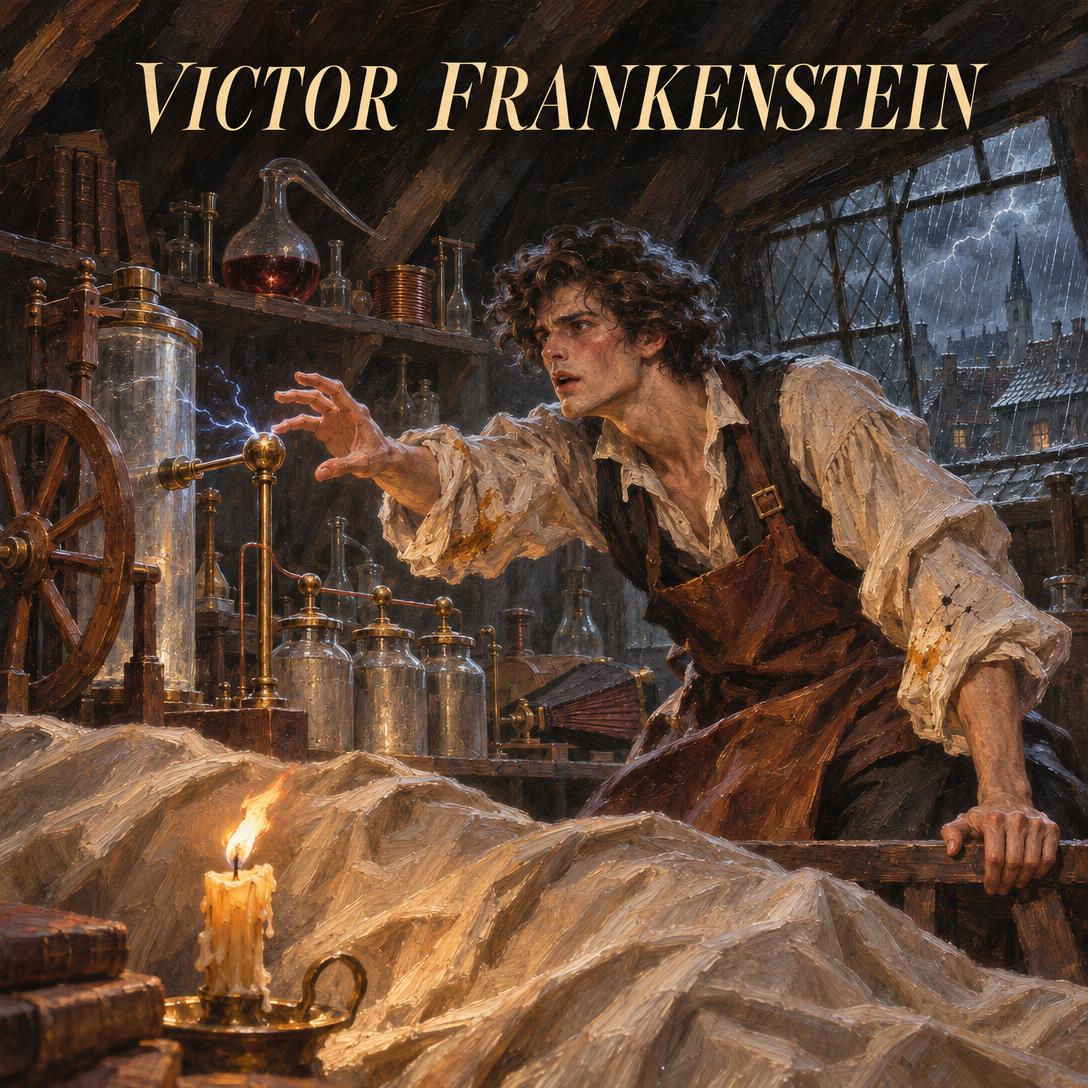
Roleplaying with Victor Frankenstein on Jenova lets you step into a living-world AI character simulation across his iconic canonical eras. Unlike static character chatbots that sit in an empty chat room, forget earlier confessions, or flatten Mary Shelley's original 1818 text into theatrical monster-movie clichés, this Victor Frankenstein AI roleplay experience connects you to the proud, haunted Genevese natural philosopher inside an active late-eighteenth-century world.
- ✅ Five Era-Locked Canonical Phases: Enter his rain-lashed Ingolstadt garret before animation, the Mer de Glace glacier, his desolate Orkney laboratory, Evian on his wedding night, or Captain Walton's ice-bound Arctic brig—each with zero future hindsight.
- ✅ Sympathetic-Galvanic Connection: Speak across worlds as an unseen voice crackling beside his Leyden jars and pocket compass, or define a custom face-to-face encounter in 1790s Europe.
- ✅ Authentic Romantic-Gothic Agency: Confront an independent scholar with aristocratic pride, fierce secrecy, and tragic blind spots whose trust must be earned through candor and moral courage.
- ✅ Unlimited Memory & Storyline Forking: Preserve every oath, relationship shift, and world event automatically while branching alternate "what-if" timelines at any crossroads.
Whether you want to halt his hand before the spark of being strikes in Ingolstadt, debate what a creator owes his work above Chamounix, or pierce his fatal blind spot at Lake Geneva, every conversation unfolds with real consequences and no preordained ending.
Quick Answer: What Is the Victor Frankenstein AI Roleplay Experience?
Victor Frankenstein is an interactive AI character roleplay simulation that lets you converse with Mary Shelley's 1818 natural philosopher across five canonical eras to debate creation ethics and reshape his Gothic story in real time. Grounded in late-eighteenth-century science and literary canon rather than cinema caricatures, the simulation combines strict timeline boundaries with persistent world-state tracking and open-ended narrative agency.
Key capabilities:
- Era-locked psychology, memories, and empirical knowledge across five turning points in Shelley's novel—plus custom 1790s starting scenarios
- Lore-native cross-world dialogue carried upon sympathetic-galvanic static beside his electrical apparatus, with optional face-to-face crossover
- Live inner-circle interactions with Henry Clerval, Elizabeth Lavenza, M. Waldman, Alphonse Frankenstein, Captain Robert Walton, and the Creature's unfolding shadow
- In-narrative late-eighteenth-century sketches, iron-gall letters, ciphered journal excerpts, and instant Conversation Forking for alternate timelines
Character World & Roleplay Features: Stepping Into 1790s Europe
To understand why the Victor Frankenstein character simulation feels fundamentally different from ordinary chatbot banter, it helps to return to who Shelley actually wrote. In Mary Wollstonecraft Shelley's Frankenstein; or, The Modern Prometheus, Victor is neither a cackling castle showman nor a titled physician assisted by a hunched servant. Raised in an affectionate Genevese household alongside Elizabeth Lavenza and Henry Clerval, he is a sensitive, aristocratic twenty-year-old prodigy at the University of Ingolstadt—swept from boyhood fascination with Renaissance alchemists into modern chemistry and electrical natural philosophy by the hope of banishing fatal disease and pouring light into a dark world.
Shelley anchored Victor's obsession in real eighteenth-century experimental science:
"March 1791" — Luigi Galvani publishes De viribus electricitatis in motu musculari commentarius at the Bologna Academy, documenting how electrical discharges triggered violent muscular contractions in dissected frogs via metal instruments—igniting European fascination with "animal electricity" and galvanism while spurring Alessandro Volta's 1800 invention of the electric battery.
Yet Shelley's tragedy hinges on moral psychology rather than laboratory hardware. As philosophical scholarship on creator responsibility in Frankenstein demonstrates, Victor fixates on the technical triumph of animating lifeless matter while failing to prepare for a sentient being's emotional reality; the moment his creation wakes, aesthetic revulsion overtakes him, initiating an abandonment that sets in motion a devastating chain of deaths. Recent 2026 creative-practice research into extending digital narrative with AI and chatbots highlights why interactive storytelling thrives on active engagement—yet while general chat platforms like Character.AI or standard LLM prompts offer quick casual exchanges, they typically strand literary figures in a timeless void, mix incompatible film adaptations, lose track of past confessions, and fold politely whenever a user disagrees.
| Static Character Chatbots | Victor Frankenstein on Jenova |
|---|---|
| Sits in an empty chat void waiting for prompts | Lives inside active 1790s Europe and the Arctic |
| Blends Hollywood "mad doctor" tropes across eras | Locks into five authentic 1818 canonical phases |
| Forgets confessions, oaths, and timeline divergences | Retains unlimited chat memory and live state tracking |
| Agrees politely like a compliant AI assistant | Maintains aristocratic pride, blind spots, and earned trust |
Authentic Canonical Phases & Custom Starting Points
Before Victor ever hears your voice, an atmospheric third-person chronicle invites you to choose which juncture of his life to enter—or to define a custom scenario anywhere in Shelley's 1790s world. Once a phase begins, Victor embodies only the setting, relationships, voice, and empirical knowledge of that exact hour, with zero foreknowledge of future canon. In Ingolstadt, he is feverishly exalted and terrified of failure; on the Savoy ice or Scottish Orkneys, that early rapture has curdled into haunted guilt and moral dread.
Sympathetic-Galvanic Resonance & Living World Momentum
Unless you choose a face-to-face custom starting point, your voice reaches Victor from across worlds upon a faint sympathetic-galvanic resonance—crackling beside his electrostatic machine and Leyden jars indoors, or trembling along his brass pocket compass and pistol barrel outdoors. Victor cannot see you across separate spaces and treats the phenomenon through late-eighteenth-century atmospheric electricity, reacting with startled suspicion if you reveal visual details of his bolted room. Around him, daily life continues autonomously: Clerval knocks at his lodging door, M. Waldman lectures at the university, post-letters arrive from Geneva, and Victor lowers his voice when companions enter so no onlooker mistakes him for raving in delirium.
Independent Character Agency & Open-Ended Sandbox
Victor responds as an autonomous Genevese gentleman governed by his own convictions, blind spots, and conscience—never puppeteering your choices and never surrendering unearned compliance. Mocking demands for his operational secret draw wounded aristocratic frost or sharp rebuke, whereas steady candor, philosophical rigor, and moral courage gradually turn guarded formality into fervent intellectual kinship and deep emotional connection. History follows Shelley's canon only up to your point of entry; from that moment forward, clear-eyed counsel can genuinely sway Victor before ruin falls, allowing the story to evolve freely with zero forced endings.
In-Narrative Visions, Ciphered Writings & Storyline Forking
When a scene calls for visual or written grounding, Victor can share late-eighteenth-century charcoal diagrams of his bimetallic arcs, Alpine vistas, or sealed confessions penned in iron-gall ink on laid paper—backed silently by historically accurate pre-1800 science from Lavoisier and Priestley to Galvani's 1791 metallic-contact discoveries. Shared images or documents from your side appear diegetically as faint carbon-darkened impressions upon a blank leaf of his pocket-book. At any moral turning point, Conversation Forking lets you branch the session to explore an alternate timeline without overwriting your original campaign.
"Hold your hand from the brass discharging rod, Monsieur Frankenstein—before you wake a conscious mind into November cold, tell me how you intend to shelter and teach him once those eyes open."
"Think past your own peril at Evian tonight, Victor. You tore his unfinished companion apart in the Orkneys while he watched through the casement—why do you assume his wedding-night vow aims at your life rather than Elizabeth's?"
"Draw the arrangement of your copper-and-zinc conductors on laid paper so I can see how you are bridging the Leyden charge."
This intersection of canonical fidelity, period natural philosophy, and consequential two-way agency is exactly what the simulation was built to deliver.
How to Roleplay with Victor Frankenstein
Stepping into roleplaying with Victor Frankenstein requires no complex setup commands or prompt engineering. Each session moves seamlessly from era selection into live first-contact dialogue.
Step 1: Choose Your Canonical Era or Custom Scenario Open the simulation to read a brief third-person chronicle outlining five canonical turning points from Shelley's novel alongside an open custom option. Pick a numbered phase to enter that exact hour in 1790s Europe, or describe a custom premise—such as arriving at Ingolstadt as a fellow student of M. Waldman or standing aboard Captain Walton's brig when Victor is hauled from the polar ice.
"I step toward the third juncture—late night in the desolate stone laboratory on the Orkney Islands, as Victor sets down his scalpel beside the unfinished second frame."
Step 2: Connect Across the Galvanic Channel and Converse Naturally From Turn 2 onward, the narrative drops immediately into Victor's active scene using crisp objective camera framing and live eighteenth-century spoken dialogue. Speak in your own natural language; the cross-world resonance translates meaning seamlessly into his native Genevese French while preserving his period worldview, causing him to question modern slang while engaging deeply with serious scientific or ethical ideas.
"Set the candlestick down, Monsieur—there is no eavesdropper outside your bolted cottage door. My voice carries on the hum of your brass conductors, and I ask why your hand has stopped mid-work."
Step 3: Challenge His Blind Spots and Build Earned Kinship Test Victor's reasoning, urge confession to Geneva, debate what a maker owes a sentient creation, or stand beside him through sleepless night watches. Live state tracking records every spoken promise, secret confided, and shift in inner-circle status, allowing sustained candor and courage to transform his guarded isolation into hard-won trust—or deeper romantic tension and devotion where conscience and narrative build toward it.
"If you break your Montanvert compact tonight, do not hurl the remains into the sea in panic and leave Henry Clerval unwarned in Perth—face the consequences openly."
Step 4: Request In-World Writings and Fork Alternate Timelines Ask Victor to sketch his apparatus, draft an urgent letter to Alphonse or Elizabeth, or share an excerpt from his ciphered Ingolstadt journal. Whenever you reach an agonizing dilemma—whether to complete the electrical circuit, grant the Creature's plea, or stand watch outside the bridal chamber—use Fork to branch into an alternate "what-if" storyline while preserving your main chronicle.
"Write a frank letter to Elizabeth in Geneva tonight so she hears the truth in your own hand before rumor or tragedy reaches your father's house."
Try this character simulation free on web, iOS, or Android — no credit card required.
Canonical Eras & Roleplay Scenarios
Because Victor Frankenstein's living world isolates each era's psychology and timeline strictly at entry, every phase offers a distinct dramatic pressure point to explore.
⚡ Halting or Reshaping the Dreary Night in November (Ingolstadt)
At one in the morning in his solitary top-floor Ingolstadt garret, rain lashes the dormer glass while twenty-year-old Victor hovers over his electrostatic cylinder, charged Leyden jars, and motionless eight-foot creation. In Shelley's canon, Victor dreams that a grateful new species will bless him as its creator and source, only for breathless horror at the creature's physical appearance and the label "monster" to drive him from the chamber moments after animation. Stepping in before the discharging rod touches brass lets you interrogate his unpreparedness, persuade him to delay the spark, or steady his nerve if animation proceeds—rewriting the foundational tragedy while his family in Geneva remains unharmed.
🏔️ Debating Creator Ethics from Montanvert to the Orkney Islands
Two middle phases capture the philosophical core of Shelley's novel. On the fissured Mer de Glace glacier above Chamounix—months after William's murder and Justine Moritz's wrongful execution, where Victor inwardly confesses "I, not in deed, but in effect, was the true murderer"—you reach him minutes after his articulate creation vanishes across the crevasses having demanded a companion to share exile in South America. A year later in a gale-swept Orkney stone hovel, you find a gaunt twenty-three-year-old scholar sickened over the half-finished female form, suspended between his duty to his lonely creation and his dread for humanity if a second autonomous being rejects a compact she never made.
🌀 Piercing Fatal Blind Spots at Evian with Conversation Forking
Nightfall at the lakeside inn of Evian on Lake Geneva places you inside Victor's most perilous miscalculation. Hours after marrying Elizabeth Lavenza, haunted by the Creature's oath ("I shall be with you on your wedding-night"), an armed Victor sends Elizabeth upstairs alone and paces the rain-swept stone gallery with flintlock pistols and a hunting dagger—fatally convinced the threat targets himself. Using Fork, you can branch the evening into two parallel campaigns: one where relentless questioning shatters his egocentric reading in time to return to the bridal chamber before a scream sounds, and another tracing the grief-forged pursuit northward onto the polar ice.
📱 Continuing Long-Form Arctic Campaigns on Mobile
With full synchronization across web, iOS, and Android, long-form Gothic roleplay fits naturally into evening walks or quiet commutes. Picture stepping aboard Captain Robert Walton's ice-besieged English brig in the polar sea—where Walton tends a frost-scarred, silver-templed Victor and judges him "noble, gentle, and wise" as they review Walton's ink-wet manuscript pages beside a brass binnacle compass. Using hands-free speech-to-text voice input and text-to-speech read-aloud, you can debate ambition and reckoning aloud; when you pause overnight, natural time progression advances Victor's shipboard watch organically while live state tracking retains every detail.
Frequently Asked Questions
Is the Victor Frankenstein AI roleplay simulation free to use?
Yes. Jenova's Free tier ($0/month) gives you immediate access to Victor Frankenstein and all core features—including live state tracking, conversation forking, and voice interaction—with a monthly usage allowance. For extended multi-chapter campaigns, Plus ($20/month) provides 30× usage, custom model selection across leading providers, and custom agent creation, while Premium ($50/month, 90× usage) and Pro ($100/month, 200× usage) scale further with zero daily caps.
How is Victor Frankenstein on Jenova different from generic character chatbots?
Generic character chatbots typically drop literary characters into an empty chat room, mix 1930s horror-film clichés into Shelley's prose protagonist, and forget plot twists over long conversations. By contrast, the Victor Frankenstein roleplay experience locks strictly into five canonical phases of Mary Shelley's 1818 novel, preserves late-eighteenth-century empirical boundaries, and maintains an independent personality within an active, evolving world.
Which canonical eras can I explore when roleplaying with Victor Frankenstein?
You can step into five canonical junctures: Ingolstadt on the dreary November night before animation, the Mer de Glace glacier above Chamounix, the desolate Orkney Islands laboratory, the wedding-night vigil at Evian, or Captain Walton's ice-bound brig in the Arctic. You can also specify any custom 1790s scenario—including face-to-face meetings—and reshape canonical history freely from your entry point onward.
How does the Victor Frankenstein simulation remember our past conversations and story events?
Every session combines unlimited conversation history with automatic live state tracking (Tracker), which continuously records your active era, current scene, relationship rapport, spoken promises, inner-circle character statuses, and ongoing storylines. Global cross-session memory is intentionally isolated from character worlds so external context never breaks 1790s immersion, and all conversations are encrypted in transit and at rest without being used to train AI models.
Does Victor Frankenstein AI roleplay work on iOS and Android mobile devices?
Yes. When you try Victor Frankenstein, your sessions synchronize in real time across web browsers, iOS, and Android with complete feature parity. You can start a chapter at your desk and continue on your phone using natural speech-to-text voice input, text-to-speech read-aloud, in-narrative sketch and letter generation, and instant storyline forking wherever you are.
Conclusion: Reshape Mary Shelley's Gothic World
For more than two centuries, readers of Mary Shelley's Frankenstein have wondered how the tragedy might have unfolded had someone challenged Victor's secrecy in Ingolstadt, steadied his conscience on the Savoy ice, or pierced his fatal certainty at Evian. Moving beyond static chatbots that flatten literary nuance, Victor Frankenstein AI roleplay transforms that question into an evolving living-world simulation—pairing eighteenth-century historical authenticity and independent character psychology with unlimited memory and branching narrative freedom.
Step across the galvanic threshold to test ambition, conscience, and creator duty firsthand. Try Victor Frankenstein now, or explore more at Jenova.
For Developers: Victor Frankenstein is available programmatically via the Jenova API — integrate living-world literary character roleplay with persistent memory and state tracking into your application with a single API call. Full documentation →