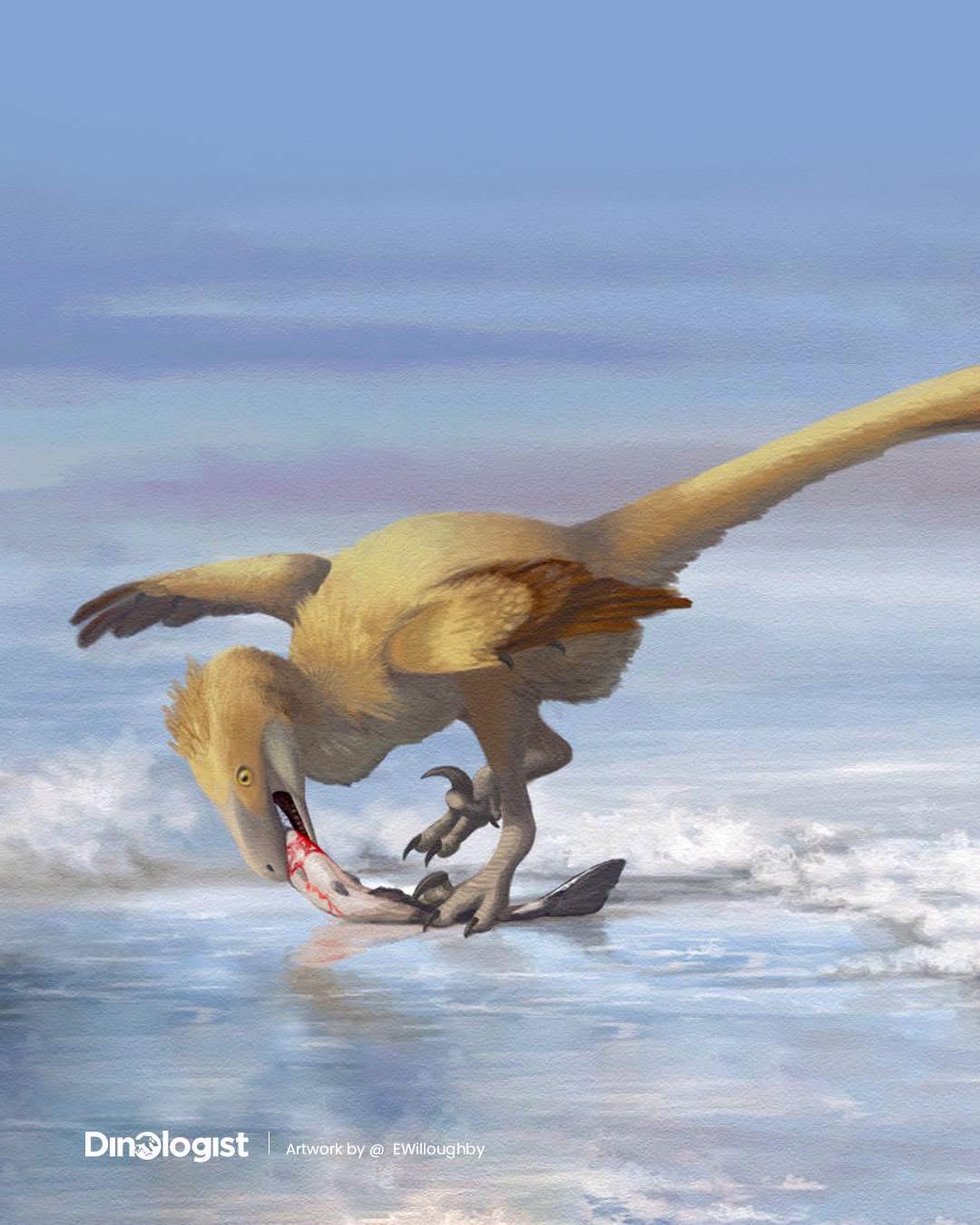
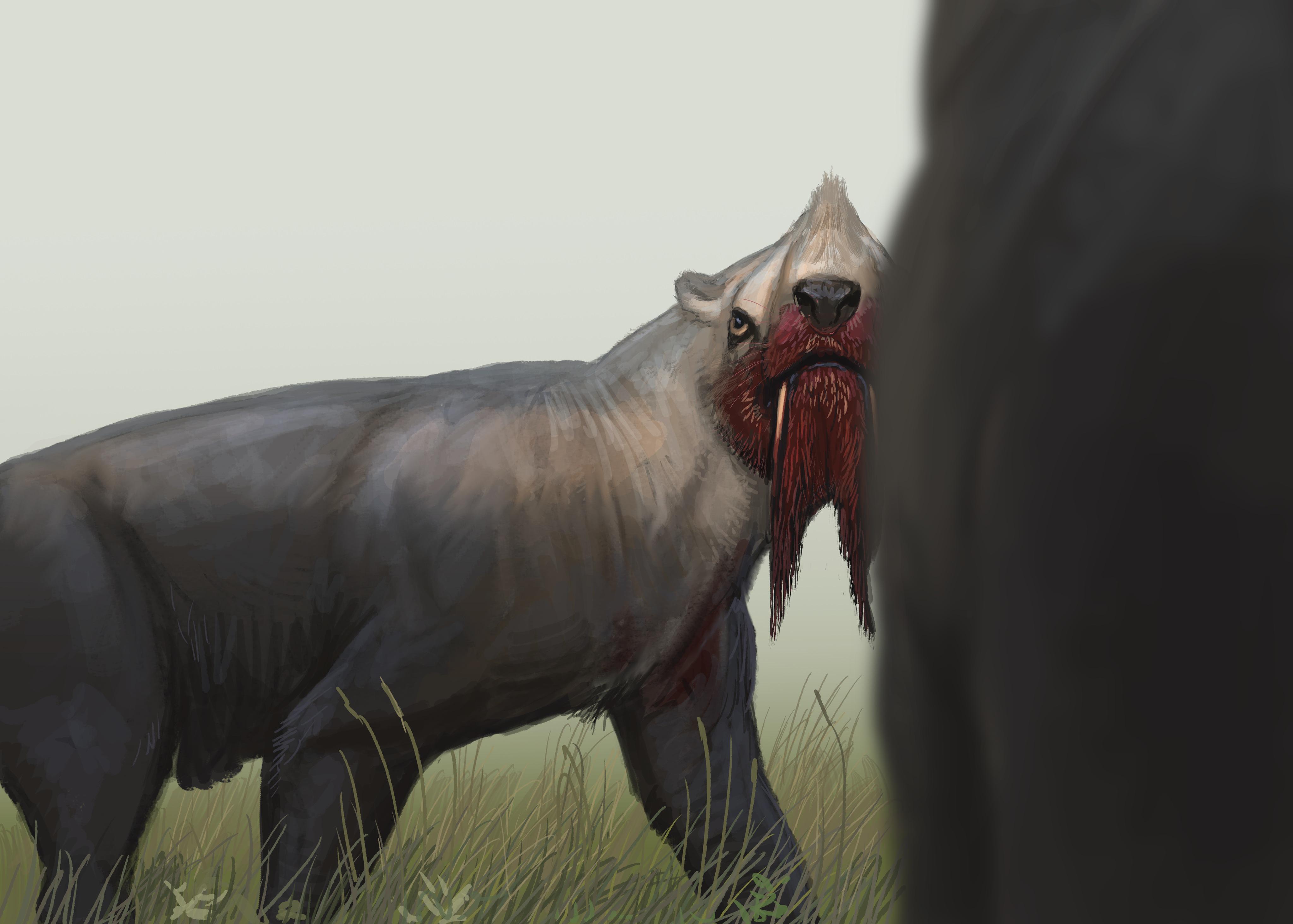
Art by Emily Stepp
I've seen quite a few posts on here and other paleontology subreddits that argue for NO feathers on the giant maniraptoriformes & even implying a scaled condition, but honestly I've come to disagree on this.
I've increasingly come to believe that giant maniraptoriforms such as Deinocheirus mirificus and Therizinosaurus cheloniformis were probably not only partially feathered as adults, but that much of their exposed integument was more comparable to the relatively smooth, non-scaly skin of modern birds than to the pebbly scales documented in large tyrannosaurids and only retaining scales in their feet & ankles like modern birds
Losing feathers & re-evolving reptilian scales aren't the same evolutionary process and honestly nothing's convinced me that the scaly integument we see in Tyrannosauridae should be extrapolated to giant Maniraptoriformes, here's a few reasons as to why:
1. We have little evidence for extensively scaled bodies among maniraptoriforms
I just read this great paper: Hendrickx et al. (2022), Morphology and distribution of scales, dermal ossifications, and other non-feather integumentary structures in non-avialan theropod dinosaurs.
.The team reviewed scaly vs. non-scaly skin across dinosaurs Notably, the authors identify naked, non-scale-bearing skin in Ornithomimus, one of Deinocheirus's closer relatives, finding that feathers and filamentous structures appear to have largely replaced extensive scaly integument in maniraptorans.
Van der Reest, Wolfe, and Currie (2016) described an Ornithomimus specimen with extensive feather impressions and exposed skin around the hind limbs, including a structure comparable to the skin web associated with the knee in living birds.
The authors compared its plumage distribution with that of modern ratites, suggesting a possible thermoregulatory function for the exposed regions.
This is especially interesting for Deinocheirus, considering that Lee et al. (2014) also documented a pygostyle-like structure in its tail, potentially supporting the presence of specialized tail feathers, although no feathers are directly preserved in the genus.
2. Therizinosaurs provide direct evidence of feathers and avian-like epidermal characteristics
The case for Therizinosaurus is equally interesting.
We already know that basal therizinosaurs possessed feathers. Xu et al. (2009) documented elongated, broad filamentous feathers in Beipiaosaurus, alongside shorter filamentous structures distributed across parts of its body.
More importantly, McNamara et al. (2018), Fossilized skin reveals coevolution with feathers and metabolism in feathered dinosaurs and early birds, examined fossilized epidermal structures in Beipiaosaurus, Sinornithosaurus, Microraptor, and Confuciusornis. The researchers identified preserved corneocytes exhibiting similarities to those of modern birds, including evidence that these animals shed portions of their epidermis as small flakes.
The study demonstrated that several characteristics of modern avian epidermal biology had already evolved among feathered non-avian maniraptorans. I think it's perfectly reasonable to suggest when scaled up that Therizinosaurus with reduced feathering across the torso, potentially more substantial plumage around selected regions of the body, and otherwise exposed avian-like skin is a perfectly reasonable reconstruction.
There is no direct evidence compelling us to depict its exposed body as extensively scaled.
3. The scaly integument of tyrannosaurids was not necessarily the ancestral condition for giant coelurosaurs
One common argument for extensively scaly giant theropods comes from the integumentary evidence of Tyrannosaurus and its relatives.
Bell et al. (2017), Tyrannosauroid integument reveals conflicting patterns of gigantism and feather evolution, documented scaly skin impressions from several tyrannosaurids, including Tyrannosaurus, Albertosaurus, Gorgosaurus, Daspletosaurus, and Tarbosaurus. HOWEVER, I think it's important to consider where this condition appears phylogenetically.
Yutyrannus, which possessed extensive filamentous feathering despite reaching approximately 1.4 tonnes,, isn't a tyrannosaurid. It has been recovered as a member of the early-diverging Proceratosauridae, including in the phylogenetic analysis of Brusatte and Carr (2016).
Bell et al. themselves reconstructed filamentous feathers as the probable ancestral condition for Tyrannosauroidea, with substantial feather reduction occurring later along the lineage leading to Tyrannosauridae. In other words, the extensively scaled integument documented in derived tyrannosaurids represents an evolutionary condition that can't automatically be assumed for other giant coelurosaurian lineages, which means we have no reason to assume that gigantism produced an identical integumentary response in every coelurosaurian lineage.
This is especially relevant because Deinocheirus, Therizinosaurus, and the scaly Tarbosaurus all inhabited the Late Cretaceous Nemegt ecosystem of Mongolia.
4. Comparisons with megafaunal mammals prove why gigantism does not necessitate total insulation loss
Another reason I'm skeptical of completely featherless reconstructions is the tendency to equate gigantism with the necessity of eliminating almost all insulating integument.
Modern elephants provide an obvious counterexample. Despite their enormous size and occupation of relatively warm environments, they retain sparse hair distributed across much of their bodies. Is it sparse, yes, but even Asian Elephants have more extensive integument than say, Indian Rhinos. In the meanwhile, animals like Black Rhinos cited as being too big for hair are roughly comparable in mass to creatures like Gaur or Giraffe, which still have hair, with the aforementioned gaur still having greater hair coverings than Sumatran Rhinos, warthogs, African Buffalo, or Babirusa. Hell, we can't even be certain that Hippos lost their hair because of sheer size when pygmy hippos are also hairless.
However, if we want the best proof we need to look at extinct temperate megafauna that lived in similar climates to the Nemegt Formation. Davis et al. (2022), Designing scientifically-grounded paleoart for augmented reality at La Brea Tar Pits, the authors discuss the surprisingly limited direct evidence for thick fur in American mastodons. They identify a Wisconsin mastodon skull preserving two small patches of hairy skin, including guard hairs and underfur. However, these remains are insufficient to establish that the entire animal possessed a uniformly thick coat.
The situation with the even larger Columbian mammoth is also interesting. The Natural History Museum discusses limited soft-tissue evidence suggesting some hair coverage, although the overall density remains uncertain. Davis et al. also emphasize that purported Columbian mammoth hair specimens have not been adequately described in the peer-reviewed literature.
While these animals showcase sparser hair coverage, they don't demonstrate that enormous body size & reduce insulation are synonymous with complete loss of hair/feathers like we see in Tyrannosaurs.
What these animals demonstrate is that enormous body size and reduced insulation are not synonymous with complete hairlessness.
I see no obvious reason why a comparable reduction in feather density would have been physiologically implausible in giant maniraptoriforms. Furthermore, Deinocheirus and Therizinosaurus inhabited seasonally variable Late Cretaceous environments, rather than uniformly tropical conditions. A complete absence of insulating or display-related feathers is not something we should regard as inevitable.
Even if we accept that gigantism encouraged substantial feather reduction in Deinocheirus and Therizinosaurus, this doesn't establish that their newly exposed skin would have resembled that of Tyrannosaurus. Modern birds demonstrate that regions of the body can be sparsely feathered or completely featherless without being covered in the same type of extensive pebbly scaling documented in tyrannosaurids.
We have evidence of non-scaly skin in ornithomimosaurs, avian-like epidermal structures in basal therizinosaurs, and a broader phylogenetic pattern in which extensive body scales appear to have been reduced or replaced by feathers in maniraptorans.
We also know that large-bodied coelurosaurs were capable of evolving dramatically different integumentary arrangements.
I'm therefore inclined to reconstruct Deinocheirus and Therizinosaurus as animals with partial feather coverage combined with predominantly non-scaly, avian-like exposed skin, while retaining scales on the feet and lower legs. I think the evidence makes this reconstruction at least as deserving of consideration as the conventional assumption that feather reduction in giant theropods must produce an extensively scaled animal.