r/pwnhub • u/wiredmagazine • 7h ago
Database Leaks Expose 3.5 Billion Usernames, Passwords, and Documents

70
Upvotes
r/pwnhub • u/My_thThrowAway • 1d ago
Hi PWN Community,
I'm Kat Traxler, Principal Security Researcher at Vectra AI, focused on abuse techniques and vulnerabilities in the public cloud. I've spent years finding cloud security bugs, before and after AI, so I know how hard they are to find and how bad models are at finding them.
I set out to fix that. The result has been 90+ valid, cloud-specific issues across multiple providers, supported by a new methodology: AI-led hunting with a Security Constitution. I presented it in my talk "Your Harness Needs a Security Constitution" at [un]prompted II (the US edition).
Models already handle code-level bugs like SQLi and XSS well, but those never intrigued me. I focus on platform-design flaws: missing authorization checks, inadequate logging, mishandled data. That is where I find the frontier models are much weaker.
The Security Constitution is modeled on Anthropic's Ethical Constitution. It is a set of 12 principles for how trust is held across multi-tenant platforms. It gives every hunt a point of view and a way to means-test a finding: the "reasonable customer test."
You can explore the research here:
Ask me anything about:
I'll be here live on Monday, November 30 from 9 AM to 10 AM PT, answering your questions in real time.
You can leave questions in advance too, and I'll answer them when I go live.
Dogs for engagement....

r/pwnhub • u/_cybersecurity_ • 19d ago
We have had 1,402 new members join the sub this week alone.
With so many new faces, we want to bring everyone up to speed on what we are building here and what makes PWN different.
1. Community Connection
Because cybersecurity occasionally intersects with geopolitics, we get our share of bad-faith actors and flame-baiting. We do a lot behind the scenes to clear out bots and bad actors.
If you see an argument breaking out: do not engage, do not argue, and do not name-call. Just hit the report button and the admin team will handle it.
2. Collaborative Information Sharing
Many cyber communities feel elitist, where people with less experience are treated poorly. We reject that entirely. We all started somewhere, and the world of security is so broad that you could spend a lifetime going a thousand miles deep into just one niche.
That’s what makes this field great. It takes all types of people learning and sharing their expertise. We value education and sharing information over gatekeeping.
3. Ethical and Defensive Standards
We are a security community first, meaning we discuss hacking with a strict focus on defense and improving security. We do not engage in or promote illegal activity. You can get paid a lot of money to hack ethically these days without worrying about the feds kicking your door in. We highly recommend taking that path.
Thanks to everyone for helping us keep this space professional, collaborative, and focused on the research, threat intelligence and news that matters.
P.S. If you're new here, or haven't engaged yet, please introduce yourself and tell us what topics you're most interested in.
r/pwnhub • u/wiredmagazine • 7h ago
r/pwnhub • u/ControlCAD • 7h ago

r/pwnhub • u/_cybersecurity_ • 46m ago
I've noticed a few interesting approaches to AI vulnerability discovery recently, all of which seem to share a common theme: changing where the agent starts its investigation.
Historical analysis: Rather than giving an agent the latest version of a codebase, researchers are feeding it historical versions, commit histories and previous vulnerabilities. Engineering mistakes tend to recur, and understanding how a codebase has evolved can help identify previously undiscovered vulnerabilities. Google's Big Sleep research is one example of using historical code changes as a starting point.
Patch diffing: We've also seen Anthropic's research demonstrating how quickly agents can reverse engineer vulnerabilities from newly released security patches. This isn't a new technique, but the speed and autonomy with which AI can do it has pretty significant implications for patch management.
Principle-driven discovery: In her recent article, A Security Constitution at Work, Kat Traxler takes a different approach. She gives the agent a set of principles describing how secure cloud infrastructure should behave, then has it examine public API documentation for violations of those principles.
Rather than looking for bad code, the agent is looking for missing security controls. Using this approach, she's submitted 109 vulnerabilities across three cloud providers in roughly three months, with 53 acknowledged as security issues and 45 still in triage or dispute.
What interests me about these approaches is that humans have historically developed investigative workflows around our own cognitive and time constraints. Starting with the latest version of a codebase is practical for a human because absorbing years of development history before beginning an investigation is extremely time-consuming.
AI doesn't necessarily have to inherit those constraints. It's particularly well suited to ingesting large amounts of historical and technical information and identifying correlations that humans might never have the time to discover.
I wonder how much of the next wave of improvements in agentic hacking will come from rethinking investigative methodologies rather than improving the models themselves.
Kat is doing an AMA with us, so if you're interested in her methodology, the Security Constitution or how she's built her agentic workflow, come along and ask her questions.
r/pwnhub • u/_cybersecurity_ • 28m ago
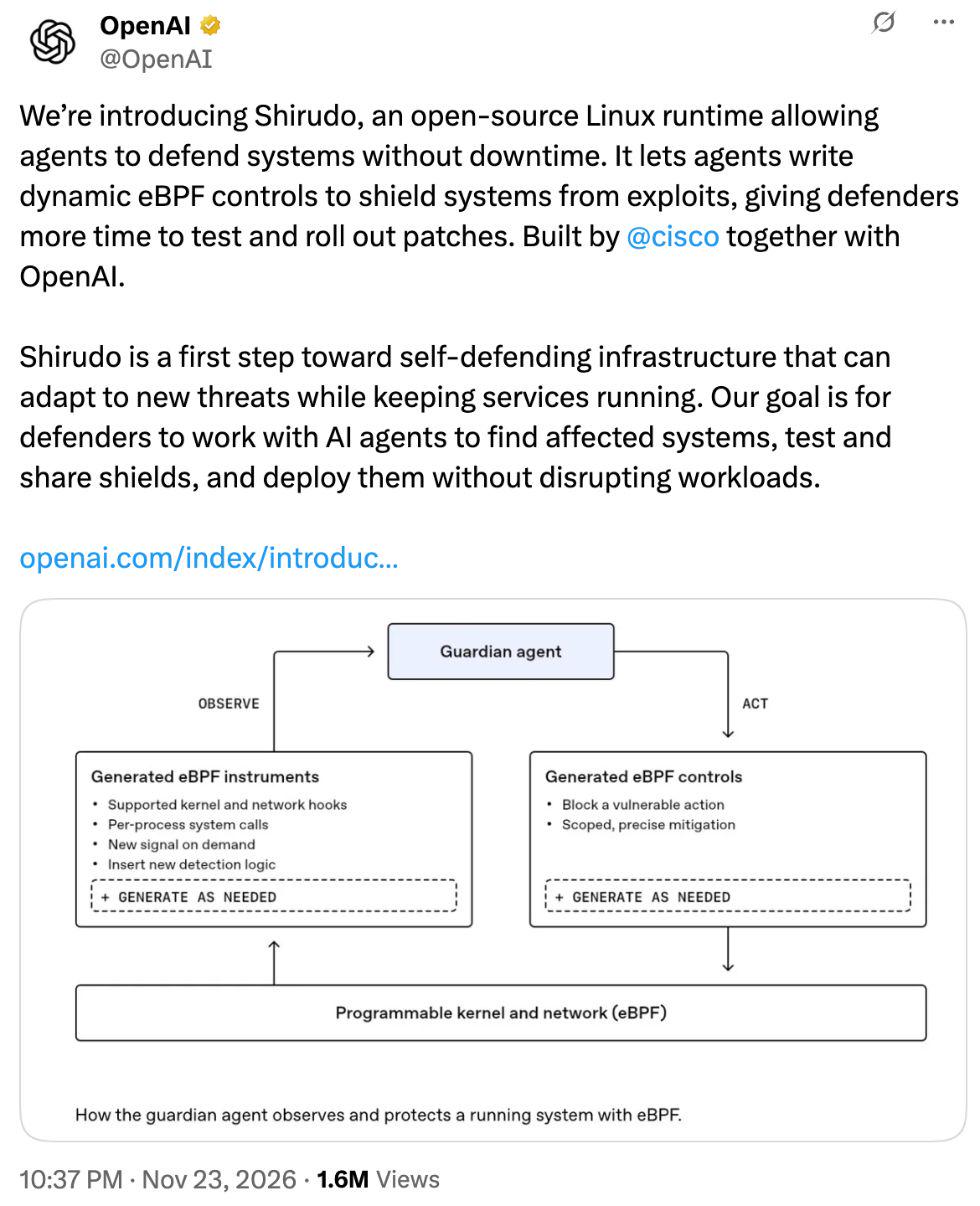
OpenAI and Cisco have introduced Shirudo, an open-source Linux runtime that enables AI agents to develop targeted security protections against exploits without requiring system restarts.
Using eBPF, agents can monitor system activity, generate security controls, and test temporary protections before deployment, with operators retaining control over what gets enforced.
In a controlled demonstration, a shield generated by Codex successfully blocked a Java4Shell exploit against a running Elasticsearch service without requiring a restart.
The goal is to close the window between vulnerability discovery and patch deployment, giving defenders more time to implement permanent fixes while keeping critical infrastructure operational.
Shirudo represents an early step toward self-defending infrastructure, where AI agents work alongside security teams to identify threats, validate mitigations, and protect running workloads.
Could agentic AI fundamentally change how organizations respond to newly discovered vulnerabilities?
Original announcement: https://openai.com/index/introducing-shirudo/
r/pwnhub • u/_cybersecurity_ • 1h ago
Reddit is great for discovering cybersecurity content, but we wanted to build a space where people could connect, collaborate, and grow together beyond individual threads.
That's why we created the PWN Discord, a dedicated community for hackers, security professionals, researchers, and anyone passionate about cybersecurity.
What you'll find inside:
Whether you're just getting started in cybersecurity or have years of industry experience, we'd love to hear from you.
How to get an invite?
Drop a comment below introducing yourself. Tell us what area of cybersecurity interests you, what you're currently working on, or what you'd like to gain from the community.
We're onboarding members gradually to maintain quality discussions and keep bots, scammers, and spam out.
Selected members will receive an invitation via DM.
Membership is completely free, with no hidden fees or paid subscriptions.
r/pwnhub • u/_cybersecurity_ • 1h ago

r/pwnhub • u/VectorWireAI • 14h ago

r/pwnhub • u/Middle-Mode3001 • 9h ago

Hey all. We run BreachLab, a hands-on wargame platform. We just shipped Wraith, our Active Directory track, and I wanted to show how it works because it's a bit different from the usual shared lab.
The setup
Every lab level boots a private Windows enterprise just for you: domain controllers, certificate authorities, SQL and SCCM servers, workstations. In the late acts you also get a second forest and an Entra ID tenant.
You connect over WireGuard from your own machine and use your own tools.Nobody else is in your domain, so nobody breaks it, resets it, or leaves loot lying around.
The path
You start as an outsider on the network and work up: name resolution poisoning, NTLM relay, Kerberos roasting, ACL and delegation abuse, ADCS, ticket and certificate forging, domain takeover, forest trust, then into the cloud and back.
Numbers
- 11 acts, 114 levels, 111 of them on a live lab
- Answers are checked against values that exist only in your session, so a writeup from someone else's lab won't solve yours
It lines up with the AD parts of CRTP, CRTE, OSCP and PNPT. It does not cover AV/EDR evasion yet. That is what the next two acts are for.
Link: https://breachlab.org/tracks/wraith
Happy to answer questions, and honest feedback on the labs is very welcome.
r/pwnhub • u/_cybersecurity_ • 21h ago
The ARTEX AI hacking tool, which automates security breaches using LLMs, is being redistributed on GitHub by third parties despite the original author taking it down in October.
Key Points:
ARTEX has emerged as a significant threat in the cybersecurity landscape by integrating large language models into the hacking process. Instead of relying solely on manual effort, the tool deploys a network of AI subagents to handle specific aspects of an attack, such as identifying vulnerabilities and extracting data. This automation allows for a complete compromise of a target system in a matter of hours, drastically reducing the time attackers need to operate.
The situation has become complicated by the tool's availability. Although the original creator took ARTEX offline in October to limit its use by bad actors, the software has not disappeared. Several individuals are now hosting and distributing the tool on GitHub, maintaining its accessibility to the public. These distributors have stated that they are not removing the repository, indicating a continued push for the tool to remain in circulation despite the security concerns it raises.
Do you think open-sourcing powerful AI hacking tools creates more risk than benefit for the security community?
Learn More: 404 Media
Want to stay updated on the latest cyber threats?
r/pwnhub • u/cve-daily • 5h ago
Severity: CRITICAL | Score: 10
TypesenseVectorStore is vulnerable to a document ID injection in its delete operation that can cause unintended documents to be deleted.
TypesenseVectorStore.doDelete(List<String>) builds a Typese...
Severity: CRITICAL | Score: 9.9
OS command injection in the a3cli restricted shell in Lantronix S2220 Series 2 allows an authenticated attacker to bypass shell restrictions and execute arbitrary operating system commands via unsanit...
Severity: CRITICAL | Score: 9.8
Several plugins for WordPress published by WP connect (Orders Sync to Airtable for WooCommerce, Add-On for Contact Form 7 to Notion, WP Sync for Notion – Notion to WordPress, Add-On for Contact Form 7...
Severity: CRITICAL | Score: 9.6
Improper input validation in Variations in Google Chrome prior to 158.0.8127.88 allowed a remote attacker to potentially execute arbitrary code outside the sandbox via a crafted HTML page. (Chromium s...
Severity: HIGH | Score: 8.8
rConfig Core 8.0.0 before 8.2.13 and rConfig Pro before 8.4.0 contain an authorization bypass vulnerability in the users API that allows authenticated users to modify other accounts. Attackers can sen...
Powered by NVD + CISA KEV | CVE Daily
r/pwnhub • u/pwn-skills • 5h ago
Type: Technique | Tactics: initial-access | Platforms: Containers, ESXi, IaaS, Linux, macOS, Network Devices, Windows
Description: Adversaries may attempt to exploit a weakness in an Internet-facing host or system to initially access a network. The weakness in the system can be a software bug, a temporary glitch, or a misconfiguration.
Exploited applications are often websites/web servers, but can also include databases (like SQL), standard services (like SMB or SSH), network device administration and management protocols (like SNMP and Smart Install), and any other system with Internet-accessible open sockets. On ESXi infrastructure, adversaries may exploit exposed OpenSLP services; they may alternatively exploit exposed VMware vCenter servers. Depending on the flaw being exploited, this may also involve Exploitation for Stealth or Exploitation for Client Execution.
If an application is hosted on cloud-based infrastructure and/or is containerized, then exploiting it may lead to compromise of the underlying instance or container. This can allow an adversary a path to access the cloud or container APIs (e.g., via the Cloud Instance Metadata API), exploit container host access via Escape to Host, or take advantage of weak identity and access management policies.
Adversaries may also exploit edge network infrastructure and related appliances, specifically targeting devices that do not support robust host-based defenses.
For websites and databases, the OWASP top 10 and CWE top 25 highlight the most common web-based vulnerabilities.
Seen in the wild:
POST requests to the ToolPane endpoint /_layouts/15/ToolPane.aspx....and 33 more examples on MITRE ATT&CK.
Full technique writeup: T1190 on MITRE ATT&CK
Have you defended against or encountered this technique? Share detections, notes, and war stories below.
r/pwnhub • u/Malwarebeasts • 12m ago

Remus deploys a malicious Chrome extension disguised as Google Sheets that leverages the victim's existing Gmail session, checks for unread messages every minute, and sends their contents to the attacker.
The particularly concerning part is that the extension can remain installed after the original malware executable exits.
While effective session revocation stops email collection, it does not remove the malicious extension. If victims sign back into Gmail through the same compromised browser, they can inadvertently restore the attacker's access.
The findings do not establish a Gmail zero-day, but they illustrate how infostealers are evolving beyond one-time credential and cookie theft into persistent email interception.
r/pwnhub • u/_clickfix_ • 23m ago

r/pwnhub • u/VectorWireAI • 1d ago

r/pwnhub • u/RoninPark • 9h ago
I've built this project called "git-repo-status" that focuses on scenarios such as some forgotten repositories that still run workflows and hold secrets, old branches keep workflow copies that can still be started or third party actions can change underneath you without any change to your own code. Quite a lot of recent supply-chain attacks used exactly these gaps.
This project scans every repository in a github organisation (or individual account) in a single run and tells you which ones need a closer look and why, for ex:
- workflow flaws (injection, risky triggers, unsafe checkouts), this one is solely carried out using zizmor
- old workflow copies on other branches and which secrets they can reach
- who can actually read secrets? -
- upstream actions such as moved tags, known vulnerabilities, gone or renamed owners and every place each one is used
- history tampering like force pushes, backdated commits etc.
- Known attack indicators, risky settings and dead repositories that are still active
- and many more..
The project requires only a github token with read-only permissions, it never changes anything or runs repository code.
Github Repository: https://github.com/Himan10/git-repo-status
r/pwnhub • u/VectorWireAI • 14h ago

Research on abusing WebDAV for NTLM relay in Active Directory environments, covering both ADIDNS and ADIDNS-less approaches.
r/pwnhub • u/_cybersecurity_ • 12h ago

r/pwnhub • u/_cybersecurity_ • 21h ago
A Peruvian call center manager was sentenced to eight years in prison for leading a multi-year fraud scheme that stole $15 million from over 30,000 Spanish-speaking Americans by impersonating government officials.
Key Points:
Carla Magaly Alcedo Mendoza, a 45-year-old call center operator from Lima, Peru, has been sentenced to eight years in federal prison for her role in a massive fraud ring. Between January 2013 and December 2018, she managed call centers that contacted Spanish-speaking Americans, initially offering free services or products. The operators then impersonated US government officials and lawyers, telling victims they were contractually obligated to pay large sums to receive these items. When victims hesitated, the scammers threatened them with court action, arrest, and immigration consequences to force payment.
The Department of Justice stated that the scheme defrauded more than 30,000 residents of the United States out of $15 million. Alcedo was arrested in March 2023 and extradited to the US in April 2025. She is the tenth defendant from Peru to be sentenced in this case, joining 14 other call center and distribution center owner-operators who have already been convicted. Acting US Attorney Yara Lorenzo Klukas noted that the criminals deliberately targeted Spanish-speaking communities using fear and intimidation to steal millions of dollars.
This sentencing comes amid a broader rise in impersonation scams in the US. The Federal Trade Commission warned in June 2026 that Americans lost $3.5 billion to impersonation scams in 2025, a figure that nearly tripled since 2020. Of that total, approximately $920 million was stolen by government impersonators. Additionally, the FBI reported in its 2025 Internet Crime Report that US victims lost nearly $21 billion to cyber-enabled crimes throughout the year.
How effective are current consumer protection measures against phone-based impersonation scams targeting non-English speaking communities?
Learn More: Bleeping Computer
Want to stay updated on the latest cyber threats?
r/pwnhub • u/_cybersecurity_ • 21h ago

r/pwnhub • u/_cybersecurity_ • 21h ago
A critical vulnerability in PHP allows attackers to achieve remote code execution by corrupting session files during interrupted writes, a flaw that shares its root cause with the earlier PHP2Shell bug.
Key Points:
Cybersecurity firm Depthfirst identified a critical flaw in PHP that allows attackers to gain remote code execution by manipulating how the language handles session files. The issue arises because PHP overwrites session files from the beginning without clearing the previous content first. If the write process is interrupted, such as during a multipart upload or a memory limit failure, the file ends up containing a mix of fresh session data and remnants of the old session. This corrupted data can be interpreted as serialized objects, which, when processed in a subsequent session, allow an attacker to execute arbitrary code.
Are you running any PHP applications that rely on session storage, and have you updated to the latest patched versions?
Learn More: Security Week
Want to stay updated on the latest cyber threats?
r/pwnhub • u/_cybersecurity_ • 13h ago
Have you been building something cool in security or ethical hacking lately? The PWN Community wants to put your work in the spotlight!
We’re curating our next edition of the PWN Newsletter and are looking for member-built projects to feature in front of 8,500+ hackers, researchers, and cybersecurity enthusiasts.
What we’re looking for:
Why submit?
How to apply:
👉 Submit your project here: https://www.reddit.com/r/pwnhub/submit
Know someone in the community building something awesome? Tag them below or share this post so they don't miss out! 👇
r/pwnhub • u/_cybersecurity_ • 21h ago
The FBI has issued a warning that the open source AI framework ARTEX is being used by hackers to conduct rapid, automated cyberattacks against critical industries worldwide.
Key Points:
ARTEX is an open source framework written in Go that allows users to connect large language models to create AI agents for various hacking tasks. Unlike traditional tools that require significant manual effort, ARTEX automates the workflow from initial reconnaissance to data exfiltration. The FBI highlights that this automation allows attacks to be executed at machine speed, meaning a single operator can set up the tool and let it run, potentially compromising a target in a matter of hours rather than days or weeks. This efficiency has made it a favorite among both state-sponsored and financially motivated hackers who are targeting high-value sectors such as defense, finance, and healthcare.
How should organizations adjust their security strategies to detect and defend against AI-driven hacking tools like ARTEX?
Learn More: 404 Media
Want to stay updated on the latest cyber threats?