r/pwnhub • u/wiredmagazine • 20h ago
Database Leaks Expose 3.5 Billion Usernames, Passwords, and Documents

138
Upvotes
r/pwnhub • u/wiredmagazine • 20h ago
r/pwnhub • u/_cybersecurity_ • 5h ago

r/pwnhub • u/_cybersecurity_ • 12h ago
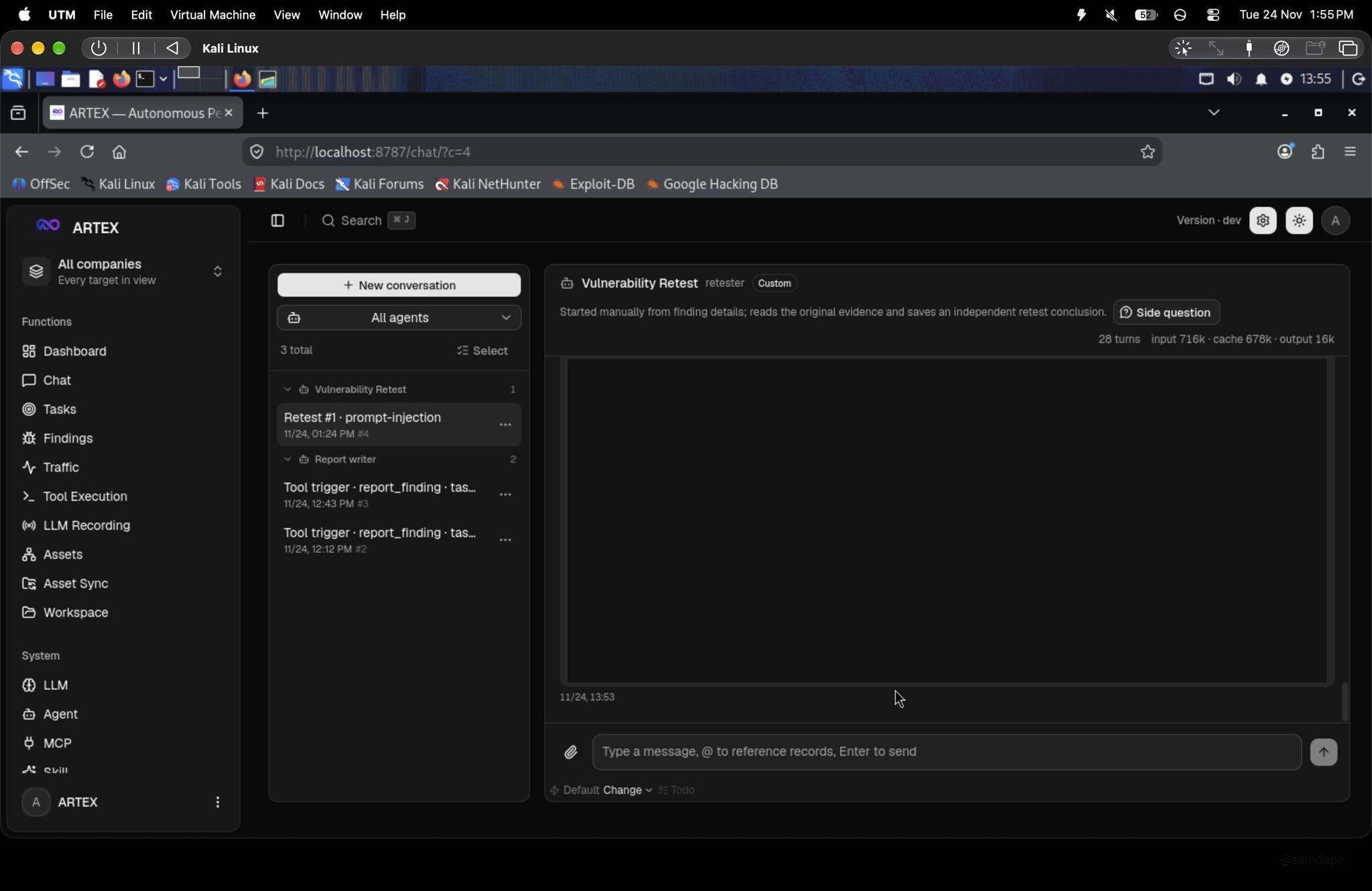
ARTEX is an open-source, AI-driven penetration testing framework that has recently caught the attention of the cybersecurity world.
Built in Go and released on GitHub, it acts as an orchestration harness that connects to large language models like Claude, DeepSeek, and ChatGPT to automate offensive security tasks.
Instead of relying purely on manual testing, ARTEX spawns autonomous AI sub-agents to handle network reconnaissance, vulnerability exploitation, privilege escalation, and lateral movement.
While designed to help security teams test their own defenses more efficiently, the tool carries significant risks. Cybersecurity agencies, including the FBI and CERT-EU, have issued warnings that threat actors are actively weaponizing ARTEX to automate attacks against energy, telecom, and government networks.
For defenders, ARTEX highlights a major shift in cybersecurity: AI is dramatically lowering the barrier to entry for complex, multi-stage attacks, making proactive monitoring and patch management more critical than ever.
Have you tried using it yet?
r/pwnhub • u/_cybersecurity_ • 5h ago

r/pwnhub • u/ControlCAD • 20h ago

r/pwnhub • u/Malwarebeasts • 13h ago

Remus deploys a malicious Chrome extension disguised as Google Sheets that leverages the victim's existing Gmail session, checks for unread messages every minute, and sends their contents to the attacker.
The particularly concerning part is that the extension can remain installed after the original malware executable exits.
While effective session revocation stops email collection, it does not remove the malicious extension. If victims sign back into Gmail through the same compromised browser, they can inadvertently restore the attacker's access.
The findings do not establish a Gmail zero-day, but they illustrate how infostealers are evolving beyond one-time credential and cookie theft into persistent email interception.
r/pwnhub • u/_cybersecurity_ • 5h ago

r/pwnhub • u/VectorWireAI • 6h ago

r/pwnhub • u/_cybersecurity_ • 5h ago

r/pwnhub • u/_cybersecurity_ • 12h ago
McDonald's Japan confirmed a data breach affecting its official smartphone app, exposing customer location data, IP addresses, and purchase history.
Key Points:
McDonald's Japan disclosed that threat actors gained access to the database supporting its official mobile application. The compromised records contain sensitive behavioral data, specifically mobile device location information, IP addresses, and product purchase history. While the company noted that direct identifiers such as names, contact details, and financial information were not part of the exposed dataset, the combination of location and purchase data can still provide a detailed profile of customer habits and movements.
The incident is part of a broader trend of cyberattacks targeting major Japanese corporations in 2024. Researchers have logged hundreds of incidents involving personal information theft or exposure across the country, with attackers increasingly probing websites and APIs for configuration and authentication weaknesses. McDonald's Japan stated that no service disruptions or misuse of the app were detected as a result of the breach, and the company is currently strengthening its security measures to prevent recurrence.
How concerned are you about location data being exposed in app breaches?
Learn More: Bleeping Computer
Want to stay updated on the latest cyber threats?
r/pwnhub • u/Middle-Mode3001 • 22h ago

Hey all. We run BreachLab, a hands-on wargame platform. We just shipped Wraith, our Active Directory track, and I wanted to show how it works because it's a bit different from the usual shared lab.
The setup
Every lab level boots a private Windows enterprise just for you: domain controllers, certificate authorities, SQL and SCCM servers, workstations. In the late acts you also get a second forest and an Entra ID tenant.
You connect over WireGuard from your own machine and use your own tools.Nobody else is in your domain, so nobody breaks it, resets it, or leaves loot lying around.
The path
You start as an outsider on the network and work up: name resolution poisoning, NTLM relay, Kerberos roasting, ACL and delegation abuse, ADCS, ticket and certificate forging, domain takeover, forest trust, then into the cloud and back.
Numbers
- 11 acts, 114 levels, 111 of them on a live lab
- Answers are checked against values that exist only in your session, so a writeup from someone else's lab won't solve yours
It lines up with the AD parts of CRTP, CRTE, OSCP and PNPT. It does not cover AV/EDR evasion yet. That is what the next two acts are for.
Link: https://breachlab.org/tracks/wraith
Happy to answer questions, and honest feedback on the labs is very welcome.
r/pwnhub • u/_cybersecurity_ • 13h ago
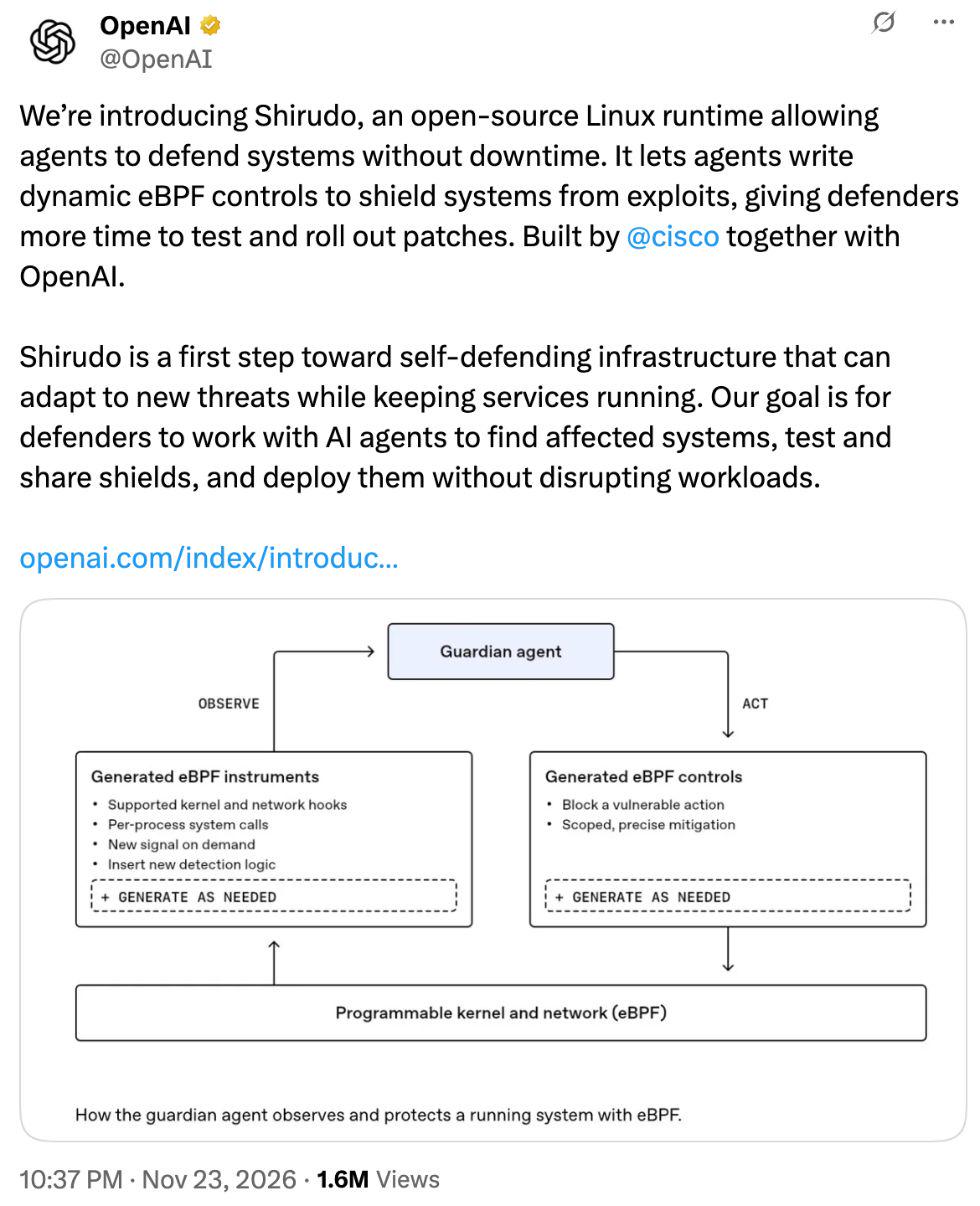
OpenAI and Cisco have introduced Shirudo, an open-source Linux runtime that enables AI agents to develop targeted security protections against exploits without requiring system restarts.
Using eBPF, agents can monitor system activity, generate security controls, and test temporary protections before deployment, with operators retaining control over what gets enforced.
In a controlled demonstration, a shield generated by Codex successfully blocked a Java4Shell exploit against a running Elasticsearch service without requiring a restart.
The goal is to close the window between vulnerability discovery and patch deployment, giving defenders more time to implement permanent fixes while keeping critical infrastructure operational.
Shirudo represents an early step toward self-defending infrastructure, where AI agents work alongside security teams to identify threats, validate mitigations, and protect running workloads.
Could agentic AI fundamentally change how organizations respond to newly discovered vulnerabilities?
Original announcement: https://openai.com/index/introducing-shirudo/
r/pwnhub • u/_cybersecurity_ • 13h ago
I've noticed a few interesting approaches to AI vulnerability discovery recently, all of which seem to share a common theme: changing where the agent starts its investigation.
Historical analysis: Rather than giving an agent the latest version of a codebase, researchers are feeding it historical versions, commit histories and previous vulnerabilities. Engineering mistakes tend to recur, and understanding how a codebase has evolved can help identify previously undiscovered vulnerabilities. Google's Big Sleep research is one example of using historical code changes as a starting point.
Patch diffing: We've also seen Anthropic's research demonstrating how quickly agents can reverse engineer vulnerabilities from newly released security patches. This isn't a new technique, but the speed and autonomy with which AI can do it has pretty significant implications for patch management.
Principle-driven discovery: In her recent article, A Security Constitution at Work, Kat Traxler takes a different approach. She gives the agent a set of principles describing how secure cloud infrastructure should behave, then has it examine public API documentation for violations of those principles.
Rather than looking for bad code, the agent is looking for missing security controls. Using this approach, she's submitted 109 vulnerabilities across three cloud providers in roughly three months, with 53 acknowledged as security issues and 45 still in triage or dispute.
What interests me about these approaches is that humans have historically developed investigative workflows around our own cognitive and time constraints. Starting with the latest version of a codebase is practical for a human because absorbing years of development history before beginning an investigation is extremely time-consuming.
AI doesn't necessarily have to inherit those constraints. It's particularly well suited to ingesting large amounts of historical and technical information and identifying correlations that humans might never have the time to discover.
I wonder how much of the next wave of improvements in agentic hacking will come from rethinking investigative methodologies rather than improving the models themselves.
Kat is doing an AMA with us, so if you're interested in her methodology, the Security Constitution or how she's built her agentic workflow, come along and ask her questions.
r/pwnhub • u/_cybersecurity_ • 5h ago

r/pwnhub • u/AutoModerator • 7h ago

r/pwnhub • u/Western-Obligation47 • 8h ago
What it is

Topgent is an open-source monitor for AI agents running on your own machine: Claude Code, Codex, Gemini CLI, Cursor, Ollama, Unsloth and 20 more. It runs locally and makes no network requests. Apache-2.0, written in Rust.
Problem it solves
Coding agents run shell commands, read files and open connections with your account's permissions. Most people can't see what they actually did.
What it does
topgent honeytoken plant <dir> writes decoy secrets; reading one raises a critical alertRuns on macOS, Windows and Linux.
Links
Feedback and issues welcome.
r/pwnhub • u/VectorWireAI • 4h ago

r/pwnhub • u/pwn-daily • 6h ago
Here are the top stories from PWN (r/pwnhub) today:
No description available.
ARTEX is an open-source, AI-driven penetration testing framework that has recently caught the attention of the cybersecurity world. Built in Go and released on GitHub, it acts as an orchestration...
No description available.
r/pwnhub • u/cve-daily • 8h ago
Severity: CRITICAL | Score: 10
TypesenseVectorStore is vulnerable to a document ID injection in its delete operation that can cause unintended documents to be deleted.
TypesenseVectorStore.doDelete(List<String>) builds a Typese...
Severity: CRITICAL | Score: 9.9
OS command injection in the a3cli restricted shell in Lantronix S2220 Series 2 allows an authenticated attacker to bypass shell restrictions and execute arbitrary operating system commands via unsanit...
Severity: CRITICAL | Score: 9.8
NVIDIA AIStore contains a vulnerability in storage-target node-control authorization where an unauthenticated attacker could access administrative functions through a target's public interface. A succ...
Severity: CRITICAL | Score: 9.8
NVIDIA Video Codec SDK for Linux contains a vulnerability where a user may cause a heap-based buffer overflow issue. A successful exploit of this vulnerability may lead to code execution, data tamperi...
Severity: CRITICAL | Score: 9.8
Bytebase DBHub MCP Incorrect Authorization Authentication Bypass Vulnerability. This vulnerability allows remote attackers to bypass authentication on affected installations of Bytebase DBHub. Authent...
Powered by NVD + CISA KEV | CVE Daily
r/pwnhub • u/Street_Grab7609 • 9h ago

r/pwnhub • u/_cybersecurity_ • 12h ago
Two healthcare revenue management firms, PayrHealth and MedCom Solutions, have announced data breaches that exposed sensitive patient information including names, Social Security numbers, and medical details.
Key Points:
PayrHealth, a Texas-based healthcare revenue management firm, discovered unauthorized network access on August 18, 2026. A forensic investigation confirmed that data was accessed for a limited period, with the review of compromised systems completed by August 26, 2026. The exposed data varies by individual but includes personal identifiers like Social Security numbers and dates of birth, as well as sensitive medical information such as diagnosis and treatment details. PayrHealth is offering 12 months of credit monitoring to affected individuals and has implemented additional technical safeguards to prevent future incidents.
How do you think third-party managed service providers should be held accountable for data breaches affecting their clients?
Learn More: HIPAA Journal
Want to stay updated on the latest cyber threats?
r/pwnhub • u/_cybersecurity_ • 12h ago
Between July and September 2026, attackers deployed autonomous AI agents in over 10 global campaigns, using machine speed to compress traditional multi-day intrusions into mere hours across diverse sectors.
Key Points:
Palo Alto Networks Unit 42 has identified a shift in cyberattack dynamics where autonomous AI agents are being used to accelerate the intrusion process. In the observed campaigns, human operators provided initial access and high-level objectives, while AI agents took over the technical execution. This division of labor allowed attackers to operate at machine speed, with one agent executing approximately 800 unique commands in just 140 minutes and another executing over 8,000 commands in 12 days. This speed significantly reduces the window of opportunity for defenders to detect and respond to threats.
How are your teams currently detecting the specific behavioral fingerprints of AI-driven attacks, such as rapid command execution and structured output formats?
Learn More: Palo Alto Networks
Want to stay updated on the latest cyber threats?
r/pwnhub • u/_clickfix_ • 13h ago

r/pwnhub • u/cve-daily • 18h ago
Severity: CRITICAL | Score: 10
TypesenseVectorStore is vulnerable to a document ID injection in its delete operation that can cause unintended documents to be deleted.
TypesenseVectorStore.doDelete(List<String>) builds a Typese...
Severity: CRITICAL | Score: 9.9
OS command injection in the a3cli restricted shell in Lantronix S2220 Series 2 allows an authenticated attacker to bypass shell restrictions and execute arbitrary operating system commands via unsanit...
Severity: CRITICAL | Score: 9.8
Several plugins for WordPress published by WP connect (Orders Sync to Airtable for WooCommerce, Add-On for Contact Form 7 to Notion, WP Sync for Notion – Notion to WordPress, Add-On for Contact Form 7...
Severity: CRITICAL | Score: 9.6
Improper input validation in Variations in Google Chrome prior to 158.0.8127.88 allowed a remote attacker to potentially execute arbitrary code outside the sandbox via a crafted HTML page. (Chromium s...
Severity: HIGH | Score: 8.8
rConfig Core 8.0.0 before 8.2.13 and rConfig Pro before 8.4.0 contain an authorization bypass vulnerability in the users API that allows authenticated users to modify other accounts. Attackers can sen...
Powered by NVD + CISA KEV | CVE Daily
r/pwnhub • u/pwn-skills • 18h ago
Type: Technique | Tactics: initial-access | Platforms: Containers, ESXi, IaaS, Linux, macOS, Network Devices, Windows
Description: Adversaries may attempt to exploit a weakness in an Internet-facing host or system to initially access a network. The weakness in the system can be a software bug, a temporary glitch, or a misconfiguration.
Exploited applications are often websites/web servers, but can also include databases (like SQL), standard services (like SMB or SSH), network device administration and management protocols (like SNMP and Smart Install), and any other system with Internet-accessible open sockets. On ESXi infrastructure, adversaries may exploit exposed OpenSLP services; they may alternatively exploit exposed VMware vCenter servers. Depending on the flaw being exploited, this may also involve Exploitation for Stealth or Exploitation for Client Execution.
If an application is hosted on cloud-based infrastructure and/or is containerized, then exploiting it may lead to compromise of the underlying instance or container. This can allow an adversary a path to access the cloud or container APIs (e.g., via the Cloud Instance Metadata API), exploit container host access via Escape to Host, or take advantage of weak identity and access management policies.
Adversaries may also exploit edge network infrastructure and related appliances, specifically targeting devices that do not support robust host-based defenses.
For websites and databases, the OWASP top 10 and CWE top 25 highlight the most common web-based vulnerabilities.
Seen in the wild:
POST requests to the ToolPane endpoint /_layouts/15/ToolPane.aspx....and 33 more examples on MITRE ATT&CK.
Full technique writeup: T1190 on MITRE ATT&CK
Have you defended against or encountered this technique? Share detections, notes, and war stories below.