r/spaceporn • u/4x6x8 • 10h ago
Amateur/Unedited Jupiter stone
We found this stone on the beach and it lives rent free in our house as the Jupiter stone
r/spaceporn • u/4x6x8 • 10h ago
We found this stone on the beach and it lives rent free in our house as the Jupiter stone
r/spaceporn
•
u/Busy_Yesterday9455
•
12h ago
Credit: guzmanramoss
r/spaceporn • u/Neaterntal • 17h ago
Astronomers discover remarkable triple-star system just 28 light-years from Earth
.
Image
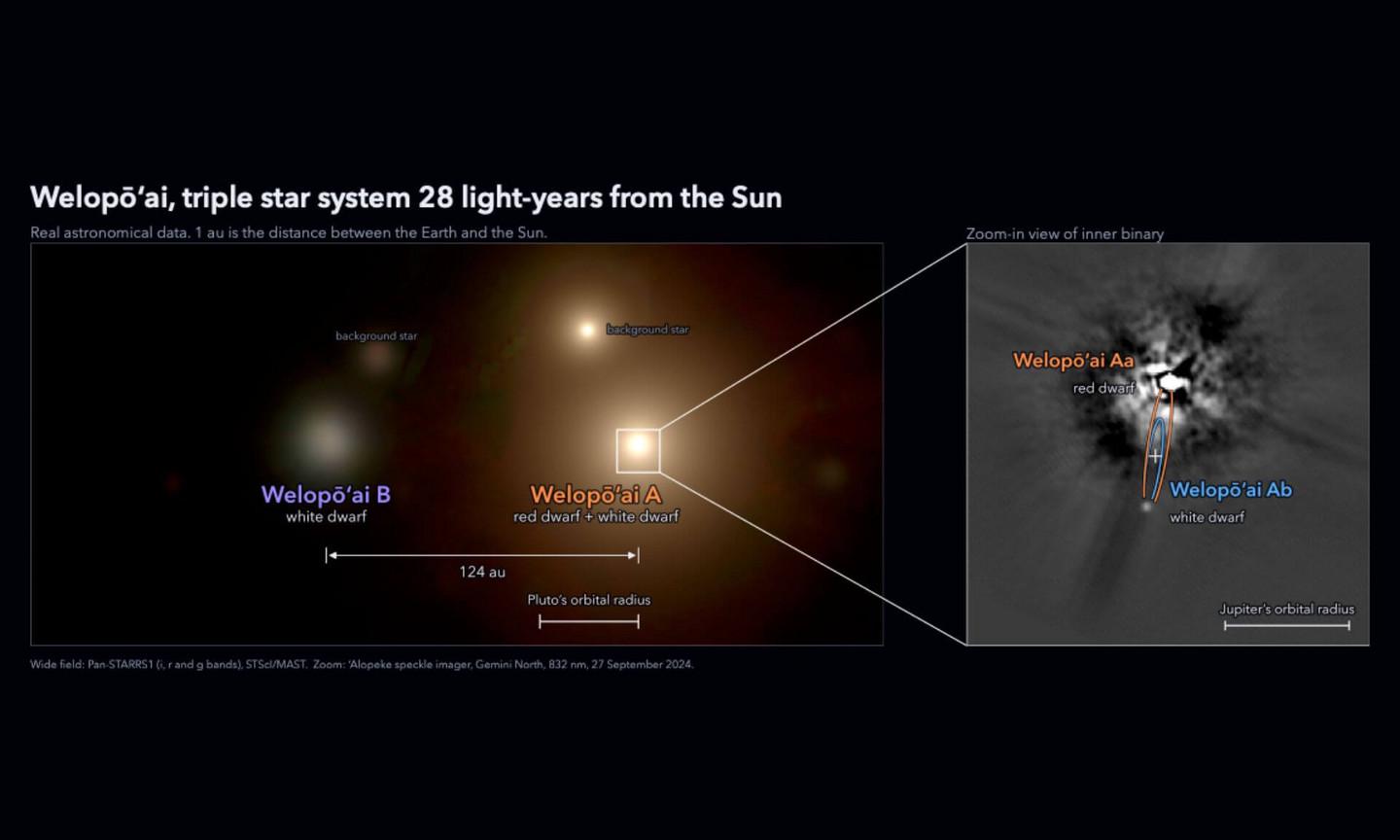
Observations of the Welopōʻai triple-star system, located 28 light-years from Earth. The image on the left shows the two components of the system: Welopōʻai A, a closely orbiting red dwarf and white dwarf pair, and Welopōʻai B, a second white dwarf located much farther away. The image on the right provides a close-up view of the inner pair, revealing the faint white dwarf companion (Ab) detected using the Gemini North telescope's ‘Alopeke instrument. The overlaid curves illustrate the stars' orbital paths.
Photo : Pan-STARRS1/STScI/MAST (left); International Gemini Observatory/NSF NOIRLab (right). Graphic compilation: Étienne Artigau and Heidi White (UdeM/IREx)
.
.
Astronomers have discovered an extraordinary stellar system just 28 light-years from Earth that challenges our understanding of how stars live, die and interact as they evolve.
Given the name Welopōʻai, this unusual triple-star system was discovered by an international team of scientists led by the Trottier Institute for Research on Exoplanets (IREx) at Université de Montréal.
They detail their discovery in a study published today in Astronomy & Astrophysics.
The system contains two white dwarfs, the extremely dense remnants of Sun-like stars that have exhausted their fuel, and a red dwarf, a star much dimmer than the Sun.
The scientists stumbled upon this remarkable configuration, unlike anything else known in the Sun’s neighbourhood, while searching for planets around the red dwarf.
“We were actually looking for planets,” explained IREx researcher Étienne Artigau, the study’s lead author. “Instead, we found something much more surprising.”
.
The discovery began with the SPectropolarimètre InfraROUge (SPIRou) instrument at the Canada-France-Hawaii Telescope on Maunakea, Hawaiʻi. SPIRou is designed to detect exoplanets by measuring the tiny changes in a star’s velocity caused by orbiting planets.
But one nearby red dwarf behaved differently: the scientists detected velocity variations of nearly 16 kilometres per second, more than a thousand times larger than expected. After several years of follow-up observations, the team established that the unseen companion had a mass greater than half that of the Sun.
“The unusual combination of high mass and very low brightness left only one plausible explanation: it was the remnant of a dead star,” explained Charles-Antoine Parent, an undergraduate student at Université Laval and co-author of the study.
“The most likely explanation was a white dwarf, although a neutron star or even a black hole couldn't be ruled out.”
The team turned to the Gemini North telescope, also on Maunakea.
Using high-resolution images from its ‘Alopeke instrument, they directly detected a faint companion: a white dwarf. A second, much more distant white dwarf was already known to be part of the system.
A red dwarf and a white dwarf therefore orbit close to one another, while the second white dwarf orbits the pair. No comparable system is known within 100 light-years of Earth.
.
.
More
Paper
https://www.aanda.org/articles/aa/full_html/2026/11/aa61214-26/aa61214-26.html
r/spaceporn • u/Neaterntal • 13h ago
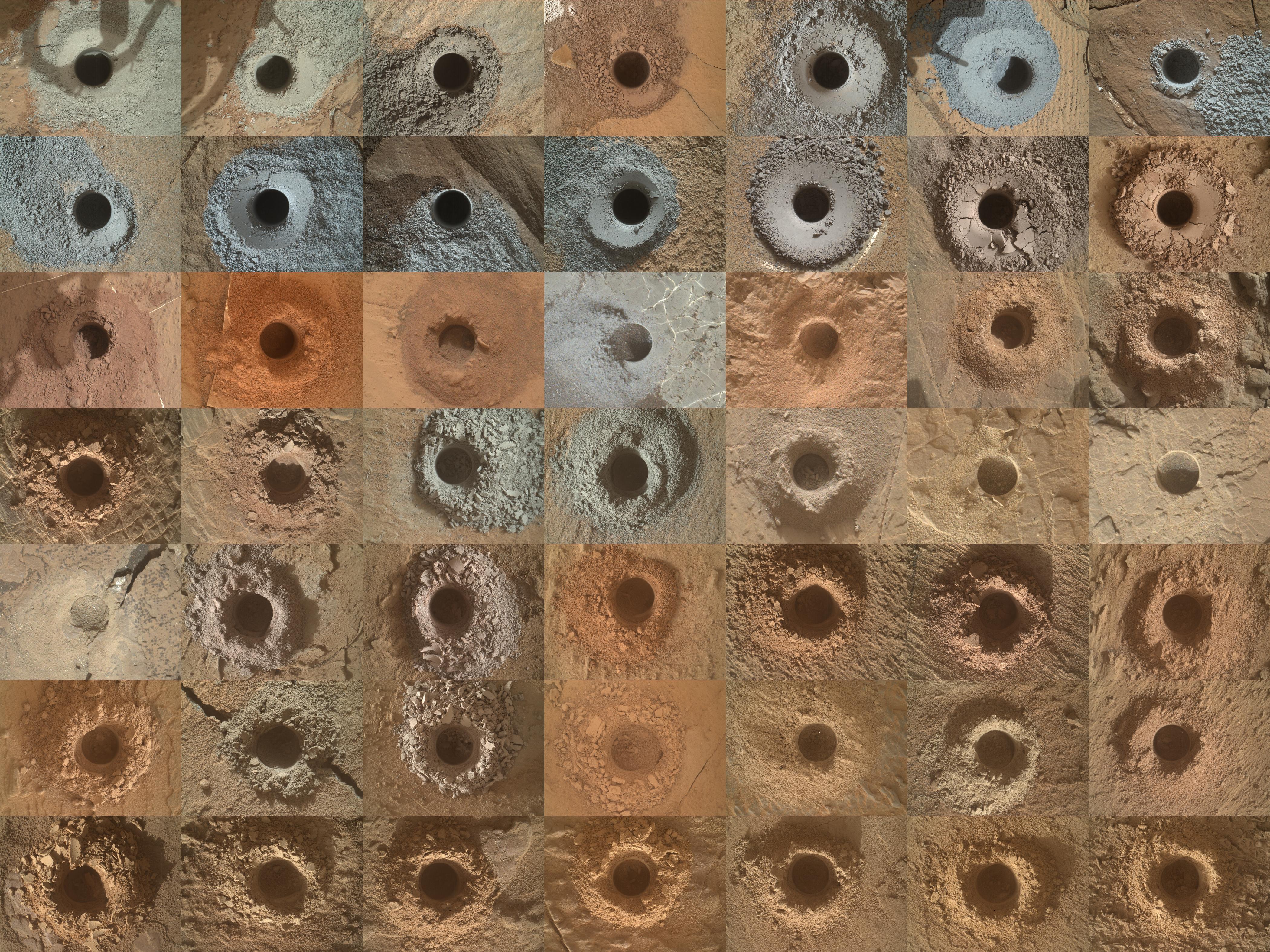
This Nov. 16 collage shows 49 drill holes captured by NASA’s Curiosity Mars rover as of November 2026. Each hole represents a sample collected from rocks on the Martian surface; Curiosity’s drill, located on the end of its robotic arm, drops pulverized rock samples into instruments in its belly that analyze their composition.
Each hole marks a location where the rover used its robotic arm to drill and collect powdered rock for analysis, building a remarkable record of the Martian surface.
.
Since landing in August 2012, Curiosity has investigated how Mars changed from a world that once supported lakes and streams into the cold, dry planet we see today. Its onboard laboratories analyze the mineral and chemical composition of collected samples, helping scientists reconstruct ancient environments and assess whether they could have supported microbial life. Together, these 49 drill holes represent more than a decade of scientific discovery, one carefully selected rock at a time.
.
https:// x. com/SETIInstitute/status/2124896144115302604
Image credit: NASA/JPL-Caltech/MSSS
https://www.nasa.gov/image-article/nasas-curiosity-mars-rover-collects-samples/
.
previous post
r/spaceporn • u/Exr1t • 3h ago
Taken Using 1:00 Video Stack (Seestar S50)
Edited In PS Express.
r/spaceporn • u/Grahamthicke • 2h ago
r/spaceporn
•
u/Busy_Yesterday9455
•
23h ago
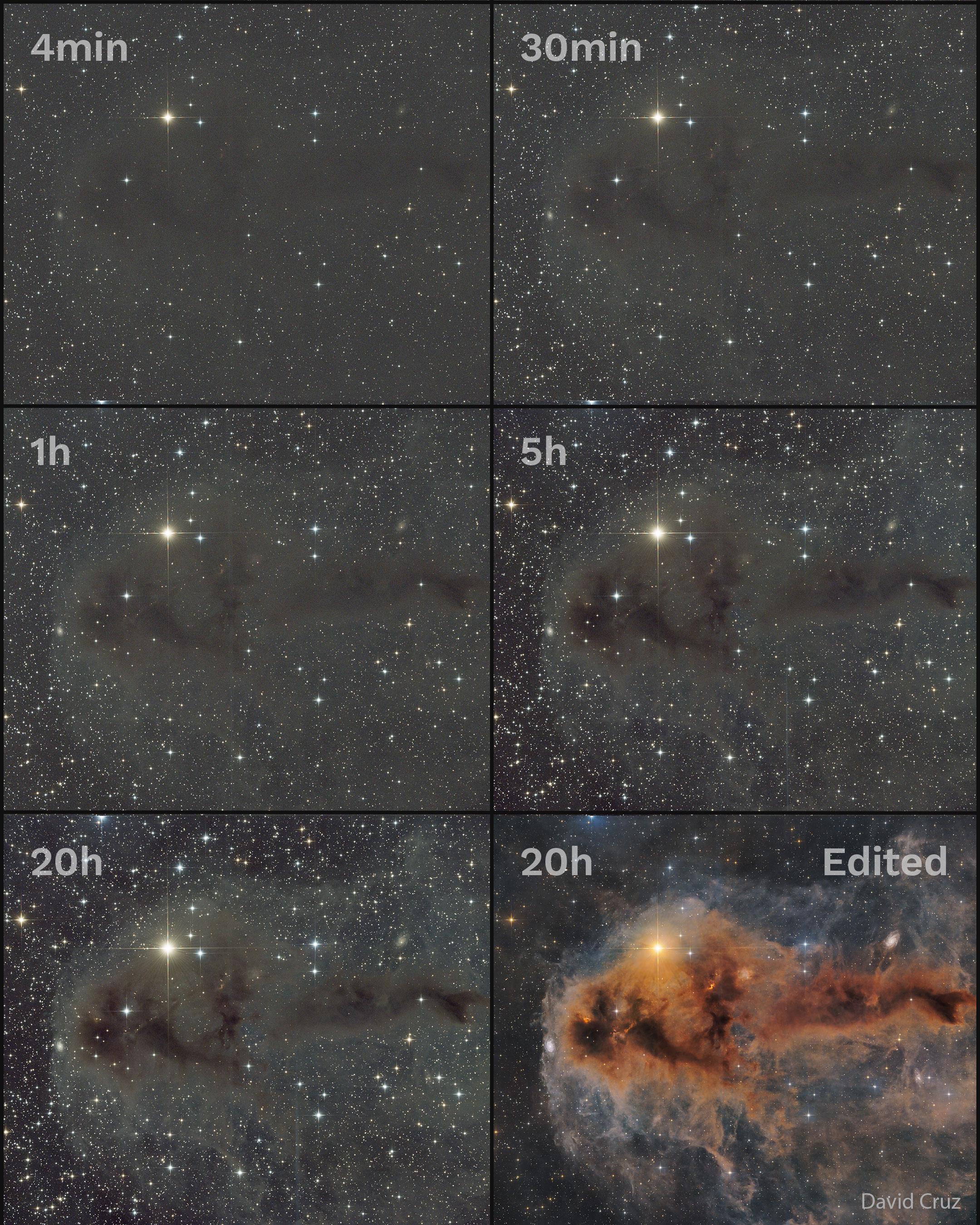
In the direction of the featured image, after only a few minutes, you would begin to notice some regions without stars. As your staring continued, the dark region would become better defined, and after a full 20 hours, you would notice a strange dark structure. To celebrate, you use digital processing to brighten the image and enhance the colors. At the end, you might have an excellent image of Lynds 1251 (LDN 1251), a star-forming region laced with opaque brown-appearing interstellar dust.
Also known as the Rotten Fish Nebula, LDN 1251 is home not only to young stars and dust, but also, your long staring indicates, energetic shock waves, fast stellar winds, and powerfully beamed jets.
Credit: David Cruz
r/spaceporn • u/the_one_99_ • 16h ago
Link to website https://noirlab.edu/public/news/noirlab2629/?lang
Wispy blue ribbons of stellar matter float deep in the cosmos, appearing like the waving tails of betta fish. This stunning snapshot features the best, most detailed view of supernova remnant SNR G295.5+09.7 to date. It was captured by the U.S. Department of Energy-fabricated Dark Energy Camera, mounted on the U.S. National Science Foundation Víctor M. Blanco 4-meter Telescope at Cerro Tololo Inter-American Observatory in Chile.
r/spaceporn • u/ojosdelostigres • 20h ago
r/spaceporn • u/Big-Computer5628 • 21h ago
r/spaceporn • u/Busy_Yesterday9455 • 17h ago
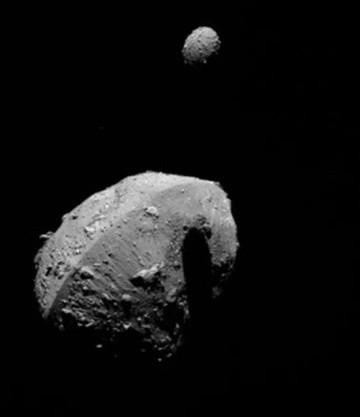
Shown in this early view of the Didymos binary asteroids from the European Space Agency’s Hera mission for planetary defence.
The smaller Dimorphos moonlet (top) is seen casting its shadow across part of its Didymos parent body (bottom), to blank out the Sun across the shaded stretch of rocky surface.
Credit: ESA
r/spaceporn • u/Professor_Moraiarkar • 17h ago
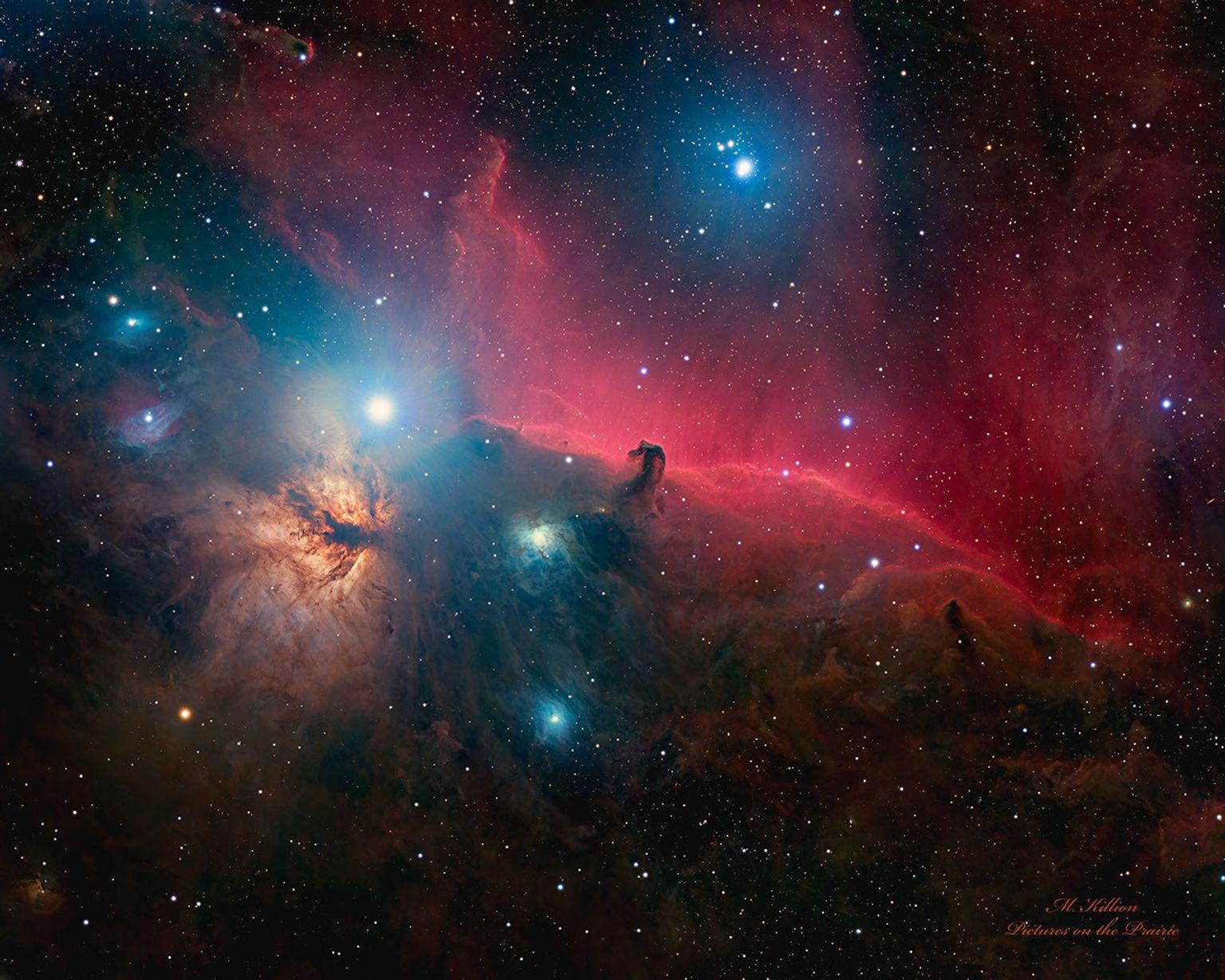
The brightest star, left of the center, is blue Alnitak (the Girdle): a triple star system best known for being the easternmost star in Orion's Belt. The instantly recognizable shape of a dark horse's head at the center is the aptly named Horsehead Nebula. It is about five light-years tall and lies approximately 1,500 light-years away. It is made of dust and gas that obscure the red glow behind it, which is caused by hydrogen gas being ionized by the bright star Sigma Orionis at the top.
The orange nebula with dark filaments on the left is the Flame Nebula. Closer to the Horsehead, the blue reflection nebula NGC 2023 is actively forming stars.
The data for this "painting" were collected for almost six hours at the Utah Desert Remote Observatories, but the equipment was remotely controlled by the astrophotographer from his home, over 2,000 km away in Illinois.
r/spaceporn • u/Busy_Yesterday9455 • 8h ago
Link to the science release on ESA website
On 21 November, starting at 18:24 UTC, BepiColombo achieved Mercury orbit insertion (MOI), the second major milestone of its planetary arrival phase.
As soon as the signal from the spacecraft was re-established after a scheduled loss of contact, the Mission Control Team at the European Space Operations Centre (ESOC) in Darmstadt, Germany, saw that the spacecraft had entered safe mode.
Credit: ESA
r/spaceporn • u/Busy_Yesterday9455 • 18h ago
Credit: KAGAYA