r/spaceporn • • 1h ago

Amateur/Composite Neptune & Its Largest Moon, Triton.

Post image
31 Upvotes

Taken On Seestar S50 Using 10:00 Raw Video Composite & A 2:00 Stack In Stargazing Mode Composited Together In PS Express.


r/spaceporn • • 1h ago

NASA NASA's Opportunity rover drove into the Victoria Crater on Mars

Post image
402 Upvotes

Credit: NASA/JPL-Caltech/LANL/CNES/CNRS/IRAP/DPA/MSSS/Jason Major


r/spaceporn • • 2h ago

Pro/Processed Gravitational lensed quasar [LAM2018] J1721+8842 with JWST NIRCam

Post image
294 Upvotes

Image

​Detailed view of the lensing system with 6 copies of the same quasar and the arcs of the lensed galaxy.​

.

F200W, F356W

This lensed #quasar is special. Previously thought to be a double quasar, it is now believed to be one quasar lensed two times, resulting in 6 images.

Processed by Melina

https://bsky.app/profile/melina-iras07572.bsky.social/post/3n33jnwliek2t


r/spaceporn • • 12h ago

Pro/Processed JUST IN: Astronomers have discovered the most distant quasar to date

Post image
1.9k Upvotes

Link to the science release on ESA website

The European Space Agency’s Euclid space telescope has discovered the most distant quasar to date (small red dot near the centre): a rare 360 million-sun-mass galactic core seen just 630 million years after the Big Bang.

The discovery breaks Euclid’s own previous record, announced only a few months ago, by peering back in time an additional 40 million years. It also raises a compelling question: how could such an enormous black hole have formed and grown so rapidly after the Big Bang?

Credit: ESA/Euclid/Euclid Consortium/NASA, Wolf et al. 2026


r/spaceporn • • 13h ago

Narrowband Galaxies Battle in the NGC 7771 Group, image by Roberto Marinoni

Post image
561 Upvotes

r/spaceporn • • 18h ago

NASA M16 in X-ray & Infrared Light (Credit: X-ray: NASA/CXO/SAO; Infrared: NASA/ESA/CSA/STScI; Image processing: NASA/CXC/SAO/L. Frattare)

Post image
385 Upvotes

r/spaceporn • • 19h ago

Amateur/Composite Clouds Cleared For About An Hour, Giving Luna The Chance To Show Her Bright Face!

Post image
294 Upvotes

Taken Using 1:00 Video Stack (Seestar S50)

Edited In PS Express.


r/spaceporn • • 1d ago

Pro/Processed After an orbital insertion glitch, BepiColombo is now safely in Mercury orbit

Post image
1.8k Upvotes

Link to the science release on ESA website

On 21 November, starting at 18:24 UTC, BepiColombo achieved Mercury orbit insertion (MOI), the second major milestone of its planetary arrival phase.

As soon as the signal from the spacecraft was re-established after a scheduled loss of contact, the Mission Control Team at the European Space Operations Centre (ESOC) in Darmstadt, Germany, saw that the spacecraft had entered safe mode.

Credit: ESA


r/spaceporn • • 1d ago

Amateur/Unedited Jupiter stone

Post image
337 Upvotes

We found this stone on the beach and it lives rent free in our house as the Jupiter stone


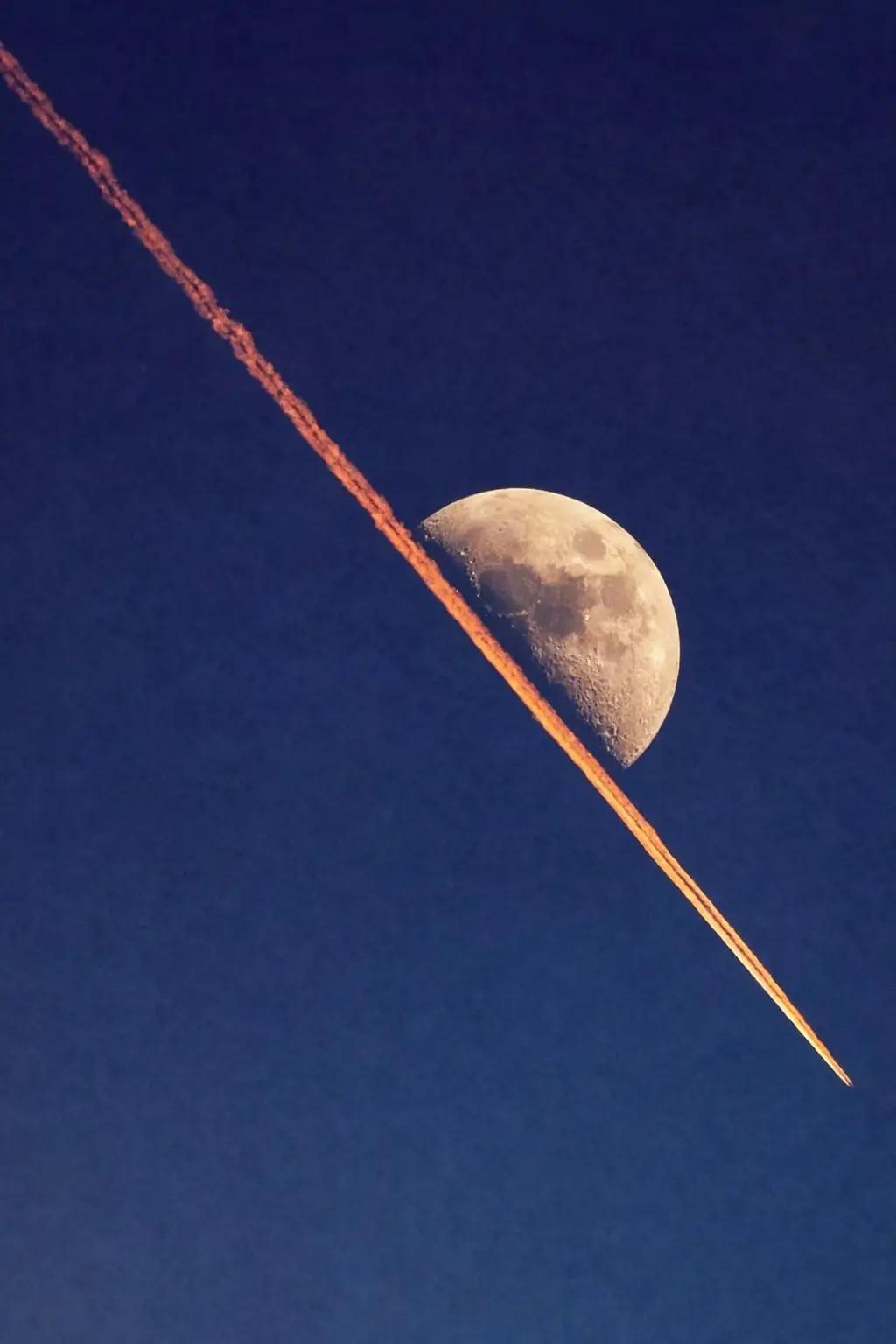
r/spaceporn • • 1d ago Bravo Heartwarming

Pro/Processed Perfect Moon Shot

Post image
7.9k Upvotes

Credit: guzmanramoss


r/spaceporn • • 1d ago

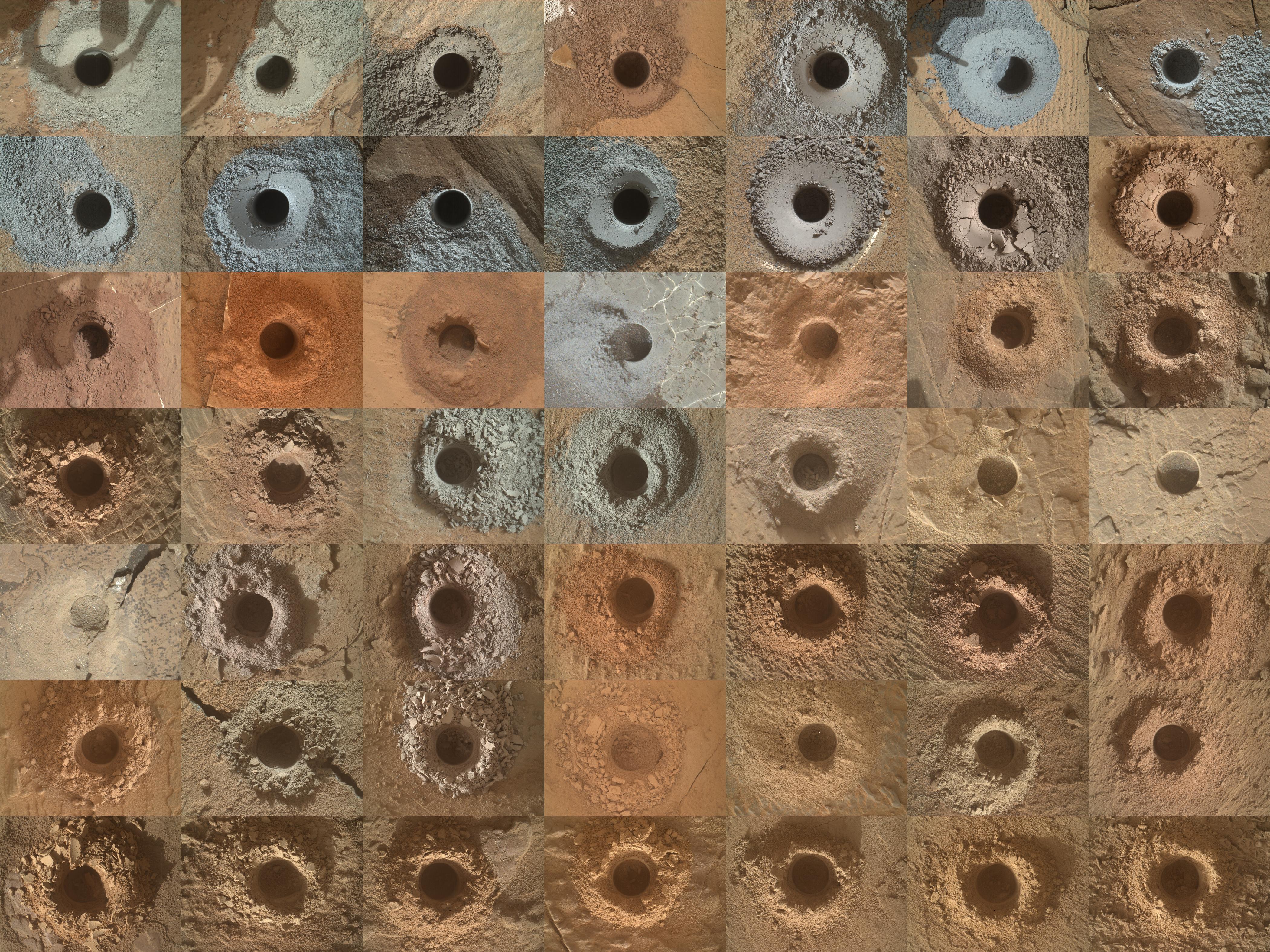
NASA Forty-nine holes, each representing another chapter in Mars's geological history! Assembled on November 16, 2026, this collage brings together 49 drill holes NASA's Curiosity rover photographed while exploring Gale Crater.

Post image
421 Upvotes

This Nov. 16 collage shows 49 drill holes captured by NASA’s Curiosity Mars rover as of November 2026. Each hole represents a sample collected from rocks on the Martian surface; Curiosity’s drill, located on the end of its robotic arm, drops pulverized rock samples into instruments in its belly that analyze their composition.

Each hole marks a location where the rover used its robotic arm to drill and collect powdered rock for analysis, building a remarkable record of the Martian surface.

.

Since landing in August 2012, Curiosity has investigated how Mars changed from a world that once supported lakes and streams into the cold, dry planet we see today. Its onboard laboratories analyze the mineral and chemical composition of collected samples, helping scientists reconstruct ancient environments and assess whether they could have supported microbial life. Together, these 49 drill holes represent more than a decade of scientific discovery, one carefully selected rock at a time.

.

https:// x. com/SETIInstitute/status/2124896144115302604

Learn more about Curiosity.

Image credit: NASA/JPL-Caltech/MSSS

https://www.nasa.gov/image-article/nasas-curiosity-mars-rover-collects-samples/

.

previous post

https://www.nasa.gov/missions/mars-science-laboratory/curiosity-rover/nasas-curiosity-mars-rover-reaches-long-awaited-salty-region/


r/spaceporn • • 1d ago

Pro/Processed Dark Energy Camera Captures the Betta Fish Nebula Swimming Through Space

Post image
106 Upvotes

Link to website https://noirlab.edu/public/news/noirlab2629/?lang

Wispy blue ribbons of stellar matter float deep in the cosmos, appearing like the waving tails of betta fish. This stunning snapshot features the best, most detailed view of supernova remnant SNR G295.5+09.7 to date. It was captured by the U.S. Department of Energy-fabricated Dark Energy Camera, mounted on the U.S. National Science Foundation Víctor M. Blanco 4-meter Telescope at Cerro Tololo Inter-American Observatory in Chile.


r/spaceporn • • 1d ago

James Webb Webb shows how supernova dust chronicles star evolution. Dust formed after the supernova shows how changes within a soon-to-explode star influenced the elements it released

Post image
116 Upvotes

Image

Cassiopeia A (Spitzer and Webb image)

NASA’s retired Spitzer Space Telescope observed the supernova remnant Cassiopeia A (Cas A), helping identify key regions that the NASA/ESA/CSA James Webb Space Telescope later examined in greater detail. Webb’s higher resolution enabled astronomers to create a map of Cas A’s dust chemistry across the entire remnant. This map provides crucial insights into shell mergers, a process in which the layers of elements formed during a star’s life begin to mix before the star explodes. These findings also reveal details about the structure of Cas A’s original star and provide astronomers with a new way to infer the internal structure of exploded stars by studying the dust preserved in their supernova remnants.

Credit:

NASA, ESA, CSA, JPL-Caltech, T. Temim (Columbia University), R. Arendt (UMBC), D. Milisavljevic (Purdue University). Image Processing: A. Pagan (STScI).

.

.

The NASA/ESA/CSA James Webb Space Telescope captured the mid-infrared light of Cassiopeia A (Cas A), one of the most well-studied supernova remnants, to characterise its dust. Astronomers used Webb’s detailed observations to gain new insights into shell mergers, a process that is theorised to occur mere hours before a star’s supernova explosion, revealing new details about the structure of Cas A’s original star.

The James Webb Space Telescope paints a vibrant tapestry of the legendary supernova remnant Cassiopeia A (Cas A). Remnants like these are the clouds of gas and dust that remain following the explosion of a massive star and will eventually seed a new generation of stars and planets.

This high-resolution, mid-infrared observation reveals new details that are helping astronomers chronicle the structure and evolution of Cas A’s original star. The Webb data supports a scenario in which the interior of the star underwent a dramatic change, possibly just hours before its demise. These results were published today in The Astrophysical Journal Letters.

Stars begin their lives as large clouds of mostly hydrogen gas and cosmic dust called molecular clouds. Eventually, gravity causes these molecular clouds to collapse, the material heats up, and protostars stars — infant stars — form. Under the constant pressure of gravity, hydrogen within a protostar begins to fuse into helium, which marks the point where protostars evolve into full-fledged stars like our Sun.

.

More

https://esawebb.org/news/weic2624/

paper

https://iopscience.iop.org/article/10.3847/2041-8213/aea901


r/spaceporn • • 1d ago

Pro/Processed Astronomers just discovered a rare triple star system 28 light-years away (266 trillion km), and they have ‘no clean explanation for how it got here’

Post image
219 Upvotes

Astronomers discover remarkable triple-star system just 28 light-years from Earth

.

Image

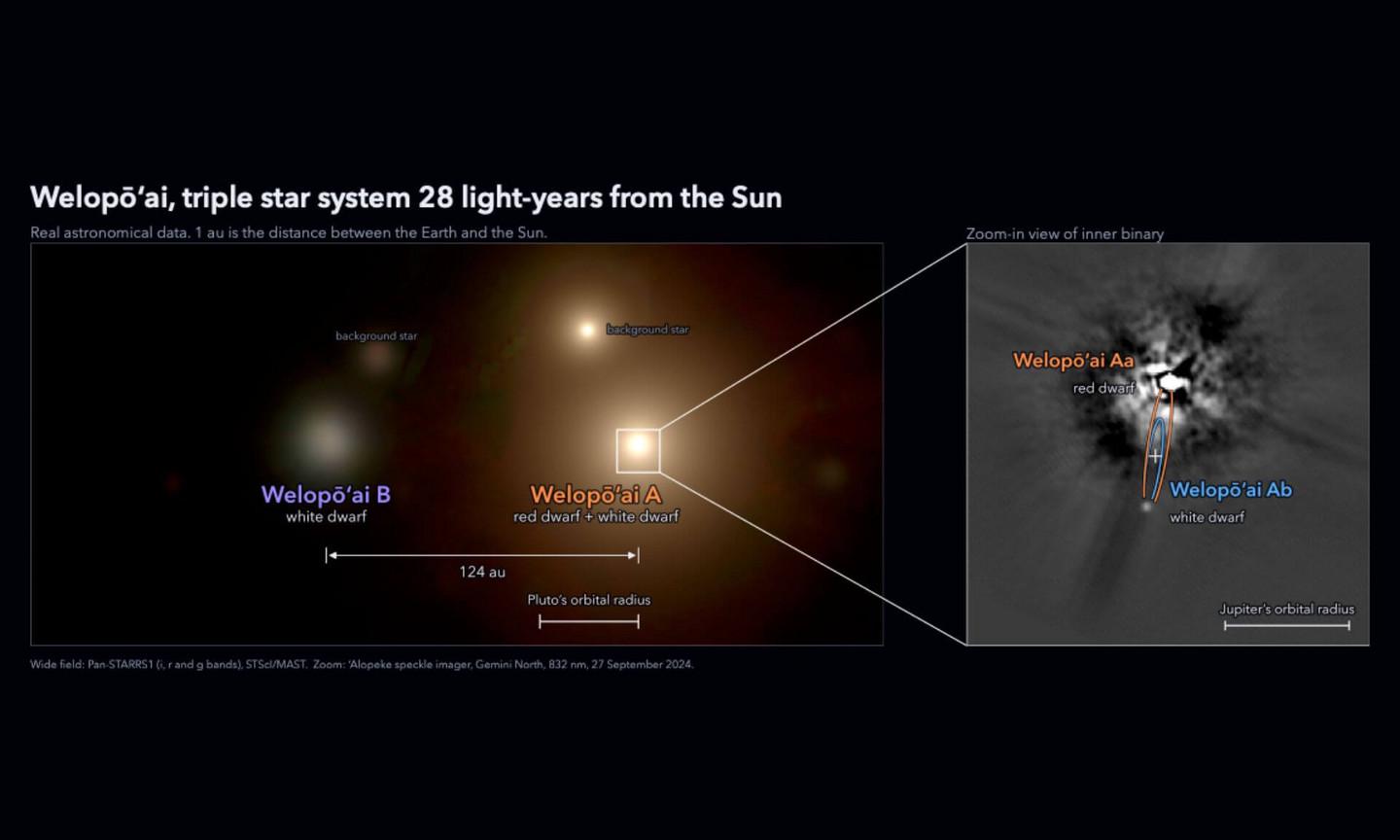
Observations of the Welopōʻai triple-star system, located 28 light-years from Earth. The image on the left shows the two components of the system: Welopōʻai A, a closely orbiting red dwarf and white dwarf pair, and Welopōʻai B, a second white dwarf located much farther away. The image on the right provides a close-up view of the inner pair, revealing the faint white dwarf companion (Ab) detected using the Gemini North telescope's ‘Alopeke instrument. The overlaid curves illustrate the stars' orbital paths.

Photo : Pan-STARRS1/STScI/MAST (left); International Gemini Observatory/NSF NOIRLab (right). Graphic compilation: Étienne Artigau and Heidi White (UdeM/IREx)

.

.

Astronomers have discovered an extraordinary stellar system just 28 light-years from Earth that challenges our understanding of how stars live, die and interact as they evolve.

Given the name Welopōʻai, this unusual triple-star system was discovered by an international team of scientists led by the Trottier Institute for Research on Exoplanets (IREx) at Université de Montréal.

They detail their discovery in a study published today in Astronomy & Astrophysics.

The system contains two white dwarfs, the extremely dense remnants of Sun-like stars that have exhausted their fuel, and a red dwarf, a star much dimmer than the Sun.

The scientists stumbled upon this remarkable configuration, unlike anything else known in the Sun’s neighbourhood, while searching for planets around the red dwarf.

“We were actually looking for planets,” explained IREx researcher Étienne Artigau, the study’s lead author. “Instead, we found something much more surprising.”

.

Variations in velocity detected

The discovery began with the SPectropolarimètre InfraROUge (SPIRou) instrument at the Canada-France-Hawaii Telescope on Maunakea, Hawaiʻi. SPIRou is designed to detect exoplanets by measuring the tiny changes in a star’s velocity caused by orbiting planets.

But one nearby red dwarf behaved differently: the scientists detected velocity variations of nearly 16 kilometres per second, more than a thousand times larger than expected. After several years of follow-up observations, the team established that the unseen companion had a mass greater than half that of the Sun.

“The unusual combination of high mass and very low brightness left only one plausible explanation: it was the remnant of a dead star,” explained Charles-Antoine Parent, an undergraduate student at Université Laval and co-author of the study. 

“The most likely explanation was a white dwarf, although a neutron star or even a black hole couldn't be ruled out.”

The Gemini reveals the hidden star

The team turned to the Gemini North telescope, also on Maunakea. 

Using high-resolution images from its ‘Alopeke instrument, they directly detected a faint companion: a white dwarf. A second, much more distant white dwarf was already known to be part of the system. 

A red dwarf and a white dwarf therefore orbit close to one another, while the second white dwarf orbits the pair. No comparable system is known within 100 light-years of Earth.

.

.

More

https://nouvelles.umontreal.ca/en/article/2026/11/18/astronomers-discover-remarkable-triple-star-system-just-28-light-years-from-earth

https://www.space.com/astronomy/stars/astronomers-discover-rare-triple-star-system-just-28-light-years-from-earth-and-they-have-no-idea-how-it-has-survived

Paper

https://www.aanda.org/articles/aa/full_html/2026/11/aa61214-26/aa61214-26.html

r/spaceporn • • 1d ago

Pro/Processed Latest image of the Didymos-Dimorphos binary asteroids

Post image
327 Upvotes

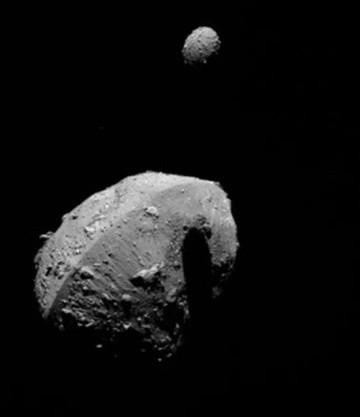
Shown in this early view of the Didymos binary asteroids from the European Space Agency’s Hera mission for planetary defence.

The smaller Dimorphos moonlet (top) is seen casting its shadow across part of its Didymos parent body (bottom), to blank out the Sun across the shaded stretch of rocky surface.

Credit: ESA


r/spaceporn • • 1d ago

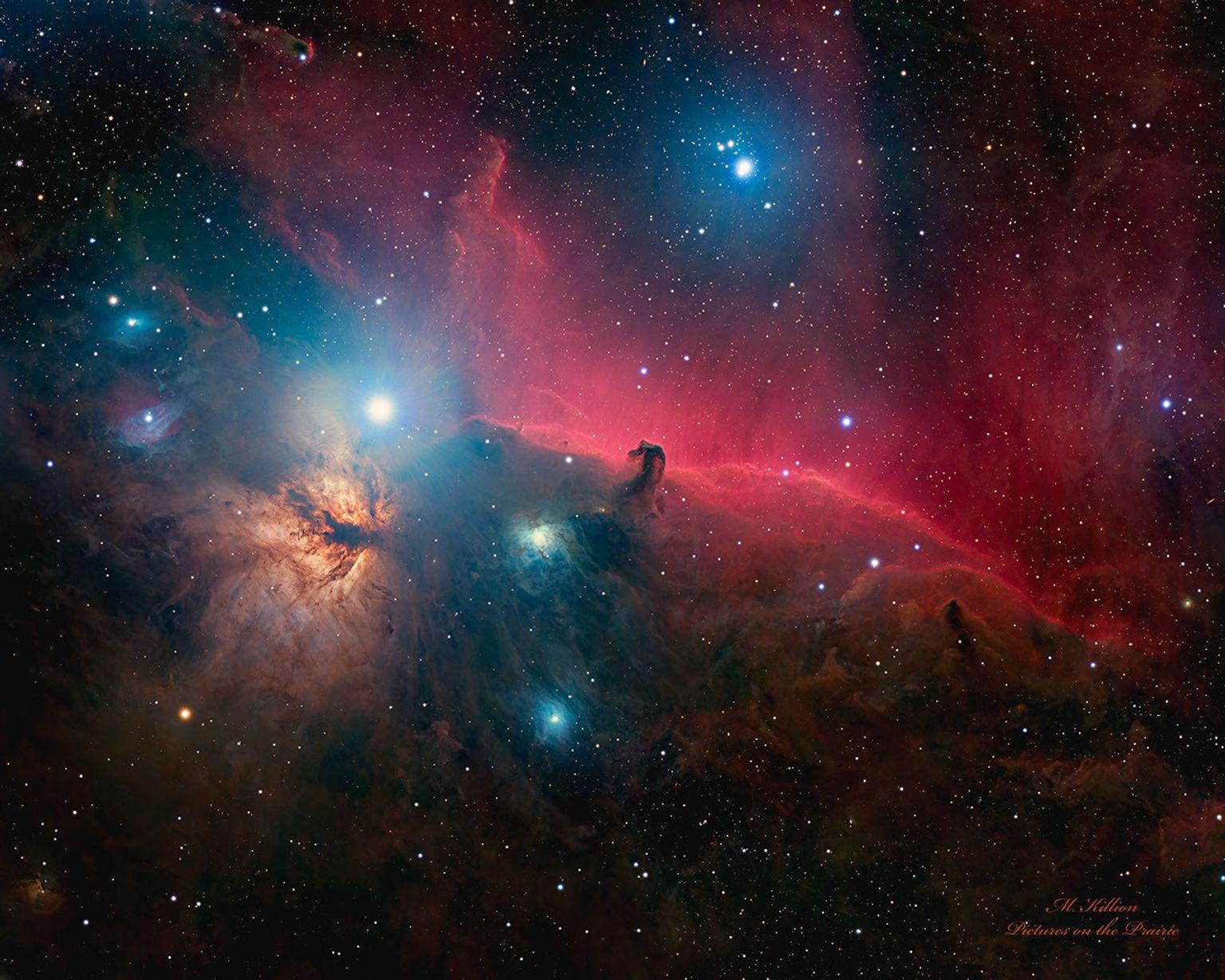
NASA The Horsehead and Flame Nebulas

Post image
449 Upvotes

The brightest star, left of the center, is blue Alnitak (the Girdle): a triple star system best known for being the easternmost star in Orion's Belt. The instantly recognizable shape of a dark horse's head at the center is the aptly named Horsehead Nebula. It is about five light-years tall and lies approximately 1,500 light-years away. It is made of dust and gas that obscure the red glow behind it, which is caused by hydrogen gas being ionized by the bright star Sigma Orionis at the top.

The orange nebula with dark filaments on the left is the Flame Nebula. Closer to the Horsehead, the blue reflection nebula NGC 2023 is actively forming stars.

The data for this "painting" were collected for almost six hours at the Utah Desert Remote Observatories, but the equipment was remotely controlled by the astrophotographer from his home, over 2,000 km away in Illinois.


r/spaceporn • • 1d ago

Pro/Processed Tonight's (almost) Full Moon

Post image
532 Upvotes

Credit: KAGAYA


r/spaceporn • • 1d ago Bravo

False Color An image of the Milky Way center captured by the MeerKAT radio telescope array

Post image
3.7k Upvotes

r/spaceporn • • 1d ago

Amateur/Processed Elephants trunk nebula in SHO

Post image
260 Upvotes

r/spaceporn • • 1d ago Bravo

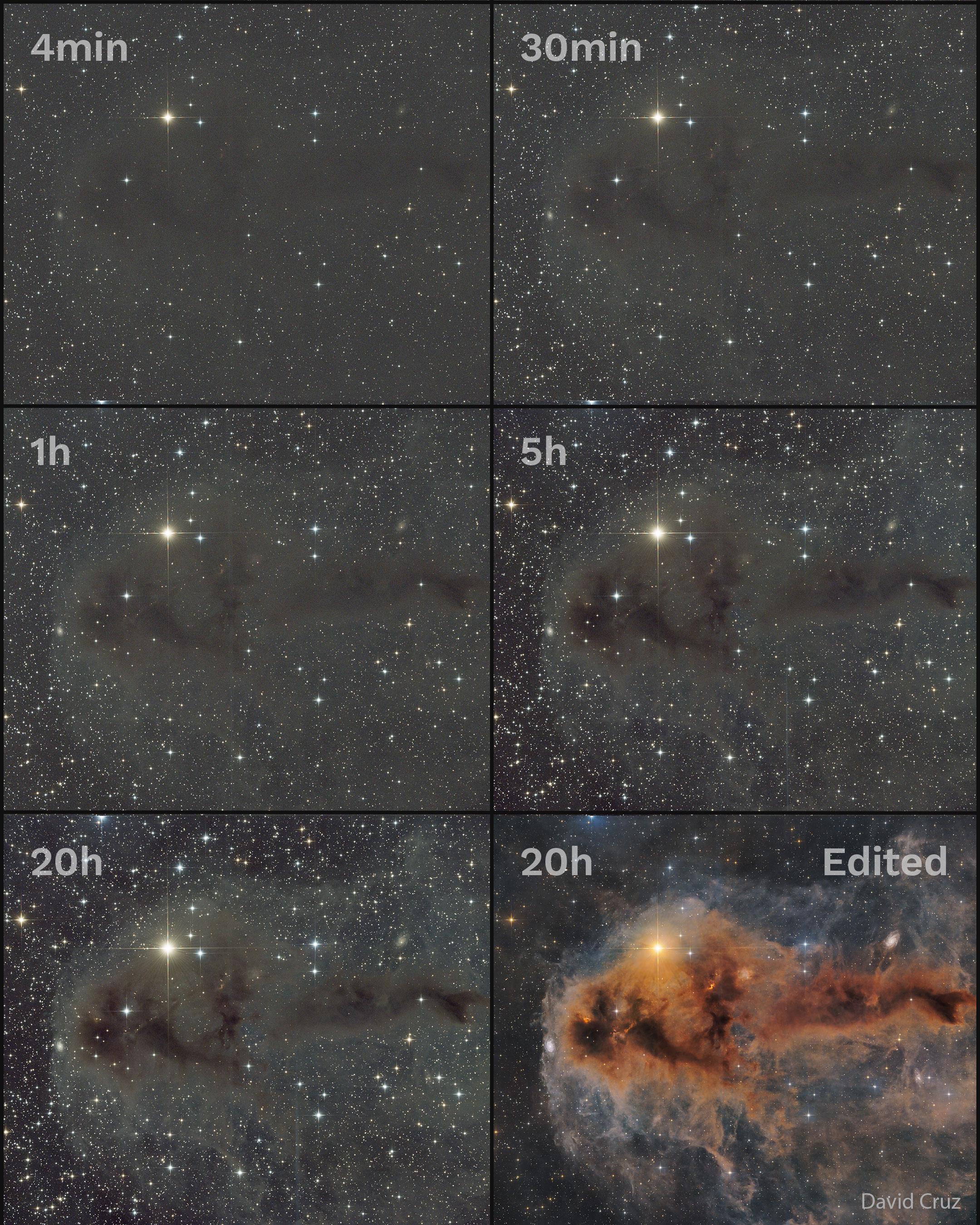
Pro/Processed If your eyes could continuously collect light, what might you see?

Post image
1.5k Upvotes

In the direction of the featured image, after only a few minutes, you would begin to notice some regions without stars. As your staring continued, the dark region would become better defined, and after a full 20 hours, you would notice a strange dark structure. To celebrate, you use digital processing to brighten the image and enhance the colors. At the end, you might have an excellent image of Lynds 1251 (LDN 1251), a star-forming region laced with opaque brown-appearing interstellar dust.

Also known as the Rotten Fish Nebula, LDN 1251 is home not only to young stars and dust, but also, your long staring indicates, energetic shock waves, fast stellar winds, and powerfully beamed jets.

Credit: David Cruz


r/spaceporn • • 1d ago

Amateur/Processed IC1396 and Trunk - Shot on phone

Post image
139 Upvotes

Tracked by ioptron skyguider pro and MSM rotator (before I got the SGP)

featuring flying bat nebula at the corner


r/spaceporn • • 2d ago Popcorn Bravo Heartwarming

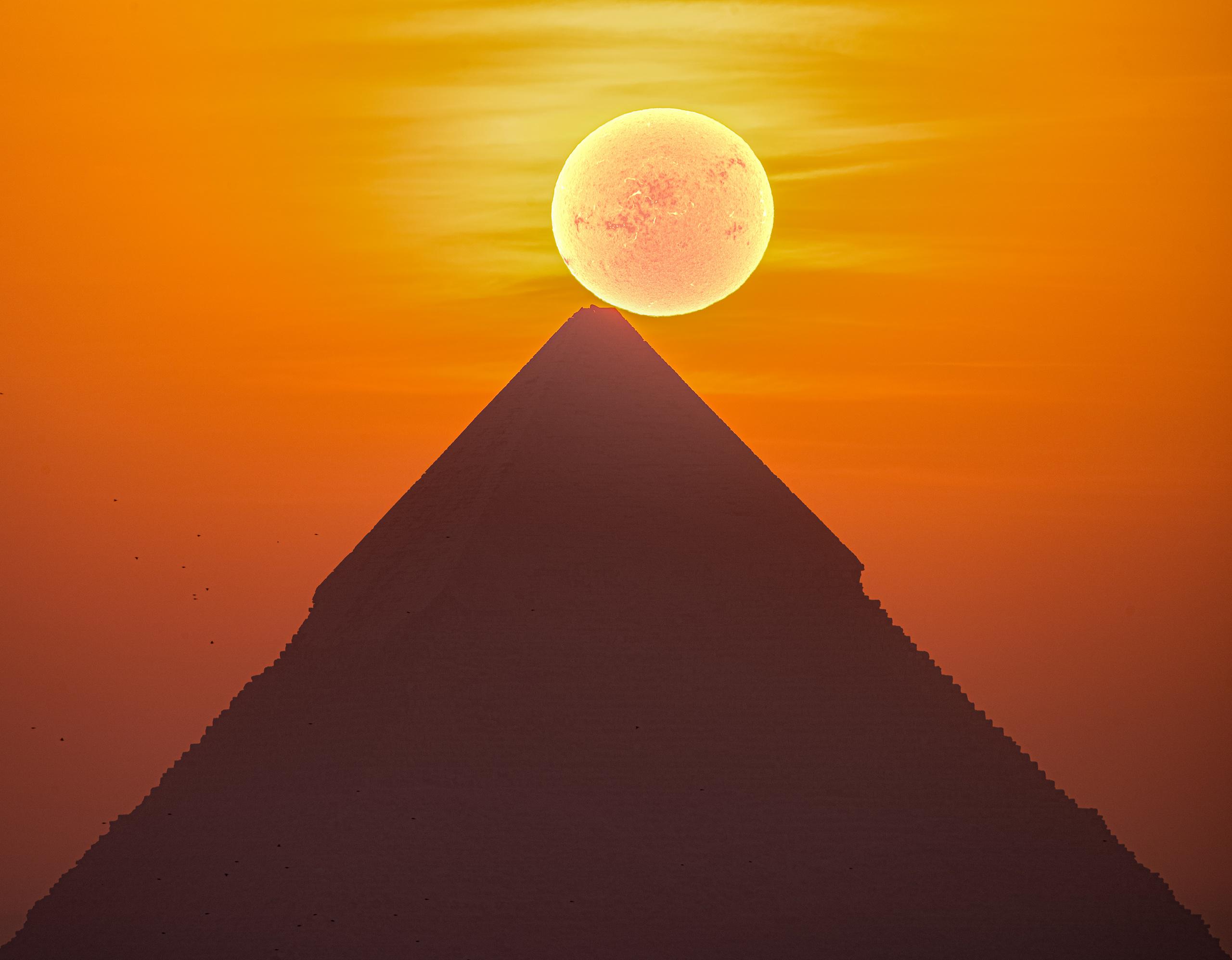
Pro/Processed Sun roll along the pyramid

Post image
4.2k Upvotes

Credit: ​Wael Omar WO (not mine)

.

.

From his description:

"The concept behind this photograph was to create a carefully aligned composition in which the rising Sun appears to emerge from behind the “ Khafrah “ Pyramid and move along its edges, creating the visual impression of the Sun rolling over the monument.

However, my objective was not limited to achieving a striking alignment. I also wanted to reveal the Sun in a way that differs from conventional solar photography by capturing details of its hydrogen emissions.

For this purpose, I used a specialized Hydrogen-Alpha imaging setup , the MLastro spectroheligraph to observe the solar chromosphere, the dynamic atmospheric layer above the photosphere. Imaging at the H-alpha wavelength of 656.28 nm reveals solar structures associated with magnetic activity, including filaments, active regions, and prominences.

.

This wavelength is particularly fascinating because hydrogen is the primary fuel in the Sun's nuclear fusion process. Approximately 600 million tons of hydrogen are converted into helium every second, releasing the energy that powers our solar system.

Achieving the intended composition required careful planning and precise calculations. I selected an elevated shooting position on top of a mosque minaret to obtain the appropriate viewing angle and alignment with the Great Pyramid.

The imaging session began shortly before sunrise continuing through sunrise and shortly afterward.

The resulting footage captured the Sun emerging from behind the Pyramid and appearing to travel along its edges, while simultaneously revealing details of its hydrogen-alpha structures.

.

​Technical Details:

Several images 1/400 sec, iso 250, F9

Video 120Fbs , 2.2ms, Gain 124 by MLastro device.​"

.

Gif video

https://cdn.astrobin.com/ckeditor-files/83312/2026/5992972a-e5cf-4bc7-82ab-e0790b90970a.gif

.

.

Source

https://app.astrobin.com/i/14nse6


r/spaceporn • • 2d ago

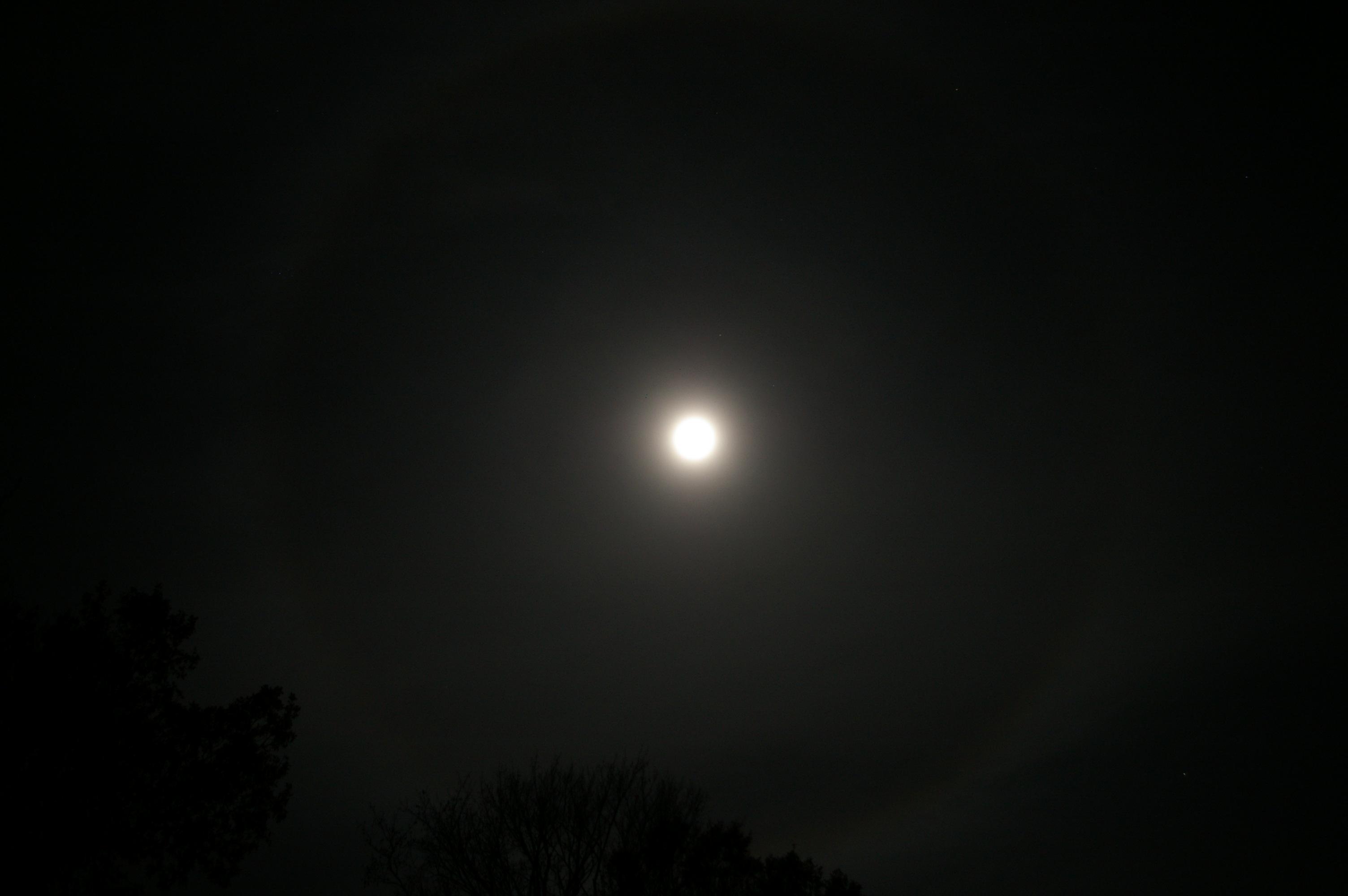
Amateur/Unedited 22° Moon Halo as seen from the UK

Post image
92 Upvotes

Saturn is visible as a star in the bottom right corner


r/spaceporn • • 2d ago

NASA The Worlds of our Solar System

Post image
102 Upvotes