r/supersentai • u/InterestingTie7600 • 1h ago
Meme We got team cannon in My-th before Sentai coming back.

26
Upvotes
r/supersentai • u/InterestingTie7600 • 1h ago
r/supersentai • u/ElectricalEarth4106 • 1h ago

E stato bello l'incontro tokusatsu
r/supersentai • u/Positive-Ice-8497 • 14h ago

I think it's a pretty neat subplot for each arc.
r/supersentai • u/Star_BoyI_1234 • 22h ago
Goggle- V is extremely basic but Goggle Black is the best character!
r/supersentai • u/NickN64 • 4h ago
Comment below your choice of best Ranger and like my comment of it so we can break any ties easier. Just remember your choice will help decide who is truly the BEST Sentai White Ranger!
Match 3:
Spider Kumonos - Jeramie Brasieri
Sentai: Ohsama Sentai King-Ohger
Premiered: May 14, 2023
Debut: Ep. 1: I am the King (voice), Ep. 11: Mysterious! The Man in the Spider Mask (Full Debut)
Actor: Masashi Ikeda
Vs
GaoWhite - Sae Taiga
Sentai: Hyakuju Sentai Gaoranger
Premiered: February 18, 2001
Debut: Super Sentai Compilation (cameo), Quest 01: The Lion Roars!! (Full Debut)
Actress: Mio Takeuchi
r/supersentai • u/bitchnibba47 • 21h ago
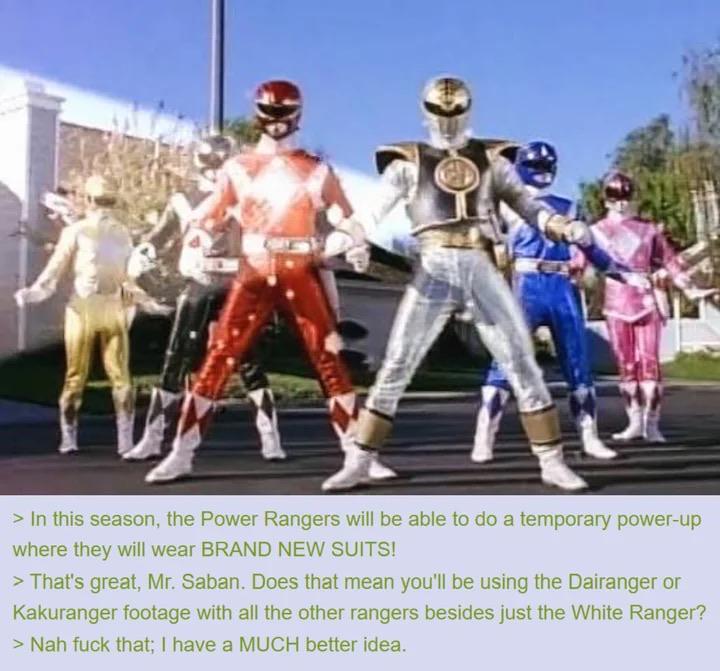
r/supersentai • u/Kaijufan97 • 3h ago
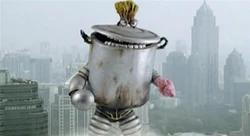
A boiling pot monster from a Thailand Cellphone commercial that parodies Super Sentai/Power Rangers, called Johranger.
Basically, all it does is attack a couple at a table where it falls in love with the woman.
Powers include electric bolt projection from its’ ladle and size enlargement.
r/supersentai • u/TraditionalBonus188 • 0m ago
So apparently the biomen rollcall wad the first ever sentai video on YouTube
r/supersentai • u/tonemocrosam • 1d ago

r/supersentai • u/the-cutest-girl • 1h ago
r/supersentai • u/TraditionalBonus188 • 1d ago
r/supersentai • u/MyInsidesLoveFood618 • 23h ago

r/supersentai • u/NickN64 • 16h ago
Comment below your choice of best Ranger and like my comment of it so we can break any ties easier. Just remember your choice will help decide who is truly the BEST Sentai White Ranger!
Match 2:
ChangeMermaid - Sayaka Nagisa
Sentai: Dengeki Sentai Changeman
Premiered: February 2, 1985
Debut: Ep. 1: Arrival! Secret Power!
Actress: Hiroko Nishimoto
Vs
DekaBreak - Tekkan Aira
Sentai: Tokuso Sentai Dekaranger
Premiered: July 18, 2004
Debut: Episode. 22: Full Throttle Elite
Actor: Tomokazu Yoshida
r/supersentai • u/TheBlackJett • 1d ago

All three performances held today, 11/28 (Sat),
will be streamed
r/supersentai • u/matt0055 • 23h ago
Like the team has to split up up so one has to take on the MegaZord while the other has to finish the Metaroid still kicking.
It gets a bit more flexible with the formula and sells the enemies threat more with divide and conquer tactics.
r/supersentai • u/baconBird_YT • 1d ago
r/supersentai • u/PowerPhantom245 • 1h ago
r/supersentai • u/Lazy_Way_1901 • 1d ago

Rewatching toqger and had this thought since his morpher Is an basically an iPhone
r/supersentai
•
u/Kakeru1986
•
1d ago
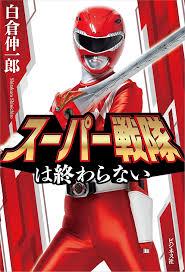
Hi ! I'm a professional Japanese-French translator. I received my copy of Shirakura's book on Monday and finished it yesterday. I wrote a review in French for some friends. Here it is in English. Enjoy !
First things first: we need to acknowledge the obvious. This book doesn’t tell THE truth. It tells Shirakura’s version of the truth. After all, we’re talking about someone who only worked as a producer on Super Sentai for a handful of years following the franchise’s revival with Jetman, a show he joined halfway through, and as an assistant producer, no less… And he only worked in that capacity on Sentai up until Dairanger.
So, three Sentai series in total, before stepping away from the franchise for many, many years, until Zenkaiger. Of course, he could hardly have been oblivious to what was going on with the franchise, given the positions he went on to hold in 2008 (deputy director of Toei’s Tokyo studios), 2010 (director of those same studios), and 2014 (head of television production). In other words, positions of authority that gave him a say in how things were run, particularly from 2014 onwards.
I’d also argue that this book should be read alongside his previous book from 2004, as well as the book published in 2018 by his former boss, Suzuki Takeyuki, aka Mr. Super Sentai himself up until Dairanger.
In an ideal world, we’d also have a book on Super Sentai by Takatera, the producer of Kuuga and Hibiki, who produced quite a few Sentai shows before moving over to Kamen Rider (looking at you, Carranger and Gingaman).
And while we’re at it, I’d love a book by Hisaka Jun, who served as chief producer from GoGo V through Abaranger after working on a TON of Metal Hero and Fushigi Comedy shows. His perspective would be particularly interesting because his career more or less followed the opposite trajectory to Shirakura’s: Sentai came towards the end of his career rather than at the beginning.
Anyway, back to the book itself.
The opening chapters cover the first three shows Shirakura worked on (Jet, Zyû, Dai). Nothing particularly interesting there. We get his first impressions of Inoue, some insight into how he worked on Zyûranger and Dairanger, etc. If you have any questions, feel free to ask.
Then comes the chapter on Power Rangers. He goes over how the whole thing came about, and it quickly becomes apparent that he was largely a bystander. He explains how the show’s success benefited Toei, particularly because it gave the Japanese teams (both at Toei and Bandai) more room to take creative and production risks, knowing that if something didn’t pan out, Power Rangers sales would make up for it.
We also learn that Disney did indeed want to make Power Rangers a Disney property in its own right, notably by developing an animated Power Rangers series, but that Suzuki (Shirakura’s former boss, as mentioned above, who was then in charge of the television division) flat-out refused. Apparently, it was this refusal, which the Americans saw as a restriction on their creative freedom, that led to the franchise’s decline during the Disney era and its eventual return to Saban.
Shirakura regrets how things played out, as he would have loved to see a world where Power Rangers got an animated series. That probably goes some way towards explaining why Fûto PI got the green light, and, more broadly, the long-term strategy unveiled a few years ago, which envisioned tokusatsu franchises branching out beyond their original genre. Generally speaking, he hopes to see Power Rangers make a comeback independently of Super Sentai, if only out of curiosity to see what the Americans can come up with without Toei.
He wraps up this first chapter dealing with Power Rangers by suggesting that the end of the franchise may have been the wake-up call the Super Sentai teams needed. They may have been on autopilot for far too long, with part of their job essentially boiling down to churning out footage for Power Rangers to use. He gets back to Power Rangers later in the book, though, so keep reading!
The following chapters deal with Shirakura’s return to Super Sentai. As I mentioned earlier, he returned as a producer with Zenkaiger, but he had already started getting his hands dirty again with Kyûranger, the first show specifically intended to reinvent the Sentai formula.
He apparently had a hand in coming up with the idea of starting out with nine characters, drawing inspiration from baseball teams and the way players are rotated depending on the needs of the game, as well as the idea of having two rival Sentai teams in LupinPat.
He confirms that Ryûsoulger and Kiramager were indeed a back-to-basics approach following the commercial failure of the previous two shows. Presumably, he then took on Zenkaiger and Donbrothers to have another proper crack at reinventing the franchise.
There’s nothing particularly surprising in this section, since you can pretty much piece all of this together just by watching the shows. What makes these chapters interesting, however, is that Shirakura lays out his central argument, the one that underpins his entire approach: that the differences between Super Sentai and Kamen Rider are supposedly inherent to the two franchises themselves.
According to him, Kamen Rider has considerably more creative freedom than Super Sentai because the latter is held hostage by everyone’s perception of what the franchise is, whether they’re fans or not. Essentially, everyone carries around their own idealized mental picture of what Super Sentai is supposed to be. That picture varies from person to person, and nobody can quite put their finger on what it actually consists of, yet every new series is measured against it.
It’s an interesting argument, although I initially struggled to follow his reasoning… Ultimately, he does concede that this difference isn’t inherent to the two franchises after all, though he seems rather reluctant to say so outright. How?
By bringing up the fact that Ryûki only became a Kamen Rider show at the behest of the sponsors, particularly Bandai, for commercial reasons. As far as Toei was concerned, Kamen Rider Kuuga and Kamen Rider Agito were just one-off projects, part of a broader effort to revive older franchises that had started with Robocon’s return in 1999. While waiting for the next revival, Toei was working on an entirely new franchise, much as it had done with Changérion.
The point is that it took a Kamen Rider show that was never meant to be a Kamen Rider show in the first place to open up a whole new range of possibilities for the franchise. KR Hibiki took things even further, cementing the idea that Kamen Rider could essentially be whatever its creators wanted it to be.
One thing that rubbed me the wrong way while reading was that, although Shirakura explains how he tried to break away from this idealized notion of Super Sentai with Zenkaiger and Donbrothers, he never really seems to question the quality of the shows themselves. He admits that he failed to achieve what he set out to do, but not once does he address the issues that had absolutely nothing to do with his own ideas.
He’s probably just trying to avoid throwing anyone under the bus, but it does leave a bit of a bad taste in your mouth, because he makes it sound as though the shows were otherwise perfectly good…
Another thing is that he barely mentions Kingohger, beyond acknowledging that it continued this push to reinvent the formula. Granted, he wasn’t the producer, but given the circumstances, I would have liked to hear his thoughts on what the team accomplished, and perhaps see him acknowledge what the show did well and which of the previous two shows’ shortcomings it managed to avoid.
My point is that Super Sentai probably could have broken free from those nebulous constraints too, but the teams just weren’t able to pull it off, mainly because they didn't get the time to do so…
And that annoyed me a little, because there’s ultimately nothing inherent or natural about this difference between Super Sentai and Kamen Rider. The latter simply had the good fortune of having Ryûki and Hibiki come along and turn the formula on its head, which helped establish that the essence of Kamen Rider boils down to one simple thing: the hero’s powers are, at best, similar to those of the monsters he fights and, at worst, intrinsically linked to them… (That’s my own take on the matter, by the way.)
That said, my frustration subsided somewhat in the following chapter, where he fleshes out his argument a little more and shows that he does, in fact, have a pretty good grasp of the situation.
This chapter deals with the reasons behind the hiatus.
The timeline isn’t laid out particularly clearly, but if you piece everything together, the possibility of putting the franchise on hiatus was already being floated back in 2020, when Bandai drew up a three-year plan to turn Super Sentai around, with the franchise facing the axe if the plan failed.
And sure enough, by the fall of 2023, the higher-ups at Bandai and Toei had agreed to pull the plug. However, some of the higher-ups on the tokusatsu side of things managed to make the case for keeping the franchise going until at least its 50th anniversary. In that sense, Boonboomger and Gozyûger were essentially bonus seasons for a franchise that was already living on borrowed time.
In this penultimate chapter, he goes over the various reasons behind the decision, which can pretty much be summed up as follows:
- The elephant in the room (comment by me, not a quote): Power Rangers. First, Hasbro’s acquisition of the franchise, which effectively shut Bandai out of the international market for its toys. Then there were the increasingly obnoxious demands coming from the Americans. Shirakura is careful not to point the finger directly at Hasbro, but if you look at the timeline, it’s pretty obvious who he’s talking about.
Apparently, Hasbro kept making increasingly unreasonable demands and shooting down absolutely every show. Kyûranger wouldn’t work because there were nine Rangers. LupinPat was a problem because you couldn’t have thieves as heroes, and having actual cops as crime-fighting heroes was out of the question, especially if they weren’t morally superior to the thieves (apparently, cops are only cool if they’re SPACE cops, à la SPD). Kiramager was a problem because gemstones sucked, and the main component of the Megazord should have been a sports car rather than a fire truck, because apparently American kids don’t like fire trucks. Trains? Forget it. And so on.
Shirakura makes it pretty clear that, by the end, there was really only one thing Hasbro wanted: Mighty Morphin. He doesn’t pass judgment on that whatsoever, but explains that, with Sentai facing problems of its own in Japan, doing Zyûranger all over again clearly wasn’t going to save the franchise.
And then came the final blow: Power Rangers going on hiatus following the death of Hasbro’s former CEO, with the company not even having the decency to give Toei a heads-up…
- The ever-widening gap between Super Sentai and Kamen Rider. Shirakura believes that Kamen Rider’s creative freedom allowed the franchise to grow richer over time, with each new series building on the ideas introduced by its predecessors. Super Sentai, on the other hand, was constantly being brought back to that idealized notion of what the franchise was supposed to be.
- A direct consequence of the above: the teams’ inability to pin down what actually made Super Sentai Super Sentai. Now, this is my own take, but perhaps if Bandai hadn’t pushed for the franchise to end, Toei would have had more time to figure that out.
That said, Shirakura does see a certain logic in putting the franchise on hiatus. There wasn’t enough new blood coming into the Super Sentai teams, and the people who did come in simply ended up rehashing what had already been done, partly because of their own preconceived notions of what Sentai was supposed to be.
The idea behind the hiatus is that, ten years down the line, an entirely new generation of creators could come in, having never worked on the franchise before, and breathe new life into it precisely because their distance from it would have allowed them to figure out what its essence really was.
So PROJECT RED has two goals: to break free from the constraints of Super Sentai and foster a generation of creators who have never worked on the franchise, and to try out all the things Super Sentai could never get away with because of its formula.
Anyway, aside from my criticism of this whole idea of an idealized image of Super Sentai, I’ve tried to summarize the book as objectively and coherently as possible. The book itself is pretty well structured, which is why I’ve largely followed its structure in this summary. Some ideas are scattered across multiple chapters, though, and I’ve done my best to piece them together in a way that makes sense.
Oh, and one thing I forgot to mention: there’s also a chapter on Kyôryûger/Power Rangers Dino Force Brave (the Korean series).
Not much to say about that one, although we do learn that the show didn’t exactly go down a storm in Korea, because what people like about Super Sentai is precisely the fact that it’s Japanese.
That’s interesting, because it raises the possibility that Super Sentai doesn’t necessarily need a localized adaptation to be successful overseas, but it’s not an idea he ever really comes back to.
If you have any questions about anything you’ve read online regarding the book, feel free to ask. I’ll be happy to answer them.
r/supersentai • u/lonely_distance • 1d ago
I was flipping through my copy of Jetman Complete Works and noticed that at the top of the episode listings spread it says "16 mm color 25 min".
I was under the impression that the analogue recordings of sentai productions pre-mid-'00s were on tape, but this book suggests that Jetman at least shot in 16mm and raises the possibility of an HD remaster of Jetman at some point, similar to the one Bioman just got.
Unfortunately Jetman is the only sentai I have a complete works book for, so I'm not able to compare it with other seasons.
r/supersentai • u/UltraZeroX7 • 1d ago

r/supersentai • u/TheBlackJett • 1d ago
r/supersentai • u/NickN64 • 1d ago
Welcome to the first Match of my new Bracket: Super Sentai White Rangers! The seeding is done and it’s time to start!
Comment below your choice of best Ranger and like my comment of it so we can break any ties easier. Just remember your choice will help decide who is truly the BEST Sentai White Ranger!
Match 1:
NinjaWhite - Tsuruhime
Sentai: Ninja Sentai Kakuranger
Premiered: February 18, 1994
Debut: Ep. 1: We Are Ninja
Actress: Satomi Hirose
Vs
Shiro Ninger - Fuka Igasaki
Sentai: Shuriken Sentai Ninninger
Premiered: February 22, 2015
Debut: Ressha Sentai ToQger vs. Kyoryuger: The Movie (cameo); Shinobi 1: We’re Ninja! (Full Debut)
Actress: Yuuka Yano