r/theravada • • 10d ago

News Invitation to Join Bhante Jayasara For a Weekend Zoom Retreat in December!

14 Upvotes

Hello friends, Bhante Jayasara (u/Bhikkhu_Jayasara) of the Maggasekha Organization will be hosting a weekend Zoom retreat in mid December titled: Understanding The Suttas - Framework for Study and Practice.

The Suttas are the collection of the earliest teachings of the Buddha. They contain ageless wisdom and are a foundation for study and practice.

They are also repetitive, hard to get into, and contain a cultural context that can be at times confusing and alien to us in the modern world. These and other factors can act as a barrier to entry and a place of confusion for many people new to Buddhism, and experienced meditators alike.

Bhante Jayasara has been studying the Suttas for 18 years and will be sharing his hard earned insights of how to read, understand, and put into practice, the ancient teachings of the Buddha found in these texts. If you are struggling with getting into the suttas, then this retreat should be of benefit to you.

As always, the retreat will be FREE of charge.

Dates and times:

Fri, Dec 11th, 2026 7:30 PM EST

through -

Sun, Dec 13th, 2026 3:00 PM EST

Sign up HERE

Bhante J is a 10 rains retreat Theravada monk, ordained under Most Venerable Bhante Gunaratana. He's currently living in Colorado, USA in the newly established Maggasekha Vihara, a rental, while drumming up support to build in more mountainous terrain. If you are local to CO and would like to connect in person, check out the website as Bhante hosts in person events on weekends and also goes on alms round on Sundays in Denver.


r/theravada • • Jan 19 '26

Announcement Weekly Online Dhamma Study Group with Yuttadhammo Bhikkhu

39 Upvotes

Yuttadhammo Bhikkhu hosts a weekly online Dhamma study group on Discord which is live-streamed on YouTube each Saturday. Participants read from traditional Buddhist texts, followed by explanations and discussion guided by Bhante. There is opportunity to ask questions and to discuss other Dhamma topics.

More information: Study Group with Yuttadhammo Bhikkhu

Current Schedule: Saturdays at 8:00 AM Canadian (Eastern) Time (13:00 UTC/GMT | 6:30 PM SLST)

Information on how to offer support to Bhante is available at: https://sirimangalo.org/support/

🙏


r/theravada • • 4h ago

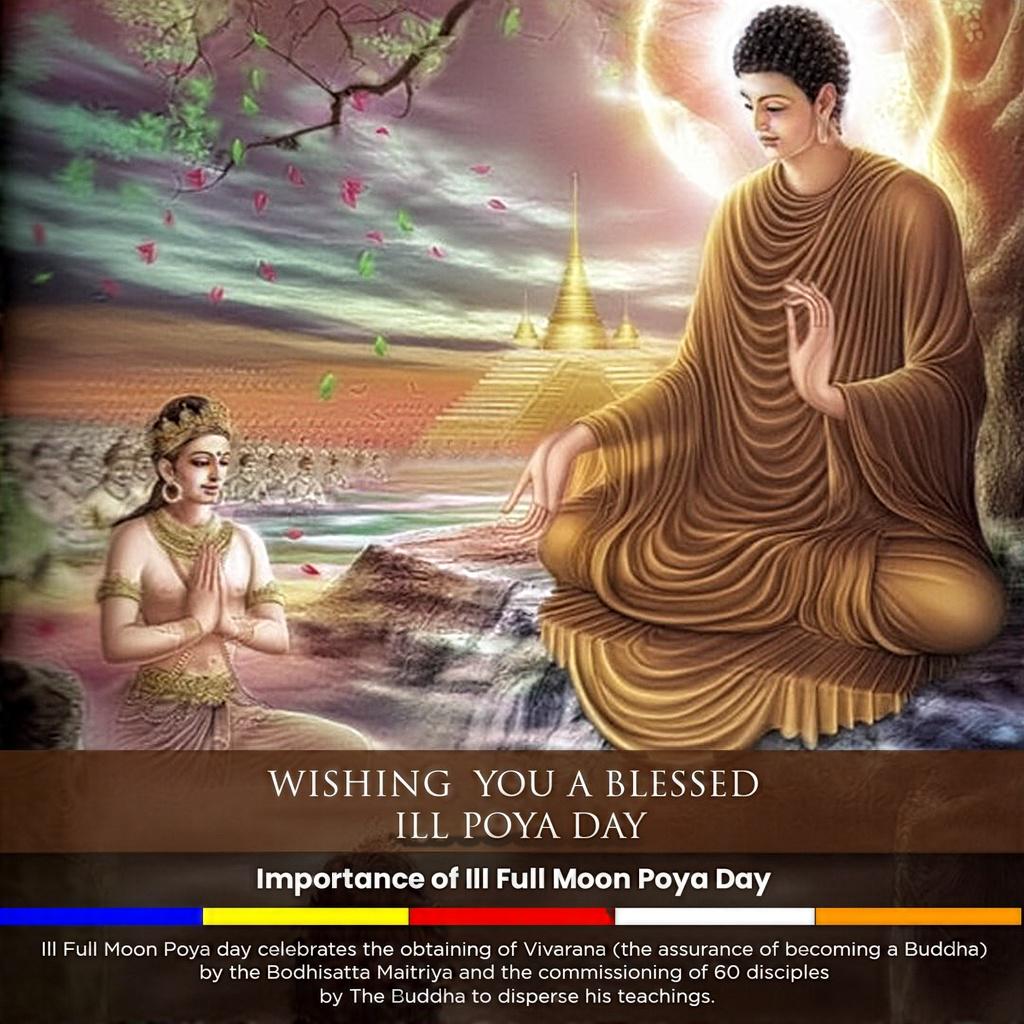
Uposatha Ill Full Moon Poya Day: Bodhisatta Maitreya receives the Prediction of Sammasambuddhahood and Buddha's Commissioning of the First Sixty Arahants to spread the Dhamma

Post image
12 Upvotes

Ill Full Moon Poya is a celebration of the Bodhisatta Maitriya obtaining Vivarana, the assurance of becoming the future Sammasambuddha.

Additionally, it commemorates the moment when the Buddha commissioned sixty Arahants to disseminate his teachings.

This auspicious day also marks the conclusion of the rainy season and the culmination of the three-month retreat known as Vassana-Samaya.

A notable tradition associated with this Poya is the laying of the foundation stone for Thuparamaya, Sri Lanka’s first stupa, enshrining the Sacred Collar Bone Relic of the Buddha after the introduction of Buddhism in 3rd century BCE.


The Buddha’s first Vassa: Sending out Sixty Arahats

The Buddha observed the first vassa-residence after the attainment of Buddhahood at Isipatana, Migadāya.

While staying there till the full moon of the month of Assayuja, the Buddha, one day, sent for the sixty venerable and asked them to go on missionary work as thus: -

“Bhikkhus, I, the Buddha, have achieved complete freedom from all the snares of such impurities as craving (taṇhā) and greed (lobha), namely, the snare of craving and greed for sensual pleasure of devas and the snare of craving and greed for the sensual pleasure of humans, bhikkhus, you also have achieved complete freedom from all the snares of such impurities as craving and greed, namely, the snare of craving and greed for the sensual pleasure of devas and the snare of craving and greed for the sensual pleasure of humans.

“Bhikkhus, go out in all the eight directions for the mundane and supramundane welfare, prosperity and happiness of many beings, such as devas, humans and Brahmās, (covering a distance of one yojana a day at the most). Let not two of you travel together for each journey, for if two take the same route, while one is preaching, the other will remain idle, just sitting in silence.

“Bhikkhus, teach the Dhamma that is full of virtuous qualities in all its three phases, namely, the beginning, the middle and the end; and endowed with the spirit and the letter. Give the devas and humans, the threefold training of sīla, samādhi and paññā which is perfect in all aspects and free from the dirt of wrong conduct (duccarita).

“Bhikkhus, there are many beings, such as devas, humans and Brahmās, who have little dust of impurity in their eyes of wisdom. Through not hearing the Dhamma, they will suffer a great loss of the extraordinary Dhamma which is the Path and the Fruition. There will appear clearly some devas and humans who will realize the nature and meaning of the Dhamma perfectly and thoroughly.

“Bhikkhus, I, the Buddha, too (will not remain in this Migadāya, which have excellent dwellings built for Me, and receiving the treatment and comfort with the four requisites given by My attending donors, but) will proceed to Uruvelā forest of Senā Nigama to teach the Dhamma and to convert the hermit brothers of one thousand ascetics.”


r/theravada • • 4h ago

Pāli Study Google Earth Tour of Places in the Pali Canon

Thumbnail pub-8b253763fee949e99aaf695110947d60.r2.dev
7 Upvotes

Hey all, I've been exploring the Pali canon as "Story" and history recently, inspired by reading Thanissaro Bhikkhu's "Noble Warrior" and cross referencing it with historical and archeological sources.

I was using claude for a lot of this research, then became very interested in the geography - I love roaming around the planet in Google Eearth. So I (well...Claude) cross referenced:

  • Suttas, Vinaya, commentaries (SuttaCentral Pāli suttas and Vinaya (Mahāsaṅgīti edition); VRI Chaṭṭha Saṅgāyana edition for the commentaries.)
  • Locations:OpenStreetMap, Wikipedia, and the Archaeological Survey of India (Patna)
  • Archaeology: Durham University / UNESCO Tilaurakot excavations (Coningham et al.), plus the ASI site registers for Pāvā
  • Photos: Wikimedia Commons (credited per photo) · Maps: OpenStreetMap, Esri, Leaflet

So here is a published version of the map.

🗺️ https://pub-8b253763fee949e99aaf695110947d60.r2.dev/index.html

You can use it here or download the .kml file to load into google earth yourself. (Click about this map. --> Download KML)

Each pin shows the Pāli name, the modern site, key suttas (linked to SuttaCentral) and a colour for how certain the identification is.

You can follow three journeys stop by stop:

  • main places of the Buddha's life
  • The Buddha's Life: the main places in their traditional order, from Lumbinī to Kusinārā (12 stops)
  • The Last Journey (DN 16): the final route, from Vulture's Peak to Kusinārā (7 stops)
  • Bāvarī's Sixteen Students (Sn 1011–1013): the walk from Patiṭṭhāna on the Godāvarī to Rājagaha, along the old southern trade route (12 stops)

Obviously this is all approximate. Anything that couldn't be indepenently confirmed is flagged in the pop ups. Many areas (Kapilavatthu, Pāvā) are still debated. Still I found it enormously fun to be able to take this "tour" as I personally will not be getting to India any time soon.

Please let me know if you have any corrections or updates or concerns. I may still be making updates today. Major rabbit hole!


r/theravada • • 34m ago

Sutta Huṁhuṅka Sutta: The Mystic Syllable Huṁ

2 Upvotes

So I have heard. At one time, when he was first awakened, the Buddha was staying in Uruvelā at the goatherd’s banyan tree on the bank of the Nerañjarā River. There the Buddha sat cross-legged for seven days without moving, experiencing the bliss of freedom. When seven days had passed, the Buddha emerged from that state of immersion.

Then a certain brahmin, one of those who murmured the mystic syllable huṁ, huṁ, went up to the Buddha and exchanged greetings with him. When the greetings and polite conversation were over, he stood to one side and said, “Worthy Gotama, how do you define a brahmin? And what are the things that make one a brahmin?”

Then, understanding this matter, on that occasion the Buddha expressed this heartfelt sentiment:

“Any brahmin who has banished bad qualities—
not murmuring the mystic syllable huṁ, unstained, self-controlled,
a complete knowledge master who has completed the spiritual journey—
they may legitimately proclaim the divine doctrine;
who have no pretensions about anything in the world.”

“Yo brāhmaṇo bāhitapāpadhammo,
Nihuṁhuṅko nikkasāvo yatatto;
Vedantagū vūsitabrahmacariyo,
Dhammena so brahmavādaṁ vadeyya;
Yassussadā natthi kuhiñci loke”ti.

Huṁhuṅka Sutta (Ud 1.4)


Huṃhuṅkasuttavaṇṇanā excerpt:

By nature a grumbler (huṃhuṅkajātiko): they say that he was a believer in auspicious sights and stiff with pride; due to conceit and anger, upon seeing anyone of lower birth, he would go about grumbling ‘huṃhuṃ’ in disgust. Therefore, he is called ‘by nature a grumbler’ (huṃhuṅkajātiko). There is also the reading huhukkajātiko.

.

Herein, that brahmin who (yo brāhmaṇo) means one who is a brahmin by virtue of having cast off evil mental phenomena, not one who claims true brahminhood by mere birth while being endowed with evil mental phenomena such as arrogant speech and stains of defilement through belief in auspicious signs. That brahmin is:

Not a grumbler (nihuṃhuṅko) by abandoning arrogant speech, since he has cast off evil mental phenomena;

Free from blemish (nikkasāvo) by the absence of stains such as craving;

Self-restrained (yatatto) because of having a mind committed to the practice of meditation, or self-restrained by having a restrained mind through the restraint of virtue;

With perfect understanding (vedantagū) because he has reached the end - namely Nibbāna, which is the termination of conditioned formations - through the knowledges (vedehi) known as the four paths, or because he has reached the end of the Vedas.

The spiritual life accomplished (vusitabrahmacariyo) because he has lived the spiritual life of the path;

By Dhamma he would declare himself a true brahmin (dhammena so brahmavādaṃ vadeyya) means he would declare this statement, ‘I am a brahmin,’ rightly and properly.

For whom (yassa) anywhere (kuhiñci) - even in a single object, even in the entire world - there are no such excesses (ussadā) as excess craving, excess hatred, excess delusion, excess conceit, and excessive views; the meaning is that they have been eliminated without omission.


r/theravada • • 2h ago

Dhamma Talk Kāmacchanda and vyāpāda, sensual desire and ill will with Ajahn Punnadhammo.

Thumbnail
youtube.com
3 Upvotes

r/theravada • • 18h ago

Practice Looking to make new friends

12 Upvotes

Hello, everyone!

I'm hoping to make some new friends and Dhamma companions, and perhaps find teachers or mentors who can offer guidance and encouragement along the way.

Growing up, I never really had any Buddhist friends, which made learning and practicing the Dhamma rather difficult. I had no one to turn to for advice, discussion, encouragement, or mutual accountability.

I've always been interested in the Dhamma and have collected quite a number of Dhamma books, including most of the Sutta Piṭaka. However, I've struggled to stay consistent with my studies and practice. I often begin reading the nikāyas/suttas with enthusiasm, only to lose motivation and leave them unfinished. This is true even for smaller texts like Udāna, Itivuttaka, and Suttanipāta.

One of my aspirations is to memorize the Tipiṭaka, particularly the Sutta Piṭaka and notably the first five books of the Khuddaka Nikāya, so I can recall the Dhamma at will to help myself and others when the situation calls for it. However, I can’t even memorize the Khuddakapāṭha, as I simply don’t have the drive (saṃvega?) for it. I'm also interested in developing vipassanā, samādhi, and jhāna, although I'm not quite sure where to begin.

Unfortunately, discipline has always been my biggest struggle. Whether it's studying the suttas, meditating, or even maintaining my morning and evening vandanā, I tend to practice sporadically before gradually falling out of the habit.

TL;DR: I'm looking for genuine Dhamma friends (kalyāṇamitta/suhada-mitta) — companions with whom I can study the Dhamma, discuss the suttas, exchange knowledge, practice together, and encourage one another to remain diligent on the path.

Friendships like those shared by:
Upatissa (Sāriputta) and Kolita (Mahāmoggallāna).
Jotipāla and Ghaṭīkāra.
Puṇṇa Koliyaputta and Seniya.
Sāmāvatī and Khujjuttarā.
Citta the householder and Acela Kassapa.

As the Buddha taught Ānanda:

"This is the entire holy life, Ānanda, that is, good friendship, good companionship, good comradeship. When a bhikkhu has a good friend, a good companion, a good comrade, it is to be expected that he will develop and cultivate the Noble Eightfold Path." — Upaḍḍha Sutta (SN 45.2)

Namo Buddhaya!


r/theravada • • 11h ago

Sīla Gluttony (tw for ED)

2 Upvotes

So, I've struggled badly with restricting food, I'm already in recovery but it has left a lot of mental behaviors. I am now very prone to binging or to become desperate for any sort of food (except meat ofc). I find myself extremely guilty for this because I think it is not right behaviour for me to indulge so much. I'm not talking about eating normally, I mean overeating or binge eating. I am not asking for medical advice, look at this like an addiction, so does anyone know how to manage addictions from a Buddhist standpoint? I find this is affecting my practice and my self control, so any sort of advice would be appreciated.


r/theravada • • 1d ago

Sutta "Conceiving is a disease, conceiving is a tumour, conceiving is a dart."

Thumbnail
reddit.com
16 Upvotes

r/theravada • • 1d ago

Dhammapada Dhammapada Verse 94

20 Upvotes

r/theravada • • 1d ago

Metta Ajaan Lee on good will

7 Upvotes

"Thoughts of good will are like clean drops of rain falling from the sky, refreshing and nourishing the grasses and trees. Such thoughts are desired by all human races. Thus if you hope to develop merit, you should examine your heart at all times to see whether or not it feels good will, so that whatever merit you may perform in thought, word, or deed will be truly conducive to future happiness.

"The crucial element lies with the heart: If the heart lacks good will, you’ll have a hard time protecting your words and deeds; but if the heart is truly benevolent, your words and deeds are bound not to be defiled. If words and deeds are defiled, though, they won’t suffer the consequences of their defilement. The heart will. The heart is what reaps the results of all good and evil. This being the case, your next step should be to practice concentration so as to develop the heart." — Ajaan Lee Dhammadharo

https://www.dhammatalks.org/books/CraftHeart/


r/theravada • • 15h ago

Question Could Nicca Saññā Operate at a More Fundamental Level Than Attachment to Specific Things?

Thumbnail reddit.com
0 Upvotes

r/theravada • • 1d ago

Jātaka Bilara Jātaka

3 Upvotes

“Where saintliness.”—This story was told by the Master while at Jetavana, about a hypocrite. When the Brother’s hypocrisy was reported to him, the Master said, “This is not the first time he has shewn himself a hypocrite; he was just the sane in times gone by.” So saying he told this story of the past.

Once on a time when Brahmadatta was reigning in Benares, the Bodhisatta was born rat, perfect in wisdom, and as big as a young boar.

He had his dwelling in the forest and many hundreds of other rats owned his sway. 

Now there was a roving jackal who espied this troop of rats and fell to scheming how to beguile and eat them. And he took up his stand near their home with his face to the sun, snuffing up the wind, and standing on one leg. Seeing this when out on his road in quest of food, the Bodhisatta conceived the jackal to be a saintly being, and went up and asked his name.

“‘Godly’ is my name,” said the jackal. “Why do you stand only on one leg?” “Because if I stood on all four at once, the earth could not bear my weight. That is why I stand on one leg only.” “And why do you keep your mouth open?” “To take the air. I live on air; it is my only food.” “And why do you face the sun?” “To worship him.” “What uprightness!” thought the Bodhisatta, and thenceforward he made a point of going, attended by the other rats, to pay his respects morning and evening to the saintly jackal. And when the rats were leaving, the jackal seized and devoured the hindermost one of them, wiped his lips, and looked as though nothing had happened. In consequence of this the rats grew fewer and fewer, till they noticed the gaps in their ranks, and wondering why this was so, asked the Bodhisatta the reason. He could not make it out, but suspecting the jackal, resolved to put him to the test. So next day he let the other rats go out first and himself brought up the rear. The jackal made a spring on the Bodhisatta who, seeing him coming, faced round and cried, “So this is your saintliness, you hypocrite and rascal!” And he repeated the following stanza—

Where saintliness is but a cloak
Whereby to cozen guileless folk
And screen a villain’s treachery,
—The cat-like nature there we see. 

So saying, the king of the rats sprang at the jackal’s throat and bit his windpipe asunder just under the jaw, so that he died. Back trooped the other rats and gobbled up the body of the jackal with a ‘crunch, crunch, crunch’; that is to say, the foremost of them did, for they say there was none left for the last-corners. And ever after the rats lived happily in peace and quiet.

His lesson ended, the Master made the connection by saying, “This hypocritical Brother was the jackal of those days, and I the king of the rats.”


r/theravada • • 2d ago

Pāli Canon Yasodharātherīapadāna: The Legend of the Arahant Therī Yasodharā

Post image
69 Upvotes

At one time the Leader of Men
was staying in a mountain cave
in the city, Rajagaha,
which was lovely and prosperous.

This is what was reasoned out then
by the nun named Yasodharā,
who was dwelling in that city,
inside a lovely convent there:

"Nanda, Rahula and Bhadda;
likewise the two chief followers;
Suddhodana Maharaja,
and Gotamī Pajāpatī;

the great theras of great renown;
and the therīs with great powers:
they've gone to peaceful nirvana,
traceless like the flame of a lamp.

While the World's Lord still is living,
I’ll travel that peaceful path too.”
And having reasoned all that out,
she foresaw the end of her life.

Foreseeing that life’s aggregates
would be destroyed that very day,
she set out from her own ashram,
carrying her robe and her bowl.

Honored by one hundred thousand
nuns, the nun named Yasodharā,
greatly powerful, greatly wise,
then went up to the Sambuddha.

Having worshipped the Sambuddha,
at the wheel-marked soles of his feet,
sitting off to one side of him,
she spoke these words to the Teacher:

“I'm seventy-eight years old now,
the last of old age has arrived;
I'm reporting to the Great Sage:
I've attained sainthood in a cave.

Old age has ripened for me now;
verily my life's a trifle.
Giving all you up I will go:
my refuge is made in myself.

In the final days of old age,
death breaks the body into bits;
today at nighttime, Great Hero,
I shall achieve my nirvana.

Where there's no birth, no growing old,
nor sickness and death, O Great Sage,
I'm going to the great city
which, unconditioned, has no death.

Throughout this vast multitude here,
all these revering the Teacher,
know that every imperfection
is forgiven face-to-face, Sage.

Transmigrating in existence,
if I have ever disturbed you,
I’m announcing it, Great Hero;
please forgive my imperfection.

After hearing that speech of hers,
the Lord of Sages then said this:
“What better can I say to you,
when you’re going to nirvana?

Now display your superpowers,
doer of my dispensation;
let doubt in the dispensation
be cut off for all assemblies.”

Having heard the words of the Sage,
the Buddhist nun, Yasodharā,
worshipping the King of Sages,
then spoke this speech to the Buddha:

"I am Yasodharā, Hero;
in the home I was your chief queen,
born in the clan of the Śākyas,
established among the women.

In your household, O Hero, I
was the leader, the lord of all
of the women there, who numbered
one hundred thousand ninety six.

All of those women, endowed with
the virtues of beauty and grace,
youthful and well-spoken, revere
me, like people revere the gods.

Leader of a thousand maidens
in the home of the Śākyan Son,
they’re the same in pleasure and pain,
like gods in the garden named “Joy.”

Beyond the essence of desire,
fixed as the essence of beauty,
they’re unmatched in terms of beauty,
other than by the World’s Leader.”

Speaking words beginning with these,
having risen into the sky,
Yasodharā displayed diverse
powers, with Buddha’s permission.

Worshipping the Sambuddha, she
showed the Teacher superpowers.
She displayed great superpowers,
diverse, having various forms.

Body big as the universe,
she made the continent up north
her head; eastern, western her wings;
and made India her torso;

tail feathers: the southern ocean;
other feathers: varied rivers;
her eyes were the moon and the sun,
her crest was cosmic Mount Meru.

In her beak, mountain at world’s end,
she carried a tree with its roots.
Coming up to him, fanning him,
she’s worshipping the World’s Leader.

She made herself an elephant,
likewise a horse, mountain, ocean,
the moon and the sun, Mount Meru,
and Śakra, the king of the gods.

She covered the thousand-fold world
with blooming lotus, and then said,
“I am Yasodharā, Hero;
I worship your feet, Eyeful One."

And making Brahma’s form appear,
she preached the doctrine of merit;
"I am Yasodharā, Hero;
I worship your feet, Eyeful One.”

I’ve mastered the superpowers
like the “divine ear” element.
I’m also a master, Great Sage,
of the knowledge in others’ hearts.

I remember my former lives;
my “divine eye” is purified.
All the defilements are destroyed;
I will not be reborn again.

In meaning and in the Teaching,
etymology and preaching,
this knowledge of mine was produced
in your presence, O Great Hero.

My meeting with all the Buddhas,
the World-Lords, was well-seen by you;
my extensive service to them
was for the sake of you, Great Sage.

O Sage, recall the good karma,
which formerly was done by me;
that merit was heaped up by me
for the sake of you, Great Hero.

I kept from misconduct, hindered
the nine impossible places;
I have sacrificed life itself
for the sake of you, Great Hero.

I gave myself to be a wife,
several tens of billions of times.
I was not distressed about that,
for the sake of you, O Great Sage.

I gave myself to do service,
several tens of billions of times.
I was not distressed about that,
for the sake of you, O Great Sage.

I gave myself to provide food,
several tens of billions of times.
I was not distressed about that,
for the sake of you, O Great Sage.

I have given you all my lives,
several tens of billions of times.
I’ll liberate myself from fear,
giving up my life once more.

Great Sage, for your sake I do not
conceal the things of a woman,
numerous clothes of varied types,
ornaments affixed to my limbs.

Wealth and grain have been given up,
villages and also small towns,
fields and sons and daughters as well
have been given up, O Great Sage.

Elephants, horses, also cows,
slaves as well as servant-women
are given up beyond all count
for the sake of you, O Great Sage.

Whatever I am told to give
as alms to beggars, I give that;
I don’t witness any distress
from giving the ultimate gift.

I have experienced dis-ease
of diverse types, beyond all count,
in this much-varied existence
for the sake of you, Great Hero.

Attaining comforts, I don’t thrill;
I don’t get distressed by troubles.
Everywhere I remain balanced
for the sake of you, O Great Sage.

After experiencing both
pleasure and pain along the way,
the Great Sage reached Awakening,
the Teaching for which Buddha strived.

By you and by me there was much
meeting with the other World-Lords,
whether you’re the god Brahmā or
Gotama Buddha, World’s Leader.

I performed a lot of service,
for the sake of you, O Great Sage;
while you sought the Buddha's Teaching,
I was always your attendant.

One hundred thousand aeons and
four incalculable aeons
hence, Dīpaṅkara, Great Hero,
the Leader of the World was born.

Someplace in a nearby country,
inviting him, the Thus-Gone-One,
happy-minded folks are cleaning
the road on which he is coming.

At that time there was a brahmin
known by the name of Sumedha.
He was making the road ready
for the All-Seer who was coming.

At that time I was a maiden,
born in a brahmin family,
known by the name of Sumittā.
I went up to that gathering.

With eight handfuls of blue lotus
for offering to the Teacher,
in the midst of all the people
I saw that fierce ascetic sage.

Seeing him, seated atop bark,
surpassing and captivating,
then I thought like this to myself:
“this life of mine is bearing fruit.”

At that time I saw that sage’s
effort which was then bearing fruit;
due to previous karma, my
heart was pleased in the Sambuddha.

Making my heart even more pleased,
I said, “O lofty-minded sage,
seeing no other gift to give,
I’m giving flowers to you, sage.

There are five handfuls for you, sage;
the remaining three are for me.
Let there be success through this gift
for your Awakening, O sage.”

The Fourth Recitation Portion
Then that sage, taking the flowers,
for the sake of Awakening,
worshipped amidst the people the
Famed One, Great Sage who was coming.

The Great Sage named Dīpaṅkara,
seeing him amidst the people,
prophesied future Buddhahood
for that sage with a lofty mind.

The Great Sage named Dīpāṅkara
then prophesied that my karma
would for numberless aeons hence
be exalted, that Sage So Great:

“She will be a like-minded wife,
with karma and conduct like yours;
through this karma she’ll be loving
for the sake of you, O great sage.

Nice looking and much beloved,
desirable, speaking sweet words,
she will be a loving woman,
and an heir among your doctrines.

Just as masters are protecting
the goods that they accumulate,
so this one likewise will protect
all of the things that are wholesome.

Compassionate for future you,
she will fulfill the perfections.
Like a lion freed from a cage,
she will achieve Awakening.”

Rejoicing about Buddha’s speech,
I lived behaving in that way
the Buddha prophesied for me
numberless aeons ago.

I brought pleasure to my mind when
that karma was well done by me;
I experienced countless wombs,
divine as well as human ones.

Undergoing pleasure and pain,
among gods and human beings,
when my last rebirth was attained,
I was born in the Śākyan clan.

Beautiful and very wealthy,
famous and likewise virtuous;
endowed with every attainment,
I’m much-honored among the clans.

Riches, fame, hospitality,
and indulgence in worldly things –
they do not agitate my mind;
I have no fear from anything.

I was appointed to attend
on what the Blessed One had said
within the harem of the king
in the kṣatriyan city then.

I’m a woman who’s a servant,
and one who feels pleasure and pain,
a woman who declares the facts,
a woman who’s compassionate.

Buddhas numbering five billion,
and another nine billion more —
I provided vast alms to them,
those Buddhas, Gods Over the Gods.

Listen to my words, O great king:
I’m constantly doing service
to eleven billion others,
and fifty billion Buddhas more.

I provided vast alms to them,
those Buddhas, Gods Over the Gods;
listen to my words, O great king:
I’m constantly doing service.

Twenty billion other Buddhas
and another thirty billion –
I provided vast alms to them,
those Buddhas, Gods Over the Gods.

Listen to my words, O great king:
I’m constantly doing service
to forty billion Buddhas more,
and another fifty billion.

I provided vast alms to them,
those Buddhas, Gods Over the Gods;
listen to my words, O great king:
I’m constantly doing service.

Sixty billion other Buddhas,
another seventy billion –
I provided vast alms to them,
those Buddhas, Gods Over the Gods.

Listen to my words, O great king:
I’m constantly doing service
to eighty billion Buddhas more,
and another ninety billion.

I provided vast alms to them,
those Buddhas, Gods Over the Gods;
listen to my words, O great king:
I’m constantly doing service.

There have been a million million
who were Chief Leaders of the World;
I provided vast alms to them,
those Buddhas, Gods Over the Gods.

Listen to my words, O great king:
I’m constantly doing service
to another ninety trillion
who were Leaders of the World too.

I provided vast alms to them,
those Buddhas, Gods Over the Gods;
listen to my words, O great king:
I’m constantly doing service

to Great Sages whose number was
eight hundred and fifty trillion,
and seven hundred eighty-five
billion additional Buddhas.

I provided vast alms to them,
those Buddhas, Gods Over the Gods;
listen to my words, O great king:
I’m constantly doing service.

Lonely Buddhas, passion removed,
six hundred and forty million;
listen to my words, O great king:
I’m constantly doing service.

Countless followers of Buddhas,
free of defilements, and stainless;
listen to my words, O great king:
I’m constantly doing service.

I always practice the Teaching
of those practiced in the teachings,
at ease practicing the Teaching,
in this world and in the other.

Well-practiced, the Teaching-practice;
that practice is not ill-practiced.
I’m at ease practicing Teaching,
in this world and in the other.

Disgusted with transmigration,
I went forth into homelessness,
surrounded by thousands of nuns,
after renouncing with nothing.

After abandoning my home,
I went forth into homelessness.
When eight months had not yet elapsed
I attained the Four Noble Truths.

Like the waves upon the ocean,
folks are bringing many varied
monastic robes and alms to eat,
requisites as well as lodgings.

My defilements are now burnt up;
all new existence is destroyed.
Like elephants with broken chains,
I am living without constraint.

Being in Best Buddha's presence
was a very good thing for me.
The three knowledges are attained;
I have done what the Buddha taught!

The four analytical modes,
and these eight deliverances,
six special knowledges mastered,
I have done what the Buddha taught!

Thus many sorts of suffering
and many types of happiness;
the pure life now has been achieved,
I have obtained all achievements.

The woman who’s giving herself
for the merit of the Great Sage
attains companionship with him,
and unconditioned nirvana.

The past is thoroughly destroyed,
and the present and the future;
all of my karma is destroyed:
I worship your feet, Eyeful One.”

Thus indeed Bhikkhunī Yasodharā spoke these verses.
The legend of Yasodharā Therī is finished.


Yasodharātherīapadāna: The Legend of the Therī Yasodharā (Thi Ap 28)

(Image from Sri Yashodara Seya - Mahamevnāwa Anagarikā Monastery, Sri Lanka)


r/theravada • • 1d ago

Question What qualities does the Buddha represent to you?

Thumbnail reddit.com
5 Upvotes

r/theravada • • 2d ago

Paññā Released from sorrow - Luang Pu Mun

Post image
25 Upvotes

“The nature of sankharas
when they appear
is to vanish.
They all decay; none remain.

Beware of the mind
when you focus on making it refined,
for you'll tend to force it
to get stuck on the stillness.
Get the heart to look again & again
at its inconstancy, until it's a habit.
When you reach 'Oh!'
it will come on its own:
awareness of the heart's song,
like a mirage.
The Buddha says the corruptions of insight
disguise themselves as true
when actually they're not.
The awareness of mental phenomena
that comes on its own,
is direct vision,
not like hearing & understanding
on the level of questioning.
The analysis of phenomena,
mental & physical,
is also not vision that comes on its own:
so look.
The awareness that comes on its own
is not the thought-song.
Knowing the mind-source
& mind-moments,
the source-mind is released from sorrow.
The mind-source's certain
automatic knowledge of sankharas
— the affairs of change —
is not a matter of parading out
to see or know a thing.
It's also not a knowledge based
on labeling in pairs.
The mind knows itself
from the motion of the song.
The mind's knowledge of the motion
is simply adjacent mind-moments.
In fact, they can't be divided:
They're all one & the same.
When the mind is two, that's called
sañña entangling things.
Inconstancy is itself, so why focus on anyone else?”

Taken from The Ballad of Liberation from the Khandhas
translated from the Thai by Thanissaro Bhikkhu


r/theravada • • 2d ago

Sutta Udaya Sutta (SN 7:12) | Breaking the Cycle

19 Upvotes

Near Sāvatthī. Then early in the morning, the Blessed One, having adjusted his under robe and carrying his bowl & outer robe, went to the home of the brahman Udaya. The brahman Udaya filled the Blessed One’s bowl with rice.

Then a second time, [on the next day,] the Blessed One, having adjusted his under robe and carrying his bowl & outer robe, went to the home of the brahman Udaya. And a second time, the brahman Udaya filled the Blessed One’s bowl with rice.

Then a third time, [on the following day,] the Blessed One, having adjusted his under robe and carrying his bowl & outer robe, went to the home of the brahman Udaya. And a third time, the brahman Udaya, having filled the Blessed One’s bowl with rice, said to him, “This pesky Gotama contemplative keeps coming again & again.”

The Buddha:

“Again & again, they sow the seed.
Again & again, the deva-kings rain.
Again & again, farmers plow the fields.
Again & again, grain comes to the kingdom.

Again & again, beggars wander.
Again & again, lords of giving give.
Again & again, having given, the lords of giving
Again & again, go to a heavenly place.

Again & again, dairy farmers draw milk.
Again & again, the calf goes to its mother.
Again & again, one wearies & trembles.
Again & again, the dullard goes to the womb.
Again & again, you take birth & die.
Again & again, they carry you to the charnel ground.

But on gaining the path
to no again-becoming,
you, deep in discernment,
don’t take birth
again & again.”

When this was said, the brahman Udaya said to the Blessed One, “Magnificent, Master Gotama! Magnificent! Just as if he were to place upright what was overturned, to reveal what was hidden, to show the way to one who was lost, or to carry a lamp into the dark so that those with eyes could see forms, in the same way has Master Gotama—through many lines of reasoning—made the Dhamma clear. I go to Master Gotama for refuge, to the Dhamma, & to the Saṅgha of monks. May Master Gotama remember me as a lay follower who has gone for refuge from this day forward, for life.”

Udaya Sutta (SN 7:12)


r/theravada • • 3d ago

Literature No Ajahn Chah: "if you are anything at all, you will suffer."

Thumbnail reddit.com
17 Upvotes

r/theravada • • 3d ago

Question How many of you here completely reject Mahayana views,suttas and other things??

14 Upvotes

How many people here completely reject Mahayana sutras, doctrines, and later developments, and accept only the Pali Canon as the authentic teachings of the Buddha? I am interested in those who strictly adhere to Theravada and do not accept Mahayana teachings as Buddhavacana.


r/theravada • • 3d ago

Dhammapada Dhammapada Verse 93

18 Upvotes

r/theravada • • 3d ago

Dhamma Talk Vipassanā-sammā-diṭṭhi: Right View on the Path of Vipassanā by Venerable Kothmale Kumarakassapa Thero, Master of Arts, Royal Pandita

Thumbnail
gallery
7 Upvotes

Dear kalyāṇa-mittatā,

We are publishing a new book, “ Vipassanā-sammā-diṭṭhi: Right View on the Path of Vipassanā” — a Dhamma sermon by Venerable Kothmale Kumarakassapa Thero on giving rise to Right View, the practice of insight (vipassanā), and common mistakes on this path.

This translation was made from the Sinhala language based on a video recording of Bhante’s sermon. The Sinhala transcript of the sermon was carefully checked against the original recording by Bhikkhu Horepola Samitha (Chittaviveka Buddhist Monastery). The translation was checked for accordance with the Dhamma by Bhikkhu Asankhata Rusiave (Chittaviveka Buddhist Monastery).
The author of this sermon is a truly exceptional bhikkhu. He is a disciple of Bhante Mankadawala Sudassana and Bhante Mankadawala Nandarathana, the founders of Labunoruwakanda Forest Monastery. Today, Bhante Kumarakassapa is the abbot of this monastery.
He holds a Master of Arts degree and the title of “Royal Pandit” (Rajakiya Panditha). This is one of the highest traditional scholarly titles in the field of Buddhist and classical Oriental studies in Sri Lanka.
Holding this title means:

  • Direct mastery of primary sources: the holder of this title has successfully passed the rigorous three-level examinations of the Oriental Studies Society of Sri Lanka, demonstrating a deep knowledge of Pali, Sanskrit, and classical Sinhala. This means that he is able to read, translate, and interpret the Tipiṭaka (the Pali Canon) and the ancient commentaries by working directly with the original texts, rather than relying solely on modern translations.
  • Doctrinal authority: in Sri Lanka, a monk with the title of “Royal Pandit” is recognized as an authoritative expert in Buddhist philosophy, history, and grammar.
  • Equivalent to a doctoral degree: in a cultural and academic context, this title is comparable in significance and depth of training to a doctoral degree (PhD) in classical and Buddhist studies, although it belongs to Sri Lanka’s traditional system of scholarship.

In other words, in addition to fulfilling his monastic duties, Bhante is an officially recognized scholar of a high level with a deep mastery of the sacred texts of Theravada Buddhism and classical languages. Bhante received this title when he was only around 20 years old (he has been in monastic life since childhood).
He is also a board member and director of the Paramaththa Foundation. This organization supports the religious and social initiatives of the monastery, including preserving and digitizing ancient palm-leaf manuscripts, distributing digital versions of the Tipiṭaka (on tablets) and printed editions among monks and scholars, and running regional programs for environmental protection and support of the local community. You can read an earlier post dedicated to one of Bhante Kumarakassapa’s teachers — Bhante Sudassana. Bhante Kumarakassapa himself has also taken part in all the initiatives listed there.
Furthermore, Bhante serves as a director of VenasaMedia Entertainment Private Limited in Sri Lanka. He actively uses digital platforms (including YouTube channels such as Sathi TV and Paramaththa — Labunoruwakanda Forest Monastery) and hosts Dhamma programs on Sri Lankan television and radio.
He is a member of the International Centre for Theravada Buddhism (ICTB) in Australia and the United Kingdom, and frequently leads programs across England, the United States, and Australia.
Venerable Kothmale Kumarakassapa is widely known in Sri Lanka as one of the most active and resolute scholar-monks speaking out against distortions of the Dhamma — non-canonical interpretations of Theravada Buddhism that have spread across the island over recent decades. He regularly participates in panel discussions and public forums dedicated to protecting the orthodox teaching of Theravada. During these discussions, he examines doctrinal errors in detail, relying on direct quotations from the Sutta Piṭaka and the Vinaya Piṭaka.
Among the key tools of his work in countering distortions of the teaching are a digital media platform and a series of YouTube videos. In hundreds of short question-and-answer episodes as well as in-depth lectures, he answers questions from laypeople confused by popular claims on social media. He analyzes specific Pali phrases in detail and explains why certain widespread “new interpretations” contradict the authentic words of the Buddha.
Bhante also took part in developing the school curriculum on Theravada Buddhism in Sri Lanka.
If you type Bhante’s name in English on YouTube (venerable Kothmale Kumarakassapa), you will be able to see for yourself the immense work he is carrying out.

This year we have already published two translations of sermons by Bhante Kumarakassapa’s teacher, Venerable Mankadawala Sudassana Thera: “From the Conditioned to the Unconditioned” and “Sammādiṭṭhi Sutta: The Section on the Paths of Kamma.” You can also read more about the topics mentioned in this sermon in the books by Bhante Rakwane Gnanaseeha, “Bhāvanā — The Art of The Mind” and “How to See the Buddha.” These books are available as a gift of the Dhamma on the website of Chittaviveka Buddhist Monastery.
I hope that as a result of this work, all this information will become accessible to Russian-speaking and English-speaking audiences and will help strengthen Theravada Buddhism.
Spoken speech always requires adaptation when converted into written form. In this book, we have tried to make Bhante’s lectures accessible to a wide audience. As a result of such editing, some errors inevitably find their way into the text and remain the responsibility of the translator; therefore, we ask readers for their understanding and invite you to write to us if you come across any typos or inaccuracies.

The publication of this translation is dedicated to a milestone occasion for all Russian-speaking Theravada Buddhists — the twentieth Rains Retreat (Vassa) of Bhante Pannyavudho Topper Mahāthera, the most senior Theravada Buddhist monk of Russian origin permanently residing in Russia. For more than twenty years, with unfailing patience and devotion to the Word of the Buddha, Bhante Topper has been helping to spread Theravada in Russia, showing rare patience and dedication to this cause. Both I, Bhante Asankhata, and many other Buddhists — laypeople and bhikkhus alike — came to the Dhamma precisely thanks to Bhante Topper’s Dhamma sermons. His many years of work, devotion to the Dhamma, and service to the Saṅgha deserve the deepest respect and gratitude.
It was in the St. Petersburg community of theravada ru that I met my best friend Alex. In that community, I found many good spiritual friends with whom I still keep in touch to this day, even though we all now live in different countries and do not see each other in person as often as we would like. I remember how in 2018 my best friend and I flew to Sri Lanka for the very first time — precisely on Bhante Topper’s advice — to Malwessa Monastery in order to meet Bhante Gnanaseeha. Sasha had previously taken Refuge with Bhante Gnanaseeha, again on Bhante Topper’s advice. For me, however, it was our first meeting. I remember how Bhante Gnanaseeha showed us a small cottage in a remote area, a 40-minute drive from Digana, hidden among dense vegetation, practically in the jungle and right on an elephant trail. He spoke about his plans to create the world’s first Russian-speaking Theravada monastery in that place. Today this place is known to many, just like the name of Bhante Gnanaseeha. On that spot, the large and growing Chittaviveka Buddhist Monastery has risen. My best friend left worldly life, received monastic ordination under the guidance of Bhante Gnanaseeha, and now bears the beautiful name Asankhata, living in this monastery. And today, looking back over the past 10 years of my life, it is hard for me to imagine what my life would be like now if all of us had not met Bhante Topper at some point. Therefore, I wish to dedicate this first translation of a sermon by such an outstanding monk as Venerable Kothmale Kumarakassapa specifically to Bhante Topper, and to wish that all his merits, wisdom, and faith may help him stay on this Path and become free from all suffering.
We publish this translation with the permission and blessing of Bhante Kumarakassapa as a gift of the Dhamma for free distribution for the benefit of all living beings. When copying any material, please include links to the websites theravada ru and samatha-vipassana.com.
Maksim Suleimanov

The entire holy life consists of good friends, good companions, good comrades.
Kalyāṇamitta Sutta, SN 3.18

Proofreading and editing of the Sinhala transcript: Bhikkhu Horepola Samitha
Translation: Maksim Suleimanov
Checking the translation for accordance with the Dhamma: Bhikkhu Asankhata Rusiave
Cover design: Maksim Suleimanov


r/theravada • • 3d ago

Question Was I overreacting Or was this a justified reaction, from the perspective of Dhamma?

Thumbnail reddit.com
2 Upvotes

r/theravada • • 3d ago

Dhamma Talk Ajahn Mun “breath energy”?

6 Upvotes

https://www.dhammatalks.org/audio/evening/2026/261118-enjoy.html

At the very beginning of this talk “Enjoy” by Ajahn Geoff:

For me one of the more unexpected stories in the Ajahn Mun biography was of the afternoon as he was sitting in the cave playing with the breath energy in his back.

Ajahn Geoff then says he was surprised by this because 1) he thought Ajahn Lee “discovered” the use of breath energy in meditation, when he apparently got it from Ajahn Mun, and 2) Ajahn Mun was enjoying himself (i.e., despite his “very serious” reputation). That sense of enjoying meditation (and not being grim about it) becomes the subject of the whole talk.

Here’s the thing— I just finished Ajahn Dick’s translation of Maha Boowa’s excellent biography of Mun, but I have no idea what passage Ajahn Geoff is referring to. In the English translation I can’t find any passage where Ajahn Mun is described as “playing with breath energy” or even anything close to that characterization.

Perhaps it might be something in the original Thai that is lost in translation? Or maybe it actually came from another source? At the same time, I can’t recall Ajahn Geoff ever bringing this up in the hundreds of talks I’ve listened to, when he references Ajahn Lee and his ideas and methods all the time.

Not trying to be pedantic, just very curious.

https://forestdhamma.org/2022/02/09/venerable-acariya-mun-bhuridatta-thera/


r/theravada • • 3d ago

Question How much Samadhi foundation is required for True insight mindfulness meditation

6 Upvotes

True wisdom can only be achieved via Mindful Meditation.

I want to see how many people here is right or wrong or divided about Noble 8 fold path Samadi foundational requirement.

My question is how much Samadi is required as a foundation for Mindful Meditation.

Please choose your answer and briefly explain "why".

  1. Jhana Samadi is not important for true Wisdom (Panna) and enlightenment, we can start Vipassana/mindful meditation
  2. State which Jhanna Samadi is required 1st, 2nd, 3rd, 4th absorption and transition to Vipassana (mindful meditation) to achieve true Wisdom and enlightenment.

Write your comment, you can read below text, after you've made your choice.

From many sermons of Monks, I've learned that 4th Jhana absorption is necessary due to its true Upekkha and Ekaggatā sukha, one cannot be disturbed by anything anymore and can focus on insight meditation where true Wisdom/Panna can be achieved.


r/theravada • • 4d ago

Question Starting from scratch

13 Upvotes

If you had to start all over again what would be some helpful tips that you would give yourself? What does a good daily practice look like? Also some recommendations for some online classes to learn the dhamma and to support your practice even if you can’t be there in person or live depending on your schedule. Thanks in advance! 🙏