"If beings knew, as I know, the results of giving & sharing, they would not eat without having given, nor would the stain of stinginess overcome their minds.
Even if it were their last bite, their last mouthful, they would not eat without having shared, if there were someone to receive their gift."
- ITI 26
This is an open sharing thread. You're welcome to share challenge areas, what is inspiring you, and what is on your mind, a teaching you're reflecting on, an art piece, a photo, your state of mind, a book recommendation, a YT video link.
The course is taught by Bhante Akiñcano (ordained since 2014) and Dr. Oliver Tanner and is being offered free of charge.
This is a weekend-only course that begins on January 10th 2027 (Sunday) and ends on October 16th 2027 (Saturday). Learn more about the course: dhammastudies.thinkific.com
Please note that this is a live and interactive course. And to accommodate participation from across the world, lessons will be provided in two time zones.
Please fill in and submit the registration form using the link here to register for the course: https://forms.gle/H7ca9yow5qhmW3Yn8 (A link to enrol on the website will be available later this month)
And how does understanding them free us from suffering?
These questions form the basis of this course.
We make the core teachings of the Buddha accessible to those who already have an established practice but feel that they have reached a plateau and want to deepen their understanding of the Dhamma.
Through careful study of the Pāli suttas and guided reflection, we offer a way of engaging with the Dhamma that is both practical and transformative. Our course creates space for enquiry, dialogue and direct reflection, helping you to see the real meaning of these teachings in lived experience.
Our approach
PHENOMENOLOGICAL
Instead of avoiding facing the burden of existence by trying to become absorbed in a meditation object, we believe that some thinking is required in order to understand the Dhamma properly. A special kind of thinking that is:
... reflexive, not objective
... descriptive, not explanatory
... concerned with the structure of experience, not with specific objects
This phenomenological approach allows us to uncover the meaning of the core teachings in the Pāli Suttas.
GRADUAL
We have designed the sessions so that they build upon each other. There is a progressive order to the whole year. But even though the sessions have been carefully prepared, we want you to have the opportunity to move the discussion into directions that are particularly relevant to you. We have found that when people authentically engage and are willing to talk honestly about their own understanding of the texts, the sessions really come alive.
INTERACTIVE
The opportunity to talk about the Dhamma is an important element of the course. Surprisingly, discussing your own understanding is not a common practice in many meditation centres and monasteries. This may be, in part, because it is difficult to do so without taking one’s views personally and getting into emotionally charged conflicts. This course offers the chance to practise discussing your understanding in a safe, friendly and non-judgmental environment.
Goal
By the end of the course, you will be able to:
Identify key concepts in the early Buddhist texts.
Explore your own understanding of these concepts.
Analyse texts that describe how the Buddha understood these concepts.
Consider different translations and interpretations.
Interpret the early Buddhist texts phenomenologically—relating them to how you understand the nature of this experience you find yourself in.
Recognise concepts found in later Buddhist literature that are not found in the early texts.
... The Buddha shares this inspired utterance after venerable Ānanda observes that the speculators receive honor and support only until perfectly Awakened Ones arise in the world.
Thus have I heard—At one time, the Blessed One was dwelling at Sāvatthi, in Jeta’s Grove, Anāthapiṇḍika’s Park. Then, the venerable Ānanda approached the Blessed One; having approached, he paid homage to the Blessed One and sat down to one side. Seated to one side, the venerable Ānanda said to the Blessed One:
“As long, venerable sir, as Tathāgatas, Arahants, perfectly Awakened Ones, do not arise in the world, wanderers of other sects are honored, respected, revered, worshipped, and esteemed. They are recipients of the four requisites: robes, alms food, lodging, and medicines. But when, venerable sir, Tathāgatas, Arahants, perfectly Awakened Ones, arise in the world, then wanderers of other sects are dishonored, disrespected, unrevered, unworshipped, and unesteemed. They are not recipients of the four requisites: robes, alms food, lodging, and medicines. Now, venerable sir, it is the Blessed One who is honored, respected, revered, worshipped, and esteemed. He is a recipient of the four requisites: robes, alms food, lodging, and medicines, and so is the Saṅgha of bhikkhus.”
“That is so, Ānanda. As long, Ānanda, as Tathāgatas, Arahants, perfectly Awakened Ones, do not arise in the world, wanderers of other sects are honored, respected, revered, worshipped, and esteemed. They are recipients of the four requisites: robes, alms food, lodging, and medicines. But when, Ānanda, Tathāgatas, Arahants, perfectly Awakened Ones, arise in the world, then wanderers of other sects are not honored, not respected, not revered, not worshipped, and not esteemed. They are not recipients of the four requisites: robes, alms food, lodging, and medicines. Now, it is the Tathāgata who is honored, respected, revered, worshipped, and esteemed. He is a recipient of the four requisites: robes, alms food, lodging, and medicines, and so is the Saṅgha of bhikkhus.”
Then, understanding the significance of this, the Blessed One at that time expressed this inspired utterance:
“The glowworm shines only so long as the sun has not yet risen; but when the radiant sun comes up, its light is extinguished and it shines no more.
Likewise do the speculators shine until the perfectly Awakened Ones arise in the world; the speculators are not purified, nor are their disciples, those of wrong view are not freed from suffering.”
---
Key Terms:
Saṅgha [saṅgha] ≈ The community of monks and nuns practicing in line with the Buddha’s teachings. In the broader sense, this is the community of disciples who have realized the noble path and fruition through the Buddha’s teachings
glowworm [kimi] ≈ firefly, a small nocturnal insect that emits a faint light
speculators [takkikā] ≈ logicians; lit. thinkers
..suffering [dukkha] ≈ discomfort, unpleasantness, discontentment, dissatisfaction, stress, pain, disease, i.e. mild or intense suffering
Image: Fireflies at Ochanomizu, Kobayashi Kiyochika, c. 1880
The Buddha outlines six causes of kamma: unwholesome roots perpetuate to bad destinations, whereas wholesome roots foster good outcomes.
Lake Thun with Symmetric Reflection, Ferdinand Hodler, c. 1905
“There are these three causes for the arising of kamma. What three? 1.) Greed is a cause for the arising of kamma, 2.) aversion is a cause for the arising of kamma, 3.) delusion is a cause for the arising of kamma. Non-greed does not arise from greed; rather only greed arises from greed. Non-aversion does not arise from aversion; rather only aversion arises from aversion. Non-delusion does not arise from delusion; rather only delusion arises from delusion. Through kamma arisen from greed, kamma arisen from aversion, or kamma arisen from delusion, devas are not manifested, humans are not manifested, nor any other good destinations. Rather through kamma arisen from greed, kamma arisen from aversion, and kamma arisen from delusion, hell is manifested, the animal realm is manifested, the realm of afflicted spirits is manifested, or whatever other bad destinations there are. These are the three causes for the arising of kamma.
There are these three causes for the arising of kamma. What three? 1.) Non-greed is a cause for the arising of kamma, 2.) non-aversion is a cause for the arising of kamma, 3.) non-delusion is a cause for the arising of kamma. Greed does not arise from non-greed; rather only non-greed arises from non-greed. Aversion does not arise from non-aversion; rather only non-aversion arises from non-aversion. Delusion does not arise from non-delusion; rather only non-delusion arises from non-delusion. Through kamma arisen from non-greed, kamma arisen from non-aversion, or kamma arisen from non-delusion, hell is not manifested, the animal realm is not manifested, the realm of afflicted spirits is not manifested, nor any other bad destinations. Rather through kamma arisen from non-greed, kamma arisen from non-aversion, and kamma arisen from non-delusion, devas are manifested, humans are manifested, and whatever other good destinations there are. These are the three causes for the arising of kamma.”
Greed [lobha] ≈ a grasping mental quality of craving, possessiveness, or lustful wanting that clings to objects or experiences; it fuels attachment and obstructs renunciation and contentment
delusion [moha] ≈ illusion, misperception, erroneous belief, false idea, misapprehension; a fundamental distortion of reality that sustains confusion, clouds discernment, and fuels further doubt
Non-greed [alobha] ≈ the absence of greed, lack of craving or lustful wanting; contentment, renunciation
Non-aversion [adosa] ≈ the absence of aversion, ill will, or hostility; loving-kindness, goodwill, friendliness
Non-delusion [amoha] ≈ the absence of illusion, misapprehension, or distorted view; clear comprehension, understanding things as they really are
devas [deva] ≈ celestial beings, deities, gods
good destinations [sugati] ≈ fortunate realms of rebirth, happy destinations
hell [niraya] ≈ a place of intense suffering, lit. no good fortune
realm of afflicted spirits [pettivisaya] ≈ the domain of ghosts or departed spirits
bad destination [duggati] ≈ state of misery
Related Teachings:
What leads to further kamma and what leads to cessation of kamma (AN 3.111) - What are the causes for the arising of kamma? The Buddha explains that greed, aversion, and delusion are the roots of unwholesome kamma, leading to painful results, and leading to further kamma. In contrast, non-greed, non-aversion, and non-delusion are the roots of wholesome kamma, leading to pleasant results and to the cessation of kamma.
Three causes giving rise to kamma (AN 3.112) - What gives rise to kamma? The Buddha explains that the roots of kamma lie in how one relates to the past, future, and present. Through repeated reflections and mental re-examination, desire springs up and binds one to objects of attachment. But when one sees the consequences of those things clearly, one instead turns away from them, leading to kamma arising from complete penetration and wisdom.
The Realized One after death is profound, immeasurable, and hard to fathom (MN 72) - The wanderer Vacchagotta questions the Buddha about the eternity of the world, the life force, and the Tathāgata after death. The Buddha entirely avoids these speculative views, explaining that the Tathāgata is freed from reckoning. He illustrates this profound, immeasurable state of liberation using the simile of an extinguished fire.
Hello friends, for those who may be interested in learning Buddhism in Hindi, I have published a Hindi translation of David Roylance's book "Developing a Life Practice: The Path that Leads to Enlightenment" (Volume 1)
"जीवन अभ्यास का विकास: पथ जो ले जाता है निर्वाण की और" (खंड १)
... which purges wrong view through right view and wrong liberation through right liberation without fail, freeing beings from birth, aging, and death.
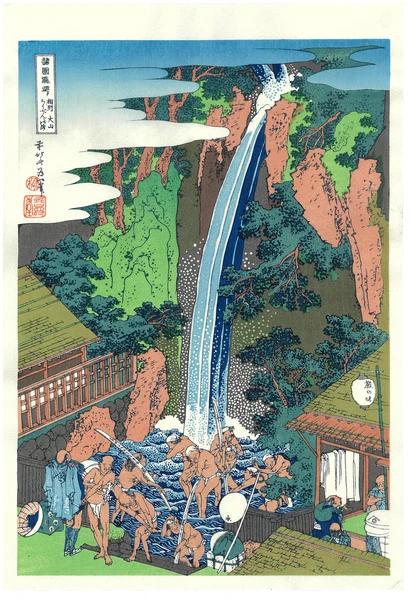
Pilgrims beneath the Roben Waterfall, Katsushika Hokusai, early 19th century
The Buddha contrasts doctors’ medicinal purgatives, which sometimes succeed and sometimes fail, with the noble purgative of the tenfold path, which purges wrong view through right view and wrong liberation through right liberation without fail, freeing beings from birth, aging, and death.
“Physicians give a purgative for dispelling afflictions originating from bile, for dispelling afflictions originating from phlegm, and for dispelling afflictions originating from wind. There is this purgative—I do not deny it. But this purgative sometimes succeeds and sometimes fails.
And I will teach a noble purgative that only succeeds and never fails—relying upon which beings subject to birth are freed from birth; beings subject to aging are freed from aging; beings subject to death are freed from death; beings subject to sorrow, lamentation, pain, displeasure, and despair are freed from sorrow, lamentation, pain, displeasure, and despair. Listen to this and pay close attention; I will speak.”
“Yes, venerable sir,” those bhikkhus replied to the Blessed One. The Blessed One said this:
“And what is that noble purgative that only succeeds and never fails—relying upon which beings subject to birth are freed from birth; beings subject to aging are freed from aging; beings subject to death are freed from death; beings subject to sorrow, lamentation, pain, displeasure, and despair are freed from sorrow, lamentation, pain, displeasure, and despair?
For one with right view, wrong view is purged; and the multitude of harmful, unwholesome qualities that arise due to wrong view, they too are purged for him. And due to right view, many wholesome qualities reach full development by cultivation.
For one with right intention, wrong intention is purged ... For one with right speech, wrong speech is purged ... For one with right action, wrong action is purged ... For one with right livelihood, wrong livelihood is purged ... For one with right effort, wrong effort is purged ... For one with right mindfulness, wrong mindfulness is purged ... For one with right collectedness, wrong collectedness is purged ... For one with right knowledge, wrong knowledge is purged ...
For one with right liberation, false liberation is purged; and the multitude of harmful, unwholesome qualities that arise due to false liberation, they too are purged for him. And due to right liberation, many wholesome qualities reach full development by cultivation. This is that noble purgative that only succeeds and never fails—relying upon which beings subject to birth are freed from birth ... are freed from sorrow, lamentation, pain, displeasure, and despair.”
---
The Buddha saw himself and his work to be similar to that of a healer, a physician, a field surgeon (MN 63, MN 75, MN 105, AN 8.85 as few other places he gives himself the title of bhisakka and sallakatta, lit. one who cuts the arrow). He did not see himself as a religious founder, philosopher, or as a spiritual teacher.
right view [sammādiṭṭhi] ≈ view that is in line with the Dhamma - teachings of the Buddha that point to the nature of reality, the ultimate truth
wrong view [micchādiṭṭhi] ≈ a distorted perception, an untrue view, a false belief
harmful [pāpaka] ≈ injurious, bad, or evil. Encompasses the deceptively alluring that is ultimately detrimental or ruinous
full development by cultivation [bhāvanāpāripūri] ≈ maturity by development, fulfillment by meditation
wrong intention [micchāsaṅkappa] ≈ wrong notion, wrong idea
right collectedness [samādhi] ≈ stability of mind, stillness of mind, mental composure
right knowledge [sammāñāṇa] ≈ distinctive knowledge, insight
right liberation [sammāvimuttī] ≈ right release, right freedom
Related Teachings:
The Tenfold Path and how one comes in contact with a Saṅgha that is practicing well (SN 14.29) - Beings come together and associate according to disposition. Those with wrong views come together and associate with those with wrong views, and similar for the other eight factors. Those with right views come together and associate with those with right views, and similar for the other eight factors.
Why does the Buddha not explain about the world, life force, and what happens to a realized one after death (MN 63) - Dissatisfied with unanswered questions, the venerable Mālukyaputta demands explanations about the world, life force, and what happens to a realized one after death. The Buddha replies with a simile of a man struck by a poisoned arrow who refuses treatment until every trivial detail about the arrow and the archer is explained. Such delay would inevitably lead to death. Likewise, speculative views do not bring freedom from suffering.
Engaging in inward examination | Sammasa sutta (SN 12.66) - The Buddha uses a simile of a bronze cup of beverage mixed with poison to illustrate how craving for agreeable and pleasant sense experiences leads to acquisition and suffering, while wisely seeing their impermanent nature leads to the ending of suffering through the abandoning of craving.
‘Here I will dwell during the rains, here during winter and summer;’ thus the immature person thinks, not understanding the danger.
287
That person, besotted with sons and cattle [possessions], with an attached mind; like a great flood sweeps away a sleeping village, death seizes and carries them away.
288
There are no sons for refuge, nor father, nor even relatives; for one seized by the Ender[1], there is no refuge among kin.
289
Understanding the truth of this, the wise one, restrained by ethical conduct, should swiftly purify the path leading to Nibbāna.
---
[1] The Ender: Antakena. A poetic epithet for Death, the one who brings all worldly things to an end.
Key Terms:
immature person [bāla] ≈ lacking in discernment or good sense, child-like in understanding
besotted with sons and cattle [puttapasusammatta] ≈ intoxicated by children and possessions
When the Brahmin Brahmāyu hears that a Buddha has arisen, he sends his student Uttara to shadow the Buddha for a period of seven months to observe his conduct.
Bronze figure of the walking Buddha, Thailand, Sukothai period, c. 14th century
Then, after the passage of seven months, the young brahmin Uttara set out on a walking tour in the Videha country toward Mithilā. Wandering by stages, he approached Mithilā and the brahmin Brahmāyu; having drawn near, he paid homage to the brahmin Brahmāyu and sat down to one side. While the young brahmin Uttara was seated to one side, the brahmin Brahmāyu said to him: “My dear Uttara, is the report that has circulated about that sir Gotama indeed so, and not otherwise? And is that sir Gotama truly such, and not otherwise?”
“The report that has circulated about that sir Gotama, sir, is indeed so, and not otherwise; and that sir Gotama is truly such, and not otherwise.
...
When walking, that sir Gotama steps out first with his right foot. He does not lift his foot too far, nor does he set his foot down too close; he walks neither too quickly nor too slowly; he walks without knocking knee against knee, and without knocking ankle against ankle. When walking, he neither raises his thighs up, nor bends them down, nor brings them inward, nor splays them outward. When that sir Gotama walks, only the lower part of his body moves, and he does not walk with bodily strain. When looking around, that sir Gotama turns to look with his entire body; he does not look straight up, nor does he look straight down; he does not walk looking about this way and that, but looks a yoke’s length before him; and beyond that, he has unobstructed knowledge and vision.
When entering indoors, he neither raises his body up, nor bends it down, nor leans it inward, nor tilts it outward.
He turns around neither too far from the seat nor too close to it; he does not sit down on the seat leaning on his hand, nor does he fling his body onto the seat. While seated indoors, he does not engage in fidgeting with his hands or fidgeting with his feet; he does not sit with knee crossed over knee, nor with ankle crossed over ankle, nor does he sit supporting his chin with his hand. While seated indoors, he does not fear, does not tremble, does not waver, and is not agitated. He is fearless, untrembling, unwavering, unagitated, and without trepidation. And while seated indoors, that sir Gotama is devoted to seclusion.
When receiving water for the alms bowl, he neither tips the bowl up, nor tips it down, nor tilts it inward, nor tilts it outward.
He receives neither too little nor too much water for the bowl. He does not wash the bowl making a sloshing sound, nor does he wash the bowl by twirling it around; he does not set the bowl down on the ground to wash his hands—when his hands are washed, the bowl is washed, and when the bowl is washed, his hands are washed. He pours out the water for the bowl neither too far nor too close, and without splashing it about. When receiving boiled rice, he neither tips the bowl up, nor tips it down, nor tilts it inward, nor tilts it outward. He receives neither too little nor too much boiled rice. Sir Gotama takes curry in suitable proportion, and does not exceed the mouthful of rice with curry. Sir Gotama turns the morsel over two or three times in his mouth before swallowing it, and no unchewed grain of rice enters his body, nor does any grain of rice remain in his mouth; only then does he bring another morsel to his lips. That sir Gotama partakes of food experiencing the taste, but not experiencing passion for the flavor.
That sir Gotama partakes of food endowed with eight factors: ‘[This food is] not for amusement, not for intoxication, not for putting on bulk, and not for the sake of physical appearance; but only for the support and maintenance of this body, for the ending of discomfort, and for assisting the spiritual life: thus I shall put an end to old feeling [of hunger] and shall not give rise to new feeling [from overeating], and I shall sustain life blamelessly and dwell at ease.’
When he has finished his meal and receives water for the bowl, he neither tips the bowl up, nor tips it down, nor tilts it inward, nor tilts it outward. He receives neither too little nor too much water for the bowl. He does not wash the bowl making a sloshing sound, nor does he wash the bowl by twirling it around; he does not set the bowl down on the ground to wash his hands—when his hands are washed, the bowl is washed, and when the bowl is washed, his hands are washed. He pours out the water for the bowl neither too far nor too close, and without splashing it about.
When he has finished his meal, he sets the bowl down on the ground neither too far away nor too close; and he is neither careless with the bowl, nor overly fussy over the bowl.
When he has finished his meal, he sits in silence for a moment, but he does not let the time for the blessing of appreciation pass by. When he has finished his meal, he expresses appreciation: he neither criticizes that meal nor longs for another meal; rather, he instructs, encourages, inspires, and gladdens that assembly purely with a talk on the Dhamma. Having instructed, encouraged, inspired, and gladdened that assembly with a talk on the Dhamma, he rises from his seat and departs.
He walks neither too quickly nor too slowly, and he does not walk as one anxious to get away.
On the body of that sir Gotama, his robe is worn neither pulled up too high nor hanging down too low, neither clinging tightly to the body nor billowing away from the body; nor does the wind blow the robe off the body of that sir Gotama; nor do dust and dirt adhere to the body of that sir Gotama.
Having gone to the park, he sits down on the prepared seat. Having sat down, he washes his feet; yet that sir Gotama does not dwell devoted to the practice of beautifying his feet. Having washed his feet, he sits down folding his legs crosswise, setting his body upright, and establishing mindfulness as his primary focal point. He does not intend for his own affliction, nor for the affliction of others, nor for the affliction of both; that sir Gotama sits intending solely for his own welfare, the welfare of others, the welfare of both, and the welfare of the whole world. Having gone to the park, he teaches the Dhamma to the assembly: he neither flatters that assembly nor disparages that assembly; rather, he instructs, encourages, inspires, and gladdens that assembly purely with a talk on the Dhamma.
The sound that issues forth from the mouth of that sir Gotama is endowed with eight qualities: it is distinct, intelligible, melodious, pleasant to hear, cohesive, undispersed, deep, and resonant. That sir Gotama makes his voice understood in accordance with the size of the assembly, and his voice does not carry outside the assembly. Having been instructed, encouraged, inspired, and gladdened by that sir Gotama with a talk on the Dhamma, they rise from their seats and depart, looking back at him alone, reluctant to leave.
We have seen that sir Gotama walking, sir; we have seen him standing; we have seen him entering indoors; we have seen him seated indoors in silence; we have seen him eating indoors; we have seen him seated in silence after his meal; we have seen him expressing appreciation after his meal; we have seen him going to the park; we have seen him seated in silence at the park; we have seen him at the park teaching the Dhamma to the assembly. Such and such is that sir Gotama, and even more than that!”
When this was said, the brahmin Brahmāyu rose from his seat, arranged his upper robe over one shoulder, raised his joined palms toward the Blessed One, and uttered this inspired exclamation three times:
“Homage to the Blessed One, the Arahant, the perfectly Awakened One!
Homage to the Blessed One, the Arahant, the perfectly Awakened One!
Homage to the Blessed One, the Arahant, the perfectly Awakened One!
Perhaps some time or other we might meet with that sir Gotama! Perhaps there might be some conversation with him!”
---
Key Terms:
yoke’s length [yugamatta] ≈ a distance of about two meters (four cubits) ahead
knowledge and vision [ñāṇadassana] ≈ direct understanding and clear perception
fussy [ativelānurakkhī] ≈ spending excessive time tending to it
blessing of appreciation [anumodana] ≈ discourse of thanksgiving and merit-sharing offered after a meal
anxious to get away [muccitukāma] ≈ eager to be rid of the company
as his primary focal point [parimukhaṁ] ≈ as first priority, directed towards the meditation object; lit. around the front
cohesive [bindu] ≈ compact, clear
undispersed [avisārī] ≈ not scattering outward
Related Teachings:
Six kinds of assemblies (AN 2.44, 2.47, 2.48) - Six assemblies are distinguished: one where practitioners are indulgent and careless, one where practitioners are not indulgent nor careless, one trained in empty talk, one trained in examining and questioning, one that values worldly things, and one that values the true Dhamma.
How should one who is an inquirer examine a teacher wrt their awakening (MN 47) - The Buddha provides a detailed and rigorous method for examining a Teacher. By discerning the teacher’s mental qualities, through prolonged observation, questioning, and learning directly, one gradually realizes a certain aspect of the teaching and builds unshakeable confidence in both the teacher and the teachings.
Buddha's gradual training guidelines for lay persons - Sekha sutta (MN 53) - When the Buddha inaugurates a new assembly hall for the Sakyans of Kapilavatthu, he asks the venerable Ānanda to teach the assembly. Ānanda outlines the comprehensive path of a disciple in training—detailing the perfection of virtue, sense restraint, moderation in eating, wakefulness, the seven good qualities, and the four jhānas—culminating in the breakthroughs of true knowledge.
A friendly person is someone who can empathize with you. They can put themselves in your shoes and see things from your point of view. That is what the Buddha meant by “noble.” So I like to call the Four Noble Truths the Four Friendly Facts.
Rock-cut reclining Buddha at Isurumuniya Vihara in Anuradhapura, Sri Lanka
Thus have I heard—At one time, the Blessed One was dwelling at Vesāli, in the Great Forest, in the hall with the peaked roof. There the Blessed One addressed the bhikkhus: “Bhikkhus!”
“Venerable sir,” the bhikkhus replied. The Blessed One said this:
“At present, the Licchavīs dwell using wooden pillows, diligent and with continuous effort in their training. Therefore, King Ajātasattu of Magadha, son of Vedehi, finds no opportunity or foothold. But in the future, the Licchavīs will be delicate, with soft and tender hands and feet. They will sleep until sunrise on soft beds with cotton pillows. At that time, King Ajātasattu of Magadha, the son of Videhi, will find an opportunity and a foothold.
At present, the bhikkhus dwell using wooden pillows, diligent and with continuous effort in their striving. Therefore, Māra the Evil One finds no opportunity or foothold. But in the future, there will be bhikkhus who are delicate, with soft and tender hands and feet. They will sleep until sunrise on soft beds with cotton pillows. At that time, Māra the Evil One will find an opportunity and a foothold.
Therefore, you should train yourselves: ‘We will dwell using wooden pillows, diligent and with continuous effort in our striving.’ This is how you should train yourselves.”
---
Key Terms:
Vesāli [vesālī] ≈ capital of the Licchavīs
Great Forest [mahāvana] ≈ name of a forest outside Vesāli; lit. great forest
Licchavīs [licchavī] ≈ the Licchavīs were a republican clan of Vesāli, known for their unity and democratic governance. The Buddha often praised their diligence, using them as a model of collective strength, while warning against complacency
diligent [appamatta] ≈ doing one’s work or duty well, with alertness, carefulness and care
with continuous effort [ātāpī] ≈ ardent, zealous, with energy, with application; lit. burning
striving [padhāna] ≈ making effort, exerting
Evil One [pāpimant] ≈ profoundly immoral and wicked, having evil quality, epithet of Māra
The Buddha explains the four kinds of happiness that are attainable by a lay person who enjoys sensual pleasures.
Then the householder Anāthapiṇḍika approached the Blessed One. Having drawn near and paid homage to the Blessed One, he sat down to one side. When Anāthapiṇḍika was seated to one side, the Blessed One addressed him thus:
“Householder, there are these four kinds of happiness that are attainable by a lay person who enjoys sensual pleasures, from time to time, and on appropriate occasions. What four? The happiness of ownership, the happiness of using wealth, the happiness of debtlessness, and the happiness of blamelessness.
1.) And what, householder, is the happiness of ownership? Here, householder, a clansman has acquired wealth through initiative and effort, built up by hard work, earned by sweat, lawfully and legitimately obtained. When he reflects, ‘I have acquired wealth through initiative and effort, built up by hard work, earned by sweat, lawfully and legitimately obtained,’ he attains happiness and pleasure. This is called the happiness of ownership, householder.
2.) And what, householder, is the happiness of using wealth? Here, householder, a clansman enjoys wealth acquired through initiative and effort, built up by hard work, earned by sweat, lawfully and legitimately obtained, and he does good deeds with it. When he reflects, ‘I enjoy wealth acquired through initiative and effort, built up by hard work, earned by sweat, lawfully and legitimately obtained, and I do good deeds with it,’ he attains happiness and pleasure. This is called the happiness of using wealth, householder.
3.) And what, householder, is the happiness of debtlessness? Here, householder, a clansman owes nothing to anyone, whether little or much. When he reflects, ‘I owe nothing to anyone, whether little or much,’ he attains happiness and pleasure. This is called the happiness of debtlessness, householder.
4.) And what, householder, is the happiness of blamelessness? Here, householder, a disciple of the Noble Ones is endowed with blameless bodily conduct, blameless verbal conduct, and blameless mental conduct. When he reflects, ‘I am endowed with blameless bodily conduct, blameless verbal conduct, and blameless mental conduct,’ he attains happiness and pleasure. This is called the happiness of blamelessness, householder.
These, householder, are the four kinds of happiness that are attainable by a lay person who enjoys sensual pleasures, from time to time, and on appropriate occasions.”
Having known the happiness of debtlessness, and furthermore, the happiness of ownership; a mortal enjoying the happiness of using wealth, by that, sees clearly with wisdom.
While seeing things clearly, the wise one, knows both kinds of happiness[1]; compared to the happiness of blamelessness, these do not amount to even a sixteenth part.
---
Note: [1] The two kinds of happiness compared here are: the happiness of debtlessness, ownership, and the enjoyment of wealth as one kind, available to laypersons who enjoy sensual pleasures; and the happiness of being blameless as the second kind, available to laypersons who enjoy sensual pleasures and in addition are purified in ethical conduct, disciples of the Noble Ones.
“There are these five drawbacks for a person who speaks much. What five? They speak falsely, speak divisively, speak harshly, chatter frivolously, and upon the breaking up of the body, after death, they are reborn in a state of loss, in a bad destination, in a realm of downfall, in hell. These are the five drawbacks for a person who speaks much.
There are these five benefits for a person who speaks wisely. What five? They do not speak falsely, do not speak divisively, do not speak harshly, do not chatter frivolously, and upon the breaking up of the body, after death, they are reborn in a good destination, a heavenly world. These are the five benefits for a person who speaks wisely.”
---
Key Terms:
drawbacks [ādīnavā] ≈ dangers
speaks much [bahubhāṇī] ≈ is talkative, talks excessively
Five factors of well-spoken speech (AN 5.198) - Five factors of well spoken speech are - 1) It is spoken at the proper time, 2) truthfully, 3) gently, 4) in a way that benefits, and 5) spoken with a mind of loving-kindness.
... through sense restraint, moderation in eating, wakefulness, and radical comprehension.
“Speaking rightly of Nanda, one would call him a ‘clansman.’ Speaking rightly of Nanda one would call him ‘strong.’ Speaking rightly of Nanda one would call him ‘graceful.’ Speaking rightly of Nanda one would call him ‘strongly prone to lust.’ How else could Nanda live the complete and perfectly pure spiritual life, unless he guards the doors of the sense faculties, observes moderation in eating, is devoted to wakefulness, and is endowed with radical comprehension[1]?
Here, this is how Nanda guards the doors of the sense faculties. If Nanda needs to look toward the eastern direction, having brought his whole mind to bear, Nanda looks toward the eastern direction, thinking: ‘While I am looking toward the eastern direction thus, harmful, unwholesome states of craving and distress might not stream in.’ Thus he is clearly aware in that regard.
If Nanda needs to look toward the western direction ... the northern direction ... the southern direction ... if he needs to look up ... to look down ... if he needs to survey the intermediate directions, having brought his whole mind to bear, Nanda surveys the intermediate direction, thinking: ‘While I am surveying the intermediate direction thus, harmful, unwholesome states of craving and distress might not stream in.’ Thus he is clearly aware in that regard. This is how Nanda guards the doors of the sense faculties.
Here, this is how Nanda observes moderation in eating. Here, Nanda consumes food after careful reflection: ‘[This food is] not for pleasure, not for indulgence, not for beautifying oneself, and not for the sake of physical appearance; but only for the support and maintenance of this body, to prevent harm, and as a support for the spiritual life. Thus I shall put an end to the old feeling [of hunger] and not give rise to a new feeling [from an excess of eating], and I shall sustain life blamelessly and dwell at ease.’ This is how Nanda observes moderation in eating.
Here, this is how Nanda is devoted to wakefulness. Here, during the day, Nanda practices walking meditation[2] and sitting [meditation], purifying the mind of obstructive states. During the first watch of the night, he practices walking meditation and sitting meditation, purifying the mind of obstructive states. During the middle watch of the night, he lies down on his right side in the lion’s posture, placing one foot on top of the other, mindful and clearly aware, having attended to the idea of rising up. During the last watch of the night, having risen up, he practices walking meditation and sitting meditation, purifying the mind of obstructive states. This is how Nanda is devoted to wakefulness.
Here, this is how Nanda is endowed with radical comprehension. Here, felt experiences arise known to Nanda, remain present known, and pass away known; perceptions arise known ... thoughts arise known, remain present known, and pass away known. This is how Nanda is endowed with radical comprehension.
How else could Nanda live the complete and perfectly pure spiritual life, unless he guards the doors of the sense faculties, observes moderation in eating, is devoted to wakefulness, and is endowed with radical comprehension?”
---
[1] Radical comprehension is the rendering used for satisampajañña. A traditional rendering for it should look like mindfulness and clear comprehension. However, the endpoint of this practice leads to complete comprehension of perception, feeling, and thoughts as they arise, persist, and fade away; and it arises dependent on frequent cultivation and making much of radical attention [yoniso-manasikāra], see AN 10.61. Hence, the choice of rendering satisampajañña as radical comprehension. For one endowed with radical comprehension, the practice of sense restraint becomes effortless.
[2] Walking meditation is to be done with continuous awareness, i.e. maintaining spatial focus on the meditation path so as to not drift off into the past or future, with senses directed inward, and mind not straying outward. See AN 7.61.
Key Terms:
Nanda [nanda] ≈ the Buddha’s half-brother and cousin, foremost disciple in guarding the doors of the sense faculties; read his story in Ud 3.2 - Nanda sutta
clansman [kulaputta] ≈ young gentleman, son of a good family
spiritual life [brahmacariya] ≈ a life of celibacy, contemplation, and ethical discipline lived for the sake of liberation; oriented toward inner development rather than sensual pleasures
guards the doors [guttadvāra] ≈ protects the mind with respect to; lit. guarded doors
wakefulness [jāgariya] ≈ lucidity, being awake, being alert
radical comprehension [satisampajañña] ≈ complete comprehension of the arising, persisting, and fading away of phenomena, structural comprehension, discerning mindfulness
unwholesome [akusala] ≈ unhealthy, unskillful, unbeneficial, or karmically unprofitable
craving and distress [abhijjhā + domanassa] ≈ greediness and dissatisfaction, wanting and unhappiness, craving and aversion
stream in [anvāssavati] ≈ flood in, overwhelm me
clearly aware [sampajāna] ≈ with attentiveness, with clear and full comprehension, intentional, deliberate, purposeful
obstructive [āvaraṇīya] ≈ hindering, impeding
watch [yāma] ≈ one eighth of the day; about three hours
felt experiences [vedanā] ≈ pleasant, neutral, or painful sensations, feelings felt on contact; second of the five aggregates
Observing Aññāsi Koṇḍañña reviewing his liberation from craving, the Buddha utters an inspired verse praising the Arahant who is rootless, unbound, and beyond reproach.
Thus have I heard—At one time, the Blessed One was dwelling at Sāvatthi, in Jeta’s Grove, Anāthapiṇḍika’s Park. Now at that time, the venerable Aññāsi Koṇḍañña was sitting not far from the Blessed One, having folded his legs in a cross-legged sitting position, aligning his body upright, reviewing his liberation through the extinction of craving.
Then the Blessed One saw the venerable Aññāsi Koṇḍañña sitting not far away, having folded his legs in a cross-legged sitting position, aligning his body upright, reviewing his liberation through the extinction of craving.
Then, understanding the significance of this, the Blessed One at that time expressed this inspired utterance:
“He whose root is not in the earth, who has no leaves—whence could there be a vine? that steadfast one, released from all chains, who is worthy to criticize him? even the gods praise him, and by Brahmā too, he is praised.”
---
Key Terms:
Aññāsi Koṇḍañña [aññāsikoṇḍañña] ≈ first person to realize the Buddha’s teaching; lit. Koṇḍañña understood
cross-legged sitting position [pallaṅka] ≈ meditation posture
reviewing [paccavekkhamāna] ≈ reflecting, self-examining; lit. looking back down
Brahmā [brahmā] ≈ God, the first deity to be born at the beginning of a new cosmic cycle and whose lifespan lasts for the entire cycle
Image: First Teaching of the Buddha depicted at the Tam Bao Son monastery in Quebec, Canada
Related Teachings:
Paccavekkhaṇa sutta - Reviewing (Ud 6.3) - The Buddha reviews the multitude of harmful and unwholesome mental qualities he has abandoned, and the multitude of wholesome mental qualities he has developed to completion.
Rolling Forth The Wheel of The Dhamma (SN 56.11) - The first discourse the Buddha taught at Varanasi to the group of five ascetics. It begins by rejecting the extremes of asceticism and indulgence and recommends the middle way of the eightfold path. Then it defines the four noble truths and analyzes them in twelve aspects. It ends with Venerable Kondañña becoming the first person apart from the Buddha to realize the Dhamma.
Anattalakkhaṇa sutta - Characteristic of Not-self (SN 22.59) - After examining the impermanence, unsatisfactoriness, and the changing nature of the five aggregates, the Buddha teaches how to see them with proper wisdom, as not being suitable to identify with.
... the Buddha teaches on the impermanence of the body and the naturally wearing-away nature of feelings.
Lotus by Hugo Victor
Thus have I heard—At one time, the Blessed One was dwelling at Rājagaha in the Boar’s Cave on Vulture’s peak mountain.
Then the wanderer Dīghanakha approached the Blessed One. Having drawn near, he exchanged friendly greetings with the Blessed One. After the exchange of a courteous and polite conversation, he stood to one side. Standing to one side, the wanderer Dīghanakha said to the Blessed One: “Sir Gotama, I assert this, I hold this view: ‘Nothing is acceptable to me.’”
“This view of yours, Aggivessana: ‘Nothing is acceptable to me’—is this view also not acceptable to you?”
“If this view of mine were acceptable to me, sir Gotama, it too would be the same, it too would be the same.”
“Well, Aggivessana, there are plenty in the world who say: ‘It too would be the same, it too would be the same,’ yet they do not abandon that view and they take up another view. There are few in the world, Aggivessana, who say: ‘It too would be the same, it too would be the same,’ and who abandon that view and do not take up another view.
There are, Aggivessana, some ascetics and brahmins who assert this and hold this view: ‘Everything is acceptable to me.’ There are, Aggivessana, some ascetics and brahmins who assert this and hold this view: ‘Nothing is acceptable to me.’ There are, Aggivessana, some ascetics and brahmins who assert this and hold this view: ‘Some things are acceptable to me, some things are not acceptable to me.’ Among them, Aggivessana, the view of those ascetics and brahmins who assert and hold the view ‘Everything is acceptable to me’ is close to lust, close to bondage, close to delight, close to holding on, close to clinging. Among them, Aggivessana, the view of those ascetics and brahmins who assert and hold the view ‘Nothing is acceptable to me’ is close to non-lust, close to not being bound, close to non-delight, close to not holding on, close to non-clinging.”
When this was said, the wanderer Dīghanakha said to the Blessed One: “Sir Gotama praises my viewpoint! Sir Gotama fully praises my viewpoint!”
Relinquishing Views
“Among them, Aggivessana, regarding those ascetics and brahmins who assert this and hold this view: ‘Some things are acceptable to me, some things are not acceptable to me’—whatever is acceptable to them, that view is close to lust, close to bondage, close to delight, close to holding on, close to clinging. Whatever is not acceptable to them, that view is close to non-lust, close to not being bound, close to non-delight, close to not holding on, close to non-clinging.
Now, Aggivessana, a wise person among those ascetics and brahmins who asserts and holds the view ‘Everything is acceptable to me’ considers thus: ‘If I obstinately adhere to and insist upon the view “Everything is acceptable to me” and declare: “Only this is true, anything else is wrong,” then I may clash with the two others: with an ascetic or brahmin who asserts and holds the view “Nothing is acceptable to me,” and with an ascetic or brahmin who asserts and holds the view “Some things are acceptable to me, some things are not acceptable to me.” I may clash with these two, and when there is a clash, there are disputes; when there are disputes, there are quarrels; when there are quarrels, there is vexation.’ Thus, foreseeing for himself clashes, disputes, quarrels, and vexation, he abandons that view and does not take up another view. This is how there comes to be the abandoning of these views; this is how there comes to be the relinquishing of these views.
Now, Aggivessana, a wise person among those ascetics and brahmins who asserts and holds the view ‘Nothing is acceptable to me’ considers thus: ‘If I obstinately adhere to and insist upon the view “Nothing is acceptable to me” and declare: “Only this is true, anything else is wrong,” then I may clash with the two others: with an ascetic or brahmin who asserts and holds the view “Everything is acceptable to me,” and with an ascetic or brahmin who asserts and holds the view “Some things are acceptable to me, some things are not acceptable to me.” I may clash with these two, and when there is a clash, there are disputes; when there are disputes, there are quarrels; when there are quarrels, there is vexation.’ Thus, foreseeing for himself clashes, disputes, quarrels, and vexation, he abandons that view and does not take up another view. This is how there comes to be the abandoning of these views; this is how there comes to be the relinquishing of these views.
Now, Aggivessana, a wise person among those ascetics and brahmins who asserts and holds the view ‘Some things are acceptable to me, some things are not acceptable to me’ considers thus: ‘If I obstinately adhere to and insist upon the view “Some things are acceptable to me, some things are not acceptable to me” and declare: “Only this is true, anything else is wrong,” then I may clash with the two others: with an ascetic or brahmin who asserts and holds the view “Everything is acceptable to me,” and with an ascetic or brahmin who asserts and holds the view “Nothing is acceptable to me.” I may clash with these two, and when there is a clash, there are disputes; when there are disputes, there are quarrels; when there are quarrels, there is vexation.’ Thus, foreseeing for himself clashes, disputes, quarrels, and vexation, he abandons that view and does not take up another view. This is how there comes to be the abandoning of these views; this is how there comes to be the relinquishing of these views.
Contemplating Body and Feeling
Now, Aggivessana, this body, made of material form, consisting of the four great elements, procreated by a mother and father, built up out of rice and porridge, and subject to impermanence, to being worn and rubbed away, to injury and destruction, should be regarded as impermanent, unsatisfactory, a disease, a boil, a dart, misery, an affliction, alien, disintegrating, empty, and not-self. When one regards this body as impermanent, unsatisfactory, a disease, a boil, a dart, misery, an affliction, alien, disintegrating, empty, and not-self, whatever bodily desire, bodily affection, and bodily subservience one has is abandoned.
There are, Aggivessana, these three feelings: pleasant feeling, painful feeling, and neither-painful-nor-pleasant feeling. Aggivessana, at the time one feels a pleasant feeling, one does not feel a painful feeling or a neither-painful-nor-pleasant feeling; one feels only a pleasant feeling at that time. Aggivessana, at the time one feels a painful feeling, one does not feel a pleasant feeling or a neither-painful-nor-pleasant feeling; one feels only a painful feeling at that time. Aggivessana, at the time one feels a neither-painful-nor-pleasant feeling, one does not feel a pleasant feeling or a painful feeling; one feels only a neither-painful-nor-pleasant feeling at that time.
Pleasant feeling, Aggivessana, is impermanent, constructed, dependently arisen, naturally wearing away, subject to disintegration, subject to fading away, having the nature to end. Painful feeling, Aggivessana, is impermanent, constructed, dependently arisen, naturally wearing away, subject to disintegration, subject to fading away, having the nature to end. Neither-painful-nor-pleasant feeling, Aggivessana, is impermanent, constructed, dependently arisen, naturally wearing away, subject to disintegration, subject to fading away, having the nature to end.
Seeing thus, Aggivessana, a learned disciple of the Noble Ones becomes disenchanted with pleasant feeling, disenchanted with painful feeling, and disenchanted with neither-painful-nor-pleasant feeling. Being disenchanted, he becomes dispassionate. Through dispassion, he is liberated. When liberated, there is the knowledge that he is liberated.
He knows clearly: ‘Birth is exhausted, the spiritual life has been lived, what had to be done has been done, there is no more coming to any state of existence.’
A bhikkhu whose mind is thus liberated, Aggivessana, does not side with anyone, does not dispute with anyone; he uses the speech of the world without clinging to it.”
Sāriputta’s Liberation and Dīghanakha’s Breakthrough
At that time, the venerable Sāriputta was standing behind the Blessed One fanning him. Then it occurred to the venerable Sāriputta: “The Blessed One speaks of the abandoning of these various things through direct knowledge; the Accomplished One speaks of the relinquishing of these various things through direct knowledge.” As the venerable Sāriputta reflected on this, his mind was liberated from the taints through non-clinging.
Moreover, to the wanderer Dīghanakha, there arose the stainless, immaculate Dhamma eye: “Whatever is subject to arising is all subject to cessation.” Then the wanderer Dīghanakha—having seen the Dhamma, attained the Dhamma, understood the Dhamma, deeply penetrated the Dhamma, having crossed beyond doubt, with no more uncertainty, confident and self-assured, and become independent of others in the Teacher’s instruction—said to the Blessed One:
“Excellent, sir Gotama! Excellent, sir Gotama! Just as if one might set upright what had been overturned, reveal what had been concealed, point out the way to one who was lost, or hold up a lamp in the dark so that those with eyes could see forms, in the same way, sir Gotama, the Dhamma has been explained by you in many ways. I go for refuge to sir Gotama, to the Dhamma, and to the Saṅgha of bhikkhus. May sir Gotama remember me as a lay follower who has gone for refuge from this day forth for life.”
---
Key Terms:
Rājagaha [rājagaha] ≈ name of a city; capital of Magadha; lit. king’s house
Vulture’s peak [gijjhakūṭa] ≈ name of a mountain peak around Rājagaha; lit. vulture’s peak
Dīghanakha [dīghanakha] ≈ name of a wandering ascetic; lit. long nails
Aggivessana [aggivessana] ≈ name of a Brahman family clan; lit. descendant of Aggivessa
dependently arisen [paṭiccasamuppanna] ≈ casually produced, arisen together from a cause
disenchanted with [nibbindati] ≈ disillusioned with
becomes dispassionate [virajjati] ≈ is detached
dispute [vivadati] ≈ argue, disagree
direct knowledge [abhiññā] ≈ experiential realization
stainless [viraja] ≈ dustless, pure, untainted
Dhamma [dhamma] ≈ the ultimate truth that the Buddha’s teachings point to
reveal [vivarati] ≈ uncover
explained [pakāsita] ≈ illustrated
Saṅgha [saṅgha] ≈ The community of monks and nuns practicing in line with the Buddha’s teachings. In the broader sense, this is the community of disciples who have realized the noble path and fruition through the Buddha’s teachings
The great distinction in skill in the experience of feelings between the wise and the ordinary (SN 36.6) - The ordinary person reacts to physical pain by resistance to it [thus reinforcing the tendency of aversion] and only knows escape from it through sensual pleasures [thus reinforcing the tendency of passion]. Thus, he keeps swinging like a pendulum between pleasure and pain, and fails to discern the peaceful escape that lie beyond both.
... the venerable Sāriputta guides him through an inquiry into the five aggregates, showing that a Tathāgata cannot be pinned down even in this very life and illustrating with the simile of a treacherous servant how clinging leads to harm while liberation is arrived at through non-clinging.
Luminous ring over midnight waves, an artwork inspired by Jacqueline Page's New Moon
At one time, the venerable Sāriputta was dwelling at Sāvatthi, in Jeta’s Grove, Anāthapiṇḍika’s Park.
Yamaka’s Harmful View
Now at that time, a pernicious view had arisen in a bhikkhu named Yamaka to this effect: “As I understand the Dhamma taught by the Blessed One, a bhikkhu whose taints are exhausted, with the breaking up of the body, is annihilated and perishes, and does not exist after death.”
Several bhikkhus heard that such a pernicious view had arisen in the bhikkhu named Yamaka: “As I understand the Dhamma taught by the Blessed One, a bhikkhu whose taints are exhausted, with the breaking up of the body, is annihilated and perishes, and does not exist after death.” Then those bhikkhus approached the venerable Yamaka; having approached, they exchanged friendly greetings with the venerable Yamaka.
After the exchange of a courteous and polite conversation, they sat down to one side. Seated to one side, those bhikkhus said this to the venerable Yamaka: “Is it true, friend Yamaka, that such a pernicious view has arisen in you: ‘As I understand the Dhamma taught by the Blessed One, a bhikkhu whose taints are exhausted, with the breaking up of the body, is annihilated and perishes, and does not exist after death’?”
“Exactly so, friends, I understand the Dhamma taught by the Blessed One: ‘A bhikkhu whose taints are exhausted, with the breaking up of the body, is annihilated and perishes, and does not exist after death.’”
“Do not say so, friend Yamaka, do not misrepresent the Blessed One. For it is not good to misrepresent the Blessed One. The Blessed One would not speak thus: ‘A bhikkhu whose taints are exhausted, with the breaking up of the body, is annihilated and perishes, and does not exist after death.’” Yet even when spoken to in this way by those bhikkhus, the venerable Yamaka still stubbornly held on to and adhered to that same pernicious view and declared: “As I understand the Dhamma taught by the Blessed One, a bhikkhu whose taints are exhausted, with the breaking up of the body, is annihilated and perishes, and does not exist after death.”
Since those bhikkhus were unable to dissuade the venerable Yamaka from this pernicious view, they rose from their seats and approached the venerable Sāriputta. Having approached, they said this to the venerable Sāriputta: “Friend Sāriputta, such a pernicious view has arisen in the bhikkhu named Yamaka: ‘As I understand the Dhamma taught by the Blessed One, a bhikkhu whose taints are exhausted, with the breaking up of the body, is annihilated and perishes, and does not exist after death.’ It would be good if the venerable Sāriputta would approach the bhikkhu Yamaka out of compassion.” The venerable Sāriputta consented in silence.
Then, in the late afternoon, having emerged from seclusion, the venerable Sāriputta approached the venerable Yamaka. Having approached, he exchanged friendly greetings with the venerable Yamaka. ․․․ Seated to one side, the venerable Sāriputta said this to the venerable Yamaka:
“Is it true, friend Yamaka, that such a pernicious view has arisen in you: ‘As I understand the Dhamma taught by the Blessed One, a bhikkhu whose taints are exhausted, with the breaking up of the body, is annihilated and perishes, and does not exist after death’?”
“Exactly so, friend, I understand the Dhamma taught by the Blessed One, that a bhikkhu whose taints are exhausted, with the breaking up of the body, is annihilated and perishes, and does not exist after death.”
Impermanence of the Aggregates
“What do you think, friend Yamaka, is formpermanent or impermanent?”
“Impermanent, friend.”
“Is feeling permanent ․․․ ... Is perception ... Are intentional constructs ... Is consciousness permanent or impermanent?”
“Impermanent, friend.”
“Therefore, ․․․ Seeing thus, ․․․ He knows clearly: ‘․․․ there is no more coming to any state of existence.’
Non-Apprehension of Tathāgata
What do you think, friend Yamaka, do you regard form as the Tathāgata?”
“No, friend.”
“Do you regard feeling as the Tathāgata?” “No, friend.” “Do you regard perception ... intentional constructs ... consciousness as the Tathāgata?”
“No, friend.”
“What do you think, friend Yamaka, do you regard the Tathāgata as in form?”
“No, friend.”
“Do you regard the Tathāgata as apart from form?”
“No, friend.”
“Do you regard the Tathāgata as in feeling? As apart from feeling? ... As in perception? As apart from perception? As in intentional constructs? As apart from intentional constructs? Do you regard the Tathāgata as in consciousness?”
“No, friend.”
“Do you regard the Tathāgata as apart from consciousness?”
“No, friend.”
“What do you think, friend Yamaka, do you regard form, feeling, perception, intentional constructs, and consciousness [taken together] as the Tathāgata?”
“No, friend.”
“What do you think, friend Yamaka, do you regard the Tathāgata as one who is without form, without feeling, without perception, without intentional constructs, without consciousness?”
“No, friend.”
“But here, friend Yamaka, when a Tathāgata is not to be apprehended by you as real and actual in this very life, is it fitting for you to declare: ‘As I understand the Dhamma taught by the Blessed One, a bhikkhu whose taints are exhausted, with the breaking up of the body, is annihilated and perishes, and does not exist after death’?”
“Friend Sāriputta, formerly, when I was ignorant, I had that pernicious view; but now, having heard this Dhamma teaching of the venerable Sāriputta, that pernicious view has been abandoned by me, and I have made the breakthrough to the Dhamma.”
An Arahant After Death
“If, friend Yamaka, they were to ask you thus: ‘Friend Yamaka, as to that bhikkhu who is an Arahant, one whose taints are exhausted—with the breaking up of the body, after death, what becomes of him?’ Being asked thus, friend Yamaka, how would you answer?”
“If, friend, they were to ask me thus: ‘Friend Yamaka, as to that bhikkhu who is an Arahant, one whose taints are exhausted—with the breaking up of the body, after death, what becomes of him?’ Being asked thus, friend, I would answer in this way: ‘Friends, form is impermanent. What is impermanent is unsatisfactory; what is unsatisfactory has ceased and passed away.
Feeling ... Perception ... Intentional constructs ... Consciousness is impermanent. What is impermanent is unsatisfactory; what is unsatisfactory has ceased and passed away.’ Being asked thus, friend, I would answer in this way.”
Simile of the Treacherous Servant
“Good, good, friend Yamaka! Well then, friend Yamaka, I shall give you a simile for an even greater insight into this very meaning. Suppose, friend Yamaka, there were a householder or a householder’s son—rich, affluent, and wealthy—and he was well-protected. Then a certain man might appear desiring his ruin, desiring his harm, desiring his insecurity, wishing to deprive him of life. It would occur to him: ‘This householder or householder’s son is rich, affluent, and wealthy, and he is well-protected; it is not easy to deprive him of life by force. Suppose I were to ingratiate myself and then deprive him of life.’ So he would approach that householder or householder’s son and say thus: ‘Sir, I would serve you.’ Then that householder or householder’s son would employ him as a servant. He would serve him, rising before him, sleeping after him, willing to do whatever he commands, agreeable in conduct, and speaking pleasantly. That householder or householder’s son would regard him as a friend, would regard him as a companion, and would place trust in him. When, friend, it occurred to that man: ‘This householder or householder’s son has complete trust in me,’ then, knowing him to be alone, he would deprive him of life with a sharp blade.
What do you think, friend Yamaka? When that man approached that householder or householder’s son and said thus: ‘Sir, I would serve you,’ even then he was a murderer, yet though he was a murderer, the householder did not know: ‘He is my murderer.’ And when he served him—rising before him, sleeping after him, willing to do whatever he commands, agreeable in conduct, and speaking pleasantly—even then he was a murderer, yet though he was a murderer, the householder did not know: ‘He is my murderer.’ And when, knowing him to be alone, he deprived him of life with a sharp blade, even then he was a murderer, yet though he was a murderer, the householder did not know: ‘He is my murderer’?”
“Yes, friend.”
The Uninstructed Person
“In the same way, friend, an uninstructed ordinary person, who has no regard for the Noble Ones and is unskilled and untrained in the Dhamma of the Noble Ones, who has no regard for persons of integrity and is unskilled and untrained in the Dhamma of persons of integrity, perceives form as self, or self as possessing form, or form as being in self, or self as being in form. He perceives feeling ․․․ perception ․․․ intentional constructs ․․․ consciousness as self, or self as possessing consciousness, or consciousness as being in self, or self as being in consciousness.
He does not know clearly impermanent form as it truly is: ‘Form is impermanent.’ He does not know clearly impermanent feeling as it truly is: ‘Feeling is impermanent.’ He does not know clearly impermanent perception as it truly is: ‘Perception is impermanent.’ He does not know clearly impermanent intentional constructs as they truly are: ‘Intentional constructs are impermanent.’ He does not know clearly impermanent consciousness as it truly is: ‘Consciousness is impermanent.’
He does not know clearly unsatisfactory form as it truly is: ‘Form is unsatisfactory.’ He does not know clearly unsatisfactory feeling ․․․ unsatisfactory perception ․․․ unsatisfactory intentional constructs ․․․ unsatisfactory consciousness as it truly is: ‘Consciousness is unsatisfactory.’
He does not know clearly the impersonal [nature of] form as it truly is: ‘Form is not-self.’ He does not know clearly the impersonal [nature of] feeling ․․․ the impersonal [nature of] perception ․․․ the impersonal [nature of] intentional constructs ․․․ the impersonal [nature of] consciousness as it truly is: ‘Consciousness is not-self.’
He does not know clearly the constructed [nature of] form as it truly is: ‘Form is constructed.’ He does not know clearly the constructed [nature of] feeling ․․․ the constructed [nature of] perception ․․․ the constructed [nature of] intentional constructs ․․․ the constructed [nature of] consciousness as it truly is: ‘Consciousness is constructed.’
He does not know clearly murderous form as it truly is: ‘Form is a murderer.’ He does not know clearly murderous feeling: ‘Feeling is a murderer’ ... murderous perception: ‘Perception is a murderer’ ... murderous intentional constructs as they truly are: ‘Intentional constructs are murderers.’ He does not know clearly murderous consciousness as it truly is: ‘Consciousness is a murderer.’
He engages with form, clings to it, and resolves upon it: ‘This is my self.’ He engages with feeling ... perception ... intentional constructs ... consciousness, clings to it, and resolves upon it: ‘This is my self.’ These five aggregates subject to clinging, when engaged with and clung to, lead to his harm and suffering for a long time.
The Learned Disciple of the Noble Ones
But a learned disciple of the Noble Ones, friend, who has regard for the Noble Ones ․․․ and well-trained in the Dhamma of persons of integrity, does not perceive form as self, nor self as possessing form, nor form as being in self, nor self as being in form. He does not perceive feeling ... does not perceive perception ... does not perceive intentional constructs ... does not perceive consciousness as self, nor self as possessing consciousness, nor consciousness as being in self, nor self as being in consciousness.
He knows clearly impermanent form as it truly is: ‘Form is impermanent.’ ․․․ impermanent feeling ․․․ impermanent perception ․․․ impermanent intentional constructs ․․․ impermanent consciousness as it truly is: ‘Consciousness is impermanent.’
He knows clearly unsatisfactory form as it truly is: ‘Form is unsatisfactory.’ ․․․ unsatisfactory feeling ․․․ unsatisfactory perception ․․․ unsatisfactory intentional constructs ․․․ unsatisfactory consciousness as it truly is: ‘Consciousness is unsatisfactory.’
He knows clearly the impersonal [nature of] form as it truly is: ‘Form is not-self.’ ․․․ the impersonal [nature of] feeling ․․․ the impersonal [nature of] perception ․․․ the impersonal [nature of] intentional constructs ․․․ the impersonal [nature of] consciousness as it truly is: ‘Consciousness is not-self.’
He knows clearly the constructed [nature of] form as it truly is: ‘Form is constructed.’ ․․․ the constructed [nature of] feeling ․․․ the constructed [nature of] perception ․․․ the constructed [nature of] intentional constructs ․․․ the constructed [nature of] consciousness as it truly is: ‘Consciousness is constructed.’
He knows clearly murderous form as it truly is: ‘Form is a murderer.’ ․․․ murderous feeling ․․․ murderous perception ․․․ murderous intentional constructs as they truly are: ‘Intentional constructs are murderers.’ He knows clearly murderous consciousness as it truly is: ‘Consciousness is a murderer.’
He does not engage with form, does not cling to it, and does not resolve upon it: ‘This is my self.’ He does not engage with feeling ... perception ... intentional constructs ... consciousness, does not cling to it, and does not resolve upon it: ‘This is my self.’ These five aggregates subject to clinging, when not engaged with and not clung to, lead to his welfare and happiness for a long time.”
“This is how it is, friend Sāriputta, for those venerable ones who have such compassionate spiritual companions desiring their welfare, who advise and instruct them. And now, having heard this Dhamma teaching of the venerable Sāriputta, my mind is liberated from the taints through not clinging.”
---
Key Terms:
Sāriputta [sāriputta] ≈ foremost disciple of the Buddha in great wisdom
form [rūpa] ≈ materiality, material existence, experience of the material world, i.e. encompassing both one’s body and external objects, whether near or far, gross or subtle, deficient or refined; first of the five aggregates
permanent [nicca] ≈ stable, not in flux
impermanent [anicca] ≈ not lasting, transient, unreliable
feeling [vedanā] ≈ pleasant, neutral, or painful sensation, the experience felt on contact through eye, ear, nose, tongue, body, mind; second of the five aggregates
perception [saññā] ≈ The mental process of recognizing and giving meaning to experience. It marks sensory information by signs, labels, or associations drawn from memory and the field of contact. Perception shapes how one experiences the world; third of the five aggregates
intentional constructs [saṅkhārā] ≈ the constructive activity that shapes each moment of experience, expressed as bodily, verbal, and mental formations; the accumulated conditioning — patterns, tendencies, and habits — produced by prior action
consciousness [viññāṇa] ≈ quality of awareness — distinctive knowing that arises in dependence on the meeting of eye and form, ear and sound, nose and odor, tongue and taste, body and tangible object, mind and mind object; fifth of the five aggregates
Tathāgata [tathāgata] ≈ one who has arrived at the truth, an epithet of a perfectly Awakened One
ignorant [aviddasu] ≈ unwise, unknowing
made the breakthrough to [abhisameta] ≈ completely realized
Arahant [arahant] ≈ a worthy one, a fully awakened being
unsatisfactory [dukkha] ≈ distressful, unfulfilling, marked by discontent, suffering
ceased [niruddha] ≈ ended
passed away [atthaṅgata] ≈ disappeared, subsided
insight [ñāṇa] ≈ knowing, understanding
ingratiate myself [anupakhajja] ≈ insinuate myself, get close to
resolves upon [adhiṭṭhāti] ≈ determines, fixates on
five aggregates subject to clinging [pañcupādānakkhandhā] ≈ the physical and mental heaps that are appropriated, grasped at, or taken as self; the fivefold collection of form, feeling, perception, intentional constructs, and consciousness bound up with attachment
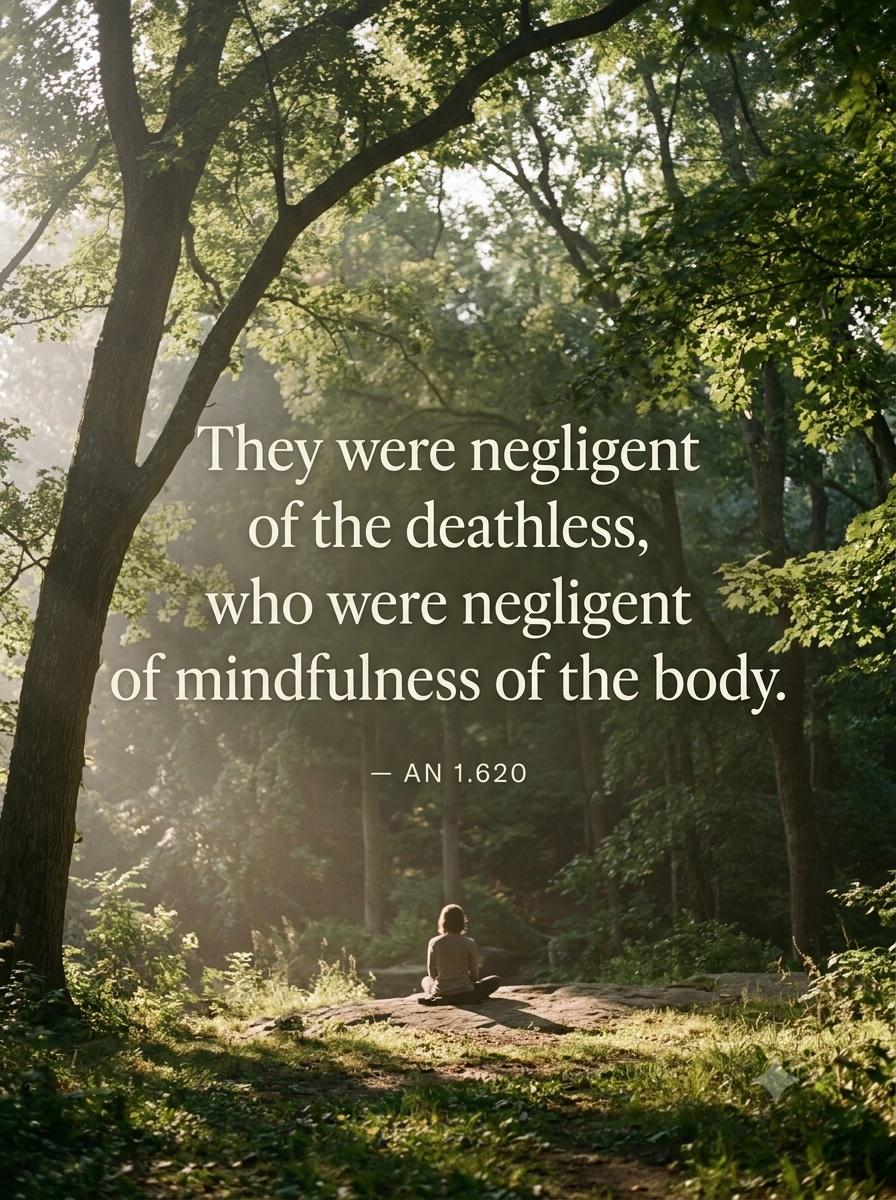
“They were negligent of the deathless, who were negligent of mindfulness of the body. They were not negligent of the deathless, who were not negligent of mindfulness of the body.”
This was said by the Blessed One, said by the Awakened One, as I have heard:
“There are these three roots of the unwholesome. What are the three? Greed is a root of the unwholesome, aversion is a root of the unwholesome, delusion is a root of the unwholesome. These are the three roots of the unwholesome.”
The Blessed One spoke on this matter. In this regard, it is said:
“Greed, aversion, and delusion, afflict the person with a corrupt mind; they arise from within and harm him, as its own fruit destroys the reed.”
This matter too was spoken by the Blessed One, as I have heard.
---
Key Terms:
Greed [lobha] ≈ a grasping mental quality of craving, possessiveness, or lustful wanting that clings to objects or experiences; it fuels attachment and obstructs renunciation and contentment
delusion [moha] ≈ illusion, misperception, erroneous belief, false idea, misapprehension; a fundamental distortion of reality that sustains confusion, clouds discernment, and fuels further doubt
corrupt mind [pāpacetasa] ≈ evil-minded, a mind with defilements
reed [tacasāra] ≈ bamboo; lit. hardwood skin
Image: Māra Sends His Daughters to Entice the Bodhisattva, Borbodur, Photo by Anandajoti Bhikkhu
The great distinction in skill in the experience of feelings between the wise and the ordinary (SN 36.6) - The ordinary person reacts to physical pain by resistance to it [thus reinforcing the tendency of aversion] and only knows escape from it through sensual pleasures [thus reinforcing the tendency of passion]. Thus, he keeps swinging like a pendulum between pleasure and pain, and fails to discern the peaceful escape that lie beyond both.