r/DSALeetCode • • 13h ago

Amazon new-grad SDE interview: train fares and a sliding-window maximum

8 Upvotes

An Amazon SDE new-grad candidate finished four rounds and got rejected. They left with mixed feelings. Some of the coding questions felt manageable, but nerves got to them during parts of the loop.

Leadership Principles and train fares

The first interview opened with about 10–15 minutes of Leadership Principles. The coding part asked for a function that returns the fare between two stops, at one unit per segment. For a route G → U → H → K → I, going from G to I costs four.

The candidate assumed a stops array already existed and wrote the calculation. They made a couple of small mistakes, including an incorrect edge-case return. When the interviewer asked where the array was coming from, they started modeling the route as a class and showing how stops would be added. Revising the solution midway got messy, and the interviewer brought them back to the fare function. They implemented the additional weekend cap. This was their weakest round, and they felt the missed modeling requirement mattered more than the typos.

String problem and GenAI

They came up with a solution to a string or substring problem and dry-ran it. When asked to write tests, they overthought the request until the interviewer gave a simple input/output example. They then wrote several cases, including empty input. The GenAI discussion also felt good. They considered this their strongest round.

For prep before another loop, try implementing and testing a problem from PracHub’s Amazon Interview Questions. If you’re applying to other teams, LandOffer can autofill repeated application fields. I work on both.

Behavioral

One question was about working with a difficult teammate or making a difficult decision. There were a lot of follow-ups. They felt some stories landed well and that they gave more background than needed on others.

Leadership Principles and sliding-window maximum

The last round started with a story about overcoming an obstacle to reach an important goal. The coding task was to implement put and getMax for the most recent k values. They started by keeping every insertion and scanning the last k when asked for the max. That gave them amortized O(1) inserts, O(k) queries and O(n) space.

When asked to reduce memory, they explained that they only needed the last k values and could evict the oldest as each new one arrived, bringing the space down to O(k). They talked through alternatives using arrays, hash maps, linked lists and heaps. They didn't get to the monotonic deque during the interview, but they had a working baseline and could explain the trade-offs. They left that round feeling reasonably good.

The final result was a rejection after all four rounds.


r/DSALeetCode • • 7h ago

How much coding required for AI engineer role?

2 Upvotes

I’m currently learning AI/ML and exploring the AI Engineering path. I understand concepts like LLMs, RAG, embeddings, vector databases, and AI agents, but I’m unsure about the actual coding expectations.

  • How strong should Python skills be?
  • How much DSA and problem-solving is expected?
  • Should we be able to code everything from scratch?
  • How important are debugging and building applications using frameworks like LangChain, LangGraph and FastAPI?

Would love to hear from working AI Engineers about the coding skills required in real-world projects and interviews, especially for entry-level roles.


r/DSALeetCode • • 19h ago

PhonePe SDE-2 interview: a to-do app, two DSA problems and Shazam-style design

18 Upvotes

A backend engineer interviewed for an SDE-2 role at PhonePe in Bangalore. The process had four rounds: machine coding and low-level design, DSA, high-level design, and a hiring manager interview.

Round 1: Machine coding and low-level design

The take-home assignment was to design and implement a working to-do list app. It was delivered through a link, with no camera or screen monitoring, and the instructions explicitly ruled out using AI to write the code.

The follow-up lasted 45–60 minutes. The interviewer read through the code, asked how different pieces worked and why the candidate chose that design, and went into edge cases, trade-offs, and optimizations. They also picked two functions the candidate had implemented with brute force and asked them to improve both during the review.

Round 2: DSA

There were two medium problems, one graph-based and one set-based. Both were wrapped in scenarios, so the candidate spent part of the round clarifying what the problems were asking. For each, they explained the brute-force and optimized approaches, compared time and space complexity, and explained why the optimization helped. The interviewer focused on the reasoning and implementation logic. The candidate didn't have to run the code against a full set of test cases.

For coding prep before a similar loop, try a graph problem from PracHub’s PhonePe Interview Questions and explain the complexity aloud. If you’re applying to other roles, LandOffer can autofill repeated application fields. I work on both.

Round 3: High-level design

The prompt was to design a Shazam-style service: take a short audio sample and identify the song. The candidate hadn't practiced that problem before. They started with requirements, then discussed processing the input, representing the audio for matching, storing and retrieving large binary objects, and scaling the service. The interviewer gave them room to explore several approaches. Time ran out before they could go deep on every component, but they were able to explain the overall architecture and felt the discussion went well.

Round 4: Hiring manager

About a week after HLD, the candidate had a hiring manager slot. The interviewer didn't join the first appointment, and the next date was postponed too. The candidate followed up with HR. HR asked if another location would work, but the candidate preferred Bangalore and the meeting was eventually scheduled for that role.

The interview lasted about 75 minutes. They went deep on one project and discussed difficult technical problems, on-call scenarios, how the systems worked in production, CI/CD, how the team operated, and what the candidate owned. The candidate came away feeling they had answered confidently.

Outcome

They expected to move toward an offer after the last round. After a few days of silence and an unanswered follow-up, a rejection came by email. They asked HR for feedback and didn't get specifics. They wondered whether headcount in Bangalore played a part, given the earlier location question, but never learned the reason.

The technical rounds were interesting and put a lot of weight on explaining trade-offs. Scheduling and communication after the interviews could have been better. The rejection came after the hiring manager round, without specific feedback.


r/DSALeetCode • • 14h ago

Microsoft SDE II interview: Nested List Weight Sum, Create Maximum Number and two live coding problems

4 Upvotes

A candidate shared their 2024 Microsoft SDE II loop.

For interview prep, try implementing a prompt from PracHub’s Microsoft Interview Questions. LandOffer can autofill repeated application fields if you’re applying elsewhere. I work on both.

  • Online assessment. Nested List Weight Sum and Create Maximum Number. The first uses nesting depth as the weight. The second combines two arrays while preserving relative order.
  • Coding. Best Time to Buy and Sell Stock and Number of Islands.
  • Low-level design. Design a task scheduler that can represent dependencies and priorities and reschedule work sooner or later.
  • System design. Discuss the architecture and data flow of a DDoS detection and mitigation system. Then design collaborative document editing with real-time updates, conflict resolution, persistence and scaling.
  • Combined high- and low-level design. Build a daily-meeting reminder feature with same-day, next-day and holiday scheduling. The candidate described how the components fit together, then got into API and database design, recurring versus one-off events and holiday edge cases.

r/DSALeetCode • • 8h ago

Need suggestions. Please help

Thumbnail reddit.com
1 Upvotes

r/DSALeetCode • • 14h ago

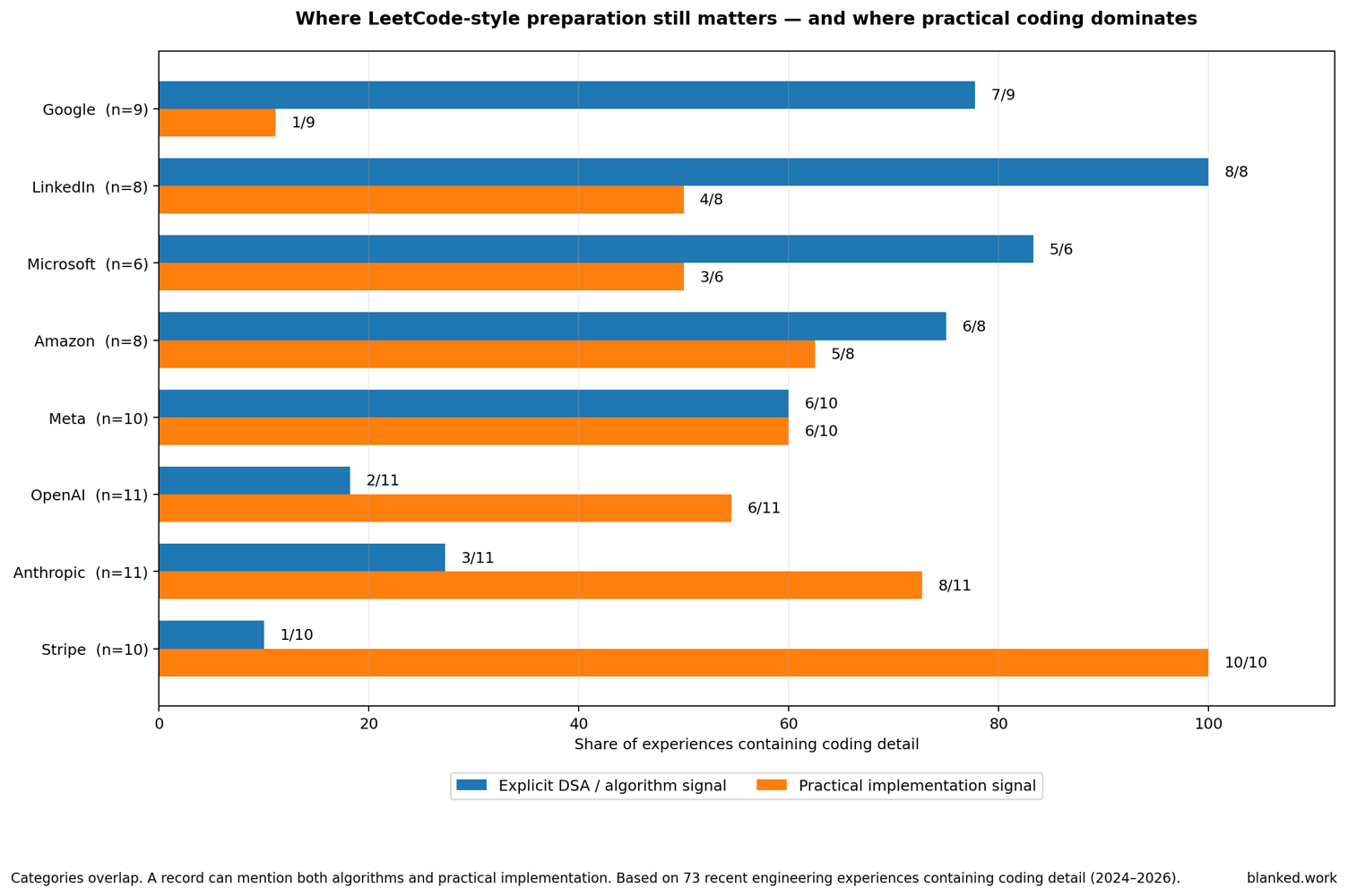
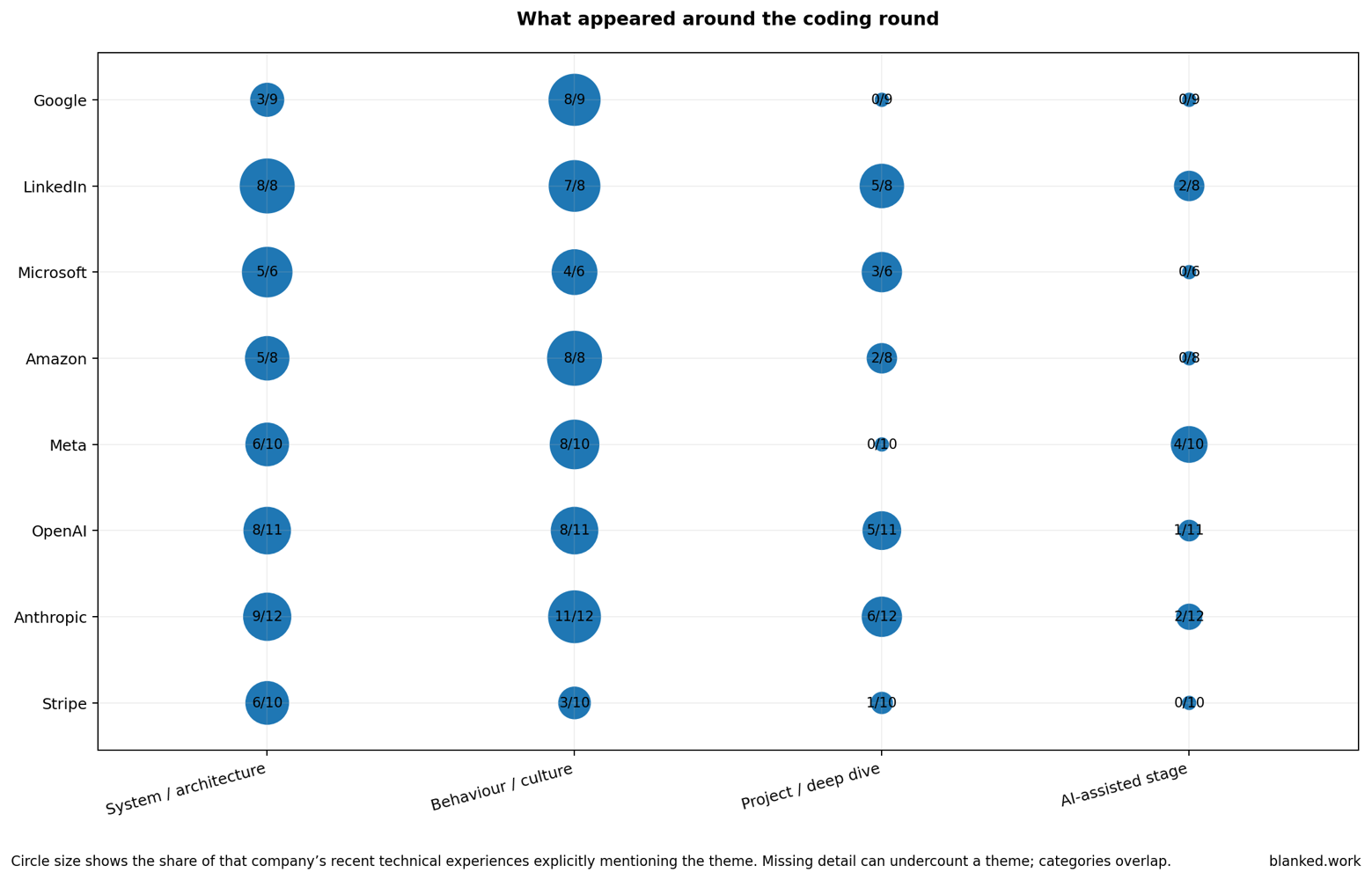
Where LeetCode still matters: what 74 recent interview reports showed across 8 companies

2 Upvotes

A review of 74 engineering interview reports from 2024–2026 found very different patterns across eight companies. The 74 reports came from a larger collection of 229 candidate experiences across 41 companies.

Coding-round chart · Interview-pattern matrix

Google, LinkedIn and Microsoft

Among reports with coding details, DSA or algorithmic work appeared in 7 of 9 at Google, 8 of 8 at LinkedIn, and 5 of 6 at Microsoft. Google reports described graphs, DP, heaps, unfamiliar problems and follow-ups. LinkedIn combined multiple coding rounds with concurrency, design, and project or leadership depth. Microsoft reports mentioned trees and graphs, concurrency, low-level design, OOP and project discussions.

The takeaway for those loops was to practice clarifying the problem, explaining your approach before coding, finishing in time and testing edge cases. Custom problems and changed constraints can matter even when the interview is DSA-heavy.

Stripe

All 10 technical reports mentioned practical implementation. One resembled a conventional DSA-heavy exercise. Candidates described API and SDK work, multi-part requirements, parsing and validation, debugging existing code, and modeling payment, invoice or reconciliation rules. The practice suggested by those rounds is to read a longer prompt, implement it in stages, verify edge cases and tests, and explain the business rules as you go.

OpenAI and Anthropic

At OpenAI, practical implementation appeared in 6 of 11 reports, design in 8 of 11, and project or technical deep dives in 5 of 11. Reports included refactoring, APIs, reliability, distributed systems and end-to-end product design.

At Anthropic, practical coding appeared in 8 of 12, system or architecture design in 9 of 12, values or behavioral evaluation in 11 of 12, and project or technical deep dives in 6 of 12. Alongside debugging and infrastructure trade-offs, candidates described conversations about mission, safety, ethical disagreements, and judgment under ambiguity.

Meta

Six of 10 reports each mentioned DSA, practical implementation, and system design. Four mentioned an explicit AI-assisted stage. The reports paired conventional coding and design with tasks where candidates had to inspect generated suggestions, debug or extend the output, and explain what they accepted or rejected.

Amazon

Of eight reports, six featured DSA, five mentioned design, and all eight covered Leadership Principles or behavioral evaluation. Some candidates described strong coding performance followed by rejection or a downlevel after other rounds. Their accounts suggest preparing one or two technically detailed ownership stories so you can answer follow-ups on decisions, trade-offs and what you personally contributed.

To turn this into prep, PracHub has coding, debugging and design prompts to practice before interviews. Pick a task your target role emphasizes, then explain your approach and test its edge cases. LandOffer can autofill repeated fields if you’re applying across companies. I work on both.

What the numbers can tell you

A theme was counted only when it was explicitly mentioned. The categories overlap, and a report can omit something that took place in the loop. These are self-selected candidate accounts, so the counts describe what that group reported. They give no pass rate or guarantee of what a company will ask next.

If you've interviewed recently, which company's pattern matches your experience? Where does it already look outdated, and which company would you want to see broken down next?


r/DSALeetCode • • 18h ago

I Almost Gave Up on DSA. Then I Found These 14 Patterns.

Thumbnail
javarevisited.substack.com
3 Upvotes

r/DSALeetCode • • 17h ago

Arctic Wolf senior UI interview: JavaScript fundamentals, a to-do app and React async

1 Upvotes

A senior UI developer candidate applied to Arctic Wolf through a referral in September 2025. The loop ended up being five hour-long rounds.

JavaScript fundamentals

The interviewer asked for closure examples, vanilla JavaScript implementations of debounce and throttle, and polyfills for Promise.all and Array.prototype.reduce. The output questions covered a promise chain with rejection, catch and finally, how `this` changes across methods, arrow functions and detached calls, and the order of synchronous code, microtasks and timers. They also asked about var versus let in a loop and about hoisting and scope.

Machine coding

Build a to-do app with Completed, In Progress and Deleted tabs. Show the tasks for the selected filter and handle keyboard interactions, including adding a task with Enter. The candidate finished early and got another promise-chain output question, with non-function values passed to then.

System design

A lead engineer dug into past projects, virtualization and lazy loading. They asked for vanilla JavaScript pseudocode using Intersection Observer to virtualize content. The discussion also touched on using React Profiler and how micro-frontends work.

If you’re preparing for a UI loop, PracHub has coding prompts you can use to rehearse JavaScript implementations and explain edge cases. LandOffer can autofill repeated fields when you’re applying to other teams. I work on both.

Hiring manager

The engineering manager asked about the candidate's career, situational questions and team fit. They also discussed message queues, even though the role was UI-focused, and how to implement role-based authentication and show pages based on a user's role.

Final technical round

The recruiter had said the first four rounds were positive and the offer letter was expected Monday. On Monday, an extra design and coding round was scheduled instead. The candidate explained a Gatsby-to-React migration at Fairmatic, why they made particular design choices, and how they worked with their manager, junior developers and product managers.

The React exercise involved async behavior. The candidate misunderstood the prompt and wrote a more complicated solution that, by their account, worked. The interviewer asked for a simpler implementation, and they couldn't produce it in the remaining time.

The feedback for that round was “Do Not Proceed,” and the application ended there. The candidate was surprised and frustrated after hearing that the hiring manager liked them and that an offer letter was coming. They were interviewing for the main platform team and had heard of other candidates having three rounds at most.


r/DSALeetCode • • 1d ago

Four SWE intern interview loops from 2021 at Coinbase, Copart, Salesforce and Walmart

3 Upvotes

An SWE intern applicant shared four interview loops from 2021.

For current interview practice, PracHub has coding prompts to solve and explain aloud. LandOffer can autofill repeated fields while applying to other internships. I work on both.

  • Coinbase. Two medium-to-hard HackerRank problems, a 30-minute behavioral round, then an hour of coding about maximizing profit from buy and sell orders and discussing practical issues at a crypto exchange. Rejected a week later.
  • Copart. Resume, Java OOP and databases in a 30-minute round. The team-lead round covered JavaScript and Node.js, keyword filtering, pagination, palindromes and ES6. Offer.
  • Salesforce. Two easy HackerRank problems, a coding and behavioral round with a medium problem, then a resume and behavioral round. The candidate kept the prompts private under an NDA and accepted the offer.
  • Walmart. An easy HackerRank assessment, a ModernHire judgment assessment, a take-home that pulled and filtered API data with pagination, then a coding round covering Coin Change and distinct values in an array. Offer.

Interview calls picked up when the candidate tailored their resume to each job, matched relevant keywords and linked projects to GitHub READMEs. They recommended explaining your reasoning out loud, asking interviewers to clarify a flaw, and sticking with practice through rejections.


r/DSALeetCode • • 1d ago

Uber SWE II interview: graph coding rounds and a stock-alert system design

22 Upvotes

An Uber Software Engineer II candidate went through six rounds over about two months.

PracHub’s Uber Interview Questions bank has system-design prompts for practice before interviews. Sketch one and walk through failure cases. LandOffer can autofill applications elsewhere. I work on both.

  • OA. Two medium-to-hard problems, on strings and graphs. The graph problem could use union-find.
  • Phone screen. Find the itinerary that visits the most distinct cities. The candidate memoized DFS results. Cycles were a missed edge case, though the interviewer hadn't expected one. Strong Hire.
  • Coding. Find the first timestamp when all riders are connected in shared-ride logs. They implemented union-find and parsed the input. A follow-up added blocking events that could sever connections, so they explained a BFS approach. Hire.
  • Low-level design. Build a C++ key-value store with constant-time get, put, delete, and random retrieval. They generalized the key and value types. Strong Hire.
  • High-level design. Alert subscribers when a stock moves 5% from its close. They used Kafka and Postgres, then moved threshold checks upstream to limit database lookups. The discussion covered sharding, idempotency, and dead-letter queues.
  • Hiring manager. Project work, cross-team collaboration, and receiving feedback.

High-level design was the only No Hire. The recruiter said the candidate could reapply in six months. They asked for resources to improve at high-level design.


r/DSALeetCode • • 1d ago

Resume advice please

Post image
6 Upvotes

I know I still need to do a lot currently I am few ratings short of knight on LC and about to be a pupil on CF help me and roast my resume and tell me where I can improve so that I can get opportunities 2026 grad btw


r/DSALeetCode • • 1d ago

Welcome to r/MyDSAJourney! 🚀 Let's learn DSA together.

Thumbnail reddit.com
1 Upvotes

r/DSALeetCode • • 1d ago

PhonePe SDE-2 interview: machine coding, DSA and Shazam-style design

8 Upvotes

A backend SDE-2 candidate interviewed for a Bangalore role at PhonePe. The loop had four rounds.

For readers preparing before a PhonePe interview, PracHub’s PhonePe Interview Questions bank has graph problems to practise. LandOffer can autofill repeated fields when applying elsewhere. I work on both.

  1. Machine coding. Build a working to-do app and be ready to defend the low-level design. The assignment prohibited AI tools. In a 45–60 minute review, the interviewer asked about edge cases and trade-offs, then had the candidate optimize two functions.
  2. Algorithms. Two medium-level problems, one involving graphs and one involving sets. Both were framed as scenarios. The candidate explained brute-force and optimized approaches and compared their time and space costs.
  3. System design. Identify a song from a short audio clip. The discussion covered how to represent the audio, find a match, store large binary objects, and scale the service.
  4. Hiring manager. After a missed appointment and another postponement, the conversation ran about 75 minutes. It covered a project in depth, production incidents, CI/CD, and what the candidate owned on the team.

They thought the final conversation went well, then received a rejection after a few days of silence. They never got specific feedback and don't know why the process ended.

Interview write-up


r/DSALeetCode • • 1d ago

I'm interested in DSA give me suggestions for interview

Thumbnail reddit.com
0 Upvotes

r/DSALeetCode • • 1d ago

Salesforce LMTS interview: HackerRank, live coding and typeahead design

4 Upvotes

A candidate for Salesforce LMTS went through five rounds.

The 90-minute HackerRank screen had two problems, one on strings and one on arrays. A recruiter followed up the next day. The first live coding round opened with questions about the candidate's project. They then solved three medium-level problems in about 40 minutes and ran their code against HackerRank's tests. In the next round, they solved a variation of the harder problem and coded a second solution that went well.

For readers preparing before a Salesforce interview, PracHub’s Salesforce Interview Questions bank has coding and design prompts. Pick one and explain the trade-offs out loud.

The architecture round was the toughest for them. An architect spent about half the session asking why the candidate's current system was built the way it was and what alternatives they'd considered. The other half was a typeahead design exercise. In the hiring manager round, the design prompt concerned the team's own product. Knowing which team they were interviewing with helped them prepare.

If you’re applying to other teams too, LandOffer can autofill repeated application fields. I work on both.

They'd been preparing for three to four months and received an offer about a month later. The recruiter kept them updated throughout.

Interview write-up · Offer details


r/DSALeetCode • • 1d ago

LeetCode: 1046. Last Stone Weight

Post image
1 Upvotes

Go's container/heap only builds min-heaps. You get a max-heap by lying to it. Define Less as greater-than, and that one inverted comparison is the whole difference.

Why sorting is the wrong shape for Last Stone Weight: sort, take the two heaviest, smash them, put the remainder back in the right place. That's an insertion, O(n) every round.

The deeper mismatch is that sorting answers a question nobody asked. This problem never needs the third-heaviest stone. It needs the maximum, repeatedly, from a collection that keeps changing.

A heap keeps exactly one promise: the largest is at the root. Read its backing array left to right, and it looks close to random, and that's the point. Maintaining less is what makes it cheaper.

Did inverting Less feel wrong the first time you did it?

Day 78/365 of my LeetCode challenge: 1046. Last Stone Weight. Problem link and full breakdown in today's newsletter.

https://www.linkedin.com/pulse/leetcode-1046-last-stone-weight-easy-archit-agarwal-ummqc


r/DSALeetCode • • 1d ago

Arctic Wolf senior UI interview: JavaScript, a to-do app, and an extra technical round

2 Upvotes

An Arctic Wolf senior UI candidate applied through a referral in September 2025 and went through five hour-long rounds.

The first covered closures, debounce and throttle, Promise.all and reduce polyfills, promise chains, this binding, the event loop, loop scoping, and hoisting. The second was a to-do app with completed, in-progress and deleted views and an Enter-key shortcut. Finishing early led to another promise-output question.

For coding practice before another interview, PracHub has prompts you can solve and test, then explain aloud.

In system design, a lead engineer asked about past projects, lazy loading, virtualization with Intersection Observer, the React Profiler, and micro-frontends. The hiring manager covered behavioral questions, message queues, and how a role-based app would decide which pages to display.

For readers applying to other teams, LandOffer can autofill repeated fields. I work on both.

The candidate was told the first four rounds went well and an offer letter was expected on Monday. Instead, there was another technical interview. They discussed a Gatsby-to-React migration and then misread an async React prompt. Their implementation worked, but they ran out of time when asked to simplify it. They were rejected after that extra round. The candidate said the role was on the main platform team and had heard other candidates went through fewer rounds.


r/DSALeetCode • • 1d ago

Hello Interview

Thumbnail reddit.com
1 Upvotes

r/DSALeetCode • • 2d ago

How do you practice getting unstuck and explaining your thinking after the Amazon OA?

1 Upvotes

I passed the amazon oa. And now i'm thinking about how to prepare for the next interview without turning it into another endless list of questions.

After the roblox rejection, it's tempting to treat every bit of uncertainty as something I can fix by doing more prep. but I want the next practice session to tell me something useful about how I explain my thinking.

This is the plan i'm putting together, not a recap of a completed amazon round. the examples below are practice ideas, not questions amazon asked me.

  1. practice the first few minutes, not just the solution

take a simple interval-merging exercise. before touching the code, ask whether [1,3] and [3,5] should merge, whether the input is sorted, and what the output should look like. then explain a straightforward approach and test it on a tiny example. i want to get comfortable making assumptions visible instead of silently picking one.

2. make getting stuck part of the mock

i'd like to do a 30-minute mock where the other person changes one requirement halfway through. if my approach stops working, the goal is to say what still works, show the smallest example that breaks it, and choose a next step. even 'i can solve this with a slower approach first' is something concrete to discuss.

for fresh prompts, i'll pick from some practice questions and keep the solution closed until the attempt is over. i don't want familiarity with an answer to be the thing I'm measuring.

For readers using this approach, PracHub’s Amazon Interview Questions bank has fresh prompts for practice before the interview. LandOffer can autofill repeated fields if you’re applying elsewhere too. I work on both.

3. prepare for the second question about a project

I'll pick one real project and start with a short explanation of my part. then work through: why that approach, what i disagreed with, what evidence changed my mind, and what i'd do differently now. no invented numbers to make the ending sound better. if an outcome wasn't measured, i need to be clear about that.

4. ask for feedback i can actually use

after a mock, i'd rather hear 'you lost me when you changed the data structure without explaining why' than just 'communicate more'. the plan is to repeat that small section with the feedback, then stop for the day instead of immediately opening another problem.

i'm happy about getting through the oa, but i don't want to confuse that with being ready for everything after it. for people who improved at live interviews, what helped you recover when you got stuck? did recording yourself help, or was feedback from another person the bigger difference?


r/DSALeetCode • • 2d ago

Free live session: 10 sorting algorithms explained visually (beginner-friendly, ask anything)

1 Upvotes

Hi everyone,

I recently finished learning DSA and found that teaching is the best way to really lock it in. So I'm hosting a free live session on sorting algorithms, and I'd love a small group of people who want to learn together.

What we'll cover:

Bubble, Selection, Insertion, Merge, Quick, Heap, Counting, Radix, Bucket and Shell Sort: how each works step by step, time/space complexity, and when to actually use which.

Details:

> - 📅 Sunday 22th November at 10:AM IST

> - ⏱ ~90 minutes (with breaks for questions)

> - 💻 Google Meet, free

> - 👥 Best for: beginners and anyone preparing for interviews or placements

This is interactive, not a lecture. Interrupt me, ask "why", and we'll solve things together.

After this, I plan to do one pattern-based DSA problem every week with the group.

Sign up here and I'll send the link + a reminder: https://forms.gle/Jy67XqSYjRQRohbCA


r/DSALeetCode • • 2d ago

DSA

2 Upvotes

Hey guys,, currently an engineering undergrad ( S3 ). I'm more likely interested towards learning DSA and genAI in the future. Currently since my Semester exams are ongoing I'm not planning to start doing any of these as of now but I'm going start from December as my exams will have an end by that time. If someone is interested in learning DSA together as a study partner with whom I can hold accountability with or mentor me, would appreciate any of the two, id like to stick together so we won't distract maybe?


r/DSALeetCode • • 2d ago

Stop grinding 600 leetcode problems, you literally just need 49

Thumbnail
youtu.be
2 Upvotes

r/DSALeetCode • • 3d ago

Need serious DSA partner till December..

5 Upvotes

If you are not delusional then sorry if you r the welcome ....( want to connect 1 or 2 people not more than that dm me if u want to do )

my plan is to do dsa till 1 December so much so that for future dsa will become easy.....

targeted topics dp, tree, graph ...

high level topics .....

see listen I don't care from which year from which place from which college you belong...

I just care about my dsa journey or your dsa journey ...

please we will be solving 20 problems each day ...

I don't know how it will done but some how if we target 20 then only we can do 10.......

let's do it I have solved 138 question yet....

efforts from both side ....

dsa and system design ......

see we have time till December I just want to do dsa regressly mann.....

I have filled microsoft position i may be get call (delusional) from the recruiter....


r/DSALeetCode • • 4d ago

How I Cracked Blinkit's SDE-1 Interview!

92 Upvotes

Just a few days ago, I wrapped up one of the most exciting interview processes I’ve ever been part of — and today, I'm thrilled to share that I've accepted an offer from Blinkit as an SDE-1! 🚀

Total years of experience - around 2.5 years.

Blinkit’s interview process is short, crisp, and focused — just 3 rounds:

DSA Round

System Design

Hiring Manager Round

For readers preparing for a similar process, the Blinkit Interview Questions bank on PracHub includes a tree-and-graph coding problem to practise. If you are still applying to other roles, LandOffer can reduce repeated application form filling.

Here’s a breakdown of my experience 👇

⚙️ Round 1: DSA + Kafka Curiosity
The interview started off with the interviewer spotting Kafka multiple times in my resume (and rightly so, I’ve worked extensively on it).
This sparked a discussion around:

How I used Kafka in my previous projects

How I handled fault tolerance, load balancing, and failures

Real-world use cases I built around it

Then came the DSA part — a story-based problem that was a blend of House Robber II + Combination Sum.
I walked through both recursive and memoized approaches, and the interviewer was happy with the way I structured and explained my thought process.

🛠️ Round 2: System Design
This was taken by an SDE-3 who was deep into systems thinking.
He gave me an open-ended but realistic problem:

Design a system that can collect credentials from multiple financial apps, scrape data, process it, and generate analytics for both users and admins.

As we discussed, he dynamically added admin-level analysis to the requirements — and I had to adapt the architecture on the fly. It was tricky but fun!

⚠️ Pro Tip: Practice using tools like draw.io or Alphine beforehand — I usually use whiteboards but had to quickly adapt during the call.

We extended beyond time as I kept pitching scalable ideas (analytics with pie charts, generic services, etc.).
That persistence paid off — we ended up discussing:

Elasticsearch and inverted indexes

Database tradeoffs

Master-slave setups and caching strategies

The interviewer appreciated the effort and told me, "You had misses, but you didn’t give up — that’s what mattered." ❤️

👨‍💼 Round 3: Hiring Manager (but it felt like a Kafka deep-dive)
Expected a cultural fit round? Well, surprise!
The manager saw Kafka again on my resume and deep-dived into real-world async problems Blinkit is facing right now while processing orders.

We discussed:

Async order processing challenges

Kafka optimization strategies

Frontend checks + backend resilience

Scenarios I handled in production

He ended by saying:

"Kafka is our backbone, and your understanding of it is solid. I’m impressed."

💬 We even touched on comp discussion at the end — but more on that in a separate post 😉

✨ Same day offer. Offer accepted.
I’m super excited to be joining Blinkit and can’t wait to build impactful systems with the team!

If you’re preparing for interviews or working with Kafka, feel free to drop a comment or message — always happy to chat tech 💬

#blinkit #interviewexperience #sde1 #kafka #systemdesign #softwareengineering #careerjourney #offeraccepted