r/DSALeetCode • • 14h ago

Amazon new-grad SDE interview: train fares and a sliding-window maximum

8 Upvotes

An Amazon SDE new-grad candidate finished four rounds and got rejected. They left with mixed feelings. Some of the coding questions felt manageable, but nerves got to them during parts of the loop.

Leadership Principles and train fares

The first interview opened with about 10–15 minutes of Leadership Principles. The coding part asked for a function that returns the fare between two stops, at one unit per segment. For a route G → U → H → K → I, going from G to I costs four.

The candidate assumed a stops array already existed and wrote the calculation. They made a couple of small mistakes, including an incorrect edge-case return. When the interviewer asked where the array was coming from, they started modeling the route as a class and showing how stops would be added. Revising the solution midway got messy, and the interviewer brought them back to the fare function. They implemented the additional weekend cap. This was their weakest round, and they felt the missed modeling requirement mattered more than the typos.

String problem and GenAI

They came up with a solution to a string or substring problem and dry-ran it. When asked to write tests, they overthought the request until the interviewer gave a simple input/output example. They then wrote several cases, including empty input. The GenAI discussion also felt good. They considered this their strongest round.

For prep before another loop, try implementing and testing a problem from PracHub’s Amazon Interview Questions. If you’re applying to other teams, LandOffer can autofill repeated application fields. I work on both.

Behavioral

One question was about working with a difficult teammate or making a difficult decision. There were a lot of follow-ups. They felt some stories landed well and that they gave more background than needed on others.

Leadership Principles and sliding-window maximum

The last round started with a story about overcoming an obstacle to reach an important goal. The coding task was to implement put and getMax for the most recent k values. They started by keeping every insertion and scanning the last k when asked for the max. That gave them amortized O(1) inserts, O(k) queries and O(n) space.

When asked to reduce memory, they explained that they only needed the last k values and could evict the oldest as each new one arrived, bringing the space down to O(k). They talked through alternatives using arrays, hash maps, linked lists and heaps. They didn't get to the monotonic deque during the interview, but they had a working baseline and could explain the trade-offs. They left that round feeling reasonably good.

The final result was a rejection after all four rounds.


r/DSALeetCode • • 19h ago

PhonePe SDE-2 interview: a to-do app, two DSA problems and Shazam-style design

18 Upvotes

A backend engineer interviewed for an SDE-2 role at PhonePe in Bangalore. The process had four rounds: machine coding and low-level design, DSA, high-level design, and a hiring manager interview.

Round 1: Machine coding and low-level design

The take-home assignment was to design and implement a working to-do list app. It was delivered through a link, with no camera or screen monitoring, and the instructions explicitly ruled out using AI to write the code.

The follow-up lasted 45–60 minutes. The interviewer read through the code, asked how different pieces worked and why the candidate chose that design, and went into edge cases, trade-offs, and optimizations. They also picked two functions the candidate had implemented with brute force and asked them to improve both during the review.

Round 2: DSA

There were two medium problems, one graph-based and one set-based. Both were wrapped in scenarios, so the candidate spent part of the round clarifying what the problems were asking. For each, they explained the brute-force and optimized approaches, compared time and space complexity, and explained why the optimization helped. The interviewer focused on the reasoning and implementation logic. The candidate didn't have to run the code against a full set of test cases.

For coding prep before a similar loop, try a graph problem from PracHub’s PhonePe Interview Questions and explain the complexity aloud. If you’re applying to other roles, LandOffer can autofill repeated application fields. I work on both.

Round 3: High-level design

The prompt was to design a Shazam-style service: take a short audio sample and identify the song. The candidate hadn't practiced that problem before. They started with requirements, then discussed processing the input, representing the audio for matching, storing and retrieving large binary objects, and scaling the service. The interviewer gave them room to explore several approaches. Time ran out before they could go deep on every component, but they were able to explain the overall architecture and felt the discussion went well.

Round 4: Hiring manager

About a week after HLD, the candidate had a hiring manager slot. The interviewer didn't join the first appointment, and the next date was postponed too. The candidate followed up with HR. HR asked if another location would work, but the candidate preferred Bangalore and the meeting was eventually scheduled for that role.

The interview lasted about 75 minutes. They went deep on one project and discussed difficult technical problems, on-call scenarios, how the systems worked in production, CI/CD, how the team operated, and what the candidate owned. The candidate came away feeling they had answered confidently.

Outcome

They expected to move toward an offer after the last round. After a few days of silence and an unanswered follow-up, a rejection came by email. They asked HR for feedback and didn't get specifics. They wondered whether headcount in Bangalore played a part, given the earlier location question, but never learned the reason.

The technical rounds were interesting and put a lot of weight on explaining trade-offs. Scheduling and communication after the interviews could have been better. The rejection came after the hiring manager round, without specific feedback.


r/DSALeetCode • • 7h ago

How much coding required for AI engineer role?

2 Upvotes

I’m currently learning AI/ML and exploring the AI Engineering path. I understand concepts like LLMs, RAG, embeddings, vector databases, and AI agents, but I’m unsure about the actual coding expectations.

  • How strong should Python skills be?
  • How much DSA and problem-solving is expected?
  • Should we be able to code everything from scratch?
  • How important are debugging and building applications using frameworks like LangChain, LangGraph and FastAPI?

Would love to hear from working AI Engineers about the coding skills required in real-world projects and interviews, especially for entry-level roles.


r/DSALeetCode • • 18h ago

Arctic Wolf senior UI interview: JavaScript fundamentals, a to-do app and React async

1 Upvotes

A senior UI developer candidate applied to Arctic Wolf through a referral in September 2025. The loop ended up being five hour-long rounds.

JavaScript fundamentals

The interviewer asked for closure examples, vanilla JavaScript implementations of debounce and throttle, and polyfills for Promise.all and Array.prototype.reduce. The output questions covered a promise chain with rejection, catch and finally, how `this` changes across methods, arrow functions and detached calls, and the order of synchronous code, microtasks and timers. They also asked about var versus let in a loop and about hoisting and scope.

Machine coding

Build a to-do app with Completed, In Progress and Deleted tabs. Show the tasks for the selected filter and handle keyboard interactions, including adding a task with Enter. The candidate finished early and got another promise-chain output question, with non-function values passed to then.

System design

A lead engineer dug into past projects, virtualization and lazy loading. They asked for vanilla JavaScript pseudocode using Intersection Observer to virtualize content. The discussion also touched on using React Profiler and how micro-frontends work.

If you’re preparing for a UI loop, PracHub has coding prompts you can use to rehearse JavaScript implementations and explain edge cases. LandOffer can autofill repeated fields when you’re applying to other teams. I work on both.

Hiring manager

The engineering manager asked about the candidate's career, situational questions and team fit. They also discussed message queues, even though the role was UI-focused, and how to implement role-based authentication and show pages based on a user's role.

Final technical round

The recruiter had said the first four rounds were positive and the offer letter was expected Monday. On Monday, an extra design and coding round was scheduled instead. The candidate explained a Gatsby-to-React migration at Fairmatic, why they made particular design choices, and how they worked with their manager, junior developers and product managers.

The React exercise involved async behavior. The candidate misunderstood the prompt and wrote a more complicated solution that, by their account, worked. The interviewer asked for a simpler implementation, and they couldn't produce it in the remaining time.

The feedback for that round was “Do Not Proceed,” and the application ended there. The candidate was surprised and frustrated after hearing that the hiring manager liked them and that an offer letter was coming. They were interviewing for the main platform team and had heard of other candidates having three rounds at most.


r/DSALeetCode • • 18h ago

I Almost Gave Up on DSA. Then I Found These 14 Patterns.

Thumbnail
javarevisited.substack.com
3 Upvotes

r/DSALeetCode • • 15h ago

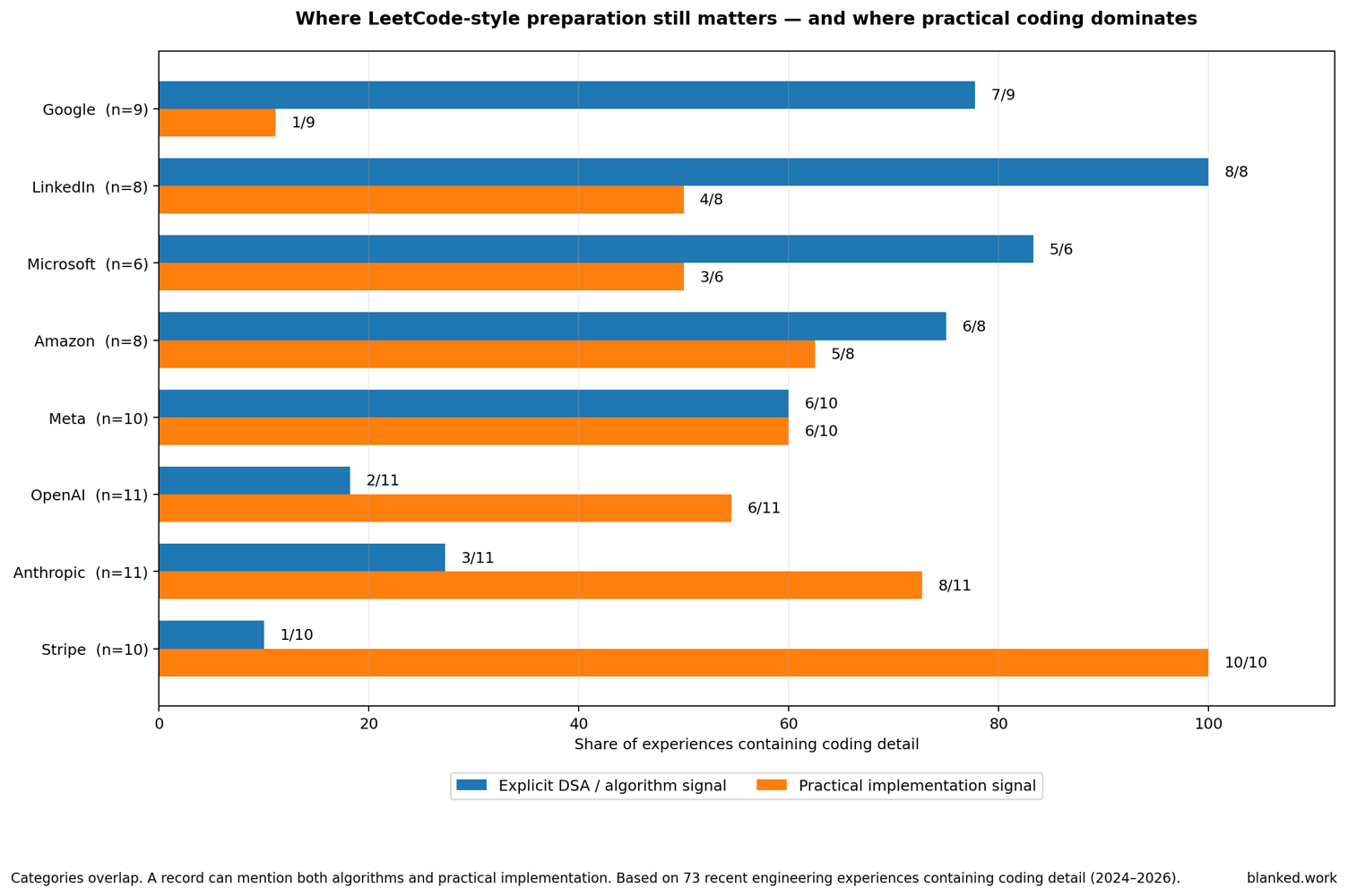
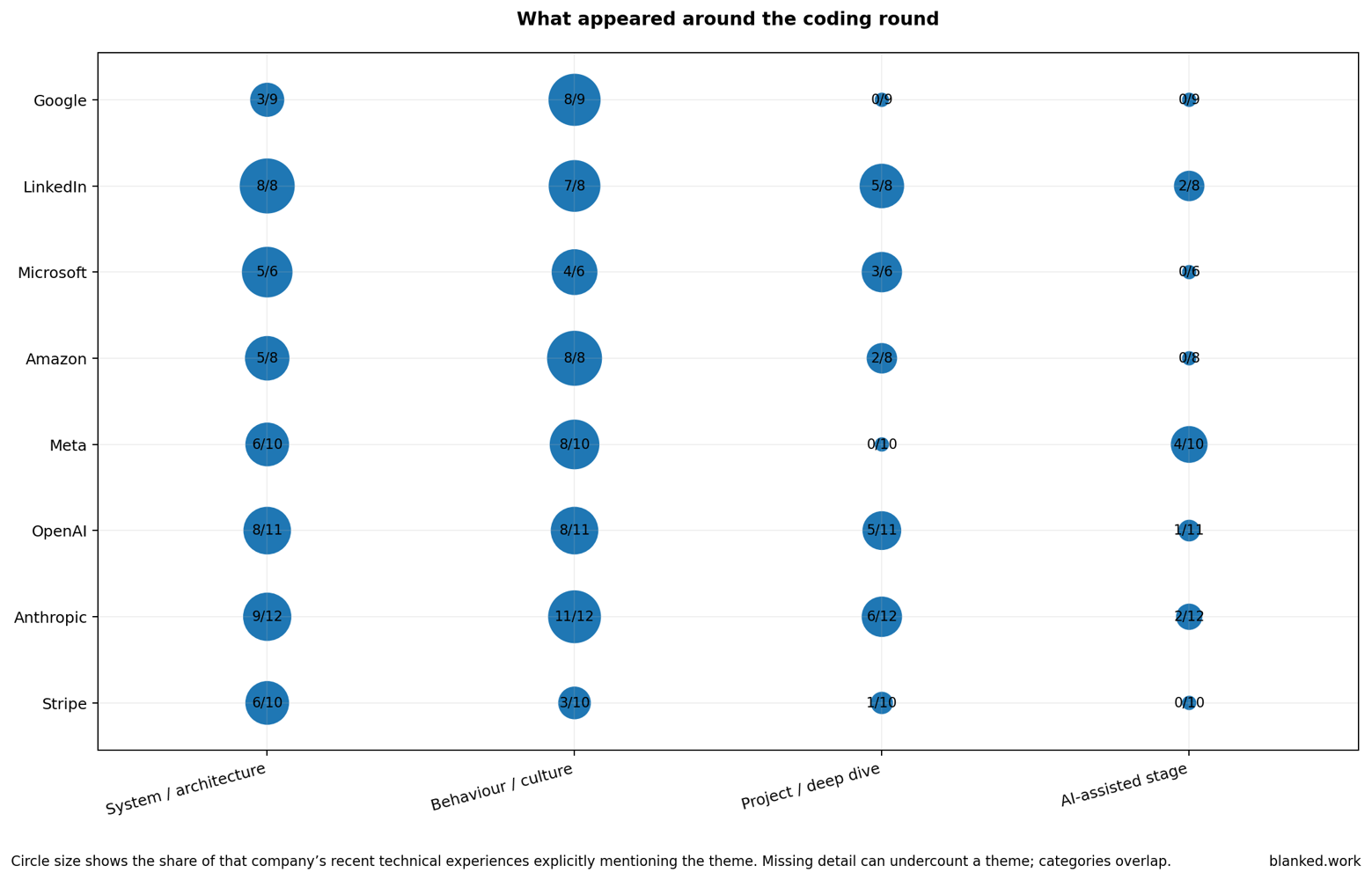
Where LeetCode still matters: what 74 recent interview reports showed across 8 companies

2 Upvotes

A review of 74 engineering interview reports from 2024–2026 found very different patterns across eight companies. The 74 reports came from a larger collection of 229 candidate experiences across 41 companies.

Coding-round chart · Interview-pattern matrix

Google, LinkedIn and Microsoft

Among reports with coding details, DSA or algorithmic work appeared in 7 of 9 at Google, 8 of 8 at LinkedIn, and 5 of 6 at Microsoft. Google reports described graphs, DP, heaps, unfamiliar problems and follow-ups. LinkedIn combined multiple coding rounds with concurrency, design, and project or leadership depth. Microsoft reports mentioned trees and graphs, concurrency, low-level design, OOP and project discussions.

The takeaway for those loops was to practice clarifying the problem, explaining your approach before coding, finishing in time and testing edge cases. Custom problems and changed constraints can matter even when the interview is DSA-heavy.

Stripe

All 10 technical reports mentioned practical implementation. One resembled a conventional DSA-heavy exercise. Candidates described API and SDK work, multi-part requirements, parsing and validation, debugging existing code, and modeling payment, invoice or reconciliation rules. The practice suggested by those rounds is to read a longer prompt, implement it in stages, verify edge cases and tests, and explain the business rules as you go.

OpenAI and Anthropic

At OpenAI, practical implementation appeared in 6 of 11 reports, design in 8 of 11, and project or technical deep dives in 5 of 11. Reports included refactoring, APIs, reliability, distributed systems and end-to-end product design.

At Anthropic, practical coding appeared in 8 of 12, system or architecture design in 9 of 12, values or behavioral evaluation in 11 of 12, and project or technical deep dives in 6 of 12. Alongside debugging and infrastructure trade-offs, candidates described conversations about mission, safety, ethical disagreements, and judgment under ambiguity.

Meta

Six of 10 reports each mentioned DSA, practical implementation, and system design. Four mentioned an explicit AI-assisted stage. The reports paired conventional coding and design with tasks where candidates had to inspect generated suggestions, debug or extend the output, and explain what they accepted or rejected.

Amazon

Of eight reports, six featured DSA, five mentioned design, and all eight covered Leadership Principles or behavioral evaluation. Some candidates described strong coding performance followed by rejection or a downlevel after other rounds. Their accounts suggest preparing one or two technically detailed ownership stories so you can answer follow-ups on decisions, trade-offs and what you personally contributed.

To turn this into prep, PracHub has coding, debugging and design prompts to practice before interviews. Pick a task your target role emphasizes, then explain your approach and test its edge cases. LandOffer can autofill repeated fields if you’re applying across companies. I work on both.

What the numbers can tell you

A theme was counted only when it was explicitly mentioned. The categories overlap, and a report can omit something that took place in the loop. These are self-selected candidate accounts, so the counts describe what that group reported. They give no pass rate or guarantee of what a company will ask next.

If you've interviewed recently, which company's pattern matches your experience? Where does it already look outdated, and which company would you want to see broken down next?


r/DSALeetCode • • 14h ago

Microsoft SDE II interview: Nested List Weight Sum, Create Maximum Number and two live coding problems

4 Upvotes

A candidate shared their 2024 Microsoft SDE II loop.

For interview prep, try implementing a prompt from PracHub’s Microsoft Interview Questions. LandOffer can autofill repeated application fields if you’re applying elsewhere. I work on both.

  • Online assessment. Nested List Weight Sum and Create Maximum Number. The first uses nesting depth as the weight. The second combines two arrays while preserving relative order.
  • Coding. Best Time to Buy and Sell Stock and Number of Islands.
  • Low-level design. Design a task scheduler that can represent dependencies and priorities and reschedule work sooner or later.
  • System design. Discuss the architecture and data flow of a DDoS detection and mitigation system. Then design collaborative document editing with real-time updates, conflict resolution, persistence and scaling.
  • Combined high- and low-level design. Build a daily-meeting reminder feature with same-day, next-day and holiday scheduling. The candidate described how the components fit together, then got into API and database design, recurring versus one-off events and holiday edge cases.