A review of 74 engineering interview reports from 2024–2026 found very different patterns across eight companies. The 74 reports came from a larger collection of 229 candidate experiences across 41 companies.
Coding-round chart · Interview-pattern matrix
Google, LinkedIn and Microsoft
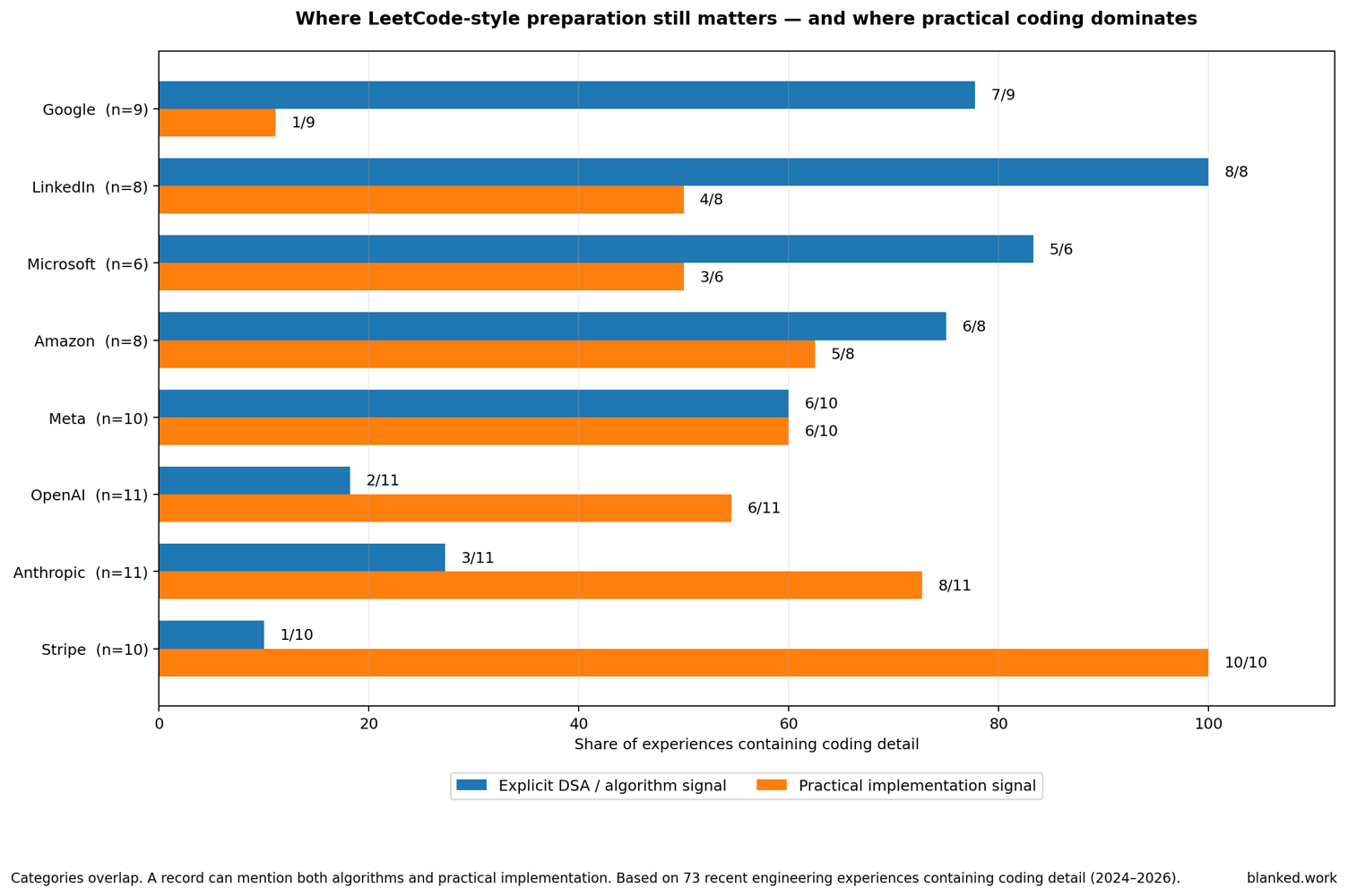
Among reports with coding details, DSA or algorithmic work appeared in 7 of 9 at Google, 8 of 8 at LinkedIn, and 5 of 6 at Microsoft. Google reports described graphs, DP, heaps, unfamiliar problems and follow-ups. LinkedIn combined multiple coding rounds with concurrency, design, and project or leadership depth. Microsoft reports mentioned trees and graphs, concurrency, low-level design, OOP and project discussions.
The takeaway for those loops was to practice clarifying the problem, explaining your approach before coding, finishing in time and testing edge cases. Custom problems and changed constraints can matter even when the interview is DSA-heavy.
Stripe
All 10 technical reports mentioned practical implementation. One resembled a conventional DSA-heavy exercise. Candidates described API and SDK work, multi-part requirements, parsing and validation, debugging existing code, and modeling payment, invoice or reconciliation rules. The practice suggested by those rounds is to read a longer prompt, implement it in stages, verify edge cases and tests, and explain the business rules as you go.
OpenAI and Anthropic
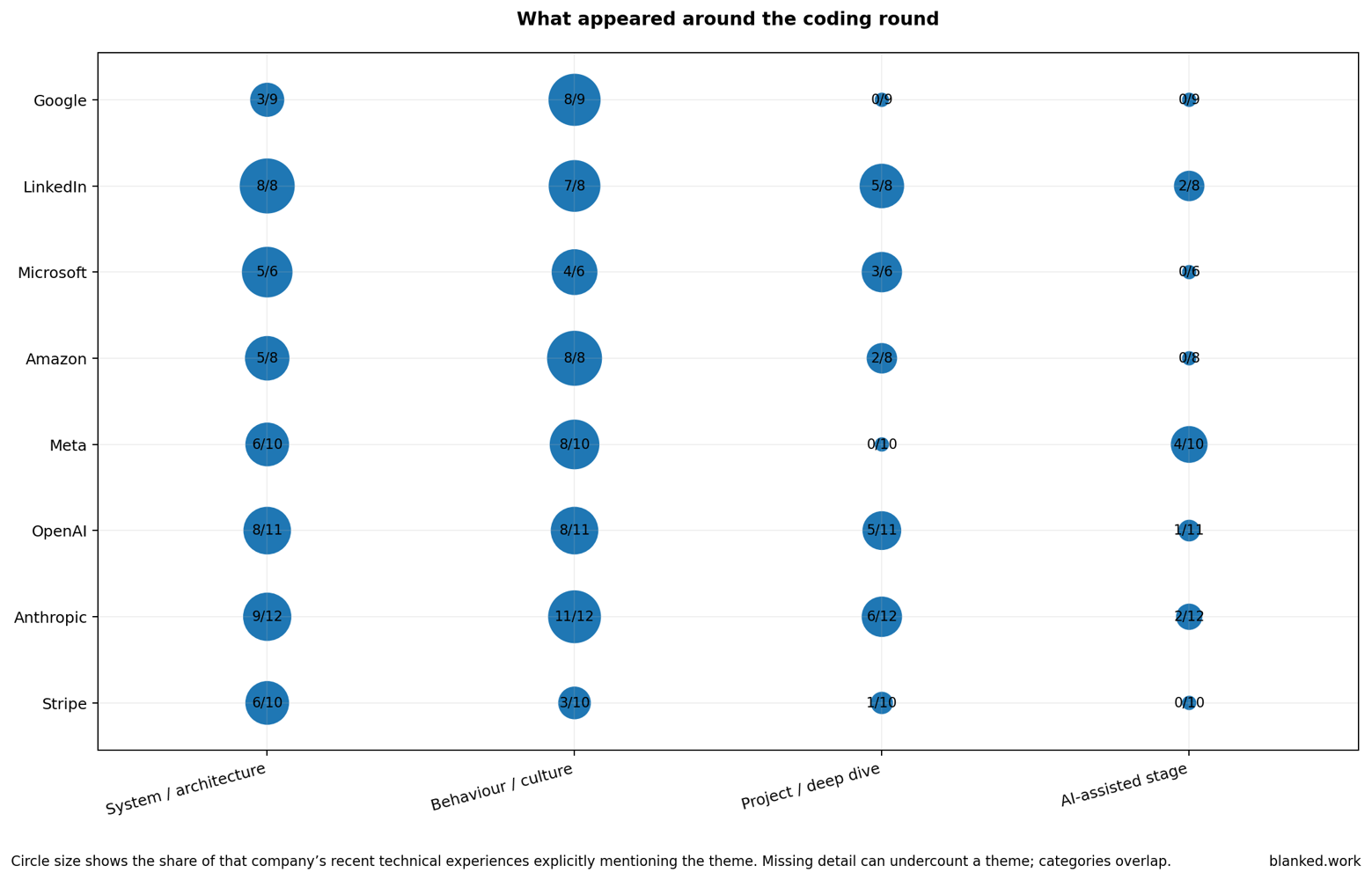
At OpenAI, practical implementation appeared in 6 of 11 reports, design in 8 of 11, and project or technical deep dives in 5 of 11. Reports included refactoring, APIs, reliability, distributed systems and end-to-end product design.
At Anthropic, practical coding appeared in 8 of 12, system or architecture design in 9 of 12, values or behavioral evaluation in 11 of 12, and project or technical deep dives in 6 of 12. Alongside debugging and infrastructure trade-offs, candidates described conversations about mission, safety, ethical disagreements, and judgment under ambiguity.
Meta
Six of 10 reports each mentioned DSA, practical implementation, and system design. Four mentioned an explicit AI-assisted stage. The reports paired conventional coding and design with tasks where candidates had to inspect generated suggestions, debug or extend the output, and explain what they accepted or rejected.
Amazon
Of eight reports, six featured DSA, five mentioned design, and all eight covered Leadership Principles or behavioral evaluation. Some candidates described strong coding performance followed by rejection or a downlevel after other rounds. Their accounts suggest preparing one or two technically detailed ownership stories so you can answer follow-ups on decisions, trade-offs and what you personally contributed.
To turn this into prep, PracHub has coding, debugging and design prompts to practice before interviews. Pick a task your target role emphasizes, then explain your approach and test its edge cases. LandOffer can autofill repeated fields if you’re applying across companies. I work on both.
What the numbers can tell you
A theme was counted only when it was explicitly mentioned. The categories overlap, and a report can omit something that took place in the loop. These are self-selected candidate accounts, so the counts describe what that group reported. They give no pass rate or guarantee of what a company will ask next.
If you've interviewed recently, which company's pattern matches your experience? Where does it already look outdated, and which company would you want to see broken down next?