r/IndianHistory • • 6m ago

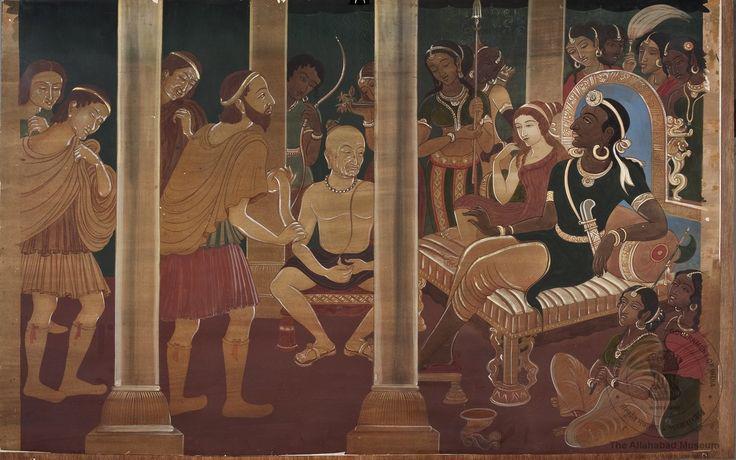
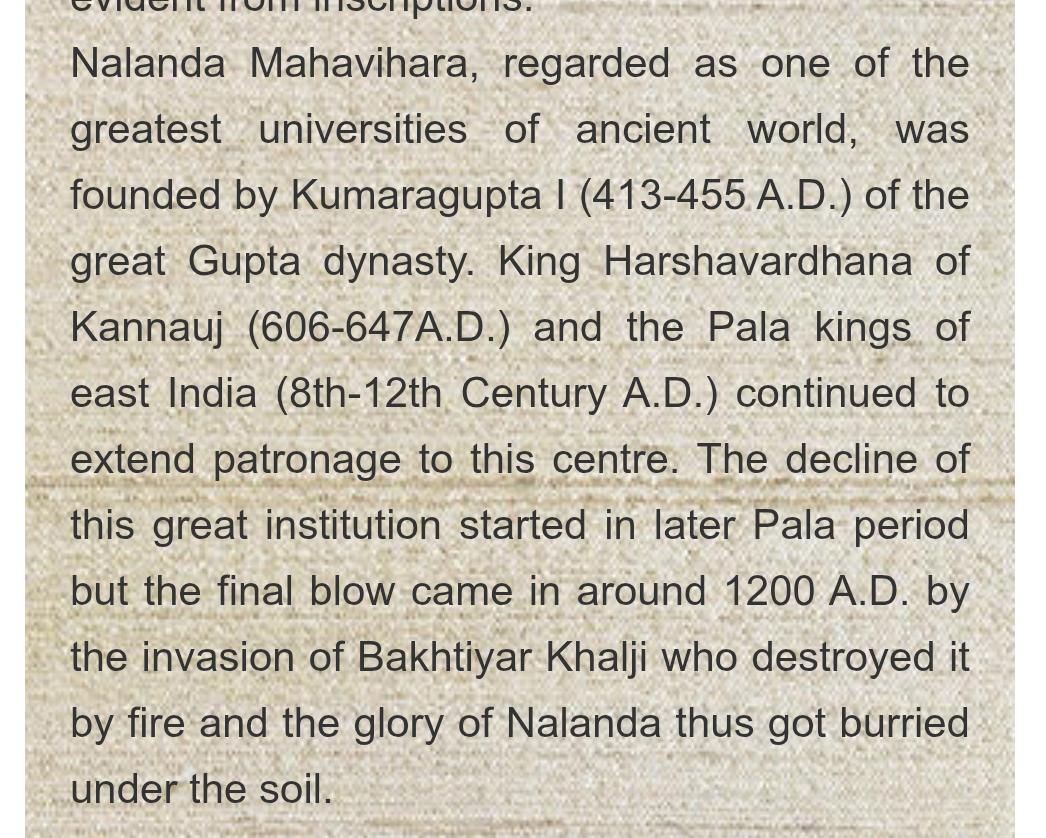
Question If Nalanda University was such a grand university, then did they help Gupta, Pushyabhuti & Pala Empire to get an edge over others? Like, some unique medical treatment, new weapons, better infrastructure, unique military tactics and so on?

Post image
1 Upvotes

People say that Nalanda University was the greatest of the world, and many foreigners are their notable alumni.

It is regarded as the world's first residential university.

Most probably, what burned was: advanced and extensive studies on mathematics, medicines, military tactics, and so on. It was not something pseudo scientific, like nuclear weapons, flying airplanes.

So, do we have some inscriptions or observations from foreign travelers from the time of Guptas, Later Guptas, Harsha, or Palas, which states something like:

'We won over our enemy because of the war tactics taught in Nalanda'.

'We used the xyz mathematics studies to solve some problem which was discovered by Nalanda'

'We used Nalanda's new study to heal our soldiers faster'

'We used Nalanda's study to build our towns or trading routes or our food storage infrastructure'

If not, then what actually was taught here?

I know nothing about Nalanda history. I am curious to know.

Image Source:

Archeological Survey of India website:

https://asi.nic.in/search?searchText=nalanda


r/IndianHistory • • 37m ago

Classical 500 BCE–550 CE The story of Chandragupta Maurya from Greeco-Roman sources

Post image
13 Upvotes

Roman historian Justin says that Chandragupta was from a humble origin and had to once flee away after offending the Nanda king. Here Justin narrates a miraculous legend of Chandragupta getting blessed by a Lion

"This man was of mean origin, but was stimulated to aspire to regal power by supernatural encouragement; for, having offended King Nandrus by his boldness of speech, and orders being given to kill him, he saved himself by swiftness of foot; and while he was lying asleep after his fatigue, a lion of great size having come up to him, licked off with his tongue the sweat that was running from him, and after gently waking him, left him. Being first prompted by this prodigy to conceive hopes or royal dignity, he drew together a band of robbers, and solicited the Indians to support his new sovereignty."

- Book 5, Epitome of Pompeius Trogus Philippic Histories.

Justin then narrated another legend about Chandragupta and an elephant

"Some time after, as he was going to war with the generals of Alexander, a wild elephant of great bulk presented itself before him of its own accord, and, as if tamed down to gentleness, took him on its back, and became his guide in the war, and conspicuous in fields of battle. Sandrocottus, having thus acquired a throne, was in possession of India, when Seleucus was laying the foundations of his future greatness;"

- Book 5, Epitome of Pompeius Trogus Philippic Histories.

Chandragupta led the war against Greeks in India and overthrew all the greek garrisons that Alexander had established earlier

"He (Seleucus) then headed towards India, which, after the death of Alexander, had murdered its prefects, as if it had shaken off the yoke of servitude from its neck.

Having thus acquired royal power, Sandrocottos possessed India at the time when Seleucus was laying the foundations of his future greatness."

- Book XV, Philippic Histories of Trogus Pompey.

Seleucus waged war with Chandragupta but was unable to win. Eventually both came to an understanding

"For the whole region from Phrygia the Indus was subject to Seleucus. He crossed the Indus and waged war with Androcottus, king of the Indians, who dwelt on the banks of that stream, until they came to an understanding with each other and contracted a marriage relationship."

- Page 209, the Syrian wars, history of Rome.

Chandragupta gave 500 elephants to Seleucus while Seleucus gave most of his eastern Satrapies to Chandragupta

"The geographical position of the tribes is as follows: along the Indus are the Paropamisadae, above whom lies the Paropamisus mountain: then, towards the south, the Arachoti: then next, towards the south, the Gedroseni, with the other tribes that occupy the seaboard; and the Indus lies, latitudinally, alongside all these places; and of these places, in part, some that lie along the Indus are held by Indians, although they formerly belonged to the Persians. Alexander took these away from the Arians and established settlements of his own, but Seleucus Nicator gave them to Sandrocottus, upon terms of intermarriage and of receiving in exchange five hundred elephants."

- Chapter 2, book XV, Geography.

Megasthanes visited the court of Chandragupta

"Then the southern part of Asia may again be divided into four parts, and of these Eratosthenes and Megasthenes regard as the greatest part the region of India — Megasthenes dwelt with the satrap of Arachosia, Sibyrtius, and writes that he often visited Sandracottus, the king of the Indians; the smallest part, that bounded by the Euphrates, looks towards our inland sea."

- Book V, Anabasis of Alexander.


r/IndianHistory • • 38m ago

Question What happened to original Indian cuisine?

4 Upvotes

We know many vegetables were not native to India and were introduced by the British, and should not have been part of cuisine before, and what happened to original Indian dishes?


r/IndianHistory • • 2h ago

Vedic 1500–500 BCE North India in the Middle & Late Vedic Period

Post image
7 Upvotes

r/IndianHistory • • 3h ago

Vedic 1500–500 BCE Rishi dirgatamas timeline

1 Upvotes

I'm often intrigued by the work of Srikanth talgeri which states that mandalas of rig ved 2-7 are oldest composed and compiled layers

Where as the 1,8,,9,10 are later layers

But i had this doubt

About the timeline paradox of rishi dirghatamas

If king bharata was traditionally 14-17 generations predecessor of sudas as

And rishi dirghatamas was chief priest of king bharata as stated in aitareya brahmana

How come rishi dirghatamas is associated with newer mandalas and much later vashishta vishwamitra priests of sudas associated with older mandalas????

So I just found this paradox of philology and linguistic chronologies

People told me that since the mention of dirgatamas as bharatas chief priest comes from a brahmana that is composed much later than the events it's not reliable

And other argument i came across is that bharata was not an established individual as per vedas and it's only the name of the lineage to which king sudas belonged to so the later Vedic scholors must have done retrospective fitting of the individual and attributed him to dirgatamas, the brilliant sage, to legitimise it

I don't know which argument to lean toward so can anyone please clarify


r/IndianHistory • • 5h ago

Question Why do Indian movies always depict ancient and medieval India as a barren, empty wasteland?

28 Upvotes

In almost every Bollywood historical movie that I have seen (from about Ashoka to Akbar), not just the forts, but the entire country, roads, towns, battlefields, and countryside is shown as remarkably dry, sparse, and underpopulated.

Is there any historical truth to India looking this bare during those eras, or is this purely a result of filming constraints (I heard they shoot in Rajasthan for scenes set in Delhi for example) and budget limits? What did "India" look like exactly?


r/IndianHistory • • 5h ago

Post Independence 1947–Present Found this Old Health Mobile Clinic

Thumbnail
gallery
21 Upvotes

This is an old Mobile Health clinic run during the late 70s and early 80s, 2 of these were donated to MGIMS Sevagram, India's oldest Rural Medical College by the Health Ministry, This one stands now in Anji Wardha converted into an office, In its heyday it travelled the Indian countryside aiding people.

It also had a functioning OT with deliveries and all kinds of surgical procedures taking place inside this one a kind vehicle.

This was called "White Elephant" in the local language.

A neat piece of Indian Medical history.

If you know something more about this or something similar please share, if you have any questions I'll be answering them.


r/IndianHistory • • 5h ago

Early Modern 1526–1757 CE Audrey Truschke's recent book "India: 5,000 years of History on the Subcontinent" fails source audit. Some examples of the failures are particularly telling.

Thumbnail
gallery
91 Upvotes

Rohit Shinde has conducted a source audit of Audrey Truschke's recent book "India: 5,000 years of History on the Subcontinent" by using AI to check her claims against what the sources say. Truschke's book seems to fail the audit very badly.

For more info, see:

https://x.com/rohitshinde121/status/2124028571530432839

https://x.com/rohitshinde121/status/2124383645242933752

https://x.com/rohitshinde121/status/2124383661298716988

https://x.com/rohitshinde121/status/2124383677157462384

https://x.com/rohitshinde121/status/2124383692902842832

I think AI was used to identify the relevant parts of the sources, so we shouldn't discount it since it's just a tool (like a search engine) in this case; this is not a case of AI slop. (In general, AI output shouldn't be blindly trusted without further manual verification.) See the illustrative examples provided in the post that compare the content in her book with what the sources say.

His audit seems to be in alignment with my own post https://www.reddit.com/r/IndianHistory/comments/1kkx1w2/mischaracterizations_of_rigveda_and_errors_in_the/ titled "Mischaracterizations of Rigveda and errors in the forthcoming book titled "India" by Audrey Truschke ..." that I made (without the use of AI) when a preview of the book's e-book version was made available by the publisher.


r/IndianHistory • • 6h ago

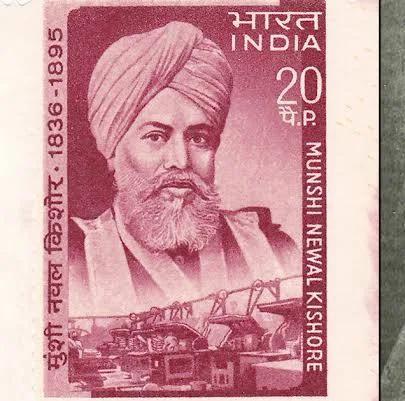
Colonial 1757–1947 CE From Wazirganj to the Heart of Colonial Lucknow: The Rise of Munshi Nawal Kishore and His Press in Hazratganj

Post image
24 Upvotes

A historical look at how Munshi Nawal Kishore transformed a modest Urdu printing shop into a publishing powerhouse at the centre of colonial power, mostly based on Ulrike Stark’s An Empire of Books.

When Munshi Nawal Kishore first arrived in Lucknow, his publishing empire began not in a grand commercial avenue, but in a small rented space in Agha Mir ki Deorhi, a neighbourhood in Wazirganj. Following the naming conventions of early Urdu presses, he called his humble establishment Matba-e Avadh Akhbar (the Avadh Akhbar Press), named after the Urdu journal he launched simultaneously from the premises.

What started as a lithographic press quickly gained momentum—and influential backing. Within its very first year, the shop was outfitted with type presses at the urging of local colonial officials. Nawal Kishore had found a crucial patron in Colonel Saunders A. Abbott, who served as the commissioner and superintendent of the Lucknow Division between 1858 and 1863. Abbott arranged for printing machinery and equipment to be shipped from Calcutta and steadily supported the young printer-journalist with government printing contracts.

The 1861 Breakthrough

The defining turning point in Nawal Kishore’s career arrived in 1861. Likely at Abbott’s behest, the Nawal Kishore Press (NKP) secured the contract to print the Urdu translation of the newly enacted Indian Penal Code, titled Ta'zīrāt-e Hind. The project was so important that its principal translator, Deputy Inspector Nazir Ahmad, travelled to Lucknow personally to oversee the printing.

Issued in a massive run of 30,000 copies priced at Rs 3 each, the Urdu Penal Code was both a financial triumph and a watershed moment in Nawal Kishore’s relationship with the British administration. From that point forward, he was officially recognised as a publisher of the first rank.

Outgrowing Old Lucknow

Success brought rapid expansion, particularly in the Lithographic Department. By its fourth year, the press was running 25 hand presses and employing roughly 300 pressmen and workers. The original Wazirganj shop could no longer contain the operation, forcing a series of relocations in the early 1860s:

  • Golganj and Rakabganj: The press moved first to Golganj and then to Rakabganj, where Nawal Kishore rented Ajodhya Kothi, a spacious building formerly owned by Maharaja Mansingh.
  • Lalbagh and Kaisarbagh: Around the same period, additional presses were set up in the former maktabkhāna (school-house) of Suleiman Qadir, situated between Lalbagh and Kaisarbagh (as noted by Nurani, 1995).

Even as he expanded across Lucknow, Nawal Kishore looked outward. On September 1, 1865, he opened a major branch press on the banks of the Ganga near Sarsaiya Ghat in Kanpur, 90 kilometres southeast of Lucknow. As a growing military station and commercial hub for local produce and European imports, Kanpur was rapidly becoming one of northern India’s premier industrial centres. The new press was placed under the joint management of Maulvi Muhammad Isma'il and Munshi Lalta Prashad.

Moving into Hazratganj: A Shift in Space and Status

In 1870, the Nawal Kishore Press made its third and final move within Lucknow—relocating to Hazratganj, the fashionable, modern commercial district in the city's Civil Lines.

This move was far more than a logistical upgrade; it was a physical and symbolic entry into the epicentre of colonial authority in the province. Being allotted land for purchase in Hazratganj was a rare privilege typically reserved for influential ta'alluqdārs (landed aristocrats), underscoring Nawal Kishore’s elevated standing with the British administration.

Nawal Kishore established himself in Kothi Inayat Sultan, part of the historic Begum Kothi complex. Originally built in 1844 by Nawab Amjad 'Ali Shah as a palace for his queen, Begum Kothi had witnessed fierce fighting during the 1857 uprising, and parts of it were later converted into Lucknow's General Post Office (Hay, 1994).

Alongside Kothi Inayat Sultan, Nawal Kishore acquired prime real estate on the grounds to construct additional buildings—including a structure that later came to house the Central Bank. Historian Veena Oldenburg (1989) highlights a telling detail about his private residence there: in 1869, Nawal Kishore submitted two architectural designs to the British authorities—one for a traditional native-style home and another for an English-style bungalow. To preserve the European aesthetic of Hazratganj, officials rejected the native design and approved the bungalow. Shortly afterwards, he also purchased Mubarak Manzil, part of the Moti Mahal complex built by Nawab Ghaziuddin Haidar.

Inside the Hazratganj Publishing Complex

With ample real estate at his disposal, Nawal Kishore divided his printing operations across two distinct buildings:

  1. Matba-e Avadh Akhbar (Kothi Inayat Sultan): Adjacent to the General Post Office, this was by far the larger facility. It served as the firm's administrative headquarters—handling incoming orders and business correspondence—and housed the bulk of the lithographic work, including Avadh Akhbar and other Urdu periodicals. By 1870, its daily output had reached an astonishing 12,000 juz, equivalent to 192,000 printed pages every day.
  2. Matba-e Navalkishor (Mubarak Manzil): Continuing the work of the original Typographic Department, this branch employed around 150 workers and focused primarily on typesetting, alongside occasional lithographic work. Over time, however, the distinction between the two names faded, and "Nawal Kishore Press" became the umbrella title for the entire enterprise.

Yet behind the prestigious Hazratganj facade, the daily reality of the workshop remained deeply rooted in Indian craft traditions. In 1884, an American visitor named John F. Hurst documented his impressions of the premises after turning down a long lane off the main avenue:

"The buildings are numerous, but low, mostly of one story, after the native fashion, and exceedingly plain. Many of them are mere sheds, where the work is done in full view of others on the premises. The roofs are of brick tiling. These buildings cover a vast space, which is divided into many alleys and nondescript passageways, running at all angles with each other, and describing such curves as one can find in the denser parts of Luebeck or Nuremberg. I entered the premises by a long lane running at right angles from the main street. No one in passing along the street would suspect, unless he should turn into the lane, the number of men hard at work at the farther end, or the wonderful magnitude of their operations... The huts have no wooden floors. Mother Earth is the common resting-place. The men and boys in great numbers sit on the earthen floor in all possible positions, and carry on their work. They set type, read proof and bind the sheets while sitting squat on the ground."

Even with this sprawling complex, demand eventually outpaced capacity, leading Nawal Kishore to rely heavily on outside subcontractors to fulfil printing orders.

Industrial Scale and Educational Reach

The sheer volume of books leaving Hazratganj was staggering. During the financial year 1872–73 alone, the press produced 104,025 printed volumes valued at Rs 41,806. The vast majority of this output was driven by colonial educational initiatives: 98,000 of those volumes (worth Rs 13,901) were commissioned directly by the Oudh Education Department.

To keep pace with growth, Nawal Kishore continually modernised his mother firm in Lucknow. By 1885, several power presses imported from England were running in Hazratganj, and by 1891, twenty steam-powered presses were operating under European supervision.

This mechanisation placed the Nawal Kishore Press in a league of its own. Under the Indian Factories Act of 1891, it became the only Indian-owned printing press in the North-Western Provinces and Oudh to qualify as a factory—standing alongside just three British-run institutions: the Methodist Publishing House in Lucknow, the Oudh and Rohilkhand Railway Press in Lucknow, and the Allahabad Government Press. While steam power naturally reduced the size of the manual workforce by 1895, the press's overall commercial momentum never slowed.

Under Nawal Kishore’s adopted son, Pragnarayan Bhargava, operations at Hazratganj continued to flourish into the twentieth century. As The Cyclopaedia of India observed in 1908:

"The works, godowns, etc. occupy a very considerable area at Hazratganj, and no expense has been spared in equipping them with the latest printing and steam machinery. They do a very extensive business, giving employment to about 500 men. The works are specially equipped for printing in all the vernaculars of India, and experts are retained who can handle any of the local languages, Arabic, Persian, Urdu, Sanskrit, Hindi, Marathiu, Punjabi, etc., besides English. In consequence, work flows in from all parts of India, as well as from foreign countries, such as Persia…"

From a single rented room in Wazirganj to an industrial-scale multilingual publishing house in Hazratganj, Munshi Nawal Kishore’s journey mirrored—and actively shaped—the literary and colonial landscape of nineteenth-century North India.

Sources & References
  • Primary Text: Adapted from Ulrike Stark, An Empire of Books: The Naval Kishore Press and the Diffusion of the Printed Word in Colonial India.
  • Historical Works Cited Within the Text:

    • Hay, Sidney (1994). Historic Lucknow.
    • Hurst, John F. (1884). Eyewitness account of the Hazratganj press premises.
    • Nurani, Amir Hasan (1995). Historical account of the press's early Lucknow locations.
    • Oldenburg, Veena Talwar (1989). The Making of Colonial Lucknow, 1856–1877.
    • TheCyclopaediaa of India (1908), Vol. II, p. 362.


r/IndianHistory • • 7h ago

Early Modern 1526–1757 CE Importance of non-Maratha/. Maharashtrian soldiers in the Maratha Empire

2 Upvotes

As I was reading Uday Kulkarni's Solstice at Panipat, he mentions the presence of Arabs in the armies of the From other literature there is the mention of Rajput and Purbiya soldiers.

So what was their numbers and importance for the Maratha kingdoms like those of the Scindia, Holkar and Gaekad?


r/IndianHistory • • 9h ago

Question Age of Consent Act vs Sarda Act: What was in Tagore's mind?

2 Upvotes

In 1887, Tagore debated with Chandranath Basu on child marriage. Tagore was fiercely against it and said that it must need serious reform to protect the young girls. Then, why did he oppose the Age of Consent Act, 1891 where the age of consent was raised from 10 to 12? Alongside, what change happened in Tagore's view that he later supported the Sarda Act, 1929 in which the age of consent was similarly raised by 2 yrs from 12 to 14?

What change happened to Tagore's mind in those almost four decades?


r/IndianHistory • • 22h ago

Prehistoric ~65k–10k BCE Ajab Ghar ki Ghazab Kahani: The Nagpur Central Museum

Thumbnail
thenewsdirt.com
1 Upvotes

In 1863, during the early years of British administration in the Central Provinces, a museum was established in Nagpur that would eventually become one of India's oldest surviving museums.

Today, it is known as Nagpur Central Museum, or more popularly, Ajab Bangla.

Its establishment is associated with Sir Richard Temple, who served as Chief Commissioner of the Central Provinces.

What makes this institution particularly interesting is the extraordinary range of historical material collected from Central India.

Prehistoric and geological collections

The museum preserves fossils and geological specimens, including prehistoric remains recovered from areas around Jabalpur and Chandrapur.

Among its notable exhibits is a femur bone attributed to Jainosaurus, a large sauropod dinosaur that inhabited the Indian subcontinent millions of years ago.

Ancient inscriptions and manuscripts

The museum contains inscriptions and manuscripts reflecting the region's linguistic and political history.

These include material associated with Sanskrit, Prakrit, Persian and Marathi, offering glimpses into different periods of Central India's past.

Tribal history and material culture

Another significant collection documents the everyday lives and craftsmanship of communities across Central India.

Traditional clothing, tools, utensils, decorative objects and other artefacts illustrate cultural practices that are often overlooked in conventional historical narratives.

Weapons and military history

The museum preserves arms and armour associated with different periods, including the Mughal, Maratha and British eras.

These collections are particularly relevant to understanding Nagpur's history as the capital of the Bhonsle kingdom and its subsequent incorporation into British India.

Photographs of old Nagpur

The museum also documents the transformation of Nagpur through historical photographs and exhibits.

Images of old Futala Lake and the city's changing landmarks offer a fascinating glimpse into how Nagpur developed over time.

What's remarkable is that this institution has survived for more than 160 years, preserving historical material from different civilisations, dynasties and communities.

I previously wrote about the museum and its collections, with photographs from my visit:

https://www.thenewsdirt.com/post/ajab-ghar-ki-ghazab-kahani-the-nagpur-central-museum

For anyone interested in the history of the Central Provinces, Berar or pre-independence Nagpur, this museum is an interesting place to begin.

I'd be particularly interested in seeing archival photographs of the museum building from the late nineteenth or early twentieth century.

Has anyone come across old British-era photographs, museum catalogues or records documenting its original collections?


r/IndianHistory • • 1d ago

Colonial 1757–1947 CE The birthday celebration of Maharawal Jawahir Singh

Post image
56 Upvotes

The 18th of November marked the birth anniversary of Maharawal Jawahir Singh Bhati of Jaisalmer. While researching over the old files, I came across this beautiful piece depicting the birthday celebrations of him.

As it was, the birthday, back then, was celebrated as per the Hindu tithi. The birthday of the king was marked with a great celebration throughout the state and was considered as an official public holiday.

Maharawal Jawahir Singh ruled Jaisalmer from 1914 till 1949 and this particular document shows the chronological order of the celebration of his birthday in the year 1937.

One can only wonder how the atmosphere would have been at that moment.


r/IndianHistory • • 1d ago Popcorn

Early Modern 1526–1757 CE I think I created the most detailed Historically accurate map of Himalaya Region in 1700s, showing Kingdoms, Trade routes and Volume, forts, Mines.

Post image
55 Upvotes

this is culmination of 2 months of work. I also Turned it into a video explaining the Economy of this region: https://youtu.be/xrUtK3mZqSE?si=5PZb5goNSf5uoxcy

here is High-res Photo of that Map: https://imgur.com/gallery/greater-nepal-1700s-JVm4jH3


r/IndianHistory • • 1d ago

Linguistics Applies to Most of the Proto-Indo-European Denier or Sanskrit is PIE Crowd [OP: arumnatzorkhang]

57 Upvotes

Again not to say colonial era scholarship was without its fair share of flaws or that racism wasn't a part of atleast some it, however it did bring about a more integrated approach to history and linguistics in the Subcontinent, that went beyond the usual platitudes of Sanskrit is the mother of all languages, and more rigorous record keeping practices. Again, I cannot emphasise this enough, colonialism was a net negative under whose consequences we live with to this day, nonetheless there's no running away from these aspects of their scholarship as well.


r/IndianHistory • • 1d ago

📖 Deep Dive Millet farmers and two routes into India: the origin of Sino-Tibetan in Indian Subcontinent

Thumbnail
vaagritam.com
34 Upvotes

TLDR: Sino-Tibetan languages (Chinese, Tibetan, Meitei, Bodo, Ladakhi and about 500 others) most likely began with millet farmers on the Yellow River. According to Jacques and Stevens (2024), they reached India by two routes: across the Tibetan Plateau to Kashmir, based on stone harvesting knives and hairpin styles, and through Yunnan and northern Myanmar into Assam, based on shouldered stone spades and shared words like peach. The full post has the details.

Sources

  1. Dated language phylogenies shed light on the ancestry of Sino-Tibetan. Sagart, Jacques, Lai, Ryder, Thouzeau, Greenhill, List. PNAS 116 (21), May 6, 2019.
  2. Linguistic, archaeological and genetic evidence suggests multiple agriculture-driven migrations of Sino-Tibetan speakers from Northern China to the Indian subcontinent. Jacques, Stevens. Quaternary International, September 20, 2024.
  3. Dated phylogeny suggests early Neolithic origin of Sino-Tibetan languages. Zhang, Ji, Pagel, Mace. Scientific Reports 10.
  4. Genomic insights into the formation of human populations in East Asia. Wang et al. Nature 591.
  5. Peopling History of the Tibetan Plateau and Multiple Waves of Admixture of Tibetans Inferred From Both Ancient and Modern Genome-Wide Data. He et al. Frontiers in Genetics 12, September 3, 2021.
  6. Multiple Human Population Movements and Cultural Dispersal Events Shaped the Landscape of Chinese Paternal Heritage. Wang et al. Molecular Biology and Evolution 41 (7), June 17, 2024.
  7. Ancient genomes reveal millet farming-related migration from the Yellow River into southwest China. Tao, Yuan, Zhu et al. Current Biology 33 (22), November 20, 2023.
  8. Archaeogenetics: Tracing ancient migrations from the Yellow River. Bellwood. Current Biology 34 (1), January 8, 2024.
  9. Tibeto-Burman languages and classification. Bradley. Pacific Linguistics.

r/IndianHistory • • 1d ago

Colonial 1757–1947 CE Why does the Class 10 NCERT curriculum stop its narrative of the Indian Independence movement at 1942, largely omitting the INA, the Red Fort Trials, and the 1946 RIN Mutiny?

12 Upvotes

I am a 16-year-old Class 10 student currently studying the "Nationalism in India" chapter in our history textbook. While reading through it, I noticed a massive gap in the timeline and the figures covered, and I wanted to get some historical perspective on why the narrative is structured this way.

In our textbook, the timeline moves from Gandhi’s arrival in 1915 through Non-Cooperation, Civil Disobedience, and concludes around the Quit India Movement of 1942. However, there is almost no mention of figures like Subhas Chandra Bose or Bhagat Singh, nor is there coverage of the events between 1942 and 1947.

Specifically, I am trying to understand two things from a historical standpoint:

  1. The 1942–1947 Gap: If the Quit India Movement was largely suppressed by the British by 1942–43, how does standard textbook historiography connect it directly to independence five years later in 1947 without covering the intermediate triggers?
  2. Omission of Armed/Military Factors: Why are events like the Indian National Army (INA) campaigns, the Red Fort Trials (1945–46), and the Royal Indian Navy (RIN) Mutiny of 1946 left out of foundational school curricula, despite historians (and even British officials like Clement Attlee in later accounts) noting their role in eroding British confidence in the loyalty of the Indian armed forces? Additionally, the post-independence rehabilitation—or lack thereof—of INA soldiers is rarely discussed.

I understand that Class 10 textbooks have to condense a massive amount of history into a single chapter, so space is limited. From a historiographical perspective, is this omission simply due to curriculum constraints and thematic focus (focusing strictly on mass civil movements), or is there an academic debate around how much weight is given to constitutional/mass-movement history versus revolutionary and military pressure in the final years of the Raj?

Would appreciate any insights or book recommendations to read more about the 1945–1947 period!


r/IndianHistory • • 1d ago

Colonial 1757–1947 CE Indian wet nurses (dhais)

Thumbnail
gallery
533 Upvotes

Extensively documented in 19th- and early 20th-century British household manuals, medical guides, paintings, and fiction.British physicians in India often advised European mothers (memsahibs) against breastfeeding their own children. They believed the hot, tropical climate drained European women's physical energy and ruined their nursing capacities, making local wet nurses a perceived medical necessity.

Before being hired, Indian wet nurses—who were predominantly low-caste Hindu or Muslim women—were subjected to invasive physical examinations by colonial doctors to ensure their milk was "pure" and free of disease.

Many memsahibs resented the intimate bond that formed between their children and the dhais or ayahs (nursemaids). Colonial handbooks warned that breast milk could transmit Indian habits, temperament, or "inferior" traits to future rulers of the empire, leading to a push in the late 19th century for British mothers to nurse their own babies whenever possible.

Because British families demanded exclusive access to the wet nurse's milk supply, dhais were frequently forced to neglect, wean early, or find inadequate substitutes for their own infants to keep their employment.Women could not refuse to obey, knowing they risked physical, sexual, verbal and psychological abuse and retribution against their families if they did.

Images of Some Paintings of Them Attached Above.

Refrences :-

https://www.faqs.org/childhood/Bo-Ch/British-Colonialism-in-India.html

https://ijme.in/articles/childcare-and-medicine-in-colonial-india/?galley=print


r/IndianHistory • • 1d ago

Question Did Freedom at Midnight make anyone else think about how differently we remember Partition?

7 Upvotes

One thing I find interesting about Freedom at Midnight is how much attention it gives to the people making decisions behind closed doors.

We usually talk about Partition through a few famous names, dates and political decisions. But millions of ordinary people had no say in those decisions and still had to live with the consequences.

The series also makes me wonder how much our understanding of history depends on whose perspective we're following. The same event can look very different when told through a political leader's eyes instead of an ordinary family's.

I think that's something worth discussing beyond whether the show is historically accurate or not.

When we watch historical dramas like this, are we actually learning more about history, or just getting a more convincing version of one particular perspective?


r/IndianHistory • • 1d ago

Colonial 1757–1947 CE Celebrating the Centenary of a City Icon----Some milestones in pictures

Thumbnail
gallery
9 Upvotes

Join us at 1:00 PM on Saturday, 28th November, at Baithak, Le Press, Metaphor Lucknow Litfest, for the Book Release.

Charbagh Station in Lucknow is more than a terminus—it is a city icon celebrating its centenary.

Yet there was a station before it that dutifully received passengers for 50 years, lauded by the pens of Bharatendu and Ratan Nath Sarshar, mentioned in Umrao Jaan, and witness to the meeting of Gandhi and Nehru.

How did it look? This article, published in 1917, shares a picture and describes it. This article, published in 1917, shares a picture and portrays it ( A Notable Indian Railway Junction, Brian Bramal): “The exterior is a low, unimposing, barrack-like structure of red brick, quite devoid of any architectural features of note. Access to the platform is gained through the booking hall, a gloomy, cheerless chamber, with its iron railings, more suggestive of a prison than a railway station”.

Construction of this magnificent edifice was started by the ORR, but when it opened its portals on 19th December 1926, it was part of the EIR, with the then Governor of UP doing the honours. This picture from the last stages of construction tells the saga of its building.

It became the finest example of Indo-Saracenic architecture in a railway station.

From the first tracks of the 1860s to the grand opening of Charbagh Station in December 1926, this book traces how the iron horse reshaped Lucknow—a rare historical journey filled with stories of colonial infrastructure, civic memory, and the railways’ deep impact on Awadh’s social, cultural, economic, and literary life.

📍 Venue: Baithak, Le Press

📅 Date: 28th November, Saturday

🕐 Time: 1:00 PM

🎪 Metaphor Lucknow Litfest

📖 Lucknow Aur Railway: Ek Aitihasik Yatra


r/IndianHistory • • 1d ago

Early Modern 1526–1757 CE A rather odd miraculous story attributed to Baba Ram Rai involving a three-legged goat and Mughal emperor Aurangjeb

Thumbnail
gallery
47 Upvotes

As per a rather odd legend, when Baba Ram Rai (ex-communicated son of Sri Guru Har Rai Sahib Ji Maharaaj) visited Delhi, Mughal emperor Aurangzeb gifted him with a goat. Some time later when the emperor visited Baba Ram Rai, Aurangzeb requested the goat to be returned as he missed it and longed to be re-united with the goat. In-response, Baba Ram Rai presented a miraculous three-legged goat he conjured using his supposed spiritual power (siddha and shakti) and told Aurangzeb to get his men to restore the goat's fourth-leg.

Interestingly, the Ram Rai Darbar Sahib complex in Dehradun has three, separate murals depicting the tale. A mere coincidence? I think not! Another mural, this time located at the Qila Mubarak at Chhachhrauli, also depicts the story.

Oddly enough, there is a slightly-different version of this tale, narrated as below by Debjit Chatterjee:

"Aurangzeb wasn’t ignorant about Ram Rai’s tales of magic. He, too, was curious as to whether these tales were true or just a fabrication of some tall tales and speculations. Therefore, he demanded Ram Rai showcase his talent in front of everyone, which he accepted. As the story goes, Ram Rai requested the bones of a goat that had been butchered for its meat for the Emperor. He claimed that he would make those bones join together and bring the goat back to life. The Emperor ordered for his request to be fulfilled. Once the bones were laid out in front of Ram Rai, he started to perform his act. How he did it is a tale lost in time. But it is said that when he was done, a live and healthy goat stood in place of the bones. But something was odd about it. The goat was found to have only three legs, with one of its rear legs missing. When demanded for an explanation, Ram Rai claimed that he wasn’t given all the bones. A search and inquiry were carried out. After a much more extensive investigation, it was found out that the cook of the royal kitchen had refrained from handing over all the bones, for he disbelieved Ram Rai and his powers. It’s not known what he did with the bone, but who knows? Maybe he gave it to a dog?"

Sources:

  1. Rasool, Shahid; Mishra, H. N. (November 1990). "Wall Paintings of Darbar Guru Ramrai". Audio Visual Research Centre, University of Roorkee. Timestamp 19:26–20:12.
  2. Kang, Kanwarjit Singh (2022). "Vanished and Vanishing Wall Paintings of Punjab and Haryana". Unistar Books.
  3. Chatterjee, Debjit (7 May 2024), "Baba Ram Rai: The Mystical Founder of Dehradun". Medium.

r/IndianHistory • • 1d ago

Classical 500 BCE–550 CE The Dravidian Origins of Toddy Tapping and Occupational Vocabulary in North India

Thumbnail
gallery
86 Upvotes

In Sanskrit, nīra means “water” or “juice.” In several modern Indo-Aryan languages, including Hindi, Marathi, and Konkani, nīrā means fresh, unfermented palm sap. Both words closely match Proto-Dravidian nīr “water,” which survives in Tamil நீர், Malayalam നീര്, Kannada ನೀರು, Telugu నీరు, and other Dravidian languages.

Linguists since Robert Caldwell have proposed a Dravidian origin for Sanskrit nīra. The use of nīrā for palm sap also has a parallel in Tamil padanīr (பதநீர்), unfermented palm sap.
My theory is that toddy tapping was already an established occupation among Dravidian speakers before Indo-Aryan became dominant across much of northern India. I am not claiming that toddy-tapping castes existed in their present form in the Proto-Dravidian period. Occupations can be older than hereditary caste identities by centuries or millennia.

Palm tapping takes skill. A tapper has to know which palms to use, how to prepare the flower stalk, when to collect the sap, and how to stop it fermenting too early. A skill like this comes with its own vocabulary. As Indo-Aryan spread, Dravidian-speaking communities could have switched languages while keeping their work and the words that went with it. Their descendants could have become Hindi, Bhojpuri, Marathi, Bengali, or Odia speakers and still carried on the same trade.

A second word points the same way. Proto-Dravidian kaḷ “toddy, liquor” survives as Tamil கள் kaḷ, Malayalam കള്ള് kaḷḷŭ, Kannada ಕಳ್ಳು kaḷḷu, and Telugu కల్లు kallu, with related forms in Tulu, Gondi, Kui, and other languages. Burrow and Emeneau (DEDR 1374) connect this root with Indo-Aryan liquor words. In Prakrit, kallā meant liquor and kallāla meant a liquor dealer. These are linked to the caste names Kalwar and Kalal, found across northern and western India.

Andrea Drocco’s 2024 study, “In Search of Regional/Local (deśī) Words for ‘Intoxicant’ in First-Millennium India,” discusses this link and identifies Dravidian kaḷ as a major source of regional Indo-Aryan liquor terms.

The proposed sequence is:
Dravidian kaḷ (toddy) → Prakrit kallā (liquor) → Prakrit kallāla (liquor dealer) → Kalwar / Kalal

Kalwars and Kalals are traditionally linked to liquor making, distilling, and trade in Uttar Pradesh, Bihar, Madhya Pradesh, Rajasthan, Gujarat, Punjab, and nearby regions. The name for their occupation may itself be a Dravidian contribution to Indo-Aryan.

Toddy-tapping communities are found across India, Pakistan, Bangladesh, Nepal and Sri Lanka. In Uttar Pradesh and Bihar, the Pasi have historically climbed palms and tapped toddy. They were treated as untouchable and were once subjected to the inhuman practice of feudal lords deflowering newly married women before the marriage could be consummated. Their product is usually called tāṛī. In coastal Maharashtra and Goa, Bhandari (a relatively newly created name) communities tapped coconut and other palms, along with other work. In Telangana and Andhra Pradesh, the Goud and Gamalla are traditionally toddy tappers, as are the Ediga in parts of Karnataka and the Deccan. Further south are the Ezhava and Thiyya of Kerala, the Shanar/Nadar of Tamil Nadu, and the Billava of Tulu Nadu.​​​​​​​​​​​​​​​​

Tappers and liquor sellers are not the same group. The Kalwar and Kalal of the north and west, the Sunri of Bengal, and the Sundhi of Odisha were mainly makers, distillers, or sellers of liquor, not palm climbers. Still, the spread of these trades across India points to a large, connected economy built around palm products, fermentation, and alcohol.

My hypothesis is that some of this knowledge and vocabulary began among prehistoric Dravidian-speaking communities and passed into Indo-Aryan. The same could apply to other trades in northern India: oil pressers, smiths, farm labourers, and farmers. These are all old technologies. People could have kept practising them through several rounds of language change, and the technical words could have survived after the original language died out locally.

This could also explain some Dravidian loanwords in Indo-Aryan for crops, plants, tools, food, and everyday objects. Scholars already trace part of early Indo-Aryan vocabulary to Dravidian and other non-Indo-Aryan sources, which shows Indo-Aryan grew through long contact with other languages.
When a community switches languages, it does not have to give up its trades or skills. A palm tapper could start speaking Indo-Aryan and keep the words his ancestors used for the work. Over time those words could enter the wider language and even become caste names. The kaḷ → Kalwar/Kalal link matters because it is a documented case of exactly this, tied to the same trade.

Occupational vocabulary is worth studying for what it can tell us about ancient language contact and the spread of Indo-Aryan. I propose that some northern occupational communities may still carry linguistic traces of Dravidian-speaking ancestors who adopted Indo-Aryan but kept their trades.

References
1. Burrow, T., and M. B. Emeneau. 1984. A Dravidian Etymological Dictionary, 2nd ed. Oxford: Clarendon Press. Entry 1374 (kaḷ); entry 3690 (nīr). https://kolichala.com/DEDR/
2. Drocco, Andrea. 2024. “In Search of Regional/Local (deśī) Words for ‘Intoxicant’ in First-Millennium India.” https://edizionicafoscari.unive.it/media/pdf/books/978-88-6969-816-3/978-88-6969-816-3_7zFoAKe.pdf
3. Turner, R. L. 1966–1969. A Comparative Dictionary of the Indo-Aryan Languages. London: Oxford University Press. Entry 2950. https://dsal.uchicago.edu/dictionaries/soas/
4. Caldwell, Robert. 1856. A Comparative Grammar of the Dravidian or South-Indian Family of Languages. London: Harrison.
5. Krishnamurti, Bhadriraju. 2003. The Dravidian Languages. Cambridge: Cambridge University Press. https://doi.org/10.1017/CBO9780511486876
6. Witzel, Michael. 1999. “Substrate Languages in Old Indo-Aryan (Ṛgvedic, Middle and Late Vedic).” Electronic Journal of Vedic Studies 5(1).
7. Southworth, Franklin C. 2005. Linguistic Archaeology of South Asia. London: Routledge.
8. Ghurye, G. S. 1932. Caste and Race in India. London: Kegan Paul, Trench, Trubner & Co. (Later editions: Caste and Class in India.)
9. Ray, Umesh Kumar. 2023. “All the Way to the Top of the Toddy Tree.” People’s Archive of Rural India, October 4, 2023. https://ruralindiaonline.org/article/all-the-way-to-the-top-of-the-toddy-tree


r/IndianHistory • • 2d ago

Colonial 1757–1947 CE Just received, an interesting piece..

Thumbnail
gallery
38 Upvotes

This book was published in 1997, in the Golden Jubilee year of India-Unites Kingdom Diplomatic Relations. The content is evident from the title itself. Attaching some glimpses of the book.

Title– "INDIA: British-Indian campaign in Britain for Indian reforms, justice & freedom 1831-1947"/ Author- Kusoom Vadgama/ Publisher- Banyan Tree Publishing, London

  1. Cover page (obverse)/ 2. Verso page/ 3. Content/ 4. Forward/ 5. Preface/ 6. Cover page (Reverse)/ 7. Collage of both of the dust jacket flap copies

r/IndianHistory • • 2d ago

Post Independence 1947–Present What actually happened in South India during the Partition of 1947?

37 Upvotes

I'm rewatching Hey Ram and it got me curious about something.

We often hear about what happened during the Partition of 1947 in North India, especially Punjab and Bengal — the violence, mass migration, riots, families being separated and millions of people being displaced.

But what actually happened in South India?

Did people in South India experience similar violence, communal tensions and displacement? Were there riots or mass migrations here as well, or was the situation relatively peaceful compared to the North?

I'm also curious about the Muslim population in South India at the time. Did a significant number of Muslims migrate to Pakistan, or did most families stay back in India?

Were there any major incidents that we don't hear about much in mainstream discussions of Partition?

I'd love to hear historical accounts, family stories or experiences passed down through generations. I feel like we mostly learn about Partition from a North Indian perspective, and I'm curious about what our grandparents and great-grandparents experienced in South India.