r/IndianHistory • • 27d ago

Please avoid using AI generated videos and images in your posts and comments

82 Upvotes

Please avoid using images and videos that are generated using AI in your comments and posts otherwise they will be removed and repeated infractions will result in a permanent ban.


r/IndianHistory • • 23d ago

Question 📅 Monthly Feedback & Announcements Post

3 Upvotes

Hi everyone!

Feel free to chat, leave suggestions, or recommendations for AMAs. The mod team is always working on adding resources in the wiki and we encourage you to take a look! Also check out the link to our Discord server.

📖 Wiki

💬 Discord


r/IndianHistory • • 5h ago

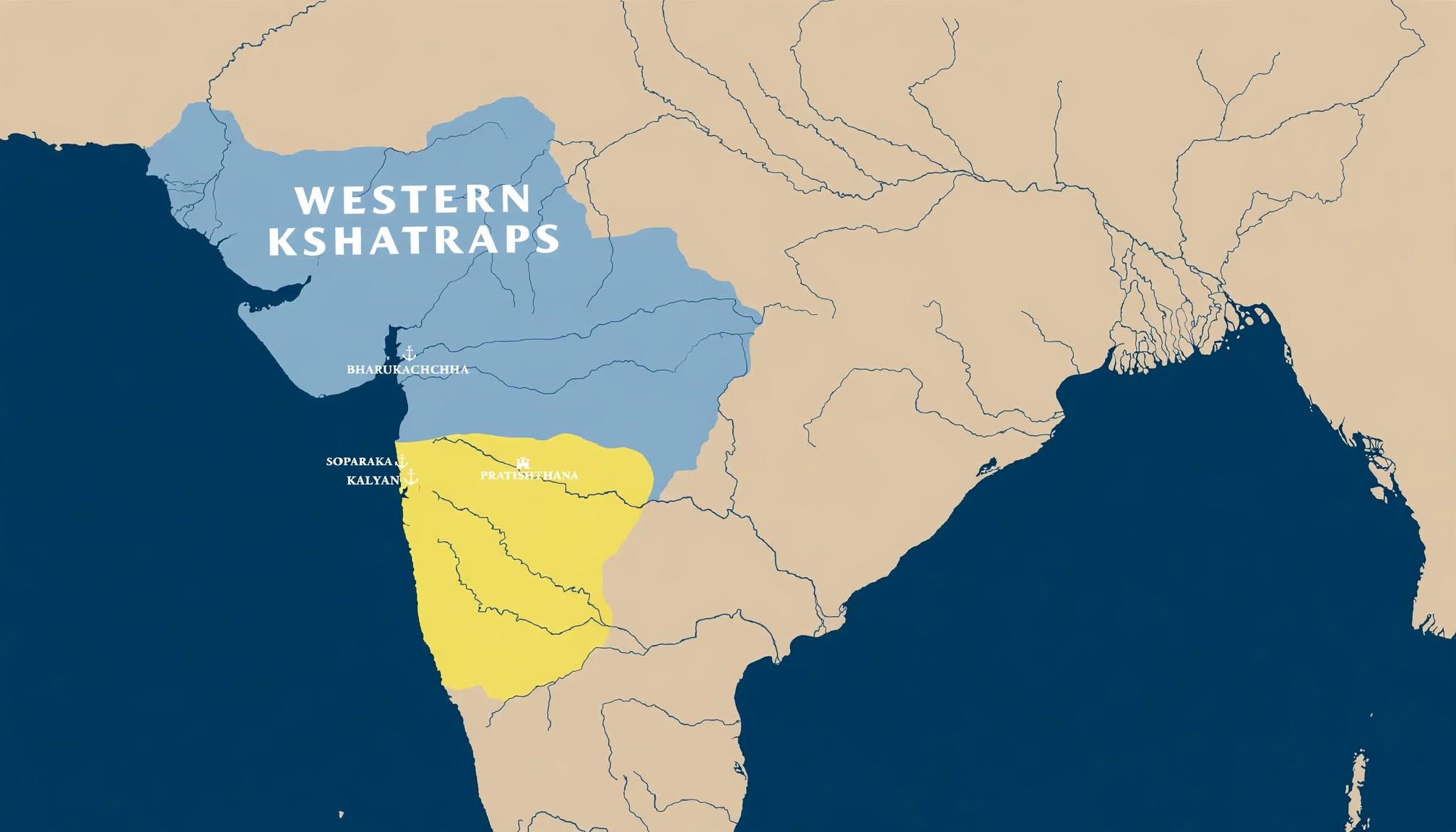
Question Shakas and satvahanas kept fighting for 200 years for the control of these 3 ports but why ... I mean why couldn't they come to an agreement or a treaty to maintain peace among them

Post image
31 Upvotes

As we know shaka satvahana conflict starts with bhumaka the shaka king ruling western kshatraps , then comes nahapana , then gautamiputra satakarni counterattacks , then again chastan , rudradaman , his son , yajna shri satakarni , and then again rudrasimha strikes and that lead to destruction of wealth and armies of both the sides , SHAKAS got weakened and satvahanas got completely broken after these huge conflicts , so after realising this in first half of the conflicts why did the chose to fight again and again and not to sign a peace treaty or come to an agreement to divide roman trade with the 3 ports or kalyana , soparakha , bharukaccha , do we have a answer to that question or what is your theory regarding that

https://youtu.be/6H9vcv1dbK8


r/IndianHistory • • 23m ago

Question The r/Indianhistory Cabal

7 Upvotes

There are several users here who have formed a group of staunch opinionaters who refuse to consider the plethora of evidence Indian institutions including the government have put out regarding not only the old Saraswati River, but several archaeological, genetic, and linguistic evidences that make us see conclusions that differ from those of what this cabal calls mainstream historians.

This cabal, including users like u/dunmano—others interested in an Indigenist historical viewpoint can put forward names of other staunch supporters and particiapnts of this cabal—engages in repetitive dismisses, character assisnation, insults, and a general lack of interest in considering evidence that points to conclusions different from their own.

Why should an Indian history sub that comes under the purview of the Indian land and Indian government, that is allowed to run under Indian law and Indian executive government without any hinderance, dismissing arguments that its own government makes?

If the government has conducted geological research on the Ghaggar Hakra river valley and put out its findings, why only if similar research is not conducted in the Helmand valley, etc, should it be dismissed as propaganda? Are these articles not perr-reviewed?

Users favouring an Indigenist viewpoint have put out peer-reviewed research, as rightly requested by so many users on this forum, like those from Nature, on the geology of the Ghaggar Hakra river spanning the last 20,000 years, don’t mainstream leaning users here have the courage to read and acknowledge these papers which researchers have painstankingly put in so much effort to make?

Why is there no decency and no culture on this subreddit?

It is my request that all of us anonymous users come together and discuss this question as a state of the sub discussion.


r/IndianHistory • • 16h ago

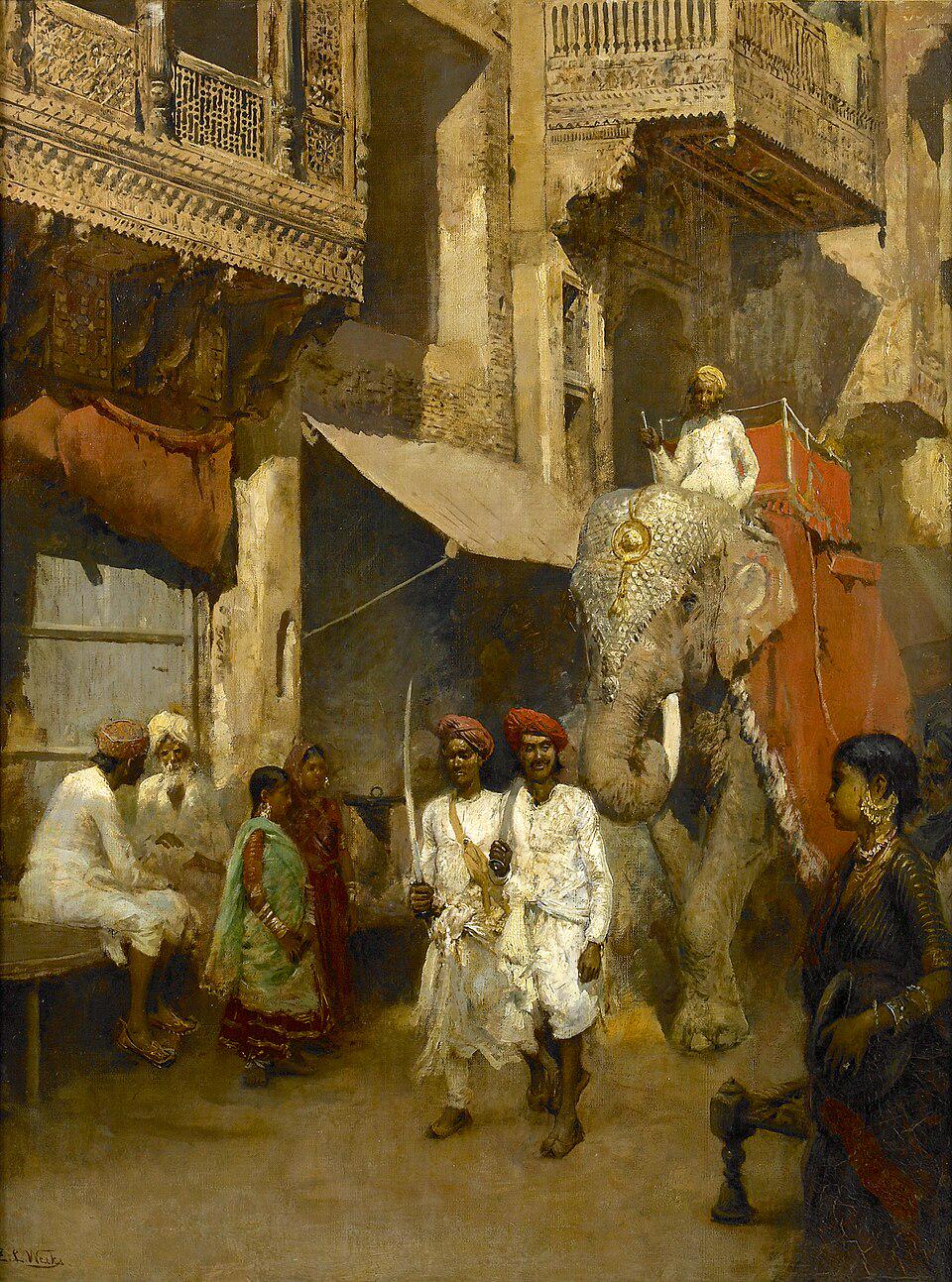
Art History "Promenade on a Maratha street"(mid 1880s)—Edward Lord Weeks, an American orientalist painter

Post image
93 Upvotes

r/IndianHistory • • 7h ago

Question Why was so much (not all) of early Sanskrit literature/kavya retellings of already existing works, Hindu epics and Scriptures?

10 Upvotes

I do not intend to say any of this in derision or disrespect and it is very much possible that there are works which I haven't read yet that don't fit this. From the little I know, I have noticed that a lot of the old Sanskrit works of drama and poetry are retellings of older works, especially Ramayana and Mahabharata.

For example Kalidasa's Shakuntala adapts a part of Mahabharata. Vikramorvashiyam is from Vedic legends and Kumarsambhavam from traditional accounts of Shiva, Parvati and Kartikeya.

Bhasa one of the earliest Indian playwrights in Sanskrit, has 13 available works. According to Wikipedia, 3 of these are based on Ramayana, 6 based on Mahabharata and 4 based on stories from Brihatkatha.

The five works that are considered the greatest Mahakavyas, the pancha-mahakavyas are also based on narratives from existing works: Raghuvamsha from Ramayana and Puranic genealogies, Kumarsambhavam from Shiva Parvati stories and Naishadhiyacarita, Shishupalavadha, Kiratarjuniya from different parvas of Mahabharata.

Is there a reason for this? Unlike current literature, they did not seem to favour writing new, original plots or writing fiction. Instead they chose existing works that they retold with more literary ornamentation and digressions. I am aware there are exceptions that were original like meghaduta, mrichhakatika etc. I personally feel like it makes reading these works a lot less interesting. Works like Panchatantra, Kathasaritsagar, jataka tales feel a lot more engaging in comparison.


r/IndianHistory • • 34m ago

Linguistics Can there be a Substrate of Burushaski in Modern day NorthWest Indian languages?

2 Upvotes

There are quite a lot unknown origin words especially in Punjabi which are said to be non sanskritic non Persian and lack a clear etomology.

One word in punjabi that's hard to trace back is ਬੁੱਲ੍ਹ/bullh/बुल्ल्ह, meaning lips. A lip is also called bullh/ਬੁੱਲ੍ਹ.

In Western punjabi (multani, thalochaRi, pothowari) it is hontth ofcourse from samskritam - "ōshttha".

Surely, there are such words in every language. Do share them if you want to. And, if there's something in your understanding to say about origin of punjabi bullh than comment section is yours.

Other words like

ਬੇਲੀ/bēli— friend

ਛਾਲ਼/chāḷ— jump

ਛੇਤੀ/chēti— quickly (syn: jaldi)

ਟੀਸੀ/ṭīsī— highest point as peak or summit (of tree/mountain) (syn: choti)

Tisi which somewhat sounds similar to the Burushaski sequal for summit "Chish" or "tom" word for tree which is also connected in this word


r/IndianHistory • • 1d ago

Artifacts A rare sixteen-armed Durga sculpture from 12th-century Bengal, preserved at the Met Museum in New York

Post image
311 Upvotes

The sculpture dates back to the 12th century, during the Pala and Sena periods of Bengal. According to the museum, it originated from the Bengal region, in what is now either Bangladesh or India.

It depicts Goddess Durga in her sixteen-armed form, defeating the buffalo demon Mahishasura. Her numerous arms carry different weapons, while her lion can be seen attacking the demon below.

What surprised me most was its actual size. Despite the incredible amount of detail, the sculpture is only 13.5 cm tall, 8.9 cm wide and 4.4 cm deep. It was carved from argillite, a type of sedimentary rock. Just look at the detailing of the jewellery, crown, facial expression, weapons and floral patterns at the base.

The museum considers it one of the finest examples of Indian miniature sculpture from the Pala and Sena period. It also suggests that the sculpture would have looked particularly impressive inside a shrine illuminated by oil lamps.

The Metropolitan Museum of Art acquired this piece in 1993 through a gift from Diana L. and Arthur G. Altschul. It is currently displayed in Gallery 238 as part of its Asian Art collection.

Considering that this sculpture was created nearly nine centuries ago, it is remarkable how much detail the artist managed to achieve on such a small piece of stone.

It is also interesting to compare this sixteen-armed depiction of Durga with the ten-armed form that we commonly see during Durga Puja in Bengal today.

Does anyone know of similar Durga sculptures from the Pala or Sena period that are still preserved in museums or temples across West Bengal and Bangladesh? I would love to learn more about Bengal's medieval sculptural heritage.

Source: https://www.metmuseum.org/art/collection/search/38583


r/IndianHistory • • 1d ago

Post Independence 1947–Present Pandit nehru visit to soviet union 1955.

155 Upvotes

r/IndianHistory • • 1d ago

Post Independence 1947–Present 1948 Invasion of Jaisalmer: Unknown chapter of desert state

Post image
47 Upvotes

In 1948, When India was preoccupied with the invasion of Kashmir, a similar-style invasion was on its way in the desert state of Jaisalmer.

Jaisalmer and Bahawalpur were traditional rivals. The Bhati Rajputs of Jaisalmer and the Daudpotras of Bahawalpur had checked each other's power every once in a while as both shared the same geography.

Everything had gone cold when both the states decided to sign a treaty with the British. However, as India gained independence in 1947, a storm started to brew in the desert.

In January 1948, around 2000 Pathans gathered in Bahawalpur with the single intention of invasion. 500 of them were picked for the first wave of invasion and the clear goals were laid down:

  1. Initial attack will be carried out by 500 of the Pathans.
  2. Capture the border villages of Jaisalmer.
  3. Send the report of military strength of the Jaisalmer.

Wazir of Bahawalpur, futher more, instructed the Subedar of Khanpur to make arrangements for the food and other goods.

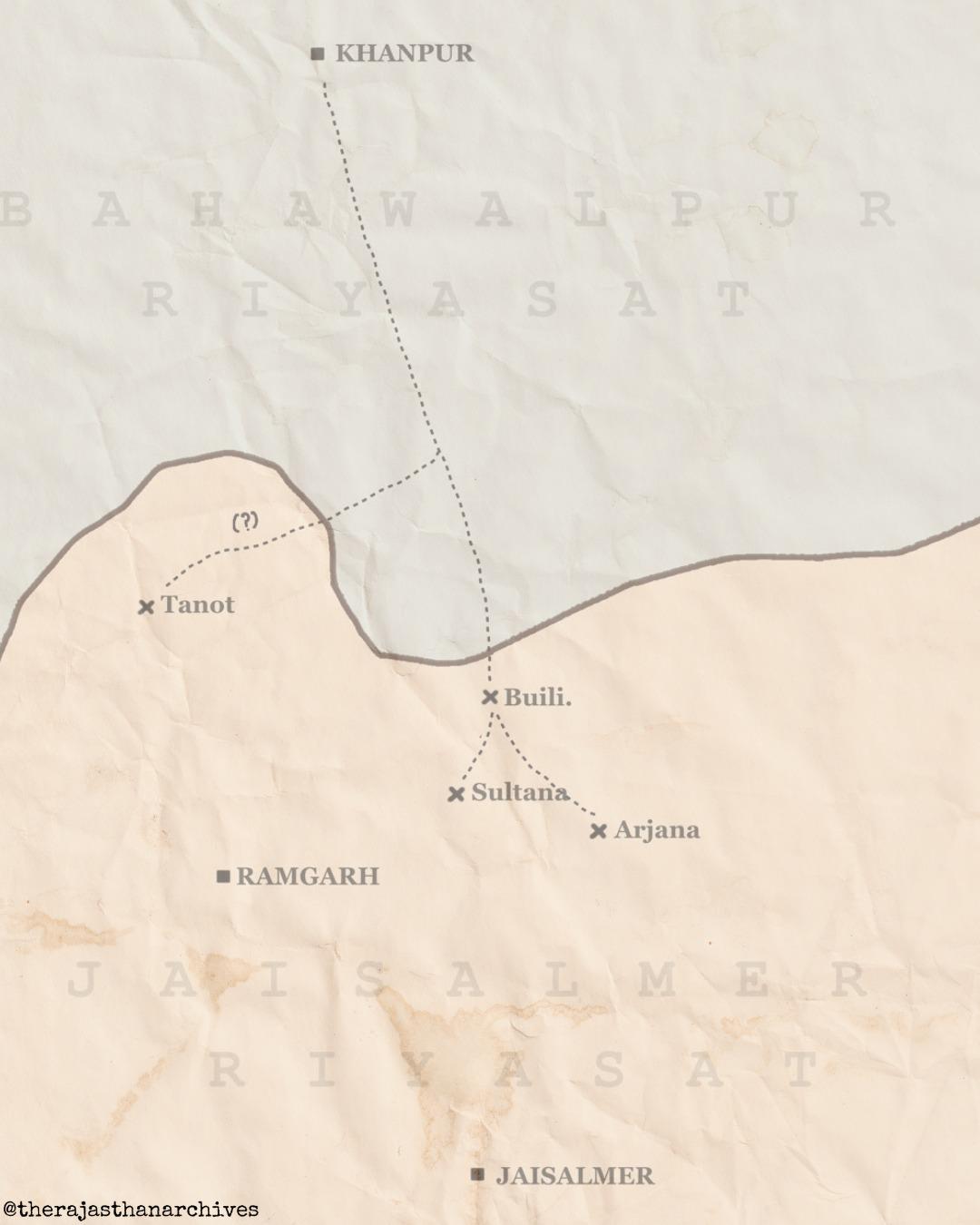
On 14/15th January, 500 Pathans departed from Khanpur and reached the village of Buili (then Jaisalmer State) on 22nd Jan. The village was attacked, looted and burned down. Total of six were killed.

Then they divided into several small groups. One of the group reached Sultana on the afternoon of 23rd. The village met the same fate as Buili. Arjana was also targeted and around 22 Hindus were killed. A total of 30 Hindus were killed while property worth Rs. 4,61,431 were either destroyed or looted. Reports also mentioned sighting 200 Pathans outside Tanot.

Jaisalmer was not the one to keep quiet. The first case of resistance emerges from the village of Sultana where Kishan Singh Bhati resisted the invaders. His fate remains unknown.

Officers of Jaisalmer State Forces like Guman Singh Rawlot and Mohan Singh had reached the forefront. Maharajkumar (later Maharawal) Girdhar Singh had also reached Rampura to oversee the counteroffensive.

After looting Arjana, the group made their way to Mohangarh. However, they faced stiff resistance from the police forces at Nehdai. Pathans were compelled to run away.

As the Jaisalmer forces closed in, Pathans abandoned the plan and made their way to Bahawalpur.

Constable Tinrao Singh Bhati was martyred. His devli (herostone) was constructed by then Maharawal Raghunath Singh. No other casualties from the police forces are known.

India protested against this behaviour as per the newspaper report from The New York Times of 26.01.1948

By February first week, Pathans had run away. The King of Jaisalmer handed out monetary help to the affected people.

A map depicting the route is attached.

(The Rajasthan Archives is my page so no i haven't taken it from anyone else)


r/IndianHistory • • 22h ago

Colonial 1757–1947 CE No hate on anyone but Why exactly did india opted for non violent revolution when it was a very long process which also enabled british to suck dry whatever was left like I'm just curious ?

32 Upvotes

Indian independence movement didn't use excessive violence till like 1940s in ww2

Why didn't indian revolutionaries organised a revolution when ww1 like mk Gandhi had a military background in boer war as well


r/IndianHistory • • 5h ago

Art History Overlap between Krishna's bal-leela and Devnarayan's childhood stories

0 Upvotes

Continuing on Phad tradition, i have put in next part of story, covering birth of Devnarayanji and infant period.

Devnarayan Katha Part 2 - Hope After the Fall: The Early Years of Devnarayan

Note the similarity of incidents here with Krishna's childhood story. Bal-Leela stories appeared in Bhagwata Purana which was written in 9-10th century. Devnarayan story is also from same time period.

Give a read and share your point of view.


r/IndianHistory • • 1d ago Heartwarming Mindblown

Architecture I'm from Brazil and really like Indian architecture. I recently finished building Shaniwar Wada as it was before the fire in Minecraft. Hope you like this tribute

Thumbnail
gallery
853 Upvotes

I'm from Brazil, really like Indian architecture, and know I still have a lot to learn about India. I tried to recreate Shaniwar Wada as it was before the fire in Minecraft. I used reference images I found online to complete the layout, proportions, and interior areas. If you have any suggestions to improve it, I'd be happy to hear them. Hope you like this tribute. Working on this project was very rewarding because I ended up learning more about Maratha history


r/IndianHistory • • 20h ago

Colonial 1757–1947 CE A Palace for the Iron Horse: How Lucknow’s Charbagh Station Perfected Indo-Saracenic Architecture

Post image
11 Upvotes

Join us at 1:00 PM on Saturday, 28th November, at Baithak, Le Press, Metaphor Lucknow Litfest, for the Book Release.

Step out of a train at Lucknow’s Charbagh station, and you are not greeted by the steel-and-glass monotony of a modern transit hub. Instead, you are met by a sprawling expanse of red brick, soaring minarets, and a skyline punctuated by bulbous domes and delicate Rajput chhatris.

Built between 1914 and 1926, the Lucknow Railway Station looks less like a railway terminus and more like a Nawabi palace. Yet this architectural landmark was no mere aesthetic whim. It grew out of a late-19th- and early-20th-century architectural movement, a booming railway’s financial strength, and a deliberate effort to anchor a major civic building in the cultural idioms of Awadh.

The Indo-Saracenic Blueprint

To understand Charbagh, we need to view it within the broader development of Indo-Saracenic architecture in the late 19th and early 20th centuries. Used largely by British architects in India for major public buildings, this revivalist style blended Western construction methods with decorative and spatial elements drawn from indigenous Indo-Islamic—especially Mughal—and Hindu traditions. In medieval Europe, "Saracen" was used for Arabic-speaking Muslims of the Middle East and North Africa, a term British writers later adapted when describing early Islamic architecture in India.

Rather than relying on a single rigid formula, Indo-Saracenic architecture brought together familiar visual elements. It featured onion-shaped domes set on drums with lotus motifs and kalash finials, alongside pointed, cusped, or Moorish horseshoe arches. Deep chhajjas supported by brackets, slender minarets, open pavilions, jharokhas, and finely carved stone lattice screens (jalis) completed the vocabulary, pairing Islamic arches and domes with chhatris, brackets, and column forms rooted in Hindu traditions.

Pioneers of this style—including Robert Fellowes Chisholm, Sir Samuel Swinton Jacob (who also designed Lucknow’s King George’s Medical College), George Wittet, and Frederick Stevens—helped shape its reach. By the early 20th century, railway stations increasingly adopted the idiom. Chennai’s Egmore Station (1908), designed by Henry Irwin, was an early landmark that incorporated Dravidian motifs. Later, Hyderabad’s Kacheguda Station (1916), designed by Jerome Esch, combined Vijayanagara-style brackets and South Indian trabeated beams with Islamic domes, kalash finials, pointed arches, battlements, and turrets—a synthesis well documented in Vinoo Mathur’s Indian Railway Buildings: Heritage, History and Beyond.

J.H. Horniman’s Nawabi Vision

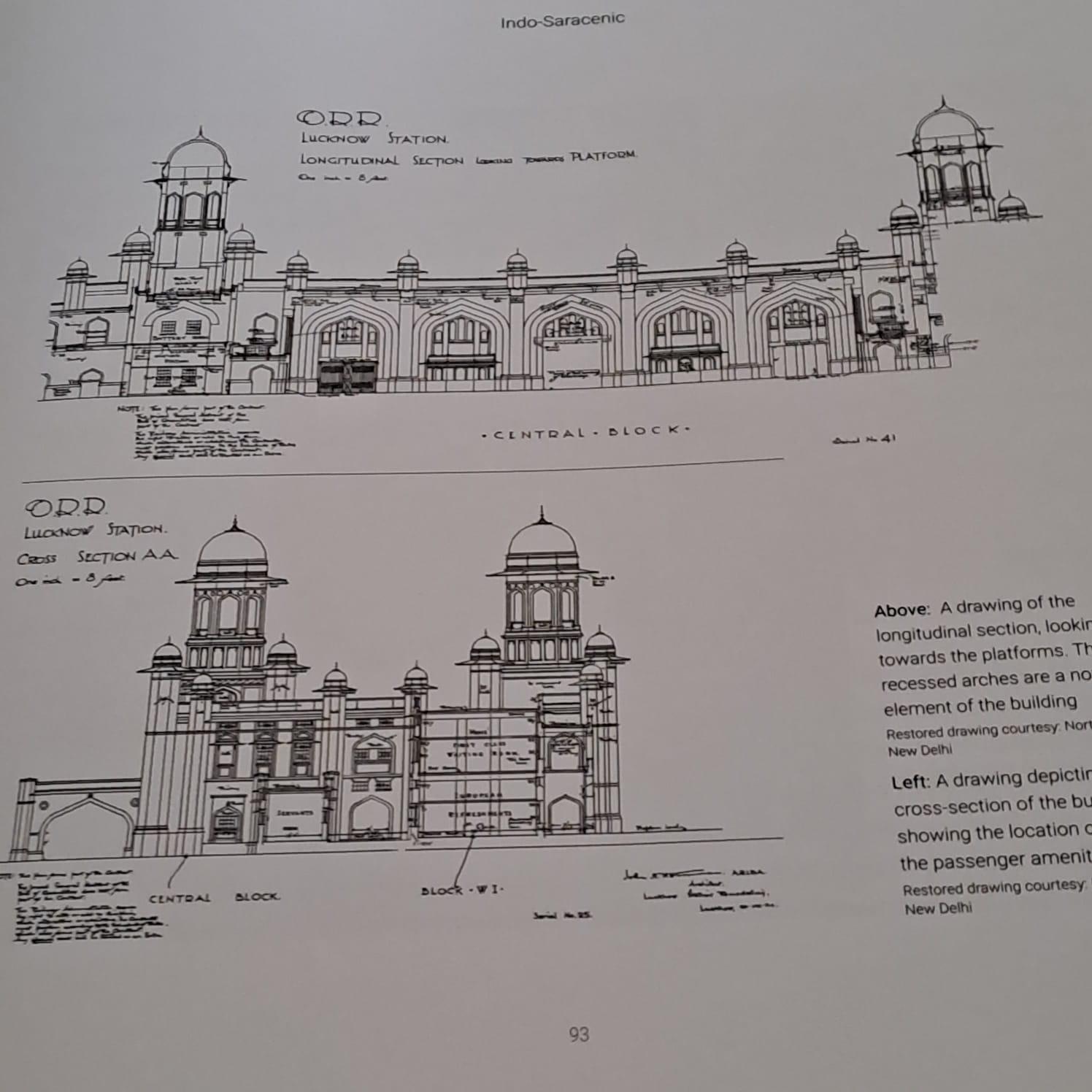
In Lucknow, which served as headquarters of the Oudh and Rohilkhand Railway (O&RR) and was soon to become the capital of the United Provinces, Indo-Saracenic architecture found a particularly expressive home. Work on the new station building began when Bishop George Herbert laid the foundation stone on March 21, 1914, and the Governor of the United Provinces inaugurated the station on December 19, 1926, following designs by J.H. Horniman.

Horniman looked directly to Awadh’s local architectural traditions so the station’s domes, minarets, and overall massing would harmonize with historic buildings across Lucknow. The design pairs a grand porte-cochère and sweeping entrance hall with a spacious, naturally lit circulating hall marked by fine pillars, impressive stairs, and large recessed arches. Above, roof pavilions with bracketed cornices, chhatris, and onion domes sit alongside finely carved jalis on windows and tower openings, while the interior layout organizes waiting rooms, refreshment spaces, patterned floor tiles, and wall paneling with careful precision.

Why Spend 60 to 70 Lakh Rupees?

Two central questions always surround Charbagh: why did the Oudh and Rohilkhand Railway spend roughly 60 to 70 lakh rupees on such an ambitious building, and how did it become the visual face of Lucknow?

The financial answer rests on a thriving railway and a manageable annual outlay. In 1913–14, as construction began, the O&RR recorded net earnings of ₹1,23,21,631 (a 5.69% return on capital). Across the next five years, net earnings stayed above ₹1 crore in every year but one, reaching ₹1,76,54,269 in 1917–18, while weekly earnings per mile rose from ₹209 after the 1889 state takeover to ₹345 in 1917–18. Against surpluses exceeding ₹1 crore a year, a ₹70 lakh cost spread over a ten-year construction period equates to roughly ₹7 lakh per year—a modest share of the railway’s earnings for a flagship terminus projecting strength and growth.

How Charbagh Became Lucknow’s Landmark

A grand railway terminal often becomes the defining image of arrival in a city, much as Mumbai’s CSMT has for generations. Charbagh achieved that status in Lucknow through scale, setting, and visual contrast.

Unlike many public buildings around town finished in lime-wash, Charbagh stands out with its distinct color scheme, wide open space in front, grand proportions, and layered mix of architectural motifs. Together, those choices turn a working railway station into an unmistakable civic landmark.

Sources and Further Reading

  • Mathur, Vinoo (2012). Indian Railway Buildings: Heritage, History and Beyond. Niyogi Books.
  • Metcalf, Thomas R. (1989). An Imperial Vision: Indian Architecture and Britain's Raj.
  • Oldenburg, Veena Talwar (1984). The Making of Colonial Lucknow, 1856–1877. Princeton University Press.
  • Abbas Ali, Darogha (1874). The Lucknow Album.
  • Historical Records: Gazetteer of the Province of Oudh, Vol. II (1877); Professional Papers on Indian Engineering (Roorkee Papers, 1874); and The Pioneer (October 30 and November 15, 1865).


r/IndianHistory • • 1d ago

Artifacts This belongs to my friend’s Great-Grandfather. Could someone give me some info about this ?

Post image
72 Upvotes

r/IndianHistory • • 1d ago

Colonial 1757–1947 CE Govindarao Kale’s Letter to Nana Phadnavis (1792): “The Land from Attock to the Southern Sea Is Hindustan, Not Turkistan”

Post image
178 Upvotes

During the tenure of Shrimant Sawai Madhavrao Peshwa, the Maratha Empire had reached a remarkable position of influence in North India. The Maratha flag flew over Delhi, and the Mughal Emperor at the Red Fort remained under the political influence of the Marathas.

Two of the most influential figures behind this power were Nana Phadnavis, the astute statesman and administrator of the Peshwa court, and Mahadji Shinde, the formidable Maratha general who had established Maratha supremacy in North India.

However, despite their shared contributions to the Maratha state, differences had emerged between these two prominent personalities, creating tensions within the Maratha political establishment.

In 1792, after nearly a decade, Mahadji Shinde returned to Pune. The royal farmans he had brought from the Mughal Emperor were received with great ceremony, and he also received recognition from Chhatrapati Maharaj.

During this visit, the misunderstandings between Nana Phadnavis and Mahadji Shinde were finally resolved, restoring harmony between the two leading figures of the Maratha administration.

Nana Phadnavis subsequently informed Govindarao Kale, the Peshwa's diplomatic representative at the Nizam's court in Hyderabad, about the reconciliation and the remarkable political and military achievements of Mahadji Shinde.

Upon receiving Nana's letter, Govindarao Kale was so overwhelmed with enthusiasm that he immediately wrote back to him.

His letter, dated July 1, 1792, is particularly remarkable for the historical perspective it provides on the territorial ambitions, political achievements, and ideological aspirations of the Maratha state.

Kale began by reflecting on the historical extent of India and the transformation of political power over the centuries. He then praised the achievements of the Marathas under Shivaji Maharaj, the Peshwas, and the great Maratha commanders who had carried forward that legacy.

The following is an English translation of the letter:

The southern sea on the other side of the Atak River is the place of the Hindus—not Turkey. This was our territory, preserved and enjoyed by the Pandavas up to Vikramaditya. The rulers turned out to be foolish in this regard.

When the dominance of the Yavanas came, the Chakratryas took the position of Hastinapur. Finally, during Alamgir's tenure, when the sacred thread was sold for three and a half rupees, and wet food had to be bought and eaten by everyone, such a plight passed.

In those days, the Kailas-resident Shivaji Maharaj turned out to be the upholder of power and protector of faith. He did a little to protect the faith in Kannauj, and later, the Kailas-resident Nana Saheb and Bhao Saheb, with their immense valor, achieved such feats that they had never happened before.

There is no description in the Shastri Purana of some Brahmin having ruled. Whatever the case with Parashuram the avatar, those matters aside, the Shinde-Holkar on two fronts came into possession.

Nowadays, through the virtuous deeds of the wealthy and the intellect and sword prowess of Rajshri Patil Baba, everything has come to the house. But how did it happen? It seemed easy because it came into possession.

Even if it were a Muslim, great, great chronicles would have come. If something good happened in the Yavana caste, it should be celebrated fittingly with the heavens. It is proper for us Hindus, even if something reaches the heavens, not to proclaim it aloud.

Be that as it may. Rare things happened. Sudden wealth came to the house. Protecting them is extremely difficult! Many friends and foes. In the minds of the Yavanas, they say that infidel rule has come. But those who raised their heads in Hindustan, Patil Baba smashed their heads.

Whatever malice is in anyone's mind, it should not go to the end; for that, they must be destroyed in various forms and through strategy.

Things that should not be gained were gained. Their management, like that of the upholder of power, and enjoyment of them is yet to come. Where virtue falls short and what evil eye falls, who knows.

In these happenings, it's not just the acquisition of land and kingdom, but also the protection of Vedas and Shastras, establishment of faith, maintenance of cows and Brahmins, attainment of sovereignty in hand, the trumpets of fame and glory sounding—these are the things.

Handling this alchemy is the right of us and Patil Baba! If a wrinkle falls in it, friends and foes are present. The doubts have been dispelled, this is excellent! Excellent!

Besides this, may this assembly and these armies be in the fields of Lahore, may their minds race and wrinkle fall, may they watch spectacles—those people who are like that are lagging behind.

There is no peace now after we have written; we cannot rest easy. Whatever is written, let that much be pondered just so. True or false, let it be understood. This is a request.

One of the most striking aspects of this letter is Kale's description of the geographical and political vision of the Maratha state. He regarded the territory stretching from the Attock River in the northwest to the southern ocean as Hindustan, rather than Turkistan.

He traced the historical loss of Hindu political power through the centuries and credited Chhatrapati Shivaji Maharaj with reviving that power and protecting the faith.

He also acknowledged the contributions of Peshwa Balaji Baji Rao (Nana Saheb), Sadashivrao Bhau, Mahadji Shinde, and the Holkar family in extending and consolidating Maratha influence.

Another particularly interesting aspect is his praise of Mahadji Shinde, whom he refers to as Patil Baba. Kale observed that the achievements of the Marathas were so extraordinary that, had they possessed chroniclers like those of the Muslim rulers, their accomplishments would have been celebrated in numerous historical accounts.

He also emphasized that the Maratha achievement was not merely about acquiring territories and kingdoms. In his understanding, it involved the protection of the Vedas and Shastras, the establishment of Dharma, the protection of cows and Brahmins, and the consolidation of sovereignty.

Most importantly, despite the political differences that had emerged between Nana Phadnavis and Mahadji Shinde, Kale considered their reconciliation essential for protecting and managing the vast territories that had come under Maratha influence.

His repeated exclamation, "The doubts have been dispelled, this is excellent! Excellent!", reflects his immense satisfaction at the restoration of harmony between the two stalwarts.

The letter offers a fascinating glimpse into the political thinking of the late eighteenth-century Maratha leadership. It illustrates how diplomacy, military achievement, political cooperation, and the ideological concept of Maharashtra Dharma were intertwined in the correspondence of that period.

Reference: Rosalind O’Hanlon, Entrepreneurs in Diplomacy: Maratha Expansion in the Age of the Vakil, Indian Economic and Social History Review, Vol. 57, Issue 4 (2020), pp. 503–534. See also the historical correspondence of Govindarao Kale cited in the article.
r/IndianHistory • • 1d ago

Question looking for book that provide a breakdown of art on the caves of Ellora, in Maharashtra

4 Upvotes

I recently visited Ellora caves, and I was fascinated. It feels like every sculpture, every painting, is trying to depict something. I really wanted to know more about each artwork. But, the official Ellora caves app called 'Digitour' misses a lot of artwork. Since then, I have been looking for a book, or if there is an academic paper that gives details of artwork on Ellora caves, specifically Kailasa temple, cave 16. can anyone suggest me some material to read on it? thanks in advance!


r/IndianHistory • • 1d ago

Question Help me finding this book

Thumbnail
gallery
9 Upvotes

Hey so I was thinking to gift my dad something on his bday and I recently noticed he had been very keen in learning about shivaji maharaj and upon lil research I found many ppl on reddit praising this specific book "Shivaji His lIfe and Times" for knowledge it carries that has backing to it not just like a story but reality.

So after searching for while I can see it on some local sites (for around 1.2-1.5k) idk if they are genuine and book cover also seems different than what i saw on reddit. So went for amazon and damn it was around 6k not that I don't wanna support author etc but as a student thats a huge money when you are not earning. Can someone suggest me alternative way ik by some way I can get pdf something but I felt as bday gift a hard copy book will be best way. Thanks


r/IndianHistory • • 2d ago

Classical 500 BCE–550 CE The story of Chandragupta Maurya from Greeco-Roman sources

Post image
105 Upvotes

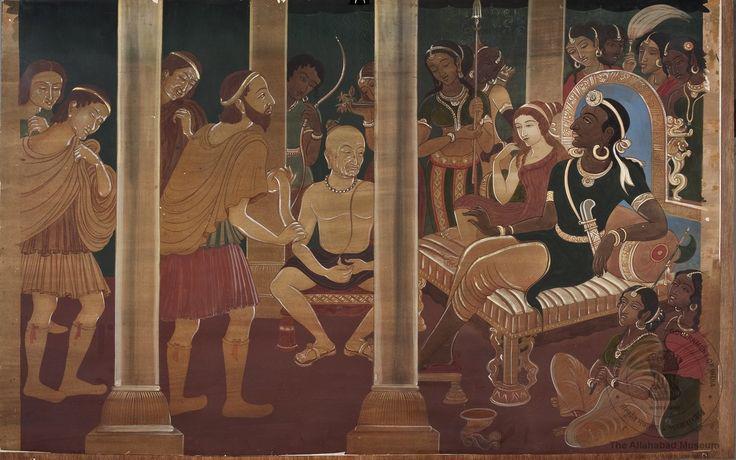
Roman historian Justin says that Chandragupta was from a humble origin and had to once flee away after offending the Nanda king. Here Justin narrates a miraculous legend of Chandragupta getting blessed by a Lion

"This man was of mean origin, but was stimulated to aspire to regal power by supernatural encouragement; for, having offended King Nandrus by his boldness of speech, and orders being given to kill him, he saved himself by swiftness of foot; and while he was lying asleep after his fatigue, a lion of great size having come up to him, licked off with his tongue the sweat that was running from him, and after gently waking him, left him. Being first prompted by this prodigy to conceive hopes or royal dignity, he drew together a band of robbers, and solicited the Indians to support his new sovereignty."

- Book 5, Epitome of Pompeius Trogus Philippic Histories.

Justin then narrated another legend about Chandragupta and an elephant

"Some time after, as he was going to war with the generals of Alexander, a wild elephant of great bulk presented itself before him of its own accord, and, as if tamed down to gentleness, took him on its back, and became his guide in the war, and conspicuous in fields of battle. Sandrocottus, having thus acquired a throne, was in possession of India, when Seleucus was laying the foundations of his future greatness;"

- Book 5, Epitome of Pompeius Trogus Philippic Histories.

Chandragupta led the war against Greeks in India and overthrew all the greek garrisons that Alexander had established earlier

"He (Seleucus) then headed towards India, which, after the death of Alexander, had murdered its prefects, as if it had shaken off the yoke of servitude from its neck.

Having thus acquired royal power, Sandrocottos possessed India at the time when Seleucus was laying the foundations of his future greatness."

- Book XV, Philippic Histories of Trogus Pompey.

Seleucus waged war with Chandragupta but was unable to win. Eventually both came to an understanding

"For the whole region from Phrygia the Indus was subject to Seleucus. He crossed the Indus and waged war with Androcottus, king of the Indians, who dwelt on the banks of that stream, until they came to an understanding with each other and contracted a marriage relationship."

- Page 209, the Syrian wars, history of Rome.

Chandragupta gave 500 elephants to Seleucus while Seleucus gave most of his eastern Satrapies to Chandragupta

"The geographical position of the tribes is as follows: along the Indus are the Paropamisadae, above whom lies the Paropamisus mountain: then, towards the south, the Arachoti: then next, towards the south, the Gedroseni, with the other tribes that occupy the seaboard; and the Indus lies, latitudinally, alongside all these places; and of these places, in part, some that lie along the Indus are held by Indians, although they formerly belonged to the Persians. Alexander took these away from the Arians and established settlements of his own, but Seleucus Nicator gave them to Sandrocottus, upon terms of intermarriage and of receiving in exchange five hundred elephants."

- Chapter 2, book XV, Geography.

Megasthanes visited the court of Chandragupta

"Then the southern part of Asia may again be divided into four parts, and of these Eratosthenes and Megasthenes regard as the greatest part the region of India — Megasthenes dwelt with the satrap of Arachosia, Sibyrtius, and writes that he often visited Sandracottus, the king of the Indians; the smallest part, that bounded by the Euphrates, looks towards our inland sea."

- Book V, Anabasis of Alexander.


r/IndianHistory • • 2d ago

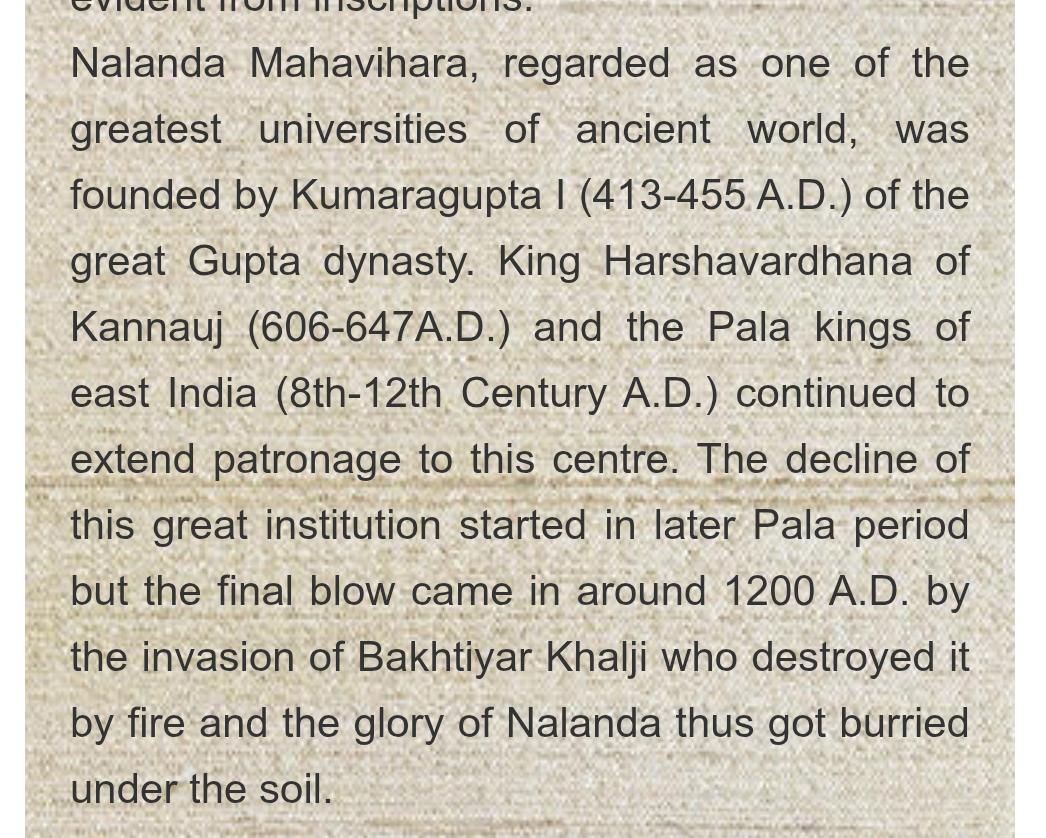
Question If Nalanda University was such a grand university, then did they help Gupta, Pushyabhuti & Pala Empire to get an edge over others? Like, some unique medical treatment, new weapons, better infrastructure, unique military tactics and so on?

Post image
77 Upvotes

People say that Nalanda University was the greatest of the world, and many foreigners are their notable alumni.

It is regarded as the world's first residential university.

Most probably, what burned was: advanced and extensive studies on mathematics, medicines, military tactics, and so on. It was not something pseudo scientific, like nuclear weapons, flying airplanes.

So, do we have some inscriptions or observations from foreign travelers from the time of Guptas, Later Guptas, Harsha, or Palas, which states something like:

'We won over our enemy because of the war tactics taught in Nalanda'.

'We used the xyz mathematics studies to solve some problem which was discovered by Nalanda'

'We used Nalanda's new study to heal our soldiers faster'

'We used Nalanda's study to build our towns or trading routes or our food storage infrastructure'

If not, then what actually was taught here?

I know nothing about Nalanda history. I am curious to know.

Image Source:

Archeological Survey of India website:

https://asi.nic.in/search?searchText=nalanda


r/IndianHistory • • 1d ago Bravo

Post Independence 1947–Present 1962 war : when Punjab, 4.6% of India, carried 46% of its war fund

Thumbnail
gallery
55 Upvotes

India was caught unprepared when the war began on 20 October 1962, with fighting in Ladakh in the west and in the North-East Frontier Agency (NEFA, now Arunachal Pradesh) in the east. The ceasefire took effect on 21 November. By the Indian official count, 1,383 Indian soldiers were killed.

People were asked to give to the National Defence Fund. By 28 November it had received ₹8 crore (about ₹780 crore in today's money). Punjab, with 4.6% of the country's people, gave over ₹3.7 crore of it (about ₹360 crore today), which is 46%. In gold, Punjab gave 252 kg of ornaments, coins and medals, about 47 times the 5.327 kg reported from the rest of the country. The people of Amritsar alone gave about 65 kg, half of one 130 kg batch of Punjab's gold. Separately, 12,000 gold coins were collected, some from the time of Maharaja Ranjit Singh.

Sources


r/IndianHistory • • 1d ago

Architecture Baba Hazara Bagh in Lucknow.

Thumbnail
gallery
46 Upvotes

Baba Hazara was a Nanak-shahi/Udasin ascetic from Punjab, reportedly from the village of Hazara near Jalandhar. He came to Lucknow during the reign of Nawab Shuja-ud-Daula (1753-1775), where his spiritual practices and the miracles attributed to him won him a growing following and a link with the Nawabs of Awadh. He reportedly died in 1799 beneath a neem tree, and his samadhi was built at that spot. A devotee, Natha Mai Jat, is said to have given the garden and land, which his followers later developed into the complex known as Bagh Baba Hazara. The complex also holds the samadhi of his disciple and successor, Baba Amriti Das, who is traditionally credited with building the memorial.


r/IndianHistory • • 2d ago

Early Modern 1526–1757 CE Audrey Truschke's recent book "India: 5,000 years of History on the Subcontinent" fails source audit. Some examples of the failures are particularly telling.

Thumbnail
gallery
190 Upvotes

Rohit Shinde has conducted a source audit of Audrey Truschke's recent book "India: 5,000 years of History on the Subcontinent" by using AI to check her claims against what the sources say. Truschke's book seems to fail the audit very badly.

For more info, see:

https://x.com/rohitshinde121/status/2124028571530432839

https://x.com/rohitshinde121/status/2124383645242933752

https://x.com/rohitshinde121/status/2124383661298716988

https://x.com/rohitshinde121/status/2124383677157462384

https://x.com/rohitshinde121/status/2124383692902842832

I think AI was used to identify the relevant parts of the sources, so we shouldn't discount it since it's just a tool (like a search engine) in this case; this is not a case of AI slop. (In general, AI output shouldn't be blindly trusted without further manual verification.) See the illustrative examples provided in the post that compare the content in her book with what the sources say.

His audit seems to be in alignment with my own post https://www.reddit.com/r/IndianHistory/comments/1kkx1w2/mischaracterizations_of_rigveda_and_errors_in_the/ titled "Mischaracterizations of Rigveda and errors in the forthcoming book titled "India" by Audrey Truschke ..." that I made (without the use of AI) when a preview of the book's e-book version was made available by the publisher.

UPDATE: The full audit is now up on the following website: https://india-source-audit.vercel.app


r/IndianHistory • • 2d ago

Question What happened to original Indian cuisine?

35 Upvotes

We know many vegetables were not native to India and were introduced by the British, and should not have been part of cuisine before, and what happened to original Indian dishes?