r/IndoAryan • u/Proper-Progress1691 • 21h ago
Linguistics Expensive 🤑🤑

48
Upvotes
r/IndoAryan • u/Icy_Function_5839 • 23h ago
r/IndoAryan • u/Proper-Progress1691 • 1d ago
Why don’t people understand the concept of Sanskrit borrowings (ie., tatsama) and natural descendant words (ie., tadbhava) from Middle Indo-Aryan Prakrits and Apabhramshas, in this sub?
r/IndoAryan • u/Proper-Progress1691 • 1d ago

r/IndoAryan • u/Quick-Seaworthiness9 • 2d ago

r/IndoAryan • u/Proper-Progress1691 • 2d ago

r/IndoAryan • u/RedStarHimalayan • 2d ago
Këshir zyav, koshur zaban, Këshir bashx
r/IndoAryan • u/Proper-Progress1691 • 2d ago

r/IndoAryan • u/Proper-Progress1691 • 3d ago

r/IndoAryan • u/Archaic-Custodian • 5d ago
Hey guys so I learnt Hindi in school as a second language though it is not my mother tongue. I wanted to know, what are the native speakers of the language called? I see the Dakhni variety speakers get called Deccani people but what do people who speak Hindustani/Hindi-Urdu as a mother tongue call themselves? Like as an ethnicity? Is it supposed to Hindustani? That would be confused for just an Indian based on the language user and the context. Are they Kauravis or Khariboli? I know Kauravi is usually the dialect that is used in the Kurukhand/Upper Doabi and western Rohilkhand region (though I have read someone call the latter as Ruheli dialect and that is is different from Kauravi, but that was just some online pots on social media).
This is just out of curiosity and nothing else. I don't want it to misunderstood as anything else. I see people groups like Marathi, Punjabi, Bengali, Sinhalese etc., so I was wondering what would those who have Hindi/Urdu/Hindustani people call themselves.
r/IndoAryan • u/imprajapati • 6d ago
I've been thinking about the expression "Bagad Buddhi" (बागड़ बुद्धि). From what I've understood, it seems to be used in a rather playful way, but not necessarily as an insult. In fact, there seems to be a certain sense of pride attached to it.
I'm curious about how people from the Bagri-speaking region understand this expression. What does it actually imply? Is it about being clever, having a sharp mind, being street-smart or approaching things in an unconventional way?
I'd especially like to hear how older generations used it and whether people still use it in everyday conversations.
r/IndoAryan • u/moeanimeboy • 8d ago
What exactly was Vṛtra from a historical/paleontological standpoint?
The descriptions of the large serpent/serpent-like creature across various Indo-European mythology, particularly how it’s usually associated with the obstruction of water.
Could the original story of Indra, Zeus, Thor slaying Vṛtra, Typhon and Jormungandr be actually a story/event that occurred in the proto Indo-European homeland? something like a guy back then slaying a large serpent creature maybe a large snake, monitor lizard or crocodilian species around a water body, and the story then later getting immortalized as a legend or mythology over time.
Are there any research done on this particular topic, I’m curious to know!
r/IndoAryan • u/Osgood108 • 8d ago
I’ve been mapping where the Vedic texts place the Pūrus, Bharatas, Dāsas and Kuru-Pañcāla, with every pin tied to the verses that support it. A screenshot is attached, and the interactive version is linked with the comment below (my earlier attempts to embed the link was blocked by Reddit filters).
What’s on it
How it was made: I used my Agentic RAG tool to find candidate verses, then checked as many as I could by hand. The ◦ marks show what I haven’t checked yet; treat those as claims to test.
Optional ancient-DNA layer (off by default): it plots the find-spots of three published ancient DNA samples (Swat, Roopkund, and Aktogai in Kazakhstan) on my paternal haplogroup. It is provisional, with its own grades, and I’m not claiming any of these samples is “Vedic.” Ignore it if it isn’t useful.
What I’d most like feedback on


r/IndoAryan • u/yusufumama • 8d ago
r/IndoAryan • u/Immediate_Stress7382 • 8d ago

Key Cultural & Linguistic Patterns
• The Three-Tier Advantage. Unlike English (thou vs. you) or French (tu vs. vous), having a middle "familiar" tier (tum, tumi, tume) gave Indo-Aryan languages a natural landing spot for modern marriage. Couples did not have to drop all respect to be intimate; they simply met in the middle.
• The "Respectful Āp" Tradition. In refined Urdu- and Hindi-speaking cultures (such as in Delhi, Lucknow, or Hyderabad), using mutual āp between husband and wife has long been a mark of tehzeeb (cultural refinement) rather than coldness or distance.
• Name Avoidance (Teknonymy & Indirect Reference). Alongside pronouns, traditional Hindu and Muslim customs across North, West, and East India discouraged wives from speaking their husband's given name aloud. Wives instead referred to their husbands using pronouns alone, honorific titles (like suno ji in Hindi or o go in Bengali), or as "the father of [child's name]."
• Timeline of Change (Mid-20th Century to Present). The move away from strict one-way deference began in educated urban circles in the 1940s–1960s (often depicted in mid-century Bengali and Hindi cinema and literature) and accelerated sharply after the 1990s with nuclear families, higher education, and co-ed workplaces where future spouses first met as peers using tum or tumi.
r/IndoAryan • u/RedStarHimalayan • 8d ago

r/IndoAryan • u/moeanimeboy • 10d ago
stayed up the entire night feeling bored, so i just felt like making a video about indra lol
r/IndoAryan • u/Sensitive_Bill_8916 • 15d ago

The name Maharashtra for this region was something which was not clearly defined for much of earlier history. Even though earliest references to Maharashtra certainly existed. From the 3rd cen Eran inscription to the mention of Xuanxang's account of Mo-ho-laa-cha.
But now multiple sources which tell us about it's extent,
(Narmada-Karnataka-vishayayor-madhye Maharashtra-vishayaha)
In Vātsyāyana’s Kamasutra (composed roughly around the 3rd to 4th century CE) does explicitly describe the geographical extent of Maharashtra, and it uses a remarkably similar logic—relying on major geopolitical and natural frontiers.
Because the Kamasutra was written nearly a thousand years before the Mahanubhava texts, its northern boundary is pushed slightly further north to the Narmada River, rather than the Vindhya mountains.
However this account came under scrutiny when Kannada personalities like Alur Venkata Rao and Sham. Ba Joshi started claiming that Karnatak extended the all uptill Godavari basin, treating a poetic exaggeration as legitimate history.
But their claims were countered by another two highly important accounts which give new insights-
First one-
The prose directive was originally spoken by the sect’s founder, Chakradhar Swami, during his travels in the mid-13th century. Shortly after the Swami's departure, his chief disciple Mhaimbhat painstakingly collected these real-life accounts and compiled the Leela Charitra in 1278 CE.
This directive was given by Chakradhar Swami as a strict geographical boundary for his disciples (especially Nagdevacharya and Mhaimbhat). He forbade his followers from leaving this Maharashtra Parimandala because he believed their spiritual duty and linguistic medium (Marathi) belonged exclusively to the people living between the Vindhyas and the Krishna River.
Since he explicitly told them not to leave Marathi speaking regions and also mapped Maharashtra till Krushna, it all pointed towards the fact that Krushna river spoke primarily in Marathi rather than Kannada. This was the case even before the Muslim and Maratha power came back in the region.
Source-
Second one-
While Chakradhar Swami's prose in the Leela Charitra laid down the north-south axis (Vindhyas to Krishna), Dimbha Muni added a crucial third dimension—the Eastern boundary (Zadi Mandala). By defining Maharashtra as everything west of these dense eastern forests, he perfectly mapped out the core linguistic and cultural geography of the medieval Marathi-speaking world.
Dimbha Krishnamuni was a prominent scholar and poet who operated during the 16th century revival of the Mahanubhava literature. His verses served to codify the geographical memories of the sect's early footprint into structured poetic meters (Ovi), making the boundaries easy for traveling monks to memorize and recite.
It was composed in the Vidarbha region of Maharashtra, specifically within the holy circles of Riddhipur (in modern-day Amravati district). Riddhipur was the principal seat of the Mahanubhava sect, centered around the legacy of Govinda Prabhu (the guru of Chakradhar Swami).
For modern historians and linguists, this verse is treated as a primary cartographic document. It proves that even before the rise of the Maratha Empire under Chhatrapati Shivaji Maharaj, the people of Maharashtra had a highly sophisticated, unified consciousness of exactly where their cultural, linguistic, and geographic country began and ended.
Source -
Mahanubhava Sanshodhan (महानुभाव संशोधन) or volumes by Dr. V. B. Kolte: Dr. Kolte spent his life digging through ancient Mahanubhava mathas (monasteries) in Vidarbha to compile fragmented poems, hagiographies, and geographical memoirs written by later scholars like Dimbha Krishnamuni.
r/IndoAryan • u/inghunarve • 17d ago

If anyone else is working on Brahmic scripts too, or has questions, feel free to mention!
r/IndoAryan • u/GrumpyGuyMugdha • 17d ago
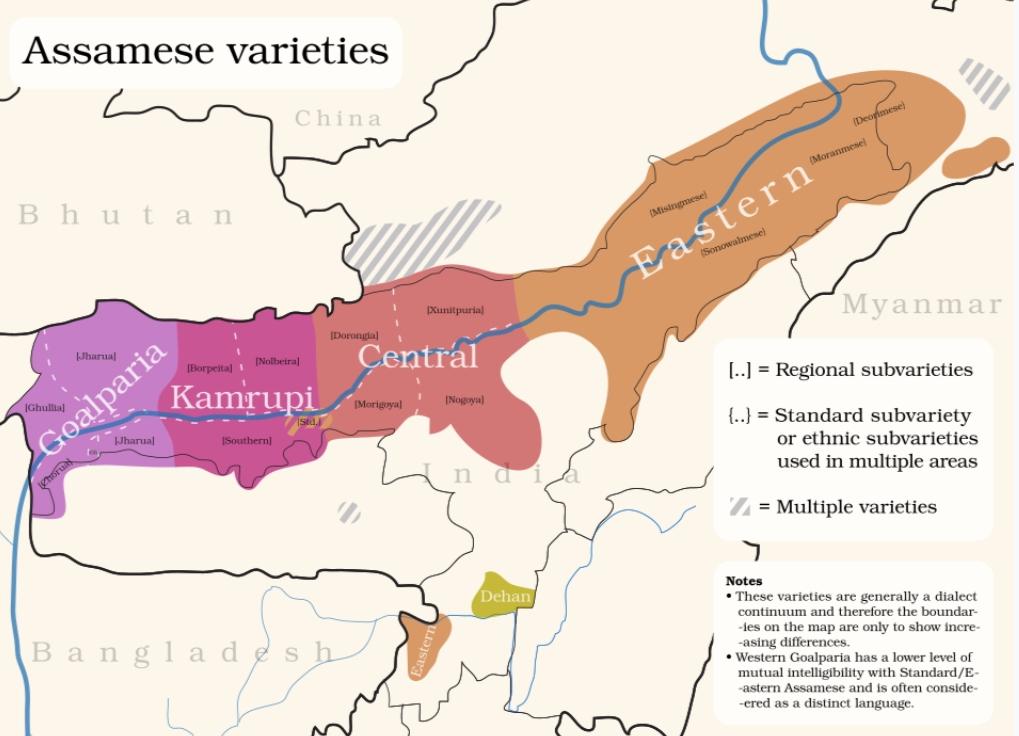
(অসমীয়া ভাষাৰ আঞ্চলিক ৰূপসমূহৰ এক মানচিত্ৰ।)
Assamese has five primary dialects:
Together, these dialects form the easternmost Indo-Aryan language, spoken by around 24 million people, that is Assamese.
r/IndoAryan • u/The-Mastermind- • 19d ago
r/IndoAryan • u/Agitated-Bison-663 • 19d ago

r/IndoAryan • u/idleDevWiz • 20d ago
I have been researching the historical development of Hindi and Urdu, particularly how two closely related linguistic traditions developed into distinct standardized languages during the 20th and 21st centuries.
One of the most interesting aspects of this history is that Hindi and Urdu share a substantial linguistic foundation, yet their scripts, formal vocabulary, institutional development, and political identities have increasingly diverged.
This post summarizes some of the major developments between 1900 and 2026. I would welcome corrections, additional historical sources, and academic perspectives.
- The distinction between Hindi and Urdu had already been developing during the 19th century.
- Both were closely associated with the Khariboli speech base of northern India.
- Urdu generally used the Perso-Arabic script, particularly Nastaliq, and incorporated substantial Persian and Arabic vocabulary.
- Hindi increasingly used Devanagari and promoted Sanskrit-derived vocabulary in formal writing.
- The distinction was not simply linguistic. Script, education, employment, administration, literary institutions, and religious identity were increasingly involved.
- In 1900, the British administration in the North-Western Provinces and Oudh granted the Nagari script recognition alongside the Perso-Arabic script for administrative and judicial purposes.
- This became a major turning point in the Hindi–Urdu controversy.
2. 1900–1947: Language movements and standardization
- Hindi organizations campaigned for greater recognition of Devanagari in education, courts, and administration.
- Urdu supporters defended the established position of Urdu and its Perso-Arabic writing tradition.
- The Nagari Pracharini Sabha, established in 1893, promoted Devanagari and Hindi.
- The Hindi Sahitya Sammelan, established in 1910, became another important institution for Hindi.
- The Dakshina Bharat Hindi Prachar Sabha was established in 1918 to promote Hindi in southern India.
- Hindi prose, journalism, dictionaries, grammar, and educational terminology developed rapidly.
- Urdu continued to develop through poetry, prose, journalism, education, and publishing.
- Important Urdu literary figures included Muhammad Iqbal, Mirza Ghalib (whose influence continued into the 20th century), Faiz Ahmad Faiz, and Saadat Hasan Manto.
- Important Hindi literary figures included Premchand, Jaishankar Prasad, Mahadevi Verma, and Ramdhari Singh Dinkar.
- Premchand is particularly interesting because he wrote in both Urdu and Hindi.
- Mahatma Gandhi advocated Hindustani as a shared language, accepting both Devanagari and Perso-Arabic scripts.
- The movement for Hindustani represented an alternative to treating Hindi and Urdu as entirely separate cultural identities.
3. 1947: Partition and the political separation
Partition fundamentally changed the institutional development of Hindi and Urdu.
In India:
- Hindi in Devanagari became the official language of the Union under Article 343 of the Constitution, which came into effect in 1950.
- English continued to be used for official purposes.
- Urdu remained a constitutionally recognized Scheduled Language.
- Hindi received substantial institutional support through education, administration, broadcasting, and government terminology.
In Pakistan:
- Urdu was declared the national language.
- It was promoted as a common language across provinces with different mother tongues.
- English continued to play a major role in government, law, higher education, and administration.
- Urdu became a major symbol of national identity, despite being the mother tongue of a relatively small proportion of Pakistan's population.
An important distinction: Urdu being Pakistan's national language does not mean that it is the first language of most Pakistanis.
4. 1948–1973: Language politics and constitutional developments
- In 1948, Pakistan's leadership promoted Urdu as the national language.
- The Bengali Language Movement in East Pakistan challenged the attempt to privilege Urdu over Bengali.
- On 21 February 1952, students and demonstrators were killed during protests in Dhaka demanding recognition of Bengali.
- Bengali was eventually recognized as a state language of Pakistan in 1956.
- The episode demonstrated the difficulties of imposing a single national language on a multilingual population.
- India's Constitution came into force in 1950.
- Article 343 specified Hindi in Devanagari as the official language of the Union.
- The Official Languages Act of 1963, subsequently amended in 1967, enabled the continued use of English for Union official purposes.
- Pakistan's 1956 Constitution recognized Urdu as the national language.
- Article 251 of Pakistan's 1973 Constitution again declared Urdu the national language and provided for its eventual replacement of English in official use. That transition has not been fully implemented.
5. 1970s–1990s: Education, literature, broadcasting, and identity
India:
- Hindi expanded through government broadcasting, cinema, education, newspapers, and television.
- Urdu continued to have important literary and educational communities, particularly in Uttar Pradesh, Bihar, Telangana, Delhi, and other regions.
- Urdu's position in education and public employment became a recurring political issue.
- The three-language formula influenced language education across India.
- The anti-Hindi movements in Tamil Nadu demonstrated that Hindi's expansion was not universally accepted.
- Urdu was already included in India's Eighth Schedule in the original Constitution of 1950. It was not added in 1992.
Pakistan:
- Urdu became deeply established in television, radio, newspapers, popular music, and education.
- English remained influential in elite education, government, law, and professional life.
- Regional languages such as Punjabi, Sindhi, Pashto, Balochi, and Saraiki continued to play important roles in everyday life and cultural identity.
Literature:
- Urdu literature continued through poetry, novels, short stories, criticism, and progressive literary movements.
- Hindi literature developed through modernism, experimental writing, Dalit literature, feminist writing, and regional literary movements.
- Both languages continued to influence each other through shared cultural and literary spaces.
6. 2000–2010: The digital transition
- Computers and the internet created new opportunities for both languages.
- Unicode made it easier to represent Devanagari and Arabic-derived scripts consistently across digital systems.
- Hindi websites, newspapers, blogs, and online publications expanded.
- Urdu publishing increasingly adopted digital typesetting and online distribution.
- Nastaliq presented particular technical challenges because of its complex cursive connections and positioning requirements.
- Digital fonts and shaping technologies improved the presentation of Urdu.
- Online dictionaries, digital libraries, and searchable literary archives made historical works more accessible.
7. 2011–2020: Smartphones, social media, and language policy
India:
- The 2011 Census recorded approximately 345 million people under the broad Hindi mother-tongue grouping and approximately 50.8 million under Urdu.
- These figures need careful interpretation: the Hindi grouping includes several related mother tongues and varieties. It should not be treated as a count of speakers of Standard Hindi alone.
- Urdu continued to face challenges in some educational and publishing environments.
- Social media increased the visibility of Hindi, Urdu, Hinglish, and Roman Urdu.
- The National Education Policy 2020 emphasized mother-tongue and regional-language instruction in the early years of schooling, subject to implementation and local circumstances.
Pakistan:
- Urdu remained widely taught and used as a lingua franca.
- English continued to be important in higher education, law, administration, and professional employment.
- The difference between Urdu as a national language and the actual mother tongues of Pakistan's population remained significant.
8. 2021–2026: Current developments
- Smartphone keyboards and Unicode-compatible applications have made Hindi and Urdu digital communication much easier.
- Hindi has a large presence in Indian digital media, streaming platforms, online journalism, and entertainment.
- Urdu continues to have a strong literary and cultural presence in Pakistan and among Indian Urdu readers.
- Roman Urdu is widely used in informal online communication.
- Hindi-English mixing, commonly called Hinglish, is widespread in informal communication and entertainment.
- Digital archives and online platforms are helping preserve historical manuscripts, poetry, newspapers, and books.
- Machine translation, speech recognition, text-to-speech, and generative AI are creating new possibilities for both languages.
- However, OCR, handwriting recognition, dialect coverage, and high-quality Nastaliq text processing remain technical challenges.
- The future of both languages will depend not only on official recognition but also on education, publishing, economic opportunities, digital infrastructure, and intergenerational transmission.
9. Hindi and Urdu: A comparison
Feature| Hindi| Urdu
Linguistic family| Indo-Aryan| Indo-Aryan
Main basis of modern standard| Khariboli| Khariboli
Standard script| Devanagari| Perso-Arabic, usually Nastaliq
Formal vocabulary tendency| Sanskrit-derived| Persian- and Arabic-derived
Everyday spoken grammar| Closely related to Urdu| Closely related to Hindi
Indian constitutional status| Union official language; Scheduled Language| Scheduled Language; official status in certain states and territories
Pakistani constitutional status| No comparable national status| National language
Major literary traditions| Bhakti, modern Hindi, contemporary literature| Classical poetry, ghazal, modern prose and poetry
Informal digital forms| Hinglish, Roman Hindi| Roman Urdu
A caution about vocabulary: claims such as “Urdu is 75% Sanskrit” or “Hindi is 99% Sanskrit” need a clearly defined corpus and method. Vocabulary percentages vary according to whether we count word origins, everyday usage, dictionaries, literary texts, or formal registers. A single percentage cannot adequately describe either language.
10. A few important historical clarifications
I would particularly like to hear informed perspectives on these questions:
- How should we define the historical relationship between Hindi, Urdu, and Hindustani?
- At what point did Hindi and Urdu become distinct standardized languages rather than primarily different literary registers?
- How much did colonial administration contribute to the institutional separation of Hindi and Urdu?
- Did Partition accelerate a process that was already underway, or fundamentally change the languages themselves?
- What is the present condition of Urdu education and publishing in India?
- How is Urdu evolving in Pakistan, particularly alongside Punjabi, Sindhi, Pashto, Balochi, and English?
- Can Devanagari and Nastaliq coexist as writing systems for a shared Hindustani linguistic space?
I am interested in historically grounded answers, especially academic books, primary documents, census records, constitutional sources, old newspapers, and digitized manuscripts.
This is an ongoing historical investigation, not a claim that the subject is settled. Corrections and additional primary sources are welcome.

