r/NewToEMS • • Sep 14 '17

Important Welcome to r/NewToEMS! Read this before posting!

35 Upvotes

Welcome to /r/NewToEMS!

This subreddit's mission is to provide resources, support, feedback, and a community for those interested in emergency medical services. Discuss, ask, and answer questions about EMS education, certifications, licensure, jobs, physical & mental health, etc.

For general EMS discussion, please visit /r/EMS.

What is allowed here?

Questions related to:

  • Emergency medical services (EMS) in general
  • EMS education, certification, and licensure
  • Organizations that provide EMS certifications and licensure, such as the National Registry of Emergency Medical Technicians (NREMT), or your state/country EMS authority
  • Physical, mental, and/or emotional health for EMS providers
  • General EMS advice, tips, and tricks
  • EMS employment/hiring questions
  • Career advice
  • EMS volunteering
  • Gear and equipment

What is not allowed here?

  • Posts that violate our rules (see below).
  • General EMS discussion. Please head over to /r/ems!
  • Discussion unrelated to the mission of this subreddit

Posting Rules

You are required to follow our rules and failing to do so may result in your posts removed and account banned.

1) All top-level comments should contain helpful content or contribute to the discussion in a meaningful way. Follow-up questions are allowed in top-level comments. Trolling, memes, sarcasm, or other content that does not contribute to the discussion are not allowed in top-level comments. Comments such as "I would like to know this too" will be removed.

2) Posts or comments containing spam, hate speech, bigotry, racism, off-topic, overtly explicit, distasteful, vulgar, indecent or inappropriate content are not allowed.

General EMS-related discussions, links, images, and/or videos should be posted over in /r/EMS.

Memes, image macros, reaction gifs, rage comics, cringe shirts, 'look at this truck', and 'office' type submissions are not allowed in /r/NewToEMS. Post these in /r/EMS on Mondays (0000-2359 EST) or in non-top-level comments only.

3) Do not ask for or provide medical or legal advice.

If you believe you are experiencing a medical emergency, dial your local emergency telephone number.

For legal advice, consider posting to /r/legaladvice or consulting a local attorney.

4) No posts relating to or advocating intentional self-harm or suicide, unless strictly as part of a clinical discussion.

If you are having thoughts of self-harm, the United States' national suicide prevention hotline can be reached for free at 988, or call your local emergency number.

5) The National Registry exams are copyrighted tests, and as such, it is illegal to post or discuss questions directly from the NREMT exams. Any such posts will be removed and the poster may be banned.

6) New certifications and licenses may only be posted in our weekly thread, Triumphant Thursday.

Posts such as "NREMT cut me off at... did I pass?" are not allowed. Consider posting these in the weekly NREMT Discussions thread.

7) All posts and comments that contain surveys, solicitations, or self-promotion must be approved by moderation team prior to posting.

Please message the mods for permission prior to posting.

Flairs

We have elected to only flair users who have verified their certification level to the moderator team. All EMS, public safety, and medical professionals (e.g. paramedics, law enforcement, registered nurses, etc.) are eligible, and we would especially like for all EMTs and Paramedics to verify their flairs. This ensures users are receiving responses from real EMS, public safety, and medical professionals.

If you are an EMS, public safety, or medical professional, click here to submit a flair verification request form to the moderator team. Thank you!

Note: Students may select an unverified student flair by clicking "Community Options" on the side-bar and then clicking the Edit button next to "User Flair Preview". You do not need to submit a form. All other users will be automatically assigned an "Unverified User" flair.

Helpful Resources and FAQ

We have compiled a list of helpful links and resources! Click here to check it out!

Also, consider checking out the EMS FAQ and Wiki for more helpful information.

Thank you for taking the time to read this, and we hope you enjoy our community. Please contact the mods if you have any questions or concerns.

-The r/NewToEMS Moderation Team

r/NewToEMS • • Mar 28 '25

Weekly Thread NREMT Discussions

2 Upvotes

Please discuss, ask, and answer all things NREMT (National Registry of Emergency Medical Technicians)! As usual, test answers or cheating advice will not be tolerated (rule 5).


r/NewToEMS • • 16h ago

Beginner Advice Practicing patient trauma assessment

Post image
182 Upvotes

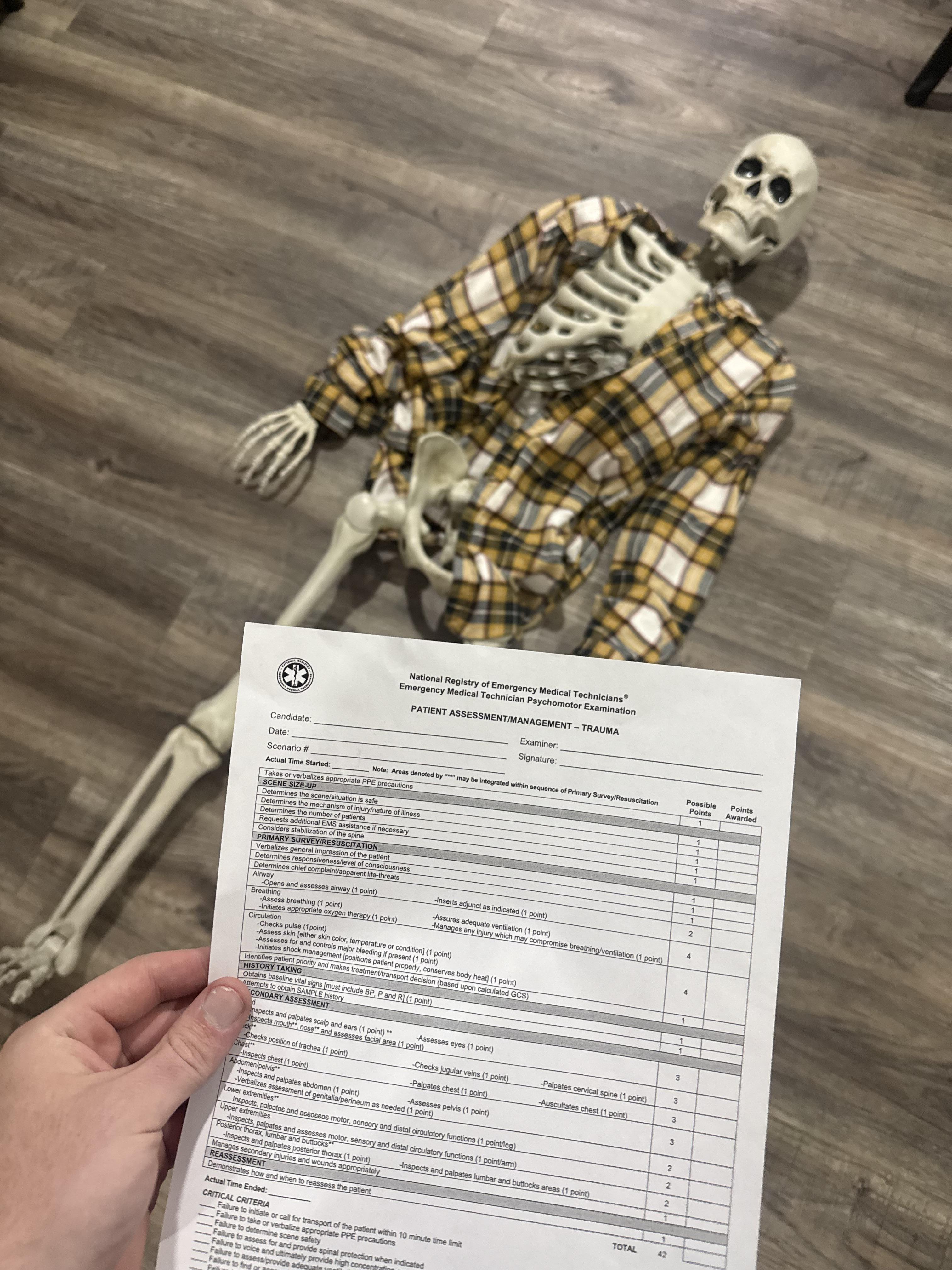
I take my final exam and do my patient assessment in roughly 1 week and really working on memorizing the trauma assessment lol. Me, a skeleton as my patient, chatgpt to give me scenarios, and a DREAM. I definitely recommend doing this for at home practice outside of class.


r/NewToEMS • • 6h ago

Clinical Advice Can’t get pediatric assessment.

13 Upvotes

We are required to have 9 adult assessments and 1 pediatric in my class. I’ve done all my hours and extra and have more than enough assessments but no pediatric. Our clinical deadline is on December 1st and I still have one more clinical scheduled. I literally don’t know what to do at this point as I have terrible luck.
Update: I got told no extensions and that they weee just sorry about my luck! The assessment had to be in the field and all clinical slots are closed now. We only have two approved ERs we can use aswell.


r/NewToEMS • • 1h ago

Testing / Exams AMR San Diego Interview

4 Upvotes

Have an interview with AMR San Diego coming up, what should I expect for the skills tests? Any input would be much appreciated, thanks.


r/NewToEMS • • 4h ago

Clinical Advice I feel like my skills are being wasted. How do I get the most out of this?

7 Upvotes

I work 911 but I'm also an ER tech on the side. They definitely recognize that I'm an EMT since yesterday during my first orientation shift, I did orthostatic vitals on a patient and when charting it, I saw my name formatted like this:

"FIRSTNAME LASTNAME, EMT" whereas my preceptor was "FIRSTNAME, LASTNAME, STNA" (she's a CNA but can only work as a float, this was her first day in an ER unit lmao). I hardly got to use my skills yesterday sadly.

Like sure I got vitals and a BGL on whomever needed it in the CDU (considered part of the ER here), but that's not hard. On the ambulance I can give meds and transfers and stuff. There was only one time when someone got hypoxic and the nurse said "get her on 3 liters per NC."

Otherwise, I'm happy. I got to feed someone who couldn't yesterday. I like taking care of people, but I want to use my full scope. I still do 911. I can only float from CDU to main ER.


r/NewToEMS • • 1m ago

Career Advice Advice for considering EMS as a new career

1 Upvotes

Hello all!

For context, im 23 years old in a graduate masters program in Oregon. I’m suffering from extreme burnout and frustration with my current career path. There was already very poor outlook for my field before AI, but things are much worse now. I knew that I would have to consider a new career path anyways, but recent personal experiences are making me want to drop out and pursue something else right now.

I’ve thought about EMS as a career before, but I never studied medicine or anything even closely related. My sister studied to be a doctor, passed the MCAT, and worked in a hospital for several years before also switching careers. She was surprised when I asked for her advice because she never considered me the type of person to want to be in an ambulance, administering blood, resuscitating patients, et cetera. She said I wasn’t crazy, though, and we’ve been talking more about next steps.

A primary motivator for me is that I feel I have to start doing something meaningful on a day-to-day basis. I went into my current career because I was passionate about teaching, and loved the gratification of helping students at their lowest when they needed dire help on an essay or application (I was a writing tutor). I want to be doing more, though, and feel like I have a great patience towards helping people. I’ve just been feeling this overwhelming sense that I can and should be doing more.

I’m worried now about if I have what it takes to do this kind of work. I have a strong sense that I do, even though I’ve always felt like I was more sensitive and introverted. I always always the one to help my friends when they were throwing up, or caring for my partner when she’s sick, helping my elderly family. I’m also incredibly inspired by my sister and the lives she’s saved. But Ive always suffered from imposter syndrome, and I’m fully aware that no amount of self assurance could prepare ANYONE for the first moment they’re dealing with a tragedy up close and directly responsible for the outcome.

I guess what I’m asking for is some guidance? How can I be sure that I’ll be able to handle everything? I’ve been told I work well under pressure, but this is an entirely different kind of pressure. Is there anyone out there that had these doubts?

TLDR: how can I be sure that I have what it takes or that I’m considering EMS for the right reasons?


r/NewToEMS • • 11m ago

Career Advice Just got “fired” what do I do?

1 Upvotes

So I have been working at a department since July. I have struggled to get my minimum hours and go to training due to being a college student at a university and balancing things with my personal life. I was meant to be working 48 hours a month but I legit couldn’t because of balancing the hours with my other volunteer FD. I have sorta been teetering on being let go for a while because I hadn’t been dedicating enough time to completing the training in our first due system. I am Pre-med so I’m also balancing stuff with research and volunteering. Anyways I signed this contract in the beginning saying that if I didn’t work 700 hours or something like that that I would have to pay the department $700 in training costs minus any hours I did work. My chief called me telling me I should resign or I will be removed from the roster. I don’t really want to pay $700 as I expect most people wouldn’t, so what should I do. Also in terms of where I go next I think I plan to work IFT while working at my volunteer FD. Does anyone have other ideas as to where I go next?


r/NewToEMS • • 3h ago

Educational How I’m organizing paramedic drug cards in school (3 checks + a tiny med-math refresher)

1 Upvotes

I’m a working EMT in paramedic school, and my handwritten drug cards were turning into a mess — half-finished doses, no pediatric line, and I kept mixing up look-alike concentrations.

I started running every card, homemade or otherwise, through the same three checks:

  1. Why we give it, in plain language — not just the class name.
  2. When we don’t: contraindications and the “hold up” notes, in the same spot on every card.
  3. Typical adult dose and route, labeled by indication when a drug has more than one use, plus a pediatric dose only when an established weight-based figure exists. If it isn’t established, I write “verify with local protocol,” not a number I guessed.

Two med-math moves I keep on a sticky note (study examples only — always use the concentration on the vial in your hand and your local protocol):

• Volume to draw = (dose you want) ÷ (concentration on the label).

Example: the vial is 10 mg in 2 mL, and you want 2 mg.

2 mg ÷ (10 mg / 2 mL) = 0.4 mL.

• Weight-based: mg needed = (mg/kg) × (patient weight in kg). Then convert that mg amount to mL with the formula above. Check the listed max on your protocol before you ever think about pushing it. Write the units down so they cancel; if the units don’t work out, the math isn’t done.

Ten mix-ups I keep seeing in class (memory hooks, not a protocol):

  1. Epi 1:10,000 vs 1:1,000 — more zeros means more dilute. 1:10,000 is 0.1 mg/mL; 1:1,000 is 1 mg/mL. Confirm the indication and the route before you confirm the number.
  2. D50 vs D10 (and D25) — know which concentration your system actually carries, especially for pediatric hypoglycemia. Many services have moved toward D10; don’t assume the bottle you memorized from a slide.
  3. Adenosine — first and repeat doses are easy to swap. It’s a rapid push with a flush, and a brief pause in the rhythm can be expected. Follow your ACLS/protocol card, not a rhyme you half-remember.
  4. Amiodarone in arrest vs a drip for a patient with a pulse — those are different pathways. Don’t borrow the arrest dose for a stable patient, or the other way around.
  5. Atropine — for symptomatic bradycardia in the right context, not a reflex for every slow heart rate. Know the situations where it doesn’t help.
  6. Naloxone — titrate when you can; some opioids last longer than the naloxone does. “Max dose and walk away” is a bad study habit.
  7. Nitroglycerin — the hold-ups matter as much as the dose: hypotension, recent ED/pulmonary hypertension meds, and right-sided / inferior MI caution. Check your protocol.
  8. Aspirin — usually chewed in the ACS pathway; still check contraindications instead of treating it as harmless because it’s familiar.
  9. Albuterol vs ipratropium — one is the common bronchodilator rescue; the other is the anticholinergic add-on. Don’t treat them as interchangeable.
  10. Fentanyl vs morphine — onset, duration, and stacking with other sedatives. Pick the one your protocol actually calls for and know why.

Non-negotiable: I do not treat study cards as a protocol. I check every number against the current textbook, the instructor, and local protocols / medical direction. Cards go stale. Systems differ.

This is a study aid, not medical advice, and it isn’t official NREMT material. Anything that sounds like an “exam hack” should still mean study smarter — not a cheat and not a leaked question. Nobody should treat a patient off a study card.

If you have a better field you always include (onset/duration, infusion rates, reconstitution), I’d like to hear it.


r/NewToEMS • • 20h ago

Career Advice IFT tips?

10 Upvotes

Hey so for background I just recently got certified and been wanting to get straight to work so I applied for a ton of ift jobs. I start tomorrow and idk how to feel about it. Anything I should know before hand? Advice would be greatly appreciated. 🙏🙏🙏


r/NewToEMS • • 17h ago

Beginner Advice What extracurriculars or activities prepares you to become a paramedic?

Thumbnail reddit.com
5 Upvotes

r/NewToEMS • • 22h ago

Cert / License Renew via Inactive Status?

2 Upvotes

Hello, I'm an APRN (licensed in six states independently) of about 15 years and worked from home nearly 10 of those.

I was a NREMT Paramedic and let all of that lapse in 2016. I hadn't worked as a paramedic in over 8 years at that point but always had some random employer I would list in the employment section.

In 2024, I took the NREMT-B exam again and passed and obtained state and NR basic credentials. I'm set to renew in March those and have obtained a myriad of CME. I took a PHTLS course, renewed AHA ACLS and did some other things I used to have that don't serve my current career.

Is listing an employer and active or inactive something to do or just let it lapse again? I'm 45 and live in town with no volunteerism, etc so I'm nit sure how I'd ever use it.


r/NewToEMS • • 20h ago

Career Advice What to do?

0 Upvotes

I live in a mid sized city about 15 minutes from a major city, all 4 counties in my area are opening up apps for AMR, and I planned on applying and getting 6-12 months in before going to Medic school, which AMR will pay for me to attend. My dad’s best friend (who he actually met on the ambulance) told me that the fire department he was a Captain at and just retired from about 3 months ago will pay me to go to medic school and he’ll get me an in with them but it’s a 3 hour commute up there and I do not plan on moving from my current city. I planned on doing just AMR transport locally, then get my medic and go fire after but that seems like a good opportunity.

Thoughts? Pay at that fire department is about 15,000 a year more than at AMR but I would of course have to go do my CPAT, commute up there and do my firefighter training and such, and it is a much slower system up there than it is down here.


r/NewToEMS • • 21h ago

Career Advice Data engineer in Canada considering a career switch to EMR. Questions about industrial/oil field work.

Thumbnail reddit.com
1 Upvotes

r/NewToEMS • • 1d ago

Career Advice About to start school

2 Upvotes

Hey everyone, I am about to start EMT training in January and go straight into AEMT, then hopefully paramedic(having issues getting enrolled in college due to an identity theft but luckily emt and AEMT at my local school don’t require me to be “enrolled” in college). I’m wondering where is some good cities to work at in the US as I want to move, and any information about critical care, flight medic or tactical medic info would also be appreciated. I have a background as an infantryman so is any of my CLS training an advantage?


r/NewToEMS • • 1d ago

School Advice Looking for advice on next steps

1 Upvotes

Hello all! I’m finishing up my EMT-B in a few weeks and am looking for advice on next steps.
I receive Chapter 35 VA benefits that will run out in just over a year. I really want to use them before I lose them. I know I want to be a paramedic and I would love to teach one day. I do intend to work at least part time for an EMS agency while doing either option.
Here are my options:
There’s a year long paramedic course starting shortly after my basic class concludes. Everyone I have spoken to has advised I do not do it because it is extremely difficult without at least 6 months of experience on the truck, many have recommended closer to a year. As much as I’d like to wait, my benefits will expire by that time and I’ll lose access to them.
My college also offers an AAS in EMS degree path starting around the same time. I’ve been told by a few people that it is much harder especially while working and I don’t want to fail out of that either. I’ve also pursued other degrees in the past and struggled a lot due to some time management and focusing issues. I’d like to think this would be different because my coworkers would help support me but I don’t know for sure unless I try.
What would y’all do? Any advice or recommendations would be awesome. Thank you!


r/NewToEMS • • 1d ago

School Advice ARC Paramedic Program

12 Upvotes

Hey everyone ive been an emt for 2 years. One year in IFT and one year in 911. I just got into ARC (American River College) in Sacramento for their paramedic program and I was wondering if there was anyone who has gone through the program that wouldnt mind answering some questions I have. Or if anyone else got into the program Im open to that as well.
I start in January so wish me luck 👍


r/NewToEMS • • 1d ago

Career Advice Richmond Va

1 Upvotes

Any emt , Aemt or paramedic that lives in Richmond I just got my emt license and I got some question that could be answered better from someone who works here since it changes base on the state .


r/NewToEMS • • 1d ago

School Advice Passed the NREMT! And my advice for others

0 Upvotes

Hey everyone! I just passed the NREMT today, and I completed a 2-week accelerated EMT course. I wanted to share some advice for anyone considering EMT school, especially those trying to decide between a traditional program and an accelerated one.
The biggest piece of advice I can give you is this: Choosing the right EMT school is just as important as how much effort you’re willing to put into learning the material.
Here’s something that might sound strange: I genuinely don’t think the EMT curriculum itself is incredibly difficult. It’s a lot of information, absolutely, but it’s manageable if you’re willing to study and put in the work. What makes EMT school unnecessarily difficult, in my opinion, is how certain schools structure their programs, administer their exams, and approach teaching their students.
Let me explain.
I just completed an EMT course that lasted only two weeks. Yes, TWO weeks. You might assume that a program that short would be incredibly difficult or wouldn’t prepare students adequately for the National Registry. However, my experience was quite the opposite.
What made this program different was how the instructors approached learning and testing.
Throughout those two weeks, we were given opportunities to review our exams, see which questions we missed, understand why our answers were incorrect, and retake certain tests when necessary.
That might not sound like a big deal, but I cannot emphasize enough how important that is.
When you’re learning emergency medicine, you’re going to make mistakes. You’re going to misunderstand certain concepts, confuse medical terminology, and occasionally choose the wrong answer. That’s part of learning.
The important thing is whether your instructors help you understand those mistakes or simply give you a failing grade and move on.
There’s a massive difference between teaching someone to pass a test and teaching someone to understand emergency medicine.
If I get a question wrong about shock, airway management, cardiac emergencies, or trauma assessments, I want to know WHY I got it wrong. I want to understand the reasoning behind the correct answer so that when I encounter a similar situation again, whether on the NREMT or with an actual patient, I know what to do.
That’s what a good EMT program should encourage.
Unfortunately, not every school operates this way.
Some programs have extremely strict testing policies, limited opportunities for remediation, and additional exit examinations that can prevent students from graduating even after they’ve completed their coursework.
I’m not saying every school with strict testing policies is bad. EMTs absolutely need to demonstrate competency because people’s lives are going to depend on their decisions.
But there is a difference between maintaining high standards and creating unnecessary obstacles for students who are genuinely trying to learn.
I also believe prospective students should be cautious about programs where failing means paying thousands of dollars to repeat an entire course, especially if the school provides little opportunity for remediation or additional instruction.
I’m not claiming every school intentionally wants students to fail, but I do think some programs have policies that can leave students feeling like they’re being treated more as paying customers than future healthcare professionals.
And that’s exactly why researching your school beforehand is so important.
Before you spend your money on EMT school, I strongly recommend doing the following:
Read the school’s reviews. Don’t just look at the overall rating. Read what former students say about the instructors, testing policies, administration, and whether they felt prepared for the NREMT.
Ask about graduation and NREMT pass rates. Call the school and ask what percentage of students successfully complete the program and what percentage pass the National Registry on their first attempt. A school should be willing to discuss its students’ outcomes.
Ask whether they require the HESI or another exit examination. This is extremely important. Some programs require students to pass an additional examination before they can graduate or receive the necessary documentation to pursue certification. Find out exactly what is required before enrolling.
Ask about exam retakes and remediation. If you fail a chapter exam or module exam, what happens? Can you review your mistakes? Are retakes permitted? Is tutoring available? Or are you immediately at risk of failing the course?
Ask what happens if you fail. Do you have to pay for the entire program again? Can you repeat a particular module? Are there additional fees? Get those answers before signing anything.
Research the instructors. Having an instructor who actually cares about your education makes an enormous difference. You want someone who can explain difficult concepts, answer questions, and help you develop clinical reasoning rather than simply reading PowerPoint slides.
Make sure the program meets your state’s requirements. A fast course is worthless if it doesn’t provide the education, practical training, and eligibility you need to pursue certification and state licensure.
Personally, if a school offered absolutely no opportunities for remediation, refused to explain its testing policies, or couldn’t provide reasonable information about student outcomes, I would seriously consider looking elsewhere.
Remember, you’re paying these schools to educate you, not simply to hand you exams and collect tuition.
Now, I also want to address something about accelerated EMT programs.
A lot of people automatically assume that a longer EMT course is better than a shorter one. I don’t necessarily agree.
A longer program gives you more time to absorb information, practice skills, and develop confidence, which can absolutely be beneficial. But the length of a course doesn’t automatically determine the quality of the education.
A well-organized accelerated program with knowledgeable instructors, effective teaching methods, and motivated students can be a great option.
However, a two-week program is NOT an easy way out.
You have to be willing to dedicate those two weeks almost entirely to studying. You’re going to be learning a tremendous amount of information in a very short period of time. If you fall behind, catching up can become extremely difficult.
You also have to be honest with yourself about how you learn. Some people do better with a slower-paced course, and there’s absolutely nothing wrong with that.
The goal isn’t to finish EMT school as quickly as possible. The goal is to become a competent EMT who can recognize emergencies, make good decisions, and provide appropriate patient care.
As far as studying goes, here’s what helped me and what I would recommend:
Read your textbook. Seriously. Don’t rely entirely on PowerPoint slides or Quizlet. The textbook explains the reasoning behind the information you’re learning.
Use Pocket Prep. I highly recommend it for NREMT preparation. Practice questions help you identify weaknesses and become familiar with scenario-based testing.
Watch Paramedic Coach. His explanations can make complicated topics easier to understand, especially when you’re struggling with certain concepts.
Study the explanations, not just the answers. If you get a question wrong, understand why. If you get a question right by guessing, you still need to review it.
Focus on patient assessment and critical thinking. The NREMT isn’t simply asking whether you memorized a definition. It’s testing whether you can apply your knowledge to a patient scenario and determine the most appropriate action.
And that brings me to my final point.
CRAMMING FOR EXAMS WILL NOT MAKE YOU A GOOD EMT.
You might memorize enough information to pass a chapter exam, but that doesn’t mean you’ll understand what to do when a patient is experiencing respiratory failure, hypovolemic shock, or an altered mental status.
The NREMT tests your ability to think through situations, prioritize interventions, and recognize life-threatening conditions.
That’s why understanding the material is so much more important than memorizing questions.
Passing the National Registry today was an incredible feeling, especially after completing such a short program. But I also understand that passing an exam is just the beginning. There’s still an enormous amount to learn through clinical experience, working alongside experienced providers, and continuing my education.
I don’t believe passing the NREMT automatically makes someone a great EMT. It demonstrates that you’ve met an important entry-level standard. Becoming a great EMT takes practice, experience, humility, and a willingness to keep learning.
So, to anyone thinking about enrolling in EMT school: PLEASE do your research before spending your money.
Don’t automatically choose the cheapest school, the closest school, the fastest program, or even the most expensive one.
Choose the program that gives you the best opportunity to actually learn.
Ask questions. Read reviews. Compare testing policies. Find out about remediation, graduation requirements, and NREMT pass rates.
And most importantly, find instructors who genuinely want to see their students become competent healthcare professionals.
Your education is an investment in your future, and eventually, the knowledge you gain could make a difference in someone else’s life.
Choose your school carefully, put in the effort, understand the material, and don’t let a poorly structured program discourage you from pursuing a career in EMS.
Good luck to everyone currently going through EMT school or preparing for the National Registry. You can do it!


r/NewToEMS • • 3d ago

Career Advice Becoming a wilderness EMT?

27 Upvotes

How much experience would jobs be looking for before applying to this type of role? I’m starting my first EMT job soon, so would it be possible to apply to work at a national park next summer/fall? Or is this something that I would need a year to a few years of experience first? I was also wondering if i should work towards paramedic first. That’s something I am also interested in anyway!

If anyone has worked a job like this I would love to hear about it and get your thoughts! :)


r/NewToEMS • • 2d ago

School Advice Passed my first exam

6 Upvotes

Hey guys just want some feedback I guess I’m all new to this. But I had my first exam today and it was about air way and ventilation. During the entire exam I was stressed. Minimum was to get 80% so 40/50 questions right. I got a 41/50😭 so I barely got a 82%. A pass is a pass but not feeling like super great on it. Next week is cardiology and resuscitation and that’s the one I’m a little afraid of. So I guess what I’m trying to say is that I’m glad I passed but also not really proud lol


r/NewToEMS • • 3d ago

Cert / License CEs

5 Upvotes

What is your best advice to get free CEs?
I’m re-certifying for the first time and it seems like these websites are desperate for money. Any good websites to get most of not all 40 CEs for free? Or maybe direct me to the right forum.


r/NewToEMS • • 2d ago

Male Specific What are you guyses favorite boots I’m looking for Christmas present ideas for myself from family

2 Upvotes

Please give me your all time favorites for comfort. Thank you!


r/NewToEMS • • 3d ago

Career Advice Clearing rides, paramedic told me not to work for the company I’m on

60 Upvotes

He said it had nothing to do with my performance but that he has been with this particular company for 11 years and that “the higher ups don’t give a fuck about you or anyone else on these trucks” and that “they will replace you tomorrow”. He also told me to go back to construction multiple times toward the end of my shift. And no, he was not my fto, but my trainer (the emt-b on this particular unit) had the same mentality.

I’ve been thinking about it all day. I’d just like to read some opinions about this.