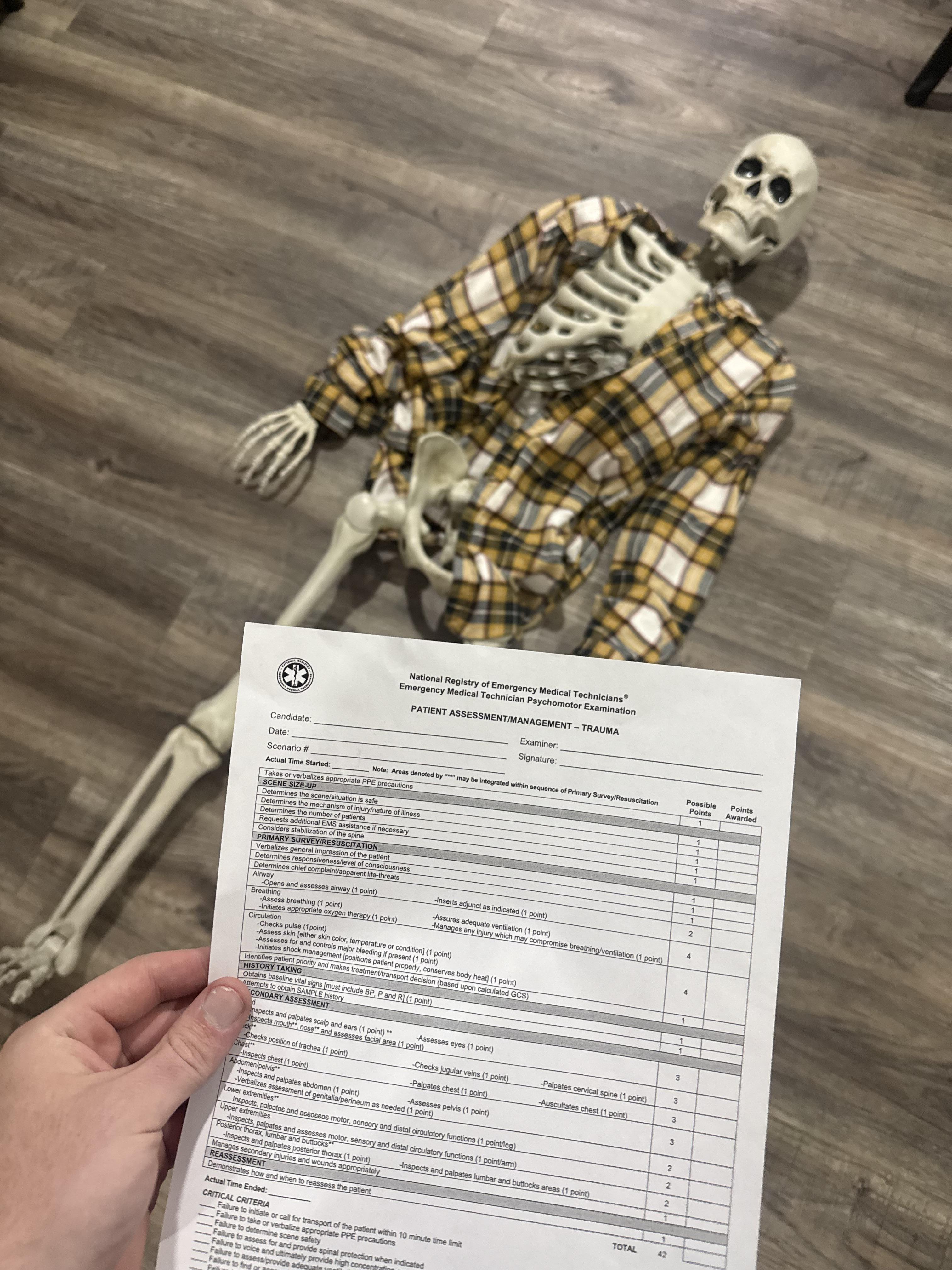
Hey everyone! I just passed the NREMT today, and I completed a 2-week accelerated EMT course. I wanted to share some advice for anyone considering EMT school, especially those trying to decide between a traditional program and an accelerated one.
The biggest piece of advice I can give you is this: Choosing the right EMT school is just as important as how much effort you’re willing to put into learning the material.
Here’s something that might sound strange: I genuinely don’t think the EMT curriculum itself is incredibly difficult. It’s a lot of information, absolutely, but it’s manageable if you’re willing to study and put in the work. What makes EMT school unnecessarily difficult, in my opinion, is how certain schools structure their programs, administer their exams, and approach teaching their students.
Let me explain.
I just completed an EMT course that lasted only two weeks. Yes, TWO weeks. You might assume that a program that short would be incredibly difficult or wouldn’t prepare students adequately for the National Registry. However, my experience was quite the opposite.
What made this program different was how the instructors approached learning and testing.
Throughout those two weeks, we were given opportunities to review our exams, see which questions we missed, understand why our answers were incorrect, and retake certain tests when necessary.
That might not sound like a big deal, but I cannot emphasize enough how important that is.
When you’re learning emergency medicine, you’re going to make mistakes. You’re going to misunderstand certain concepts, confuse medical terminology, and occasionally choose the wrong answer. That’s part of learning.
The important thing is whether your instructors help you understand those mistakes or simply give you a failing grade and move on.
There’s a massive difference between teaching someone to pass a test and teaching someone to understand emergency medicine.
If I get a question wrong about shock, airway management, cardiac emergencies, or trauma assessments, I want to know WHY I got it wrong. I want to understand the reasoning behind the correct answer so that when I encounter a similar situation again, whether on the NREMT or with an actual patient, I know what to do.
That’s what a good EMT program should encourage.
Unfortunately, not every school operates this way.
Some programs have extremely strict testing policies, limited opportunities for remediation, and additional exit examinations that can prevent students from graduating even after they’ve completed their coursework.
I’m not saying every school with strict testing policies is bad. EMTs absolutely need to demonstrate competency because people’s lives are going to depend on their decisions.
But there is a difference between maintaining high standards and creating unnecessary obstacles for students who are genuinely trying to learn.
I also believe prospective students should be cautious about programs where failing means paying thousands of dollars to repeat an entire course, especially if the school provides little opportunity for remediation or additional instruction.
I’m not claiming every school intentionally wants students to fail, but I do think some programs have policies that can leave students feeling like they’re being treated more as paying customers than future healthcare professionals.
And that’s exactly why researching your school beforehand is so important.
Before you spend your money on EMT school, I strongly recommend doing the following:
Read the school’s reviews. Don’t just look at the overall rating. Read what former students say about the instructors, testing policies, administration, and whether they felt prepared for the NREMT.
Ask about graduation and NREMT pass rates. Call the school and ask what percentage of students successfully complete the program and what percentage pass the National Registry on their first attempt. A school should be willing to discuss its students’ outcomes.
Ask whether they require the HESI or another exit examination. This is extremely important. Some programs require students to pass an additional examination before they can graduate or receive the necessary documentation to pursue certification. Find out exactly what is required before enrolling.
Ask about exam retakes and remediation. If you fail a chapter exam or module exam, what happens? Can you review your mistakes? Are retakes permitted? Is tutoring available? Or are you immediately at risk of failing the course?
Ask what happens if you fail. Do you have to pay for the entire program again? Can you repeat a particular module? Are there additional fees? Get those answers before signing anything.
Research the instructors. Having an instructor who actually cares about your education makes an enormous difference. You want someone who can explain difficult concepts, answer questions, and help you develop clinical reasoning rather than simply reading PowerPoint slides.
Make sure the program meets your state’s requirements. A fast course is worthless if it doesn’t provide the education, practical training, and eligibility you need to pursue certification and state licensure.
Personally, if a school offered absolutely no opportunities for remediation, refused to explain its testing policies, or couldn’t provide reasonable information about student outcomes, I would seriously consider looking elsewhere.
Remember, you’re paying these schools to educate you, not simply to hand you exams and collect tuition.
Now, I also want to address something about accelerated EMT programs.
A lot of people automatically assume that a longer EMT course is better than a shorter one. I don’t necessarily agree.
A longer program gives you more time to absorb information, practice skills, and develop confidence, which can absolutely be beneficial. But the length of a course doesn’t automatically determine the quality of the education.
A well-organized accelerated program with knowledgeable instructors, effective teaching methods, and motivated students can be a great option.
However, a two-week program is NOT an easy way out.
You have to be willing to dedicate those two weeks almost entirely to studying. You’re going to be learning a tremendous amount of information in a very short period of time. If you fall behind, catching up can become extremely difficult.
You also have to be honest with yourself about how you learn. Some people do better with a slower-paced course, and there’s absolutely nothing wrong with that.
The goal isn’t to finish EMT school as quickly as possible. The goal is to become a competent EMT who can recognize emergencies, make good decisions, and provide appropriate patient care.
As far as studying goes, here’s what helped me and what I would recommend:
Read your textbook. Seriously. Don’t rely entirely on PowerPoint slides or Quizlet. The textbook explains the reasoning behind the information you’re learning.
Use Pocket Prep. I highly recommend it for NREMT preparation. Practice questions help you identify weaknesses and become familiar with scenario-based testing.
Watch Paramedic Coach. His explanations can make complicated topics easier to understand, especially when you’re struggling with certain concepts.
Study the explanations, not just the answers. If you get a question wrong, understand why. If you get a question right by guessing, you still need to review it.
Focus on patient assessment and critical thinking. The NREMT isn’t simply asking whether you memorized a definition. It’s testing whether you can apply your knowledge to a patient scenario and determine the most appropriate action.
And that brings me to my final point.
CRAMMING FOR EXAMS WILL NOT MAKE YOU A GOOD EMT.
You might memorize enough information to pass a chapter exam, but that doesn’t mean you’ll understand what to do when a patient is experiencing respiratory failure, hypovolemic shock, or an altered mental status.
The NREMT tests your ability to think through situations, prioritize interventions, and recognize life-threatening conditions.
That’s why understanding the material is so much more important than memorizing questions.
Passing the National Registry today was an incredible feeling, especially after completing such a short program. But I also understand that passing an exam is just the beginning. There’s still an enormous amount to learn through clinical experience, working alongside experienced providers, and continuing my education.
I don’t believe passing the NREMT automatically makes someone a great EMT. It demonstrates that you’ve met an important entry-level standard. Becoming a great EMT takes practice, experience, humility, and a willingness to keep learning.
So, to anyone thinking about enrolling in EMT school: PLEASE do your research before spending your money.
Don’t automatically choose the cheapest school, the closest school, the fastest program, or even the most expensive one.
Choose the program that gives you the best opportunity to actually learn.
Ask questions. Read reviews. Compare testing policies. Find out about remediation, graduation requirements, and NREMT pass rates.
And most importantly, find instructors who genuinely want to see their students become competent healthcare professionals.
Your education is an investment in your future, and eventually, the knowledge you gain could make a difference in someone else’s life.
Choose your school carefully, put in the effort, understand the material, and don’t let a poorly structured program discourage you from pursuing a career in EMS.
Good luck to everyone currently going through EMT school or preparing for the National Registry. You can do it!