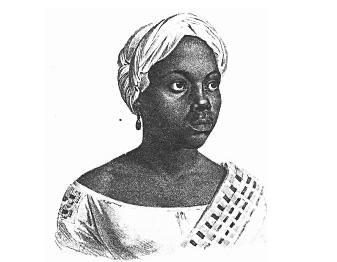
She was born near the Pacific-coast city of Guayaquil, then part of the Royal Audiencia of Quito, in the Kingdom of Peru. María Chiquinquirá was the daughter of an African woman named María Antonia, a slave belonging to the wealthy, powerful Cepeda family. Before María Chiquinquirá’s birth, María Antonia had become infected with leprosy. Expelled from the family house and abandoned, she died soon after María Chiquinquirá’s birth.
When she was five, the patriarch of the Cepeda family reclaimed María Chinquinquirá as a slave. She ended up in the home of one of the sons, Presbyter Cepeda, where she joined a large group of slaves who worked outside the house. In exchange for their autonomy they gave the master a certain daily wage. This custom, very common during the colonial period in Spanish America, was called jornal de esclavos (slaves’ daily wage), and in many cases it gave slaves the opportunity to be independent and accumulate some savings.
At some point, Díaz married a skilled tailor, José Espinosa, a freeborn pardo (black man) who lived in the same house. Together, they built a home and carried on a successful business. By the time their daughter María del Carmen was born, they were living “as free persons.” They lived as such until the presbyter suddenly reclaimed María del Carmen, now in her early teens, as a slave. By then, Díaz’s daughter was an educated young lady who had learned to read, write, and sew and the mother was determined to safeguard her daughter’s freedom. She begged the presbyter to desist in his demand or negotiate prices for their freedom. As a last resort, she decided to sue the powerful priest.
In May 1794, María Chinquinquirá acted as a free woman and brought various charges against the Cepeda family. The legal argument put forward by the attorney in charge of her case was that once the owners of María Antonia abandoned her, she had acquired compulsory manumission and was considered freeborn. The judges of the colonial city council of Guayaquil decided against María Chinquinquirá and her daughter. However, she appealed to the royal court in Quito. Unfortunately, the final outcome remains unknown. Still, the case set in motion an effort to articulate a narrative of her own and her daughter’s freedom based on witness testimony of those who knew them best.
View complete story (pdf)
Bibliography:
- Chaves, María Eugenia. Honor y libertad: Discursos y recursos en las estrategias de libertad de una mujer esclava. Gothenburg, Sweden: Department of History and Iberoamerican Institute, University of Gothenburg, 2001.
- Chaves, María Eugenia. “Slave Women’s Strategies for Freedom and the Late Spanish Colonial State.” In Hidden Histories of Gender and the State in Latin America, edited by Elizabeth Dore and Maxine Molyneux, pp. 108–126. Durham and London: Duke University Press, 2000.
- Hunefeldt, Christine. Paying the Price of Freedom: Family and Labor among Lima’s Slaves, 1800–1854. Berkeley: University of California Press, 1994.
- Johnson, Lyman, and Sonia Lipsett-Rivera. The Faces of Honor: Sex, Shame and Violence in Colonial Latin America. Albuquerque: New Mexico University Press, 1998.
- Maldonado, María Eugenia Chaves. "Díaz, María Chiquinquirá." Dictionary of Caribbean and Afro-Latin American Biography , edited by Ed. Franklin W. Knight. , edited by and Henry Louis Gates Jr.. . Oxford African American Studies Center, http://www.oxfordaasc.com/article/opr/t456/e648(accessed Thu Sep 05 12:40:53 EDT 2019).
- Townsend, Camilla. “‘Half my body free, the other half enslaved’: The Politics of the Slaves of Guayaquil at the End of the Colonial Era.” Colonial Latin American Review 1 (June 1998): 105–128
Author
María Eugenia Chaves Maldonado
Adapted by
James Almeida and Steven J. Niven
Contributing Institutions
- Hutchins Center for African & African American Research, Harvard University, Cambridge, MA.
- Oxford University Press (USA) African American Studies Center.
Published by
Enslaved: Peoples of the Historical Slave Trade (Enslaved.org)