I had 8 bots and personal APIs running on an old 4 GB Celeron N3060 netbook on Debian 13. Docker + Coolify/Portainer ate half the RAM before starting a single service, so I built a lightweight native panel on top of systemd + SQLite + Linux /sys/class/ sensors instead.
At idle it sits at 27 MB cgroup memory with zero background polling daemons, and gives you 1-click systemd templates (with MemoryMax= and CPUQuota=), Starter Pack presets, live WebSocket logs + Git deploys, GitHub webhooks, optional Caddy HTTPS, native systemd timer backups, and temp/battery monitoring.
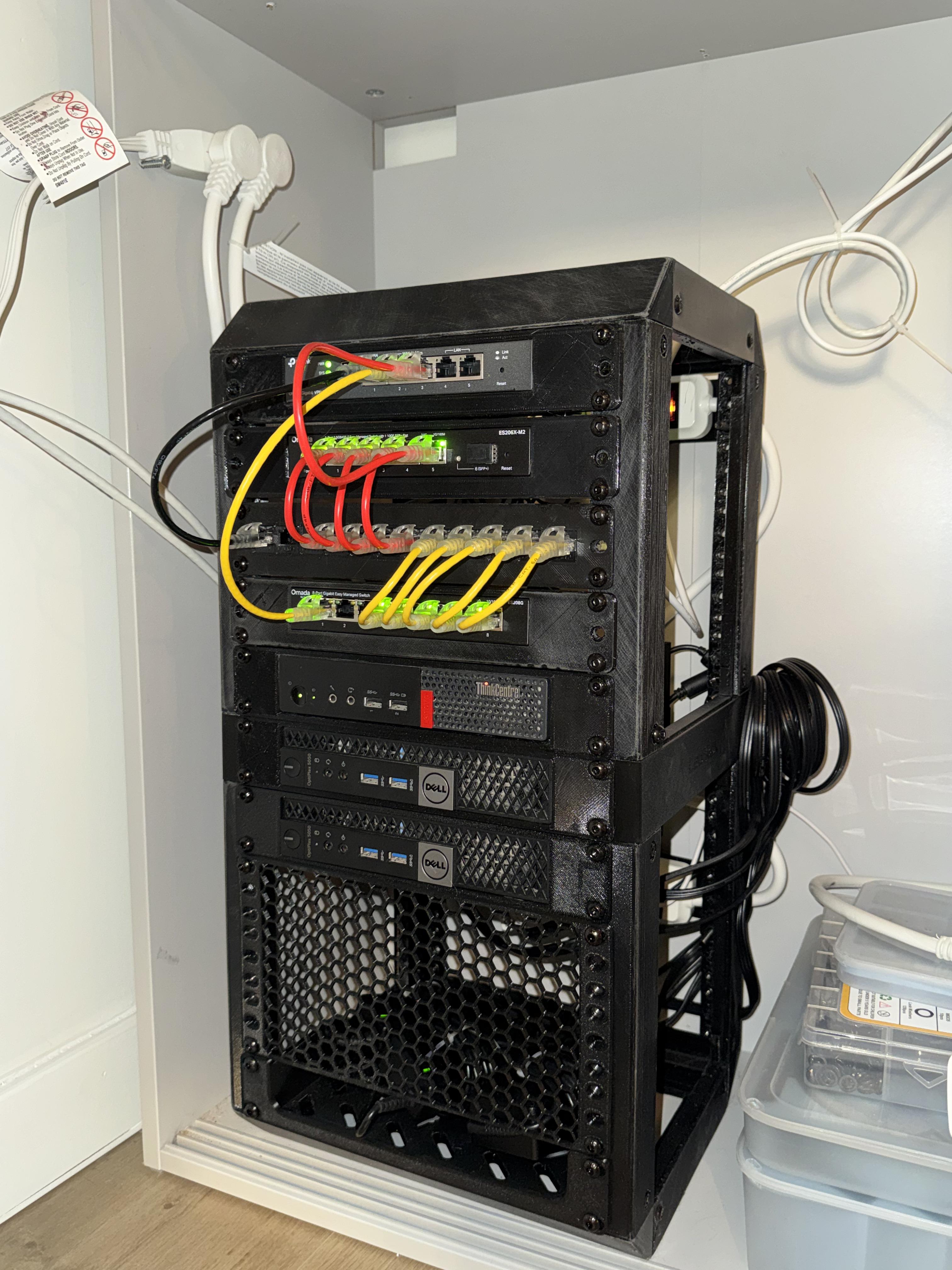
Operations: 3-node Proxmox cluster with 6 Ubuntu VMs (provisioned using Terraform, configured using Ansible, Flux bootstraps to kubeadm cluster based on Git source of truth) and Tailscale LXC, Pi-hole LXC, Omada Controller LXC Larger of storage devices in LVM-thin pool (I don't know why I tried Ceph initially, clearly not built for it, unless...?)
Rack: LabRax 10+1U (2x Lab Rax + 1U extension and joiner block) Bunch of cable organizing prints and power strip mounts
I have it all set up for basic use for small-scale data jobs (I have not benchmarked anything yet), but my goal is to set up comprehensive monitoring dashboards once I figure out what makes sense to monitor for me and wire up Slack notifications accodingly.
Honestly, I don't know where this post is going but I would love to engage with the community to learn more about what they think about this (I'm just having a terrible few weeks at work and with life) and how I could leverage this for career opportunities in cloud engineering, devops, data engineering etc.
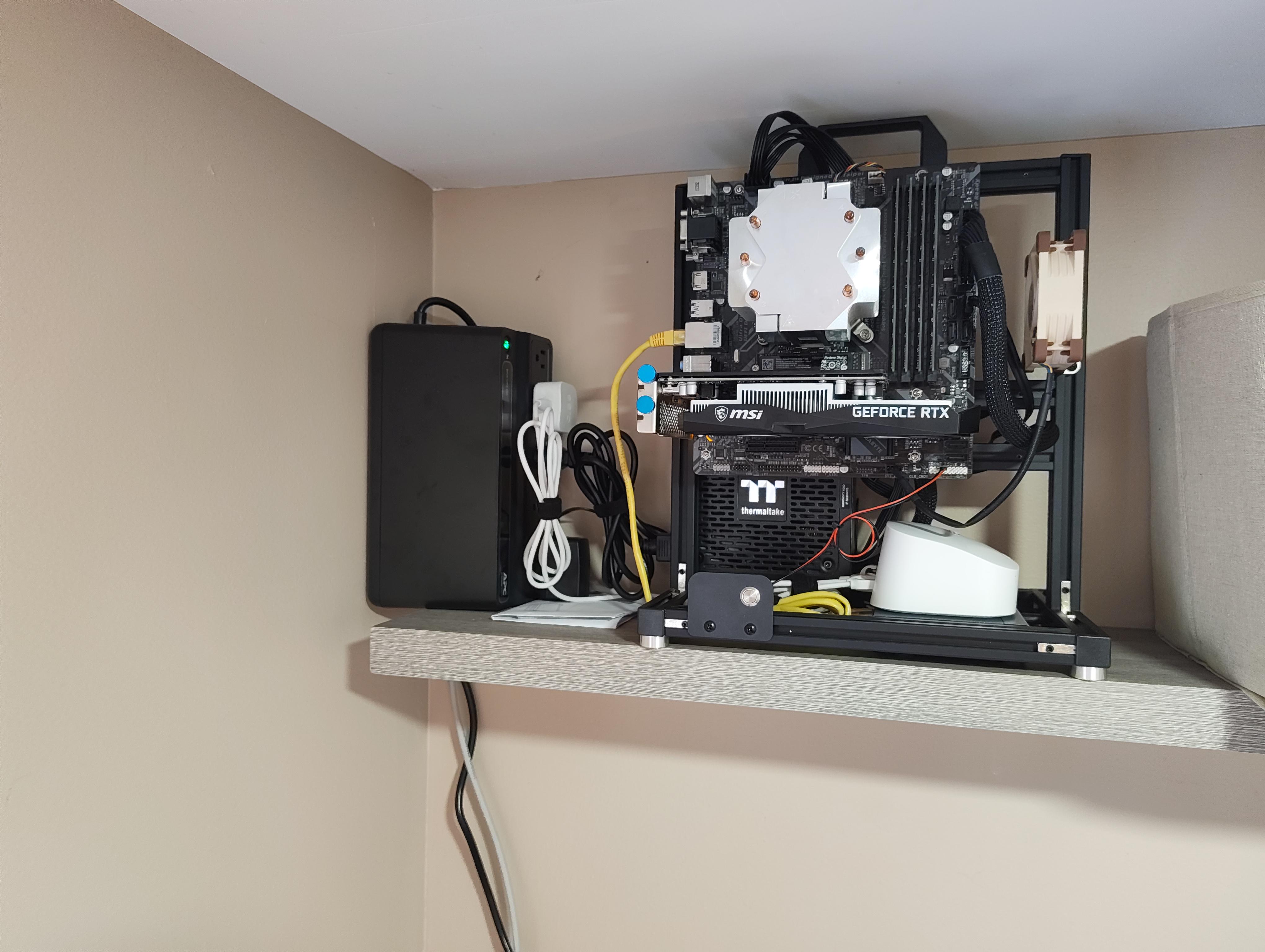
I ended up with an ASUS Pro Q870M-C-CSM (LGA1851 / mATX) and want to use it for my first home server build. I'm pretty new to both LGA1851 and self-hosting in general, so I want to keep things simple and power-efficient from the start.
On the hardware side, I'm looking at pairing it with a 65W Core Ultra 5 (like a 225 or 235) for low idle power and QuickSync, plus some DDR5 and NVMe drives. Since I don't have a case yet and have a 3D printer, I'm planning to print a compact mATX frame or enclosure. As a business board without VRM heatsinks, I know it relies on general airflow across the PCB, so I'm trying to plan fan placement properly in the printed case.
For the OS, instead of adding a hypervisor layer I probably don't need yet, I'm leaning toward running a lightweight Linux distro bare-metal (like Debian or Fedora Server) with Docker or Podman for containers.
A few quick questions for people running similar setups:
For a beginner, would you recommend Debian + Docker or Fedora + Podman/Cockpit for clean management without too many headaches?
Which BIOS settings (C-states, power limits, disabling unused I/O) make the biggest difference for idle power on Q870 boards?
Is Intel AMT/vPro worth setting up for headless management on this board, or is it finicky enough that I should just plan on an external IP KVM like JetKVM down the road?
Appreciate any advice on the hardware pairing or initial setup.
I've been building rynas, a web interface that turns a plain Debian 13 server into a NAS. You install Debian your way, add one package, and manage everything from the browser.
I want to make myself a present for christmas: the GeeekPi DeskPi RackMate T2. I've googled a lot and found different values for the following measurement:
Can someone tell me whether the 212 mm refers to the inside of the tray or to the inner dimension between the two profiles? Or maybe someone who has the rack at home could measure it for me.
Has any of you tried these? 4U, 6U and they come even with 9U for a very good price. As I have no 3D printer I think I am going to get one. I do not want a door or a black panel and i rather put it on my table then on the wall, so these seems to be perfect.
Has anyone here used it? What do you think? Is it okay quality?
Currently my lab isn't ready for two reasons and the first being cooling the mini PC inside, I am prepapring three of them inside of a T1 Plus U8 and from perspective I can see I'll need to install two fan rack (possibly 80mm fan)
The problem I am facing is how to power the fans or is there an alternative solution for my problem? Like maybe using USB powered fans as a rack fan? (Btw I can't use 120V I have to use a step down for it to work)
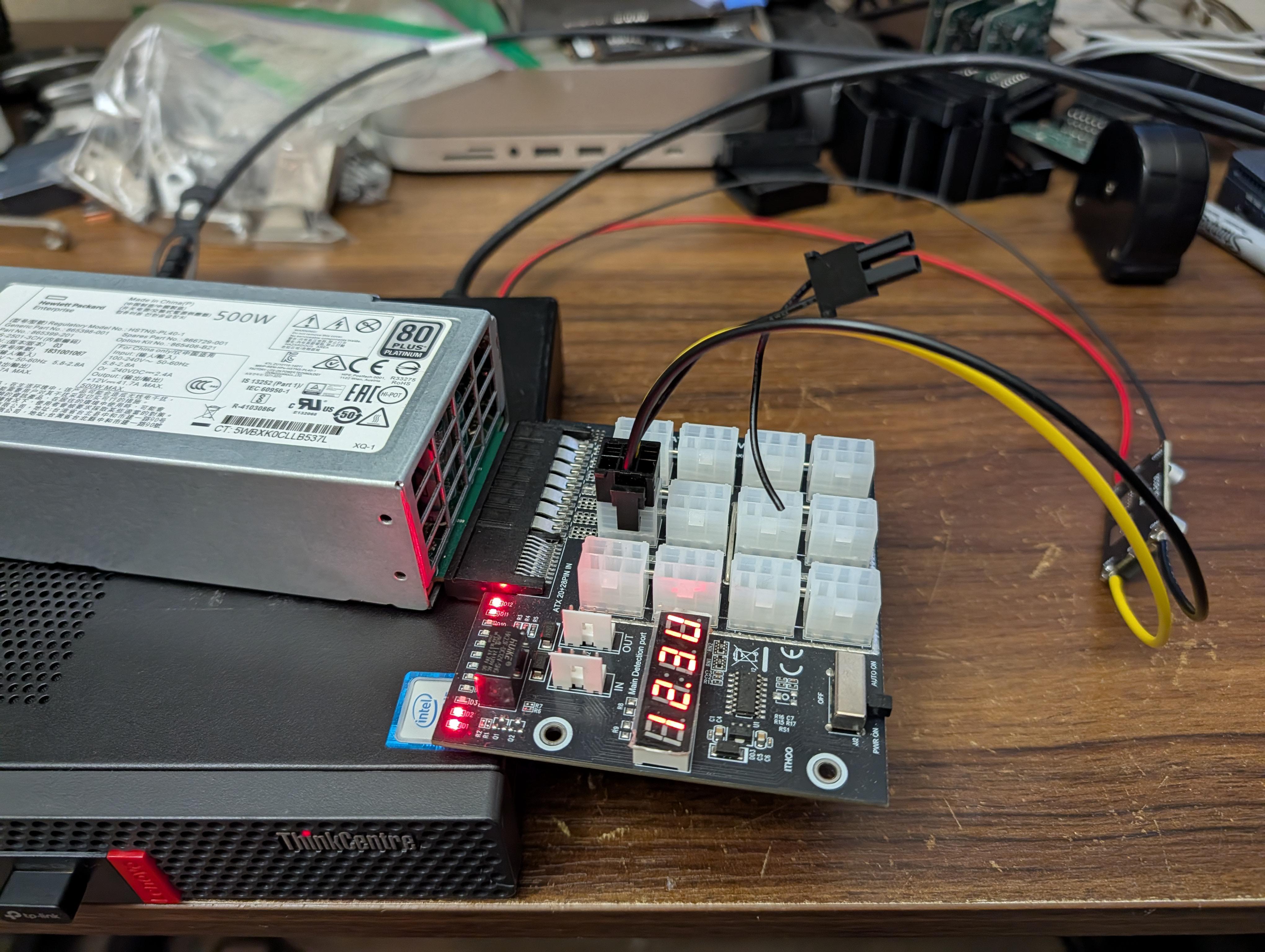
Making a dual HPE 12v hot swappable 500w power supply. Takes up 2U space but will have a power distribution board on the top that will use a combination of barrel jacks and PCIE power 2x3pin plugs. They it will be switchable via mosfets. The microcontroller will be able to get the current reading supplied by each PSU so i can monitor the power supplies. should be good enough to power all my switches and the couple of mini PCs i have along with 4 HDD drives.
this is my first revision. later might switch out the physical fuses with some eFuse chips.
After the last electricity bill I tore the rack apart. What's left is a single N100 mini PC, 9W idle measured at the wall, everything else sold.
Setup: Proxmox, 6 LXC, all with cgroup limits set instead of "just let it run". Jellyfin with QuickSync via /dev/dri and the render group so the CPU isn't doing the transcoding. Immich, Paperless, Vaultwarden, HA, Uptime Kuma. Storage hangs off a USB DAS and is only mounted for the nightly restic run.
Thermals: it stands upright with 2cm of air under the desk, CPU stays under 70°C while transcoding, fan spins audibly but not annoyingly. A 120mm USB fan blows in from the side, quiet enough for the living room since then.
What I miss: nothing. Before this I burned 140W idle for the exact same services, for three people in the household.
What's tight: one PSU, one NIC, one stick of RAM. Backups go to the DAS and an offsite bucket, and I ran a full restore drill before the rebuild, not after.
If you're on the fence: the box cost 180 € and pays for itself in under half a year. Going from four servers to one was the best move I made.
What would you even put on a 9W budget at this point?
I'm pretty new to homelabbing. I first tried in January, but I got lost fast and ended up copy-pasting commands I didn't understand. This time I want to do it properly, so I'd love some advice on how to plan which services run where before I install anything.
the 2 messy pic is my current setup (I'm waiting for some new parts) the nice pic is my old setup, but I didn't understand a single thing about what I had installed
Hardware - Switch: TP-Link TL-SG108PE - Router: Ubiquiti UniFi Cloud Gateway Ultra (no UniFi switch) - Raspberry Pi 5 (1 GB RAM) + 2x 2 TB drives - Raspberry Pi 5 (8 GB RAM) + 512 GB SSD (m2 hat) - Raspberry Pi Zero 2 W - All running Raspberry Pi OS Lite 64-bit
What I want to run - A Minecraft server ? on the 8gb? - Home Assistant - Homelabel - AdGuard Home ? - Tailscale ? - Caddy ? - Docker + Dockge (simpler than Portainer?) - Authelia ? - OpenMediaVault for the two 2 TB drives ?
Are these good choices for a beginner, or would you recommend other apps instead?
Which service would you put on which device?
Any tips for a beginner to avoid ending up with a mess like last time?
Build: four Pis on slide-out drawers (custom fit to the various Pis - 3B, 3B+, 4 and Zero in this build) and a PoE switch to power everything on its own shelf. Everything fits in one 10" unit printed in PLA on a P1S. Build details and what it runs are in my r/homelab post: here
Future Growth: I designed the build on Bayforge.app, a free Pi-rack generator I’m working on, which designs fully modular racks. The rack ears (not in these photos) print a piece per U and the rear hood a piece per row. When I add my next Pi, I can print the new row and add it on top, so nothing I’ve already printed becomes obsolete. I’ve also tried to make maintenance and upgrades less fiddly: there are optional clip-in parts and pull-out pins (for the fans, for example) in place of some of the screws and nuts.
No rack: as you can see, I don’t have a rack to fit this into yet. The generator produces a frame too, and that will be my next upgrade. I’m planning a fully printed one for this 10" build, but it also supports printed corners on 2020 extrusion for heavier or 19" builds.
Last picture is the exploded preview from the app, which shows how everything fits together.
Any must-have additions I should make sure the generator supports?
Making a dual redudnant PSU addon for my 12V mini lab. but one thing i always ran into issues is powering my 1L lenovos. since the power input is 20V. Recently tested these "high efficiency" modules to boost a 12v to 15/20/30V. and it seems to be working great even under load for on a 8500 (non T). A dual Connectx 4 card. On fedora 44 idles at about 22w (wall meter), and low C state to about 5W. Did sustained loads of about 100W and it gets warm but not hot in open air with no fans. I will do long term testing but this seems to be promising for those of us who use 12v for power.
Hey all, posted this project to a few subreddits like r/diyelectronics and r/hwstartups and then r/homelab had people there suggest to post here, as minilabs need a programmable power supply too, not just live music rigs.
My biggest question as you read the description below: For your homelab/minilab, how many power channels would you need? Max voltage / current needed? Total power available to a rack? 10" or 19" or the current form factor as-is? Would you want multiple USB-C PD Source ports? If so, what power negotiations for each? 30W? 60W? 100W? more?
From the r/homelabcomment thread, the consensus seems to be trending towards the following desired specs:
1U, 10" rackspace DC PDU, approx ~200mm wide by ~200mm deep by 44mm tall
600W total power available
~6 barrel jacks with programmable voltage, polarity, and current-limit (preferably 4 of them able to source up to 140W for power-hungry mini PCs)
~6 USB-C PD ports, so if your equipment already supports this as a power delivery mechanism, or you've already invested in USB-C->barrel converter cables, you're good to go (though several have said that some cables here are hit-or-miss).
Optionally, a second 1U UPS setup that is basically a big smart battery that connects to the PDU and can handle outages.
(Quick aside: It's funny there's interest here, as the product we designed before this was a NAS specifically for audio professionals. Unfortunately the RAM/NVMe shortage and pricing killed that project for the time-being, so we moved to this as our next product. But we're no strangers to homelabs, two of us running clustered Proxmox setups in our homes, and we self-host much of our internal infrastructure.)
Description from the prior posts below:
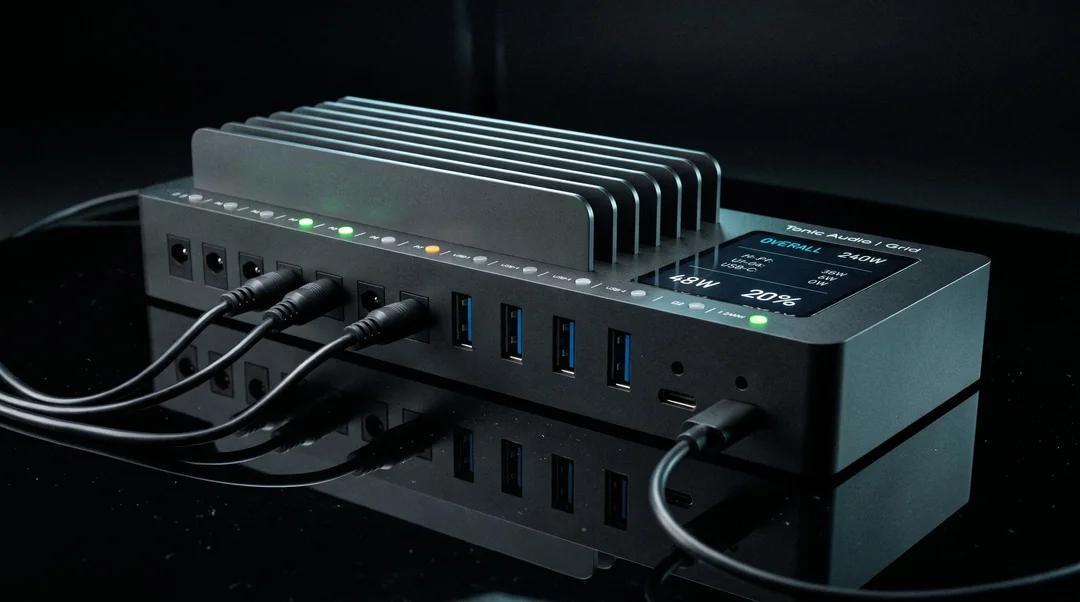
I got so tired of the pile of wall warts and power strips for my music gear, I'm building a programmable power supply: 7 isolated DC channels with barrel jacks: configurable voltage, polarity, and max current settings. Also a four port USB hub, and a 100W USB-C charge port for a laptop or tablet. With all of it powered by a single USB-C power brick like you use for your laptop today.
I have a music solo act where I play live, and had some close calls with unplugged power bricks during soundchecks. I finally had it and started asking around on popular forums on how the heck other people solved this.
Most the answers I got was the same approach I already took, or a me-too-wish-this-existed response. So started designing it.
It's still in the early stages (thus the renders), but the first pass of the enclosure is designed. Have the main layout done. Now getting the first critical path board fabbed and shipped here in the next week.
Grid enclosure in FreeCAD, ready for first article CNC milling
Also trying something a little different with this product by designing it in the open, with weekly videos tracking how the product development is going, both the wins and the setbacks. It's kinda scary to develop like this as it's very vulnerable, but it's also awesome to share with others how our tiny team goes about building new products.
I'll aim to post here regularly with updates if there's interest. Otherwise we'll be posting updates on the blog at https://tonicaudio.com/blog and via YouTube: https://youtu.be/9xP5pFiPCFk . If you're interested in following along with this project outside of Reddit, the mailing list signup link is here: https://grid.tonicaudio.com.
(Mods: if these links are against the rules, please let me know and I'll remove them. Def not trying to be spammy!)
- Lenovo 2 (Home Assistant & AdGuard) (AG not yet)
- Ugreen NAS (Docker, Jellyfin, Immich, Navidrome, Backups, KX Bridge,...)
Still waiting for a few parts, but everything is up and running. Once all my orders are here, I have to do some cable management.
M75Q (Lenovo 1) runs Bazzite with some light games (hades 2, ori,...) directly on it. For heavier titles, I use Sunshine / Moonlight to stream from my gaming PC.
It's my first setup and everything works surprisingly well. Still, I'm open & gratful for input and suggestions.