r/vocabulary • • 1d ago

Sunday Vocabulary Marketplace Sunday Vocabulary Marketplace - November 22, 2026

3 Upvotes

This weekly self-promotion thread is the place for content creators to compete for our attention in the spirit of capitalism. Tell us about your vocabulary app/blog/video/podcast/etc.

The rules:

  • Top-level comments should only be from creators/authors/bloggers/whatever who want to tell us about their content. This is their place. Creator/promoters may post one top-level comment per weekly thread.
  • Content should be relevant to the goal of increasing English vocabulary. Non-relevant content will be removed under Rule 2: Discussions must be on-topic.
  • Discussions of, or questions about, the content being promoted get free rein as sub-comments.
  • Link shorteners will not be allowed and any link-shortened comments will be removed until the links are fixed.
  • If you are not the actual content creator but are posting on their behalf (e.g. ‘My sister created this awesome vocabulary app’), this is the place for you as well.
  • If you found something great that you think needs more exposure but YOU HAVE NO CONNECTION TO THE CREATOR, the Marketplace is not the place for you. Feel free to make your own thread, since that sort of post is the bread-and-butter of r/Vocabulary.
  • Marketplace comments must adhere to all other subreddit rules. Self-promoted content will be allowed in the Marketplace thread only.

More information on r/Vocabulary's self-promotion policy is here.


r/vocabulary • • 2d ago

New Words November 21, 2026: What New Words Have You Learned?

8 Upvotes

What new words have you learned? Did you learn them here or from another source? Maybe a book you read or a magazine or a website, or school, or in a conversation?

You are free to create a separate post with your new word(s) but if you're short on time you can leave them here in a comment. Please include definitions for your new words so others can learn them too.

This post will be renewed every ten (10) days, so come back here whenever you have a word to share.

If you are a new word lover here – Welcome!


r/vocabulary • • 8m ago

New Words Word of the day: Dilatory

Post image
6 Upvotes

Dilatory means to cause delay or intended to gain time; slow to act, often deliberately so.

Origins

From Latin 'dilatorius,' from 'dilator' meaning one who delays, from 'differre' meaning to postpone or carry apart.

Interesting fact

In legal contexts, a 'dilatory plea' is a formal delaying tactic a motion filed not to win a case but simply to buy more time. Courts can impose sanctions if they determine a party is being dilatory in bad faith.

Common misuse

Often confused with 'desultory' (aimless, unfocused). Dilatory specifically implies deliberate slowness or delay, not randomness.


r/vocabulary • • 1d ago

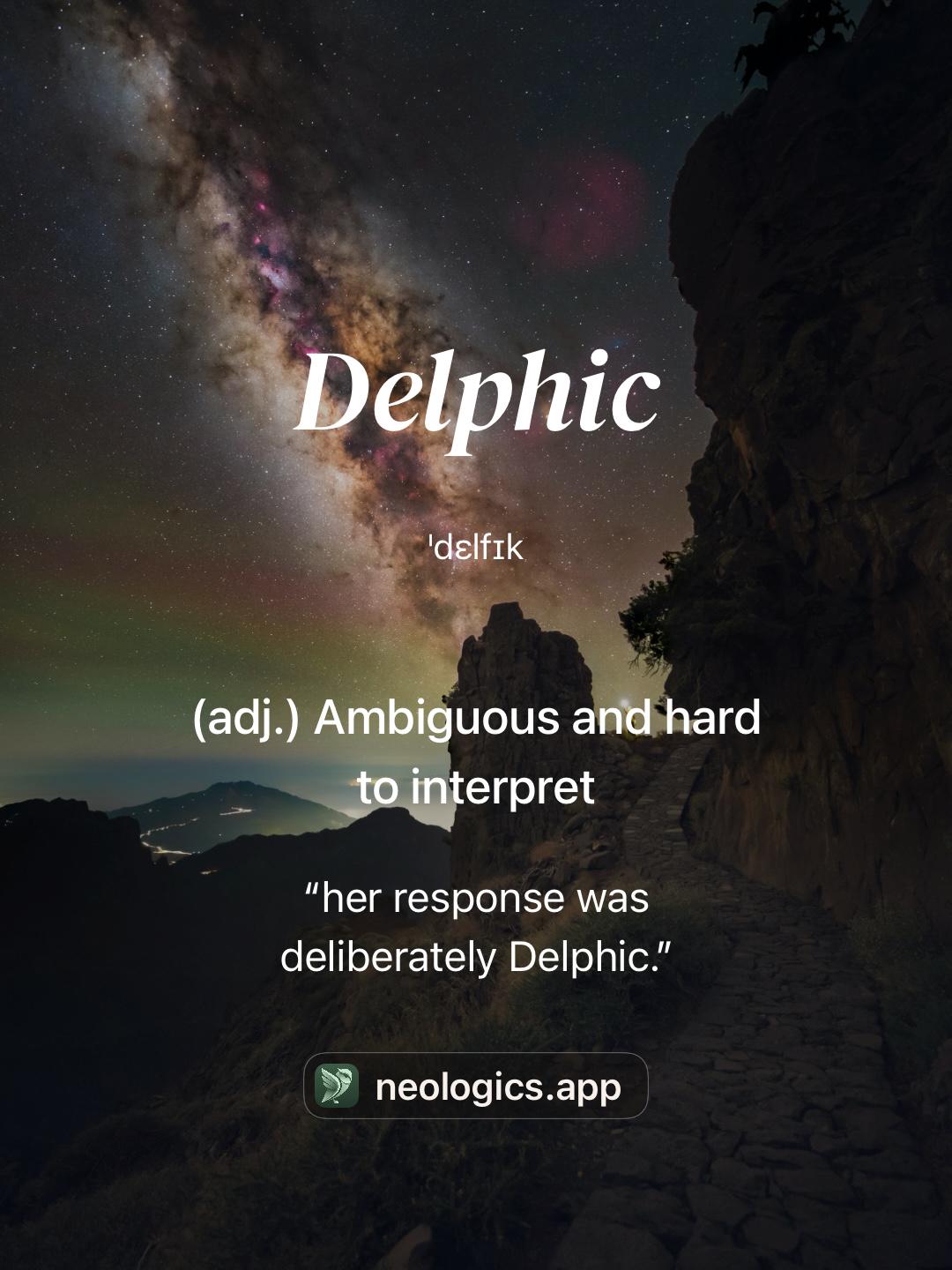
New Words Word of the day: Delphic

Post image
270 Upvotes

Delphic means deliberately obscure or ambiguous, especially in a way that seems to conceal deeper meaning; resembling the cryptic pronouncements of the ancient Oracle at Delphi.

Origins

From Delphi, the ancient Greek sanctuary on Mount Parnassus where the Pythia delivered famously ambiguous prophecies. The site was considered the center of the world by the ancient Greeks.

Interesting fact

The most famous delphic prophecy was given to King Croesus of Lydia, who asked whether he should attack Persia. The Oracle replied that if he did, a great empire would be destroyed. Croesus attacked and it was his own empire that fell.

Common misuse

Sometimes used to mean simply 'wise' or 'prophetic.' The key connotation of delphic is deliberate ambiguity wisdom wrapped in riddles, not clear-eyed prediction.


r/vocabulary • • 21h ago

New Words "Not my bailiwick" is my favorite way to turn down a job, because it never says whether I can't do it or I'm not supposed to

Post image
99 Upvotes

"Not my bailiwick" gets me out of things without explaining why, and I think that's down to where the word sits among these six.

At one end are the words about you. An aptitude is natural, so "I have no aptitude for spreadsheets" gets you out of the spreadsheet for good, which is either honest or very convenient. Expertise is learned, so "not my area of expertise" leaves room to pick it up later. A niche is the spot that fits you. In the 1610s it was a shallow recess in a wall, the kind a statue stands in, and the figurative sense is recorded by 1725.

At the other end the reason stops being about you. Jurisdiction comes from Latin iuris dictio, literally a saying of law, and when it entered English in the early 1300s it meant the administration of justice. I mostly hear "not my jurisdiction" as a joke, in a TV-cop voice. Purview was a legal word too. In the 1400s it meant the body of a statute, from Anglo-French purveu est, "it is provided," the phrase old statutes opened with. The broader sense of scope is attested by 1788, in Madison's Federalist, and the spelling drifted toward view. "Outside my purview" still sounds like somebody checking a rulebook.

Bailiwick started on the authority side. In the mid-1400s it was a bailiff's district, the patch a royal officer or under-sheriff answered for: bailiff plus wick, an Old English word for a village, borrowed early from Latin vicus. Etymonline has the figurative sense, "one's natural or proper sphere," by 1843. Dictionaries now give it as an area of expertise or authority, both in one word. So when I say a job isn't my bailiwick, it sounds like I'm pointing at a boundary, when I might just mean I have no idea how to do it. Nobody ever asks which.

Where would you put wheelhouse on this line? My guess is pure ability, since nobody has a wheelhouse they're bad at, but I'm not sure it never means turf.


r/vocabulary • • 1d ago

New Words Underrated word of the day: Cajole

64 Upvotes

When you cajole someone into something, you persuade them into doing so, although you do it by gentle persuasion like flattery or urging. You're coercing or strong-arming them, you're coaxing them into doing something, especially if that person is reluctance. Cajoling someone usually involves deliberate flattery, sweet-talking, or teasing. It can come off a bit pushy or manipulative from the person on the receiving end. She cajoled her boyfriend into buying a new perfume for her with some light flirtations.


r/vocabulary • • 1d ago

Daily vocab is useless if I never have to use the word

3 Upvotes

The writing games in the Elevate app are where you cut a sentence down is actually really good practice.

"Due to the fact that we are currently in the process of reviewing the document, we will be able to get back to you at a later time."

Got this one down to 12 words ^^^ Curious what you would cut? I want to see if we get to the same answer!


r/vocabulary • • 1d ago

New Words I'd call a battlefield hallowed and a temple sacred, and Lincoln explains the difference better than the dictionaries I checked

Post image
67 Upvotes

Hallowed (adj.): revered, consecrated.

On paper, hallowed and sacred are one idea in two languages. Hallowed is the past participle of hallow, from Old English hālgian, "to make holy." Sacred is a past participle too, of a Middle English verb sacren that came through Old French sacrer from Latin sacrare, built on sacer, "holy." Both literally mean "made holy."

Where they split, as far as I can tell, is who did the making. Sacred usually points at a god or a rite: sacred texts, the sacred cow nobody is allowed to touch. Hallowed leans toward places people have revered for a long time. Hallowed ground, the hallowed halls of a university, the hallowed turf of an old stadium. A stadium earns that from what happened on the pitch, not from a blessing.

In the Gettysburg Address, Lincoln says the people gathered there can't dedicate, consecrate or hallow the field, and then: "The brave men, living and dead, who struggled here, have consecrated it." The dead had already done it. That's the sense I hear in hallowed ground.

The other place most of us meet the word is the Lord's Prayer, and there it isn't an adjective. "Hallowed be thy name" is the verb in a wish: let your name be treated as holy. It doesn't claim the name already is.

The noun survives as well. A hallow was a saint, which is where Halloween comes from: All Hallows' Eve, the night before All Saints' Day.

Hollowed, with an o, is a separate word from hollow and means scooped out. Hollowed ground would be ground somebody dug out, which is an odd thing to call a battlefield.


r/vocabulary • • 1d ago

New Words Underrated phrase of the day: Hedge Your Bets

6 Upvotes

To hedge your bets means to reduce the risk of making a mistake by keeping your options open. By supporting more than one possible result and covering your bases, you prevent a great loss or failure if the desired outcome does not come to fruition. You're playing it safe by pre-empting, essentially. I was able to hedge my bets by saving my money rather than spending it all outright.


r/vocabulary • • 2d ago

New Words A Word which touched me deeply

15 Upvotes

I have recently came across a word “Seelenschmerc”
which means “pain of soul”.
And I was sitting quietly for a while after discovering this word.


r/vocabulary • • 1d ago

New Words I am planing to learn new new English words ie that r not been used regularly but as a part of vocabulary development also u ppl help me out by dropping ur rare words with there meaning (hoping only good words come)

0 Upvotes

r/vocabulary • • 3d ago

New Words Word of the day: Sangfroid

Post image
197 Upvotes

Sangfroid means cool, unflappable composure and self-possession in the face of danger, crisis, or extreme pressure, suggesting an almost preternatural calmness.

Origins
From French 'sang-froid,' literally 'cold blood,' from 'sang' (blood) + 'froid' (cold); adopted into English in the mid-18th century to describe a distinctly French ideal of unruffled composure

Interesting fact
The concept of sangfroid became a celebrated cultural ideal in 18th-century France, where aristocrats prided themselves on maintaining perfect composure even at the guillotine during the Revolution.

Common misuse
Sometimes confused with indifference or callousness, but sangfroid implies deliberate emotional control under pressure, not a lack of caring.


r/vocabulary • • 2d ago

New Words I'll admit to a lie-in and own up to goofing off, but I've never heard anyone describe their own job as a sinecure

Post image
69 Upvotes

The card lines up six ways of not working, from no guilt at all to the kind other people resent. Sinecure sits at the far end, and its history is most of the reason.

It started as a church word. The Medieval Latin was beneficium sine cura, a benefice "without care," and the care meant the cure of souls, the parish duties a benefice normally came with. Etymonline's first English sense, from the 1660s, is "church benefice with an emolument but without parish duties." That's the same cura behind curate, the clergyman responsible for that care. So the first sinecure holders drew the income with no parishioners to look after. Nice work if you could get it. The general sense, any paid post with little or no work, grew out of that.

The other five are about what you do with your own time, and the guilt climbs as you go.

Nobody apologizes for a lie-in. While away is gentle enough to have picked up a rival spelling: Etymonline dates the verb to the 1630s, from while, "a span of time," and quotes the OED saying that associations with phrases like "beguile the day" led some writers to substitute wile. Wile in that sense is attested by 1796. While is the older form, but wile has been around long enough that I wouldn't correct anyone for it. Veg out is recent, by 1985, short for vegetate, and I nearly always hear it announced in advance, as a reward: I'm going to veg out tonight.

Goof off is where it turns into a confession. It started as World War II service slang in 1941, "to make a mistake at drill," and by 1945 it meant to loaf. People say it about themselves a little sheepishly, which tells you there was something else they were supposed to be doing.

Shirk has a shady past. In the 1630s it meant "to practice fraud or trickery, live by one's wits," and the noun was "a needy, disreputable parasite." The work-dodging sense grew out of an older one, to slink or sneak away, and isn't recorded until 1785. Where the word came from is uncertain. Etymonline's guess, with a "perhaps" in front of it, is German Schurke, "scoundrel." I can say "I goofed off all afternoon" without flinching. "I shirked" sounds like I'm reading out my own charge sheet.

A sinecure is different because nobody in it is dodging anything. The not-working is built into the post, so the resentment lands on the arrangement as much as on the person. That might be why I've only ever heard the word used about someone else's job.

Has anyone here heard a person call their own job a sinecure? I'd like to know whether it was a joke or a boast.
r/vocabulary • • 2d ago

New Words Underrated phrase of the day: Silver Bullet

30 Upvotes

Figuratively speaking, a silver bullet is a simple solution to a complicated problem. It's the direct or immediate solution that solves a long-standing issue or difficult problem. In the same way a silver bullet can defeat supernatural creatures, a silver bullet is very much a magical cure-all solution. The silver bullet answer to racial injustice isn't simply to just fire all racist cops who seek to use their authority for their own gain, we must strike at the justice system and various other institutions that seek to protect and empower such individuals in the first place.


r/vocabulary • • 2d ago

New Words Plankton's effort to cozen SpongeBob into divulging the secret formula was of no avail.

Thumbnail gallery
20 Upvotes

r/vocabulary • • 2d ago

My Palette of Words

7 Upvotes

Words are the palette which a writer paints the scene; the fifty shades of grey expressed by ‘grey matter’ that occupies those scant few inches between the left and right ear. Words express thoughts and opinions with clarity and precision. Synonyms, antonyms, homonyms, idiom and jargon, metaphor and simile; these are the tools of the trade for the writer. Words convey meaning; they express the subtlety and nuance of what we think. Somewhere in the past we discovered we needed more words; larger, more precise than before. Rather than the blunt edge of a dull axe, words are a scalpel in the hands of a skilled writer. Properly marinated, vocabulary enhance the entrée in the cuisine of language; it adds a savory nuance that accents what would otherwise leave the buffet line of literature an unpalatable assortment of bland and tasteless offerings to be chewed without flavor.

At some point we, the collective mass of humanity, realized the art of communication required more than the few monosyllabic utterances and wild gesticulations made by our inarticulate predecessors. So being the enterprising hominids we suppose ourselves to be, mankind expanded his vocabulary somewhere along the trek, from the primitive to the modern. And so I, after 6,000 years of recorded human history, am reluctant to eviscerate the English vocabulary in lieu of words with less meaning.


r/vocabulary • • 3d ago

New Words A respite is something you can take. A reprieve usually has to be given to you by someone who could have said no.

Post image
277 Upvotes

The test I use is who's in charge. You can take a respite on your own: step out of a loud party, sit in the car for ten minutes before going back into the family dinner. A reprieve usually gets handed to you. A governor reprieves a prisoner, a council reprieves the library it was about to close. Somebody had power over what happened to you and decided to hold off.

That's why reprieve feels heavier to me. In law it postpones a sentence rather than cancelling it (cancelling would be a pardon), so the relief comes with the decision still standing. A respite has no verdict behind it. The noise will come back, but nobody ruled that it should.

It isn't airtight. One of Merriam-Webster's example sentences has visitors finding "a peaceful reprieve from the bustling casino floor" among some flower displays, and nobody granted that. Even there the word borrows a little courtroom, which I suspect is why writers pick it when they want a break to sound narrowly won.

The history is the part I didn't expect: reprieve took over a job respite used to have. Respite is the older word, mid-1200s, from Old French respit, from Latin respectus "regard, consideration," literally "a looking back," the past participle of respicere: re- "back" plus specere "to look," which traces to the root *spek- "to observe." So it's a doublet of respect. Its first English sense was legal, an extension of time or a postponement of judgment, and by the early 1300s you could respite a condemned man, meaning spare him from death for now. My guess is that the path ran from giving a case consideration to giving it more time, but that's my reading, not the dictionary's.

Reprieve didn't take on that meaning until the 1590s. It shows up in the 1570s as reprive, "to take back to prison," from Middle English repryen "to remand," probably from French repris, the past participle of reprendre "to take back" (Latin reprehendere, "to hold back"). Etymonline's explanation for the jump is that being sent back to prison was the alternative to being executed. The -ie- spelling only settled in the 1640s, maybe by analogy with achieve, and Merriam-Webster thinks the v came from blending with an old verb repreve, "to reprove." Reprehendere goes back to a root meaning "to seize," which also gave us prison, so the word was never far from a cell.

Calling your lunch break a reprieve makes your job sound like a death sentence. Some days that's accurate.


r/vocabulary • • 4d ago

New Words Word of the day: Demur

Post image
157 Upvotes

Demur means to raise doubts or objections; to show reluctance or hesitation about accepting something.

Interesting fact:

In law, a 'demurrer' is a formal objection arguing that even if all the opponent's facts are true, they still do not constitute a valid legal claim. It challenges the legal sufficiency of an argument without disputing the facts a pure exercise in philosophical reasoning within the courtroom.

Common misuse:

Frequently confused with 'demure' (meaning shy or modest). To demur is to object or hesitate; demure describes someone's reserved manner. They sound alike but have entirely different meanings and origins


r/vocabulary • • 3d ago

New Words Underrated word of the day: Impertinent

55 Upvotes

If someone calls you impertinent, they're calling you rude, but it doesn't imply malicious intent. It's usually because you've overstepped your boundaries, like if you try to correct a grownup on a mistake. It can very much to anyone of higher status than you. A student tried to correct their teacher of a spelling error which resulted in them receiving a lecture on their impertinence.


r/vocabulary • • 3d ago

Do you ever discover a word that makes you wonder how you’ve never heard it before?

6 Upvotes

I've always found it interesting how many words and expressions we use every day without really thinking about them.

Recently, I've been working on a little project around discovering words while typing, and it got me curious.

Do you guys enjoy discovering unusual words and expressions? Or is that just me? 😅


r/vocabulary • • 3d ago

New English Word

5 Upvotes

existential
/ˌɛɡzɪˈstɛnʃl/
Existential (adjective) means relating to existence, especially human existence, or to the philosophy of existentialism. It can also describe something grounded in lived experience or affecting a person's or group's continued survival. [1, 2, 3, 4]

Core Meanings
Existence & survival: Having being in time and space, or threatening continued existence (such as an existential threat or risk).

Existentialism: Relating to the philosophy—associated with thinkers like Søren Kierkegaard, Jean-Paul Sartre, and Albert Camus—that centers on individual freedom, choice, responsibility, and finding meaning in an indifferent or absurd world.

Lived experience: Derived from direct experience rather than abstract theory or pure logic. [1, 2, 3, 4, 5]

Usage Examples
Existential crisis: Deeply questioning your purpose, identity, or life choices.

Existential threat: A danger severe enough to endanger survival or fundamentally alter a way of life, such as climate change, nuclear war, or advanced AI.

Existential dread / angst: Unease or anxiety about mortality, freedom, and the meaning of life. [1, 2, 3, 4, 5]

Related Terms & Synonyms
Depending on the context, related terms include experiential, empirical, existentialist, and existentialism.[1, 2]

Would you like more example sentences, a deeper look into existentialist philosophy, or synonymsfor a specific context?


r/vocabulary • • 4d ago

New Words Underrated word of the day: Doldrums

50 Upvotes

When someone is in the doldrums, their in a state of listlessness or despondency. They're in a period of inactivity, stagnation, or slump but it can just as easily refer to someone just being depressed, despondent, boredom, or low spirits. After breaking up with my girlfriend, I was just in the doldrums.


r/vocabulary • • 3d ago

Question If a committee tables a proposal, does it go on the agenda or come off?

2 Upvotes

Say your town is thinking about putting lights in the park. You bring an electrician’s estimate to the meeting. Halfway through, the chair says, “Let’s table the proposal.” Do you pass the estimate around or put it back in your bag?

Cambridge gives two meanings for the verb. In British English, someone who tables a proposal formally puts it forward for discussion. It could still be discussed next week. In American English, someone who wants to table it is usually asking to put the discussion off.

With an estimate in my hand, I’d probably just ask, “Do you want the numbers now or should I bring them next time?”

What does “let’s table it” mean where you work or live?


r/vocabulary • • 3d ago

Question Need to take a poll on the word ‘Fortified’

5 Upvotes

One of my very best friends contacted me and described an incident in which she gave her daughter some food or something to eat, and then asked her “do you feel fortified? This is not verbatim, I was far too baffled as to why she’s using a word that should be limited to marketing tactics.
Just to make sure I didn’t hear incorrect, I asked her, did you just use the word fortified? And she confirmed yes, she did.

She also attempted to gaslight me into thinking that it’s super common. May I get the opinion of the hive mind please?