r/vocabulary • • 2h ago

New Words Underrated phrase of the day: Not my Speed

5 Upvotes

If something is not your speed, it’s not really your thing. It doesn’t suit your tastes, interests, character, or skill level. It’s not your cup of tea, thing, vibe, or in your wheelhouse. I opted out of going to my high school prom. They’re not really my speed.


r/vocabulary • • 20h ago

New Words Underrated word of the day: Denigrate

37 Upvotes

To denigrate someone is to unfairly attack someone's reputation or cast aspersions on them, regardless of their veracity. It's slander, to put it simply. Denigrating someone by disseminating disquieting information is only one usage of the word, however, as denigrating someone or something can also involve diminishing their value or importance by making their feats or exploits feel less significant than they actually are. He may have had questionable morals in life, but that's no reason to denigrate his achievements.


r/vocabulary • • 20h ago

My current word hyperfixation

Post image
266 Upvotes

Turns out I was mispronouncing it for about a week 😂😂😂


r/vocabulary • • 5h ago

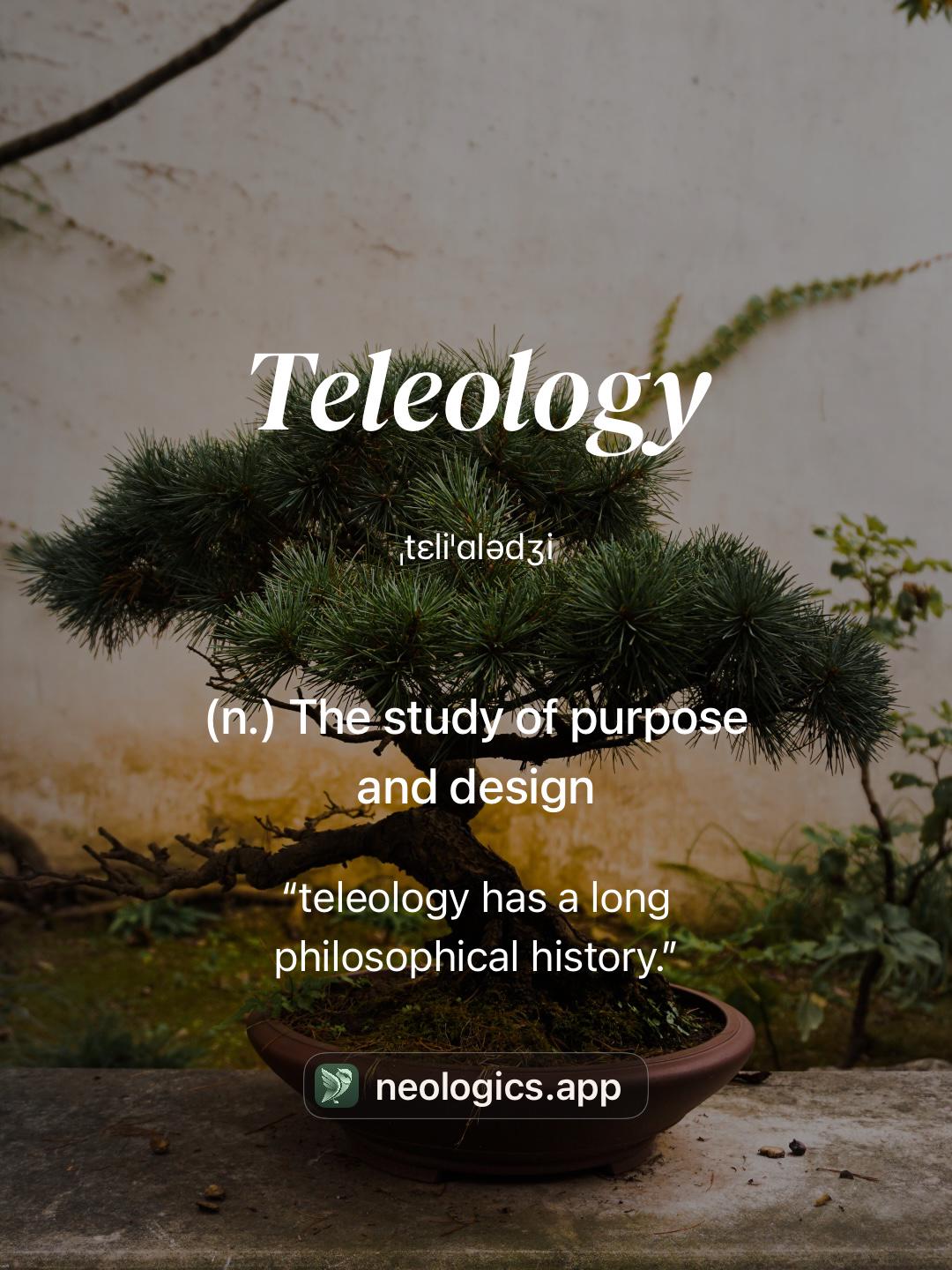
New Words Word of the day: Teleology

Post image
57 Upvotes

Teleology means the philosophical study of design, purpose, and final causes in nature; the explanation of phenomena by the purpose they serve rather than by prior causes.

Origins
From Greek 'telos' (end, purpose, goal) + 'logos' (study). Aristotle was the first to develop a systematic teleological framework with his concept of 'final causes.'

Interesting Fact
The 'teleological argument' for God's existence (argument from design) was famously critiqued by David Hume decades before Darwin, using the analogy that we wouldn't attribute design to a poorly built ship.

Common Misuse
Often confused with theology. Teleology is the study of purpose and design in nature; it can be secular. Not all teleological arguments are religious.


r/vocabulary • • 7h ago

New Words Underrated phrase of the day: Like Herding Cats

33 Upvotes

If you say something is like herding cats, you're saying something is extremely difficult to do. Specifically, it refers to trying coordinate, organize, or guide people things that are unruly, act independently, or uncooperative. It's a reference to how herding cats in real life is incredibly difficult since they love to act independently and do their own thing. The substitute teacher had the impossible task of having to manage this unruly group of children while the main teacher was away to see about an important family matter, but this was like herding cats.


r/vocabulary • • 7h ago

New Words Underrated word of the day: Lapsed

3 Upvotes

If you're lapsed, you're no longer participating in an activity or associated with an organization anymore. This can to other stuff too like a religion, belief, obligation, position, etc, but this can also apply to stuff like licenses, subscriptions, contract, agreements, etc. If your subscription for Netflix expires before you can renew it, then it is a lapsed subscription. If you stop practicing Christian, then you're a lapsed Christian.


r/vocabulary • • 18h ago

New Words Underrated phrase of the day: Better the Devil You Know than the devil you don't

4 Upvotes

This phrase is used when you think the more sagacious option is deal with someone or something familiar, although that decision isn't particularly desirable, than to deal with the unknown. It's better to deal with a difficult situation or person you know rather than risk an unknown alternative that could be worse. It's a lesser of two evils affair. It's better to stay with my current drug dealer than try to branch out and find someone else. After all, you never know what they could try and sell you.


r/vocabulary • • 38m ago

La palabra "intenso/a" usada eufemísticamente

2 Upvotes

En los últimos años se ha puesto de moda decir que una persona es "intensa" para no afirmar abiertamente que es pesada, agotadora o incluso insufrible o que tiene una excesiva dedicación a su algo (trabajo, estudios, ciertas relaciones).


r/vocabulary • • 21h ago

New Words Underrated phrase of the day: Cast One's Lot With

4 Upvotes

When you cast your lot, you join or become associated with a person, group, or thing in the hopes of winning or succeeding, although it should be noted that you accept whatever fate befalls the team you join with. You share both the fortune as well the misfortunes of the group you align with. After enough bickering, I decided to cast my lot with the opposing team.


r/vocabulary • • 58m ago

New Words Six ways to be stuck, sorted by where the trouble sits: a quandary is in your head, a dilemma is in the options, and embroil means it was somebody else's argument first

Post image
7 Upvotes

Sorting these by where the trouble sits is the only way I've managed to keep them apart.

Quandary puts it in your head. You haven't worked out what you want yet. Nobody knows where the word came from: Etymonline dates it to the 1570s, calls it "a word of unknown origin", and offers a guess with a "perhaps", a mock-Latin coinage on quando, "when?". I hope the guess is right. "When, though?" is pretty much what a quandary sounds like from the inside.

Dilemma puts it in the options. It started as a term of Greek rhetoric, di- "two" plus lemma "premise, something taken": an argument that hands your opponent two conclusions, each of which wrecks their own position. The strict use still wants two choices, both bad, the horns of a dilemma. The card says "two or more alternatives", which is how most people use it now, and I wouldn't fight anyone over the extra option. Calling every problem a dilemma is where I'd draw the line.

Embroil puts it in somebody else's fight. It arrived around 1600 from French embrouiller, en- "in" plus brouiller "to confuse", from Old French brooillier "to mix, mingle". Etymonline traces that, with a "perhaps", to breu "broth", which would take it back to a root for boiling. The quarrel sense turns up around 1610. Imbroglio is the Italian cousin.

Entangle puts it in the ties. Nobody planned anything; things got wound together, and now pulling on one moves the others.

Ensnare is the opposite, because someone meant it. A snare was a noose for catching animals, from Old English snearu and Old Norse snara, related to words for cord and twisted rope, and it has meant "anything by which one is entangled" since about 1300.

Quagmire puts it in the ground, where every move sinks you a little more. A quag was a shaking bog, from an Old English root meaning "shake, tremble", and mire is mud. The "inescapable bad position" sense is recorded by 1766 but seems to have been rare through much of the 1800s. American English brought it back in 1965 for stalled military campaigns, Vietnam above all; David Halberstam's book that year was The Making of a Quagmire.

Entangle and embroil still overlap more than I'd like, so if you sort these differently I'd like to hear how.