r/vocabulary • • 6d ago

Sunday Vocabulary Marketplace Sunday Vocabulary Marketplace - November 22, 2026

8 Upvotes

This weekly self-promotion thread is the place for content creators to compete for our attention in the spirit of capitalism. Tell us about your vocabulary app/blog/video/podcast/etc.

The rules:

  • Top-level comments should only be from creators/authors/bloggers/whatever who want to tell us about their content. This is their place. Creator/promoters may post one top-level comment per weekly thread.
  • Content should be relevant to the goal of increasing English vocabulary. Non-relevant content will be removed under Rule 2: Discussions must be on-topic.
  • Discussions of, or questions about, the content being promoted get free rein as sub-comments.
  • Link shorteners will not be allowed and any link-shortened comments will be removed until the links are fixed.
  • If you are not the actual content creator but are posting on their behalf (e.g. ‘My sister created this awesome vocabulary app’), this is the place for you as well.
  • If you found something great that you think needs more exposure but YOU HAVE NO CONNECTION TO THE CREATOR, the Marketplace is not the place for you. Feel free to make your own thread, since that sort of post is the bread-and-butter of r/Vocabulary.
  • Marketplace comments must adhere to all other subreddit rules. Self-promoted content will be allowed in the Marketplace thread only.

More information on r/Vocabulary's self-promotion policy is here.


r/vocabulary • • 7d ago

New Words November 21, 2026: What New Words Have You Learned?

11 Upvotes

What new words have you learned? Did you learn them here or from another source? Maybe a book you read or a magazine or a website, or school, or in a conversation?

You are free to create a separate post with your new word(s) but if you're short on time you can leave them here in a comment. Please include definitions for your new words so others can learn them too.

This post will be renewed every ten (10) days, so come back here whenever you have a word to share.

If you are a new word lover here – Welcome!


r/vocabulary • • 1h ago

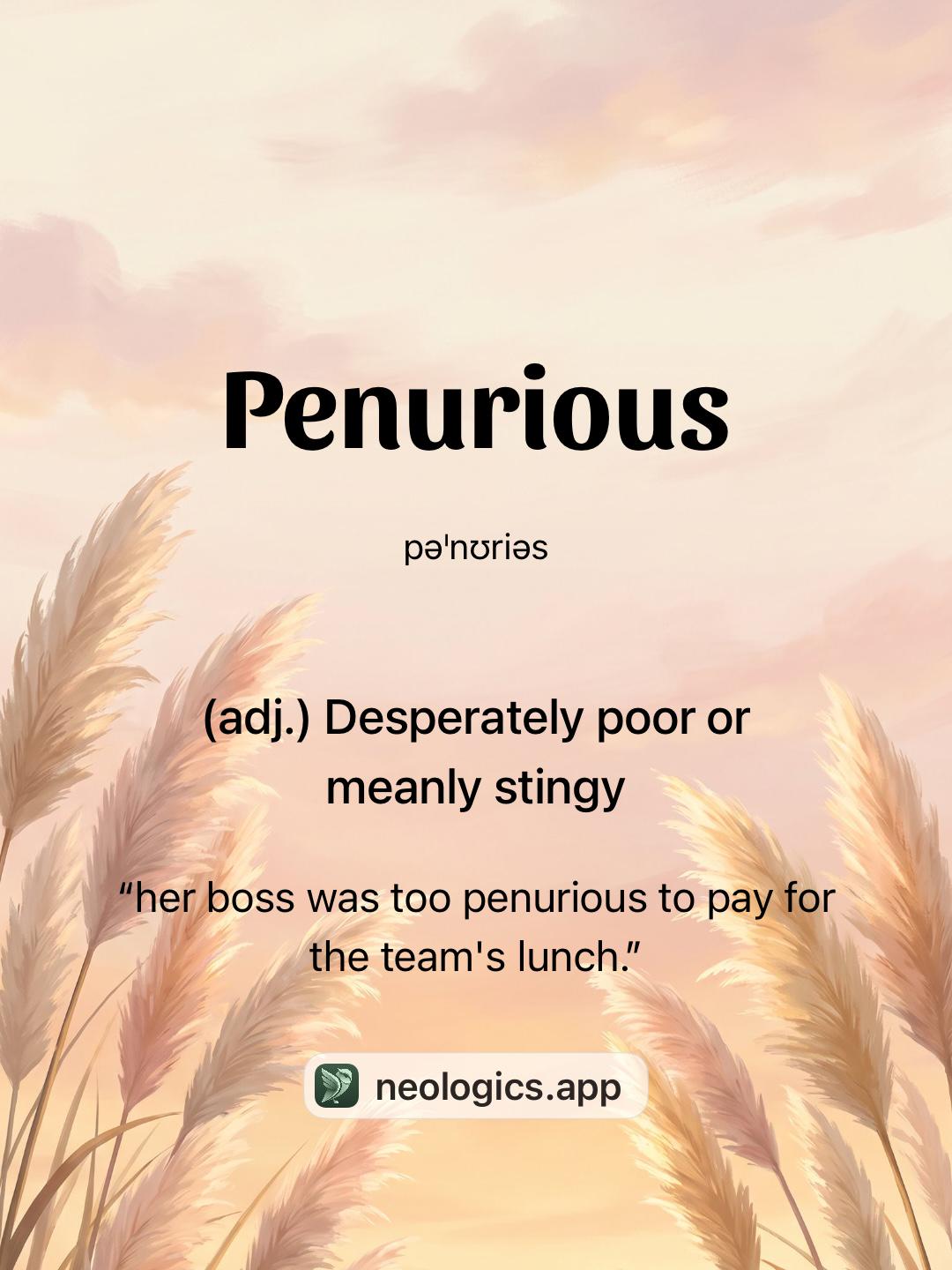
New Words Word of the day: Penurious

Post image
38 Upvotes

I can relate with this one 😅

Penurious means extremely poor and living in want. Also unwilling to spend money, tight-fisted to the point of meanness.

Origins
From Medieval Latin penuriosus, from Latin penuria, 'want, scarcity.' It entered English in the late 16th century to describe people who were poverty-stricken. It soon also came to describe those who live as if poor and grudge every coin, and both senses survive today.

Interesting fact
Hetty Green, the Gilded Age financier nicknamed the 'Witch of Wall Street,' was one of America's richest women. She was also so penurious that the Guinness Book of Records once listed her as the world's greatest miser

Common misuse
Sometimes confused with 'penitent,' which means sorry for wrongdoing, or with 'punitive,' which means intended to punish. Penurious concerns money: either having almost none or refusing to part with it


r/vocabulary • • 1d ago

Word of the day: Censorious

Post image
144 Upvotes

Censorious means severely critical of others, quick to find fault and to pass moral judgment, often in a harsh or self-righteous manner

Origins
From Latin censorius 'of a censor,' hence 'severe,' from censor, the Roman magistrate who kept the census and policed public morals. The root is censere 'to assess, judge.' English adopted censorious in the 1530s for people who judge others as sternly as a Roman censor.

Interesting fact
According to Plutarch, Cato the Elder, censor in 184 BCE, expelled a senator named Manilius for embracing his wife in daylight in front of their daughter.

Common misuse
Often confused with 'censoring.' Censorious describes a fault-finding attitude toward people, not the act of suppressing books or films. For banning content, say 'censoring.'


r/vocabulary • • 23h ago

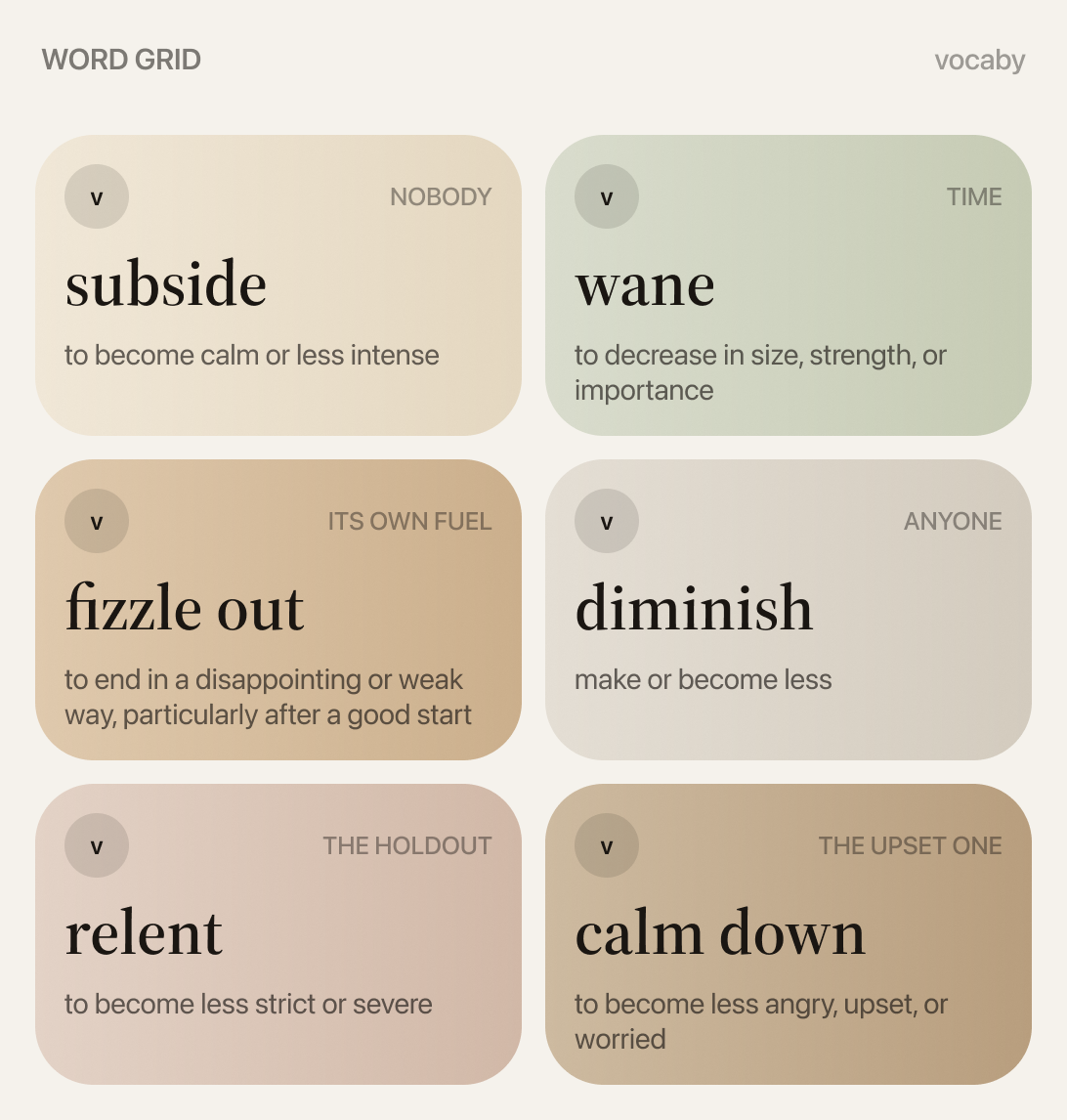
New Words "Her anger subsided" sounds kinder to me than "she calmed down", because subside started out meaning things sinking to the bottom on their own

Post image
43 Upvotes

I sorted these six by who does the lowering. The tags on the card say who, and subside is the one where the answer is nobody.

The oldest English subside, from the 1680s, was about objects sinking to the bottom. It's Latin subsidere, sub "under" plus sidere "to settle", a relative of sedere "to sit" and, a long way back, of English sit. Feelings picked up the word around 1700, and winds by 1721. So when anger subsides I picture something heavy drifting down through water while everyone waits and nobody pushes. Subsidy comes from the same verb: Latin subsidium meant help, and also troops held in reserve, the ones who stayed back.

Calm down hands the job to the upset person. The odd part is that calm started out as heat. Etymonline takes it to Old Italian calma, probably from Late Latin cauma, the heat of the midday sun, when everything in Italy rests and goes still. Before that it's Greek kauma "heat", from kaiein "to burn", which also gave us caustic. The "free from agitation" sense dates from the 1560s. Telling someone to calm down asks them to do the settling themselves while they're still hot, and I can't remember it helping once.

Relent belongs to the holdout. It came in during the late 1300s as relenten, "to melt, soften in substance, dissolve", ultimately from Latin lentus "slow, viscous, supple". The temper sense shows up in the 1520s, and Etymonline's guess is a hard heart melting with pity. It's a choice, which is why "the rain finally relented" makes the weather sound like it changed its mind.

Wane is time's job. It's the moon word, from Old English wanian, and it's related to want in its old sense of lacking, and to Latin vanus "empty", which gave us vain.

Fizzle out runs on its own fuel until there isn't any. The 1530s fizzle meant breaking wind without noise. The failure sense turns up in 1840s American college slang for a botched recitation, and in 1846 the Yale Banger, a student paper, said that getting one third of the meaning right "constitutes a perfect fizzle." Barnhart doesn't think that sense comes from the older verb, so the fart might be a coincidence. I hope it isn't.

Diminish works either way, "make or become less", and it's two older verbs merged into one: diminue and minish.

So "her anger subsided" sounds kinder to me because it doesn't put the lowering on anyone, including her. Which of these would you actually say to an upset friend?

r/vocabulary • • 9h ago

General Can you still board at 8:15? “Boarding starts” vs. “boarding ends”

3 Upvotes

You’re about to grab a coffee at the airport. Your flight leaves later, but the airline’s message shows 8:10 next to the word “boarding.” Look at the verb that follows it.

“Boarding starts at 8:10” means the airline begins letting passengers onto the plane at 8:10. If you’re at the gate then, you might still have to wait for your group.

“Boarding ends at 8:10” gives you the cutoff. If you get to the gate at 8:15, you could miss the flight even if the plane is still there.

If the app only shows “boarding time,” ask, “What time does boarding close?”

American Airlines on when boarding starts and ends


r/vocabulary • • 5h ago

How can I develop my vocabulary????????I'm learning English 😫

0 Upvotes

r/vocabulary • • 19h ago

New Words Underrated word of the day: Gradient

9 Upvotes

If you say something is in gradients, you either mean it's a spectrum between two extremes or a gradual, continuous transition.

For the former, viewing something in gradients means it's not black or white or all or nothing; there are many different layers, shades, nuances, or degrees or just stuff in-between two points rather than a strict binary divide or a all or nothing affair. For instance, people who kill should be sent to the slammer without question. If you viewed this situation in gradients, you might look at the individual circumstances of that particular incident and consider that the perpetrator wasn't sound of mind at the time and should be sent to a medical ward to receive treatment for their affliction.

For the latter, something that happens in gradients happens in a gradual, step by step progression rather than a sudden jump. It's a slow, steady buildup rather than suddenly switching to the other end of the spectrum so happen. For instance, a learning curve that smoothly and gradually progresses rather than a sudden jump in difficulty.


r/vocabulary • • 1d ago

Word of the day: petrichor

Post image
5 Upvotes

r/vocabulary • • 1d ago

New Words Underrated word of the day: Modular

20 Upvotes

The term Modular describes something that is made up of pieces of parts or pieces that can be assembled in a bevy of ways. They can be constructed or joined however you wish. This can be used for stuff like sofas, PCs, even common household appliances like vacuum cleaners. You can often take out parts without affecting the rest of the system to sub in other parts that fulfill completely different functions, and that’s really the core of what modularity is: customization and versatility. Whatever role you want it to fulfill is completely up to you. You define its purpose, its function, its meaning, but this can also be applied to video games. A very good example is Final Fantasy VII, which uses the Materia system. Party members can equip materias onto their weapon and armor for an array of different effects. You can give a party member all offensive magic to make a powerful black mage, all white magic to have them fulfill a supportive role, you can have them be a mixture of both, the sky is the limit. While the party members in FFVII have certain elements like their stat allocation and limit breaks nudging them towards certain roles, they aren’t completely pigeonholed into it. There’s more than enough freedom for the player to build and define them however you want. It’s a textbook simple of a modular system. It’s flexible, fluid, customizable, versatile, and provides tons of freedom for the player. This is the core of what modularity is to me, and I think that’s why video games can have modularity. Feel free to disagree with me.


r/vocabulary • • 2d ago

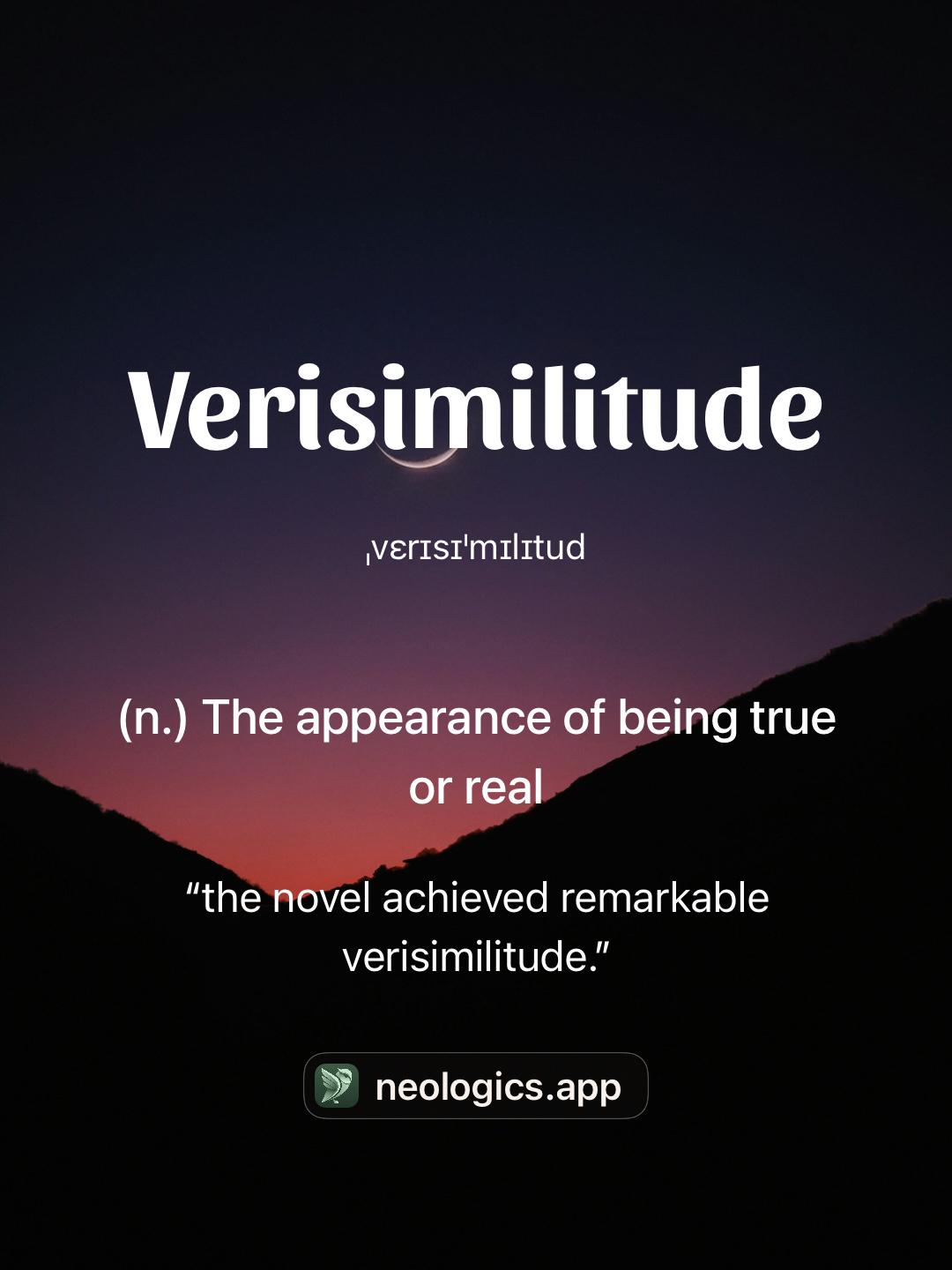
New Words Word of the day: Verisimilitude

Post image
163 Upvotes

Verisimilitude means the appearance or semblance of being true or real; the quality of seeming credible or lifelike.

Origins
From Latin 'verisimilitudo', from 'verisimilis' meaning probable or having the appearance of truth, combining 'verus' (true) and 'similis' (similar, like).

Interesting fact
Popper's concept of verisimilitude aimed to rescue science from the problem that no theory can be proven absolutely true, proposing instead that science progresses by developing theories that are increasingly truth-like.

Common misuse
Sometimes mistaken to mean actual truth. Verisimilitude is about the appearance of truth, not truth itself something can have high verisimilitude while being entirely fictional


r/vocabulary • • 23h ago

Question Thusword #170 - Clue of the Day!

1 Upvotes

28 Across, 6 letters
Standard Clue: Dot-marked tile
Hard Clue: Mask


r/vocabulary • • 1d ago

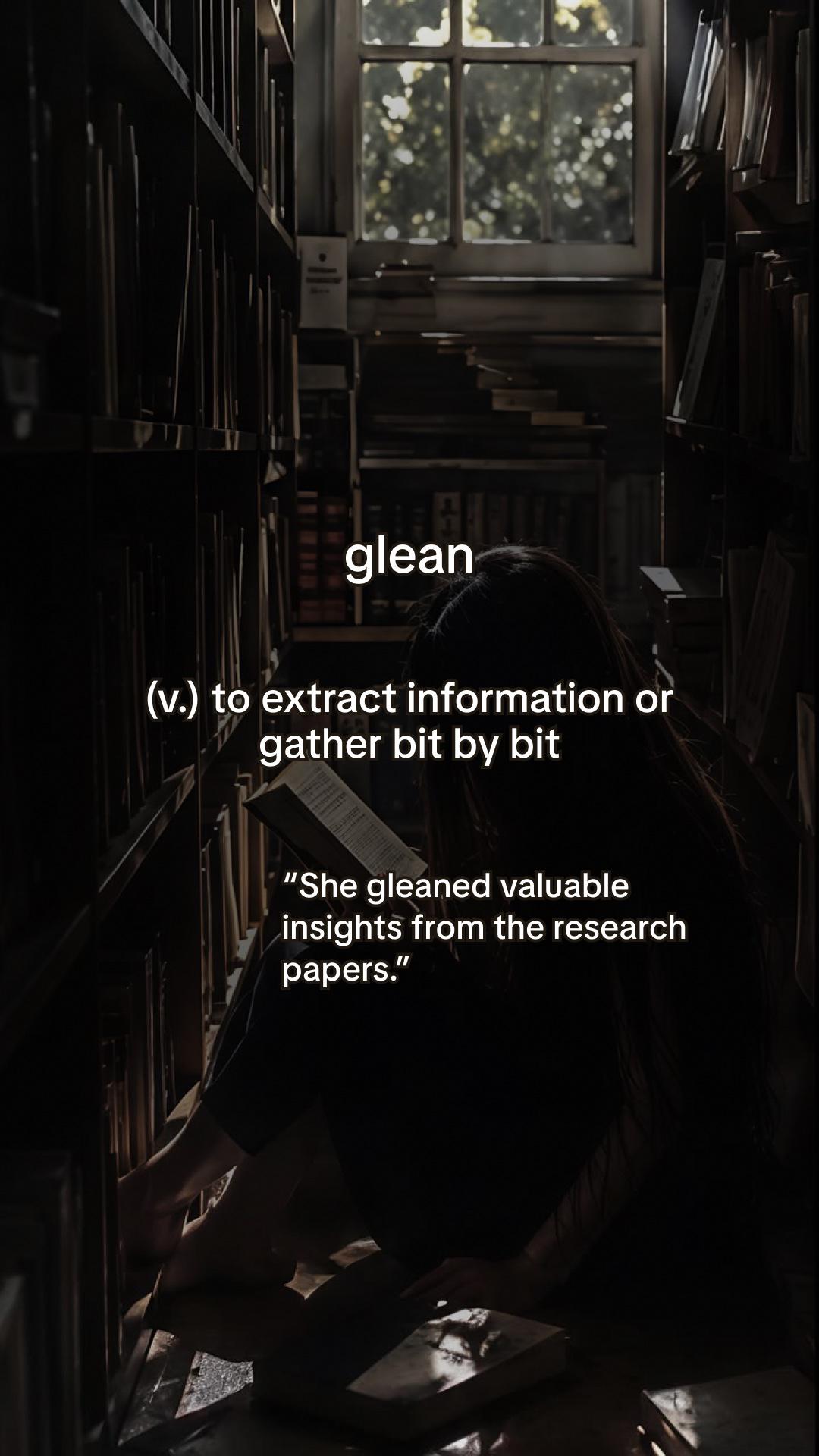
New Words You glean from someone else's leftovers and garner into your own granary, and I think that's why hints get gleaned and praise gets garnered

Post image
70 Upvotes

Both words come out of the grain harvest. They just come from opposite ends of the field.

Gleaning happened after the reapers had gone through. You walked the stubble and picked up the ears they'd dropped, and it was work for people who didn't own the crop. Leviticus 19:9 tells farmers not to reap the corners of their fields or gather the gleanings, and that law is the background to Ruth gleaning behind Boaz's workers in the Book of Ruth. If you've seen Millet's The Gleaners (1857), that's three women stooped over a field somebody else already harvested.

A garner was where the grain went: the granary. English had it by the late 1100s, from Old French gernier, a variant of grenier, from Latin granarium, a storehouse for grain (granum). Granary is the same Latin word borrowed again in the 1500s, so garner and granary are doublets. The verb, "to store grain," doesn't turn up until the late 1400s.

The modern senses kept that split better than I thought they would. You glean from a source that wasn't made to hand you the thing, like a hint from someone's tone, or the card's "insights from the research papers" (nobody wrote those papers for her). You garner what piles up on your own side, and often it comes to you instead of you going out for it. A film garners reviews. A candidate garners votes. "The film gleaned praise" sounds wrong to me, and so does "I garnered from his tone that he was annoyed."

Here's the part that surprised me. Etymonline records the figurative glean, "to gather by acquisition, scrape together," in English before the literal "gather grain left by the reapers," which it puts in the late 1300s. I can't tell you why. My guess is that English picked the word up from people who already used it both ways, but that's only a guess. Before Late Latin glennare nobody really knows; Etymonline calls it of unknown origin, perhaps Gaulish.

So when I say I gleaned something, I picture myself in somebody else's stubble, which is why I'd never say I gleaned a compliment.


r/vocabulary • • 2d ago

New Words Underrated word of the day: Churlish

74 Upvotes

To be churlish is to be bad-tempered, unfriendly, or impolite. They’re rude, hard to work with, and just very vulgar. The just lack any good manners and are discourteous. It would be churlish of me not to stifle my belch by placing my arm over my mouth at dinner.


r/vocabulary • • 2d ago

New Words Word of the day: Inherently

Post image
28 Upvotes

r/vocabulary • • 2d ago

New Words Underrated phrase of the day: Talk Out of both sides of your mouth

14 Upvotes

When you talk out of both sides of your mouth, you say something that is the opposite of what you said before, or to express different opinions about something in different situations, in a way that may deceive people. It implies dishonesty, hypocrisy, or trying to please everyone. It carries a connotation of insincerity and duplicity. If I ,as an employer, told an employee they did good work today and later that day had told another employer from another office that that employee's work was sloppy and shoddy, that employer is talking out of both sides his mouth.


r/vocabulary • • 2d ago

New Words Only some wild mushrooms are esculent, while many others are poisonous.

Post image
53 Upvotes

r/vocabulary • • 2d ago

New Words Six ways to be stuck, sorted by where the trouble sits: a quandary is in your head, a dilemma is in the options, and embroil means it was somebody else's argument first

Post image
100 Upvotes

Sorting these by where the trouble sits is the only way I've managed to keep them apart.

Quandary puts it in your head. You haven't worked out what you want yet. Nobody knows where the word came from: Etymonline dates it to the 1570s, calls it "a word of unknown origin", and offers a guess with a "perhaps", a mock-Latin coinage on quando, "when?". I hope the guess is right. "When, though?" is pretty much what a quandary sounds like from the inside.

Dilemma puts it in the options. It started as a term of Greek rhetoric, di- "two" plus lemma "premise, something taken": an argument that hands your opponent two conclusions, each of which wrecks their own position. The strict use still wants two choices, both bad, the horns of a dilemma. The card says "two or more alternatives", which is how most people use it now, and I wouldn't fight anyone over the extra option. Calling every problem a dilemma is where I'd draw the line.

Embroil puts it in somebody else's fight. It arrived around 1600 from French embrouiller, en- "in" plus brouiller "to confuse", from Old French brooillier "to mix, mingle". Etymonline traces that, with a "perhaps", to breu "broth", which would take it back to a root for boiling. The quarrel sense turns up around 1610. Imbroglio is the Italian cousin.

Entangle puts it in the ties. Nobody planned anything; things got wound together, and now pulling on one moves the others.

Ensnare is the opposite, because someone meant it. A snare was a noose for catching animals, from Old English snearu and Old Norse snara, related to words for cord and twisted rope, and it has meant "anything by which one is entangled" since about 1300.

Quagmire puts it in the ground, where every move sinks you a little more. A quag was a shaking bog, from an Old English root meaning "shake, tremble", and mire is mud. The "inescapable bad position" sense is recorded by 1766 but seems to have been rare through much of the 1800s. American English brought it back in 1965 for stalled military campaigns, Vietnam above all; David Halberstam's book that year was The Making of a Quagmire.

Entangle and embroil still overlap more than I'd like, so if you sort these differently I'd like to hear how.


r/vocabulary • • 1d ago

Question Synonyms of Dynamic

1 Upvotes

To describe the chemistry/ relationship between people


r/vocabulary • • 3d ago

New Words Word of the day: Teleology

Post image
147 Upvotes

Teleology means the philosophical study of design, purpose, and final causes in nature; the explanation of phenomena by the purpose they serve rather than by prior causes.

Origins
From Greek 'telos' (end, purpose, goal) + 'logos' (study). Aristotle was the first to develop a systematic teleological framework with his concept of 'final causes.'

Interesting Fact
The 'teleological argument' for God's existence (argument from design) was famously critiqued by David Hume decades before Darwin, using the analogy that we wouldn't attribute design to a poorly built ship.

Common Misuse
Often confused with theology. Teleology is the study of purpose and design in nature; it can be secular. Not all teleological arguments are religious.


r/vocabulary • • 2d ago

New Words Underrated word of the day: Empirical

24 Upvotes

If you say something is empirical, it's derived from direct observation, experience, or experimentation rather than pure theory or logic. Something empirical is based on real world evidence, has practical experience, or just capable of being verified. It's concrete and isn't just guesswork or theorycrafting. Empirical *is* different from anecdotal. Anecdotal evidence comes from individual experiences or secondhand stories while empirical evidence comes from rigorous, systemic testing and experimentation and is much more reliable. Through painstaking testing and experimentation, we were able to produce empirical evidence rabbits have a prospensity to breed.


r/vocabulary • • 2d ago

New Words Underrated phrase of the day: Cerberus Syndrome

18 Upvotes

Cerberus Syndrome is a phenomenon when a series goes from lighthearted, episodic, slice of life to more intense, dramatic storytelling. It also a more coherent, serialized storyline with deeper stakes, character arcs, and just a darker tone shift. This usually occurs when the show has grabbed the audience’s attention and the writing team wants to take the story in a more mature and serious direction. Many famous TV series have undergone such a phenomenon like Adventure Time, Scooby Doo, and other shows I can’t remember offhand.


r/vocabulary • • 2d ago

New Words Underrated word of the day: Wistful

31 Upvotes

If someone says you have a wistful expression, it means you're probably longing for something in the past. However, this word carries a forlorn or crestfallen connotation; You're yearning for something to be better or thinking back to better days. Of course, it doesn't need to be that. It just needs to be something that evokes a feeling of nostalgia. As I was looking through my stuff from high school, I was feeling wistful as it reminded me of my younger days.


r/vocabulary • • 3d ago

New Words Underrated word of the day: Petulant

59 Upvotes

If you call someone petulant, you mean they get unreasonable angry and upset in a childish way. It refers to someone who is easily annoyed in a childish, rude, or unreasonable way, especially when the most primary way of them flipping their lid is when they don't get their way. It can also be over a minor inconvenience or anything else that's inconsequential. For instance, a child throwing a temper tantrum over being told they had to eat their vegetables before they could eat their meats.