r/worldbuilding • • 20m ago

Question Plains Culture & Religion

1 Upvotes

Building a religion for a plains/grassland culture. I'm basing the religion loosely on a mix of plains indians, Proto-Indo-European, and Tengrist beliefs. I want it to be an animistic religion based around the predominant worship of a sky deity called Noktal, and there are no other gods, per se, but rather spirits of the land. The people are hunter-gatherers and semi-sedentary, in the sense that they have areas where they build villages and only live there for half of the year, then move to a different village for the rest of the year to chase the herds of animals they hunt. Any recs on stories or religious rituals are appreciated, any advice and further question is invited.


r/worldbuilding • • 1h ago

Lore Light that can sit still, and hit with the force of a rock. [Th'zoitrk]

Thumbnail
gallery
5 Upvotes

(For Th'zoitrk, a semi-sci-fi worldbuilding project.)

This is the third post I've made explaining the physics of Th'zoitrk, the previous two posts can be found here, and here.

According to Th'zoitrk's block model of physics, there is a fundamental particle that makes up absolutely everything in the universe, Humes. I won't go in-depth about them here since I've explained that before; all that you need to know is that Humes form 'blocks' that make up reality.

The Humes within each block spin.
Clockwise, counterclockwise, forwards, and backwards. That's the four orientations as they're usually represented, of course they aren't ACTUALLY moving in those exact ways, it's just to better visualize it to a typical person.

These four rotational 'essences' cause the given block to behave as one of four things.
Matter.
Inverse matter.
Photons.
& Tekons.

If you can change the rotational essence of a block, you can change what it fundamentally is. You can turn light into solid matter, or matter into light.

Matter and light I won't get into since you probably have a pretty good understanding of both already.

There isn't enough space in the post to discuss both tekons and inverse matter without yapping forever.
So instead, I'll focus on:

--------Tekonics & Quidium--------

Tekons are a wave, similar to light. Under normal circumstances they behave just as light does. Except, when you shorten their wavelength enough something changes.

Past a certain point the wavelength gets so short that, for some reason, it stops behaving as a wave.

The tekonic wave begins interacting with gluons, the carriers of the strong force, converting energy into mass from the interaction (the same way how most of the mass in an atom is formed) and, as a result, tekons start behaving as a particle rather than a wave.

This new particle is, while technically still a tekon, officially referred to as quidium.
Quidium particles behave very similarly to particles of matter. Quidium particles can form together with other particles to form 'atoms' of a sort which are comprised entirely out of quidium, a material which is quite literally solidified radiation.

Quidium 'atoms' behave as if they're a new element, even though they most definitely are not.
Quidium can bind with other real elements to form new compounds, although for some reason they normally don't actually change anything about how the molecule would behave if quidium weren't there anyways.
Some compounds do behave differently when quidium is present, as a new material, but for most molecules out there it doesn't seem to actually change anything.

A tekon's wavelength can continue shortening even after forming quidium, as well. It just makes the quidium denser. The first form of quidium is quidium-0, when you make the wavelength 7x smaller it becomes quidium-1, 7x smaller again for quidium-2, so on and so forth.

Quidium is the material which makes up all known life.
Th'zoitrk's biosphere is comprised of quidium-based organisms; as is the biospheres of Th'zoitrk's moon Okkaelko and the Oukapolean moon Puloini.
This is why life on Th'zoitrk, such as dectrons, do not need water whatsoever to survive.

In fact, to a lot of quidium-based life, water is a toxic substance which can break down their flesh and constituent materials like an acid.

Dectrons (the sapient species and civilization on Th'zoitrk) do not breathe oxygen, rather, they breathe nitroquidium. A compound formed when a lone nitrogen atom binds together with quidium 'atoms.'
Specifically, Th'zoitrk's atmosphere is made up of nitroquidium formed from quidium-22.

Some celestial bodies have quidium making up a significant enough portion of their mass that they possess a *teko-*magnetosphere. A magnetic field formed from the inherent magnetism of tekons and quidium.
The only celestial bodies known to posses a tekomagnetosphere are Th'zoitrk, Th'zoitrk's moon Okkaelko, the Oukapolean moon Puloini, Sh'beso, and Okott (the sun.)

Every other world (ignoring the sun) which have a tekomagnetosphere also have quidium-based life. This is why dectrons are currently investigating the gas giant Sh'beso as a very plausible location for life to have evolved separately from Th'zoitrk.

Quidium is believed to make up as much as 11% of Th'zoitrk's entire mass. Practically all the nitrogen in Th'zoitrk's atmosphere is quidium.
This substance is the constituent for all known life, getting it to other planets in significant amounts is a necessity for Dectrons to colonize the solar system.

Thankfully, due to its unique nature, quidium-based life doesn't really need to worry about temperature.
Quidium-based single-celled organisms can exist at literally any temperature above absolute zero.


r/worldbuilding • • 2h ago

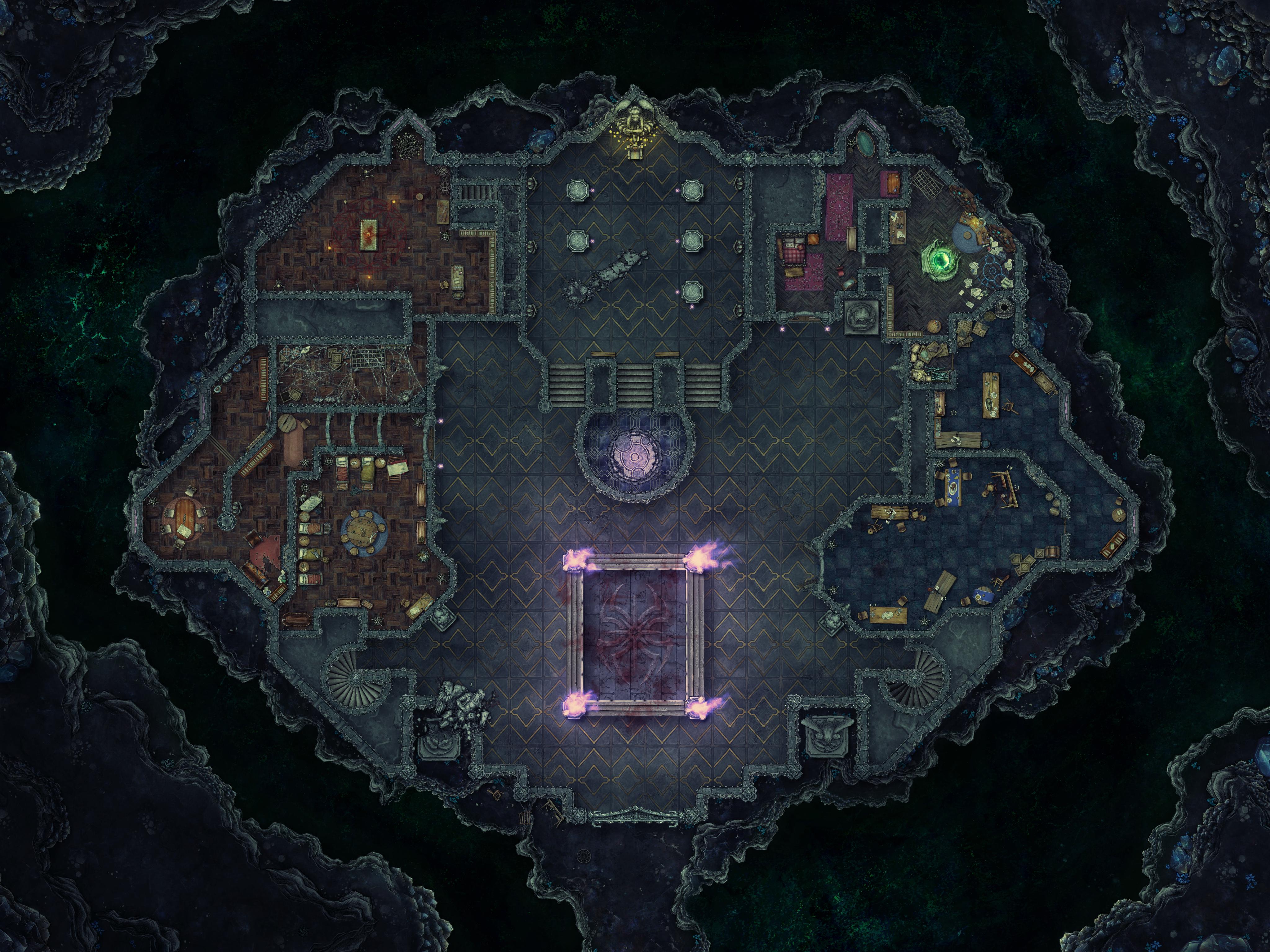
Map NOCTHRA-BAEN CASTLE — GROUND FLOOR | 100 x 75 | 4K

Post image
0 Upvotes

Original map created for my RPG campaign, Shadows of Yeenoghu.

Deep within the Underdark stands the central castle of the Necropolis of Nocthra-Baen, an ancient drow city directly connected to the Shadowlands. Once the heart of a prosperous and powerful society, Nocthra-Baen is now nothing more than a shadow of its former glory. Its halls, once filled with life, now hold only the echoes of a forgotten civilization, as death and darkness reclaim what time has left behind.

The vast abyss surrounding the castle is not merely a natural formation, but a direct gateway to the plane of the Shadowlands, the result of an ancient pact forged millennia ago. Since then, the influence of this plane has spread throughout the city's ruins, making the place even darker and more ominous.

Although much of the castle lies in ruins, some of its chambers feature newer, more elegant furnishings. This is due to events that unfolded during the campaign, in which a group of drow from distant lands formed an alliance with the undead ruler who currently governs the place, bringing new signs of occupation to the ancient fortress.

This is just the ground floor of the castle. I plan to work on the remaining floors at some point 😁


r/worldbuilding • • 2h ago

Lore For my post nuke game with 1980's flair

1 Upvotes

Idea for this Project/lore:

This game is designed to create a more expansive world in a post-nuclear apocalypse setting. While Fallout is a major influence for this TTRPG, the goal is to address perceived shortcomings and expand on unexplored concepts to make the world feel more lived in, but dangerous, political, and unstable. Everything presented here provides a set of guidelines, allowing freedom for customization.

Across the ruins of North America, people are rebuilding civilization—but that does not mean it has become civil. Some regions, counties, and enclaves have achieved measured levels of stability while others are struggling to survive the day-to-day problems of a harsh landscape. Not all locations will be part of a faction or the New Nations; there are lots of independent settlements, villages, and city-states peppered across the Wasteland. 

To the larger powers of this post-war world, these small independent lands are something to be annexed, conquered, or used to feed their ever-growing hunger for expansion, fueling dreams of unification whether to rebuild the U.S. to its pre-war state or to create a new world shaped in their own twisted image. 

Players will be able to use this sandbox however they choose—whatever players want, whether it’s Interplay-, Obsidian-, or Bethesda-style adventure or just a bunch of randos roaming the Wasteland wanting to find fame and fortune, adventure, and become heroes or villains of the Wasteland.  

The Wasteland is brutal, absurd, and darkly funny. Expect cheerful pre-war propaganda, giants who regret thinking, and a polite butler-bot holding a flamethrower. Bad things happen, and sometimes they’re hilarious. The jokes are fair game at the table, but the stakes are real. 

Lore (lots of changes and Addenda TBA):

The Age Before the Fall: A Pre-Apocalyptic Timeline

1945–1956: The Dawn of Mutually Assured Destruction

In the final years of World War II, a new, powerful, and terrifying weapon was created: the nuclear bomb. Its destructive potential was unlike anything the world had ever seen—a weapon capable of wiping out entire cities in an instant, leaving twisted ruins of metal and shattered concrete, along with catastrophic, long-term effects that poisoned the surrounding land. 

At first, the United States believed it could keep this technology exclusively to itself. That faith ended when its former ally turned rival, the Soviet Union, acquired the knowledge and ability to build their own nuclear weapons. 

When the Soviets successfully completed their first nuclear test, the old fears of invading armies and ideological expansion were quickly replaced by a far darker possibility: the threat of Mutually Assured Destruction, or M.A.D.—the idea that the next World War would be the end of humanity. 

The terrified citizens of the United States turned to their government in hopes of protection from the possibility of World War III. The federal government initiated large-scale civil defense programs, major infrastructure projects, and economic initiatives to help quell the people’s fears. 

Both superpowers avoided direct conflict—not for the sake of peace, but fear. Instead, conflicts were waged through proxy wars with smaller nations and competitions through demonstrations of dominance of mathematics, science, athletics, engineering, and pursuits aimed at improving quality of life. This fierce rivalry spurred remarkable technological progress in both the civilian and military sectors, as each side demonstrated its achievements in a high-stakes, global game of one-upmanship.
 
1957–1965: The Space Race and Rising Paranoia

On October 4, 1957, the Soviet Union launched Sputnik, the world’s first artificial satellite, officially kicking off the Space Race. To the American military leaders, this was more than an amazing scientific achievement—it was a wake-up call. 

If these satellites could orbit Earth, then the possibility of orbital nuclear platforms would be next. The thought of an undetectable and untouchable weapon that could be fired with no warning sent a wave of panic through military and political circles. Determined not to be left behind, the United States threw itself into the Space Race and began the development of Intercontinental Ballistic Missiles (ICBMs), thrusting the world into a new era of technological escalation and geopolitical paranoia that would define the coming decades.

Early on, the United States was struggling to keep pace with Soviet achievements. American scientists focused heavily on astronaut survivability, prioritizing missions that ensured crews could safely return from orbit. This near-perfect success rate pressured the Soviet Union to pursue a grand project meant to put a decisive end to the Space Race, culminating in a successful lunar landing by 1963 and the construction of the first—and only—permanent lunar colony in 1964. 

The Soviet lunar colony began as a small, village-sized outpost. Over time the colony would grow to be a thriving small city, a symbol of Soviet space superiority. 

  Meanwhile, public faith and interest in the Space Race within the United States faded dramatically. Following the assassination of President John F. Kennedy—NASA's strongest supporter—the program lost its most important political driver. 

No culprit was ever formally identified. Rumors ran rampant and unchecked, ranging from Soviet conspiracies to time-traveling agents from the future.

1965–1982: The S.U.B.U.R.B.S. Program

In the wake of Kennedy’s death, the U.S. Government decided to defund NASA, spending massive funds on what they thought would be more immediately practical and defensible. Heavily investing in robotics programs, computer engineering, military technologies, alternative fuel research, and a new massive self-preservation initiative known as S.U.B.U.R.B.S.—Safe Underground Bases for Utilitarian Relocation and Bomb Shelters. 

Most S.U.B.U.R.B.S. were commercially marketed not as small, cramped, temporary survival shelters, but as spacious underground homes, where you and your family can wait out the nuclear fallout until the surface was deemed safe to rebuild America. 

However, not all S.U.B.U.R.B.S. were created equal.
 
A few were reserved for the wealthy elite, politicians, high-ranking military officials, and classified research programs—places where experiments were conducted with little concern for ethics or oversight.

Production of the S.U.B.U.R.B.S. began in 1965 and was officially completed in 1982. Facilities were built across the United States in a wide range of occupancy. 

  • Small facilities: Designed for 100–500 people
  • Average facilities: Designed to house 1,000–5,500 people
  • Large facilities: Built to support 6,000–10,000 people

  
Each S.U.B.U.R.B.S. was stocked to be functional for over a century, depending on size and location. Areas with large population centers, strategic military sites, and industrial hubs were supplied with much larger stockpiles, as planners expected these regions would suffer heavier bombing and prolonged residual radiation.

Beyond massive reserves of food and supplies, S.U.B.U.R.B.S. were designed to be fully self-sufficient. Each facility featured:

  • Advanced hydroponics systems capable of producing fruits and vegetables year-round
  • Laboratory-grown meat production and automated food-processing micro-plants
  • Self-operating micro-factories able to manufacture tools, equipment, and essential goods
  • Cutting-edge water recycling and air filtration systems, capable of near-total material reclamation—including organic waste and dead bodies

Power was supplied by on-site thermal plants or nuclear plants, allowing the facilities to remain operational and self-sufficient for over a century without relying on external resources.

Unknown to the general public, Some S.U.B.U.R.B.S. were not built purely for survival. They housed classified experiments. These included:
  • Super-soldier enhancement programs
  • Genetically modified plants and animals
  • At least one clandestine space program, the details of which remain classified to this day

The true extent of these experiments—and the fates of the personnel and inhabitants involved—remains largely a mystery. What happened behind those sealed doors of these secret S.U.B.U.R.B.S. is largely unknown, and their legacy is one of whispered rumors, abandoned projects, and hidden horrors.

1989–2095: The Collapse and Aftermath

On December 15, 1989, at 11:25 A.M. PST, the bombs fell. 

No one knew who fired first—and in that moment, no one cared as people across America rushed into the S.U.B.U.R.B.S., homemade fallout shelters, metro tunnels—anywhere people thought could offer safety from the fire and radiation. The atomic exchange only lasted for a few hours, but the devastation and radiation lingered for years, if not decades. 

When the fires finally died down and fallout radiation dropped to what was grimly considered bearable, those who had sheltered themselves in metro tunnels or in improvised bomb shelters were the first to emerge. They cautiously picked through the ruined cities and scavenged for any food, tools, medicine, and anything else of value. Over time, small camps and settlements started to form. Most, unfortunately, would not survive—falling to internal strife, starvation, disease, or external threats. The few communities that survived slowly grew, expanded, and thrived. 

But peace would be short-lived.

Raider and bandit gangs soon roamed the Wasteland, moving from settlement to settlement—extorting and destroying anything too weak to fight back. Some communities managed to fight back, defeating the raiders and growing stronger from it as a result. These battle-hardened settlements looked to neighboring communities still under raider control. Rather than wait to be attacked, they struck first. When the raiders were gone, the stronger settlements absorbed the weaker communities into their fold. 

 This was the beginning of the New Nations. 

Most of the bombs used during World War III were low yield nuclear bombs designed to have lower explosive damage but leaving behind very heavy residual radiation that would last for several decades. This radiation would kill off most of the plants, animals, and people in the immediate blast zones. As the radiation levels reduced gradually over time, life slowly returned—but it was something new. Something alien.

It was like Nature itself had endured and allowed the radiation to take over, taking vengeance on what was left of humanity. Some animals mutated—growing a second head, extra limbs, heightened aggression, or becoming venomous when their species had previously been harmless. Plants, too, were mutated. Some could store radiation like how a cactus stores water, but instead of simply hoarding it, they exploded their seeds violently, like fragmentation grenades. There are giant flytraps big enough to eat whole people. Some mutated plants are edible—but only if cultivated under the right conditions and properly prepared and cooked. 

Humans were also affected by radiation; those who didn’t die from the exposure became the Mutants. Their mutations varied—multiple limbs, organs, eyes. Some got enhanced strength, and heightened senses. Among them, a rare few developed psionic abilities, becoming Psykers. They were feared by most. Their powers ranged from telepathy to telekinesis, and some used their abilities for personal gain or to cause harm to others.

The year is now 2095.

The Wasteland of North America is entering a new era. The New Nations are now gearing up for war with their neighbors, their rivals, and anyone who stands in their way. They fight for territories, resources, and what they believe is their God-given right to rebuild and reunite the old U.S. in their own image. 

These are the stories of those living through these chaotic times— 

and willing to forge their own path in an uncertain future.  


r/worldbuilding • • 2h ago

Visual Some old graphics from a long abandoned world building project

Thumbnail
gallery
3 Upvotes

Sigils of the Terraformer Houses, the remnants of the exodus fleet that survived the first initial contact with the natives of the [REDACTED] Star system.


r/worldbuilding • • 3h ago

Resource A big piece of advice to all worldbuilders...

75 Upvotes

This is in regards to a post I just saw, but I wanted to offer it to you all (especially those of you who just started) as someone who learned this the hard way.

WRITE.

EVERYTHING.

DOWN.

Record everything your brain comes up with, no matter if it's a quote, a piece of prose, a random worldbuilding idea, ANYTHING. WRITE IT DOWN. It's so helpful, and you never know where your ideas will go. I literally can never stress this enough and it's the best advice I can give you as someone who maladaptive daydreams a lot. Trust me, as someone who has frequently needed to reference old ideas that I've come up with dating back to the 1st century, it's a lifesaver.

Never think something has to be "good" to write it down. You can always workshop later, just get it down so you don't forget it. It's always better to have it than not to have it.

Also, if you do your best thinking in the shower (or even right before you fall asleep), get a whiteboard so you can write it down. They're called "shower thoughts" for a reason, and it pmo everytime I have to recall whatever I was thinking about and forget it.


r/worldbuilding • • 3h ago

Lore First post to wb: I simulated an 18th-century war of succession and turned it into a history audiobook

Thumbnail files.catbox.moe
2 Upvotes

I spent a few days building a simulated world of a fictional 1700s kingdom called Aurelia. It has six noble houses fighting for the rule of Aurelia after its King dies without an heir..

From what the events and data of the simulation, I created this historical-fiction audio book.

I really enjoyed the whole process and i think it came out great. But Im wondering if i like it so much because as i listein, im remembering watching the events play out on the simulator. I can imagine it might be quite boring for anyone else...

I'm simulating the sequel now. It takes about 12 to 16 hours to go from starting a sim to a finished audiobook.

here is the link... runtime is 1 hour 22 minutes.


r/worldbuilding • • 3h ago

Discussion Fantasy set on Earth with irl history and cultures

10 Upvotes

This stems from a thought I had while reading a cultivation novel and seeing a mention of Zoroastrianism; what’s happening in the rest of the world? I had an idea for a story set on an alternate Earth in the Middle Ages, with real historical figures. The idea being that magic is real everywhere, and is geographically and culturally linked. For example, in China you get the classic cultivation as seen in martial arts films, in Europe, you get power based on Christian theology, alchemy, and witchcraft. It would be possible for a person to obtain multiple powers, but they would have to travel throughout the world to obtain them from the original lands that they are from. I only have two examples, but does anyone have ideas for more power systems?


r/worldbuilding • • 4h ago

Question What would it change about our understanding of humanity, language, and culture if we got to space and realized we were the only species out there that developed multiple languages for ourselves?

14 Upvotes

I'm thinking about media like Star Wars where (other than a few nods in novelizations and such) it's largely understood that all of one alien species speaks the same language.

If that were actually true of most alien species, what would that mean about us?

How would it change our view of language(s) as a whole?

Would any of this extrapolate out into other areas like the development of culture, history, etc.?


r/worldbuilding • • 5h ago

Discussion Cephalopod mechs and robot based designs?

1 Upvotes

In the book im writing there is a vast military empire that controls huge swathes of the known universe and have technology and weapons that largely borders on magic. I wanted to design a sort of low cost and easy to produce infantry for them and at first the idea was humanoid robots or cyborgs but I thought that was a bit boring and woudnt make sense for a wide empire encompassing so many species.

I eventually came up with the idea to use cephalopods as base like the robot from the incredibles the biggest difference being they are usually a lot smaller but possess a highly modular amount of tentacles and weapons. Their base is a sort of pod but comes in different shapes and houses the main brain and ammunition. From there can extend sometimes more than a dozen limbs each built to be able to anchor themselves internally as to withstand the recoil of their weapons. Some of the tentacles hold Gatling guns, rail guns, blades, pincers, torture tools for psychological warfare, speakers for playing distressing sounds ultra loud ones, thrusters when air support is needed and much more.

They can move completely omnidirectionaly, basically having no front or back and being able to go in any direction without needing to turn which makes them ideal for virtually any terrain. There cheapness extends beyond just metal parts and they can even be made organically if their makers choose. After harvesting a planet of all organic matter, most importantly being those with muscle, they can pump a robotic shell full of curated and drugged up muscles which grant higher flexibility at the cost of less durability.

The main use of them is to either deploy themselves strategically in areas where a good counter is unlikely to be found or let a horde rush the enemy.
Due to their vast amount of limbs and sheer variety fighting them becomes difficult when you can’t properly predict what they will attack with or even when, being able to hide limbs for surprise attacks and keep smaller weapons in the tentacles.

I just wanted some feedback on my idea as I know mechs usually don’t make much sense in terms of actual military logic but my goal was to try and make something that would actually be useful.


r/worldbuilding • • 5h ago

Discussion THE STARSHOT PROJECT

3 Upvotes

The Starshot project is a sci fi worldbuilding project taking place in the future I would like to work on with any participants willing to help. I will need artists, speculative biologists, writers, and more and this is only a project for fun I am hoping to build a community and work together to make an amazing world with very expansive lore. join my discord if your interested in the lore so far or if you want to join the project: https://discord.gg/twS8EerJ3

Lore: after the human race develops interstellar travel chaos ensues as they fight amongst themselves and other competing or inferior species. including the UNGG (united nations galactic government) and fighting alongside and against other alien species for full control of the galaxy

goal: to create a thriving community of participants and people who like to world build and learn from each other and grow as a community to make this into a fully fletched out world.


r/worldbuilding • • 6h ago

Discussion Where photography meets world building

Post image
19 Upvotes

I’ve recently made up my mind on what I want to dedicate myself to for the foreseeable future, or perhaps my whole life, if people find it interesting enough. I have a deep passion for both photography and worldbuilding, and I’ve decided to combine them into a single, unique art form. I haven’t really seen anyone approach it quite like this before, so I’m super excited to finally share the concept!

For Context

My fantasy world, Médal, is a project a friend and I have been developing for about two years. It includes new creatures, unique plant life, and magic alongside humans and other familiar species. I’ve also created conlangs that I plan to weave into the world and around the pieces themselves.

Outside of worldbuilding, I’m a nature photographer, and I recently invested in a professional fine art printer to produce archival-quality prints.

So, how am I going to combine the two?

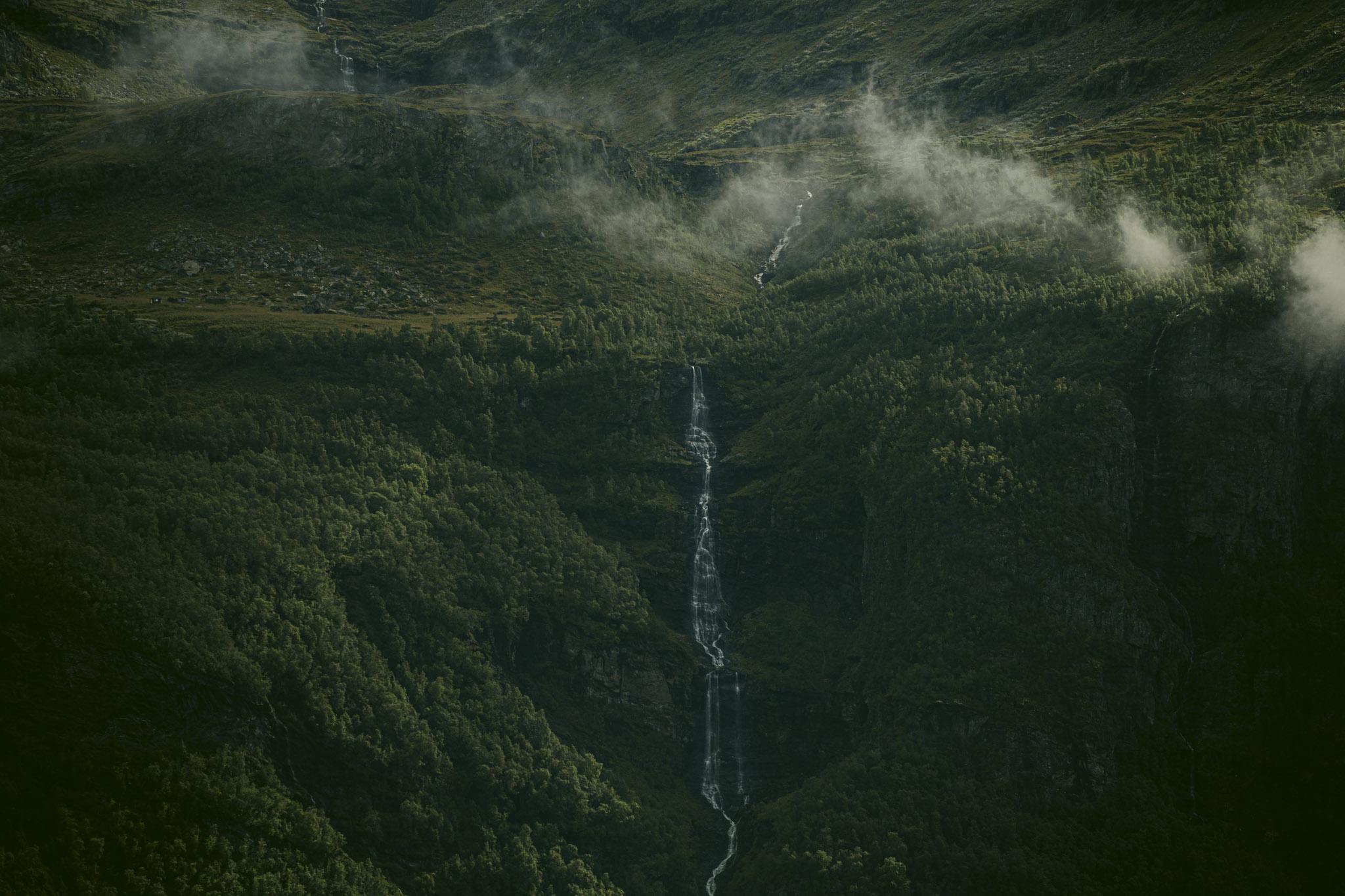
Each image isn’t just meant to look pretty, it’s meant to capture a specific feeling from the world or tell a small story. For instance, "morrnaiden" refers to the feeling of being in peaceful solitude beside something vast and greater than yourself. The piece itself is a photo of a tiny hut next to a massive waterfall, acting as a representation of a creature’s home. It’s so small that it nearly disappears on a screen, which is one of the reasons I print at A2 so you can actually make out the details up close. The final framed prints will have the feeling as though they were painted and pulled straight out of this world.

Would love to hear what you think of the concept!


r/worldbuilding • • 6h ago

Discussion How does your space-faring civilization use FTL or something similar.

0 Upvotes

Basically does your spaceships travel faster than light but while it take only a few years at most inside outside hundred of years have passed, punch a hole through an alternate dimensions, or just bend space around it.

While mine doesn’t have space since it just infinite skies, it does have a FTL type of system because some continents are too far apart to simply fly. Instead they basically travel through a dimension below them making the trip faster. But this is a dangerous trip without prepping because you’re traveling through what is basically Hell that would delete your soul without protection. You would need a large engine and a large amount of fuel, not to mention something you can attach it to since you can’t just attach to a regular ship. Heck most ships are large for that reasons and smaller ones are usually being used by mages who can power it by themselves.

But there is a way to easily bypass those two things. In this world Hype is a theoretically infinite supply source that mortals can generate, with it acting as the fuel and protection for everyone on the ship. And the easiest way to generate it is with music. So yes, they are using the power of an entire rock concert to power a ship. The only reason is theorized as infinite is because they get to their destination before they could test the upper limits and making a blind jump to a random place is a very bad idea.


r/worldbuilding • • 6h ago

Question Cultures

3 Upvotes

How does one go about making cultures for their world, especially amongst different species like humans and elves. I've been struggling making unique and interesting cultures.


r/worldbuilding • • 6h ago

Visual I designed a giant organism that grows entire cities — The Mother of Biomes (Original Concept Art)

Thumbnail gallery
12 Upvotes

r/worldbuilding • • 6h ago

Visual Some silly Djyþc Graffiti

Post image
1 Upvotes

Wer skol lavc dje vrowðormawlþswor!

[wər̪ ˈs̪kɔɫ̪ ʌʰfk ʑə ˈvr̪uw̟.ðɔr̪.mɔw̟ɫ̪θˌs̪wɔr̪]

"We must uphold the bro code!"

Literally: "We must live ourselves (to) the brother-language-words!"

A low-born teen and his friends left this message on an abandoned building (though it appears abandoned no longer).

It was carved in "common hand," an 18 character runic alphabet, which developed out of younger Futhark and early Lombardic capitals, as well as influences from the high-status textura minuscle letters used by the elite in books and official decrees.

Worldbuilding context as well as an example of the minuscle: https://www.reddit.com/r/worldbuilding/s/u5b7UGVPxG

Painted by me. No AI


r/worldbuilding • • 7h ago

Prompt Does your World/Story have Kemonomimi? What are they like?

44 Upvotes

Kemonomimi, translated to “animal ears” from Japanese, is a term used for characters (often in anime/manga), who have some animal traits, but are mostly humans. Usually ears, a tail, and some instincts. Think your catgirl/catboys, or the titular Umamusume of the media franchise Umamusume: Pretty Derby.

Does your world/story have some rough equivalent to this type of character? What are they called/how does society see them?

(And races that are anthro animals are also welcome to talk about!)


r/worldbuilding • • 7h ago

Visual Cybister-Class Cruiser

Post image
7 Upvotes

The ants have reached the sea.

The Cybister-Class cruisers were a series of armed vessels designed mainly by the antakian engineer William Miliksemut, made for direct engagement against enemy ships as well as coastal bombardment to aid infantry.

19 of them were ever built, rarely seeing combat. Across the the antakian campaing, fought against the country of Kardenantt, 8 were sunk by enemy artillery batteries and ships, and the rest were captured once the war concluded.


r/worldbuilding • • 7h ago

Discussion How would communication between werewolves work?

1 Upvotes

In my urban fantasy setting, werewolves are a clade of shapeshifting humans capable of transforming into the forms of wolves (very big wolves). The exact mechanisms of shapeshifting are a mystery, but it's a magical ability passed down through family lines, and can lie dormant for generations before suddenly appearing. Native werewolf populations are found throughout Eurasia and North America, and its believed that werewolves all have a common ancestor that existed sometime in prehistory (and thus werewolves basically all operate on the same mechanics).

Werewolves are unable to produce human speech while in wolf form, but are still able to communicate with each other. This isn't just wolf communication (though they might be able to also communicate with regular wolves and dogs), since it's capable of communicating complex ideas like how human languages can. To the untrained regular person, it just sounds like barking and such. However, this made me wonder how exactly this werewolf language would work. Some ideas so far:

  1. Some universal, physical language that all werewolves innately understand. Adds significant convenience to the story, but does raise questions about linguistic evolution. Did werewolves when the computer was invented wake up suddenly knowing the werewolf word for computer?
  2. Learned, special languages for wolf forms. Like the werewolf equivalent of American Sign Language. Allows for more cultural variation and evolution, but adds another barrier to dialogue, a basic character interaction. New werewolves having to learn to speak as a wolf might be more of a drag for the story than interesting.
  3. Supernatural mumbo jumbo like direct telepathy that doesn't obey normal rules of language. Might be its own can of worms
  4. Some mix of the above?

Has anyone here tackled a similar issue in their world? Feedback would be greatly appreciated.


r/worldbuilding • • 7h ago

Lore Lumeria - the Papp

Post image
20 Upvotes
  • Lumeria is part of a habitable band (a Goldilocks zone) called the Strip that encircles a tidally locked planet near a white dwarf.
  • The people living here are descendants of colonists who crash-landed after colliding with an astral body, now known as the Broken Moon. Unfortunately, the planet was already inhabited by parasitic beings. A long war of attrition followed, and the colonists eventually lost.
  • The planet is currently inhabited by “humans” who have undergone varying degrees of mutation over the generations, and society is neo-medieval

Among the original colonists were Catholics who, trapped between two kinds of Hell and convinced they had landed in Purgatory, gradually lost their minds. One of their batshit crazy leader decided that all the Strip must be "saved", by force if necessary. The Crusade failed and the Catholic creations were took down by native parasites.

The faith, however, did not die. Stubborn as they were, they tried to preserve it, and most of their descendants scattered across Lumeria and other regions, under the name of Katholiks and the Church of Yesoosh survived.

Some Katholiks chose to preserve the past by retreating into secluded enclaves. Calling themselves the Secret-Keepers, they are a group of scholars and politicians who operate in the shadows of neo-medieval society and led by the Papps.

Every major city has one. People say they know everything, guided by the voice of God whispering inside their heads.


r/worldbuilding • • 8h ago

Lore Evil organizations in your world

25 Upvotes

What evil organizations operate in your world and what are their ultimate objectives


r/worldbuilding • • 8h ago

Lore The art of rust cutting.

4 Upvotes

Metals in my world are far rarer than in our own, so when a sword or other weapon is broken or rusts, people will attempt to save it or even reforge it rust and all. Which is how a strange phenomenon was discovered. Rust seems to carry the memories of the metal it comes from. And when forged into a new weapon or tool, these memories enhance what the weapon is capable of. This is the process of enchantment.

Some memories of violence cause swords to deal wounds that do not heal, some memories of passion or vigor cause hammers to strike harder, some memories of focus cause knives to cut cleaner. And the more an enchantment rusts and is reforged, the more powerful it becomes.

For example, memories of violence might, in the beginning enchant swords to deal wounds that do not heal or strikes that don't miss. As the enchantment progresses in potency and presentation, these slashes may strike at a distance. Eventually, a target may be cut to ribbons just from the wielder touching the sword.

And so, people in my world have taken to rust farming; placing iron or steel weapons or tools into the moist soil to cause it to rust faster. Then they take rust and enchant other weapons or tools via imbuing them with the rust.

Crossbreeding rusts allow more nuanced and powerful enchantments.

Rust cutting

The process of rust cutting is a little more complex in this world than it would be in ours.

It all begins with the smashing of fruits or other materials with adhesives into a fine paste that loosens and collects rust. There are six standard versions of this paste recognized by the alchemist college (though technically there is no limit to its possible variations), each pulls on different memory types, preventing the mixing of non-compatible rusts and allowing the propagation of specific enchantments.

Then comes boiling. By boiling the pastes at different temperatures it becomes loose enough to get into the rust so it becomes sodden with the paste. Placing the rusty tool within the pot and altering the temperature is integral to the process of rust cutting. Each paste has one, if not several, temperatures that they need to reach to truly saturate the rust so it becomes easier to cut.

Finally cutting the rust is relatively easy to extremely difficult, depending on how well you made and applied the paste.

Six elixirs

The categories of elixer, the magic paste, are as follows:

Rubede - the hungry - desire, hate, passion; known for violent and forceful magics.

Cintrin - the receding - fear, withdraw, patience; known for distortive and illusory magics.

Caerul - the empathetic - understanding, connection; known for healing and supportive magics.

Albede - the dominating - control, subduing, suppressing; known for manipulation and dominion magics.

Necredo - the tranquil - acceptance; known to absorb and subdue other magics.

Opumus - the wild - confusion of magic; known to be volitile and unpredictable. Used specifically for expirimental magic that pushes the bounds of what magic is capable of.


r/worldbuilding • • 8h ago

Question Magic in my fantasy world

7 Upvotes

Hey, I am making a "fantasy" world, where most of the typical fantasy elements are scientificaly possible. I am making a magic system and I am wondering, if I should make it 100 % realistic, or a second option and that is making a second type of mass that would be the magic. It would be created when a specific wave length of light would hit a specific pigment in some plants/algae, it would technicaly be very simmilar to photosynthesis, but photosynthetic pigments respond to the visible light, this would respond to non-visible light so I'd call it magisynthesis. It would practicaly be just an altered science, so it wouldn't be out of place, but it would bring some mystery.


r/worldbuilding • • 8h ago

Lore Are There Other Planes/Dimensions in your setting? If so, what are they?

38 Upvotes

Mine only has one: Hell. Hell is NOT an Afterlife, It is Not created to punish the wicked and It is Not a Naturaly occurring places. It is the realm of the Beast, the Most powerful demon and one of the Most powerful mages in existence. It created Hell as is it's Personal playground to torment any who Made a pact with It, or somehow incurred it's wrath.


r/worldbuilding • • 8h ago

Discussion How do I justify the "pure" altruism of a cursed, aristocratic exorcist clan in a cynical 1890s setting? (Plus a twist on the sole survivor)

2 Upvotes

Hi everyone! I’m currently developing a dark historical-fantasy novel set in an 1890s-tech-level world governed by a mix of enlightened absolutism and aristocratic republicanism.

I’ve hit a bit of a psychological/realism snag with one of my core factions and would love some outside perspective to make sure their motivations feel grounded rather than overly idealistic.

The Setting & The "Blood Curse" Clans

The Power: Magic exists in this world, including standard elemental spells (like fireballs), alongside early modern firearms. However, against non-corporeal demons—and even materialized ones—conventional weapons and spells are largely ineffective. The only reliable counter is a visceral, flesh-and-blood power I’m tentatively calling the "Blood Curse." It’s not cast via incantations; it stems from genetic and biological mutations caused by generations of fighting supernatural entities.

Political Standing: Because they are indispensable, these mutated aristocratic clans are utilized by the human kingdoms, usually holding titles of Baron or Viscount. However, Earl is their absolute glass ceiling. The ruling elite deeply fears that letting mutated bloodlines marry too high up will cause an irreversible biological crisis within the nobility.

The Paradox: Despite being discriminated against by higher nobles, feared by the common folk (who find them cold, ruthless, and lacking "human warmth"), and ruling over kingdoms that are often deeply corrupt, these clans are fiercely loyal to humanity. They actively push for social welfare and better living standards for peasants (partially to prevent desperate people from making deals with demons) and willingly throw themselves into meat-grinder wars.

The Core Dilemma

At the start of the story, a prominent Viscount clan suffers catastrophic losses in a major campaign. Almost the entire bloodline—including branch families—is wiped out. By the end, the only ones left fighting on the front lines are the widowed matriarch (due to endogamy, the wives are also exorcists), the three youngest children, and their hereditary retainers.

My worry: In a gritty, realistic 1890s political landscape, does this level of self-sacrifice, love for humanity, and loyalty to flawed kingdoms feel too pure or unrealistic? How do I justify their altruism without making them feel like naive saints?

The Twist: The Sole Survivor

To make matters even more complicated, when the dust settles and the main family is completely gone, the title of Viscount—and the heavy duty that comes with it—falls onto the only remaining survivor: the youngest daughter of a hereditary retainer family who worked as a camp cook for the army.

Because hereditary retainers share faint traces of the clan's mutated bloodline, the dying matriarch hastily added the cook's name to the official family registry right before the final battle. Now, a kitchen girl who barely knows noble etiquette is suddenly a Viscountess sitting in the Upper House, trying to hold the line against both demons and vultures in the government.

Questions for Discussion:

  1. Justifying the Altruism: What psychological, biological, or socio-political mechanisms would realistically drive a marginalized, feared warrior-aristocracy to stay fiercely loyal and protective of humanity? (For instance, I'm considering framing their welfare policies as a cold "firefighter's logic" to prevent demonic outbreaks).
  2. The "Cook Viscountess" Dynamic: How would a low-born camp cook realistically survive—both politically and on the battlefield—when her inherited "Blood Curse" is too weak for frontline combat, and the elite nobles view her as a joke?
  3. Tone Check: Does the contrast between the tragic, high-minded sacrifice of the old clan and the gritty, grounded survival of the new "kitchen-maid Viscountess" work well, or does it feel jarring?

Any feedback, historical parallels, or brainstorming ideas would be greatly appreciated!