r/worldbuilding • • 9h ago

Discussion A big piece of advice to all worldbuilders...

227 Upvotes

This is in regards to a post I just saw, but I wanted to offer it to you all (especially those of you who just started) as someone who learned this the hard way.

WRITE.

EVERYTHING.

DOWN.

Record everything your brain comes up with, no matter if it's a quote, a piece of prose, a random worldbuilding idea, ANYTHING. WRITE IT DOWN. It's so helpful, and you never know where your ideas will go. I literally can never stress this enough and it's the best advice I can give you as someone who maladaptive daydreams a lot. Trust me, as someone who has frequently needed to reference old ideas that I've come up with dating back to the 1st century, it's a lifesaver.

Never think something has to be "good" to write it down. You can always workshop later, just get it down so you don't forget it. It's always better to have it than not to have it.

Also, if you do your best thinking in the shower (or even right before you fall asleep), get a whiteboard so you can write it down. They're called "shower thoughts" for a reason, and it pmo everytime I have to recall whatever I was thinking about and forget it.


r/worldbuilding • • 5h ago

Discussion [Discussion] How do you justify the existence of interstellar communities in your setting?

Post image
35 Upvotes

I’m at a point in my setting where I need the different aliens of the universe to meet up so I can actually begin detailing and developing the overall layout of my “space era” but I’m having a hard time justifying or finding benefits to why any of the different species and self-sufficient worlds would sustain an interstellar community past the point of initial discovery or encounter. 

General curiosity is a decent cause, but that’ll be extremely one note if it’s everyone else's motivation. I'd like to ask all of you for some insight. How do you handle this particular topic in your setting?

Image context: This is an artwork I made for my setting, Waveheart. It depicts what it might look like if some of the alien races were to meet and form a community. Waveheart is a science fiction project that aims to chronicle a region of space called Seretar's wake. Humanity (as we know it) does not exist in this setting. However, staying true to its classic sci-fi inspirations, there are some humanoid forms and human-like experiences within it. Among the variety of non-humanoid lifeforms that call Seretar's wake home, exist a six-limbed, bipedal species known as the Arjhan. We enter this world through their perspective as they unravel the origins of life on their planet and explore the wider universe around them.


r/worldbuilding • • 5h ago

Visual [Terminus] war worldbuilding: ‘The Mother’

Post image
27 Upvotes

Wow that just took 27 hours of my life

[The mother]
'And upon her forehead a name was written: Mystery, Babylon the great, the mother of harlots and abominations of the earth'

[The mother] is a mysterious but high standing figure in the [Black Communion], an underground cult organisation rooted within USSR territory, a haven for those damned by the Abyss.

Records of [The Mother] spans centuries in length, detailing the same masked woman who rode upon a six-headed abomination, adorn in robes and riches, sowing discord and rot wherever she approaches. No one has seen her face, not then, not now.

Drawn across the robes and exposed skin on [The Mother] are scriptures, incantations, unnatural geometries and runes. None but herself can replicate these patterns that to a normal man, can only be interpreted as delirious scrawls of a madman.

Upon activation of the profane illustrations, she is able to weaken the veil between two realities. It is speculated that The Mother is a scholar of a primordial language spoken by creatures before our time. Her writing has the power to bring about abyssal manifestation, to the extent of bringing [Abyss-born] into our plane of reality.

Monstrous abyss-born, despite their animalistic and fiendish nature, heed her every word, like children to their mother.


r/worldbuilding • • 2h ago

Visual The Martian Federal Army infantry chalk, circa 2547

Post image
13 Upvotes

Historical Notes

The base unit of the Martian Federal Army is the chalk, a term inherited from the airborne infantry of the 20th and 21st centuries. This arises from the fact that MFA combat doctrine prioritizes air mobility for its infantry, such that the bulk of its infantry expeditionary forces deploy via the MV28 Kingfisher tilt-rotor. Each chalk is broken down further into three teams, each with three members. Rumors persist that the MFA based this design on the packs used by the Zharan Liberation Army during the Frontier Wars, but these have been refuted by leadership.

The lead team contains the chalk leader, typically a sergeant or staff sergeant, and two backups, one of whom carries the GL38 underbarrel “smart” launcher on his R36 rifle. This launcher can fire a variety of programmable munitions from a removable stacked tube, with three rounds in each tube. The other two teams are gun teams, each centered on a gunner sporting the standard-issue MG38 light machine gun. There are typically three squads in an MFA platoon, with a handful of supporting elements attached to facilitate ground-level maneuver warfare tactics.

Standard platoon-level tactics involve the gun teams from each squad laying down a volume of fire for a leapfrogging advance which then allows all three teams on each squad in the platoon to close with and destroy any enemy force. This tactic has been used to great effect throughout the Nova War (2539-present), where MFA teams have often engaged numerically superior indigenous rebel forces supporting the independence of the Commonwealth of Talvan.

About the Setting

The Spacers Saga: Rebirther is a military science fiction storyline set in the mid-26th century. It deals with conflict between the neo-fascist Martian Federation and the neoliberal Solar Union over control of the Nova system, a resource rich star system accessible through dimensional doorways buried on Saturn's largest moon, Titan.

The plot focuses on Martian Federal Army soldier Alejandro “Alex” Martinez, who is deployed to Talvan (the chief world in Nova Space, and its chief battlefield) in 2547. When he's mortally wounded in a battle with native insurgents, he expects to wake up in the afterlife. Instead, he wakes up at a Martian cloning depot, already slated for redeployment into the fray once he regains his strength. The story of Rebirther thus deals with Alex’s struggle to come to terms with the fact that for soldiers like him, not even death is a way off the frontline anymore…

If you are interested in finding out more about the Nova system, this link will lead you to an article on the Spacers Saga Substack blog where you can learn all about it. While you're there, feel free to check out more of our blog posts, all about the world of The Spacers Saga. There is ZERO pressure to subscribe at any time.


r/worldbuilding • • 23h ago

Visual Depiction of God according to my setting's monotheistic religion

Post image
578 Upvotes

r/worldbuilding • • 40m ago

Visual A Chilly Day in Axlo Mayu

Post image
7 Upvotes

Even on a sunny day, it's cold up in the peaks of the Indikos mountains. Maybe we should head into that restaurant on the corner for some warm stew?

Lamalan is a world that I've been working on for over a decade. It is neither magical nor high-tech, but it takes place on a planet far from Earth.

The civilized/sentient species of Lamalan is a fluffy six-limbed creature called a llarma. They have their own cultures, languages, societies, politics, etc.

In this image, you see an average street in Axlo Mayu, capital city of House Indikos. It has the highest elevation of any capital city. The Indikans are a chill people who love hanging out, catching up with neighbours, and grabbing a bowl of hot food with a friend.

Hope you like it! Questions are always welcome.

Questions for you: Do you have a mountain city in your world? What are its people like? How do they deal with the chilly temperatures at high altitudes?


r/worldbuilding • • 16h ago

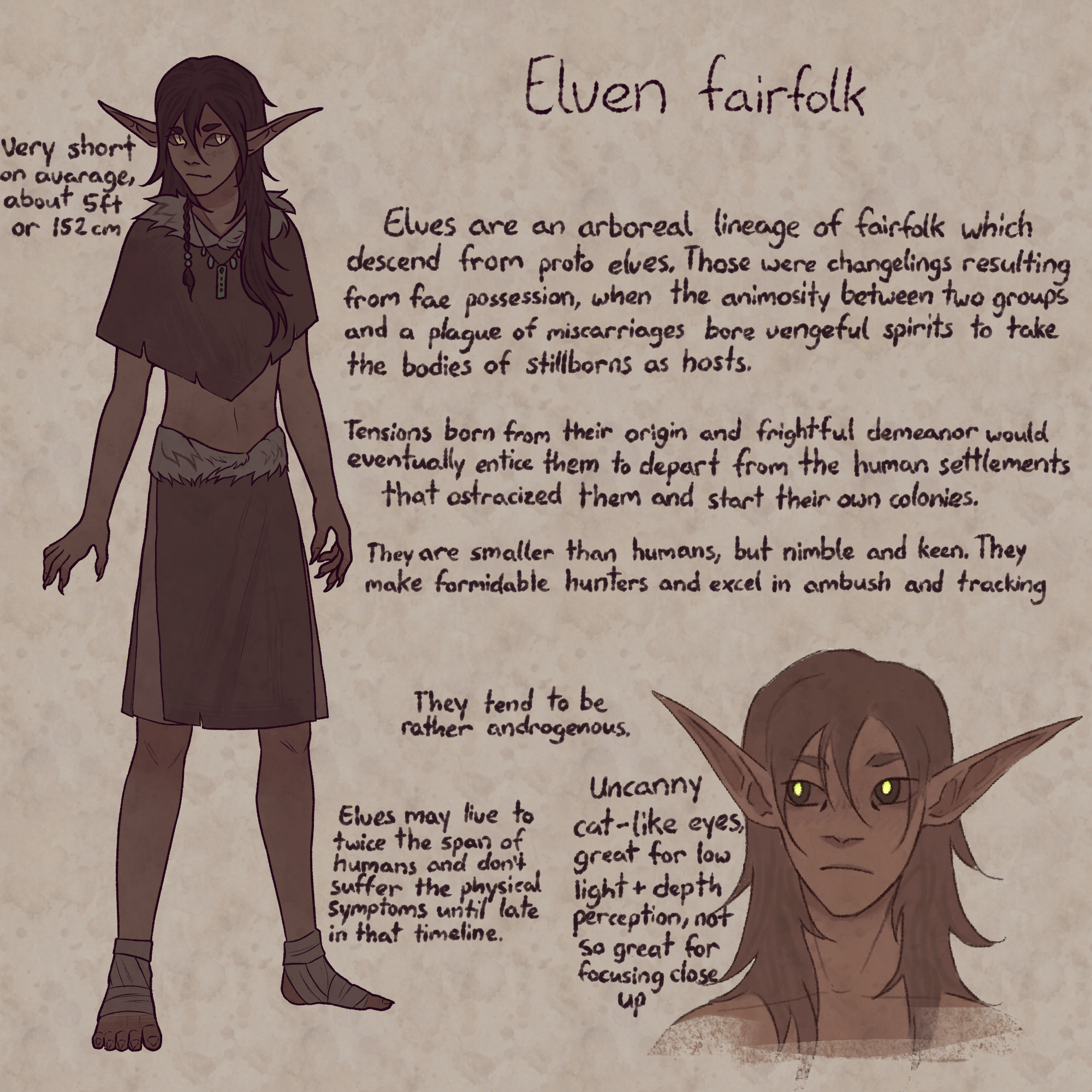
Lore Elven fairfolk

Post image
97 Upvotes

These are from this project

Elf is a broad category for a particular type of fae and associated human lineage. They originated when two groups of humans met at a wellspring, a valley made fertile by the magic that naturally flowed into it. Unfortunately, they didn't meet well and animosity formed between the already established group and the newcomers.

Clothes stolen, crops trampled, livestock killed, food spoiled, stillborn infants. Everything that went wrong was blamed on the other side, and these losses increased in frequency as tensions grew.

The land was abundant with magic, fertile to frightful invention. It readily took the seeds of animus, letting them grow into resentful spirits. It was believed that these were the souls of the stillborn children, but who could really be certain? They came through the wellspring to cause strife for the living, no matter their side on the conflict.

The Fae are shaped by fear and rumor. They are inhuman things that steal in the night, put out fires, and taint crops. They are small, like children, but feral and agile. They are sexless, with long ears and sharp teeth. They attack from the shadows, gone before they can be caught. These are true elves, elven fae spirits.

The rise of infant mortality also results in plenty of vessels for the most active of fae spirits to possess and become changelings. Many of these are killed at first, but the population becomes more desperate over time, and a changeling is still a child: moldable and susceptible to the influence of society and nurturing.

One changeling is kept and raised as a human, then another, until they make up a small but noticeable portion of the population. As the conflict is forgotten to time and fluxing magics settle, infant mortality decreased, and the fae grew skittish and elusive.

The changelings remained, integrated into their human families, some eventually having children of their own. Like the Elven changelings themselves, their children, called Elven fairfolk, are distinct from other humans. They look different, they're nimbler, keener, temperamental in their youth, and require more food to stay sated.

Periods of hardship cause strife and prejudice between the Elven Fair and the human portions of the population. Elves are called beastly and accused of eating up resources. Eventually, many Elves depart from human settlements to begin their own societies with the humans and Elves that are more compatible with their inclinations

Divergence in their population resulted in a couple subtypes of Elves with slightly different phenotypes. But ultimately there wasn't a sustainable number to begin with, and the divide between Elvenkind and humankind grew blurry. Most modern descendants, elvish humans, have few distinguishable elven traits. Some amount of pride or conflict lingers in the heritage.


r/worldbuilding • • 13h ago

Prompt Does your World/Story have Kemonomimi? What are they like?

53 Upvotes

Kemonomimi, translated to “animal ears” from Japanese, is a term used for characters (often in anime/manga), who have some animal traits, but are mostly humans. Usually ears, a tail, and some instincts. Think your catgirl/catboys, or the titular Umamusume of the media franchise Umamusume: Pretty Derby.

Does your world/story have some rough equivalent to this type of character? What are they called/how does society see them?

(And races that are anthro animals are also welcome to talk about!)


r/worldbuilding • • 1h ago

Map Created an account just for this! Help me design a 10–15 million people city (NO AI)

Thumbnail
gallery
5 Upvotes

Hey everyone!

I literally created this account just to ask for your help with a fictional city I'm working on!

Here are the basic details:

The setting:

  • Population: 10 to 15 million.
  • Technology: Modern day.
  • Climate: Winters around 59 - 68°F (15 - 20°C), summers around 77 - 86°F (25 - 30°C).
  • Country: Extremely wealthy, so the possibilities for development are practically unlimited.
  • Location: Wanna place it in this place (Open to other places)

What I'd love your help with:

I'm looking for ideas on where to place the city geographically, how to organize its districts, what industries and economic sectors it should develop, and what kind of infrastructure, landmarks, and major projects it could have.

Feel free to suggest anything: from the location and general layout to specific neighborhoods, industrial areas, financial centers, universities, transportation systems, parks, or ambitious megaprojects.

I'm also interested in the city's defense and security: how would you protect a metropolis of this size, what defensive infrastructure would you include, and how would you integrate it into the city's overall layout?

I'm open to all kinds of ideas, realistic or ambitious. I'd love to see how you would approach designing a city like this!

NO AI, please! I'd really like to hear ideas from actual people.

Thanks! :)


r/worldbuilding • • 6h ago

Discussion How many times has your world been rewritten? How many things have you changed within it? Does anything remain of the original ideas—anything you specifically wanted to keep?.

10 Upvotes

Has any nation, religion, sentient animal species, race/sapient species, or fundamental aspect of magic—anything at all—survived? EDIT: what to do to make sure the things I want the most will stay?


r/worldbuilding • • 15h ago

Lore Evil organizations in your world

47 Upvotes

What evil organizations operate in your world and what are their ultimate objectives


r/worldbuilding • • 15h ago

Lore Are There Other Planes/Dimensions in your setting? If so, what are they?

50 Upvotes

Mine only has one: Hell. Hell is NOT an Afterlife, It is Not created to punish the wicked and It is Not a Naturaly occurring places. It is the realm of the Beast, the Most powerful demon and one of the Most powerful mages in existence. It created Hell as is it's Personal playground to torment any who Made a pact with It, or somehow incurred it's wrath.


r/worldbuilding • • 10m ago

Discussion How to come up with races that aren't animal on two legs?

3 Upvotes

In many fantasies, when the creators try to come up with new races for their worlds, it mostly animals in two legs and I am not huge fan of that concept.

Things like Centaurs , Satyrs and Harpies I fine them interesting as they have animal aspects but they are not fully animals.

However when I also try to think of something new and unique, it's not easy because it's hard to create a new intelligent race that also can be relatable to the consumer.

I try to look up many sources for inspiration, books, mythology and even theology and movies but most of the good ideas are already used.

So when you build your world, how you come up with new races ideas?


r/worldbuilding • • 13h ago

Discussion Where photography meets world building

Post image
30 Upvotes

I’ve recently made up my mind on what I want to dedicate myself to for the foreseeable future, or perhaps my whole life, if people find it interesting enough. I have a deep passion for both photography and worldbuilding, and I’ve decided to combine them into a single, unique art form. I haven’t really seen anyone approach it quite like this before, so I’m super excited to finally share the concept!

For Context

My fantasy world, Médal, is a project a friend and I have been developing for about two years. It includes new creatures, unique plant life, and magic alongside humans and other familiar species. I’ve also created conlangs that I plan to weave into the world and around the pieces themselves.

Outside of worldbuilding, I’m a nature photographer, and I recently invested in a professional fine art printer to produce archival-quality prints.

So, how am I going to combine the two?

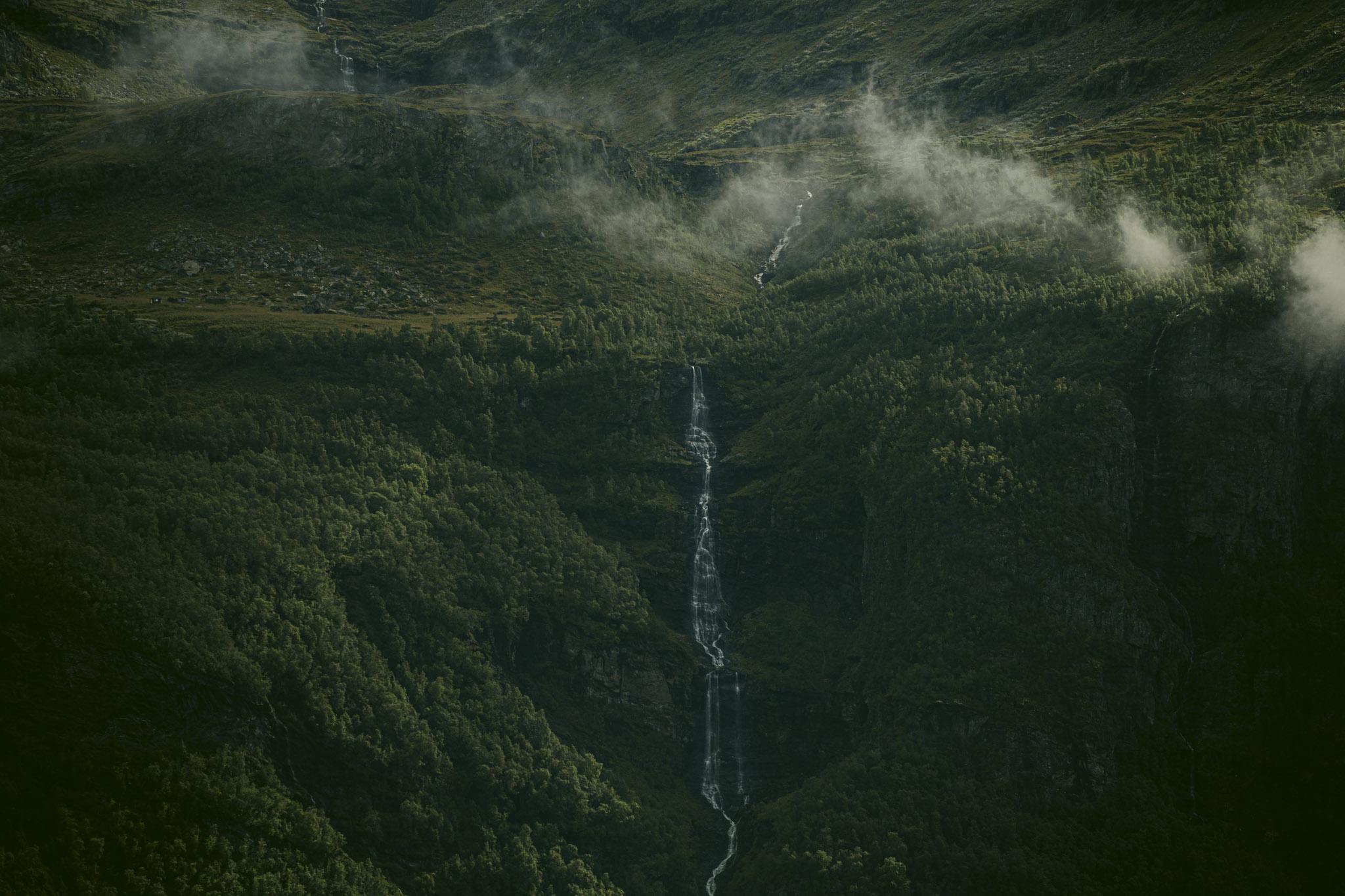
Each image isn’t just meant to look pretty, it’s meant to capture a specific feeling from the world or tell a small story. For instance, "morrnaiden" refers to the feeling of being in peaceful solitude beside something vast and greater than yourself. The piece itself is a photo of a tiny hut next to a massive waterfall, acting as a representation of a creature’s home. It’s so small that it nearly disappears on a screen, which is one of the reasons I print at A2 so you can actually make out the details up close. The final framed prints will have the feeling as though they were painted and pulled straight out of this world.

Would love to hear what you think of the concept!


r/worldbuilding • • 18h ago

Visual (Progeny) An alternative Mars.

Thumbnail gallery
73 Upvotes

Introduction to Progeny:

Progeny takes place in an alternate universe where much of the Solar System has changed. Mars and Venus are habitable* worlds, Jupiter has a terrestrial Trojan companion, and more.

Mars

Mars' mass in Progeny has been doubled relative to the real world, sitting at roughly 22% of Earth's mass. Having enamored astronomers for thousands of years, culminating in the first detailed photographs being sent by Mariner 4. Life on Mars is just as diverse as on Earth, but the cellular and chemical similarities to life on Earth cannot be ignored. Just as in the real world, Earth truly has been the only cradle of Life, it simply managed to move to other, similar worlds.

The Air

Mars' atmosphere is thin, roughly 58% pressure at sea level, and is predominantly carbon dioxide with comparatively less nitrogen and oxygen.

Photosynthesis on Mars is slower due to Mars recieving a fraction of Earth's sunlight, and lack of significant geologic activity prevents CO2 from being absorbed into the rock and buried.

The Sea

Mars oceans are far less extensive than Earth's, with much of it locked away in glaciers at the poles and along the Tharsis rise. This drop in sea level has caused the salinity of the seas to spike, being nearly twice as salty as the Pacific. The rivers sprawling across the Southern landmasses drain into just two large basins, the Boreal Ocean and the Hellas Sea, with most of the water coming from glacial melt rather than rainfall.

The Land

Tharsis

Mars' landscapes are varied and diverse, dominated by volcanic features rather than tectonic ones, with plate tectonics having fizzled out over a billion years ago. The most striking feature geographically has to be the Tharsis Rise, a volcanic plateau that houses 5 of the planet's 6 largest volcanoes, with the sole exception being Elysium Mons. Olympus, Alba, Pavonis, Arsia and Ascraeus have all built the plateau to be 6 kilometers above sea level. The air is so thin at the safe flying altitude above the plateau that the rotor planes used to navigate Mars are often forbidden from flying above it, not to mention the fact that Pavonis, Ascraeus and Arsia are becoming active again with Olympus showing signs of waking as well.

The Mariner Channel and the Gulf of Chryse

A large feature associated with the Tharsis Rise, Mariner acts as a primary mode of sea access in in the Xanthean interior. Mariner, named after the probe that discovered it, formed as the planet's crust cooled and began to crack, and this crack was widened by water and volcanic activity until we see the enormous trench system we see today. Large volumes of water flow out of the Mariner Channel into the Gulf of Chryse and then into the Boreal Sea.

Elysium Mons

The second largest volcanic province on Mars, Elysium acts as a near polar opposite of Tharsis. Far gentler in activity and elevation, Elysium supports one of Mars' most diverse biospheres and its closest environments to rainforests. Most human populations center around Elysium Mons, and as such is the most studied place in exobiology on Mars or Venus.

Much is still to come with this project, so I apologize if the lore is a bit spotty here and there. Regardless, I will try to keep working on this and flesh out Mars and the other worlds more.


r/worldbuilding • • 16h ago

Discussion How do you create names that aren't just existing words

50 Upvotes

As the title says, I'm curious about what's the thought process you use to come up with unique names for characters, locations or anything else in your world?


r/worldbuilding • • 11h ago

Question What would it change about our understanding of humanity, language, and culture if we got to space and realized we were the only species out there that developed multiple languages for ourselves?

19 Upvotes

I'm thinking about media like Star Wars where (other than a few nods in novelizations and such) it's largely understood that all of one alien species speaks the same language.

If that were actually true of most alien species, what would that mean about us?

How would it change our view of language(s) as a whole?

Would any of this extrapolate out into other areas like the development of culture, history, etc.?


r/worldbuilding • • 1h ago

Discussion Must watch TV for worldbuilders: James Burke's Connections (1978)

3 Upvotes

After binging the entire series, I highly recommend watching Connections, a BBC documentary series by James Burke that explores the interconnected history of science, technology, and human civilization.

(It's free to watch on YouTube: Connections – Full Series)

I think it illustrates one of the most important aspects of technological development that worldbuilders often overlook: inventions don't happen in a vacuum, and technological progress isn't only the result of brilliant individuals having brilliant ideas. Some of humanity's most important inventions, such as the steam engine, electricity, and computers, are the culmination of long chains of technological and societal developments that made them possible.

An invention might be centuries ahead of its time, but that doesn't mean it can actually be implemented, mass-produced, or become useful. For an invention to succeed, it needs the right environment: supporting technologies, available resources, economic incentives, infrastructure, social structures, and sometimes even entirely unrelated developments.

A great example is the steam engine. Versions of it were invented and reinvented multiple times long before the Industrial Revolution. Yet it was only when the right conditions came together – improvements in metallurgy, the ability to mass-produce quality iron and steel, abundant and accessible coal, and the economic demands of an increasingly industrial society – that steam power could truly transform the world.

This also ties into questions like medieval stasis and similar concepts. It helps explain why technological progress seems to accelerate exponentially. It took us thousands of years to go from bronze to iron, but only a couple of decades to go from the invention of the internal combustion engine to commercial aviation. Disruptions to technological development in its earlier stages can have a disproportionate effect on how long it takes societies to advance.

It's also a really good explanation for why several major inventions, such as the telephone and the lightbulb, seem to have multiple independent inventors claiming credit for them. Once the necessary conditions for an invention fall into place, its development can become almost inevitable. Conversely, when those conditions disappear, an invention or technology can disappear with them.

Connections is essentially a masterclass in thinking about the history of technology as a web of interconnected developments rather than a linear progression of increasingly clever inventions. And it's also just really good television.


r/worldbuilding • • 6h ago

Lore An Apocalypse Is Not Enough

Thumbnail
inotherworlds.net
7 Upvotes

art by Shiran Sooriya

How do you get consecutive generations moving in the same direction? The solution in a great deal of popular fiction is straightforward enough. There is some kind of cataclysmic event. The people come together and vow 'never again'. There's a flash forward to a set of impressionable schoolchildren being told by their teacher 'we don't do that anymore'. And those scenes do strike a chord. Of course people wouldn't repeat a mistake like that.

But wouldn't they?

There was a major flood along the Vltava in Bohemia in 1118 that washed away settlements all along its banks. That sounds pretty cataclysmic for the people involved. And it had an immediate impact. For a generation, people built away from the banks. But then, as the people who'd experienced it first-hand died, the settlements crept closer again. Then the floods came back and the cycle repeated, not once but six more times over the next seven centuries.

And then there's measles. It killed millions until it was brought under control in many countries through vaccinations approximately 60 years ago. Now, vaccination rates are dropping and countries that were previously measles-free are seeing a resurgence.

In both cases, the memories fade along with the people who hold them. The motivation goes with them.

So what can create an intergenerational drive? That was an important question for our story, Jupiter's Arc. In it, humanity is undertaking a multi-generational project to transform Jupiter and her moons into an ark and move them to another solar system. As the story aims at not just hard science but also, for want of a better word, hard politics, we wanted a believable answer.

Eventually, we found our answer in a surprising place: the European Union.

Europe's Flood

After the Second World War, Europe said 'never again'. The thing was, only 27 years earlier they'd said the same thing at the end of the First World War and we all know how that turned out. So this time, they created a framework with real bite. The 1950 Schuman Declaration stated that war between France and Germany should become 'not merely unthinkable, but materially impossible'. To this end, they integrated coal and steel across their borders so that neither alone had the industry to go to war. This eventually became the European Union.

The EU is not a great governmental model. But the pact that underlies it did succeed in one regard. In the 80 years before 1945, the continent produced one major war after another. Between France and Germany alone there were three: the now largely forgotten Franco-Prussian War, then WWI and WWII. In the 80-plus years since, no member of the European Union or its predecessors has gone to war with another member. 'Peace for our time', as Chamberlain so infamously put it a few months before the Germans rolled into Prague. But this time for real.

Europe's flood was in 1945 and the people who saw those waters are nearly all gone now. The number of people voting for extremist parties that question democracy and liberal values keeps going up.

And yet no government or population within the EU is clamouring for war with a neighbour even as wars tick up globally. Not a single member is looking to leave. Instead, the queue to get in keeps lengthening.

So what is holding it, if not the memory?

You Can't Leave

Some of you might think a long-nosed mammal snuck in at the end of the last section. So let's talk about Brexit. When the United Kingdom left, many predicted it was the first domino in a chain that would end the bloc. That didn't happen. Instead, Brexit demonstrated to all how excruciatingly painful leaving was. This was partially for political reasons and partially for economic ones.

The political ones first. The treaty gives a leaving member a short window of two years to finish negotiations. If they don't, they either have to convince every remaining EU country to agree to an extension or leave with no deal at all. Two years might sound like a lot but in a political negotiation the parties involved have barely finished their round of introductions in that time.

On top of that, Brussels made the terms binary: the whole package or none of it. Those arguing for leaving had thought they could cherry-pick. They were wrong. François Hollande, then French president, put the logic plainly: 'There must be a threat, there must be a risk, there must be a price.'

The economic reason was that the UK had, perhaps without fully realising it, become completely entangled. Businesses, qualifications, product certifications, the right to sell financial services across the continent, all of it ran through Brussels, and when the border went back up it all had to be unwound at speed. Economists at Stanford and the Bank of England put the UK economy at six to eight per cent smaller than it would have been, and investment at 12 to 18 per cent smaller.

You might think that this was what the European politicians wanted. It wasn't. Once the UK decided to leave, it was all about showing what that meant for the next domino. It worked: during the Brexit chaos, Le Pen shelved Frexit, the Sweden Democrats dropped Swexit, and Italy's Lega quietly painted over the 'Basta Euro' slogan on its headquarters.

Greece was on the verge of heading for the exit as well but for different reasons. In 2015, Greek voters rejected the terms of their bailout by 61 per cent in a referendum. Another round of domino predictions was splashed all over the world's front pages. A week later Greece's radical left government signed a harsher deal than the one just voted down. Not because the voters had changed their minds, but because the only alternative to the deal was even more harmful: leaving the euro.

You Don't Want To

It's not all stick. Not if so many countries want to join. So what are the carrots and who gets to eat them?

The politicians certainly get a bite. For them it's cover. A fact of policy design is that many reforms a country needs hurt one group a great deal while helping everybody else only a little.

Consider closing a coal plant. Coal doesn't just cause global warming, it's also a serious health hazard. When the plant closes, lots of people benefit as breathing-related issues and even cancer cases drop. But people do not vote for a government for not getting ill while those in other countries don't get a vote at all. The workers in the plant and mines, in the meantime, will take their anger to the ballot box.

The EU gives governments a way out of that. We didn't have a choice. It's EU policy. Blame them. In countries where big chunks of the state have been captured by special interests, this helps governments get reforms through that would otherwise never pass. Studies have shown that many countries aligning their laws with the EU experience higher economic growth even before they join. Of course, this has a cost that is paid in the high popularity of Eurosceptic parties.

Then there's the money. The developed members pay in more than they receive, and the difference goes to help poorer members catch up through infrastructure and development projects. A fair amount of it gets stolen. Hungary was, until recently, the textbook case, with billions disappearing into the pockets of Orbán's allies. It's a little mystifying that the people who built these mechanisms didn't create better audits. But notice what the theft did. Orbán vetoed and harangued, but he never seriously considered leaving.

It isn't just governments that benefit. A lot of money is also handed out to specific groups. Farmers alone receive almost a third of the EU's budget. That was a bad idea in 1962 and a worse one now. But if anybody in their government even whispers 'leave' or 'change', the farmers are driving trailers full of manure towards the capital. Pork isn't just corruption. It's also glue.

These policies continue to pull people and countries in long after the original reason for the project has been forgotten.

Of course, once they're in, people aren't just going to sit still. Since they can't leave, they'll try to find ways to bend the system to their own needs.

You Can't Rush It

So how come the system hasn't yet been bent into a pretzel that would have the original founders throwing up their hands? That's down to the thing arguably most despised about the EU: its inertia.

Changing the treaties needs every member's signature. So going back is as hard as going forward. Because every change is committeed ad infinitum, everybody can get a look in. Most of the agreements were technical specs nobody knew they had to campaign against. Once signed, they became law. Want to join? Here's a wheelbarrow full of documents you'll have to sign. Then we'll deal with the four trucks full of treaties outside.

Want to change it? Good luck convincing every other government to not just want to change it but also spend their political resources there instead of somewhere else. Until then, you'll have to follow those laws, as they're more powerful than your country's own.

Hungary spent a decade and a half in open conflict with Brussels over courts, press and money. Then that conflict crumbled as Orbán was voted out. And the project? It only changed direction slightly. The vetoes were cast and worked around. The underlying pact remains as it was.

When attitudes swing every four years but the EU only reacts at glacial speed, then treaties don't change. And therein lies the solution to the Vltava. What stopped the people near the river from building closer to the edge was something that fades. The EU's solution is to create a law that makes building there a crime and then demand a unanimous vote to change it.

Is this a good idea for a governmental body? Absolutely not. Unanimity is a dreadful way to deal with a looming disaster. The euro crisis, the migration summits and the invasion of Ukraine have all shown why you shouldn't demand that 27 governments negotiate before anything can happen (the 'my name is David' round only just completed on Ukraine).

The key word is 'governmental'. Governments have to deal with the next crisis and can't do so if everything moves painfully slowly. Brussels tries to do two jobs with one set of institutions. That is a serious design flaw. If you get the opportunity to start from scratch, we suggest you try something different.

But if you're creating a pact? It's a different matter. It should care far more about unanimity than speed. Every agreement takes forever because everybody gets a say, so nobody afterwards can argue they weren't consulted. Your country had its chance to speak out. It didn't. No backing out now. Who cares if you weren't alive when it was decided?

That might look like a bug when you're living through it. But it's a feature if your goal was to create something that keeps moving in the same direction.

So how did all that inform our intergenerational project to transform Jupiter?

Jupiter's Arc

Unsurprisingly, our story also begins with a cataclysm. Earth was pushed to the brink by an ecological disaster and only just managed to pull back. This focused minds. Humanity came to understand that all known life depends on the biosphere of one small planet. If it goes, so do we.

So a number of governments came together around a plan: turn Jupiter's moons into an ark for Earth's biodiversity, make Jupiter herself the engine, and send the lot to another solar system. Even if Earth didn't survive, the species that call it home would.

The founders knew the project would take centuries and that most of the cost would be borne by generations who hadn't seen the flood. So, while the memory was fresh and the emotions were hot, they struck an ironclad agreement that would bind not just those who signed it but their children as well.

That treaty has a technical name. Everybody just calls it the Covenant.

Unlike the EU, the Covenant wasn't designed to govern. It writes no laws and it doesn't deal with crises. Instead, members signed up to two things: a fixed slice of their GDP, every year, and oversight by a set of new institutions that spend it. Both end only when the ark is finished.

While the slice was fixed, how it was spent wasn't. It was designed to have two stages. Initially it would build the infrastructure necessary for the project in members' own countries. Only afterwards would it construct the megastructures at Jupiter.

The benefit was immediate. Joining meant serious money being invested locally to build industry, train workforces, and do research. This had knock-on effects for the whole economy. It also created a class of companies and workers who, much like the EU's farmers, depended on the status quo and were willing to defend it. The founders' generation got the boom. The bill went to people who weren't born yet.

To make sure the ark actually got built, two key mechanisms were put into place. The industries created for the project pass to the country that hosts them only once the ark is finished. So backing out of the project early meant forfeiting all that investment — a cost that only grows the longer the country is inside the Covenant.

Also, the supply chains were spread across all the members. So, even if a country were to nationalise these industries within its borders, it would be left with neither the resources to run its industry nor the customers to sell the output to.

Many countries, poor ones above all, thought those terms a fair trade for a slice of the rich world's GDP. For some governments the conditions of entry were an attraction in themselves. To get in, a country had to open its markets to the other members and clean up its courts and its books. Plenty of them had eyed those reforms for years but never dared pass them. Now they could tell their voters the Covenant did it. Others were lukewarm about this part but wanted the money. The reason why they signed didn't matter. Only that they did.

The early members boomed, and the waverers noticed. A second wave signed up even as the cataclysm itself was starting to recede from memory.

Then the building at Jupiter started and the bill arrived. The Covenant had never hidden its objective and its members had always known what was coming, which made it hard to argue they shouldn't pay. Changing the rules was nigh on impossible, because any change needed every member's signature. So even if a government came to power by campaigning against the Covenant, it still needed every other member to sign off before a comma moved. Brussels pays for that kind of slowness every time a crisis hits. The Covenant avoids this trap by leaving crises to governments.

Some still tried to get out. That's a story for another time.

Today, plenty of countries and groups are unhappy that a chunk of their GDP is being shot into space. But they are handcuffed by the decisions of their ancestors and the need for unanimity. So ships fly, engineers build, and the transformation of Jupiter keeps inching forward.

And the cataclysm itself? It's in chapter nine of the school history book. Some of the kids do presentations about it. Most will have forgotten it by summer.

Originally posted on inotherworlds.net


r/worldbuilding • • 10h ago

Discussion Fantasy set on Earth with irl history and cultures

12 Upvotes

This stems from a thought I had while reading a cultivation novel and seeing a mention of Zoroastrianism; what’s happening in the rest of the world? I had an idea for a story set on an alternate Earth in the Middle Ages, with real historical figures. The idea being that magic is real everywhere, and is geographically and culturally linked. For example, in China you get the classic cultivation as seen in martial arts films, in Europe, you get power based on Christian theology, alchemy, and witchcraft. It would be possible for a person to obtain multiple powers, but they would have to travel throughout the world to obtain them from the original lands that they are from. I only have two examples, but does anyone have ideas for more power systems?


r/worldbuilding • • 8h ago

Lore Light that can sit still, and hit with the force of a rock. [Th'zoitrk]

Thumbnail
gallery
8 Upvotes

(For Th'zoitrk, a semi-sci-fi worldbuilding project.)

This is the third post I've made explaining the physics of Th'zoitrk, the previous two posts can be found here, and here.

According to Th'zoitrk's block model of physics, there is a fundamental particle that makes up absolutely everything in the universe, Humes. I won't go in-depth about them here since I've explained that before; all that you need to know is that Humes form 'blocks' that make up reality.

The Humes within each block spin.
Clockwise, counterclockwise, forwards, and backwards. That's the four orientations as they're usually represented, of course they aren't ACTUALLY moving in those exact ways, it's just to better visualize it to a typical person.

These four rotational 'essences' cause the given block to behave as one of four things.
Matter.
Inverse matter.
Photons.
& Tekons.

If you can change the rotational essence of a block, you can change what it fundamentally is. You can turn light into solid matter, or matter into light.

Matter and light I won't get into since you probably have a pretty good understanding of both already.

There isn't enough space in the post to discuss both tekons and inverse matter without yapping forever.
So instead, I'll focus on:

--------Tekonics & Quidium--------

Tekons are a wave, similar to light. Under normal circumstances they behave just as light does. Except, when you shorten their wavelength enough something changes.

Past a certain point the wavelength gets so short that, for some reason, it stops behaving as a wave.

The tekonic wave begins interacting with gluons, the carriers of the strong force, converting energy into mass from the interaction (the same way how most of the mass in an atom is formed) and, as a result, tekons start behaving as a particle rather than a wave.

This new particle is, while technically still a tekon, officially referred to as quidium.
Quidium particles behave very similarly to particles of matter. Quidium particles can form together with other particles to form 'atoms' of a sort which are comprised entirely out of quidium, a material which is quite literally solidified radiation.

Quidium 'atoms' behave as if they're a new element, even though they most definitely are not.
Quidium can bind with other real elements to form new compounds, although for some reason they normally don't actually change anything about how the molecule would behave if quidium weren't there anyways.
Some compounds do behave differently when quidium is present, as a new material, but for most molecules out there it doesn't seem to actually change anything.

A tekon's wavelength can continue shortening even after forming quidium, as well. It just makes the quidium denser. The first form of quidium is quidium-0, when you make the wavelength 7x smaller it becomes quidium-1, 7x smaller again for quidium-2, so on and so forth.

Quidium is the material which makes up all known life.
Th'zoitrk's biosphere is comprised of quidium-based organisms; as is the biospheres of Th'zoitrk's moon Okkaelko and the Oukapolean moon Puloini.
This is why life on Th'zoitrk, such as dectrons, do not need water whatsoever to survive.

In fact, to a lot of quidium-based life, water is a toxic substance which can break down their flesh and constituent materials like an acid.

Dectrons (the sapient species and civilization on Th'zoitrk) do not breathe oxygen, rather, they breathe nitroquidium. A compound formed when a lone nitrogen atom binds together with quidium 'atoms.'
Specifically, Th'zoitrk's atmosphere is made up of nitroquidium formed from quidium-22.

Some celestial bodies have quidium making up a significant enough portion of their mass that they possess a *teko-*magnetosphere. A magnetic field formed from the inherent magnetism of tekons and quidium.
The only celestial bodies known to posses a tekomagnetosphere are Th'zoitrk, Th'zoitrk's moon Okkaelko, the Oukapolean moon Puloini, Sh'beso, and Okott (the sun.)

Every other world (ignoring the sun) which have a tekomagnetosphere also have quidium-based life. This is why dectrons are currently investigating the gas giant Sh'beso as a very plausible location for life to have evolved separately from Th'zoitrk.

Quidium is believed to make up as much as 11% of Th'zoitrk's entire mass. Practically all the nitrogen in Th'zoitrk's atmosphere is quidium.
This substance is the constituent for all known life, getting it to other planets in significant amounts is a necessity for Dectrons to colonize the solar system.

Thankfully, due to its unique nature, quidium-based life doesn't really need to worry about temperature.
Quidium-based single-celled organisms can exist at literally any temperature above absolute zero.


r/worldbuilding • • 14h ago

Lore Lumeria - the Papp

Post image
24 Upvotes
  • Lumeria is part of a habitable band (a Goldilocks zone) called the Strip that encircles a tidally locked planet near a white dwarf.
  • The people living here are descendants of colonists who crash-landed after colliding with an astral body, now known as the Broken Moon. Unfortunately, the planet was already inhabited by parasitic beings. A long war of attrition followed, and the colonists eventually lost.
  • The planet is currently inhabited by “humans” who have undergone varying degrees of mutation over the generations, and society is neo-medieval

Among the original colonists were Catholics who, trapped between two kinds of Hell and convinced they had landed in Purgatory, gradually lost their minds. One of their batshit crazy leader decided that all the Strip must be "saved", by force if necessary. The Crusade failed and the Catholic creations were took down by native parasites.

The faith, however, did not die. Stubborn as they were, they tried to preserve it, and most of their descendants scattered across Lumeria and other regions, under the name of Katholiks and the Church of Yesoosh survived.

Some Katholiks chose to preserve the past by retreating into secluded enclaves. Calling themselves the Secret-Keepers, they are a group of scholars and politicians who operate in the shadows of neo-medieval society and led by the Papps.

Every major city has one. People say they know everything, guided by the voice of God whispering inside their heads.


r/worldbuilding • • 22h ago

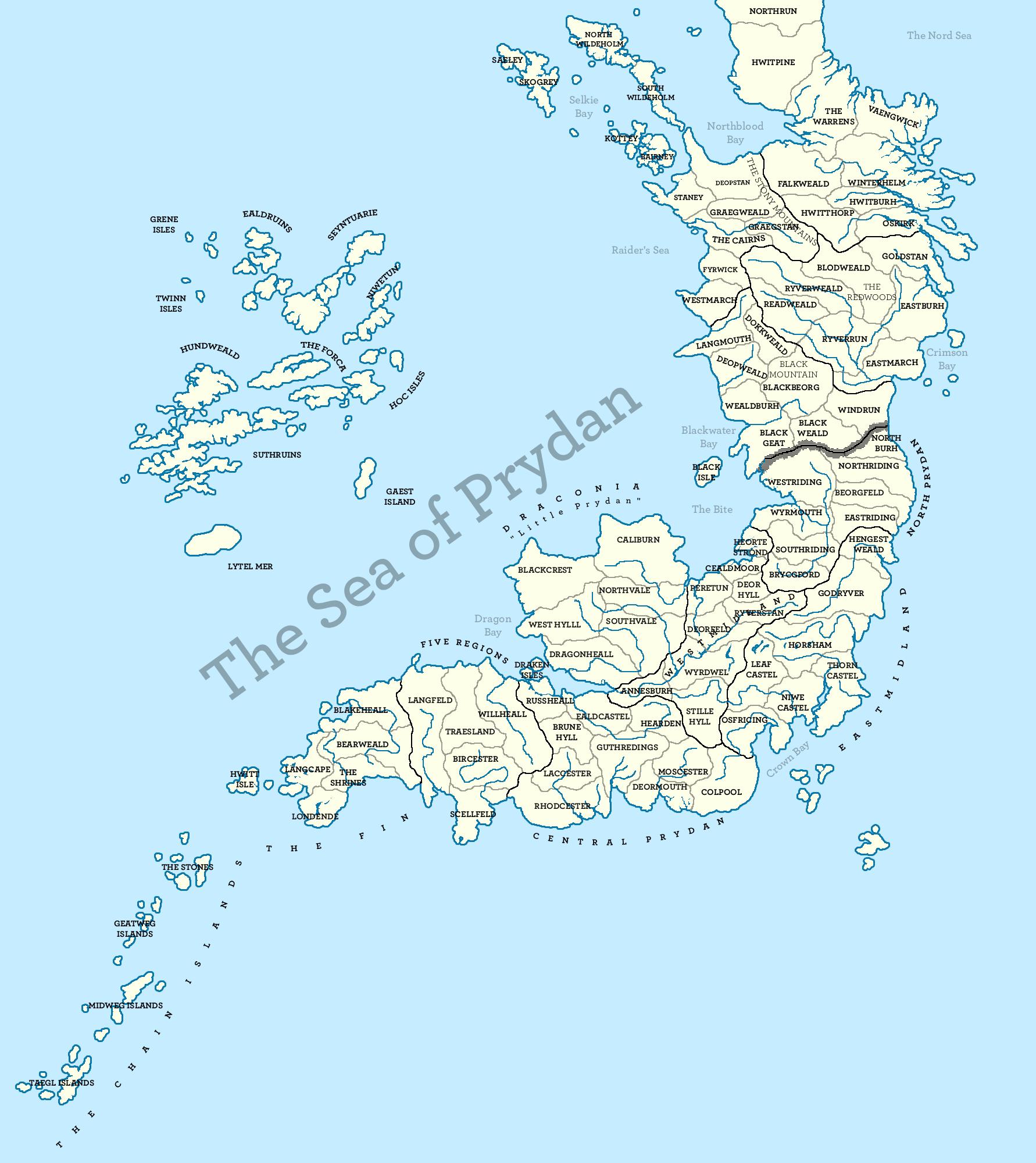
Map Map critique request

Post image
98 Upvotes

Just asking for critique for this map I put together. It's for a fantasy worldbuilding project, and I'm aiming for a large island/peninsula that blends together elements of the UK and Japan.

Firstly, does this read as a good blend between the shapes of both? And secondly, does this at all look realistic for a roughly Japan-sized set of islands?

Patterned borders divide countries; black borders are for duchies, and the lighter borders within them divide each duchy up into counties.

Place names are (mostly) in Old English and a bit of Norse.


r/worldbuilding • • 13h ago

Visual I designed a giant organism that grows entire cities — The Mother of Biomes (Original Concept Art)

Thumbnail gallery
17 Upvotes

r/worldbuilding • • 2h ago

Lore A view into the Myriad

2 Upvotes

Once again I am here to offer you a view into my setting. More than writing a novel I am interested in building a background for a living fantasy world that is still a bit down to earth. It all started by a background for DnD character. This is just a "verbal illustration", a window into the life of the people.

Uluma, Sacred city-state, seat of the Prophet-Queens, year 942 AD

*ónoma Yarva

+++ ΣΥΝΑΙΝΕΣΗ +++

*apaitísi Setter des Weges

+++ ΣΠΑΣΜΕΝΗ ΜΗΤΡΑ +++

*ektélese

+++ ΣΥΝΑΙΝΕΣΗ +++

+++ 0P¡3TH3T°; ./៛/¡4-# ΔP4Κ03,, ΝΑΚΟΥΡΟΥ +++

*apaitísi Naqurrryyyyaaauch!!!

Y: „Tjaa, Teufelswerk.“

B: „So sorry, Yarva. Didn’t mean to disturb you in the trance; thought you were just napping.“

Y: „Nevermind, I couldn't get any new answers out of the queries anyway. What’s the word?“

B: „I talked with that smuggler, Svartnar. He’ll take us on board, but he wants payment in fenniki, not credits - crazy dybbuk.“

Y: „Damned be, that’s going to cost so much more than we thought. Those bugbears might be crazy, but at least we’re together in the Alþing. Avoiding slavers is worth the coin.“

B: „Indeed. We still have most of the credits from the craft-resin we’ve… procured, but we need way more. I’ve heard there is another looting party being set up. Ergh, I hate that bog so much. Do you want hot or peanut sauce with your Onion Bliss, elvin?“

Y: „Ah-haa, tagging along with Mister Secured Citizen finally pays off! I’m sick of the nourimash one gets on this level. Oh, and Hotsprings Honeywater - what a treat! Thanks, Bırlındır.“

B: „As my personal apothecary, you deserve only the best, oh wielder of eldritch knowledge.“

Y: „As your personal apothecary, I advise against taking your medicine in my vicinity. Go outside, you malodorous gnomething.“

B: „It’s foggy out there and my leg is killing me. I wouldn’t smoke it otherwise; it gives me an awful headache lately.“

Y: „Tjaa. I’m running low on supplies, so the formula is altered. But I saw something similar to bloomreed the last time we were in the... wie heisst... Caustic Fen.“

B: „I was hoping to win the fenniki in a game of brigands. Eh, looting party it is.“

Y: „As your personal friend, I advise against any more gambling.“

B: „Eat up. I can’t wait to leave this burrow - do you see that leak in the wall? Ten credits a night, unbelievable.“

---

Y: „Bırlın? There is some moneybags at the door, but I barely understand him.“

B: „Hold on, I’m limping over! Hmm. He says his new expensive gulem broke and wandered off.“

Y: „What type, 𒍝𒅔 or 𒅇𒁕? The first is just a polished second, but they both run on old 𒀭 and have bad translators - especially the first one. If he talked to it with his terrible accent, no wonder it's stuck. What the damn is 'sorok'?“

B: „Kıskazem - I fail to grasp how you know so much about ancient arts yet miss basic vocabulary. 'Sorok' means fourty. Mizer will have to give us more if he really wants that gulem back. Also, he’s offering five credits if you just stop your technobabble right now.“

---

GM: „Asham, haviv.“

B: „Asham-mu. Metzen-nu ette ezz-e.“

GM: „Nishlamy dybbuka?“

S: "Skraeling, we hark!"

Y: "As my furry friend remarks, us knife-ears understand Urrat as well, despite your colloquialism. It would be more polite to continue in standard Pellagic, please."

---

„This short play was brought to You by the Nine Treasures fast food franchise. Nine Treasures - wash down the pungence with icecold Yminian IPA!“

---

+++ INITIATING META-LORE INFODUMP SEQUENCE +++

Characters:

Y: Yarva aka Earvaleth van Dorn, Wandering Witch, Spear of the Horned Wolf – noble background, Archfey warlock class , elf (f) from Yminian

B: Bırlındır, Secured Citizen 5732 – Temple-Palace guardsman released with honors, almost an amputee, soldier background, ranger class, gnome (m) from Uluma

S: Svartnar of the Frozen Tear, smuggler with honor – pursuer of earthly pleasures, sailor background, barbarian class, värulf (m) from Mriy

GM: Gnome mizer – random NPC

On the setting:

942 AD – After Drinking from the Jar, a catastrophic event similar to Pandora’s box

Yarva is an elf from Yminian who grew up amongst humans - her mothertongue is represented by German, and like almost everyone in the world she knows the trade language, Pellagic (English).

It is crucial that elves growing in human society are sought by their elven brethren and trained to acces their genetic memory in a controlled way in a state of trance. Otherwise the chaotic constant bombardment of thoughts could drive the young one mad and they turn into a banshee.

The genetic memory is shared in old Naqurese (Greek written in the Greek alphabet), while the Arborete elves of Yminian speak a slightly different dialect (phonetic Greek).

Yarva also partially learned the ancient dwarven language Urrat during her university studies, and the dialect spoken by the gnomes of Uluma is derived from it.