Has any work been done on understanding the Tamil alternation of /v/ and /g/ in specific contexts?
[Below I use k in the written Tamil examples and g in the spoken ones but of course, in the intervocalic contexts they exist in, they're identified in Tamil].
cikappu vs. civappu is a known alternation even in written.
Written tuvaiyal is rendered togayal in spoken.
Written pākal + kāy > pākaṟkāy is rendered pāvakkāy in spoken.
Written nāval + paḻam > nāvaṟpaḻam is rendered nāgappaḻam in spoken.
Does this phenomenon exist outside Tamil? Do we know what contexts this is viable? TIA.
The Gond comprise the largest tribal group of India with a population exceeding 12 million. Linguistically, the Gond belong to the Gondi–Manda subgroup of the South Central branch of the Dravidian language family. Ethnographers, anthropologists and linguists entertain mutually incompatible hypotheses on their origin. Genetic studies of these people have thus far suffered from the low resolution of the genetic data or the limited number of samples. Therefore, to gain a more comprehensive view on ancient ancestry and genetic affinities of the Gond with the neighbouring populations speaking Indo-European, Dravidian and Austroasiatic languages, we have studied four geographically distinct groups of Gond using high-resolution data. All the Gond groups share a common ancestry with a certain degree of isolation and differentiation. Our allele frequency and haplotype-based analyses reveal that the Gond share substantial genetic ancestry with the Indian Austroasiatic (ie, Munda) groups, rather than with the other Dravidian groups to whom they are most closely related linguistically.
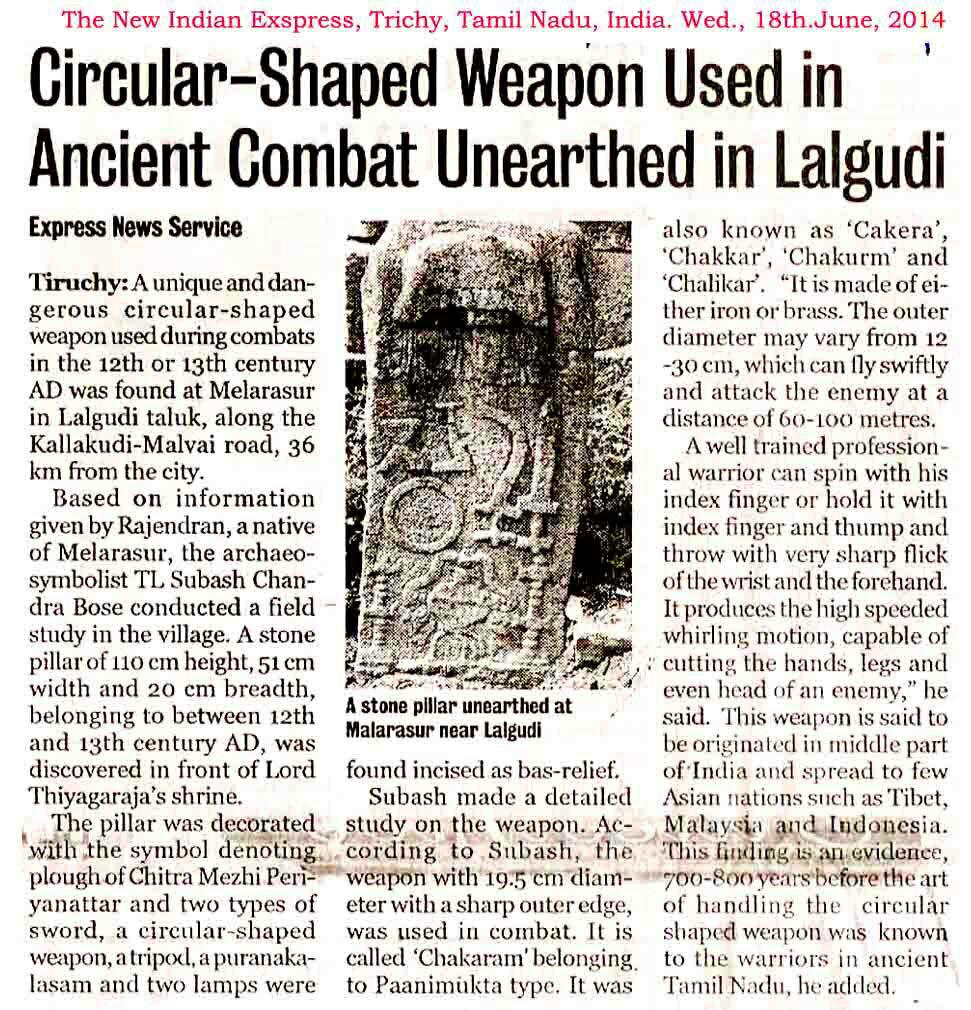
According to other Tamil archeologists this weapon is also known as சக்கரம்/ திகிரி/ வளையம்/ எறிவளையம்/ வளை/ பாறாவளை/ நேமி / பரிதி/ வலயம்/ ஆழி/ ஒளிவட்டம் / படைவட்டம்/ சுழல்படை (Cakkaram/ tikiri/ vaḷaiyam/ eṟivaḷaiyam/ vaḷai/ pāṟāvaḷai/ nēmi/ pariti/ valayam/ āḻi/ oḷivaṭṭam/ paṭaivaṭṭam/ cuḻalpaṭai resp.).
Tamil poems from the second century BC record it as thikiri (திகிரி). It's known in other languages as chakram (https://en.wikipedia.org/wiki/Chakram)
The Mer (Maher) of Saurashtra speak an Indo-Aryan language, but their kinship system is Dravidian in structure (Trivedi 1961; Trautmann 1981). Their traditional marriage rules match those of Tamil, Kannada and Telugu communities. Put that next to the megalithic burials found in neighbouring Kutch (Kumaran) and the old Tamil tradition that the Vēḷir chiefs came from Tuvarai, usually identified with Dvārakā in Gujarat (Puṟanāṉūṟu 201; Ramanathan 1969), and western India starts to look like a missing piece in the Dravidian story.
The Mer live mainly around Porbandar, the Barda Hills and nearby parts of Saurashtra. Anthropologist Harshad R. Trivedi studied them in The Mers of Saurashtra (1961) and returned to them in a 1986 follow-up focused on social change and cross-cousin marriage (Trivedi 1986). He found bilateral cross-cousin marriage, the core feature of Dravidian kinship. Your father’s brother’s children and your mother’s sister’s children are parallel cousins: they count as siblings and you can’t marry them. Your father’s sister’s children and your mother’s brother’s children are cross-cousins, and they are the preferred marriage partners. Most Gujarati Hindu communities forbid cousin marriage outright, which makes the Mer stand out (Trivedi 1986).
Thomas R. Trautmann analysed Mer kinship terms and showed that they sort relatives the same way Tamil does (Trautmann 1979: 157–166; Trautmann 1981). The Mer use four key terms. Māmā covers the mother’s brother, the father’s sister’s husband and the father-in-law. Fuī covers the father’s sister, the mother’s brother’s wife and the mother-in-law. Kākā covers the father’s brother and the mother’s sister’s husband. Māsī covers the mother’s sister and the father’s brother’s wife. This is the Dravidian pattern, where your uncle and your father-in-law can be the same category of person. Tamil works the same way: māmaṉ is both maternal uncle and father-in-law, and attai is both paternal aunt and mother-in-law. Kannada māva and atte do the same (Trautmann 1981). The Mer words are Indo-Aryan, but the system behind them is Dravidian, which shows Dravidian kinship reaching well beyond today’s Dravidian-speaking areas.
The Mer aren’t alone in Gujarat. Cross-cousin marriage has also been recorded among Ahirs, Kathis, Garasias, Gadhavi Charans, Kolis, Bhils, Dheds, and some Bhangi, Gamit and Warli groups. The Mer are simply the best documented, thanks to Trivedi and Trautmann.
Archaeologist R. N. Kumaran recorded twenty Iron Age and megalithic sites in Kutch, just north of Saurashtra: Avisar Mora, Baravad, Goliya I and II, Hajipir, Janganiya, Kulai, Maniyargadh, Motiber, Mudrai, Nagara, Navavas, Poana, Poina, Ringaivadi, Sanghi Rasta, Sukhapur, Thumdi, Vadsar and Zadva Rasta II (Kumaran). Most are in western Kutch, around Abdasa, Nakhatrana, Khirsara and Sanghi–Vadsar. They include dolmens, stone cists, cairn circles, menhirs and chamber tombs, mostly built from local limestone. Maniyargadh has dolmens, cairn circles and a chamber tomb; Goliya II has eight cists; Poina has eight menhirs in a line beside cairn circles (Kumaran). These are the same kinds of monuments found across the Deccan and the south, in Karnataka, Telangana, Andhra Pradesh and Tamil Nadu, in regions long associated with Dravidian speakers. The Kutch sites still need excavation and dating before anyone can say how they relate to the southern tradition.
Caṅkam Tamil literature links the Vēḷir chiefs to Tuvarai. In Puṟanāṉūṟu 201, the poet Kapilar approaches the Vēḷir chief Iruṅkōvēḷ, seeking husbands for the daughters of Vēḷ Pāri, and praises him as the heir of forty-nine generations of rulers of Tuvarai. Ramanathan notes that the old gloss calls the city “Tuvarāpati,” and that Iruṅkōvēḷ was clearly no longer ruling there in Kapilar’s time (Ramanathan 1969). Allowing about twenty-one years per generation and dating Kapilar to around A.D. 100, Rākavaiyaṅkār placed the arrival of the Vēḷir in Tamil Nadu around the tenth century B.C. (cited in Ramanathan 1969, n. 18), roughly the start of the Iron Age megalithic period in the south. The medieval commentator Nacciṉārkkiṉiyar, writing on the Tolkāppiyam, gives a fuller version: eighteen kings and eighteen Vēḷir families came south from Dvārakā, cleared forests, founded settlements and set up ruling lines in Tamilakam. Eighteen is a stock number in such stories, so it shouldn’t be read literally. Iravatham Mahadevan treated the tradition as a memory of real population movement from northwest India into the south (Mahadevan 2009).
Each piece on its own proves little. Together they point the same way: a Dravidian kinship system still alive among Indo-Aryan speakers in Saurashtra (Trivedi 1961, 1986; Trautmann 1981), southern-style megaliths in Kutch next door (Kumaran), and a Tamil tradition naming Dvārakā as the Vēḷir homeland (Puṟanāṉūṟu 201; Ramanathan 1969). That makes Saurashtra and Kutch worth a much closer look in the history of contact between western India and the Dravidian south.
References
Kumaran, R. N. “Iron Age Burials and Other Explorations in District Kachchh, Gujarat.” In Cultural Heritage and Archaeology: Ajoy Kumar Sinha Commemoration Volume.
Mahadevan, Iravatham. 2009. “Akatti: Agastya and the Indus Civilisation.” Proceedings of the Tamil Nadu History Congress.
Nacciṉārkkiṉiyar. Commentary on the Tolkāppiyam.
Puṟanāṉūṟu 201. Kapilar, addressed to Iruṅkōvēḷ.
Ramanathan, P. 1969. “Iruṅkoveḷ and the Koṭṭai Veḷāḷar: The Possible Origins of a Closed Community.” Bulletin of the School of Oriental and African Studies 32(2): 323–343. https://doi.org/10.1017/S0041977X00055324
Trautmann, Thomas R. 1979. “Dravidian Kinship.” In Aryan and Non-Aryan in India, 157–166.
Trautmann, Thomas R. 1981. Dravidian Kinship. Cambridge: Cambridge University Press.
Trivedi, Harshad R. 1961. The Mers of Saurashtra: An Exposition of Their Social Structure and Organisation.
Trivedi, Harshad R. 1986. The Mers of Saurashtra Revisited and Studied in the Light of Socio-Cultural Change and Cross-Cousin Marriage. New Delhi: Concept Publishing Company.
N.B :Used AI to check grammar and create flow, and create summary inforgraphics but the idea is mine based on academic sources.
Karakattam - It is an ancient folk dance of Tamil Nadu usually dedicated to goddess Mariamman.
Poikkaal Kuthirai Aattam - It is a type of dance performed with a dummy horse having a gap inside so that a person can fit into it to perform the dance.
It has come to light that more than 50 stone circles dating back roughly 3,000 years exist near the village of Keezhnandiyambadi, close to Vandavasi.
Large stones have been planted upright in a circular formation with an empty center. Between 7 and 9 stones are set up along the perimeter of a circle. In some stone circles, the stones are scattered here and there.The circular perimeter measures up to about 150 cm.
In a few places, small brick-like stones and dark granite stones have been stacked in a circular mound.
Funerary monuments of this type can be considered to belong to the Megalithic period, around 3,000 years ago. In addition, traces of ancient settlements and water bodies are also visible.
Therefore, the Archaeology Department needs to conduct a proper excavation of these archaeologically significant Keezhnandiyambadi stone circles.
Fun fact : The Battle of Wandiwash that was fought between British and French as a part of the Carnatic wars happened in this town.
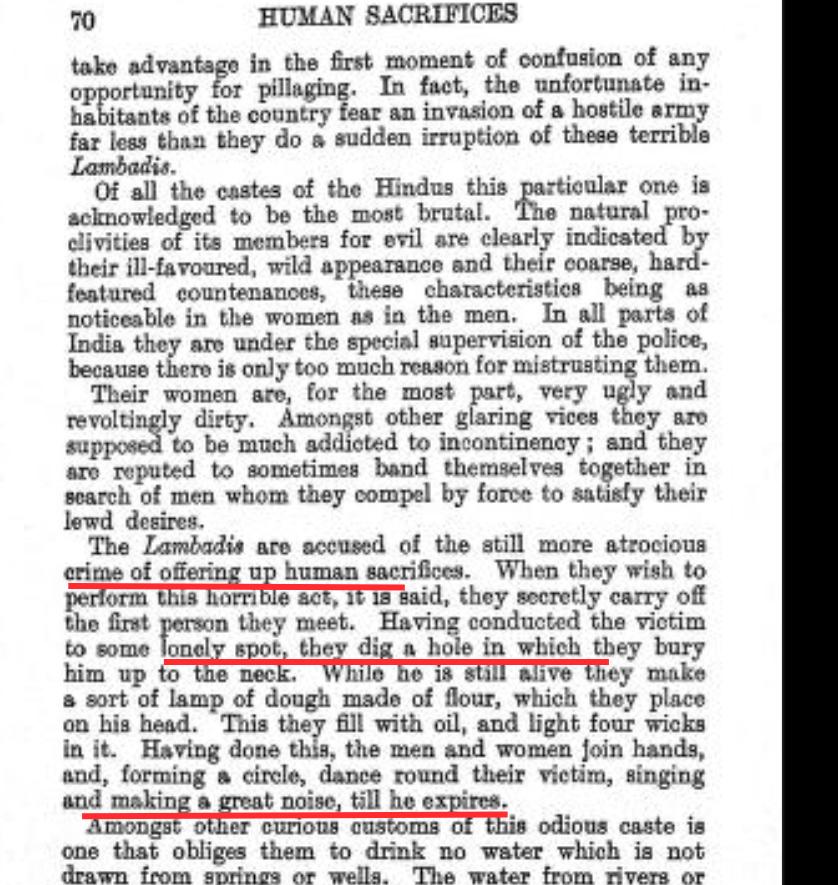
A disturbing account appears in the writings of the French Christian missionary Abbé J. A. Dubois, in his observations of Indian castes, customs and communities. The allegations presented here should be treated with caution as they are recorded in a colonial-era missionary account and should not be taken as established facts or as a representation of the a community.
The Lambadis, whom he described as "travelling communities whose sudden arrival was greatly feared by the inhabitants of the regions they traversed", were accused of taking advantage of confusion and disorder to engage in plundering. They were also placed under special police supervision in different parts of India.
One of the most extraordinary allegations concerns human sacrifice. He states that when the Lambadis wished to perform this ritual, they would secretly seize the first person they encountered and take the victim to an isolated location.
The victim was allegedly buried alive in a pit up to the neck. A lamp-like structure made from flour dough was then placed on the victim's head, filled with oil and fitted with four burning wicks.
The men and women would then join hands, form a circle around the victim, and dance and sing until the person died.
Source: Abbé J. A. Dubois, Hindu Manners, Customs and Ceremonies, section "Human Sacrifices"
A rare Ayyanar stone sculpture dating back to the 11th-12th century CE, belonging to the later Chola period, was recently found in an agricultural field at Poolambadi village in Perambalur district.
The sculpture, measuring 68 cm in height and 51 cm in width, was found by history enthusiast Dr M Selvapandian in an agricultural field on the southern side of the Arumbavur-Poolambadi road during a field study in Poolambadi village, Veppanthattai taluk.
The deity is shown in a seated posture, holding a weapon in his right hand, while his left hand is positioned in a traditional gesture. The sculpture features matted hair, palm-leaf earrings, necklaces, a sacred thread and anklets, but its face and body are damaged due to neglect.
Speaking to TNIE, Dr M Selvapandian said, “The sculptures suggest that an Ayyanar temple existed here around 1,000 years ago before falling into ruins and the land being converted into farmland.”
A smaller female sculpture was found nearby. “The nearby female sculpture could belong to a royal woman who helped establish the temple,” he said, and added that the female sculpture’s worshipping posture also suggests that it is unlikely to be a deity. Such standalone female sculptures are rare, and a corresponding male sculpture might have existed.
Image info for slide 3: The current name of Murraveli Beach is Samudragama (a Sinhala-colonized name). Across the bay, the walls of Fort Frederick stand opposite the Gokanna Rajamaha Vihara, a Buddhist temple (image inserted by the original author).
Two types of small boats, known locally as "Vallam" in Tamil, can be seen on this beach: those with outriggers and those without. Although the general term persists, the specific historical names for these distinct vessels have been lost over time.
Marathi is an Indo-Aryan language, but Maharashtra lies between the North and South Indian kinship systems. Most Marathi kinship words are Dravidian with some being Indo-Aryan. Its marriage rules follow the Dravidian pattern.
Irawati Karve, in Kinship Organization in India (1953), divided India into northern, central and southern kinship zones. She placed Maharashtra in the central zone, with (some) northern-type words and southern-type marriage rules. Franklin Southworth later argued that Marathi grammar and vocabulary contain Dravidian substrate features.
Marathi Kinship Terms and Their Dravidian Parallels
Marathi ātyā (आत्या), father’s sister, compares with Tamil attai (அத்தை), Kannada atte (ಅತ್ತೆ) and Telugu atta (అత్త). In Dravidian languages the word also means mother-in-law, because a father’s sister’s daughter is a possible bride. Marathi ātyā means only father’s sister.
Marathi māmā (मामा), maternal uncle, matches Tamil māmaṉ, Kannada māva and Telugu māma. Krishnamurti reconstructs Proto-Dravidian māma, meaning both mother’s brother and father’s sister’s husband. In a cross-cousin system, both men are possible fathers-in-law. Hindi and other northern languages also use māmā, which suggests early borrowing from Dravidian.
Marathi akkā (अक्का), elder sister, matches Tamil and Kannada akka. It is used mainly in southern Maharashtra and as a respectful name for older women. Standard Marathi uses tāī (ताई) which is also derived from Dravidian.
Marathi aṇṇā (अण्णा), used for an elder brother, father or senior man, matches Tamil aṇṇā and Kannada aṇṇa. It is common in names and titles across Maharashtra.
Marathi appā (अप्पा), used for father or an older man, matches Tamil and Kannada appā. Its use in the same regions as akkā and aṇṇā points to Kannada contact.
Cousin Terms
Marathi names cousins with compounds. Cultabhāū (चुलतभाऊ) is the father’s brother’s son and māvasbhāū (मावसभाऊ) is the mother’s sister’s son. These are parallel cousins. Māmebhāū (मामेभाऊ) is the mother’s brother’s son and ātebhāū (आतेभाऊ) is the father’s sister’s son. These are cross-cousins. Marathi divides cousins the same way Dravidian kinship does, and both cross-cousin terms are built on Dravidian roots, māmā and ātyā.
Cross-Cousin Marriage in Maharashtra
North Indian Hindu custom forbids marriage between any cousins, and often between villages or clans already linked by marriage. Maharashtra does not follow this rule.
Karve recorded that many Maharashtrian communities, including Marathas and Deshastha Brahmins, allowed and often preferred marriage with the mother’s brother’s daughter, called māmācī mulgī. Marriage with the father’s sister’s daughter was accepted in some groups and disapproved in others.
Parallel cousins could not marry. A cultabhāū or māvasbhāū was treated as a brother.
When a man married his māmā’s daughter, the māmā became his father-in-law (sāsrā) and the māmī his mother-in-law. Tamil, Kannada and Telugu kinship have the same overlap.
Karve also recorded marriage between a man and his elder sister’s daughter in some communities near the Karnataka border. This custom is common in Tamil Nadu, Karnataka and Andhra Pradesh and rare in the rest of Indo-Aryan India.
Comparison With Sinhala
Sinhala borrowed both the words and the structure of Dravidian kinship. Marathi also kept Dravidian terms along with Indo-Aryan words but took on the Dravidian marriage structure. Its Dravidian terms, ātyā, māmā, akkā, aṇṇā and appā, cover the relatives that matter most in cross-cousin marriage. Akkā, aṇṇā and appā are most common in southern Maharashtra, where contact with Kannada and Telugu speakers has lasted longest.
Marriage rules varied by caste, region and period. Not every Maharashtrian community practised cross-cousin marriage, and urban practice has changed over the last century.
Conclusion
Marathi kinship uses mostly Dravidian and Indo-Aryan words but follows Dravidian structure. Its cousin terms separate cross and parallel cousins, and unlike North India, its marriage rules allow cross-cousin marriage. A few Dravidian loans, mainly ātyā and māmā, show contact with Kannada and Telugu.
References
Burrow, Thomas, and Murray B. Emeneau. 1984. A Dravidian Etymological Dictionary. 2nd ed. Oxford University Press.
Karve, Irawati. 1953. Kinship Organization in India. Poona: Deccan College. 2nd ed. 1965, Bombay: Asia Publishing House.
Krishnamurti, Bhadriraju. 2003. The Dravidian Languages. Cambridge University Press, pp. 10, 530.
Southworth, Franklin C. 1971. “Detecting Prior Creolization: An Analysis of the Historical Origins of Marathi.” In Pidginization and Creolization of Languages, ed. Dell Hymes, 255–273. Cambridge University Press.
Southworth, Franklin C. 2005. Linguistic Archaeology of South Asia. London: RoutledgeCurzon.
Trautmann, Thomas R. 1981. Dravidian Kinship. Cambridge University Press.
Migration : Genomic studies (such as Narasimhan et al., 2019 and Chaubey & Endicott) show that indigenous Andamanese groups (Onge, Jarawa, Great Andamanese, Sentinelese) share deep ancestry with AASI (Ancient Ancestral South Indians). Specifically, they belong to the basal "Eastern Eurasian" lineage (carrying haplogroups like mtDNA M31/M32 and Y-DNA D-M174) that split from mainland AASI-related populations roughly 45,000–55,000 years ago during the early coastal dispersal out of Africa, remaining almost completely isolated afterward.
Languages : Most of the Andamanese languages went extinct over time, except for a few like Jarawa (fewer than 500 speakers) and Onge (around 100 speakers). This is because the Andamanese were mobile hunter-gatherers, and a large proportion of them were wiped out once the British established the penal colony at Port Blair in 1858. Just as in the Americas and Australia, the colonialists introduced diseases (such as measles and influenza) to the Indigenous population, who had been isolated for 50,000 years. Today, Hindi serves as the lingua franca alongside other Indian languages in the Andaman Islands.
Nicobar :
Migration : The Nicobarese represent a much later Neolithic/early Metal Age dispersal from Mainland Southeast Asia, roughly 2000–1000 BCE. Linguistically, Nicobarese languages form a primary branch of the Austroasiatic family (distantly related to Mon, Khmer, Vietnamese, and mainland Indian Munda languages). Genetically, Nicobarese carry high levels of East/Southeast Asian Neolithic ancestry (Y-DNA O-M95, the classic Austroasiatic marker) mixed with a smaller fraction of older AASI/Onge-like substrate ancestry, suggesting they either absorbed an earlier hunter-gatherer population on the islands or mixed with mainland groups before crossing over.
Languages : Nicobarese (especially Car Nicobarese) is actively spoken today by tens of thousands of people, alongside Hindi and English. Unlike the Andamanese, who were isolated for 50,000 years, the Nicobarese people lived on islands sitting directly along the ancient Bay of Bengal maritime trade routes (linking South Asia and Southeast Asia); as a result, they had already been exposed to Old World diseases and possessed partial immunity. Although Europeans (the Danish, Austrians, and British) did take over the islands, their impact on the Indigenous population was not as catastrophic as it was in the Andaman Islands.
Comparing Andaman with Australia and Nicobar with New Zealand :
The analogy works to an extent, as Australia's first-ever settlers were the Aboriginal Australians, who were part of the same Out of Africa wave as the AASI and Andamanese peoples who began migrating 50,000 years before present (YBP). The British set up their penal colonies in Australia just as they did in Port Blair, and the Aboriginal population experienced a 90% collapse because they had no immunity to European diseases.
Just as the Nicobarese had later migrants, the Polynesian Māori arrived in waves in New Zealand by 1250–1300 CE. In New Zealand, the British negotiated through chiefs (culminating in the Treaty of Waitangi, however contested); in Nicobar, the British governed lightly through existing village headmen (captains). Both populations rapidly adopted missionary literacy in the Latin script and Christianity (e.g., Māori literacy in the 1830s; Bishop John Richardson and Car Nicobarese literacy in the early 20th century), using new institutions to preserve language and collective identity.
The Right-Hand (Valangai) and Left-Hand (Idangai) factions were two broad caste groupings in South India, comprising numerous communities with competing claims to social and ceremonial privileges.
The Left-Hand faction included the Vaishyas or trading communities, the Panchalas or artisan communities, and some of the lower Sudra castes. The Chuchlers (leather-workers) were regarded as one of its chief supporting groups.
The Right-Hand faction comprised most of the higher Sudra castes, with the Pariahs as its chief supporters. The Brahmins, Rajahs and several other Sudra communities generally remained neutral and were often chosen as arbitrators when disputes arose.
The rivalry between these two factions became a perpetual source of riots and animosity. Their disagreements frequently revolved around claims to exclusive privileges, which were often poorly defined and recognised by neither side as belonging exclusively to the other.
The privileges over which they fought might appear surprisingly ordinary today. They included:
The right to wear slippers during public appearances. The right to ride horses or travel in palanquins during marriage processions. The privilege of being accompanied by armed retainers on certain occasions. The right to have trumpets sounded ahead of a procession. The use of particular musical instruments during public ceremonies. The right to carry flags of specific colours or designs.
Even the privilege of wearing particular flowers in turbans during public ceremonies.
Yet these disagreements were far from peaceful. When one faction believed the other had violated its customary rights, disturbances could spread across large territories and eventually end in bloody conflicts. The hostility could become so intense that even military intervention was sometimes insufficient to restore order.
On some occasions, rioters reportedly stood their ground against several discharges of artillery without showing any sign of submission. Even when armed forces succeeded in restoring peace, it was often temporary. At the first opportunity, the factions were ready to renew their conflicts.
The Pariahs were particularly prominent in these confrontations. They were regarded as the chief supporters of the Right-Hand faction, and were frequently the ones who caused the greatest disturbances and damage during disputes between the two groups.
Dubois also recounts an incident he personally witnessed involving a dispute between the Pariahs and the Chuchlers (leather-workers). The dispute arose when a Chuchler appeared at a public ceremony wearing red flowers in his turban, a privilege that the Pariahs claimed belonged exclusively to the Right-Hand faction.
The disagreement became so serious that there were fears of widespread violence throughout the district. Many peaceful inhabitants began abandoning their villages and moving their belongings to places of safety, anticipating serious consequences. The situation was eventually brought under control when prominent inhabitants of the district intervened as mediators and settled the dispute through diplomacy and conciliation.
Another interesting observation concerns the origins of these divisions. Dubois considers the Right-Hand and Left-Hand distinction a relatively modern institution. He notes that it was not mentioned in the ancient books of the country and that he had been told the division was unknown in Northern India.
These rivalries reveal how deeply questions of caste identity, social precedence, public recognition and traditional privileges could shape community relations. What might appear to be a minor ceremonial disagreement could become a district-wide disturbance, with people risking their lives rather than surrendering what they considered their customary rights.
Source: Abbé J. A. Dubois, Hindu Manners, Customs and Ceremonies (1905 edition)
A typical representation of a Yakshi of Kerala Myth and Folklore
Ask a Malayali to picture a Yakshi, and a familiar image usually surfaces: a beautiful woman with long, loose hair, piercing eyes and a white saree. She appears on a deserted road, beneath a Pala tree or somewhere isolated after dark. She approaches a man travelling alone, often asking for chunnambu (lime) to go with her betel leaves. She charms him, lures him into the forest or toward a nearby house, and then reveals her true form. The beauty becomes a terrifying supernatural being who kills her victim and drinks his blood.
This is the Yakshi who holds a prominent place in the Malayali imagination. But the figure has a much older and more varied religious and cultural history.
1. What is a Yakshi in Kerala folklore?
The Yakshi is not simply another word for a ghost. She holds a distinctive place in Kerala's folklore, mythology and local religious traditions. Her stories tie her to trees, groves, forests, empty pathways and places beyond ordinary human settlement.
One recurring form is the seductive, shape-shifting Yakshi who waits beside a lonely road. In her human guise, she is strikingly beautiful. She asks a traveller for lime to eat with betel leaves and draws him into conversation. She may invite him to her house, which looks like a mansion but is really an illusion. When the deception is exposed, the house vanishes, and her true dwelling turns out to be a tree. Her victim is then killed and consumed.
Meenu B., in her 2020 paper Anxious Encounters with the (Monstrous) Other: The Yakshi Tales of Medieval Kerala, examines this recurring narrative. She describes the transformation of the beautiful woman and her illusory house, which turns out to be a tree inhabited by the Yakshi. In these stories, the Yakshi does more than drink blood; she may devour the traveller entirely. The tree-dwelling element is especially notable because it preserves a link to the older association of Yakshis with vegetation and nature. (https://rupkatha.com/V12/n3/v12n339.pdf)
2. Different Yakshi traditions in Kerala
Kerala does not have one uniform tradition of the Yakshi. Representations differ by region, and some are quite unlike the familiar blood-drinking figure.
Historian and folklorist Dr M. G. Sashibhushan, discussing Kalliyankattu Neeli and other regional traditions, draws the following distinctions:
Central Kerala Yakshis: These are associated with the Devagana, or divine category. They are understood as supernatural beings rather than simply the spirits of women who died unnatural deaths.
Travancore Yakshis: These are linked to human women who suffered apamrityu, an unnatural or untimely death, and afterwards became Yakshis. Kalliyankattu Neeli belongs to the South Travancore folklore tradition of a woman who was murdered and returned as a vengeful supernatural being.
Temple Yakshis: These are worshipped as upadevatas, or subsidiary deities, in temples. Sashibhushan discusses the Sundara Yakshi, depicted as a beautiful, auspicious figure who gazes into a mirror and adorns herself. He also connects this image with Sringara Parvati in certain mantra traditions.
Southern Travancore has further local traditions, including Pillathinikal and Pillarakshinikals. The names distinguish child-devouring forms from child-protecting ones. Another local tradition describes two sister Yakshis: the elder, Pachathiyal, is comparatively gentle, while the younger, Neelathiyal, is cruel and bloodthirsty. Sashibhushan also discusses Chitharalamma as a benevolent Yakshi, identifying her with the Jain Padmavati tradition. (https://www.manoramaonline.com/news/sunday/2025/09/20/kalliyankattu-neeli-true-story.html)
These are regional traditions, not a single classification applied uniformly across Kerala. Still, they show that the Yakshi was not always imagined as a malevolent spirit.
Kalliyankattu Neeli and the Kathanar legend
Two especially important strands of Kerala folklore are the story of Kalliyankattu Neeli and the legend of Kadamattathu Kathanar.
Kalliyankattu Neeli, also known as Panchavankattu Neeli, is tied to the Villadichan Pattu tradition of Nanjinad and South Travancore. In one version, Sashibhushan discusses, she is involved with a Brahmin temple priest who eventually murders her for her jewellery. Her death and subsequent return as a Yakshi form the basis of the revenge narrative. The story exists in several versions, but Neeli is consistently associated with betrayal, violent death and vengeance. (https://www.manoramaonline.com/news/sunday/2025/09/20/kalliyankattu-neeli-true-story.html)
The Kathanar legend has its own history. In the versions examined by Nivea Thomas K. in her University of Hyderabad thesis, the Yakshi subdued by Kadamattathu Kathanar is generally identified as the Panayannarkavu Yakshi, also called the Parumala Yakshi. The popular television serial later replaced this figure with Kalliyankattu Neeli, which helped cement the widespread association between Kathanar and Neeli. The stories also share recurring motifs: the seductive, blood-drinking Yakshi and the request for chunnambu. (https://igmlnet.uohyd.ac.in/docs/hi-res/hcu_images/TH12236.pdf)
3. Yakshas and Yakshinis in the wider Indian Sramanic traditions
To understand how the Yakshi changed in Kerala, it helps to look at the older Yaksha and Yakshini traditions across India.
Yakshas and Yakshinis were tied to nature, fertility, vegetation, water, health and abundance. They were often seen as powerful local or territorial spirits, linked to particular trees, groves, forests, villages and sacred places.
These traditions existed on their own long before many Yaksha and Yakshini figures were brought into organised religious systems. In his entry on the Yaksha in The Encyclopedia of Ancient History, Robert DeCaroli describes them as nature spirits connected with health, fertility and abundance, whose local cults were later absorbed into Jainism, Buddhism and Hinduism.
The Sramanic traditions of Jainism and Buddhism are especially relevant here.
In Jainism, Yakshas and Yakshinis came to serve as the Sasanadevatas, the attendant and protective deities associated with the Tirthankaras. They held an important place in Jain religious imagery and worship. Among the most prominent Jain Yakshinis are:
Ambika, associated with Neminatha.
Padmavati, associated with Parshvanatha.
Chakreshwari, associated with Rishabhanatha.
Jwalamalini, an important Yakshini particularly linked to the southern Jain tradition.
These were not blood-drinking monsters. They were powerful attendant deities, protectors and objects of devotion.
Buddhism also drew on existing Yaksha traditions. Yakshas appear as guardians of sacred places, forests and water bodies. Buddhist literature, however, also features dangerous Yakkhinis, including beings who seduce and devour travellers. The older traditions, then, were not uniformly benevolent. They were varied and sometimes ambivalent, but the Yakshi was certainly not inherently a demon or a blood-sucking creature.
4. Evidence of the older Yakshi tradition in Kerala
This is not simply a pan-Indian religious history with no bearing on Kerala. There is archaeological, iconographic and epigraphic evidence of Jain Yaksha and Yakshi worship in the region.
In her 2017 paper Visualising Yakshi in the Religious History of Kerala, Sandhya M. Unnikrishnan documents several sites associated with Jain Yakshi images and worship.
Some notable examples include:
Kallil, near Perumbavoor: The cave temple contains Jain Tirthankara images and a Yakshi image that T. A. Gopinatha Rao identified as Padmavati. The site is now a Hindu temple.
Paruvasseri, Palakkad: The temple now known as Palliyara Bhagavathi has a Yakshi as its principal deity, according to the study. M. R. Raghava Warrier identified the image as Jwalamalini. A Tirthankara image also stands outside the shrine.
Eswarancode, Palakkad: Images identified as Jwalamalini and Padmavati Yakshis, along with Jain Tirthankara and Yaksha images, have been recorded at the site.
Thirucharanattumala, Chitharal: This historically significant South Travancore Jain centre contains images of Tirthankaras and Yakshis. An image of Ambika with two children has been documented, though scholars have identified the Yakshi sculptures differently. Later inscriptions refer to the goddess as Thirucharanattu Bhagavati.
These examples show that Yakshi worship was part of Kerala's older religious landscape, and that some Jain Yakshi figures were later incorporated into Hindu temples and goddess worship.
5. How did the Yakshi become a blood-drinking supernatural entity in Kerala?
This brings us to the central question.
How did a figure associated with nature, fertility, abundance and religious protection in older Indian traditions take on such a distinctly malevolent identity in Kerala folklore?
One compelling historical explanation is the demonisation of older local deities and religious traditions during the expansion of Brahmanical institutions and religious authority in Kerala.
This is not merely a hypothesis built for this discussion. Historian Pius Malekandathil addresses this transformation directly in his 2018 chapter Dynamics of Trade, Faith and the Politics of Cultural Enterprise in Early Modern Kerala, published in Clio and her Descendants: Essays in Honour of Kesavan Veluthat.
On pages 164–165, Malekandathil discusses how Brahmanical concepts of God spread through the Bhakti movements of Shaivism and Vaishnavism, and how existing local religious traditions were transformed as a result.
He specifically argues that earlier folk deities, including Chathan, Marutha, Madan and Yakshis, were increasingly portrayed as negative or diabolic beings. Their transformation from gods into embodiments of malice, vengeance and wickedness accompanied the growth of Brahmanical religious and social structures.
His discussion of the Yakshi is especially significant.
Malekandathil argues that the sacred spaces of Jain establishments associated with Yakshi worship were reinterpreted as places of negativity, inhabited by a seductive, blood-sucking female spirit. Sacred groves and wooded areas linked to Jain and Buddhist establishments came to be described as haunted and dangerous.
He suggests that such stories may have discouraged traders and travellers from visiting Jain sacred sites, many of which lay along important trade routes and were easily recognised as groves or clusters of trees.
He specifically mentions Yakshiparambu, on the route between Irinjalakuda and Thrissur, and the haunted stretches of trade routes near Kadamattom, associated with the story of Kadamattathu Kathanar.
In other words, the transformation of the Yakshi from a sacred, protective figure into a dangerous, blood-sucking seductress may have been part of a wider process of religious and cultural displacement.
6. Assimilation and Demonisation: Two Possible Outcomes
The archaeological and literary evidence points to two different fates for older Yakshi traditions in Kerala.
Assimilation: Some Yakshi figures were folded into later Hindu religious practice. Jain Yakshis such as Padmavati, Ambika and Jwalamalini came to be associated with local goddess worship. Certain Yakshi shrines were transformed into Bhagavathy temples, or absorbed into temple establishments as subsidiary deities.
Demonisation: Other Yakshi traditions were recast as malevolent spirits. Their old associations with groves, trees and wilderness were reworked into associations with haunted places, seduction, murder, vengeance and blood-drinking.
These two processes were not necessarily separate. They may reflect different outcomes of a shifting religious landscape: some older female divinities were absorbed into the new order, while others were pushed to its edges and reimagined as dangerous supernatural beings.
Meenu B.'s analysis of the Kerala Yakshi tales adds another layer. She looks at how these stories reflect anxieties about travel, caste boundaries and female sexuality in medieval Kerala. The travelling male protagonist meets a beautiful but dangerous woman who sits outside the familiar social order. Her independent movement and sexuality become part of what makes her monstrous within the narrative. Meenu does not offer a single proven explanation for the stories, but her reading complements the broader argument about the reinterpretation of older local deities.
7. Conclusion
The Yakshi of Kerala is a striking example of how religious figures and local traditions can change profoundly over time.
The beautiful woman in a white saree, with long hair and piercing eyes, who lures men into the forest and drinks their blood, may preserve traces of an older Yakshi tradition tied to nature, fertility, sacred groves and local worship.
Some of these figures were absorbed into established religious traditions and became protective goddesses or temple deities. Others were marginalised and demonised as Brahmanical religious authority expanded in Kerala.
The blood-drinking Yakshi of Kerala folklore, then, represents the demonised trajectory of an older Yakshini tradition, while other expressions of that tradition survived through assimilation into goddess worship. Her transformation mirrors the wider religious changes that reshaped Kerala's sacred landscape.
Meenu B. (2020). “Anxious Encounters with the (Monstrous) Other: The Yakshi Tales of Medieval Kerala.” Rupkatha Journal, 12(3). https://rupkatha.com/V12/n3/v12n339.pdf
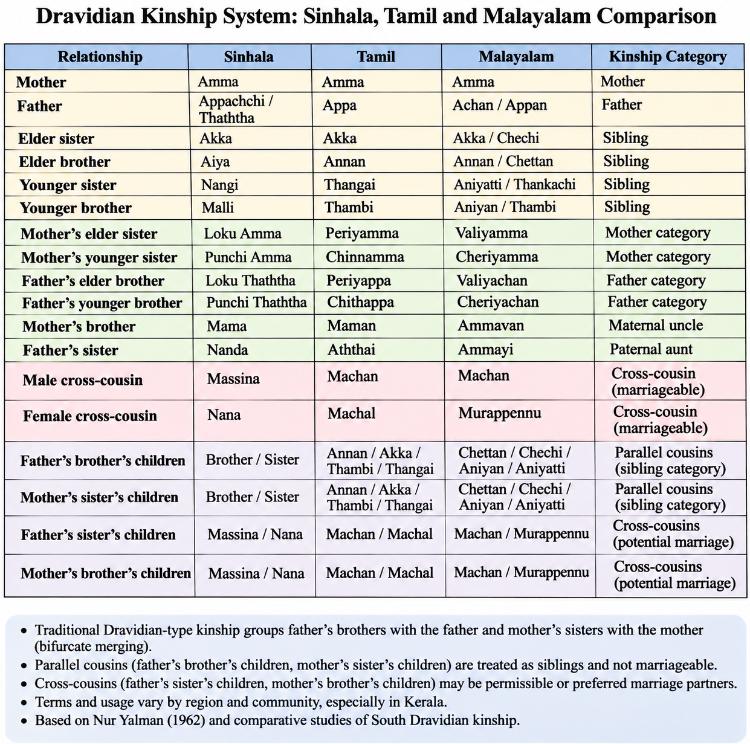
Sinhala is an Indo-Aryan language, but its kinship terms and family classification show Dravidian influence. This influence goes beyond Tamil loanwords to how relatives are grouped and who may marry whom. Nur Yalman’s 1962 study, “The Structure of the Sinhalese Kindred: A Re-Examination of the Dravidian Terminology,” documented a Dravidian-type kinship system among Sinhalese communities. Tamil and Malayalam show parallels in vocabulary, family classification, and marriage eligibility.
Sinhala Kinship Terms and Their Dravidian Parallels
Sinhala akka (අක්කා), Tamil akkā (அக்கா), Malayalam akka (അക്ക), and Kannada akka (ಅಕ್ಕ) mean elder sister. The term is reconstructed as Proto-Dravidian *akka-. Sinhala akka matches in both form and meaning and is a borrowing.
Sinhala aiya (අයියා), elder brother, corresponds to Tamil aiya (ஐயா) and aiyan (ஐயன்), terms of respect for senior men. Tamil and Malayalam use aṇṇan (அண்ணன் / അണ്ണൻ) currently for elder brother, and Malayalam also uses chettan (ചേട്ടൻ). Many Eelam Tamil households use it for father. Sinhala aiya is a term of respect that narrowed to a kinship term like Eelam or Sri Lankan Tamil.
Sinhala nangi (නංගි), younger sister, has been compared with Old Tamil nangai (நங்கை), woman or maiden. Modern Tamil uses tangai (தங்கை) or tangachi (தங்கச்சி), from reconstructed *tam-kay.
Sinhala malli (මල්ලි), younger brother, differs from Tamil tambi (தம்பி) and Malayalam aniyan (അനിയൻ). Some link it to Old Tamil maḻa, “young.”
Sinhala mama (මාමා), Tamil māma (மாமா) , māman (மாமன்), and Malayalam ammāvan (അമ്മാവൻ) mean maternal uncle, a central figure in Dravidian kinship and is a borrowing.
Sinhala massinā (මස්සිනා) matches Tamil machinan (மச்சினன்) and machān (மச்சான்), meaning brother-in-law or male cross-cousin. The shared form and meaning point to a borrowing.
Sinhala nænā (නෑනා) means female cross-cousin or sister-in-law. Tamil uses machāḷ (மச்சாள்), and Malayalam murappeṇṇu (മുറപ്പെണ്ണ്) means a female relative one may traditionally marry.
The Kerala Connection
Malayalam keeps older South Dravidian kinship terms alongside regional customs.
Tamil periyamma (பெரியம்மா), Malayalam valiyamma (വലിയമ്മ), and Sinhala loku amma (ලොකු අම්මා) mean mother’s elder sister. For her younger sister: Tamil chinnamma (சின்னம்மா), Malayalam cheriyamma (ചെറിയമ്മ), and Sinhala punchi amma (පුංචි අම්මා).
The father’s brothers fall in the father category: Tamil periyappa (பெரியப்பா) and chittappa (சித்தப்பா), Malayalam valiyachan and cheriyachan.
The father’s sister is a separate category: Tamil attai (அத்தை), Malayalam ammāyi (അമ്മായി), and Sinhala nændā (නැන්දා).
These show a shared classification even where the words differ.
Under marumakkathāyam, practised by some Nair groups in Kerala, descent and inheritance passed through the female line, and the maternal uncle held authority in the household. Malayalam ammāvan reflects this role. This matrilineal system differed from Sinhalese bilateral cross-cousin marriage, and practice varied among Malayalam-speaking groups.
The Dravidian Kinship System Among the Sinhalese
Yalman recorded a Sinhalese system that separates parallel cousins from cross-cousins, the core feature of Dravidian-type kinship. Parallel cousins are the children of the father’s brother or mother’s sister. They are classed as siblings and cannot marry.
Cross-cousins are the children of the father’s sister or mother’s brother. They are classed separately and are allowed or preferred spouses.
This pattern is called bifurcate merging: the father’s brother is grouped with the father and the mother’s sister with the mother, while the mother’s brother and father’s sister stand apart.
In the communities Yalman studied, cross-cousin marriage was bilateral, so a spouse could come from either side. The mother’s brother could become a father-in-law and the father’s sister a mother-in-law.
This matches Tamil kinship and other Dravidian systems, though marriage practice varied by community and period.
Conclusion
Sinhala kinship shows Dravidian influence in both words and structure especially Tamil. The split between parallel and cross-cousins, and the marriage rules tied to it, match the Dravidian kinship type.
References
Burrow, Thomas, and Murray B. Emeneau. 1984. A Dravidian Etymological Dictionary. 2nd ed. Oxford University Press.
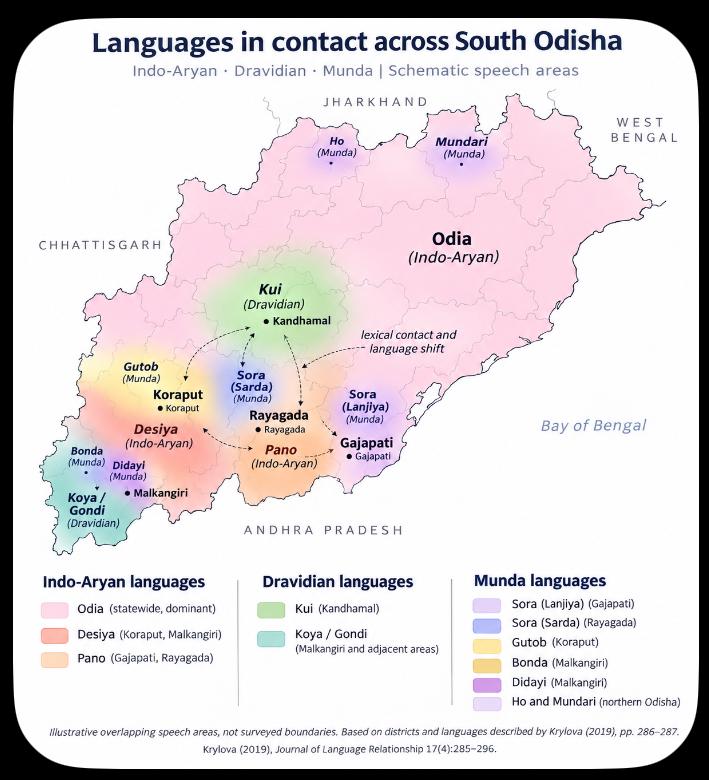
Anastasia Krylova’s 2019 study examines how contact between Indo-Aryan, Dravidian, and Munda languages shaped the basic vocabulary of eastern India, particularly southern Odisha. The research uses a 110-word basic vocabulary list to investigate borrowing, language shift, and the influence of earlier languages on modern Indo-Aryan speech. The study draws on fieldwork conducted between 2016 and 2018 and compares languages from three families. The Indo-Aryan languages include Odia, Desiya, Pano, Bengali, Assamese, Hindi, Marathi, Konkani, and others. The Dravidian languages include Kui and Koya Gondi. The Munda languages include Sora, Bonda, Didayi, Gutob, Ho, and Mundari. Southern Odisha is an important region for studying language contact because speakers of these three language families have lived alongside one another for generations. Desiya functions as a regional lingua franca in Koraput and Malkangiri. It is spoken by several caste and tribal communities, including groups that have shifted away from their ancestral languages. Krylova documents Gutob-speaking communities adopting Desiya and losing their native language.
Pano is another Indo-Aryan variety spoken in Gajapati and Rayagada. Historically, Pano speakers served as interpreters between Sora-speaking communities and Odia-speaking government officials.
These examples demonstrate how language shift operates in multilingual societies. Krylova identifies direct borrowing in all three directions, although the amounts differ. Within the basic vocabulary examined, Munda languages contain 18 identified Indo-Aryan loans and seven Dravidian loans. The two Dravidian languages contain 20 Indo-Aryan loans and one Munda loan. The Indo-Aryan varieties contain ten Dravidian loans and two Munda loans.
These figures refer to identified vocabulary items in the study, not percentages of the languages’ entire vocabularies.
Indo-Aryan is the largest source of borrowing in the sample, followed by Dravidian. Dravidian influence on Indo-Aryan basic vocabulary is strongest in southern Odisha.
The study identifies several Dravidian loanwords in Indo-Aryan languages. Desiya has gar for egg, cheṇḍi for hair, maṇḍi for knee, and dul- for lying down. Desiya and Pano share cher for root. Desiya and the Gajapati variety of Pano have aṇḍra for man.
Pano has sok for neck and guṇḍiya for heart. Odia, Desiya, and Pano have monji for seed. Odia, Bengali, and Assamese have related forms of kāmuṛ- for biting.
These examples concern basic vocabulary rather than specialized religious, literary, or administrative terms.
Dravidian vocabulary also entered neighboring Munda languages. Sora, Bonda, Didayi, and Gutob borrowed forms of maṇḍi for knee. Didayi and Gutob have related Dravidian-derived terms for hair, while Bonda and Didayi have monji for seed.
The distribution shows that Dravidian words spread across both Indo-Aryan and Munda languages in southern Odisha.
The reverse process is equally visible. Kui borrowed Indo-Aryan words such as kali for black, raka for blood, loku for person, balu for sand, bela for sun, duru for far, and basari for year.
Koya Gondi borrowed Indo-Aryan vocabulary for concepts including person, foot, round, white, far, and year.
Krylova also examines Munda contributions to Indo-Aryan. Desiya and Pano use toṇḍ for mouth, while the Rayagada variety of Pano has hora for man.
The history of toṇḍ is particularly interesting. Related Indo-Aryan forms descend from an old word associated with beaks, snouts, and mouths. Turner identified the Sanskrit tuṇḍa word family as non-Indo-Aryan in origin, probably borrowed from Munda.
In much of Indo-Aryan, descendants of this word refer to an animal’s mouth, beak, or snout. In parts of southern Odisha, however, the word refers to the ordinary human mouth. Krylova connects this development with Munda influence. Speakers shifting to Indo-Aryan could retain the semantic distinctions of their earlier language and apply them to existing Indo-Aryan words.
This leads to the central argument of the paper: language contact does not always involve borrowing foreign words. It can also change the meanings and usage of words already present in the receiving language. Krylova examines several examples of this process.
One concerns the words for yellow and green. Most Indo-Aryan languages traditionally use words descended from Indo-Aryan pītala for yellow and harita for green.
Eastern Indo-Aryan languages developed a different pattern.
Bengali uses holud for yellow, Assamese halodhiya, Odia haḷadiā, Pano hɔḷdiya, and Desiya olḍi. These words come from Indo-Aryan vocabulary associated with turmeric. The connection between turmeric and yellow is widespread in Dravidian and Munda languages. Tamil mañjaḷ means turmeric and yellow. Related semantic associations occur across Dravidian languages. Proto-Dravidian color terminology also included roots whose meanings covered both green and yellow. Krylova argues that when Dravidian and Munda speakers shifted to Indo-Aryan, they carried their earlier color classifications into their new language.
Instead of borrowing a Dravidian word for yellow, they used an inherited Indo-Aryan word for turmeric as their ordinary color term. The word itself remained Indo-Aryan, but its semantic development reflected contact with Dravidian and Munda.
The development of green terminology followed another pattern. Bengali śobuj, Assamese xeuj, Odia sabujā, and Maithili səbuj derive from Persian sabz, meaning green.
In southern Odisha, several languages use words associated with leaves, plants, or aquatic vegetation.
Pano uses an expression meaning leaf color, while Desiya and several Dravidian and Munda languages use terms derived from particular plants.
Krylova connects these developments with differences in how the language families historically divided the color spectrum. She also examines Konkani, where the word for yellow is associated with turmeric and the word for green, pācve, is identified as a Dravidian borrowing.
Another example concerns the word for sun. Most Indo-Aryan languages have words for sun descended from Sanskrit sūrya.Desiya instead uses bel. Related forms occur in Odia and Assamese. Odia bel can mean time, part of the day, or sun, while Assamese beli can refer to time, sun, or a turn.
The word belongs to an Indo-Aryan family descending from Sanskrit vēlā, meaning time, period, or boundary.
However, the association between time and sun is widespread in Dravidian languages. Malayalam nēram can refer to sun, daylight, time, or season. Related semantic associations occur in Kodagu and other Dravidian languages.
Within the Gondi-Kui branch, Pengo, Manda, Kui, and Kuwi have forms such as veɽa and vela associated with sun and time.
Krylova interprets these forms as an example of interaction in both directions. The Gondi-Kui words were borrowed from Indo-Aryan, while the meaning sun developed in eastern Indo-Aryan under Dravidian semantic influence. The result is an Indo-Aryan word whose meaning reflects contact with neighboring Dravidian languages.
A further example concerns the word for egg. Most Indo-Aryan languages use descendants of Sanskrit aṇḍa, meaning egg.
Bengali, Assamese, Odia, and Maithili instead use forms descended from ḍimba. Bengali and Odia have ḍim, Assamese has ḍima, and Maithili has ḍīm.
Krylova compares the semantic histories of these words.
The Indo-Aryan aṇḍa family is associated with egg and testicle, while ḍimba is associated with egg and embryo.
Dravidian languages have a comparable semantic relationship involving egg, embryo, and fetus.
Tamil karu means embryo, fetus, germ, or the young of an animal. Malayalam karu refers to embryo or yolk. Related forms occur in other Dravidian languages.
Kui has garbaŋ for egg, while Desiya borrowed gar for the same meaning.
Krylova argues that Dravidian influence helped eastern Indo-Aryan speakers favor the inherited ḍimba word family over aṇḍa. Again, the proposed influence concerns the selection and meaning of an inherited Indo-Aryan word rather than direct borrowing. The study also briefly considers Desiya and Pano mai and maiji, meaning woman, which are connected with the word for mother. Krylova compares this development with similar constructions in Austroasiatic languages but does not establish a definite historical connection.
Another example concerns the word for knee. Desiya uses maṇḍi, a Dravidian borrowing. Related forms occur across neighboring Munda languages.
This shows how a single Dravidian word can spread into several unrelated languages through regional contact.
The broader conclusion is that language shift can affect basic vocabulary in two ways. First, speakers borrow words directly from neighboring languages.
Second, speakers retain the meanings and categories of their earlier language while adopting words from their new language. The second process is harder to identify because the resulting vocabulary may appear entirely Indo-Aryan.
Krylova argues that this matters for historical linguistic classification. Basic vocabulary is commonly used to measure relationships between languages and reconstruct their divergence. If language contact causes speakers to replace inherited words with other inherited words, such changes can distort calculations based on vocabulary retention. The study documents direct Dravidian and Munda influence on Indo-Aryan vocabulary in southern Odisha and proposes substrate explanations for several broader developments in eastern Indo-Aryan.
Its main contribution is the distinction between borrowing words and borrowing meanings. The research shows that the linguistic history of eastern India cannot be explained through Indo-Aryan inheritance alone. The modern vocabulary of Odia, Desiya, Pano, Bengali, Assamese, and neighboring languages reflects centuries of interaction with Dravidian and Munda speakers.
Reference: Krylova, Anastasia. 2019. “Some Areal Features of the 110-Item Wordlist for the Indo-Aryan Languages of South Odisha.” Journal of Language Relationship, 17(4), 285–296.
Pavan/savaran is used in Kerala and Tamil Nadu as a unit of measurement for gold, typically equal to 8 grams. Where did this word originate from? savaran seems pretty obvious, from sovereign, but where did pavan come from?