r/etymology • u/modestplume • 1h ago
Discussion Since "homo" means "same," why didn't "homosexual" suffice for both genders and how did "lesbian" come about instead?
reddit.com
0
Upvotes
r/etymology • u/notveryamused_ • 9h ago
In French, le sol means 'soil, ground, floor' and comes from Latin solum, only today I realised it's most probably a cognate with Polish sioło 'village', from Proto-Slavic *selo 'arable land, village'. Ultimately they both come from the PIE root *sel- 'to settle down, to dwell', which also resulted in Proto-Germanic *salą 'house, dwelling' and *saliz 'hall' (French salle 'hall, room', German Saal). (Salon also belongs here).
It's not a very well attested root and the Slavic/Baltic line is a little wobbly, but Latin and Germanic branches certainly attest its existence with a general meaning 'human settlement, settling down'. Which is kinda funny because it makes it homophonous with a very well attested root meaning 'to jump' :-)
Salto comes form Latin saltus 'a jump, a leap', Latin salio 'I jump', with Greek and Sanskrit cognates, perfectly well attested. Proto-Indo-European had so many different possible paradigms that it wasn't a problem for its native speakers, similarly *men- 'to remain, stay, wait' and *men- 'to think, mind, memory' never really collided, they only look weird in a modern dictionary while a few thousand years ago it wasn't a bigger problem than modern English 'to bear' and 'a bear'. Still, I guess, a funny coincidence: words with totally opposite meanings are often in fact related, here it's just two different roots in the same shape.
r/etymology
•
u/Tishtrya1
•
1d ago
Persian and English look nothing alike, but a surprising amount of everyday Persian vocabulary goes back to the same Proto-Indo-European roots as Latin, Greek and English. The body turned out to be a great place to see it:
• dandān (tooth) ~ Latin dēns, dentis → dentist
• pā (foot) ~ Latin pēs, pedis → pedal
• zānu (knee) ~ Latin genu, Greek góny, English knee
• abru (eyebrow) ~ Greek ophrýs, English brow
• nāf (navel) ~ German Nabel, English navel
• ostokhān (bone) ~ Greek ostéon → osteoporosis
• jegar (liver) ~ Latin iecur, Greek hêpar → hepatitis
I made a short (1:40) video walking through them with the PIE roots:
https://www.youtube.com/watch?v=o-_1gYY5WV8
Full disclosure, it's my own channel and my first video, so I'd genuinely welcome corrections or other Persian–European pairs you think I should cover next. Thank you!
r/etymology • u/Professional-Ad1562 • 1d ago

I shared etyma here six months ago and I got a lot of great feedback. Since then I've been working to make the game better for etyma 2.0.
The biggest change is how puzzles are made. More puzzles generated every week, with higher accuracy.
Also new:
The daily, practice, survival and multiplayer are free with no account. There's an optional plan called Plus for extras like trace a word, stats and daily archive, on a Community Rate: US$5 a month today, and it gets cheaper for everyone as more people join.
Try out etyma 2.0 and let me know what you think
r/etymology • u/Terrible_Revenue4300 • 1d ago
so i watch an indie show on youtube, and one of the characters is my comfort character. in 2018, an episode dropped, and she called someone a word that based on my research basically just means calling someone an oaf or something like that these days, which is very much in character for her. at that point in the story she often looked down on people based on her own intelligence, using fancy and archaic words to do so.
but i ended up researching it, and it turns out this word used to be an american slur for central/eastern european immigrants? i know full well that this show used it in it’s modern meaning because of the context (she wasnt talking to a central/eastern european character or a central/eastern european coded character) and how based on my research most people don’t realize it exists, let alone was a slur, but i don’t know what i should do? should i abandon the show? or should i just move on? especially considering the show has only gotten more inclusive since and this is the only incident with potentially anti-central/eastern european immigrant aspects that the show in it’s entire 15 years of being a thing has had?
r/etymology
•
u/PetriDude
•
1d ago
Someone can be referred to as the poetic word "Evening Star", "Iltatähti" in Finnish, when they are the family's youngest child born much later than their other siblings. In contrast to other languages, there are usually not any equivalent words that refer to the age difference compared to other siblings.
The word also refers to the planet Venus, "the brighest star" visible in the night sky.
Source; Kaksplus (in Finnish)
https://kaksplus.fi/vauva/iltatahti/
English Wiktionary:
https://en.wiktionary.org/wiki/iltat%C3%A4hti
r/etymology • u/QuailThick1339 • 1d ago
I think I need to invent a word for a fantasy story I want to write.
Amphi- means 'two modes' or 'on both sides of,' but I can't find a similar root for 'three modes' or 'on three sides of.' Does that exist? Trying to smash 'tria' into it feels wrong. The only other thing I've thought of is 'panphibious' but that also feels clunky and 'all sides of life' isn't quite what I'm after anyway.
How would you approach this?
r/etymology • u/RosBreezyhaze • 1d ago
I just found out that the term 'emoji' actually stems from the Japanese word 絵文字 (えもじ, emoji), which is a combination of 絵 (え, e, meaning 'picture') and 文字 (もじ, moji, meaning 'character'). It's interesting to note that the link to 'emotion' and 'emoticon' is just a coincidence.
r/etymology • u/AdditionalThinking • 1d ago
I'm hoping that someone can explain or provide sources for how and why "plantations" in 18th & 19th century USA (particularly slave plantations) were given their name.
My question mostly comes from being unable to access or corroborate this journal article: https://academic.oup.com/jsh/article-abstract/54/3/741/5849160, but I'd still like to know more.
Is it perhaps the case that US plantations were named in the style of earlier colonial plantations (like the Irish Plantations), and people over time misinterpreted the word as referring to the planting of cash crops rather than the planting of settlers? Or is it the case that the word plantation to refer to agriculture already existed before that point?
I've tried to find information about the history of use of the word, but it's hard to distinguish when the noun was used to mean the act of planting vs a specific place where planting was done. Thanks for any information.
r/etymology • u/Clowdnine17 • 1d ago
WHERE ON EARTH DID THIS START AND WHY?
I was making a ham and pickle sandwich for someone and it got me thinking.
r/etymology • u/Round_Square_3420 • 1d ago
I noticed that many words containing tw relate to the concept of two.
two
twelve
twenty
twist
twin
twine
What other tw words could fit in this list?
r/etymology • u/TrevorCidermaker • 2d ago
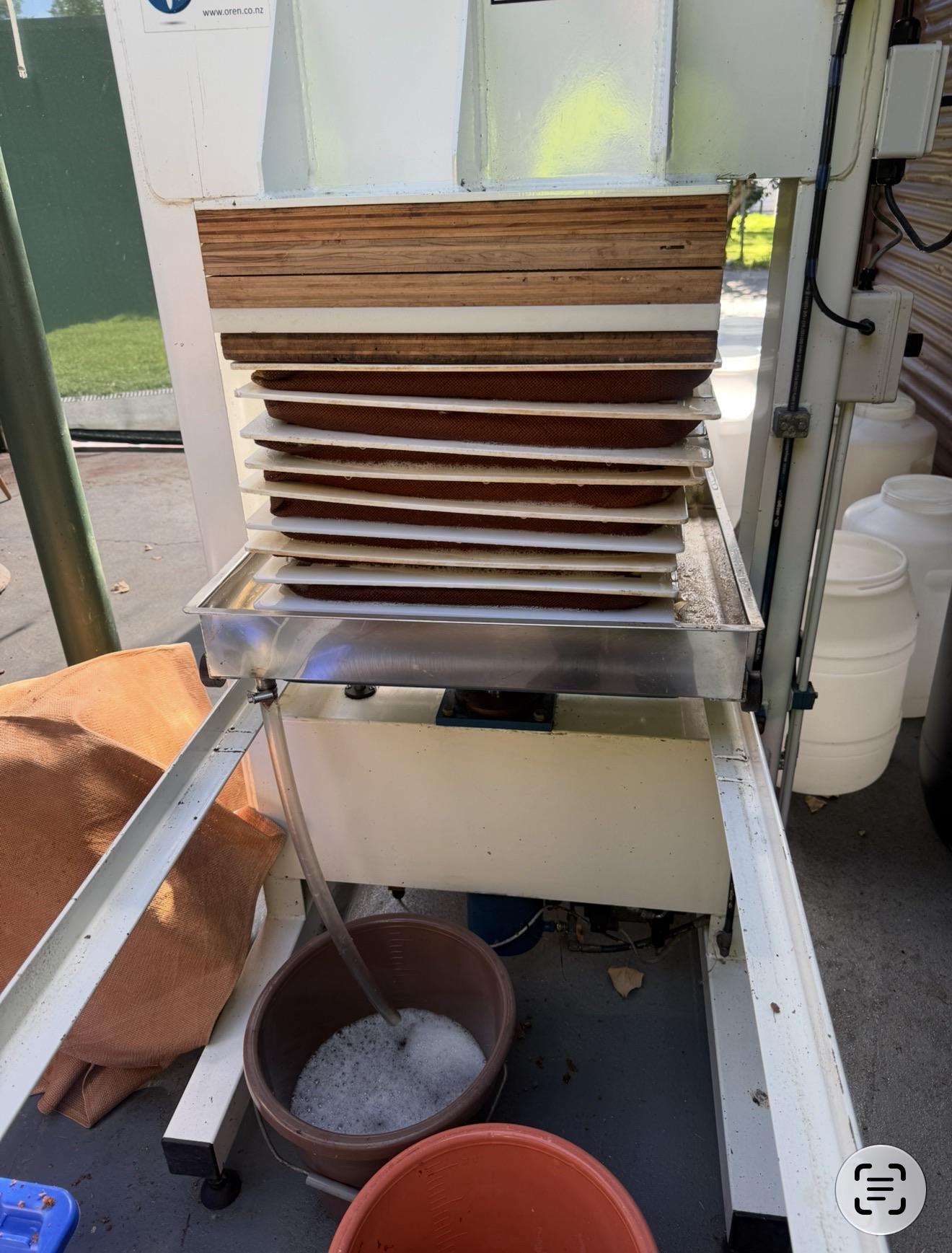
In cider making the large heavy block of wood on top of a rack and cloth press is called a chuter. A strange term at first sight but the probable etymology gives some explanations.
Following the Norman Conquest of 1066, French became the ruling language, French orchardists brought large-scale cidermaking to England, leaving behind a heavy layer of Norman French vocabulary which was adopted by the Anglo Saxons peasants. In the West Country there are other French words in cider making such as pomace from pomme, and must from moût). In French, chuter is an actual verb meaning "to fall" or "to drop down" (from the Latin cadere, to fall). On a traditional screw or beam press, the heavy pressing slab is suspended above the fruit stack and is literally lowered down onto the cheese to crush it. So I n Norman-influenced dialect, a heavy block designed to drop onto the stack was named after that downward action—the "faller" or "dropper."
Another aspect is found in 19th-century rural glossaries from Somerset and Devon, local writers wrote down spoken words phonetically, and "chuter" is widely considered a phonetic spelling of "shooter." In older English dialects, to shoot also meant to pour, shed, or cast off liquid (similar to how a roof shoots water). Because the top slab forced the juice to "shoot" out of the sides of the stack, the board itself took on the name.
r/etymology • u/LordLubbock • 2d ago

Here’s this week’s etymology question from 3Roads.xyz.
In aerodynamics, the flight X, or performance X, of an aircraft or spacecraft describes the limits of its capabilities in terms of speed, load factor, and altitude. The term later gave rise to a popular phrase, Y, meaning “to test the limits,” originally referring to pilots pushing an aircraft to or beyond its designated speed and altitude boundaries. What are X and Y?
r/etymology • u/VViatrVVay • 2d ago
After 4 years of learning Japanese, only now did I realise that 醜い (minikui) - “ugly” is just 見にくい (mi-nikui) - lit. “hard to look at”.
r/etymology • u/fnord_happy • 2d ago
I saw this whole browsing twitter
Source to the tweet
https://x.com/ManishEarth/status/2123564108473884723?a=ytaeENm6T2AjI8iwH_A&s=19
This is what OP is claiming:
Stan < Stanley (via the eminem song) < OE stān+lēa ("stone-field", like Ashley = "ashtree field") < PG stainaz ("stone") < PIE steh₂ ("to stand", as stones are static) > PII *stáHnam ("place", as places are also static) > Classical Persian ـستان ("place of")
Source:
https://x.com/ManishEarth/status/2123616772159078489?a=J5E3Kx2ZiMo2nCby5yk&s=19
Thoughts?
r/etymology • u/LanguageShrimp • 3d ago
r/etymology • u/Pure-Leadership-1737 • 3d ago
was comparing words between Finnish and Sinhala and noticed something really interesting.
Finnish: härkä = ox
Sinhala: (harak) = cattle
They sound surprisingly similar, even though Finnish and Sinhala aren't closely related languages
Then I noticed another one:
Swedish: samband = connection /
relationship
Sinhala: (sambandha)
connected / related
So we have:
härkä→ harak
samband → sambandha
The samband/sambandha connection has a genuine historical linguistic explanation, while härkä/harak is just a coincidence in sound.
Has anyone else noticed interesting similarities like this between languages that aren't closelv related?
r/etymology
•
u/Due-Cat-8156
•
3d ago
A few everyday words with a Turkish stop on their journey (sources: Etymonline):
As a native Turkish speaker I still find the tulip/turban one a bit wild.
Which everyday words in your language turned out to have a Turkish link?
r/etymology • u/fuchsely • 3d ago

r/etymology • u/eyounglawca • 4d ago
Is there a word that is either "bandy" or "banty" followed or joined to as one word by "cree" or "creed." I do not think it violates the group's rules as I read them to say that I think Google Gemini was wrong this morning when it asserted there is no such word(s) and never has been in the English language. I know this is not true because I recall the word in one of these variations being uttered by Gandalf, at least in the film, The Two Towers. I have not yet consulted my tattered copy of The Two Towers to see if Tolkien actually wrote a word like this. Assuming for the moment he did, and he was the first, would that not introduce the word into the English language to some extent in a similar way Shakespeare introduced words. Perhaps, it is a Shakespeare original. I fully endorse not relying on AI when it comes to etymology and a host of other things, too. Any constructive feedback is welcomed.
r/etymology • u/future_sponJ • 4d ago
All the English words I can think of about things related to 12 all have a base-10 origin. That includes twelve, dozen, & duodecimal.
Is there any word for 12 that does not have a decimal origin? I made up "bihexal" but is there one already in use?
EDIT: Ig I'll just use "uncial" from uncia/ounce. Also thanks for the responses guys.
r/etymology • u/OtherwiseClassic1930 • 5d ago
Like the title says, what is the difference between buy or buying,
Sell or selling,
Exchange or exchange,
Trade or trading?
Dont these all just mean the same thing.
Someone gives something and gets something in return.
I can buy pizza if i hand over 6 euro.
I can sell 6 euro and get 1 pizza in return.
I can exchange 6 euro for 1 pizza.
I can trade 6 euro for 1 pizza.
The merchant can buy 6 euro with 1 pizza.
The merchant can sell 1 pizza and get 6 euro in return.
The merchant can exchange 1 pizza for 6 euro.
The merchant can trade 1 pizza for 6 euro.
Are there any real differences, or do all of those mean the same?
Because, currently i think that all these words mean the same thing, but people/humans just use other words depending on the situation, even if other words would be equally correct.