In the space of a generation, the Kurds of Iraq have gone from being among the greatest beneficiaries of Iraq’s constitutional reconstruction to struggling to preserve the autonomy they secured. The generation that fought for Kurdish self-government and negotiated its constitutional recognition has also lived to witness much of that political capital squandered through entrenched governing practices, inherited political and tribal rivalries and the failures of subsequent leadership.
Across greater Kurdistan, established forms of Kurdish political power are being challenged or renegotiated. In Syria, Kurdish-led territorial autonomy is being significantly diminished. In Turkey, Abdullah Ocalan’s peace initiative represents a fundamental departure from decades of armed struggle. In Iran, Kurdish political movements remain vulnerable to repression.
These developments need not all represent defeats. Some could ultimately deliver more sustainable political gains. But collectively, they expose the limitations of a Kurdish political paradigm excessively dependent on personalities, parties, military leverage and favorable geopolitical circumstances.
Kurdistan may be approaching its own 1945 moment; a historical juncture at which the accumulated failures of political leadership create an unprecedented appetite for institutional transformation.
What made 1945 different?
The end of the Second World War marked a profound transformation in global political thinking. Two world wars had exposed the dangers of leaving peace, prosperity and security excessively dependent on political personalities, competing national ambitions and temporary alliances.
The United Nations, Bretton Woods institutions and subsequent European integration project emerged partly from a recognition that political goodwill was insufficient. Cooperation needed to be institutionalized, power constrained and collective interests protected through durable arrangements.
These institutions were imperfect, reflected existing power inequalities and did not eliminate conflict. Nevertheless, they represented a fundamental shift in how political order was conceived.
Kurdistan’s experiences are in no way comparable to the world wars in their scale of death, destruction or human suffering. The parallel lies instead in the political conditions that make institutional transformation desirable: accumulated disappointment, diminishing trust in leadership, and an appetite for peace, predictability, and stability.
Sometimes, the greatest institutional innovations emerge not from confidence in political leaders, but from the collective exhaustion of trusting them.
A generation of squandered opportunity
The Kurdish political leadership that emerged from the 1991 uprising achieved something extraordinary. Former liberation movements became governing parties and helped negotiate a post-Saddam constitutional settlement that recognised Kurdistan as a federal region, with substantial legislative, executive and security powers.
The Kurds were among the principal beneficiaries of Iraq’s 2005 constitution. Yet the political practices that followed progressively weakened the foundations upon which those achievements depended.
Party patronage, competing security forces, politically dependent employment and the concentration of power within ruling families have undermined institutional development. Reports of corruption, restrictions on political opposition and interference with protests further illustrate the distance between the aspirations of Kurdish liberation and the realities of Kurdish governance.
For those who spent their lives fighting for Kurdish autonomy, there can be few more painful political contradictions than witnessing its foundations weakened from within. A generation fought to secure Kurdistan’s political institutions.
Subsequent governing practices have too often made those institutions instruments of political parties rather than protectors of the people, a trajectory that has continued to evolve.
Looking beyond conventional measures of victory
Developments elsewhere in Kurdistan demand a more nuanced interpretation. In Syria, the Kurdish-led Syrian Democratic Forces have relinquished substantial territorial control following military confrontations and integration agreements with Damascus. Yet integration need not constitute defeat if it produces enforceable constitutional recognition, cultural rights, meaningful political representation and lasting security.
Similarly, in Turkey, Ocalan’s call for the Kurdistan Workers’ Party (PKK) to disband could create opportunities for democratic participation and legal recognition that decades of armed confrontation could not secure.
What appears to be a military or territorial retreat could ultimately become a political advance. Much depends on whether promises are translated into enforceable institutional guarantees.
In Iran, where Kurds have not enjoyed comparable recognized autonomy, continued repression and pressure on Kurdish political organizations illustrate the difficulty of achieving sustainable political gains without legal protection. The common lesson is not that every Kurdish political movement has failed. It is that political achievements remain vulnerable unless supported by institutions capable of preserving them, something in which Sardar Aziz has written extensively on.
The ultimate measure of Kurdish political success should not simply be how much territory Kurdish movements control, but how securely Kurdish people can exercise their rights.
The crisis that could change everything
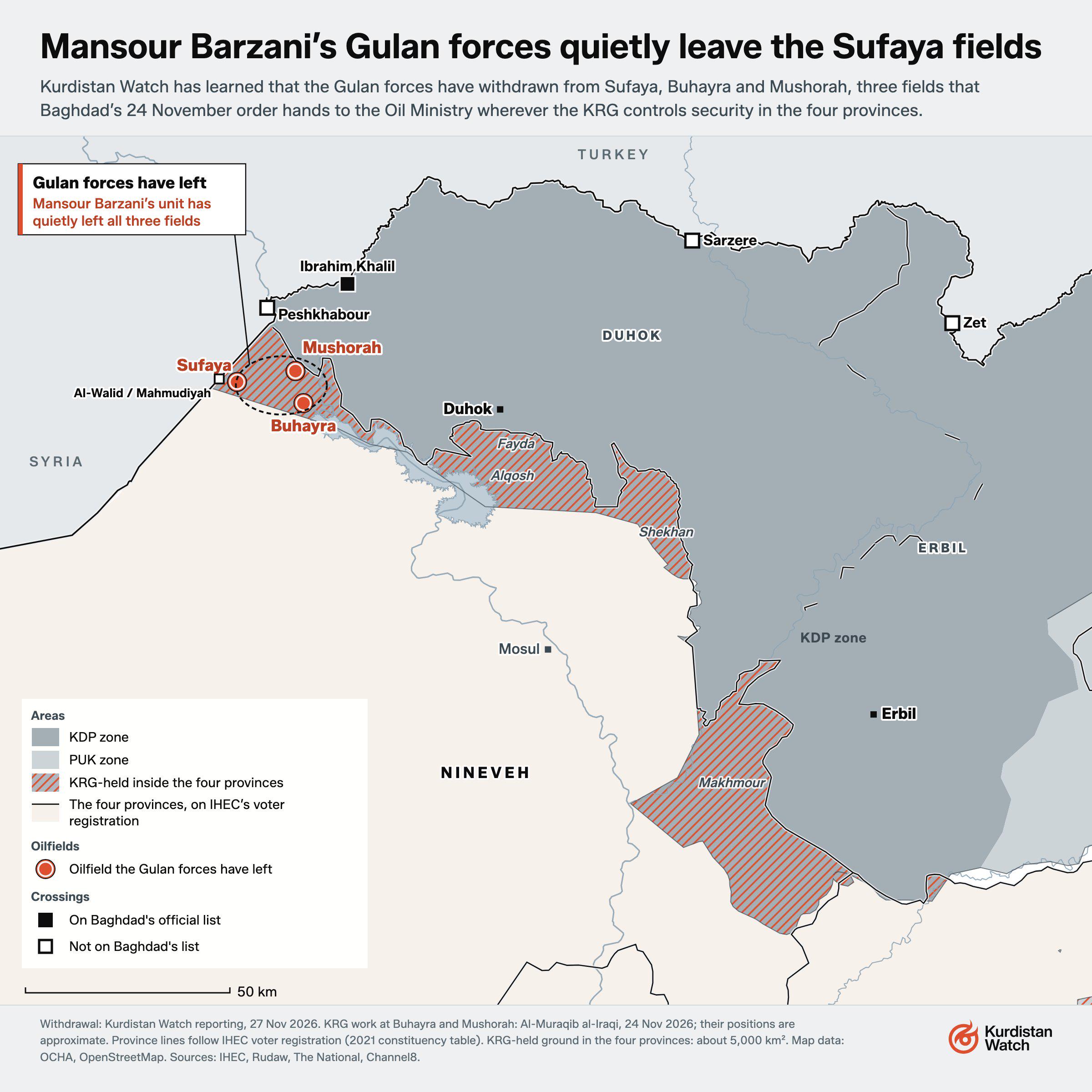
The latest confrontation between the Kurdistan Democratic Party (KDP) and Patriotic Union of Kurdistan (PUK), alongside Iraqi prime minister Ali al-Zaidi’s moves to consolidate federal control over border crossings, oil resources and revenues, brings this institutional predicament into sharper focus.
Baghdad’s centralizing ambitions deserve scrutiny, but Kurdish fragmentation also weakens the region’s capacity to defend its constitutional position. Nawshirwan Mustafa recognised elements of this predicament when he established the Gorran Movement in 2009, challenging corruption, patronage and the subordination of public institutions to ruling parties. Gorran’s subsequent decline, however, illustrated another uncomfortable lesson; even reformist political personalities cannot deliver lasting transformation without fundamentally altering the structures through which power operates.
Kurdistan cannot indefinitely search for exceptional leaders to compensate for defective institutions. In an increasingly multipolar and multiplex world, where power is dispersed not only among states but across economic networks, international institutions and non-state actors, personal relationships and conventional diplomacy are no substitute for institutional capacity.
Foreign relations cannot simply be entrusted to individual leaders or diplomatic representatives; they require an entire institutional ecosystem of independent think tanks, research centers, policy specialists and strategic planning bodies capable of interpreting global shifts, anticipating threats and identifying opportunities.
Kurdistan has too often treated diplomacy as the management of personal relationships rather than the institutional management of long-term strategic interests. In a world of increasingly complex interdependencies, relationships may open doors, but only institutions can ensure they remain open long after the individuals who opened them have departed.
Kurdistan cannot survive without institutions
In my earlier The Amargi article, Kurdistan’s greatest political idea is closer than we think, I argued that Kurdistan needed an institutional infrastructure capable of liberating human potential from political dependency.
The present crisis makes that argument not merely developmental, but existential. Kurdistan needs independent courts, professional civil services, transparent revenue management, functioning parliaments and politically neutral security institutions. But it also needs independent think tanks, research centers, policy expertise and strategic planning institutions capable of anticipating geopolitical change rather than merely reacting to it.
A nation cannot develop a foreign policy around personal relationships, an economy around political loyalty, or a future around the lifespan of its leaders. The purpose of institutions is to accumulate knowledge, preserve achievements, correct mistakes, and provide continuity beyond individual administrations and political generations.
Kurdistan needs the intellectual infrastructure to think collectively, the institutional infrastructure to govern effectively and the democratic infrastructure to hold power accountable. In 1945, much of the international community recognised that preserving peace required building structures that could outlast those who negotiated it.
Kurdistan now faces a comparable choice. It can continue treating each crisis as another struggle between political personalities, or understand the cumulative crisis as evidence that its existing governing model requires transformation. The liberation generation fought to give Kurdistan a political existence. The task of the next generation is to give that existence institutional permanence.
Kurdistan cannot simply be a nation whose people have repeatedly demonstrated their willingness to die for it. It must become one with institutions capable of ensuring that everything they fought for survives them.
--
Bamo Nouri is an award-winning senior lecturer in International Relations at the University of West London, an Honorary Research Fellow at City St George’s, University of London, and a One Young World Ambassador. He is also an independent investigative journalist and writer with interests in American foreign policy and the international and domestic politics of the Middle East. He is the author of Elite Theory and the 2003 Iraq Occupation by the United States.