Other than Assimil, language courses with French as the base language are rarely recommended. Surely there must be a lot of hidden treasures out there?
I'm open to any target language (TL). Especially Latin, Ancient Greek, German, Italian, Spanish, Turkish, Persian, Arabic and Hebrew.
I initially began learning through immersion and grammar, and didn't particularly pay too close attention to reading, since I primarily learned it to listen and speak. I will be going to my target language's country next year and decided to at least get it up to survival mode, because some things where I plan on going there will be no English at all (part of the point of me going there) While I am confident that I can talk my way back to civilization, not so sure I will be able to operate things like ATMs or restaurant menus. So, I am not looking for fluency here, though that would be a nice long term goal, but the immediate goal is fix it so I can read just enough to get on the right train and not wind up 9 hours in the wrong direction because I misread the train platform.
Me and my mum are learning italian (TL) my mum used to learn french and knows a fair bit still, and a few of my friends are learning either french or spanish. Id really enjoy if there was something we could play together that would focus on language, ideally in a way that works with multiple different languages, could be a videogame, a wordgame, a certain website, anything! Keep in mind we are absolute beginners for the most part
theres one kinda small game ive played at some point where i looked for a simple word generator and we all tried to see if we could remember the word translated in our target language, but that one is rather flat and it can get a bit tedious to check for the proper translation in each language every time after a while lol
edit: Me and my mum live together so we can play in person games of course and possibly games that rely on knowing the same language though she JUST started italian, and we are limited to 2 people, me and my friends would only be able to play games online
I know people love Anki and I find it works great for me when the meaning is rather binary. I’ve been kinda stuck in a rut with German vocab that is a little more advanced. Doing Anki by itself just helps me to know the meaning (even if it is the definition in my target language), but I have trouble actually using more complex words in every day language when I have elementary words I can use instead. How do you embed the more niche words into your everyday vocab rather than falling back on the easier words? Another challenge I have is that I don’t have the opportunity to apply German every day in a conversation since I don’t live there. Any additional methods for picking up and practicing more complex words would be appreciated
Grind to 500 words with Anki before bothering with anything else (immersion, TV)
Walk while doing flashcards to study longer
Study just before sleeping or after waking up
After 500 words, switch to graded readers
A bit every day beats a lot all at once
Read on for the full story of how I learned this the hard way.
My dad is Chinese (TL), so growing up I picked up a few phrases you’d teach kids, but at home we only spoke French and English. I did weekend Chinese classes for a bit but was a bad student. (What kid wants to go to school on weekends?) Then I didn’t touch the language for over a decade.
False start
I took 8 months of beginner Chinese in university. After graduating, I got an online tutor and picked a business-language textbook because I wanted a challenge. That was a mistake: the vocabulary was boring and useless outside of work. I was busy with a new job and barely studied between classes, so progress was slow. My goal was speaking, so I skipped learning to read and write. After 6 months, I paused for a one-week vacation. That pause never ended.
Moving to Taiwan
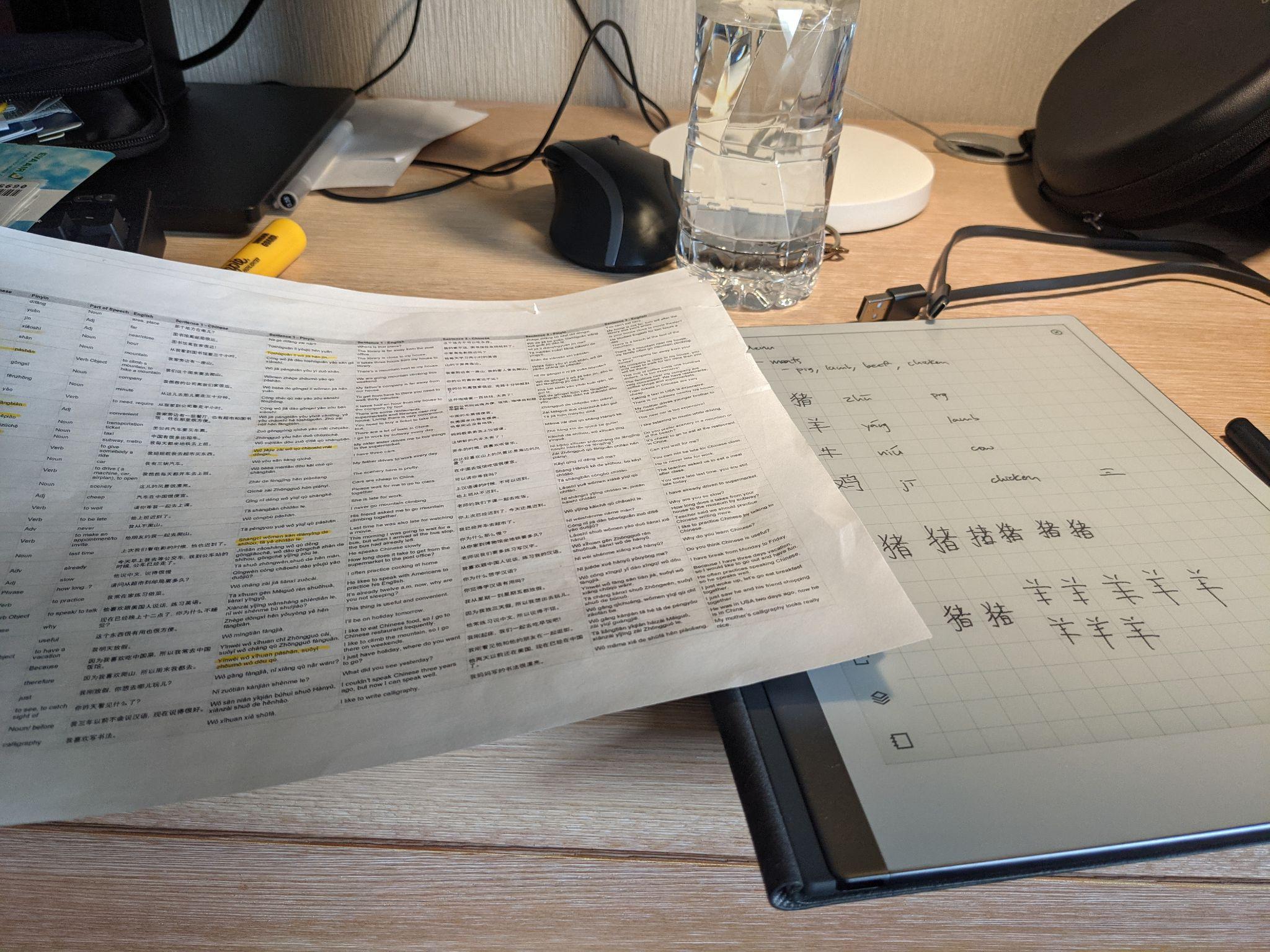
Four years later, during COVID, I moved to Taiwan, starting with a 15-day hotel quarantine. I spent hours a day memorizing printed vocab lists and watched almost all 46 episodes of a TV drama. I probably learned fewer than 10 words from the show because it was way beyond my level... but at least it passed the time.
You’d think living in Taiwan would speed up my learning, but it didn’t. Some people learn by chatting with strangers, but that’s not me. I’m more on the reserved side, and with my limited vocabulary I’d hit a wall after a couple of sentences. Most of the friends I made spoke English and my remote job was in English, so sometimes weeks went by where the only words I used were “thank you” and “check please.”
I restarted online lessons, and progress was better since I studied between classes. After 6 months, work got too busy, so I paused again.
Inflection point #1: Anki
A year later I finally discovered Anki, and it changed everything. I loved that I could study anywhere, even a few cards while waiting in line. I ground through 30–90 minutes a day and kept it up for a year. I found that doing flashcards while walking let me study longer without getting distracted, and that I remembered more when I studied just before sleeping or right after waking up. My vocabulary grew dramatically.
This is also when I started learning to read, and I found that breaking the writing system into its building blocks made words much easier to remember.
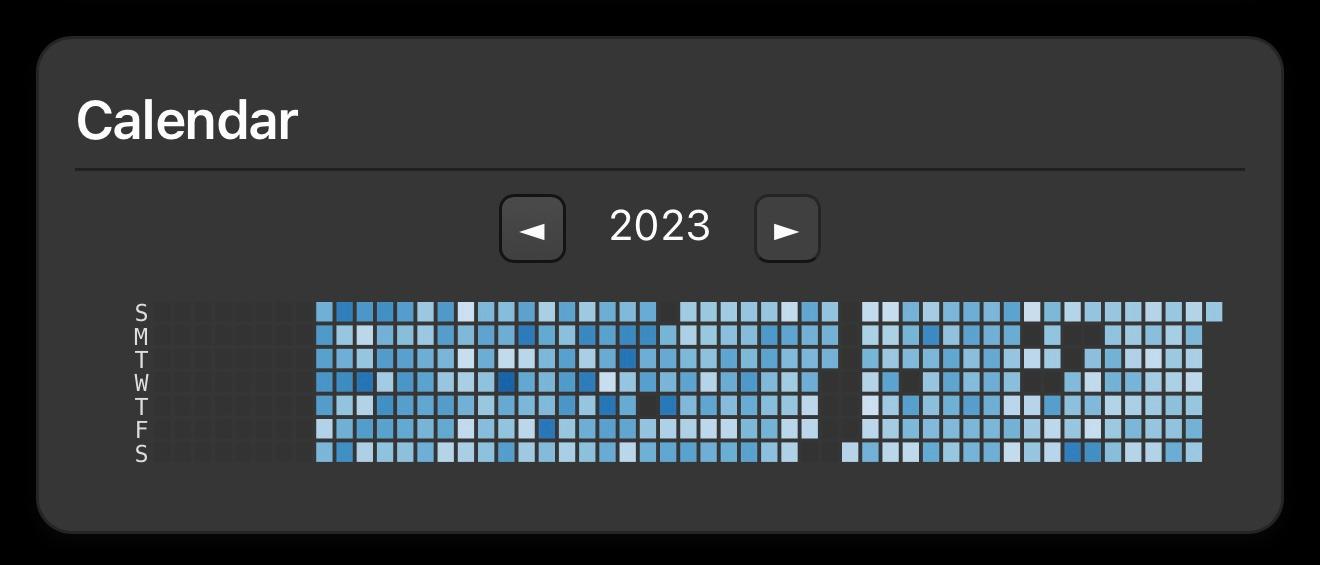
I was proud of my streaks, which motivated me to keep going.
Anki activity heatmap.
Inflection point #2: graded readers
Another year later I discovered graded readers, which let me put all that vocabulary to use. They were a game changer compared to textbooks: tapping a word to look it up beats flipping through dozens of pages to find the definition. Saving new words straight to flashcards also took the work out of maintaining an Anki deck.
Everyone learns differently, and for me reading is by far the most effective. I’ve been reading for close to 4 years now and I’m at an upper-intermediate level.
These days I read whatever I’m interested in, adapted to my level. I just finished an abridged version of the Red Rising series and started an abridged version of The Hitchhiker’s Guide to the Galaxy. I’m reading more than ever now that I have unlimited content that’s both at my level and actually interesting to me.
What didn’t work for me
Audio-only learning like podcasts or AI voice mode. Without seeing the words written down, they didn’t stick.
Difficult content. Whether it’s reading or TV, if it’s too hard, most of it goes over my head and I can’t stay focused for long.
Boring content.
Tutoring before knowing 500 words. I got more out of flashcards and reading at that stage.
If I could talk to my younger self, I’d tell him to go straight to Anki and grind to 500 words. Everything else, like TV, immersion and even tutors, can wait until there’s enough vocabulary for it to stick. I’d tell him to do flashcards while walking to keep going longer, and to study just before bed or after waking up. Then he should move to graded readers. A bit every day beats a lot all at once, so study daily, even if it’s just a few cards.
It took me years to figure this out. Hopefully it’s helpful to you!
I'm super new to French—literally at the "Bonjour, je m'appelle" stage. I've been using Duolingo for the past 30 days to pick up some basic vocab, which helped a bit, but I keep hearing it's not great for the long run.
It claims the book can take you from A1 to B1 by the time you finish it. The whole thing is written completely in French, and I'm currently on Chapter 1. Even with just a handful of vocab words under my belt, my brain is actually starting to piece things together!
Has anyone here read this book and can share their honest opinion on it? Did you end up finishing it, and did it actually help expand your French vocab?
Hey yall, I’m 20 and I’ve been wanting to reconnect with German (TL) bc it is a language that was a pretty big part of my life growing up.
From PK until 8th grade I attended a German international school in my country where almost every subject was taught in German. Unfortunately I had a terrible experience at that school. I dealt with a lot of classism and racism from both teachers and classmates. It was one of the most expensive schools in the country and my parents were making a big effort to pay for it but most of the students came from wealthy German expat families. German culture was always talked about as superior and the local culture was regarded as backwards or even savage.
Some of my teachers made me feel stupid bc I struggled academically, even though I was learning pretty much everything in a foreign language and had no support at home since neither of my parents spoke German. One teacher even told me I wasn’t intelligent bc I didn’t have German or Northern European heritage like most of my classmates.
Eventually I transferred to another school that followed the National curriculum and there I was much happier and graduated high school. However by that point I had developed such a negative association with German that I completely stopped speaking it for around six years.
I’m in university rn and really want to reconnect with the language. I’ve always been passionate about languages and it feels like such a shame to let all those years of learning go to waste. I think I can still understand quite a lot but whenever I try to speak, I feel really insecure. I constantly worry about making mistakes or sounding stupid and I know a lot of that comes from my past experiences.
Has anyone else gone through something similar? How did you reconnect with a language that was tied to such negative memories?
I’d really appreciate any advice. I don’t want to give up on German. I just want to learn how to enjoy it again and eventually feel comfortable speaking it without being so hard on myself
Is there a word for this? I want to be fluent in my target languages someday. But I've realized my most realistic short-term goal is to not sweat my mistakes and to try to not get so overwhelmed and flustered when talking to native speakers.
I think part of it is to try to speak at a slightly lower level than I'm technically capable of so I can speak more fluidly and comfortably.
I was wondering if anyone also struggled with this and found ways to build up this specific skill.
I'm looking for some advice. I've been learning European Portuguese(TL) for around 2 years now. I was in group classes from A1-B1, and then switched to a private tutor after finishing the B1 course. I had some gaps between each module in this time, so I'd say it was about a year of weekly classes in total over this time.
My classes with my tutor are fully in Portuguese and I can understand her well, there's rarely any friction. But as soon as I'm in the real world - interacting with strangers, watching the TV, listening to the radio - I really struggle (unless it's simple interactions like ordering food, in a store, etc. where I'm fully aware of the context).
This is something I really want to improve over the next year. I think my written/reading skills are quite a bit ahead of my speaking/oral comprehension. I'm still quite shy to speak, but I think this is mostly because I am nervous about my ability to understand what the other person replies so I tend to avoid conversations.
This is the first language I've ever learned properly outside my NL and I'm in my late 30s. I live in Lisbon so I do have a lot of access to native speakers and content, though everyone here does speak English really well so it's easy for me to avoid it.
I've been doing small listening exercises on sites like Practice Portuguese, and I'd say that I'm fairly comfortable with those - again, they're short, recorded specifically for learners and I know the context. What I want to get to grips with is fast, accented, real-world content.
A few people have suggested podcasts, but I've tried this in the past and have struggled. Would it be better to find content that I can listen to AND read along with? For example, if I could find a podcast that also had a transcript? It feels counter-intuitive because I worry I'll just end up using my stronger skill (reading) rather than training my weaker one. But listening to complex B1 content is challenging, so I'm not sure it does much good if I'm struggling to pick out words.
It's frustrating for me because 9/10 times, if I see the written content I understand all of it. So it's not a vocab issue! It just seem to go in one ear and out the other without my brain actually being able to process it.
I see his courses are going on Black Friday sale heavily discounted soon. What do you all think of his courses? I'm especially interested in his Intermediate German course. Are his courses worth it, espec when 50% off? Thanks.
In my case, the spaced repetition technique and anki cards have never worked when I was trying to study japanese and french. Only comprehensive input aquired by listening to japanese material helps me a bit, so do you know/use another strategy? At the present time, I'm planning to learn polish and korean language.
My (TL) is Spanish, but this question goes for any language.
I like to read sentences out loud when reading in my target language. What I have been doing so far is speaking very slowly to try to get the pronunciation as close to correct as I can. My thinking has been: start slow, get the pronunciation right, and I will naturally pick up the pace as I get more practice, getting closer to a natural speaking speed as I get used to the pronunciation.
However, this hasn't happened. I'm not really getting any faster, and when I make a conscious effort to speak faster (like close to a native speaker's rate), I trip over my tongue and my pronunciation is horrible.
Does it make more sense to try practicing at a normal speed from the get-go? Has speaking so slowly for so long been counter-productive?
I've been learning languages for about 8 years now, mainly through comprehensible input and watching shows/content in my TLs, as well as a few foreign language courses in my uni. I'm looking to improve my speaking skills in my two main TLs (Thai and Spanish), but as an introvert, I find it really draining to talk for even half an hour straight. I've also tried language exchange apps, but I've found them to be ineffective as our conversations usually don't go beyond superficial small talk and "how was your day?" sort of questions. I realised that once I click with a particular tutor or person and our conversations flow nicely, I don't find it draining at all, but the thought of having to test out dozens of tutors before finding the right person just makes me dread the entire process. Are there any other introverts who have faced something similar? And if so, what did you do?
I am curious about something with i+1. I suppose this is a bit more theoretical or philosophical than practical, but let's pretend my target language (TL) is English and, in a sentence I understand completely otherwise, I come across the phrase "black hole." Let's pretend I don't know "black" or "hole" in English and also don't know what "black hole" refers to as a phrase.
Is that i+1 because "black hole" is something very specific (like "White House"), i+2 because of "black" and "hole" as separate words, or i+3 because I don't know "black" or "hole" separately and don't know that "black hole" is a fundementally unique thing?
Hi everyone! I am on a lifelong quest to learn Spanish (TL). I've used Preply for the past month and while I like to practice of speaking, I feel like it's too unstructured- my tutor asks what I want to talk about and then we just go. I am looking for something more akin to how classes are, with a book we work out of and then homework to do on my own time and review with my tutor, and then conversing based off of what I just learned. Does anyone have any suggestions of where to look for that? Or is that something I could request of a Preply tutor (I guess assuming we have access to the same book)? Thanks!
I have been learning foreign languages for years, in fact since childhood. By training, I am a teacher of German and Swedish. I polish my English on my own, and I taught myself Spanish (TL) to an intermediate level. Despite my experience and education, I find it hard to answer the question of how to learn in order to actually learn. In this text, however, I will try to work out what I think is the right way to study.
On the internet, "the method" is the Holy Grail: that one, unique method. Dozens of YouTube videos promise that it will give you a speed and durability of learning you have never experienced, as if it were something mystical. Perhaps it is this trend that makes me feel that, as an "expert," I should know. I should know the method, or at least a competing one. In this YouTube noise, in the battle for views, likes, attention and course sales, we forget that learning a new language is hard, grinding work. Nothing matters more than staying consistent over a long period, and which specific method you use is secondary. Yet people keep talking about a method, a single one, and I do not believe a language can be learned effectively that way. At least nothing in my experience suggests it. Unless, that is, by "method" we mean many approaches: a method as a system of methods.
To get down to specifics, I believe we need a little of each approach: a classic grammar book, listening, apps, reading, writing, speaking, lessons with a teacher. And the less classic ones: translating songs, watching films, playing games, or pursuing a hobby through content and materials in the target language. How often and how intensively each is used depends on individual preferences and dispositions, but also on one's level. At the beginning, playing a story-driven game entirely in the language you are learning can be off-putting.
In closing, I want to mention the most important "method" besides consistency: intrinsic motivation, such as passion and a love of the subject. You can learn without it, but a sincere desire to explore a language and keep getting better at it strengthens every approach you choose and sustains your consistency. And that brings me back to where I started: perhaps the expert's honest answer is not a method at all, but a habit and a reason to keep going.
I’ve been using this as a tool to help improve my understanding of Portuguese past tenses and have found it really helpful, so I thought I’d share it here.
It tells an LLM how to teach using the Socratic method - teaching by asking questions to guide you to the answer. It isn’t specific to language learning- you can use it for anything.
You can either install it if using something like Claude, or simply paste it at the top of a chat along with telling it what you want to learn.
Sharing a link to the original source for credit. The triple dot menu has copy/download options:
Does anyone have tips for reading more quickly with a new alphabet? It's for a language I already speak pretty well, considering both my parents do, but I never learned how to read or write. Which is quite frustrating, as I try to learn to read because my brain thinks much faster than I can read in the language having to sound out each letter. Also I have an issue with messing up some characters that are different sounds but flipped and I also mess up the difference between unaspirated and aspirated characters which I dont do when I speak or listen as I can listen to both perfectly and do not have issues differentiating them in my speech. So if anyone has any tips for a similar situation lmk. (TL) Georgian
TLDR: Since June i’ve been studying 2 lessons a week on preply at around 16 euros a lesson. I think I’ve spent about €800 in total. So far so good. If got me from A1 to A2 and I’m currently trying to decide whether it’s worth taken on an additional lelsson.
I moved to Madeira in spring assuming that it would be simple from my current level (A1) level to the next level A2. Even with immersion this was more difficult than anticipated.
I used a textbook to push myself to somewhere around A1 but ended up stalling. The biggest lmitation for me was not having that direct feedback and being able to ask the more specific grammar questions.
Building a rural college out in Madeira is the thing that finally made me take the jump to getting a tutor. It was a big struggle to speak with and understand the construction team that was working on my place.
I’d recommend a tutor to anyone who’s struggling to make that leap at the moment. I’m not saying i’m perfect but i can more or less carry a conversation now and people mostly people have stopped changing to english. It feels like a big win.
For anyone who’s gone through this, would a 3rd lesson a week help speed up the process of learning portuguese (TL).
What strategies have worked for you? Do you or someone you know have success at learning new languages after 30? How does age change the practice program?
First time applying and super nervous as I heard it pretty competitive. I guess most of the worry is that my college degree is going to be geared into healthcare. I know the language Russian (TL) I'm applying for can be used in my career choice, but it's not a requirement for it. I would assume applicants who are going for business or government oriented careers would have a better chance of getting accepted into the program.
Speaking regularly helps me most, but I find it harder to tell how much I’m improving. I’m thinking of recording myself describing the same everyday situation once a week, then comparing where I get stuck.
Do you track speaking progress in a way that tells you more than whether you kept a streak going?
Is this asking too much? I just want to converse with someone in the language I am learning. And maybe converse with them in English too. I tried Hello talk, but couldn't get past the AI proof of humanity thing. I have looked at others, but they are all either heavily invested in trying to get you to use their AI, or require your photo to even sign up. So... What's left?