r/languagelearning • • 7d ago

Discussion A genuine appeal to all fellow language learners: Have you ever learned a language simply to feel more connected to people?

22 Upvotes

Hi everyone!

I have a genuine question for fellow language learners, especially those who have pursued a language without any practical necessity.

Usually, learning a language comes with a strong motivation: studying, working, immigration, family, or a romantic relationship. After all, we're talking about hundreds, sometimes thousands of hours that could otherwise be spent doing something considerably more comfortable.

My story is a little different.

A bit about myself: I'm Turkish, in my early 30s, and I've been living in Lithuania for over six years, apart from an exchange semester in Norway. Besides English, I speak Lithuanian at B2 level, and I used to speak Norwegian at a similar level before losing much of it through lack of practice. German was actually my first foreign language, but poor teaching and a rather forced learning experience put me off it. I've dabbled in several other languages since.

My Lithuanian-learning journey has been rather bittersweet.

I've come this far almost entirely on my own. Apart from a wonderful tutor and a handful of genuinely encouraging people, I've received surprisingly little enthusiasm or support.

When I was around A2–B1, precisely when you need to start interacting, making mistakes, and learning from real conversations, I often encountered the same reaction. I'd enthusiastically explain why I was learning Lithuanian, what I loved about living here, and how much effort I'd put into it.

The response, usually in English, would be something like "Hmm. That's nice. But why?"

And after I'd explained everything*: "Oh, I see. Lithuanian is difficult even for us."*

And that was pretty much the end of the conversation. Not even an attempt to continue in Lithuanian, or participating further into the conversation, giving insights, offering help, or at least sharing their own experiences.

I found this particularly discouraging because Lithuania is a small country, and relatively few foreigners reach conversational fluency in its language.

Compare that with my experience as a Turkish speaker. Whenever I meet someone learning Turkish, whether because of our ridiculously dramatic soap operas, music, or sheer curiosity, I'm genuinely thrilled. I'll happily explain expressions, cultural references, and little linguistic tricks that textbooks rarely teach.

Perhaps you're thinking that I was simply approaching the wrong people or expecting too much. Or perhaps, maybe I'm just some odd bloke who people try to politely avoid. Sure thing. But I've also travelled extensively, particularly around the geographical south, and repeatedly experienced something very different: strangers showing genuine curiosity, sharing stories, and occasionally even inviting me to join them, despite me almost never speaking their language.

Of course, not everyone is like that, anywhere. But those encounters left a lasting impression on me.

Fast-forward to today.

I passed my Lithuanian B2 exam last year, obtained permanent residency, and now work in home care with a family who genuinely treat me as one of their own. I've also made a rather radical decision at starting medical school from scratch. (how's it going is completely a different topic of another post:D)

So I'm not planning to leave Lithuania anytime soon. The bureaucracy works, my living expenses are manageable, I've built a stable life here, and I can function independently in the local language. Moving to Spain or Italy wouldn't necessarily improve my financial situation either.

Yet something still feels missing.

Despite becoming proficient in Lithuanian, attending local events, and making further efforts to integrate socially, I haven't quite found the sense of connection and belonging I've been looking for. I can participate in everyday life, understand conversations, and navigate society, but linguistic integration hasn't necessarily translated into social integration.

And that brings me to my dilemma.

I'm considering seriously learning Spanish or Italian. Not because I need either language for work, immigration, or education. Not because I'm planning to move tomorrow. But because I want to meet people, build friendships, share experiences, travel with more purpose, and perhaps feel that excitement of discovering another culture from within.

At this stage of my life, I'm increasingly interested in collecting memories rather than simply accumulating qualifications.

But I also wonder whether I'm romanticizing the whole thing. Learning a language takes an enormous investment of time(and money too), and there's obviously no guarantee that speaking Spanish or Italian will magically produce meaningful friendships.

So here's what I'd genuinely love to ask you:

Have any of you learned a language primarily because you were seeking a deeper human connection, rather than pursuing a practical goal?

Did it actually change your social life? Did knowing the language help you build friendships, feel welcome, or experience things that would otherwise have remained inaccessible?

Or did you eventually discover that the people, rather than the language itself, were what really mattered?

I'd especially love to hear from people who already had a stable life somewhere but decided to learn another language simply because they wanted more out of life. I also don't want to limit it into Spanish or Italian. I'm open to other recommendations and any other experience in any piece of land in the world is welcome.

Thanks for reading. I'd really appreciate your experiences and perspectives.


r/languagelearning • • 8d ago

Discussion Why do American high schools kill the joy of learning a language?

168 Upvotes

I have been wondering this for a while. I took spanish in high school and then stopped the first chance I could. I don't have a desire to go back to learning that language even though it would be very beneficial to learn. I have started learning Chinese in college and am enjoying it more. I only did because I needed a language class to graduate college. Why do high school language classes kill the joy of language learning and make you want to stop learning? Do other people have this experience? It's like it leaves a bad taste in your mouth for language learning and makes it harder to start again. (TL)


r/languagelearning • • 7d ago

Studying Language Learning Practice Partners (Discussion)

Thumbnail reddit.com
2 Upvotes

r/languagelearning • • 7d ago

Discussion Heritage Language, Brain Science and Language Learning?

5 Upvotes

Hi all!

I am trying to learn Spanish enough to speak and connect with my family, and trying to learn basic conversational Thai.

I spent years growing up in a Spanish speaking home, I have visited my family’s country of origin, spent my whole life around those who speak Spanish, took Spanish K-8, and still cannot speak it. I have decent pronunciation of reading (I have been told I sound fluent when I do speak), I can understand Id say 40% of what I hear, but somehow the anxiety and trying to learn the different tenses holds me back. I personally cannot hear things in my brain (no internal monologue), I am a very tactile learner and work well with memorization and “doing” to learn . Anyone have suggestions on learning through memorization and online portals for talking? Also open to any other tricks!

Additionally for Thai, this is a whole different skill set as I’m trying to genuinely learn the alphabet over romantic stylizing. I am wondering the best methods to learn it through. I have my first tutoring session tomorrow but probably can only do one per week. I am most interested in learning conversational Thai and the alphabet enough to read, but worry that I’ll become fluent in reading and pronunciation but not comprehension like I am with Spanish.

Open to apps, subscriptions, whatever!

Thanks for help and advice! (TL)


r/languagelearning • • 8d ago

Discussion How to improve intonation in your TL?

11 Upvotes

I'm a native English speaker learning Korean, and I've been working on improving my accent lately, but more specifically intonation. What I do is I use this podcast hosted by a male speaker who speaks with a standard Seoul accent, then I try to copy his intonation, rythem, and pronunciation as closely as possible, and keep re-recording until it sounds very similar.

I've submitted my recordings to native Korean speakers for review, and they were able to find several issues with my intonation patterns that I was completely unaware of despite listening to the recordings multiple times and comparing them to my reference speaker.

I'm not aiming to sound 100% like a native speaker, but I want to make my accent/intonation more Korean-like if that makes sense. I'm understandable when I speak Korean, but my friends told me my intonation is the thing that really makes me sound foreign. I like the way Korean sounds and I want to develop a good accent in the language.

For those of you who develop good accents and intonation in your TLs, how did you do it?


r/languagelearning • • 7d ago

Resources Why do some Japanese words just refuse to stick? Looking for Anki users to help find out (~10 min)

Post image
0 Upvotes

Hi everyone! I’m Stewart McCauley, a language-learning researcher at the University of Iowa.

You know those Japanese (TL) words that keep coming back no matter how many times you review them? Not rare, not hard to say, and they still won’t stick. I want to find out why, and your review history may hold the clues.

To better understand this, we need real review data from real learners, and that’s where you come in.

What’s involved

  • Exporting your Japanese deck(s) with Anki’s built-in export feature and uploading the file. There’s nothing to install, and it’s best done on a computer, where exporting and uploading are much easier.
  • A few short questions about your language background and how you study (for example, your native language, whether you did WaniKani first, and whether you use the Free Spaced Repetition Scheduler [FSRS] that Anki offers as an alternative to its default scheduling method)
  • About 10 minutes in total

Shared decks (Core, Kaishi, and so on) and your own custom (e.g., “mined”) decks are both welcome, and it’s fine if you’re only partway through a deck.

What happens to your data

  • It’s anonymous: we never see your name, email, AnkiWeb account, or IP address.
  • We keep only your review history and the Japanese word and reading on each card, plus example sentences only if you say yes. Everything else in the file, like your notes, definitions, and tags, is deleted. Your export will remove all images, video, audio, etc.
  • Right after you upload, you’ll get a code. Email me with it if you ever want your data removed from the study.

You need to be 18 or older. Taking part is voluntary and unpaid. We hope this study will increase our understanding of how spaced repetition works for vocabulary and lead to smarter scheduling for new cards.

Take part: [Qualtrics Link]

Questions? Email stewart-mccauley@uiowa.edu or ask in the comments.


r/languagelearning • • 8d ago

Discussion Favorite language courses (any target language) with French as the base language?

19 Upvotes

Other than Assimil, language courses with French as the base language are rarely recommended. Surely there must be a lot of hidden treasures out there?

I'm open to any target language (TL). Especially Latin, Ancient Greek, German, Italian, Spanish, Turkish, Persian, Arabic and Hebrew.


r/languagelearning • • 8d ago

Culture For immersion heavy learners, how to correct, a reading problem?

7 Upvotes

I initially began learning through immersion and grammar, and didn't particularly pay too close attention to reading, since I primarily learned it to listen and speak. I will be going to my target language's country next year and decided to at least get it up to survival mode, because some things where I plan on going there will be no English at all (part of the point of me going there) While I am confident that I can talk my way back to civilization, not so sure I will be able to operate things like ATMs or restaurant menus. So, I am not looking for fluency here, though that would be a nice long term goal, but the immediate goal is fix it so I can read just enough to get on the right train and not wind up 9 hours in the wrong direction because I misread the train platform.


r/languagelearning • • 8d ago

Discussion Fun games to play with multiple people learning different languages?

20 Upvotes

Me and my mum are learning italian (TL) my mum used to learn french and knows a fair bit still, and a few of my friends are learning either french or spanish. Id really enjoy if there was something we could play together that would focus on language, ideally in a way that works with multiple different languages, could be a videogame, a wordgame, a certain website, anything! Keep in mind we are absolute beginners for the most part

theres one kinda small game ive played at some point where i looked for a simple word generator and we all tried to see if we could remember the word translated in our target language, but that one is rather flat and it can get a bit tedious to check for the proper translation in each language every time after a while lol

edit: Me and my mum live together so we can play in person games of course and possibly games that rely on knowing the same language though she JUST started italian, and we are limited to 2 people, me and my friends would only be able to play games online


r/languagelearning • • 8d ago

Resources What is your preferred method for actually learning vocab at the higher levels (not just Anki)?

4 Upvotes

I know people love Anki and I find it works great for me when the meaning is rather binary. I’ve been kinda stuck in a rut with German vocab that is a little more advanced. Doing Anki by itself just helps me to know the meaning (even if it is the definition in my target language), but I have trouble actually using more complex words in every day language when I have elementary words I can use instead. How do you embed the more niche words into your everyday vocab rather than falling back on the easier words? Another challenge I have is that I don’t have the opportunity to apply German every day in a conversation since I don’t live there. Any additional methods for picking up and practicing more complex words would be appreciated


r/languagelearning • • 8d ago

Moving to Taiwan didn’t make me fluent: What I’d tell my younger self after 6 years of learning a new language

53 Upvotes

TLDR

  • Grind to 500 words with Anki before bothering with anything else (immersion, TV)
  • Walk while doing flashcards to study longer
  • Study just before sleeping or after waking up
  • After 500 words, switch to graded readers
  • A bit every day beats a lot all at once

Read on for the full story of how I learned this the hard way.

My dad is Chinese (TL), so growing up I picked up a few phrases you’d teach kids, but at home we only spoke French and English. I did weekend Chinese classes for a bit but was a bad student. (What kid wants to go to school on weekends?) Then I didn’t touch the language for over a decade.

False start

I took 8 months of beginner Chinese in university. After graduating, I got an online tutor and picked a business-language textbook because I wanted a challenge. That was a mistake: the vocabulary was boring and useless outside of work. I was busy with a new job and barely studied between classes, so progress was slow. My goal was speaking, so I skipped learning to read and write. After 6 months, I paused for a one-week vacation. That pause never ended.

Moving to Taiwan

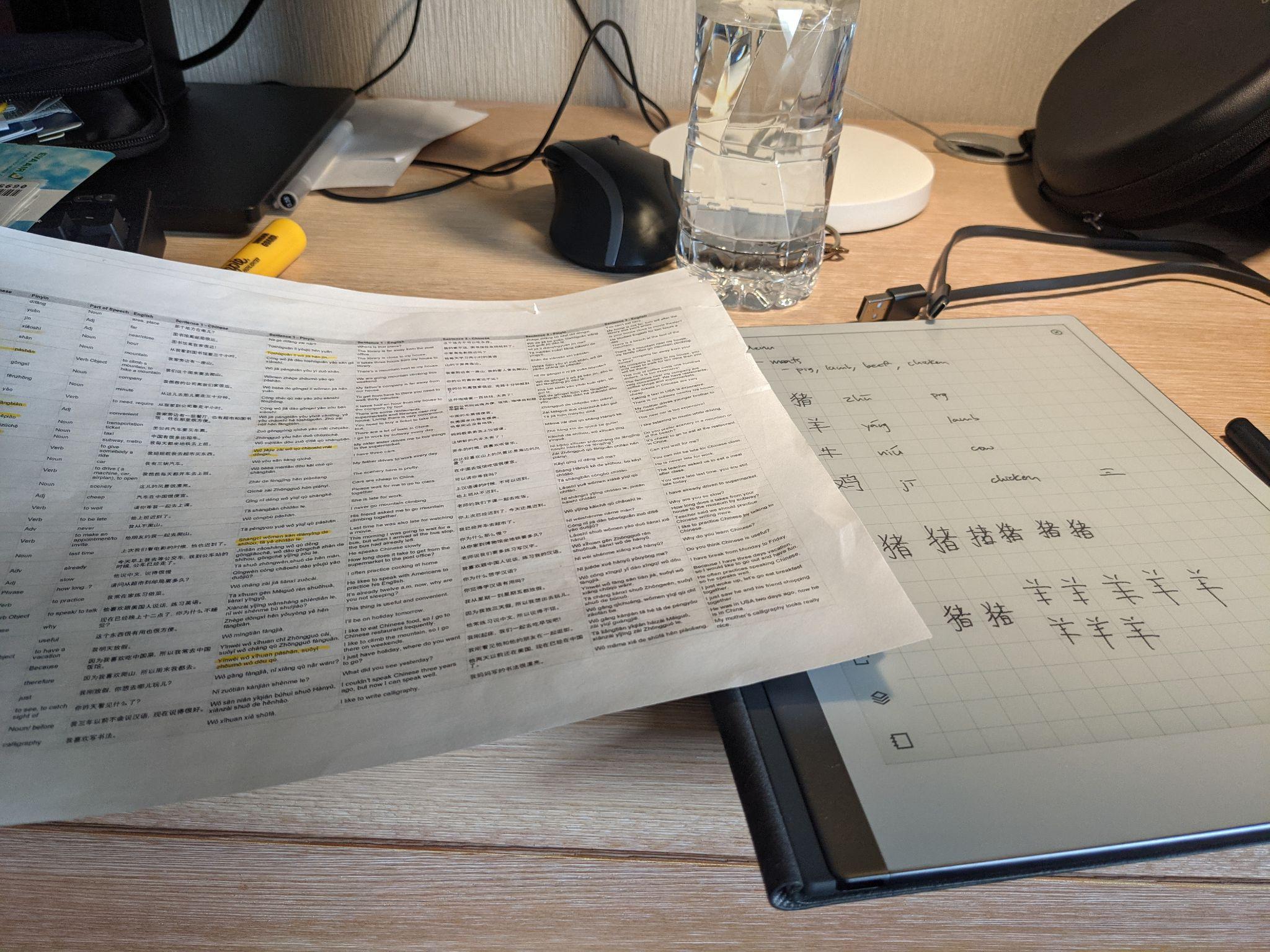
Four years later, during COVID, I moved to Taiwan, starting with a 15-day hotel quarantine. I spent hours a day memorizing printed vocab lists and watched almost all 46 episodes of a TV drama. I probably learned fewer than 10 words from the show because it was way beyond my level... but at least it passed the time.

Printed vocabulary list.
Depressing quarantine hotel.

You’d think living in Taiwan would speed up my learning, but it didn’t. Some people learn by chatting with strangers, but that’s not me. I’m more on the reserved side, and with my limited vocabulary I’d hit a wall after a couple of sentences. Most of the friends I made spoke English and my remote job was in English, so sometimes weeks went by where the only words I used were “thank you” and “check please.”

I restarted online lessons, and progress was better since I studied between classes. After 6 months, work got too busy, so I paused again.

Inflection point #1: Anki

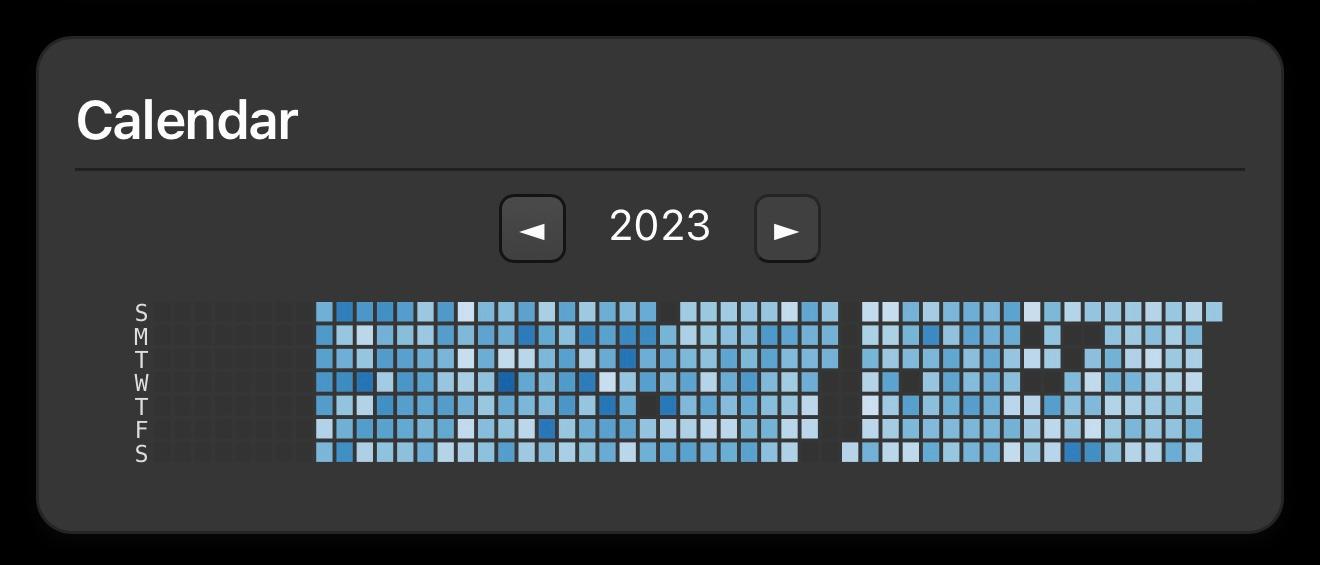
A year later I finally discovered Anki, and it changed everything. I loved that I could study anywhere, even a few cards while waiting in line. I ground through 30–90 minutes a day and kept it up for a year. I found that doing flashcards while walking let me study longer without getting distracted, and that I remembered more when I studied just before sleeping or right after waking up. My vocabulary grew dramatically.

This is also when I started learning to read, and I found that breaking the writing system into its building blocks made words much easier to remember.

I was proud of my streaks, which motivated me to keep going.

Anki activity heatmap.

Inflection point #2: graded readers

Another year later I discovered graded readers, which let me put all that vocabulary to use. They were a game changer compared to textbooks: tapping a word to look it up beats flipping through dozens of pages to find the definition. Saving new words straight to flashcards also took the work out of maintaining an Anki deck.

Everyone learns differently, and for me reading is by far the most effective. I’ve been reading for close to 4 years now and I’m at an upper-intermediate level.

These days I read whatever I’m interested in, adapted to my level. I just finished an abridged version of the Red Rising series and started an abridged version of The Hitchhiker’s Guide to the Galaxy. I’m reading more than ever now that I have unlimited content that’s both at my level and actually interesting to me.

What didn’t work for me

  • Audio-only learning like podcasts or AI voice mode. Without seeing the words written down, they didn’t stick.
  • Difficult content. Whether it’s reading or TV, if it’s too hard, most of it goes over my head and I can’t stay focused for long.
  • Boring content.
  • Tutoring before knowing 500 words. I got more out of flashcards and reading at that stage.

If I could talk to my younger self, I’d tell him to go straight to Anki and grind to 500 words. Everything else, like TV, immersion and even tutors, can wait until there’s enough vocabulary for it to stick. I’d tell him to do flashcards while walking to keep going longer, and to study just before bed or after waking up. Then he should move to graded readers. A bit every day beats a lot all at once, so study daily, even if it’s just a few cards.

It took me years to figure this out. Hopefully it’s helpful to you!


r/languagelearning • • 8d ago

Discussion Is Le Français Par la Méthode Nature actually worth it for a complete beginner?

11 Upvotes

Hey everyone!

I'm super new to French—literally at the "Bonjour, je m'appelle" stage. I've been using Duolingo for the past 30 days to pick up some basic vocab, which helped a bit, but I keep hearing it's not great for the long run.

I recently stumbled across this YouTube video about Le Français Par la Méthode Nature: https://www.youtube.com/watch?v=kJZc0FQIoDQ

It claims the book can take you from A1 to B1 by the time you finish it. The whole thing is written completely in French, and I'm currently on Chapter 1. Even with just a handful of vocab words under my belt, my brain is actually starting to piece things together!

Has anyone here read this book and can share their honest opinion on it? Did you end up finishing it, and did it actually help expand your French vocab?


r/languagelearning • • 8d ago

Discussion How to reconnect and relearn a language you associate with a bad experience?

22 Upvotes

Hey yall, I’m 20 and I’ve been wanting to reconnect with German (TL) bc it is a language that was a pretty big part of my life growing up.

From PK until 8th grade I attended a German international school in my country where almost every subject was taught in German. Unfortunately I had a terrible experience at that school. I dealt with a lot of classism and racism from both teachers and classmates. It was one of the most expensive schools in the country and my parents were making a big effort to pay for it but most of the students came from wealthy German expat families. German culture was always talked about as superior and the local culture was regarded as backwards or even savage.

Some of my teachers made me feel stupid bc I struggled academically, even though I was learning pretty much everything in a foreign language and had no support at home since neither of my parents spoke German. One teacher even told me I wasn’t intelligent bc I didn’t have German or Northern European heritage like most of my classmates.

Eventually I transferred to another school that followed the National curriculum and there I was much happier and graduated high school. However by that point I had developed such a negative association with German that I completely stopped speaking it for around six years.

I’m in university rn and really want to reconnect with the language. I’ve always been passionate about languages and it feels like such a shame to let all those years of learning go to waste. I think I can still understand quite a lot but whenever I try to speak, I feel really insecure. I constantly worry about making mistakes or sounding stupid and I know a lot of that comes from my past experiences.

Has anyone else gone through something similar? How did you reconnect with a language that was tied to such negative memories?

I’d really appreciate any advice. I don’t want to give up on German. I just want to learn how to enjoy it again and eventually feel comfortable speaking it without being so hard on myself


r/languagelearning • • 8d ago

Discussion Is there a theory basis for alter egos helping solidify second/third language? (TL)

Thumbnail reddit.com
0 Upvotes

(TL)


r/languagelearning • • 8d ago

How do I learn to work around my limitations and make the most of my skills, accepting that I'm not going to be fully fluent anytime soon?

7 Upvotes

Is there a word for this? I want to be fluent in my target languages someday. But I've realized my most realistic short-term goal is to not sweat my mistakes and to try to not get so overwhelmed and flustered when talking to native speakers.

I think part of it is to try to speak at a slightly lower level than I'm technically capable of so I can speak more fluidly and comfortably.

I was wondering if anyone also struggled with this and found ways to build up this specific skill.


r/languagelearning • • 9d ago

Advice on improving oral comprehension

22 Upvotes

Hi all

I'm looking for some advice. I've been learning European Portuguese(TL) for around 2 years now. I was in group classes from A1-B1, and then switched to a private tutor after finishing the B1 course. I had some gaps between each module in this time, so I'd say it was about a year of weekly classes in total over this time.

My classes with my tutor are fully in Portuguese and I can understand her well, there's rarely any friction. But as soon as I'm in the real world - interacting with strangers, watching the TV, listening to the radio - I really struggle (unless it's simple interactions like ordering food, in a store, etc. where I'm fully aware of the context).

This is something I really want to improve over the next year. I think my written/reading skills are quite a bit ahead of my speaking/oral comprehension. I'm still quite shy to speak, but I think this is mostly because I am nervous about my ability to understand what the other person replies so I tend to avoid conversations.

This is the first language I've ever learned properly outside my NL and I'm in my late 30s. I live in Lisbon so I do have a lot of access to native speakers and content, though everyone here does speak English really well so it's easy for me to avoid it.

I've been doing small listening exercises on sites like Practice Portuguese, and I'd say that I'm fairly comfortable with those - again, they're short, recorded specifically for learners and I know the context. What I want to get to grips with is fast, accented, real-world content.

A few people have suggested podcasts, but I've tried this in the past and have struggled. Would it be better to find content that I can listen to AND read along with? For example, if I could find a podcast that also had a transcript? It feels counter-intuitive because I worry I'll just end up using my stronger skill (reading) rather than training my weaker one. But listening to complex B1 content is challenging, so I'm not sure it does much good if I'm struggling to pick out words.

It's frustrating for me because 9/10 times, if I see the written content I understand all of it. So it's not a vocab issue! It just seem to go in one ear and out the other without my brain actually being able to process it.

Any advice would be greatly appreciated!!


r/languagelearning • • 9d ago

Michel Thomas courses

7 Upvotes

I see his courses are going on Black Friday sale heavily discounted soon. What do you all think of his courses? I'm especially interested in his Intermediate German course. Are his courses worth it, espec when 50% off? Thanks.


r/languagelearning • • 10d ago

Alternative techniques for language learning

26 Upvotes

In my case, the spaced repetition technique and anki cards have never worked when I was trying to study japanese and french. Only comprehensive input aquired by listening to japanese material helps me a bit, so do you know/use another strategy? At the present time, I'm planning to learn polish and korean language.


r/languagelearning • • 9d ago

Discussion Speaking speed/pace while practicing?

10 Upvotes

Hi, languagelearning -

My (TL) is Spanish, but this question goes for any language.

I like to read sentences out loud when reading in my target language. What I have been doing so far is speaking very slowly to try to get the pronunciation as close to correct as I can. My thinking has been: start slow, get the pronunciation right, and I will naturally pick up the pace as I get more practice, getting closer to a natural speaking speed as I get used to the pronunciation.

However, this hasn't happened. I'm not really getting any faster, and when I make a conscious effort to speak faster (like close to a native speaker's rate), I trip over my tongue and my pronunciation is horrible.

Does it make more sense to try practicing at a normal speed from the get-go? Has speaking so slowly for so long been counter-productive?

What do you think? What has worked for you?


r/languagelearning • • 10d ago

Conversation classes as an introvert

47 Upvotes

I've been learning languages for about 8 years now, mainly through comprehensible input and watching shows/content in my TLs, as well as a few foreign language courses in my uni. I'm looking to improve my speaking skills in my two main TLs (Thai and Spanish), but as an introvert, I find it really draining to talk for even half an hour straight. I've also tried language exchange apps, but I've found them to be ineffective as our conversations usually don't go beyond superficial small talk and "how was your day?" sort of questions. I realised that once I click with a particular tutor or person and our conversations flow nicely, I don't find it draining at all, but the thought of having to test out dozens of tutors before finding the right person just makes me dread the entire process. Are there any other introverts who have faced something similar? And if so, what did you do?


r/languagelearning • • 10d ago

I+1 clarification

5 Upvotes

I am curious about something with i+1. I suppose this is a bit more theoretical or philosophical than practical, but let's pretend my target language (TL) is English and, in a sentence I understand completely otherwise, I come across the phrase "black hole." Let's pretend I don't know "black" or "hole" in English and also don't know what "black hole" refers to as a phrase.

Is that i+1 because "black hole" is something very specific (like "White House"), i+2 because of "black" and "hole" as separate words, or i+3 because I don't know "black" or "hole" separately and don't know that "black hole" is a fundementally unique thing?


r/languagelearning • • 10d ago

Structured Tutor Lessons

3 Upvotes

Hi everyone! I am on a lifelong quest to learn Spanish (TL). I've used Preply for the past month and while I like to practice of speaking, I feel like it's too unstructured- my tutor asks what I want to talk about and then we just go. I am looking for something more akin to how classes are, with a book we work out of and then homework to do on my own time and review with my tutor, and then conversing based off of what I just learned. Does anyone have any suggestions of where to look for that? Or is that something I could request of a Preply tutor (I guess assuming we have access to the same book)? Thanks!


r/languagelearning • • 11d ago

There Is No "The Method"

243 Upvotes

I have been learning foreign languages for years, in fact since childhood. By training, I am a teacher of German and Swedish. I polish my English on my own, and I taught myself Spanish (TL) to an intermediate level. Despite my experience and education, I find it hard to answer the question of how to learn in order to actually learn. In this text, however, I will try to work out what I think is the right way to study.

On the internet, "the method" is the Holy Grail: that one, unique method. Dozens of YouTube videos promise that it will give you a speed and durability of learning you have never experienced, as if it were something mystical. Perhaps it is this trend that makes me feel that, as an "expert," I should know. I should know the method, or at least a competing one.
In this YouTube noise, in the battle for views, likes, attention and course sales, we forget that learning a new language is hard, grinding work. Nothing matters more than staying consistent over a long period, and which specific method you use is secondary. Yet people keep talking about a method, a single one, and I do not believe a language can be learned effectively that way. At least nothing in my experience suggests it. Unless, that is, by "method" we mean many approaches: a method as a system of methods.

To get down to specifics, I believe we need a little of each approach: a classic grammar book, listening, apps, reading, writing, speaking, lessons with a teacher. And the less classic ones: translating songs, watching films, playing games, or pursuing a hobby through content and materials in the target language. How often and how intensively each is used depends on individual preferences and dispositions, but also on one's level. At the beginning, playing a story-driven game entirely in the language you are learning can be off-putting.

In closing, I want to mention the most important "method" besides consistency: intrinsic motivation, such as passion and a love of the subject. You can learn without it, but a sincere desire to explore a language and keep getting better at it strengthens every approach you choose and sustains your consistency. And that brings me back to where I started: perhaps the expert's honest answer is not a method at all, but a habit and a reason to keep going.

Do you agree?


r/languagelearning • • 9d ago

AI Skill for language learning

0 Upvotes

I’ve been using this as a tool to help improve my understanding of Portuguese past tenses and have found it really helpful, so I thought I’d share it here.

It tells an LLM how to teach using the Socratic method - teaching by asking questions to guide you to the answer. It isn’t specific to language learning- you can use it for anything.

You can either install it if using something like Claude, or simply paste it at the top of a chat along with telling it what you want to learn.

Sharing a link to the original source for credit. The triple dot menu has copy/download options:

https://github.com/janestreet/agent_skills/blob/master/socratic-tutor/SKILL.md


r/languagelearning • • 10d ago

Learning Alphabets

7 Upvotes

Does anyone have tips for reading more quickly with a new alphabet? It's for a language I already speak pretty well, considering both my parents do, but I never learned how to read or write. Which is quite frustrating, as I try to learn to read because my brain thinks much faster than I can read in the language having to sound out each letter. Also I have an issue with messing up some characters that are different sounds but flipped and I also mess up the difference between unaspirated and aspirated characters which I dont do when I speak or listen as I can listen to both perfectly and do not have issues differentiating them in my speech. So if anyone has any tips for a similar situation lmk. (TL) Georgian